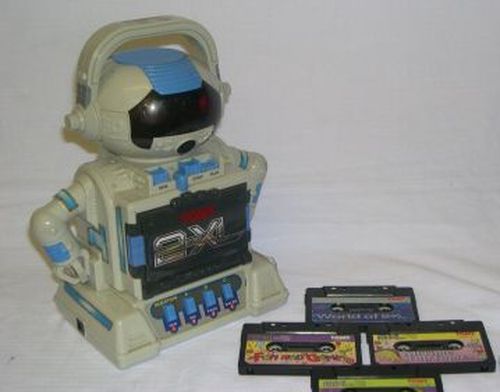

 The 2-XL version with its cassette tapes distributed by Tiger Electronics in 1992. A European version distributed by Tomy is seen here. | |
| Other names | 2-XL Robot, 2XL Robot, 2XL |
|---|---|
| Type | Educational toy robot |
| Invented by | Michael J. Freeman |
| Company |
|
| Country | United States |
| Availability | 1978–1981; 1992–1995 |
2-XL (2-XL Robot, 2XL Robot, 2-XL Toy) is an educational toy robot that was marketed from 1978–1981[1] by the Mego Corporation, and from 1992–1995 by Tiger Electronics. 2-XL was the first "smart-toy" in that it exhibited rudimentary intelligence, memory, gameplay, and responsiveness.[2][3] 2-XL was infused with a "personality" that kept kids focused and challenged as they interacted with the verbal robot. Learning was enhanced via the use of jokes and funny sayings as verbal reinforcements for performance. 2-XL was heralded as an important step in the development of toys, particularly educational ones. 2-XL won many awards, and Playthings, a toy industry magazine, placed 2-XL on its 75th anniversary cover as one of the industry's top-ten toys of all time.[4] The 2-XL name is a pun of the phrase "to excel".[5]
History and development
[edit]The toy was invented and licensed for manufacture by Michael J. Freeman, inventor, Ph.D. and was patented.[6] 2-XL exhibited rudimentary intelligence, memory, gameplay, and responsiveness. Dubbed the "Toy with a Personality", 2-XL could respond verbally to the user depending upon which "input or answer" buttons were chosen.[7] 2-XL during its run was one of the most popular toys in terms of market revenue and was dubbed the Talking Robot with a mind of its own.[8] The toy was voiced by Freeman,[9] using a synthesizer to make his voice a high-pitched robot-like sound; it was through this process that Freeman developed 2-XL's personality. 2-XL was first introduced in 1978 by the Mego Corporation, a publicly traded US-based toy company in New York City[10] and it subsequently became a success.[10][11][12] The toy was sold in different countries and the tapes were translated into seven foreign languages.[13] Games were also developed for the toy.[10]
Mego, otherwise known for its production of dolls and classic action figures in the 1970s, was seen as an innovator combining toys and education. The toy's name literally meant "To Excel". The toy was voice capable, was able to tell stories, and sing using its special 8-track tapes. The toy's tapes asked multiple-choice questions (MCQs) that were answered by pushing a YES or NO button that changed the tracking of the tape. It was a crude but reportedly innovative use of the technology that was present in that era.[14]
In addition to its general popularity, 2-XL was unprecedented in terms of market revenue.[15][16][17] Playthings magazine, in its cover story of September 1978, considered the 2-XL robot as one of the most important toys ever developed, and included it in a class of "toys with impact" along with the Teddy Bear, Barbie Doll, Raggedy Ann, Mickey Mouse among others.[4] The robot was a popular educational toy whose success anticipated the dominant influence of technology in education today.[18] Dubbed the "Toy with a Personality", 2-XL could respond verbally to the user depending upon which "input or answer" buttons were chosen.[19] Part of the reason for this is the connection the toy made between education and fun.[15]
2-XL was interactive playing various tracks from a magnetic audio tape depending on the user's actions. 2-XL's personality was popular and kids loved the back-and-forth banter. For example, if a child got an answer wrong 2-XL might utter something like "Perhaps your brain went on strike! You are Wrong" or, "Nice try but (whispering) you are wrong, but go ahead, I will be a nice little toy robot and give you a second chance now". Other lines from 2-XL included: "Even though you needed two chances you finally got the answer right, elephant is the correct answer"'; "But do not get too excited, you have now earned yourself a more difficult question. Hold on to your hat, here it comes". If the child was right, 2-XL might say: "Although I have the looks you have the brains. You must be a genius. Good work", or, "It is amazing that big brain of yours fits into the head of a child. Nice answer, football is correct".[20]
In 1981, the toy's popularity waned, and it was later discontinued.[10] In 1992, 2-XL was re-introduced by Tiger Electronics, a toy company based in Vernon Hills, Illinois.[21] The toy was changed into a more modern design, and new programmed toy cartridges were also introduced.[22] The voice for this version was done by Freeman as well, and all programs were translated into many different languages.
Versions
[edit]Mego Corporation version
[edit]
The original version, created by Mego Corporation, was made of brown plastic with white plastic found on the anterior face of the robot. It had two red light bulbs for the eyes. These bulbs also flashed at moments while 8-track cartridge tape programs played. It had four red buttons on its stomach with designated options for answers to questions asked by the toy, such as "Question", "A or Yes Or True", "B or More Info", and "C or No or False" (NOTE: Some programs came with overlay cards for the buttons that redefined the choices the user could make for that specific program). A knob is also found on the lower right portion of the toy which controlled its volume and power. The "mouth" was reused detail molding taken from the Micronauts Battle Cruiser. At the bottom was a large slot for 8-track cartridge tapes: this version was essentially a regular 8-track tape player, but by employing mathematical decision tree programming methods over 20 interactive modes of operation were achieved.[23] The result had enough information and interactive questions to entertain and educate a person for up to two hours. Subjects included sports quiz, Guinness Book of World Records, the metric system, general information and jokes.
.jpg)
The mold and look received a minor revision in 1980. The eye lights became red and responded to the voice. The flashing lights were also brighter, and the speaker in the back of the unit was changed from a hexagon shape to a more traditional round. The plastic had a glossier appearance. There was a modified version of 2-XL made just for schools with extra earphone jacks, specialty tapes for school curricula, and a teacher's manual to go with each educational tape.[24]
Tiger Electronics version
[edit]
Tiger Electronics re-introduced 2-XL in 1992. Instead of using 8-track cartridge tapes, this version used cassette tapes that were twice the length of the tapes in the previous version and had a better sound quality.[25] Freeman again recorded the 2-XL voice for the cassette tapes in a professional sound studio.[13] In addition to eyes that would light up, the toy now sported a circle for a mouth that could light up as the machine talked. The toy could now run on batteries and had a headphone jack. Instead of the buttons simply switching tracks on the 8-track tape as in the old version, the cassette version took advantage of the fact that a cassette has a total of four tracks - one for the left and right channel on each side. The tape head in the player could play any of the four parallel tracks, based on which button was pressed. Playing a 2-XL tape in a standard tape player would result in different audio on the left and right channels, and if the reverse side was played, one would hear the other two tracks played in reverse.
Using all four tracks simultaneously in one direction was not unique in toys to the 2-XL since the concept had been borrowed from the Talk 'n Play educational system in existence from 1983-1992 and provided the basis for the interactive give and take on both toys.[25] That concept in turn had been borrowed both from early home-portastudio cassette recorders with the built-in mixing board used by garage bands to put their demos together to try and get hired or get a record deal. The earliest instances were the 4.0 surround sound cassette experiments in the mid '70s to again try to supplant with a cassette counterpart the quadraphonic 8-track (which was just as prone to breaking and jamming as the original 2-XL tapes).
As with the previous version, this version could play any standard type of similar tape, but the user needed to first push the "Question" button (or the "2/A/No" button would work as well, playing the correct (left/dominant) channel of the (forward/A-side) of the program. Pressing buttons labeled 3 or 4 would play the left or right channel of the B-side of the tape in reverse.
Newly released tapes were branded with famous fictional characters and popular film and TV properties, including Spider-Man, X-Men, Star Trek: The Next Generation, Mighty Morphin' Power Rangers, Are You Afraid of the Dark?, Tales from the Cryptkeeper, Jurassic Park, Superman and Batman. These particular 2-XL programs would allow the user to go on an adventure with various characters, deciding their fate by pushing one of the buttons (much like the old Choose Your Own Adventure books).
The second version was on the market from 1992 through 1996, and about 45 tapes were released in total. The toy was sold internationally, including in Japan, Germany, Hungary, Italy, France, UK, Ireland, Canada, Brazil (where it was distributed by Nintendo's official local licenser Playtronic) and others. The tapes were translated into many foreign languages, but were not recorded by Freeman.
Television series spin-off
[edit]
The toy's success was also the basis for a game show called Pick Your Brain produced by Marc Summers Productions and Summit Media Group. The 2-XL robot in the show served as the assistant of Marc Summers. 2-XL was also a spokesrobot for basketball player Michael Jordan and his charitable foundation in 1992 and 1993 and appeared in a number of PSA (public service announcements) with Jordan.[26][27]
Tapes
[edit]List of 2-XL tapes manufactured by Mego Corporation between 1978 and 1981
[edit]General Information was included with each toy robot. The remainder programs were each sold separately:
- 50's and 60's Nostalgia (1978)
- Adult Games and Puzzles (1978)
- Animal World (1978)
- Astronomy: 2-XL in Space (1978)
- The Basics of ABCs (1978)
- Believe This or Not (1978)
- Games and Puzzles Number 1 (1978)
- General Information 2 (1978)
- General Information 3 (1978)
- Guinness Book of World Records (1978)
- Interviews with Great People from History (1978)
- Metric System Education (1978)
- Monsters, Myths and Legends (1978)
- Reading, Writing and Arithmetic (1978)
- Science Fiction (1978)
- Sports (1978)
- Sports 2 (1978)
- Storyland (1978)
- Storyland: 2-XL and the Time Machine (1978)
- US Presidents and American History (1978)
- Exercise with 2-XL (1979)
- Fairy Tale Quiz (1979)
- Math and Number Games (1979)
- Pre-School Facts and Fantasies (1979)
- Science Fiction 2 (1979)
- Strange but Is Is It True (1979)
- Super Heroes and Comic Books Cavalcade (1979)
- Talking Calculator and Number Game (1979)
- Tid Bits and Funny Facts (1979)
- Tri-Lex (1979) - a simulated game-playing AI
- TV and Movie Challenges (1979)
- Who Said It (1979)
- Wonders of the World (1979)
- Robotrivia (1980) - two tape set including a board game.
- Robotstronomy (1980) - two tape set including a board game.
- Word and Sound Games (1980) - two tape set.
- Amazing Sports Feats (1981)
- Amazing World of the Small (1981)
- Bet Your Life (1981)
- Challenges of General Science (1981)
- General Information Revised (1981) - used the same label as the original General Information including the date of 1978.
- Pre-school Bed Time Stories (1981)
- Traffic and Bicycle Safety (1981)
List of 2-XL tapes manufactured by Tiger Electronics between 1992 and 1995
[edit]The World of 2-XL was sold with each toy robot. The remainder programs were each sold separately. For foreign sales, the Freeman voiced 2-XL English language tapes were translated into foreign languages performed by a professional that spoke the designated language.
- Sportsworld (1992)
- Fun and Games (1992)
- World of Animals (1992)
- World of Science (1992)
- Monsters, Myths, & Dinosaurs (1992)
- Trivia Time (1992)
- Amazing World's Records (1992)
- Fascinating Facts (1992)
- Storymaker (1992)
- African Safari (1993)
- Jurassic Facts (1993)
- Batman: Carnival of Crime (1993)
- Treasure Chest of Facts and Fun (1993)
- Voyage to Outer Space (1993)
- Batman: The Sizzling Scheme (1993)
- Music Maker (1993)
- Oceans of Fun (1993)
- Planet Earth (1993)
- Pet Parade (1993)
- Letter Perfect (1993)
- Count On It (1994) - Scholastic Series[28]
- Food Facts and You (1994)
- Chaos in Jurassic Park (1994)
- Fun With Words (1994) - Scholastic Series
- Incredible Sports Feats (1994)
- Are You Afraid of the Dark - Nickelodeon (1994)
- Geography & You (1994)
- Power Rangers (1994)
- All-Time Top Topics (1994)
- Careers & You (1994)
- Nature & You (1994)
- Ripley's Believe It Or Not!: The Strange & True! (1994)
- Safety First (1994)
- Say Hello to Famous Folks (1994)
- Spider-Man: For King and Country (1994)
- Stars and Planets Game (1994)
- Star Trek - The Next Generation: Blinded by the Light (1994)
- Superman - The Man of Steel: Mayhem in Metropolis (1994)
- Superman - The Man of Steel: A New Hero In Town (1994)
- Surprise Package (1994)
- X-Men: Deadly Games (1994)
- X-Men: Ghosts That Haunt Us (1994)
- Tales From The Cryptkeeper: If Wishes Were Hornets (1994)
Trilex
[edit]One of the last tapes released for the Mego Corporation version of 2XL was "Trilex", a complete board game designed to be played against 2XL. The tape came with a board which fitted over the front of the 2XL unit itself, with the board in front of the tape slot. The game board consisted of an inverted pyramid shape, 4 squares wide at the top to 1 square at the bottom, with each row colored in a different color (Blue, Yellow, Green, and Tan), and 4 slots through which pieces (which 2XL called "checkers") could be dropped into the pyramid. The slots aligned with 2XL's 4 buttons, with the intention that dropping the checker would also press the appropriate track button on 2XL. The objective of the game was to create either a line or a triangle of three checkers of a selected color. The game and tape design are interesting because they enabled the 4-track tape player to provide a passable simulation of a game-playing AI.[29]
Merchandising
[edit]A number of secondary products were licensed under the 2-XL (2XL) name including: laptop computer bags, earphones, lunch boxes and more.[30]
Awards
[edit]During its time, both iterations of 2-XL won hundreds of awards, including FamilyFun magazine's award for best toy of 1992, and Right Start Magazine's honor as Europe's best toy in the 3-5 year-old category for 1993. For the 75th anniversary issue of Playthings magazine, 2-XL was featured on the cover and named one of the top ten toys of all time. The Tiger 2-XL was also the winner of the 1992 Walt Disney Company Best Learning Toy for 1992.[31]
See also
[edit]- Talk 'n Play, another toy created by Dr. Freeman
References
[edit]- ^ Coopee, Todd (September 8, 2015). "2-XL Talking Robot". ToyTales.ca.
- ^ Gardner, Howard. "Mego 2-XL Talking Robot". Psychology Today (1979): 93.
- ^ Jake Rossen (October 13, 2016). "Remembering the First Smart Toy: 2-XL". mentalfloss.com. Archived from the original on October 14, 2016.
- ^ a b "75 Years of Toys" Playthings Magazine, September 2008, Volume 9, Cover page Story. Progressive Business Media. Retrieved October 11, 2011.
- ^ "The kids' Whole Earth Catalogue, Random House book, 1982, ISBN 0-394-85090-4
- ^ "US Patent 4078316 A: Real Time Conversational Toy". IFI CLAIMS Patent Services. Google Patents. March 14, 1978. Retrieved December 7, 2013.
- ^ "BEST & WORST – D Magazine". www.dmagazine.com. January 1980. Retrieved January 23, 2017.
- ^ "2-XL Talking Robot by Tiger Electronics - The Old Robots Web Site". www.theoldrobots.com. Retrieved January 23, 2017.
- ^ "Meet 2-XL". Retro Junk. Retrieved May 3, 2017.
- ^ a b c d "2-XL Electronic Game Console and Tape Player". The Strong. Retrieved December 6, 2013.
- ^ "Mego Before". Action Figure Digest. 171. 2008.
- ^ Mannes, George (September 1, 2001). "Almost Famous Interactive television company ACTV has been the next big thing in the entertainment field for 18 years". Fortune Small Business. CNN. Retrieved December 6, 2013.
- ^ a b Kaminski, Joseph (May 22, 2008). "Retro Tech: Mego's 2-XL". CNET. Archived from the original on December 19, 2013. Retrieved December 6, 2013.
- ^ "2XL – Robot of the Future". THE SURFING PIZZA. January 18, 2009. Archived from the original on November 28, 2010. Retrieved January 23, 2017.
- ^ a b "Retro Cool Gear – The Tiger 2XL Interactive Talking Robot". December 13, 2013. Archived from the original on January 1, 2014.
- ^ "2-XL: Learning To Think". Psychology Today. 13 (6): 93. November 1979.
- ^ "Make-your-own cable heading to California". Times-Post News Service. Toledo, Ohio. Toledo Blade. March 21, 1995. p. 17. Retrieved December 26, 2013.
- ^ Mark Adams (May 18, 2013). "Types of 2-XLs". 2-XL.net. Archived from the original on December 19, 2013. Retrieved January 5, 2014.
- ^ Adams, Mark R. "General Information of 2-XL". 2-XL. Archived from the original on October 20, 2016. Retrieved December 6, 2013.
- ^ 2-XL Tapes. Mego Corporation.
- ^ "2-XL". Retroland. Archived from the original on May 23, 2017. Retrieved January 23, 2017.
- ^ Jenson, Jeff (1998). "Tiger Activating Mutoids in '98 for Electronic Games". Advertising Age.
- ^ "Vintage 2-XL Robot uses 8-track tapes, not as scary as teddy ruxpin". Newstex Blog. May 2009.
- ^ 2-XL Ed. Specially Created for the School Market (2-XL ed.), Mego Corporation
- ^ a b "You have selected B: Tiger 2-XL Type 3". 2XL Robot. Retrieved December 7, 2013.
- ^ Tiger Electronics 2 XL Robot Toy commercial 1992), archived from the original on December 22, 2021, retrieved June 14, 2021
- ^ 2XL By Mego (Commercial, 1981), archived from the original on December 22, 2021, retrieved June 14, 2021
- ^ "World of 2-XL: Tiger 2-XL Program "Count on It"".
- ^ Turner, Peter (November 1979). "New toys with minds of their own". Omni. 2 (2): 53.
- ^ "2-XL laptop bag". Make: DIY Projects, How-Tos, Electronics, Crafts and Ideas for Makers.
- ^ "World of 2-XL: Tiger 2-XL Type 3 and Programs". www.2xlrobot.com. Retrieved January 23, 2017.
External links
[edit]
- World of 2-XL - an extensive source on anything regarding 2-XL and its inventor, Dr. Michael J. Freeman.
- Unofficial 2-XL Page
- 2-XL Simulator – an online web simulator with dozens of the original cartridges.
- 2XLBot.com - updated and complete version of the above site.
- The original 2-XL patent retrieved from Google Patents
- The Old Robots
History and Development
Invention and Launch
The 2-XL (a pun on "to excel") educational toy robot was invented by Dr. Michael J. Freeman, Ph.D., a prolific inventor with a background in robotics and telecommunications, in the mid-1970s. Freeman, who had earlier developed teaching robots like the classroom-sized Leachim in the early 1970s, drew inspiration from interactive audio technologies and concepts of rudimentary artificial intelligence to create an engaging tool for children's education and entertainment. He aimed to simulate conversational interaction through audio, allowing kids to "talk" with the robot via responses to questions on topics like science, history, and trivia. Freeman patented the core design in 1976 (US Patent 4,078,316, filed June 24, 1976; issued February 14, 1978), which detailed the innovative use of multi-track 8-track cartridges enabling branching dialogues—where pressing response buttons switched tracks to simulate personalized feedback and "intelligence," a novel feature for toys at the time.[1][4][5] Following several years of pitching the concept to toy manufacturers, Freeman licensed the invention to the Mego Corporation, a publicly traded US-based toy company based in New York City known in the 1970s for producing dolls and classic action figures. The 2-XL positioned Mego as an innovator in combining toys with education. Mego began production and launched 2-XL in 1978 as one of its first forays into electronic toys. The robot, standing about 12 inches tall with a gray and white plastic body, eyes that lit up, and a distinctive synthesized voice provided by Freeman himself (filtered to sound robotic with a Brooklyn accent), was marketed as the "robot with a personality" to appeal to parents seeking educational play. Priced at approximately $50 for the base unit (including an AC adapter and one introductory tape), with additional 8-track programs costing $7.95 to $9.95 each, it targeted children aged 6–12 and was distributed through major U.S. retailers.[1][4][6] The launch proved immediately successful, becoming a top seller during the 1978 holiday season and introducing many families to interactive edutainment. Mego's marketing emphasized 2-XL's ability to "learn" from user inputs via the tape system, positioning it as a bridge between toys and early computing concepts, though production continued only until 1981 amid the company's financial challenges.[1][7]Commercial Success and Decline
Following its 1978 launch, the 2-XL robot quickly became a top seller in the U.S. educational toy market, captivating children with its interactive features and positioning Mego Corporation as a leader in electronic toys.[1] The product's success was bolstered by aggressive marketing, including television commercials that highlighted its personality-driven conversations and educational programs on topics like math, science, and history.[8] Partnerships with major retailers such as Toys "R" Us ensured wide availability, contributing to strong holiday season performance and international distribution in multiple languages.[9] The toy's popularity peaked through 1980, with over 40 educational 8-track programs released, generating significant revenue and establishing 2-XL as a pioneer in smart toys.[10] However, sales began to dwindle by 1981 due to several factors, including the obsolescence of 8-track technology amid the growing dominance of cassette tapes and compact discs, which offered superior portability and sound quality. Additionally, the surge in home video game consoles like the Atari 2600, which sold over 30 million units worldwide by the mid-1980s, diverted children's attention toward more dynamic interactive entertainment. Mego's broader financial troubles, exacerbated by heavy investments in electronic products, culminated in the company's Chapter 11 bankruptcy filing in 1982, effectively ending 2-XL production.[11] In the wake of Mego's collapse, substantial unsold inventory of 2-XL units and tapes was warehoused, representing a significant asset during liquidation proceedings.[12] Inventor Michael J. Freeman, who held the patents, pursued licensing opportunities with other manufacturers in the years following, aiming to revive the concept amid shifting technology trends; these efforts ultimately succeeded a decade later with Tiger Electronics.[10]Design and Functionality
Core Components and Operation
The original Mego version of the 2-XL robot features a humanoid plastic body approximately 12 inches tall with a white anterior face, designed for durability and portability, with integrated lights serving as eyes and mouth indicators that illuminate or flash to mimic expressive responses during operation. It has two red light bulbs serving as eyes that flashed at moments during playback of 8-track cartridge tape programs. The "mouth" detail was originally taken from the Micronauts Battle Cruiser toy.[1][6] The construction emphasizes lightweight molded plastics for the exterior shell, housing internal components while allowing access to media slots and controls on the front panel. Four red buttons are located on the stomach labeled "Question", "A or Yes Or True", "B or More Info", and "C or No or False". Some 8-track programs provided overlay cards that redefined the choices for that specific program. A knob controlling volume and power is located on the lower right portion. The large slot for 8-track cartridge tapes is located at the bottom.[1][6] The original model was powered by a 9V DC AC adapter. The 1992 Tiger Electronics version used four D-cell batteries, enabling portability, with an optional AC adapter.[13] The audio system centers on a built-in media player—an 8-track mechanism in the original design, which employs four dedicated tracks for alternating question prompts and answer segments in a continuous loop, or a cassette deck in subsequent versions—paired with a speaker that delivers output with voice modulation effects to create a synthesized, personality-infused robotic tone.[6][2] Electronic circuitry is minimalist, comprising mechanical switches connected to the four response buttons that trigger selection of one of the four audio tracks on the media player, along with LED indicators for status feedback like power or activity.[6] Basic session memory is achieved through the media's track positioning and sensor detection, allowing the system to branch responses without advanced digital storage.[6] In operation, users insert a program cartridge or tape into the designated slot, power on the device, and select a mode via initial track positioning or button input, prompting sequential playback of pre-recorded audio that advances to user-selected tracks upon button presses, thereby facilitating interactive sessions without requiring complex computation. Pressing a specific button selects the corresponding track to play the appropriate response audio. This mechanism utilized the era's technology in a crude but innovative manner.[1][6] This flow ensures responsive audio delivery while maintaining the toy's educational focus through structured, media-driven progression.[2]Interaction and Pseudo-Intelligence Features
The 2-XL toy simulated conversational interaction through a system of branching audio paths on its 8-track tapes, where users responded to questions or prompts by pressing one of four buttons (labeled A, B, C, or D), each corresponding to a specific audio track. This mechanism allowed the toy to switch tracks seamlessly, providing contextually appropriate responses such as confirmation of correct answers, corrections for incorrect ones, or continuations of stories, creating the appearance of direct responsiveness to user input.[6][14] The tapes were structured with four parallel audio programs across the tape's length, allowing the playback head to switch to a specific track for up to four response options per interaction point, though more complex branching could emerge over multiple segments by reconverging paths.[6] Central to the toy's pseudo-intelligence was its personality simulation, achieved via pre-recorded dialogue delivered in a synthesized, high-pitched robotic voice with a distinctive Brooklyn accent, performed by inventor Michael J. Freeman. This voice incorporated humor, jokes, and varied intonations to engage children, fostering an illusion of wit and adaptability as 2-XL would "react" with praise, teasing, or follow-up questions based on the selected track. Examples of this distinctive, teasing, and encouraging dialogue include:- On an incorrect answer, offering a second chance: "Nice try but (whispering) you are wrong, but go ahead, I will be a nice little toy robot and give you a second chance now"
- After a correct answer on the second attempt: "Even though you needed two chances you finally got the answer right, elephant is the correct answer"
- To prepare for a harder question: "But do not get too excited, you have now earned yourself a more difficult question. Hold on to your hat, here it comes"
- On correct answers: "Although I have the looks you have the brains. You must be a genius. Good work" and "It is amazing that big brain of yours fits into the head of a child. Nice answer, football is correct"
Versions
Mego Corporation Version (1978–1981)
The Mego Corporation version of the 2-XL educational toy robot, introduced in 1978, featured a humanoid design constructed primarily from molded brown plastic, standing approximately one foot tall with a bulky body that housed an integrated 8-track cartridge player. The exterior typically consisted of a brown plastic casing accented by a white anterior face panel, complete with red flashing lights simulating eyes, a top-mounted red dome, and four interactive buttons labeled for question selection and responses. This model utilized proprietary endless-loop 8-track tapes, which played continuous audio without the need for mechanical track advancement, enabling seamless delivery of educational content. Accompanying accessories included colorful overlay cards that users placed over the robot's chest area to display visuals, diagrams, or multiple-choice options synchronized with the audio programs.[1][15][16] Production occurred mainly in Hong Kong facilities, with a portion assembled in the United States, under Mego Corporation's oversight from 1978 to 1981. A European version of the toy was distributed by Tomy. The toy retailed for $50 to $80, reflecting its advanced electronics for the era, and achieved significant commercial traction, with over 200,000 units sold by the summer of 1979. Targeted at children aged 5 and older, 2-XL promoted STEM learning through interactive programs covering science experiments, mathematical puzzles, and general knowledge quizzes, fostering engagement via a synthesized voice with a distinctive Brooklyn accent delivered through the tapes.[17][15][1] In contemporary collecting circles, intact Mego 2-XL sets remain scarce, as many original tapes have deteriorated due to the inherent fragility of 8-track media, including issues like magnetic oxide flaking, splice glue breakdown, and overall audio distortion from decades of storage. Complete configurations, including the robot, power adapter, multiple tapes, and overlay cards, command premium prices, often exceeding $200 for functional examples. Restoration efforts typically involve disassembling the tape mechanism for thorough cleaning with isopropyl alcohol, re-lubricating pinch rollers and capstans with appropriate silicone-based compounds, and testing alignment to prevent further tape damage; for severely degraded tapes, enthusiasts recommend professional services for rebaking to restore playability or digitizing audio for archival playback.[18][19][20]Tiger Electronics Version (1992–1996)
In 1992, the toy company Tiger Electronics, based in Vernon Hills, Illinois, revived the 2-XL educational robot under license from its inventor, Dr. Michael J. Freeman, updating the design to a more modern style for a new generation of children while retaining the core concept of interactive audio-based learning.[12] The toy was on the market from 1992 to 1996, with units manufactured in China to capitalize on cost efficiencies in the growing toy electronics sector.[21] It was sold internationally in countries including Japan, Germany, Hungary, Italy, France, the UK, Ireland, Canada, Brazil, and others.[12] This version shifted from the original's bulky 8-track cartridges to standard compact cassettes, introducing new programmed cassettes aligned with contemporary audio technology and enabling longer program durations.[12] The redesign featured a more modern design, emphasizing portability and modern aesthetics, reducing the toy's height to approximately 10.5 inches tall and 9 inches wide, about 1 inch shorter than the 1978 Mego model, with a black and red color scheme for a sleeker appearance.[13][12] The body featured a more pronounced robotic form, including glowing eyes and a blinking mouth light synchronized to audio output, enhancing the illusion of responsiveness.[21] A built-in carrying handle further improved mobility compared to the stationary original.[12] Key enhancements included superior sound quality over the predecessor, thanks to the cassette format, and four interactive buttons (A, B, C, D) that switched between the tape's four mono tracks to simulate intelligent replies.[21][13] The player supported standard cassettes, allowing compatibility with off-the-shelf recorders for creating custom educational or entertainment tapes.[21] Powered by four D batteries or an AC adapter, it also added a headphone jack for private listening.[12] Positioned amid the 1990s surge in edutainment products, the Tiger 2-XL targeted families seeking engaging learning tools, retailing for $39.99 and bundled with the introductory "World of 2-XL" cassette featuring trivia and stories.[22] It received acclaim as the "Best Learning Toy" of 1992 from the Walt Disney Company, underscoring its appeal in blending education with interactive play.[12]Mego2 AI Version (2024–present)
In 2023, Mego2 Corporation, a revival of the original Mego brand, partnered with D1srupt1ve Inc., an AI technology firm, to reintroduce 2-XL as an AI-powered companion robot. The project was announced on October 17, 2023, during a preview event, marking the first major update to the toy in nearly three decades.[23] The modern iteration, known as the 2XL Cobot, officially launched on March 26, 2024, via Amazon and select retailers, aiming to blend nostalgic design elements with cutting-edge technology for interactive play.[24] The design features a compact, plastic robot figure reminiscent of the 1970s original but updated for contemporary use, standing approximately 11 inches tall with a lightweight build suitable for children. It includes Wi-Fi connectivity for seamless cloud integration and is powered by a rechargeable battery, enabling portable operation without the need for constant plugging in. Unlike earlier models reliant on physical media, this version incorporates a [TFT LCD](/page/TFT LCD) screen for facial animations while focusing on voice-based interactions to encourage imaginative engagement. Built-in safety features, such as parental guardrails and compliance with COPPA and GDPR standards, ensure age-appropriate content delivery.[25][26] At the core of the Mego2 AI version is a large language model (LLM) that powers real-time conversations, dynamic story generation, and personalized learning tailored to the user's responses and age. The robot supports multilingual interactions in over 30 languages, facilitating vocabulary building and cultural exploration without predefined scripts. Content is delivered entirely through cloud-based processing, eliminating the need for tapes or cartridges and allowing for ongoing updates to expand educational and entertainment options. This shift enables endless, adaptive play sessions focused on social skill development and creativity.[2][27] Priced at $179.99, the 2XL Cobot targets children aged 3 and older, with robust parental controls to monitor usage and customize experiences. Availability expanded through major online platforms like Amazon following its 2024 debut, and by mid-2025, it had garnered positive initial market reception, evidenced by media coverage highlighting its innovative blend of education and fun. The first year of use includes unlimited access to core features, transitioning to a subscription model for advanced content thereafter.[3][28][26]Programs and Accessories
8-Track Tapes for Mego Version
The Mego Corporation released over 40 eight-track tape programs for the 2-XL robot between 1978 and 1981, with many released in 1978 as part of the product's initial launch. Each 2-XL toy robot was bundled with the program "The World of 2-XL", while additional programs were sold separately. These tapes were designed to deliver educational and entertaining content through interactive sessions.[1][29] Known tape releases by year include:- 1979: Talking Calculator and Number Game, Tid Bits and Funny Facts, Tri-Lex, TV and Movie Challenges, Who Said It, Wonders of the World
- 1980: Robotrivia, Robotstronomy, Word and Sound Games
- 1981: Amazing Sports Feats, Amazing World of the Small, Bet Your Life, Challenges of General Science, General Information Revised, Pre-school Bed Time Stories, Traffic and Bicycle Safety
Cassette Tapes for Tiger Version
The Tiger Electronics version of 2-XL, released from 1992 to 1996 by the toy company, utilized a series of approximately 45 compact cassette tapes designed specifically for interactive edutainment, reviving the concept with new programmed content while introducing new themes relevant to the era.[35] These tapes focused on educational topics such as science, history, and languages, alongside games and trivia, allowing children to engage through voice responses and choice-based interactions.[36] The tapes employed a standard compact cassette format divided into four mono tracks to enable branching narratives and responses, providing higher audio fidelity compared to the original Mego 8-track cartridges and supporting portability for the smaller robot design.[36][13] Typical tapes were around 90 minutes in length, with custom overlays for the robot's sensors to detect user inputs, and some included bilingual options for language learning programs like Spanish or French Fun.[35] Representative titles included the introductory "World of 2-XL," which familiarized users with the robot's functions; science-oriented tapes such as "Amazing Universe" or "World of Science," exploring astronomy and natural phenomena; and game-focused ones like "Trivia Challenge" or "Robotrivia," testing knowledge through quizzes.[37][38] The cassette programs were released over several years, with the following known titles by year:[35] 1992- Sportsworld
- Fun and Games
- World of Animals
- World of Science
- Monsters, Myths, & Dinosaurs
- Trivia Time
- Amazing World's Records
- Fascinating Facts
- Storymaker
- African Safari
- Jurassic Facts
- Batman: Carnival of Crime
- Treasure Chest of Facts and Fun
- Voyage to Outer Space
- Batman: The Sizzling Scheme
- Music Maker
- Oceans of Fun
- Planet Earth
- Pet Parade
- Letter Perfect
- Count On It (Scholastic Series)
- Food Facts and You
- Chaos in Jurassic Park
- Fun With Words (Scholastic Series)
- Incredible Sports Feats