


Community hub
Recent from talks
Contribute something
Nothing was collected or created yet.
36th Wing
View on Wikipedia | This article includes a list of general references, but it lacks sufficient corresponding inline citations. (December 2012) |
36th Wing
 | |
|---|---|
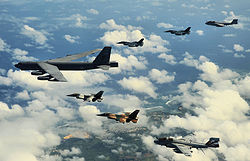
 A Boeing B-52 Stratofortress deployed to Andersen AFB leads a formation of Japanese Mitsubishi F-2s, USAF F-16s and Navy EA-6B Prowlers | |
| Active | 1948–1994; 1994–present |
| Country |  United States United States |
| Branch |  United States Air Force United States Air Force |
| Role | Command of deployed combat forces |
| Part of | Pacific Air Forces |
| Garrison/HQ | Andersen Air Force Base |
| Nickname | The Fightin' 36th[citation needed] |
| Motto | Prepared to Prevail[a] |
| Decorations | Air Force Outstanding Unit Award[1] |
| Commanders | |
| Current commander | Brig Gen(Select) Charles "Dan" Cooley |
| Deputy Commander | Col. Daniel E. Mendoza |
| Command Chief | CCM Jeremy Swistak |
| Notable commanders | Ronald Keys |
| Insignia | |
| 36th Wing emblem[b][1] |  |
The United States Air Force's 36th Wing is the host wing for Andersen Air Force Base, Guam. It is part of Pacific Air Forces' Eleventh Air Force. The 36th Wing provides day-to-day mission support to more than 9,000 military, civilian, dependent and retired personnel and 15 associate units on the base.
The 36th Wing has three major missions: operate Andersen Air Force Base via its subordinate 36th Mission Support and 36th Medical Groups; Provide power projection through rotational forces via its subordinate 36th Operations and 36th Maintenance Groups; and provide rapid air base opening and initial air base operation ability via its subordinate 36th Contingency Response Group. The 734th Air Mobility Squadron assists the 36th Wing in accomplishing this mission by operating Andersen's air cargo terminal on behalf of Air Mobility Command.
Units
[edit]- 36th Operations Group
- 36th Maintenance Group
- 36th Expeditionary Aircraft Maintenance Squadron
- 36th Maintenance Squadron
- 36th Munitions Squadron
- 36th Contingency Response Group
- 736th Security Forces Squadron
- 554th RED HORSE Squadron
- 36th Contingency Response Squadron
- 36th Contingency Response Support Squadron
- 644th Combat Communications Squadron
- 36th Medical Group
- 36th Medical Operations Squadron
- 36th Medical Support Squadron
- 36th Mission Support Group
- 36th Communications Squadron
- 36th Civil Engineering Squadron
- 36th Contracting Squadron
- 36th Logistics Readiness Squadron
- 36th Security Forces Squadron
- 36th Force Support Squadron
- Mission Partner Units
- 254th Air Base Group – Guam Air National Guard
- 337th Air Support Flight – Australia
- 497th Combat Training Squadron
- 624th Regional Support Group
- 734th Air Mobility Squadron
- Det. 1, 69th Reconnaissance Group
- Det. 2, 21st Space Operations Squadron – U.S. Space Force (Satellite Control Network, Remote Tracking Station)
- Det. 602, AFOSI
- HSC-25 Island Knights
- United States Department of Agriculture
History
[edit]- For additional history and lineage, see 36th Operations Group
On 2 July 1948 the United States Air Force 36th Fighter Wing was activated at Howard Air Force Base, Panama Canal Zone. The former USAAF 36th Fighter Group became the operational component of the new Air Force wing. Active squadrons of the 36th were:
- 22d Fighter Squadron (F-80A/B, Red color band)
- 23d Fighter Squadron (F-80A/B, Blue color band)
- 53d Fighter Squadron (F-80A/B, Green color band)
United States Air Forces in Europe
[edit]


As a result of the Berlin Blockade and other Cold War tensions in Europe, the 36th Fighter Wing was reassigned to United States Air Forces Europe (USAFE). The squadron was assigned to Fürstenfeldbruck Air Base West Germany on 13 August 1948, being the first USAFE unit to be jet-equipped with the Lockheed F-80 Shooting Star. At Fürstenfeldbruck tactical operations included air defense, tactical exercises, maneuvers, and photographic reconnaissance. In May 1949, the wing formed the Skyblazers aerial demonstration team, which it controlled until August 1952, and again from October 1956 to January 1962 when it was disbanded.
On 20 January 1950, the wing was redesignated as the 36th Fighter-Bomber Wing when 89 Republic F-84E Thunderjets arrived. Existing USAFE bases in West Germany, however, were deemed very vulnerable to an attack by the Soviet Union, given their proximity to East Germany and other Warsaw Pact nations. Negotiations with other NATO nations were made to build new bases west of the Rhine River. The F-80s were sent back to CONUS to equip Air National Guard units. In addition to its primary installation at Fürstenfeldbruck, the wing controlled Oberpfaffenhofen AB, West Germany, December 1949 – February 1950.
The 36th FBW remained at Fürstenfeldbruck until 1952 when it was reassigned to the new Bitburg Air Base, in the Eifel mountains west of the Rhine River. Throughout the summer, elements of the 36th FBW moved into Bitburg, with the wing officially arriving in November 1952. Under various designations, the 36th would remain at Bitburg for the next 40 years.
In August 1953, the North American F-86F Sabre was introduced to the wing, replacing the F-84s. On 31 March 1954, The 1st Pilotless Bomber Squadron, equipped with the Martom B-61A Matador, was attached to the 36th Fighter Bomber Wing, making it the first operational U.S. missile unit. The 1st eventually was renamed a Tactical Missile Squadron, and in 1958 was replaced by the 71st Tactical Missile Squadron and the unit was assigned to the 701st Tactical Missile Wing, headquartered at Hahn Air Base, although the squadron remained at Bitburg.
In August 1954, the wing was redesignated as the 36th Fighter-Day Wing. In 1956, the wing received the North American F-100 Super Sabre, marking the first time a wing in USAFE flew supersonic jets. On 15 May 1958, the 36th FDW was redesignated as the 36th Tactical Fighter Wing, with its squadrons redesignated as tactical fighter squadrons, because its missions had now grown to include delivery of tactical nuclear weapons.
In May 1961, the wing received the Republic F-105 Thunderchief. Formal USAFE acceptance of the Mach 2 fighter-bombers was held at the Paris Air Show on 3 June 1961. Deliveries of the F-105D model were completed in 1963, and the 36th carried on its Cold War mission of tactical nuclear weapons delivery. Twice in the early 1960s when Cold War tensions were elevated due to the 1961 Berlin Wall crisis and 1962 Cuban Missile Crisis the 36th rose to a high level of alert.
By 1966 the Thud was being phased out of NATO, being replaced by the McDonnell F-4D Phantom II. The tactical nuclear deliver mission, still necessary, was being eclipsed by the ability of ICBMs and the primary mission of the 36th TFW changed to Tactical Air support of NATO ground units in West Germany. By December 1966, all the 36th TFW Thuds had been ferried stateside for combat crew training duties at McConnell Air Force Base, Kansas, or to Southeast Asia after stateside refurbishment.
In October 1965, the 36th accepted command of the 71st Tactical Missile Squadron from the inactivated 38th Tactical Missile Wing at Sembach Air Base.[2] The 36th maintained and operated two hardened launch sites (at Rittersdorf, Site 7, and at Idenheim, site 8) with a total of 16 CGM-13B Mace tactical missiles until 30 April 1969.
In September 1969, the 36th TFW took responsibility for Spangdahlem Air Base West Germany until December 1971.
By 1976 a major modernization of USAFE was necessary. The Soviet Union's new generation of MiG and Sukhoi fighters made NATO military planners anxious. Indeed, intelligence reports about the MiG-25 left little room for comfort; the performance of this latest Russian combat aircraft was far superior to any NATO aircraft. The twin-engined MiG-25 reached speeds of over 3,000 km/h even at high altitude (over 70,000 feet) and it could be armed with radar-guided AA-6 Acrid air-to-air missiles. When the Soviets stationed large numbers in the Soviet Union and later in the GDR, NATO had to address this problem.
The solution was provided by the McDonnell Douglas F-15 Eagle. Just like the MiG-25 it has two powerful engines and a double tail fin. The 23 aircraft for the first operational squadron (525th Tactical Fighter Squadron) with the 36th left Langley Air Force Base on 27 April 1977 for a mass Atlantic crossing. Over the following months the aircraft for two other squadrons (23d and 53d Tactical Fighter Squadrons) arrived. The 36th's full strength of 79 fully operational F-15As was reached in December 1977. In 1980 more advanced F-15Cs and F-15Ds would replace the original F-15As.
Throughout the 1970s and 1980s, the 36th conducted routine training missions however the outbreak of the 1990–91 Gulf War put the F-15s of Bitburg into the heart of the conflict. The 36th's pilots and aircraft performed magnificently in Operation Desert Storm. Not a single F-15 aircraft was lost in combat during the war. On 13 March 1991, the deployed squadrons of the 36th returned in victory.
The celebration was brief, however, as the 36th deployed back to Incirlik Air Base, Turkey to support Operation Provide Comfort. Between 5 April and 25 May 1991, the 36th flew 285 sorties over Iraq. Just as before, not a single aircraft was lost in Iraq due to hostile fire.
On 1 October 1991 the wing was redesignated as the 36th Fighter Wing when the objective wing concept was implemented. The 525th Fighter Squadron was inactivated 31 March 1992 as part of the initial post Cold-War drawdown.
Bitburg Air Base was part of the 1993 Base Realignment and Closure (or BRAC) process that saw the drawdown of many military facilities in a series of post-Cold War force reductions. In July 1993, HQ USAFE announced the closure of Bitburg Air Base and the pending inactivation of the 36th Fighter Wing. The 53d Fighter Squadron was transferred without personnel or equipment to the 52d Operations Group at Spangdahlem Air Base. Some squadron aircraft transferred to 22d Fighter Squadron. The 22d Fighter Squadron was also transferred without personnel or equipment to the 52d Operations Group at Spangdahlem Air Base.
The wing's combat readiness was tested in Southwest Asia as part of Operations Desert Shield, Desert Storm and Proven Force. While flying combat air patrols during the war, the F-15s of the 36th were a strong deterrent to the air forces of Iraq. During Operation Desert Storm, the 36th was credited with downing 17 enemy aircraft in air-combat engagements. On 1 October 1994 the 36th Fighter Wing was inactivated and the final 36th Wing Commander, Brigadier General Roger E. Carleton, presented Bitburg Air Base to the German government.
Pacific Air Forces
[edit]The wing was reactivated at Andersen Air Force Base, Guam the same day as the 36th Air Base Wing, a non-flying organization taking over as the host unit. The former host unit, the 633d Air Base Wing was inactivated in keeping with the Air Force Chief of Staff's policy of keeping the most highly decorated and longest serving Air Force units on active duty.
The 36th Air Base Wing was activated at Andersen Air Force Base, Guam, on 30 September 1994. Under that designation, the wing lived up to its mission several times. In September 1996, the wing provided around-the-clock forward-deployment support to Air Combat Command Boeing B-52 Stratofortresses during their Operation Desert Strike missions over Iraq, and began hosting more than 6,600 Kurdish evacuees during the 8-month humanitarian assistance mission, Joint Task Force Pacific Haven.
On 12 April 2006, the 36th Air Base Wing was redesignated as the 36th Wing. Prior to the redesignation, the wing had been using a temporary designation of air expeditionary wing. The change in the wing's official designation was meant to better align Andersen with its mission statement: "To provide a U.S.-based lethal warfighting platform for the employment, deployment, reception, and throughput of air and space forces in the Asia-Pacific region."
In February 2007, the 36th Operations Group was reactivated as a permanent subordinate unit to the 36th Wing, replacing the temporary 36th Expeditionary Operations Group.
Lineage
[edit]- Established as the 36th Fighter Wing on 17 June 1948
- Activated on 2 July 1948
- Redesignated 36th Fighter-Bomber Wing on 20 January 1950
- Redesignated 36th Fighter-Day Wing on 9 August 1954
- Redesignated 36th Tactical Fighter Wing on 8 July 1958
- Redesignated 36th Fighter Wing on 1 October 1991
- Inactivated on 1 October 1994
- Redesignated 36th Air Base Wing and activated on 1 October 1994
- Redesignated 36th Wing on 15 March 2006[1]
Assignments
[edit]
|
|
Components
[edit]- Wings
- 121st Tactical Fighter Wing: attached 12–27 May 1977
- 7149th Tactical Fighter Wing: attached 15 April – 15 September 1969[1]
- Group
- 36th Fighter Group (later 36th Fighter-Bomber Group, 36th Fighter Day Group, 36th Operations Group): 2 July 1948 – 8 December 1957 (not operational after 1 October 1956), 31 March 1992 – 1 October 1994; 15 March 2006 – present[1]
- Squadrons
- 1st Pilotless Bomber Squadron (later 1st Tactical Missile Squadron): attached 14 March 1955 – 15 April 1956.
- 7th Tactical Fighter Squadron: attached 2 March – 4 April 1973, 3 April – 3 May 1974, 4 October – 6 November 1975
- 9th Tactical Fighter Squadron: attached 12 September – 6 October 1970, 4 February – 15 March 1973, 6 September – 7 October 1975
- 18th Tactical Reconnaissance Squadron: attached 12–28 April 1977.
- 22d Fighter-Day Squadron (later 22d Tactical Fighter Squadron, 22d Fighter Squadron), attached 1 October 1956 – 7 December 1957, assigned 8 December 1957 – 31 March 1992 (not operational 25 October 1976 – 30 June 1977)
- 23d Fighter-Day Squadron (later 23d Tactical Fighter Squadron), attached 1 October 1956 – 7 December 1957, assigned 8 December 1957 – 31 December 1971
- 32d Fighter-Day Squadron (later 32d Tactical Fighter Squadron, 32d Fighter-Interceptor Squadron: attached 1 October 1956 – 7 December 1957, assigned 8 December 1957 – 8 April 1960
- 39th Tactical Electronic Warfare Squadron: attached 1 April 1969 – 31 December 1971
- 45th Tactical Reconnaissance Squadron: attached 13 August 1948 – 25 March 1949
- 53d Fighter-Day Squadron (later 53d Tactical Fighter Squadron, 53d Fighter Squadron)], attached 1 October 1956 – 7 December 1957, assigned 8 December 1957 – 31 March 1992 (not operational, 1 February – July 1977)
- 71st Tactical Missile Squadron: 1 October 1965 – 30 April 1969
- 461st Tactical Fighter Squadron: attached 1 October 1956 – 7 December 1957, assigned 8 December 1957 – 1 August 1959
- 525th Fighter-Interceptor Squadron (later 525th Tactical Fighter Squadron): 1 November 1968 – 31 March 1992 (not operational, 9 March – 26 April 1977)[1]
Stations
[edit]Shakey the Pig
[edit]
Shakey the Pig is the wild boar mascot of 36th Munitions Squadron at Andersen AFB. The first boar given this name was captured in the late 1970s from the jungle near the munitions flight storage area, with the intention of slaughtering the animal and cooking it on a barbecue. The airmen relented and kept it as a mascot. When the incumbent mascot dies, another is caught from the jungle to take its place. It is rumored that some Shakeys "were the guests of honor at more barbecues than people might imagine" and MSgt David Torelli has said at least one Shakey "was the main course at a local wedding dinner."[3]
List of commanders
[edit]- Brig Gen(S) Charles D. Cooley, 20 May 2025 - Present
- Brig Gen Thomas B. Palenske, 30 June 2023 - 20 May 2025[4]
References
[edit]Notes
[edit]- Explanatory notes
- Citations
- ^ a b c d e f g h Robertson, Patsy (19 June 2017). "Factsheet 36 Wing (PACAF)". Air Force Historical Research Agency. Retrieved 19 February 2018.
- ^ 36th TFW Special Order AA-84, 29 September 1965
- ^ Kinkade, Mark (1 November 2002). "The Secret Life of Shakey the Pig". Airman Magazine. Archived from the original on 14 July 2014. Retrieved 13 July 2014. (link requires membership)
- ^ "Brig. Gen. Thomas Palenske takes command of the 36th Wing". 30 June 2023.
Bibliography
[edit] This article incorporates public domain material from the Air Force Historical Research Agency
- Endicott, Judy G. (1998). Active Air Force Wings as of 1 October 1995 and USAF Active Flying, Space, and Missile Squadrons as of 1 October 1995 (PDF). Air Force History and Museums Program. Washington, DC: Office of Air Force History. ASIN B000113MB2. Retrieved 2 July 2014.
- Martin, Patrick (1994). Tail Code: The Complete History of USAF Tactical Aircraft Tail Code Markings. Atglen, PA: Schiffer Military Aviation History. ISBN 0-88740-513-4.
- Mindling, George; Bolton, Robert (2008). U.S. Air Force Tactical Missiles, 1949–1969: The Pioneers. Raleigh, NC: Lulu Press, Inc. ISBN 978-0-557-00029-6. LCCN 2008908364.
- Ravenstein, Charles A. (1984). A Guide to Air Force Lineage and Honors (2d, Revised ed.). Maxwell AFB, AL: USAF Historical Research Center.
- Rogers, Brian. (2005). United States Air Force Unit Designations Since 1978. Hinkley, UK: Midland Publications. ISBN 1-85780-197-0.
- USAAS-USAAC-USAAF-USAF Aircraft Serial Numbers—1908 to Present [1]
External links
[edit]| Leadership |  | ||||||||||
|---|---|---|---|---|---|---|---|---|---|---|---|
| Structure |
| ||||||||||
| Personnel and training | |||||||||||
| Uniforms and equipment | |||||||||||
| History and traditions |
| ||||||||||

| Pacific Air Forces (PACAF) | ||
|---|---|---|
| Air Forces | | |
| Bases | ||
| Wings | ||


36th Wing
View on GrokipediaOverview
Mission and Role
The 36th Wing serves as the host unit at Andersen Air Force Base, Guam, with a core mission to provide base support, sustainment, and rapid deployment capabilities that enable power projection for Pacific Air Forces (PACAF).[1] This includes preparing to execute pacing operational plans (OPLANs) in support of U.S. Indo-Pacific Command (USINDOPACOM) objectives, such as maintaining readiness for air base opening and mobility operations in a competitive environment.[1] As a non-flying wing, it emphasizes infrastructure maintenance, logistics, medical support, and contingency response rather than direct combat flying operations, ensuring seamless integration with tenant units for bomber, tanker, and fighter missions.[4] The wing's strategic significance lies in its role as a key platform for deterrence and conflict preparation in the Indo-Pacific theater, supporting joint forces through robust sustainment and rapid response capabilities.[6] It operates the base's airfield management systems, including two runways and landing zones capable of handling all Department of Defense aircraft, while maintaining the U.S. Air Force's largest fuel and munitions storage facilities to sustain extended operations.[3] Key capabilities also encompass integration with 22 tenant units, enabling coordinated power projection without permanent assigned aircraft.[1] In addition to operational support, the 36th Wing provides comprehensive services to over 9,000 military personnel, civilians, dependents, and retirees, including housing, morale, welfare, recreation, and emergency response through its mission support elements.[4] For instance, the subordinate 36th Contingency Response Group enhances rapid airfield establishment and airbase operations across the region.[6] Medical and logistical functions further bolster personnel readiness, with the 36th Medical Group delivering health services to home station and deployed beneficiaries.[7]Location and Facilities
The 36th Wing is stationed at Andersen Air Force Base, located in Yigo, Guam, in the western Pacific Ocean at coordinates approximately 13° N, 144° E, spanning approximately 20,000 acres of which more than half remains undeveloped land.[8] The base, part of Joint Region Marianas alongside Naval Base Guam and Marine Corps Base Camp Blaz, collectively occupies nearly one-third of Guam's total land area and has been in continuous operation since 1945 as a key strategic outpost.[1] Its renaming to Andersen Air Force Base on October 7, 1949, honors Brigadier General James R. Andersen, a World War II aviation pioneer and chief of staff at Harmon Field, Guam, who was lost at sea in a B-24 Liberator crash en route to Kwajalein Atoll on February 26, 1945.[9] Infrastructure at Andersen includes two parallel runways totaling over 1 million square yards, two landing zones, and 7.5 million square feet of ramp space capable of accommodating every aircraft in the Department of Defense inventory, including B-52 bombers for strategic operations.[1] The base features the Air Force's largest fuel and munitions storage facilities, including over 127 earth-covered igloos, extensive hangars, dedicated munitions areas, family housing units, and medical facilities to support operations and personnel.[1][10] It also accommodates transient aircraft from Pacific Air Forces units, facilitating rapid deployment and sustainment in the region.[1] Strategically positioned 3,800 miles west of Hawaii, 2,800 miles north of Australia, and 1,300 miles east of the Philippines, Andersen enables swift responses to Asia-Pacific contingencies due to its proximity to regional hotspots.[1] Unique environmental features include access to remote training ranges, such as the uninhabited Farallon de Medinilla island (FDM Range) in the Commonwealth of the Northern Mariana Islands, used for routine flight training exercises.[11] On-base training areas, like those at Northwest Field, incorporate limestone forests and overlap with protected zones such as the Ritidian Unit of the Guam National Wildlife Refuge, requiring mitigation for ecological and cultural impacts including historic latte stone sites.[12] Andersen supports a population of over 8,000 personnel (as of 2022), including active-duty Airmen, civilians, contractors, and approximately 2,500 dependents across 22 tenant units.[1][3] The base contributes significantly to Guam's economy, generating an annual economic impact of approximately $502 million (as of fiscal year 2022) through $175 million in payroll and $327 million in expenditures for goods, services, and contracts, fostering local jobs and community services.[13]Organization
Subordinate Units
The 36th Wing's subordinate units are organized into five primary groups, each responsible for essential aspects of base operations, maintenance, and support at Andersen Air Force Base, Guam. These groups collectively ensure the wing's readiness to project airpower in the Indo-Pacific region.[3] The 36th Operations Group, reactivated on February 14, 2007, oversees airfield operations, weather forecasting, intelligence analysis, and air traffic control to sustain all-domain force projection from the second island chain. It provides 24/7 support for theater operations, including agile mission planning and airspace command and control, while developing facilities like Northwest Field for contingency use.[14][15] The 36th Maintenance Group manages aircraft maintenance, munitions storage and assembly, and logistics to integrate agile capabilities for mission partners, including tenant bomber and fighter units, across the INDOPACOM theater. It maintains the largest munitions stockpile in Pacific Air Forces and supports deployed forces through versatile resourcing, such as during agile logistics exercises.[16][17] The 36th Contingency Response Group delivers rapid deployment teams to open austere airfields, establish airbases, and provide initial support in crises, including humanitarian assistance via satellite communications and heavy construction in remote areas. Comprising specialized squadrons, it builds partnerships and responds to Pacific Air Forces directives to set the theater for operations.[18] The 36th Medical Group delivers comprehensive healthcare, preventive medicine, and aeromedical evacuation support to wing personnel and dependents, maintaining operational readiness through clinic services and health education resources. It ensures seamless medical integration for base inhabitants exceeding 9,000 individuals.[19][3] The 36th Mission Support Group handles civil engineering, security forces, communications infrastructure, and community services to support daily operations for over 9,000 personnel and 15 associate units, while preserving expeditionary capabilities for deployments. It conducts infrastructure assessments, base security, and quality-of-life enhancements to sustain mission continuity.[4][3] These groups integrate to enable seamless support for transient forces and multinational exercises, such as Pacific Iron 2021, where they coordinated refueling, security, logistics, and medical response to enhance deterrence and interoperability in the Indo-Pacific. This collaborative structure allows the wing to rapidly adapt to pacing operational plans, projecting power from forward locations.[20][21]Operational Components
The 36th Operations Support Squadron manages airfield operations, including range control for training exercises, survival training programs for aircrew and personnel, and mission planning support to ensure seamless coordination for the 36th Wing's flying operations. This squadron directs aerodrome activities at Andersen Air Force Base, Guam, providing air traffic control, weather forecasting, intelligence analysis, and contingency planning to support both peacetime and wartime missions for the wing and its tenant units.[22] The 734th Air Mobility Squadron executes cargo and passenger handling, aircraft refueling, and mobility support operations, primarily for transient aircraft such as C-130 Hercules transports and KC-135 Stratotankers, facilitating rapid deployment and sustainment in the Indo-Pacific theater. Assigned under the 515th Air Mobility Operations Wing, the squadron operates the passenger and cargo terminals at Andersen Air Force Base, coordinates ground servicing, and ensures efficient onload/offload procedures to maintain airlift readiness for joint and coalition forces.[23] The 36th Security Forces Squadron delivers base defense through law enforcement patrols, access control, and combat arms training for security personnel, safeguarding critical assets at Andersen Air Force Base against diverse threats. This squadron conducts defensive operations for five major command protection-level resources, including installation entry point screening, anti-terrorism measures, and weapons qualification courses to enhance the wing's overall force protection posture.[24] The 36th Communications Squadron maintains information technology networks, implements cybersecurity defenses, and manages satellite communications systems to enable secure command and control across the 36th Wing's operations. Responsible for cyber operations, the squadron supports network infrastructure, data encryption, and communication relays vital for mission partners in the region, ensuring resilient connectivity during exercises and real-world contingencies.[25] Specialized detachments within the 36th Civil Engineer Squadron handle explosive ordnance disposal and fire protection, addressing hazardous threats to personnel and infrastructure. The EOD flight responds to unexploded ordnance, improvised explosive devices, and chemical/biological hazards, providing technical expertise and training while supporting high-profile events like U.S. Secret Service operations. The fire protection flight operates three stations for 24/7 structural firefighting, aircraft crash response, hazardous material mitigation, and emergency medical services across base facilities.[26] Recent activities of these components include support for Pacific Air Forces exercises, such as the 36th Operations Support Squadron's weather forecasting during Resolute Force Pacific 2025 to enable aircraft operations amid simulated contingencies, and the 734th Air Mobility Squadron's disaggregated cargo handling in Slingstone 24-4 in 2024 to practice agile logistics in austere environments. These efforts, spanning 2023 to 2025, have focused on training in motion for PACAF Airmen, enhancing rapid deployment and integrated response capabilities through scenarios like mass casualty drills and engine-running offloads.[27][28]History
Activation and Early Service
The 36th Fighter Wing was established on 17 June 1948 and activated on 2 July 1948 at Howard Air Force Base in the Panama Canal Zone, falling under the Caribbean Air Command.[2] This activation built upon the existing 36th Fighter Group, which had been stationed there since October 1946, providing a foundation for the wing's operational structure.[29] However, the wing remained at Howard for only 23 days before being reassigned to United States Air Forces in Europe and relocating to Furstenfeldbruck Air Base, Germany, on 13 August 1948.[2]European Operations
Upon arrival in Europe in August 1948, the 36th Fighter Wing's primary mission shifted to air defense and tactical fighter operations amid rising Cold War tensions, including support for the Berlin Airlift.[2] Equipped with Lockheed F-80 Shooting Star jet fighters, the 36th became one of the U.S. Air Force's early all-jet units in the region, conducting patrols, exercises, antisubmarine, and reconnaissance missions.[29] Stationed at Furstenfeldbruck Air Base until December 1952, the wing contributed to NATO's forward defense posture.[2] In December 1952, the 36th Fighter Wing relocated to Bitburg Air Base in West Germany as part of United States Air Forces in Europe (USAFE) commitments to NATO, enhancing forward air defense capabilities amid escalating Cold War tensions following the Berlin Blockade.[30] In January 1950, while at Furstenfeldbruck, the wing had been redesignated as the 36th Fighter-Bomber Wing, reflecting an expanded role that aligned with broader Air Force shifts toward ground support capabilities, while transitioning to Republic F-84 Thunderjet aircraft.[2] By August 1954, it became the 36th Fighter-Day Wing, emphasizing daylight tactical operations.[2] By 1958, the wing was redesignated the 36th Tactical Fighter Wing, reflecting its evolving tactical role in nuclear and conventional strike missions.[30] Stationed at Bitburg for the remainder of its European service, the wing supported NATO's deterrence posture, including participation in annual REFORGER exercises that simulated rapid reinforcement of European allies against potential Soviet aggression.[31] The wing underwent several aircraft transitions to maintain operational superiority. It operated the North American F-100 Super Sabre from 1956 to 1961, becoming the first USAFE unit equipped with supersonic fighters for close air support and interdiction.[30] In 1961, it transitioned to the Republic F-105 Thunderchief, optimized for low-level nuclear strike missions through the 1960s until 1966.[30] The McDonnell F-4 Phantom II served from 1966 to 1977, enabling multirole capabilities in air superiority and ground attack during heightened Cold War alerts.[30] Finally, from 1977 to 1994, the wing flew the McDonnell Douglas F-15 Eagle, with upgrades to C/D models by 1981, focusing on air defense intercepts along the Iron Curtain.[30] These evolutions ensured the wing's readiness for rapid deployments to regions like Turkey and Italy in response to crises such as the 1974 Cyprus conflict.[30] During the 1991 Gulf War, the 36th Tactical Fighter Wing deployed elements, including the 53rd Fighter Squadron with F-15Cs, to Saudi Arabia for Operation Desert Storm from December 1990 to July 1991, where it achieved 17 confirmed air-to-air victories against Iraqi aircraft without losing any fighters.[2] Following the ceasefire, wing personnel supported Operation Provide Comfort from Incirlik Air Base in Turkey, enforcing no-fly zones and aiding Kurdish relief efforts.[32] On 1 October 1991, the wing was redesignated the 36th Fighter Wing amid post-Cold War restructuring.[30] It inactivated on 1 October 1994 at Bitburg as part of USAFE drawdowns after the Soviet Union's collapse, with assets and personnel realigning to other commands.[30]Pacific Reassignment
The 36th Air Base Wing was reformed and activated on 1 October 1994 at Andersen Air Force Base, Guam, as the host unit under Pacific Air Forces (PACAF), succeeding the inactivated 633d Air Base Wing to provide base support in the Western Pacific.[33] This reactivation marked the wing's transition from its prior European focus to a strategic role in projecting airpower across the Indo-Pacific region.[34] On 15 March 2006, the unit was redesignated as the 36th Wing to encompass its broadened responsibilities beyond base operations, including mission support for rotational forces and expeditionary activities at the forefront of PACAF's strategic posture.[2] Post-reactivation, the wing contributed to global operations by delivering around-the-clock forward-deployment support for Air Combat Command B-52 Stratofortresses during Operation Desert Strike in September 1996, enabling strikes against Iraqi targets.[35] Beginning in 2001, it hosted KC-135 and KC-10 tanker fleets on Andersen's ramps to sustain aerial refueling missions for Operation Enduring Freedom.[33] The wing's efforts extended to Indo-Pacific exercises, such as integrating with Bomber Task Force rotations and mobility operations to enhance deterrence and interoperability among allies.[3] The 36th Operations Group was reactivated on 14 February 2007 at Andersen AFB after more than a decade of inactivation, establishing a centralized structure for managing the wing's growing expeditionary flying and combat operations in the Pacific theater.[36] In the 2020s, amid escalating tensions with China in the Indo-Pacific, the wing expanded its capabilities in rapid air base opening through Agile Combat Employment (ACE) frameworks, including the development of a unique Jungle ACE course by the 36th Contingency Response Group to train Airmen for dispersed operations in austere, contested environments.[37] The wing participated in Operation Pacific Iron 2021, a PACAF-led dynamic force employment exercise that reunited elements of the 36th Wing with the deployed 525th Fighter Squadron's F-22 Raptors, facilitating multi-domain training across Guam and Tinian with approximately 800 Airmen and 35 aircraft.[38] As of 2025, the wing continues specialized training to integrate seamlessly with PACAF's force presentation model, supporting rotational deployments and large-scale exercises to maintain readiness in the region.Lineage
Formal Lineage
The 36th Wing was established as the 36 Fighter Wing on 17 June 1948 and activated on 2 July 1948.[2] It was redesignated as the 36 Fighter-Bomber Wing on 20 January 1950, reflecting its evolving tactical roles in the early Cold War era.[2] Further redesignations followed to align with Air Force doctrinal changes: 36 Fighter-Day Wing on 9 August 1954; 36 Tactical Fighter Wing on 8 July 1958; and back to 36 Fighter Wing on 1 October 1991.[2] The wing was inactivated on 1 October 1994 but reactivated the same day as the 36 Air Base Wing, marking a shift toward base support functions.[2] It was redesignated as the 36 Wing on 15 March 2006 to encompass its integrated mission set.[2] Throughout its history, the wing has included various constituent units, such as the 22d Fighter Squadron, 23d Fighter-Day Squadron, and 53d Fighter Squadron, which supported its operational objectives across different periods.[2] The 36th Wing's formal honors include campaign credits inherited from World War II predecessors, encompassing Antisubmarine, American Theater, Air Offensive Europe, Normandy, Northern France, Rhineland, Ardennes-Alsace, Central Europe, Air Combat, and European-African-Middle Eastern Theater; it also earned streamers for Southwest Asia operations during the Defense of Saudi Arabia, Liberation and Defense of Kuwait in the Gulf War.[2]Assignments and Stations
The 36th Wing was initially assigned to Caribbean Air Command upon its activation on 2 July 1948.[2] Shortly thereafter, on 13 August 1948, it was reassigned to United States Air Forces in Europe (USAFE).[2] This assignment to USAFE persisted until 1994, with intermediate reporting to Twelfth Air Force from 7 May 1951 and then Seventeenth Air Force from 15 November 1959.[2] Following inactivation on 1 October 1994, the wing was reactivated under Pacific Air Forces (PACAF), initially assigned to Thirteenth Air Force on 1 October 1994 and later to Eleventh Air Force on 28 September 2012, where it remains.[2] The wing's stations reflect its evolving operational focus across theaters. It was briefly stationed at Howard Air Force Base, Canal Zone, from 2 to 25 July 1948 before relocating to Fürstenfeldbruck Air Base, Germany, on 13 August 1948.[2] On 13 December 1952, it moved to Bitburg Air Base, Germany, serving as its primary station until inactivation on 1 October 1994.[2] Upon reactivation as the 36th Air Base Wing, it was stationed at Andersen Air Force Base, Guam, from 1 October 1994 onward.[2] Throughout its history, the 36th Wing controlled various subordinate components to execute its missions. The 36th Fighter Group served as a core component from 2 July 1948 to 8 December 1957, and again from 31 March 1992 to 1 October 1994, as well as from 15 March 2006 to the present.[2] Other notable components included temporary wings such as the 7149th Tactical Fighter Wing from 15 April to 15 September 1969 and the 121st Tactical Fighter Wing from 12 to 27 May 1977.[2] Squadrons under its control encompassed the 22nd Fighter Squadron, 23rd Fighter-Day Squadron, 7th Tactical Fighter Squadron, and 9th Tactical Fighter Squadron, among others, supporting tactical fighter and missile operations across its assignments.[2]Traditions and Leadership
Mascot and Nickname
The 36th Wing's nickname, "The Fightin' 36th," originated during World War II with the 36th Fighter Group, reflecting the unit's efficiency and endurance in combat operations across Europe.[30] This moniker has been carried forward through the wing's subsequent activations and deployments, symbolizing its aggressive fighter heritage and operational tenacity..pdf) The wing's emblem, approved on 17 July 1952, features a golden shield charged with a red arrowhead pointing upward, set against a blue chief bearing a silver demi-wing..pdf) Ultramarine blue and Air Force yellow represent the service's colors, while the arrowhead signifies the unit's offensive striking power, and the wing denotes its core mission of air superiority. The emblem underscores the wing's commitment to prevailing in aerial combat, as echoed in its motto, "Prepared to Prevail.".pdf) Shakey the Pig serves as the official mascot of the 36th Munitions Squadron, a subordinate unit of the 36th Wing stationed at Andersen Air Force Base, Guam.[39] The tradition began in 1957 at Bitburg Air Base, Germany, where airmen adopted a wild boar that shook when handled, earning it the name Shakey; this live mascot has been passed down through generations of boars, making it one of only two officially recognized mascots in the U.S. Air Force.[39] Today, Shakey resides in a dedicated enclosure and plays a key role in boosting squadron morale through participation in unit ceremonies, sports events, and informal gatherings.[40] The mascot also appears in community outreach activities on Guam, such as base tours and public engagements, fostering goodwill and esprit de corps among personnel and locals alike.[40] During deployments, Shakey's symbolic presence—often represented by stuffed replicas—helps maintain unit traditions and motivation in remote operations.[39]Commanders
The 36th Wing, activated on July 2, 1948, at Albrook Air Force Base, Panama Canal Zone, has seen a succession of commanders who guided its transitions from tactical fighter operations in the Caribbean and Europe to its current role as the host unit at Andersen Air Force Base, Guam, under Pacific Air Forces. Early leaders focused on establishing air defense and training missions in Panama during the late 1940s and 1950s, while commanders in the 1980s oversaw the wing's integration of F-15 Eagle fighters during its European assignment with United States Air Forces in Europe (USAFE). The wing's 1994 reactivation as an air base wing and its 2006 redesignation to full wing status marked pivotal leadership shifts emphasizing logistical and expeditionary support in the Indo-Pacific. Recent commanders have prioritized readiness amid regional tensions, including deployments and base sustainment.[2] Key commanders and their tenures are outlined below, with emphasis on notable contributions such as operational deployments and organizational changes:| Commander | Tenure | Notable Contributions |
|---|---|---|
| Col. Malcolm N. Stewart | August 13, 1948 – September 16, 1948 | Served as one of the initial commanders during the wing's activation and early organization in Panama, focusing on fighter squadron integration.[2] |
| Col. Hubert Zemke | November 2, 1949 – November 10, 1949 | Brief leadership during the wing's transition to fighter-bomber roles; Zemke, a World War II ace, contributed to tactical doctrine development in the Canal Zone.[2] |
| Col. Robert L. Scott Jr. | March 1, 1951 – May 30, 1953 | Oversaw the wing's relocation to Germany and early Cold War air defense missions in Europe; emphasized pilot training and combat readiness.[2] |
| Col. John A. Warden III | August 19, 1987 – January 22, 1988 | Commanded during the USAFE F-15 era at Bitburg Air Base, West Germany; advanced airpower strategy concepts that influenced later operations, including precision strikes.[2] |
| Col. Ronald E. Keys | July 11, 1991 – August 3, 1992 | Led wing deployments to Southwest Asia during Operation Desert Storm; units under his command destroyed 17 enemy aircraft, supporting the liberation of Kuwait.[2] |
| Brig. Gen. Roger E. Carleton | October 7, 1992 – September 30, 1994 | Final commander of the 36th Fighter Wing in Europe; managed the closure of the Ground Launched Cruise Missile base at Florennes Air Base, Belgium, ensuring compliance with arms reduction treaties.[2] |
| Col. Dennis R. Larsen | October 1, 1994 – August 7, 1995 | First commander following the wing's inactivation and reactivation as the 36th Air Base Wing at Andersen AFB, Guam; established foundational infrastructure and support operations for Pacific theater logistics.[2] |
| Brig. Gen. Douglas H. Owens | October 25, 2006 – September 2, 2008 | Oversaw the wing's redesignation from Air Base Wing to full 36th Wing status; enhanced expeditionary capabilities and joint training exercises in the Indo-Pacific.[2] |
| Brig. Gen. Gentry W. Boswell | June 8, 2018 – July 8, 2020 | Strengthened base resilience and bomber task force integrations at Andersen AFB amid rising Indo-Pacific challenges.[41] |
| Brig. Gen. Jeremy T. Sloane | July 8, 2020 – June 10, 2022 | Directed COVID-19 response measures and agile combat employment training to maintain operational tempo.[42] |
| Brig. Gen. Thomas B. Palenske | June 30, 2023 – May 22, 2025 | Focused on Indo-Pacific readiness, including execution of pacing operational plans and multinational exercises; presided over mascot events symbolizing wing traditions.[43][44] |
| Col. Charles D. Cooley | May 22, 2025 – present | Current commander emphasizing strategic deterrence and joint force sustainment at Andersen AFB as of November 2025.[45][44] |