Hubbry Logo
AC AcecaAC AcecaMain
Open search
AC Aceca
Community hub
AC Aceca
logo
8 pages, 0 posts
0 subscribers
Be the first to start a discussion here.
AC Aceca
AC Aceca
from Wikipedia

Aceca
1958 AC Aceca
Overview
ManufacturerAC Cars
Production1954–1963
Body and chassis
ClassGrand tourer
RelatedAC Ace
AC Greyhound
Powertrain
Engine2.0 or 2.6 L I6
Transmission4-speed manual
Dimensions
Wheelbase90 in (2,286 mm)[1]
Length153.5 in (3,899 mm)[1]
Width61 in (1,549 mm)[1]
Curb weight2,120 lb (962 kg)

The Aceca (UK: /ˌæˈsˌkə/) is a fixed head coupé built by AC Cars from 1954 until 1963. Three variations of the car were offered: the original Aceca, with an engine from AC; the Aceca-Bristol, with an engine from Bristol Cars; and the Aceca 2.6, with a tuned Ford engine.

Overview

[edit]

The Aceca is a hand-built grand tourer in the British tradition, with ash wood and steel tubing used in its construction. One notable feature is the hatchback at the rear, making the Aceca only the second car, after the 1953 Aston Martin DB2/4, to incorporate this element.

The styling of the AC Ace, on which the Aceca is based, is generally believed to have been inspired by, or a direct copy of, the Ferrari 166 MM barchetta.[2][3]

The car is relatively light, owing to its tubular ladder frame and aluminium body panels. Large 16" spoked road wheels and near 50/50 weight distribution allowed exceptional handling on substandard road surfaces. Later Acecas feature front-wheel disc brakes (optional in 1957, standard from 1958 on), while all share transverse leaf spring independent front and rear suspensions, articulated rear half-axles, worm-gear steering, an optional overdrive on second, third and fourth gears, curved windscreen, and leather-covered bucket seats. The differential has a rubber mounting, and additional fibreglass panels were installed between the interior bulkheads to reduce noise in the cabin.

Models

[edit]

The main difference between the Aceca, the Aceca-Bristol, and the Aceca 2.6 are their engines. All three use straight-six engines, but from different manufacturers.

Original Aceca

[edit]

When launched in 1954, the only engine available in the Aceca was AC's own Light Six straight six engine. This 2.0 L (1,991 cc; 121.5 cu in) engine was first produced in 1919 by John Weller, who was one of the original founders of AC. The engine has an aluminium cylinder block and cast iron head. Often called a single overhead camshaft design, the engine has a single cam-in-head, which operates the valves through rocker arms. Power outputs ranged from 85 to 105 bhp (63 to 78 kW) during production, which ended in 1961.

Aceca-Bristol

[edit]
1957 AC Aceca-Bristol

Beginning in 1956 and lasting until 1963, AC offered an Aceca powered by an engine from Bristol Cars. The straight-six Bristol engine is based on the BMW M328 engine of 1936, with a cylinder block of cast chromium-steel alloy with dry liners of Brivadium austenitic steel[4] and an aluminium cylinder head. It has a single camshaft in the block, with pushrods running vertically to a rocker shaft for the intake valves, and an additional six pushrods in tubes running horizontally from the intake rocker shaft across the top of the head to operate the exhaust rockers. The two inclined rocker covers give the engine an appearance similar to that of an overhead camshaft arrangement. Three inline Solex downdraught carburettors were bolted directly to the cylinder head casting using small adaptor plates.

This 2.0 L (1,971 cc; 120.3 cu in) engine was offered in different stages of tune. The base Type 100B engine produces 105 hp (78 kW), while the Type 100D makes 125 hp (93 kW). In the UK, the basic car cost £1722.[5]

Aceca 2.6

[edit]

The Aceca 2.6 debuted in 1961, and was offered until the end of production in 1963. It has a 2.6 L (2,553 cc; 155.8 cu in) version of the overhead valve Ford Zephyr 6 engine specially tuned by Ken Rudd's Ruddspeed company for use in the Aceca. The Ruddspeed engine was offered in four (originally five) levels of tune, with power outputs of up to 170 bhp (127 kW).

Chassis numbers and production

[edit]

As with the Ace, AC used chassis numbers beginning with AE for cars with the AC Light Six, BE for Bristol-powered cars, and RS for those equipped with the Ruddspeed-tuned Ford unit. An "X" following the first two letters indicated an export model with left-hand drive.[6]

151 Acecas, 169 Aceca-Bristols and 8 Aceca 2.6es had been built when production halted in 1963.[7]

Specials and modified cars

[edit]

AC Aceca 'Bluebird' VPL 441

[edit]

In 1954 the AC Aceca was launched at the Earls Court Motor Show in London. The car displayed on the stand is the prototype Aceca, later registered as VPL 441.[8]

As the first Aceca, there were differences between VPL 441 and the production models. At the motor show, the car was shod with white-wall tyres, and the Aceca name in chrome metal badging was affixed to the wings and tailgate. The windscreen is flat, rather than curved glass as in production Acecas.[9] It also has overriders rather than the production tubular bumpers.[8]

From 1954 to 1956 VPL 441 was used by water- and land-speed record holder Donald Campbell as his personal vehicle. Campbell had the car painted with the leftover ultramarine "Bluebird Blue" used on his K7 hydroplane. During the time that Campbell was using the car, its original AC Light Six engine was upgraded to a Bristol 100B.[8] Campbell returned the car to AC at the end of the three-year period.

VPL 441 then passed through a series of owners, and eventually was left abandoned in a farmyard. After this, it was bought by a couple named Nickless, who restored the car and campaigned it in sprint races and hill-climbs. After another round of ownership changes, Kevin Shilling acquired the car in 2014 and began an extensive restoration that was completed in 2018. The car was loaned to the Lakeland Motor Museum.[9][10]

AC Aceca-Aigle

[edit]

Hubert Patthey was the importer of AC Cars for Switzerland. He created or influenced the creation of more than one AC model. Patthey had three Aceca-Bristols customised by the carrozzeria Ghia-Aigle, which had been a subsidiary of Carrozzeria Ghia until 1953. The revised body had a lower tapering nose, with headlamps recessed into the front wings with transparent covers. By 2016, of the three cars built, one was destroyed in 1965, one was in Germany in need of restoration, and one, a 1956 model, was restored and drivable.[11][12][13]

AC Aceca Triumph

[edit]
AC Aceca Triumph

On 2 July 1957, a single AC Aceca was completed with a Triumph engine installed as original equipment by the factory. The car has chassis number TAE 618, the prepended "T" standing for "Triumph", and was a prototype of a lower-cost option than the Bristol-engine Acecas, as AC sought a replacement for its Light Six engine which had reached the end of its development.[14][15]

Instead of a six-cylinder engine, TAE 618 is powered by the same version of the Standard wet liner inline-four engine that was used in the contemporary Triumph TR3 and TR3A. This engine displaces 2.0 L (1,991 cc; 121.5 cu in), and produces 100 hp (75 kW). The transmission is a four-speed unit, with overdrive on third and fourth. The car was finished in gunmetal grey for the body and red for the interior.[14][16]

The AC Aceca Triumph was the subject of a restoration that was made into series 4, episode 2 of the Car SOS television series.[15][16]

AC Aceca Bristol wide-body special

[edit]

In 1959 AC completed a special one-off Aceca-Bristol. Visually this car is distinguished by its being four inches wider than a standard Aceca, and by the small arch extensions over the wheels. Mechanically it also dispenses with the transverse leaf suspension of the standard model in favour of a coil-over-damper suspension, and rack and pinion steering gear instead of the usual worm and sector system. Used extensively by Charles Hurlock after completion, it was informally known as "Mr. Charles' car".[17]

AC Aceca 240 SPF

[edit]

The 1960 AC Aceca registered 240 SPF has had three engines over its lifetime. It originally left the factory with a Bristol engine but the owner, apparently uncomfortable with the performance of the Bristol six, returned the car to Thames Ditton, where an AC Light Six was substituted. At a later date, during a complete rebuild of the AC engine, a tuned 2.5-litre Triumph straight-six engine was installed. After the rebuild of the AC engine was completed, the car continued with the Triumph six, while the AC engine remained in storage to preserve the provenance of the car.[18]

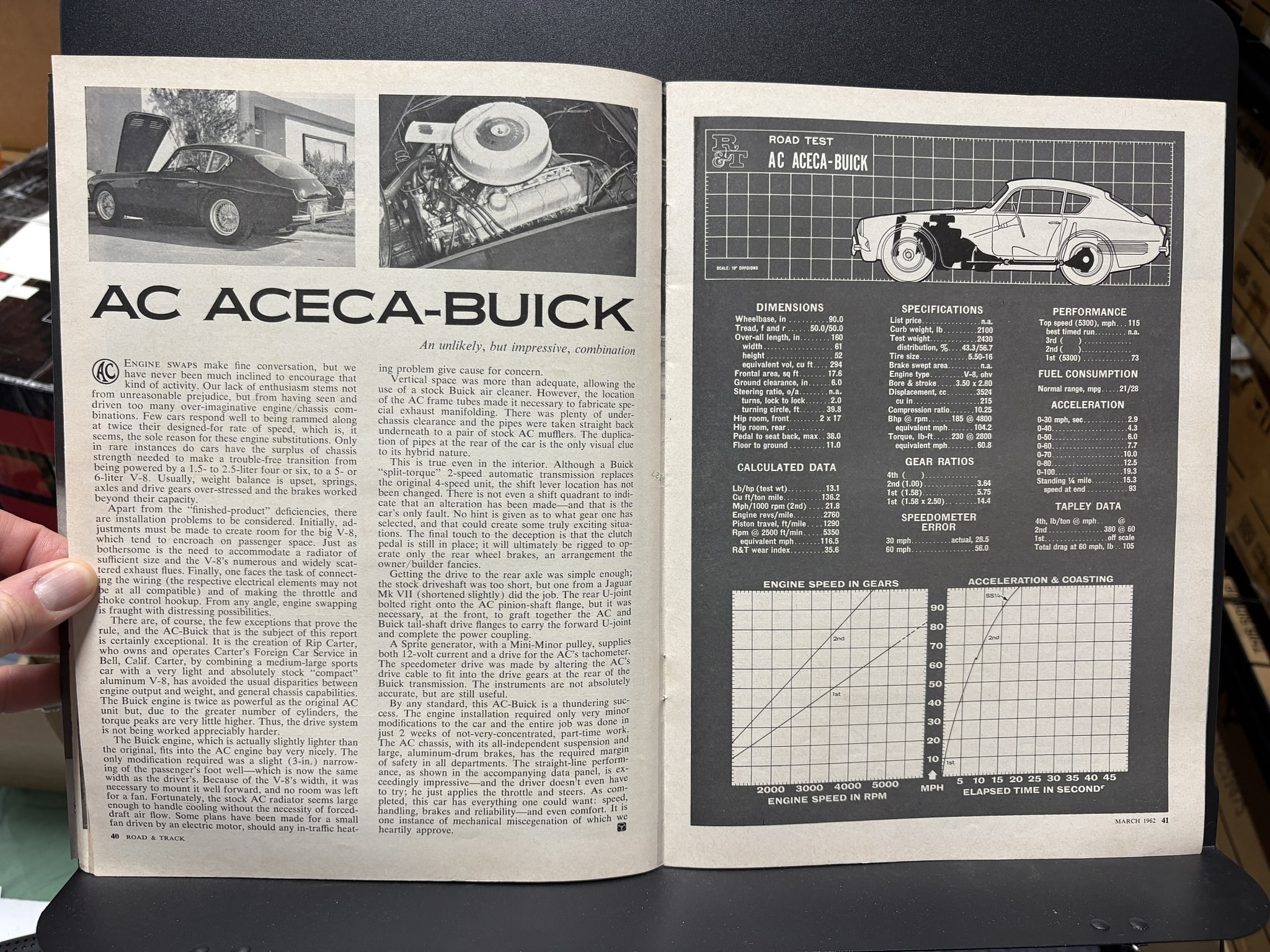
AC Aceca-Buick

[edit]

In the early 1960s, American Rip Carter created an engine-swapped Aceca coupé. Working out of his shop, Carter's Foreign Car Service in Bell, California, Carter installed an aluminum-block Buick 215 V8 in place of the AC Light Six. The Buick V8 had twice the power output of the original engine, but weighed less.[19]

To accommodate the wider V8, Carter narrowed the passenger's footwell by three inches, making it the same width as the driver's. The engine was mounted forward in the chassis, which did not leave enough room for an engine-driven cooling fan, although the stock AC radiator seemed to cool the engine adequately without the extra airflow. A plan to add an electric fan was considered.[19]

Changes to the placement of the chassis tubes necessitated fabricating a new exhaust manifold. The original 4-speed manual transmission was replaced by a 2-speed automatic. The driveshaft was a shortened part from a Jaguar Mk VII, while a generator from an Austin-Healey Sprite with a pulley from a Mini-Minor supplied 12 volt power.[19]

References

[edit]

Further reading

[edit]
[edit]
Revisions and contributorsEdit on WikipediaRead on Wikipedia
from Grokipedia
The AC Aceca is a hand-built coupé manufactured by the British automaker from 1954 to 1963, renowned for its lightweight aluminum bodywork mounted on a ladder-frame and its agile handling derived from the contemporary roadster. Designed by engineer John Tojeiro and introduced at the 1954 Motor Show, the Aceca featured a distinctive profile with a curved one-piece and a hinged rear luggage compartment, providing refined two-seat grand touring accommodations while maintaining the open Ace's sporting character. Production of the Aceca totaled 328 units across three main variants, reflecting AC's low-volume, bespoke approach to coachbuilding at their Thames Ditton facility. The initial models, numbering 151 examples built from late 1954 to mid-1956, were powered by AC's own 1,991 cc overhead-valve inline-six engine, derived from prewar designs and producing approximately 100 bhp for a top speed of around 103 mph. From 1956 onward, 169 Aceca-Bristol variants adopted a more advanced 1,971 cc inline-six engine sourced from Bristol Cars—based on a prewar BMW design—delivering 120 bhp in standard form or up to 130 bhp when tuned, which elevated performance to a top speed of about 115 mph and 0-60 mph acceleration in under 10 seconds. The rarest iteration, the Aceca 2.6 with only eight units produced between 1961 and 1963, utilized a tuned 2,553 cc inline-six from the Ford Zephyr, modified by AC's Ruddspeed division to yield 170 bhp, enabling even brisker dynamics including a top speed exceeding 120 mph. All Acecas employed independent front suspension with transverse leaf springs and tubular shock absorbers, a live rear , and four-wheel brakes (upgradable to front discs on later Bristols), contributing to their reputation for precise steering and balance on winding roads. Weighing around 950–1,000 kg depending on the engine, these cars exemplified mid-1950s British with Italian-inspired aesthetics, and their design directly influenced the iconic that succeeded the Ace lineup in 1962. Though production ceased in 1963 amid AC's shift toward the Cobra's V8 power, surviving Acecas remain highly collectible for their rarity, craftsmanship, and role in automotive history.

Overview and History

Introduction

The AC Aceca is a hand-built fixed-head coupé produced by the British manufacturer from 1954 to 1963. As the enclosed counterpart to the open-top roadster, it featured a distinctive design with an innovative rear for enhanced practicality, setting it apart in the era's grand touring landscape. In total, 328 units were produced across its variants, underscoring its status as a low-volume specialist vehicle. Key to its engineering appeal was a utilizing an wood frame reinforced with tubing and clad in hand-formed aluminum panels, which contributed to its agile character. From 1958, the Aceca adopted front disc brakes as standard, an early implementation that improved stopping performance alongside its setup. These elements, combined with engine options ranging from AC's own inline-six to more powerful units, endowed the car with a reputation for exceptional handling and competitive prowess in period racing events.

Development

The AC Ace roadster, launched in 1953, marked ' return to the sports car market following , where the company had shifted to producing aircraft components and fire engines. Drawing on a lightweight tubular chassis designed by freelance engineer John Tojeiro, the Ace was envisioned as a competitive alternative to established rivals, incorporating with transverse leaf springs for enhanced handling. Building on the Ace's success, developed the Aceca as an enclosed coupé variant to offer greater practicality for grand touring, featuring a pioneering design that allowed easier access to the rear storage area. The body, hand-formed in aluminum over a tubular framework by AC's in-house team, emphasized and lightness while maintaining the roadster's sporty proportions. The prototype Aceca debuted at the 1954 London Motor Show (), where it garnered immediate interest for its innovative fixed-head configuration, with production commencing later that year. Post-war material shortages in Britain's automotive sector posed significant challenges for , delaying full-scale production and forcing reliance on limited supplies of steel and aluminum, while intense competition from models like the pressured the company to innovate quickly. To address braking limitations in high-speed applications, AC introduced Girling front disc brakes as an option in 1957, making them standard by 1958 to improve safety and performance for touring duties. Engine developments followed suit, with the six-cylinder unit becoming available in 1956 for enhanced power and refinement; by 1961, after ceased engine supply, AC adopted a tuned 2.6-liter inline-six to sustain the model's viability until production ended in 1963.

Design and Engineering

Chassis and Construction

The AC Aceca utilized a tubular steel ladder-frame designed by John Tojeiro, which was shared with the roadster and consisted of two large-diameter main tubes supplemented by smaller tubes and front and rear subframes for mounting the bodywork. This lightweight yet rigid structure provided a strong foundation for the coupé's grand touring capabilities, with the body bolted directly to the subframes for enhanced structural integrity. The body construction followed traditional British hand-built methods, employing of hand-formed wood joined with tubing, over which aluminum panels were fitted to form the exterior shell, including the bonnet, lid, and doors. This hybrid approach of wood framing and aluminum skin contributed to the Aceca's balanced weight distribution, approaching 50/50, and overall rigidity, which supported agile handling characteristics without excessive mass. The dimensions included of 90 inches (2,286 mm), a track of 50 inches (1,270 mm) front and rear, and an overall length of approximately 160 inches (4,064 mm). Suspension was fully independent at all four wheels, utilizing transverse springs front and rear in conjunction with shock absorbers and lower wishbones, marking an early adoption of such a setup in British sports cars. Braking initially relied on hydraulic drum units all around, but was upgraded to front Girling disc brakes as an option in 1957 and standard from 1958 onward, with rear drums retained for a balanced stopping system suited to the era's performance demands.

Body and Styling

The AC Aceca was a two-door fixed-head coupé designed as a , featuring a hand-built aluminum body with ash wood framing for and tailgate, mounted on a tubular steel chassis. Its roofline and low-slung profile contributed to an elegant, aerodynamic appearance, with the body incorporating fibreglass bulkheads and footwells for enhanced sound insulation. A distinctive top-hinged liftgate at the rear provided practical access to a generous luggage compartment, making it one of the earliest production cars with such a design after the 1953 DB2/4. Styling cues drew from a late-1940s Pinin Farina front-end design adapted for AC, including a long bonnet with two banks of four louvres, curved lines around the headlights, and a simple grille accented by chrome surrounds. From , the windscreen adopted a curved, one-piece wraparound style with rounded lower corners to improve water resistance and reduce wind buffeting, enhancing the car's aerodynamic efficiency. Exterior trim included vertical chrome overriders and optional full-width chrome bumpers front and rear, while standard 16-inch centre-laced wire wheels—often painted silver—could be specified in chrome or colors like cream or red, with 15-inch wheels becoming optional that year. The body integrated seamlessly with the underlying for , allowing the lightweight aluminum panels to define its sleek silhouette. Inside, the Aceca accommodated two passengers in leather-upholstered bucket seats trimmed in Connolly hides, paired with wool carpets and a padded headliner for a refined yet minimalist grand touring experience. The featured burr walnut inserts housing basic Smiths instrumentation, including , , and auxiliary gauges, behind a wood-trimmed . Door panels were leather-covered with manual window winders, and amenities were sparse, limited to essentials like a chromed pull-out , sun visors, and an optional heater, emphasizing the car's sporting character over luxury. Color options for the exterior were typically , silver, or blue, with matching or contrasting interiors available to suit buyer preferences.

Models and Specifications

Original Aceca

The Original Aceca served as the entry-level variant of the Aceca lineup, offering a more accessible introduction to AC's sporting heritage through its standard in-house . Introduced in 1954, it utilized the same tubular chassis as the open-top , providing a lightweight foundation for the fixed-head body. This model emphasized balanced handling and everyday usability over outright performance, positioning it as a practical for enthusiasts seeking British refinement without the higher costs of optional engine upgrades. At its core, the Original Aceca was equipped with AC's venerable Light Six engine, a naturally aspirated 1,991 cc inline-six cylinder unit featuring overhead valves and a single . Initially, it delivered 85 at 4,500 rpm, providing adequate propulsion for the era's standards. By 1957, refinements including improved compression and tuning boosted output to 100-105 , enhancing responsiveness without altering the engine's fundamental character. Power was routed through a 4-speed with synchromesh on the top three gears, paired with a single-plate and a hypoid final drive for smooth shifts and reliable operation. Performance figures reflected the model's modest , with from 0-60 mph taking approximately 13.0 seconds and a top speed of 103 mph (166 km/h), making it suitable for spirited road use rather than track dominance. Fuel economy hovered around 20-25 under normal conditions, contributing to its appeal as an economical . Braking was handled by standard 11-inch units on all wheels via a Girling hydraulic system, though disc brakes became available as an starting in to address fade during prolonged high-speed driving. Priced at roughly £1,500 when new, it represented a premium yet attainable option for buyers in the mid-1950s market. Production of the Original Aceca spanned from 1954 to 1963, with a total of 151 units assembled at AC's Thames Ditton facility, underscoring its status as a low-volume specialist offering that catered to discerning customers valuing craftsmanship over mass appeal.

Aceca-Bristol

The Aceca-Bristol represented an uprated variant of the AC Aceca, introduced in 1956 to offer enhanced performance through a more powerful engine option, positioning it as a premium grand tourer suitable for both road and track use. Production spanned from 1956 to 1963, during which 169 units were assembled at AC Cars' Thames Ditton facility in England. Priced at £1,722 in the UK, it commanded a premium over the standard Aceca, reflecting the cost of the advanced Bristol powertrain and its associated refinements. At the heart of the Aceca-Bristol was the 1,971 cc Bristol Type 100 inline-six engine, derived from the pre-war design, featuring an iron block with an aluminum alloy cylinder head and twin SU carburetors. From 1958 onward, this engine delivered 120-125 at 5,750 rpm, providing smoother power delivery and greater flexibility than the base AC unit. The powerplant was mated to a four-speed , with overdrive available as an option to improve highway cruising efficiency. Disc brakes became standard from 1958, enhancing for the increased performance. Performance figures underscored the Aceca-Bristol's sporting credentials, achieving 0-60 mph in 9.0 seconds and a top speed of 116 mph (187 km/h), with improved characteristics that made it particularly well-suited for long-distance touring. Unique to this model was an enhanced cooling system, including an optional oil cooler, which addressed the demands of the higher-output Bristol engine during sustained high-speed runs. Its reputation for reliability also made the Aceca-Bristol popular in racing, with the related AC Ace-Bristol securing class victories in events like the 1959 24 Hours two-litre sports category.

Aceca 2.6

The Aceca 2.6 represented the concluding production variant of AC's fixed-head coupé, developed in response to the discontinuation of engine supplies in 1961. With ceasing production of their inline-six, AC adapted the platform to accommodate a Ford-derived powerplant, resulting in a limited run of just eight units assembled between 1961 and 1963. This scarcity stemmed from the model's transitional role, as AC shifted focus toward the forthcoming with its V8 configuration, effectively bridging the gap between the era and the American-engined future. At the heart of the Aceca 2.6 lay a 2,553 cc inline-six engine sourced from the , meticulously tuned by specialist Ken Rudd's Ruddspeed operation to deliver outputs ranging from 150 to 170 bhp at 5,500 rpm. Enhancements included a Raymond Mays aluminum and triple SU carburettors for the higher-tune variants, emphasizing improved breathing and power delivery while retaining the engine's inherent low-end characteristics. Power reached the rear wheels via a four-speed manual gearbox equipped with Laycock de Normanville overdrive on third and fourth gears, optimizing cruising efficiency. Performance metrics underscored the model's refined capabilities, with acceleration from 0-60 mph achieved in 8.1 seconds and a top speed of 121 mph (195 km/h), bolstered by the engine's robust low-rev for responsive highway manners. Unique to this variant were practical upgrades such as a larger 12 UK-gallon (54.5-litre) mounted beneath the floor and revised gearing ratios tailored for extended road use, addressing the demands of longer journeys in an era of expanding motorway networks. These features, combined with the retained body design, positioned the Aceca 2.6 as a sophisticated amid AC's evolving lineup.

Production

Chassis Numbers

The chassis numbering system for the AC Aceca utilized a prefix indicating the engine type combined with a sequential numeric identifier to track production order across variants. Models equipped with the standard AC six-cylinder , including the Original Aceca, employed the "AE" prefix, with "AEX" denoting export-oriented examples. The Aceca-Bristol variant used "BE" for home-market cars and "BEX" for exports, while the Aceca 2.6 adopted "RS" or "RSX" prefixes. This format facilitated identification of the and approximate assembly date, as numbers were assigned progressively during . Representative examples illustrate the scheme's application: a 1955 Original Aceca was assigned AE512 or AE513, and later AC-engined models reached numbers like AEX674 by 1959. For the Bristol-engined series, production commenced in 1956 with the BE prefix starting around BE550; examples include BE602 (1957), BE662 (1958), and BE785 (1960), demonstrating the progression up to around BE830 given the limited production run. The Aceca 2.6 series began at RS5500, as seen in examples like RS5506 (1962). These sequences align with overall production volumes, though exact endpoints vary slightly by export status. Chassis numbers hold key significance in distinguishing build details, including , production timing, and any factory-applied modifications, which is essential for authentication and valuation. Comprehensive records of these numbers, including cross-references to engine and body details, are preserved in the archives and accessible through the AC Owners Club for verified historical research. Identification of the chassis number involves locating the stamping on the frame adjacent to the engine bay, where it can be verified against engine serial numbers and factory documentation to confirm originality and matching components.

Total Production Figures

The AC Aceca achieved a total production of 328 units between 1954 and 1963, comprising 151 examples with the original AC engine, 169 with the engine, and 8 with the 2.6-liter engine. Production output averaged approximately 20-30 units annually, peaking during 1957-1959 amid growing demand for the Bristol-powered variant before a decline set in with the shift toward the in 1962, culminating in the model's end in 1963. The hand-built construction at AC's facility inherently constrained volumes to boutique levels, emphasizing craftsmanship over mass output and aligning with the company's tradition of low-volume specialist vehicles. Exports played a key role in sustaining production, with significant numbers destined for the market, where the Aceca's blend of British styling and performance appealed to enthusiasts and contributed to its competitive success in events like the SCCA championships. Today, an estimated 200 or more Acecas remain extant, as tracked by classic car registries and owners' clubs, reflecting the model's durability and appeal among collectors despite its limited original run.

Specials and Custom Builds

Factory Specials

The AC Aceca 'Bluebird', registered as VPL 441, served as the inaugural prototype for the Aceca line, debuting at the 1954 Earls Court Motor Show where it was named Car of the Year. Built on a standard tube-frame chassis designed by John Tojeiro, it featured all-aluminium coachwork, a flat windscreen unique to the prototype, whitewall tyres, and chrome badging for export appeal, powered initially by AC's own 2-litre inline-six engine producing 100 bhp. In a publicity arrangement, AC loaned the car to speed record holder Donald Campbell from 1954 to 1956, during which it was repainted in his signature 'Bluebird blue'—the same hue used on his record-breaking vehicles—and fitted with a 120 bhp Bristol 100B 2-litre six-cylinder engine for enhanced performance, achieving a top speed of around 115 mph. This association boosted AC's visibility, linking the brand to Campbell's high-profile exploits in land and water speed records, though the car itself was not used for competitive attempts. Another factory-sanctioned special was the 1960 AC Aceca registered 240 SPF, initially built for display at the Earls Court Motor Show and first registered directly to Ltd in . Utilizing the standard Aceca chassis with aluminium bodywork, it left the factory equipped with a 2-litre but underwent subsequent changes to a inline-six and later a 2.6-litre Ford unit, reflecting AC's experimentation with engine options during the transition period before the Aceca-Bristol's discontinuation. Purchased new by private owners at the show, it exemplified AC's strategy of producing tailored vehicles for promotional purposes, maintaining the model's grand touring ethos with a focus on lightweight construction and agile handling. The AC Aceca-Aigle represented a rare export variant, with three examples of the Aceca-Bristol customized in 1956 by the Swiss coachbuilder —a former subsidiary of —for the European market, particularly . These featured revised bodywork on the standard chassis, including a one-piece windscreen, a one-piece for improved visibility, and expanded interior space to suit continental preferences, while retaining the 2-litre engine and setup. Commissioned by Swiss importer Patthey, the modifications enhanced practicality without altering the core engineering, positioning them as low-volume adaptations for international sales. These factory specials, totaling five documented units, were crafted on production chassis for motor shows, testing new features, and targeted exports, underscoring AC's flexibility in a . Their historical role extended beyond utility, serving as vital tools that elevated the Aceca's profile through ties and international customization, influencing the model's legacy in the pre-Cobra era of British sports cars.

Aftermarket Modifications

Due to the Aceca's shared chassis with the AC Ace roadster, which formed the basis for the later AC Cobra, many owners have undertaken aftermarket modifications, particularly engine swaps to enhance performance. In the early 1960s, American tuner Rip Carter of Carter's Foreign Car Service in , converted an Aceca coupé by installing a 260 cu in (4.3 L) Ford V8 engine, which was then campaigned in races at venues like and . Similarly, other examples from the period, such as a 1955 Aceca (chassis AEX542), received a Ford 260 V8 swap shortly after production, reflecting contemporary interest in American powerplants for improved acceleration and top speed. Common modern modifications include upgrades to braking systems, suspension components, and overdrive transmissions for better road usability, often sourced from aftermarket suppliers specializing in AC parts. These custom builds highlight the Aceca's versatility as a platform for personalization while preserving its lightweight handling characteristics.

Legacy and Modern Revivals

Cultural Impact

The AC Aceca, sharing its chassis with the open-top , contributed to a notable racing legacy through the model's overall platform, which secured a first-in-class victory in the 2-litre GT category at the 1959 , finishing seventh overall driven by Ted Whiteaway and . This success highlighted the durability and performance potential of the lightweight tubular chassis, which also saw Aceca variants compete in British events such as the 1965 Guards Trophy races at Snetterton. The chassis design's proven racing pedigree directly influenced Carroll Shelby's selection of the AC platform for the , transforming it into an iconic American sports car with over 6,000 units produced and numerous competition wins. In media, the Aceca has appeared in films such as the 1965 French thriller Pleins feux sur Stanislas, where a 1959 Bristol-powered example featured prominently, and in the 2016 episode of the British TV series Car S.O.S., which documented the restoration of a 1957 model owned for decades by a single enthusiast. Its celebrity connections include ownership of the 1954 prototype by speed record holder , who used the car from 1954 to 1956 and later had it fitted with a engine, underscoring its appeal among figures. Among collectors, the Aceca commands values typically ranging from £80,000 to £150,000 at , depending on condition and engine variant, with a 1957 Aceca-Bristol selling for £120,750 in 2025. Preservation efforts are supported by organizations like the AC Owners Club, founded in 1949, which hosts annual events such as National AC Day and maintains registers to document surviving examples, with around 150 Acecas believed to remain worldwide. The Aceca's design legacy lies in its pioneering use of an ash wood and tubular frame for a , achieving a curb weight under 1,000 kg while providing structural rigidity, a technique that echoed in later British GT models like the DB series for their balance of elegance and performance. In the , appreciation has surged due to spillover from the Shelby Cobra's enduring popularity, driving a 20-30% increase in auction values over the past five years and attracting younger collectors to this rarer coupé.

1990s Revival

In the late 1990s, attempted a revival of the Aceca as a modern 2+2 GT coupé, serving as a to the original and built on an updated version of the contemporary platform. Development began under Brian Angliss, who had acquired the brand in 1986 through his Autokraft company, but actual production occurred after the firm's sale to Automotive in 1997, with assembly in , , from 1998 to 2000. Only a very limited number of units were completed, with records indicating around three to four cars built due to high development costs and poor market reception. The design featured a hand-laid body that closely echoed the sleek lines of the classic Aceca while incorporating modern refinements, including a stainless-steel , on all wheels, and anti-lock brakes for improved handling and safety. Interior appointments emphasized luxury, with full , power windows, heated front windshield and mirrors, and wood trim accents. The was extended by 15 cm compared to the Ace roadster to accommodate the 2+2 seating configuration. Power came from Ford Modular V8 engines, offering options from a 3.5-liter turbocharged unit producing 354 to a naturally aspirated 4.6-liter version with 326 , paired with either a five-speed manual or four-speed . These propelled the car to 0-60 mph in about 5.5 seconds and a top speed of 155 mph (250 km/h), providing grand touring performance suitable for the era. Targeted primarily at affluent buyers in the US and European markets, the Aceca was priced at over £60,000 (approximately £69,795 for base models), positioning it as a premium alternative in the GT segment. However, it achieved limited success amid intense competition from more established marques like and , resulting in minimal sales. Production ceased in 2000 as part of broader restructuring and financial difficulties that led to receivership, leaving the model extremely rare today with collector values estimated between £40,000 and £80,000 depending on condition and .

References

Add your contribution
Related Hubs
User Avatar
No comments yet.