


Community hub
Recent from talks
Contribute something
Nothing was collected or created yet.
AT&T Corporation
View on Wikipedia
AT&T Corporation, an abbreviation for its former name, the American Telephone and Telegraph Company, was an American telecommunications company that provided voice, video, data, and Internet telecommunications and professional services to businesses, consumers, and government agencies.
Key Information


During the Bell System's long history, AT&T was at times the world's largest telecommunications company, the world's largest cable television operator, and a regulated monopoly. At its peak in the 1950s and 1960s, it employed one million people and its revenue ranged between US$3 billion in 1950[4] ($42.6 billion in present-day terms[5]) and $12 billion in 1966[6] ($120 billion in present-day terms[5]).
In 2005, AT&T was acquired by "Baby Bell" and former subsidiary SBC Communications for more than $16 billion ($25.8 billion in present-day terms[5]). SBC then changed its name to AT&T Inc., with AT&T Corporation continuing to exist as a long-distance calling subsidiary until its dissolution on May 1, 2024.[7]
History
[edit]Origins
[edit]

AT&T started with Bell Patent Association, a legal entity established in 1874 to protect the patent rights of Alexander Graham Bell after he invented the telephone system. Originally a verbal agreement, it was formalized in writing in 1875 as Bell Telephone Company.[8][9]
In 1880 the management of American Bell created what would become AT&T Long Lines. The project was the first of its kind to create a nationwide long-distance network with a commercially viable cost-structure. The project was formally incorporated in New York as a separate company named American Telephone and Telegraph Company on March 3, 1885. Originating in New York City, its long-distance telephone network reached Chicago, Illinois, in 1892,[10] with its multitudes of local exchanges continuing to stretch further and further yearly, eventually creating a continent-wide telephone system. On December 30, 1899, the assets of American Bell were transferred into its subsidiary American Telephone and Telegraph Company (formerly AT&T Long Lines); this was because Massachusetts corporate laws were very restrictive, and limited capitalization to ten million dollars, forestalling American Bell's further growth. With this assets transfer at the very end of the 19th century, AT&T became the parent of both American Bell and the Bell System.[11]
On April 30, 1907, Theodore Newton Vail became president of AT&T.[12][13] Vail believed in the superiority of one phone system and AT&T adopted the slogan "One Policy, One System, Universal Service."[12][13] This would be the company's philosophy for the next 70 years.[13]
Under Vail, AT&T began buying up many of the smaller telephone companies including Western Union telegraph.[12][13] These actions brought unwanted attention from antitrust regulators. Anxious to avoid action from government antitrust suits, AT&T and the federal government entered into an agreement known as the Kingsbury Commitment.[12][13] In the Kingsbury Commitment, AT&T and the government reached an agreement that allowed AT&T to continue operating as a telephone monopoly, subject to certain conditions, including divesting its interest in Western Union. While AT&T periodically faced scrutiny from regulators, this state of affairs continued until the company's breakup in 1984. Throughout most of the 20th century, AT&T held a semi-monopoly on phone service in the United States and Canada through a network of companies called the Bell System. At this time, the company was nicknamed Ma Bell.
Early radio development
[edit]AT&T closely monitored new telephony technologies, although initially for private communication. In 1906, it sent observers to Reginald Fessenden's radiotelephone demonstration of his alternator transmitter.[14] Fessenden hoped that AT&T would purchase his company and patents, but the phone company concluded that Fessenden's system was not sufficiently refined.
It was not until the development of vacuum-tube transmitters that radiotelephony became practical. AT&T purchased the commercial rights to Lee de Forest's vacuum-tube and radio patents.[15] Although originally the company developed vacuum-tubes for distant land-line amplification, in 1915 the company conducted radiotelephony tests from station NAA in Arlington, Virginia, which established impressive new audio distance records, heard as far west as Hawaii,[16] and east to Paris, France, which was the first documented transmission of speech across the Atlantic Ocean.[17]
In 1919, the Radio Corporation of America (RCA) was formed, from the assets of the American subsidiary of the Marconi Company. A series of patent cross-licensing agreements were made, including, effective July 1, 1920, one between RCA's founders and AT&T, which granted AT&T exclusive rights within the United States for "Public Service Telephony".[18] In 1920, a telephone link using radio transmissions was established between Avalon Island, California and the mainland, although this was later replaced by an underwater cable, because local amateurs began to amuse themselves by listening-in to private conversations.[19]
It was recognized that a potential use of unrestricted radio transmissions was broadcasting to a widespread audience. In a 1919 presentation at the Convention of the American Institute of Electrical Engineers, two company engineers noted the possibility for "the broadcasting of news, time and weather signals, and warning. In some cases one objection to radio-telephony would be an advantage in this class of service."[20] The Westinghouse Electric and Manufacturing Company later purchased the successor company to Fessenden's early work. Employing vacuum-tube transmitters, it inaugurated well-financed radio broadcasting stations, starting in November 1920 with KDKA, located at its East Pittsburgh, Pennsylvania headquarters, and soon many additional stations began operating.
In December 1921, AT&T longline engineers John F. Bratney and Harley C. Lauderback prepared a memo reviewing AT&T's radio broadcasting options. They stated that commercial broadcasting was a significant opportunity, and proposed the nationwide establishment of 38 stations, linked together by long-distance telephone lines, that could be hired out (known, using telephone terminology, as "toll stations").[21]

Radio broadcasting in the United States dramatically expanded in 1922, with over 500 stations by the end of the year. Thus, AT&T ended up establishing only two stations: WBAY (later WEAF) in New York City, and WCAP in Washington, D.C., licensed to its Chesapeake and Potomac subsidiary. WEAF was the company's showcase station. Its primary competition was RCA's WJZ, also in New York City, although, based on AT&T's interpretation of the cross-licensing agreements, WJZ was prohibited from commercial operation. Moreover, WJZ's engineer-in-charge, Carl Dreher, later admitted that "WEAF... was better on the technical end than we were... Raymond Guy... sums it up in his reminiscences... 'AT&T did things with a more thorough knowledge of what they were doing... They just knew more about telephony than we did, as you might expect. They had the best telephone engineers in the world. The entire Bell Laboratories were at their disposal.'"[22]
AT&T initially found that, instead of hiring WEAF, most potential broadcasters wanted to establish their own stations. According to AT&T's interpretation of the RCA cross-licensing agreements, its Western Electric subsidiary had the exclusive right to manufacture and sell radio transmitters, although most early stations had built their own. In 1924, with only about 50 of the more than 500 U.S. stations having Western Electric transmitters, AT&T started to move aggressively to enforce its patent rights, and began a court case charging infringement against WHN, a New York City-area station. Although company president H. B. Thayer issued a statement that "We have no desire for a monopoly of the air", this was met with widespread skepticism, as earlier sales contracts for Western Electric transmitters had included a clause prohibiting stations "to operate for hire".[23] This restriction on commercial programming was seen as a covert way to largely eliminate competition, as it was becoming apparent that for most stations there was no way to finance operations without selling airtime. In view of these concerns, Commerce secretary Herbert Hoover issued a statement that "neither will our public policy allow [radio broadcasting] to become monpolized".[24]
Seeing no chance of prevailing against the AT&T suit, WHN reached an out-of-court settlement that set the standard for the radio broadcasting industry, which was reported as: "According to the stipulations of the settlement, the American Telephone and Telegraph Company released WHN from all liability for past infringement of its patents. WHN paid $2,000 for a personal, non-transferable license to do general telephonic broadcasting, including for toll or hire, for the entire term of the patents. If at any time the power of WHN should be increased, the American Telephone and Telegraph Company will grant a new license on similar terms and for a proportionally larger fee."[25] The standard rate for a license to use AT&T's radio patents was based on a station's transmitter power, set at $4 per kilowatt, although non-commercial stations were only charged $1. Even this was too much for some stations, including KFAY in Medford, Oregon, which was unable to afford a license fee of $500,[26] as well as two Portland, Oregon stations, KGG and KFOH.[27] However, despite earlier concerns, the agreement allowed stations to begin commercial operation.
Meanwhile, AT&T engineers worked to develop a network of radio stations, linked by specially prepared long-distance telephone lines. The first permanent link, originating at WEAF, was established in the summer of 1923, to station WMAF in South Dartmouth, Massachusetts.[28] As it expanded, this network became known as the "WEAF chain".
Broadcasting Company of America subsidiary
[edit]On May 11, 1926, AT&T announced a major reorganization, that "The radio broadcasting activities heretofore carried on by the radio broadcasting department of the American Telephone and Telegraph Company, under the general designation of WEAF, will be incorporated under the name Broadcasting Company of America." (BCA) Operations continued to be based at AT&T headquarters at 195 Broadway in New York City. AT&T's BCA consolidation allowed for two possible outcomes: if AT&T decided to withdraw from broadcasting, then the transfer of its radio operations would be simplified, otherwise, the new entity could continue to be run semi-independently of the parent corporation.
During BCA's short existence, the standard WEAF chain consisted of a network of 17 stations, concentrated in the northeastern United States, but also extended westward to WDAF in Kansas City, Missouri.[29] Individual evening hourly station rates ranged from $170 for three stations located in smaller communities to $480 for flagship WEAF. The standard charge for an hour of evening programming over the entire roster of stations was $4,080, before any applicable discounts.[30]
Unpublicized when the BCA subsidiary was established were ongoing intense negotiations between AT&T and the "radio group" companies, led by RCA, about the status of the cross-licensing agreements, and the overall future of the broadcasting industry. On July 21, AT&T issued a press release announcing BCA's sale to RCA for $1,000,000,[31] which in turn used these assets to form the National Broadcasting Company. This memo stated that although operation of WEAF and the WEAF chain had been financially successful, it had been concluded that "while the technical principle was similar to that of the telephone system, the objective of the broadcasting station was quite different from that of a telephone system. Consequently, it has seemed to us after years of experimentation, that the broadcasting station which we have built up might be more suitably operated by other interests."[32] Although it was ending its direct involvement in radio broadcasting, AT&T continued the very profitable leasing of long-distance telephone lines, to link together radio network affiliates.
Undersea communications and operations
[edit]AT&T had a domestic and global presence in laying the infrastructure of undersea routes for telecommunications. In 1950, the U.S. Navy commissioned a network of undersea surveillance cables for foreign submarine detection. AT&T was probably, according to internal employees, involved in this Sound Surveillance System (SOSUS). After completion, AT&T began commercial operations in cable laying for communications in 1955.[33] The implementation of cables assured local and long-distance telephone or data services would provide revenue for the company.[34] AT&T Long Lines was one of the divisions responsible for the cable-laying and maintaining of Long Lines' undersea cables.[35] Western Electric was the manufacturing company responsible for production and supply of undersea coaxial equipment and later, fiber cables. Equipment such as repeaters was manufactured in Clark, New Jersey and coaxial cable was manufactured in Baltimore, Maryland .[36] Also, Bell Labs was responsible for the innovations of products[37] or technologies in cabling in transmission by undersea systems.[38] In 1955, the first trans-Atlantic telephone undersea cable, TAT-1, from North America to Europe was installed by AT&T. This installation allowed 48 telephone circuits to be used for long-distance calling.[39] When partnering with other global Telecommunications companies, such as the French Cables de Lyon and German Felten & Guilleaume, Bell Labs provided the specification and inspection of non Bell System cable for networks such as the TAT-2.[36] By the continuous undersea network installations, AT&T was a globally technology leader with the 1970 installed TAT-5 and the 1975 installed TAT-6, achieving 720 channels and then 4000 channels for transmitting voice or data.[36] Prior to 1963, AT&T had to charter oceanic ships, such as the CS Monarch (1945) for installations. AT&T purchased CS Long Lines in 1961 and operated it with several cable laying ships that would provide, either the laying or repair of cabling under the subsidiary, Transoceanic Cable Ship Company. After the break-up, AT&T operated their ships under a subsidiary called AT&T Submarine Systems Inc, based in Morristown, New Jersey, until they sold six ships to Tyco International Ltd in 1997 for $850 million.[40] AT&T continued to maintain their communication building facilities. Here is a list of the cable laying-ship fleet:
_(14753843174).jpg)
- CS Lidiv (Decommissioned 1955) Built for AT&T Corp. for New York Telephone Company use. Decommissioned in 1955 and the CS Cable Queen was the replacement.[41]
- CS Cable Queen (Built 1951–1952) Built for AT&T Corp. for the Bell System usage by New York Telephone Company. A 65-foot small-scale underwater telephone cable-laying vessel. Decommissioned after 1989 with over 100,000 miles of cable laying.[42]
- CS Salernum (Built 1954) Built in Italy and named CS Salernum. Dimensions were length as 339.6 ft, breadth as 41.0 ft, depth as 18.5 ft, and gross tonnage at 2789. Purchased by AT&T Corp. through its subsidiary, Transoceanic Cableship Co., in 1984. Sold by AT&T in 1997 to Tyco International in the AT&T Submarine Systems fleet purchases. The wreck became an article reef in the Dutch Caribbean island, Sint Eustatius.[43]
_(14569651087).jpg)
- CS Long Lines (Built 1961–1963) Built for AT&T Corp. for the 1961 launching, but cable laying assignments began in 1963. The $19 million vessel was 511 feet length and 11,300-tons. Performed the laying of the first trans-Pacific telephone cable, known as TRANSPAC-1 (TPC-1) in 1964. and the first trans-Pacific fiber cable, known as TPC 3.[44] Sold in 1997 to Tyco International.[45] Scrapped in 2003.[44]
- C.S. Link (Built 1990s) Owned by Transoceanic Cable Ship Co., a subsidiary of the United States–based telephone company, AT&T Corp.[46]
- CS Global Sentinel (Built 1992) Maiden voyage from shipyard to Honolulu was February 1992. The 479-foot vessel equipped with bow thrusters, began cable laying operations in early 1992. Owned by Transoceanic Cable Ship Co., a subsidiary of the United States telephone company, AT&T Corp.[47]
- CS Global Mariner (Built 1992) Built in Singapore. The 479-foot vessel was equipped with bow thrusters and had storage space for up to 4100 nautical miles of cable. Seafaring was done in December 1992 by Seafarers International Union crew. A SIU publication, Seafarers Log, indicated in January 1993 the vessel was the fifth cable ship of the AT&T Corp. fleet. It was a sister ship and identical to CS Global Sentinel. Owned by Transoceanic Cable Ship Co., the subsidiary of the United States AT&T telephone company.[48]
Between 1951 and 2000, AT&T was listed 73 times in cable laying operations for specific routes deployed.[49] The Cable Ship Long Lines had 23 cable runs from 1963 to 1992, with the first deep-sea trial of optical fiber cable in 1982 leading to the consortium of countries and locations for the TAT-8 fiber cable implementation of 1988.[50]
Break-up
[edit] | This section needs additional citations for verification. (February 2021) |


The United States Justice Department opened the case United States v. AT&T in 1974. This was prompted by suspicion that AT&T was using monopoly profits from its Western Electric subsidiary to subsidize the cost of its network, a violation of antitrust law.[51] A settlement to this case was finalized in 1982, leading to the division of the company on January 1, 1984, into seven Regional Bell Operating Companies, commonly known as Baby Bells. These companies were:
- Ameritech, acquired by SBC in 1999, now part of AT&T Inc.
- Bell Atlantic (now Verizon Communications), which acquired GTE in 2000
- BellSouth, merged with AT&T Inc. in 2006
- NYNEX, acquired by Bell Atlantic in 1996, Bell Atlantic is now Verizon Communications
- Pacific Telesis, acquired by SBC in 1997, now part of AT&T Inc.
- Southwestern Bell (later SBC, now AT&T Inc.), which acquired AT&T Corp. in 2005
- US West, acquired by Qwest in 2000, which in turn was acquired by CenturyLink (now Lumen Technologies) in 2011. In May 2025, AT&T announced an agreement to purchase Lumen Technologies' consumer connectivity business.[52] This deal will incorporate most of US West's residential footprint into AT&T Inc.
| AT&T Corporation RBOC grouped into "Baby Bells" split off in 1984 | |||||||||||||||||||||||||||||||||||||||||||||||||||||||||||||||||||||
| BellSouth | AT&T Corporation (non-LEC) | Ameritech | Pacific Telesis | Southwestern Bell (later SBC Communications) | Bell Atlantic | NYNEX | US West | ||||||||||||||||||||||||||||||||||||||||||||||||||||||||||||||
| GTE (non-RBOC ILEC) | Qwest (non-ILEC) | ||||||||||||||||||||||||||||||||||||||||||||||||||||||||||||||||||||
| Verizon | |||||||||||||||||||||||||||||||||||||||||||||||||||||||||||||||||||||
| AT&T (former SBC) | |||||||||||||||||||||||||||||||||||||||||||||||||||||||||||||||||||||
| CenturyLink (non-RBOC ILEC) | |||||||||||||||||||||||||||||||||||||||||||||||||||||||||||||||||||||
| AT&T | Verizon | Lumen Technologies | |||||||||||||||||||||||||||||||||||||||||||||||||||||||||||||||||||
Post-breakup, the former parent company's main business was now AT&T Communications Inc., which focused on long-distance services, and with other non-RBOC activities.
AT&T acquired NCR Corporation in 1991. AT&T announced in 1995 that it would split into three companies: a manufacturing/R&D company, a computer company, and a services company. NCR, Bell Labs and AT&T Technologies were to be spun off by 1997. In preparation for its spin-off, AT&T Technologies was now Lucent Technologies. Lucent was completely spun off from AT&T in 1996.
Acquisition by SBC
[edit]On January 31, 2005, the "Baby Bell" company SBC Communications announced its plans to acquire "Ma Bell" AT&T Corp. for $16 billion. SBC announced in October 2005 that it would shed the "SBC" brand and take the more recognizable AT&T brand, along with the old AT&T's "T" NYSE ticker symbol.
Merger approval concluded on November 18, 2005; SBC Communications began rebranding the following Monday, November 21 as "the new AT&T" and began trading under the "T" symbol on December 1. Present-day AT&T Inc. claims AT&T Corp.'s history as its own, but retains SBC's pre-2005 stock price history and corporate structure. As well, all SEC filings before 2005 are under SBC, not AT&T.
The AT&T headquarters buildings
[edit]From 1885 to 1910, AT&T was headquartered at 125 Milk Street in Boston. With its expansion it moved to New York City, to a headquarters on 195 Broadway (close to what is now the World Trade Center site). The property originally belonged to Western Union, of which AT&T held a controlling interest until 1913 when AT&T divested its interest as part of the Kingsbury Commitment.[13] Construction of the current building began in 1912. Designed by William Welles Bosworth, who played a significant role in designing Kykuit, the Rockefeller mansion north of Tarrytown, New York, it was a modern steel structure clad top to bottom in a Greek-styled exterior, the three-story-high Ionic columns of Vermont granite forming eight registers over a Doric base.[53] The lobby of the AT&T Building was one of the most unusual ones of the era. Instead of a large double-high space, similar to the nearby Woolworth Building, Bosworth designed what is called a "hypostyle hall", with full-bodied Doric columns modeled on the Parthenon, marking out a grid. Bosworth was seeking to coordinate the classical tradition with the requirements of a modern building. Columns were not merely the decorative elements they had become in the hands of other architects but created all the illusion of being real supports. Bosworth also designed the campus of MIT as well as Theodore N. Vail's mansion in Morristown, New Jersey.
_(14569685949).jpg)

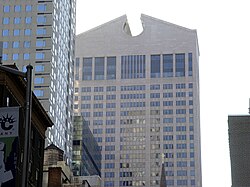
In 1978, AT&T commissioned a new building at 550 Madison Avenue. This new AT&T Building was designed by Philip Johnson and quickly became an icon of the new Postmodern architectural style. The building was completed in 1984, the very year of the divestiture of the Bell System. The building proved to be too large for the post-divestiture corporation and in 1993, AT&T leased the building to Sony, who then subsequently owned the building until it was sold in 2013.[54][55]

In 1969, AT&T began plans to construct an administration corporate complex in the suburbs. In early 1970, AT&T began purchases of land in the suburbs of New Jersey for this office complex and began construction in 1974. The award-winning architect, Vincent Kling, designed a Fordism[56] style, luxurious "Pagoda"[57] campus layout and the construction firms: New York–based Walter Kidde and Newark, New Jersey–based Frank Briscoe, managed this joint venture construction project with Vollers Construction of Branchburg, New Jersey, as the subcontractor. The 295 North Maple Avenue and Interstate 287 location of Basking Ridge in Bernards Township, New Jersey was completed in 1975 for the AT&T General Department offices. Employees began moving, in November 1975, to the seven inter-connected building complex using 28 acre of the property. The property had a 15-acre underground parking garage with spaces for 3,900 vehicles, and included a Class 1 licensed private helipad, a two-story cafeteria, a wood-burning fireplace, an indoor waterfall at the entrance lobby, and a seven-acre created lake for flood control. The entire property was 130 acre and cost $219 million to construct. Later, across the street from the complex, AT&T purchased additional land and established its Learning Center in 1985, at 300 North Maple Avenue, to become a 171 conference room inn. The AT&T Learning Center won the commercial property known as Somerset County's Land Development Award that year. In 1992, Basking Ridge location would become a corporate headquarters just before AT&T leased the New York City, 550 Madison Avenue building to Sony in 1993. The corporate statue, known as "Golden Boy" was moved in 1992, from the former New York City headquarters to this current New Jersey headquarters. In 1992, a corporate art consultant approached, artist sculptor, Elyn Zimmerman, to commission a 30-foot diameter project with fountain and seating area for the conference center courtyard gardens. In 1994, the project was completed and had one 34 ton granite boulder centered on top of the other boulders, which flowed water from the fountain designed by fountain engineer, Dr. Gerald Palevsky.[58] AT&T occupancy at the location peaked to 6,000 employees in its heyday before AT&T experienced competition and downsizing.

In October 2001, the Basking Ridge property was 140 acre with 2.6 million square feet and was placed for sale.[59] Basking Ridge employee occupancy, prior to the sale were approximately 3,200 employees. In April 2002, Pharmacia Corporation purchased the complex for $210 million for their corporate headquarters from existing Peapack-Gladstone, New Jersey headquarters.[60] A short time afterwards, in 2005, Verizon purchased the former complex, excluding the hotel/conference room building,[61] from Pfizer for Verizon Wireless Headquarters and consolidation of employees from Manhattan as well as other nearby New Jersey building locations.[62] In 2007, Pfizer placed the North Maple Inn for sale. At the time, it was a four-diamond, certified hotel and conference center under IACC ("International Association of Conference Centers") designation.[63] In 2015, Verizon performed a sale-leaseback agreement valued at $650.3 million on the complex with the address previously known as One Verizon Way.[64] In 2017, the 35 acre hotel/conference center was known as the Dolce Basking Ridge Hotel and sold for $30 million.[65]
Dissolution
[edit]On February 15, 2024, AT&T Inc. filed notice with the Kentucky Public Service Commission that it intends to make an internal structural change and merge AT&T Corp. into AT&T Enterprises, Inc., which will become a limited liability company. In a filing with the South Dakota Secretary of State dated January 30, 2024, the reason given for the merger is that New York state law does not allow AT&T Corp. to be directly converted into an LLC.[66] Although acquired by SBC in 2005, AT&T Corp. has remained a separate entity within the corporate structure of AT&T Inc. The merger, said to create "greater operational efficiencies", will end the existence of the nearly 140-year-old entity. The internal merger took effect on May 1, 2024.[67]
Divisions/Subsidiaries
[edit]AT&T, prior to its merger with SBC Communications, had three core companies:
AT&T Alascom sold service in Alaska. AT&T Communications was renamed AT&T Communications – East, Inc. and sold long-distance telephone service and operated as a CLEC outside of the borders of the Bell Operating Companies that AT&T owned. It has now been absorbed into AT&T Corp. and all but 4 of the original 22 subsidiaries that formed AT&T Communications continue to exist. AT&T Laboratories has been integrated into AT&T Labs, formerly named SBC Laboratories.
Nicknames and branding
[edit]AT&T was formerly known as "Ma Bell" and affectionately called "Mother" by phone phreaks. During some strikes by its employees, picketers would wear T-shirts reading, "Ma Bell is a real mother." Before the break-up, there was greater consumer recognition of the "Bell System" name, in comparison to the name AT&T. This prompted the company to launch an advertising campaign after the break-up to increase its name recognition. Spinoffs like the Regional Bell Operating Companies or RBOCs were often called "Baby Bells". Ironically, "Ma Bell" was acquired by one of its "Baby Bells", SBC Communications, in 2005.
The AT&T Globe Symbol,[68] the corporate logo designed by Saul Bass in 1983 and originally used by AT&T Information Systems, was created because part of the United States v. AT&T settlement required AT&T to relinquish all claims to the use of Bell System trademarks. It has been nicknamed the "Death Star" in reference to the Death Star space station in Star Wars which the logo resembles. In 1999 it was changed from the 12-line design to the 8-line design. Again in 2005 it was changed to the 3D transparent "marble" design created by Interbrand for use by the parent company AT&T Inc.
List of AT&T chief executive officers
[edit]The following is a list of the 16 CEOs of AT&T Corporation, from its incorporation in 1885 until its purchase by SBC Communications in 2005.[69]
| # | Chief executive officer | Years in office | Title |
|---|---|---|---|
| 1 |  Theodore Newton Vail Theodore Newton Vail
|
1885–1887 | President |
| 2 | _(14756392855).jpg) John E. Hudson John E. Hudson
|
1887–1900 | President |
| 3 |  Frederick Perry Fish Frederick Perry Fish
|
1901–1907 | President |
| 4 | Theodore Newton Vail
|
1907–1919 | President |
| 5 |  Harry Bates Thayer Harry Bates Thayer
|
1919–1925 | President |
| 6 | .jpg) Walter Sherman Gifford Walter Sherman Gifford
|
1925–1948 | President |
| 7 | Leroy A. Wilson | 1948–1951 | President |
| 8 | _(14569651027).jpg) Cleo F. Craig Cleo F. Craig
|
1951–1956 | President |
| 9 | Frederick Kappel | 1956–1961 1961–1967 |
President Chairman |
| 10 | H. I. Romnes | 1967–1972 | Chairman |
| 11 | John D. deButts | 1972–1979 | Chairman |
| 12 | Charles L. Brown | 1979–1986 | Chairman |
| 13 | James E. Olson | 1986–1988 | Chairman |
| 14 | Robert Eugene Allen | 1988–1997 | Chairman |
| 15 | C. Michael Armstrong | 1997–2002 | Chairman |
| 16 | David Dorman | 2002–2005 | Chairman |
See also
[edit]
- Bell Telephone Memorial, a monument sculpted by W.S. Allard, commemorating the invention of the telephone
- International Bell Telephone Company, sister company to American Bell Telephone, with its headquarters in Brussels, Belgium
References
[edit]Citations
[edit]- ^ "Foreign Corporations". bsd.sos.mo.gov. Missouri Secretary of State. Retrieved May 7, 2024.
- ^ Russell, Andrew L. (2014). Open Standards and the Digital Age: History, Ideology, and Networks. Cambridge University Press. p. 100. ISBN 978-1-107-03919-3.
- ^ Abate, Frank R., ed. (1999). The Oxford Desk Dictionary of People and Places. Oxford University Press. p. 386. ISBN 0-19-513872-4. Retrieved May 21, 2024.
- ^ "Annual Report 1950, American Telephone & Telegraph Company" (PDF).
- ^ a b c 1634–1699: McCusker, J. J. (1997). How Much Is That in Real Money? A Historical Price Index for Use as a Deflator of Money Values in the Economy of the United States: Addenda et Corrigenda (PDF). American Antiquarian Society. 1700–1799: McCusker, J. J. (1992). How Much Is That in Real Money? A Historical Price Index for Use as a Deflator of Money Values in the Economy of the United States (PDF). American Antiquarian Society. 1800–present: Federal Reserve Bank of Minneapolis. "Consumer Price Index (estimate) 1800–". Retrieved February 29, 2024.
- ^ "Annual Report 1966, American Telephone & Telegraph Company" (PDF).
- ^ McDonald, Laura (April 18, 2024). "Farewell to AT&T Corp". Levine, Blaszak, Block & Boothby, LLP. Retrieved May 1, 2024.
- ^ Bruce 1990, p. 291.[full citation needed]
- ^ Pizer 2009, pp. 120–124.Bruce 1990, p. 291[full citation needed]
- ^ Bruce 1990.Bruce 1990, p. 291[full citation needed]
- ^ Brooks 1976, p. 107.Bruce 1990, p. 291[full citation needed]
- ^ a b c d Thierer, Adam D. (1994). "Unnatural Monopoly: Critical Moments in the Development of the Bell System Monopoly" (PDF). Cato Journal. 14 (2). Cato Institute: 267–285. Archived (PDF) from the original on April 27, 2019. Retrieved May 15, 2019.
- ^ a b c d e f "AT&T Milestones in AT&T History". AT&T. Archived from the original on September 28, 2008. Retrieved September 17, 2008.
- ^ "Experiments and Results in Wireless Telephony" by John Grant, The American Telephone Journal. Part I: January 26, 1907, pages 49–51; Part II: February 2, 1907, pages 68–70, 79–80.
- ^ Father of Radio by Lee De Forest, 1950, pages 326-327.
- ^ "Wireless Telephony Now From Washington to Honolulu", The Electrical Experimenter, November 1915, p. 321.
- ^ "By Wireless 'Phone from Arlington to Paris", The Electrical Experimenter, December 1915, p. 393.
- ^ "Sec. 4. Why the Telephone Company Joined the Group", Big Business and Radio by Gleason L. Archer, 1939, pages 12-13.
- ^ "Commercial Radio Telefone at Avalon Santa Clara Island" by G. E. Hyde, Pacific Radio News, March 1921, pages 598, 638.
- ^ "Radio Telephony" by E. B. Craft and E. H. Colpitts, Telephone Engineer, July 1919, page 37.
- ^ Commerical Broadcasting Pioneer by William Peck Banning, 1946, pages 66-67.
- ^ "Notes From the Music Box", Sarnoff: An American Success by Carl Dreger, 1977, page 76.
- ^ "Bell System Denies 'Monopoly of Air'", Washington (D.C.) Evening Star, March 7, 1924, page 35.
- ^ "No Monopoly in Broadcasting Says Secretary Hoover", Radio Dealer. April 1924, page 30.
- ^ " Letter from George E. Folk , General Patent Attorney of Bell Telephone dated August 1, 1924", Economics of the Radio Industry by Hiram L. Jome, 1925, footnote #2, page 215.
- ^ "Local and Personal", Medford Mail Tribune, June 27, 1924, page 2.
- ^ "2 Radio Stations Quit", Portland Oregonian, June 1, 1924, page 19.
- ^ History of Radio to 1926 by Gleason L. Archer, 1938, pages 313-315.
- ^ "How Much It Costs to Broadcast" by Austin C. Lescarboura, Radio Broadcast, September 1926, page 368.
- ^ "How Much It Costs to Broadcast" by Austin C. Lescarboura, Radio Broadcast, September 1926, pages 367-371.
- ^ Million dollar check Big Business and Radio by Gleason L. Archer, 1939, page 288.
- ^ Big Business and Radio by Gleason L. Archer, 1939, pages 275-276.
- ^ Brock, Joe (July 6, 2023). "SPECIAL REPORT-Inside the subsea cable firm secretly helping America take on China". reuters.com. Reuters. Retrieved December 1, 2023.
- ^ Mills, Mike. "Undersea Cables Carry Growing Rivers of Data". Washington Post. Retrieved December 1, 2023.
- ^ "Submarine Coaxial Cable Restoration". long.lines.net. Long Lines. Retrieved December 1, 2023.
- ^ a b c Kelly, Paul L.; Kaminow, Ivan P.; Agrawal, Govind P. (December 21, 2019). "Undersea Fiber Communication Systems (Optics and Photonics)". www.ebin.pub. EBIN. Retrieved December 1, 2023.
- ^ Haemmerle, Ed. "1976 TAT-6". atlantic-cable.com. Atlantic Cable. Retrieved December 1, 2023.
- ^ Easton, Robert L. "Undersea Cable Systems - A Survey or: Explanation to an Unknown Lady in Philadelphia". atlantic-cable.com. Atlantic Cable. Retrieved December 1, 2023.
- ^ Wagner, Eric. "30,000 Feet Below: Connecting Continents from the Ocean Floor". about.att.com. AT&T. Retrieved December 1, 2023.
- ^ "AT&T sells cable ship division". www.tradewindsnews.com. TradeWinds. July 10, 1997. Retrieved December 1, 2023.
- ^ Glover, Bill. "CS Cable Queen". atlantic-cable.com. History of the Atlantic Cable & Undersea Communications. Retrieved December 1, 2023.
- ^ Glover, Bill. "CS Cable Queen". atlantic-cable.com. History of the Atlantic Cable & Undersea Communications. Retrieved December 1, 2023.
- ^ Mauric, Damien. "Secret Scuba Spot: Charlie Brown Wreck in Statia". www.scubadiving.com. Padi. Retrieved December 1, 2023.
- ^ a b Swinhoe, Dan (December 9, 2022). "A brief history of cable ships". www.datacenterdynamics.com. datacenterdynamics. Retrieved December 1, 2023.
- ^ "C.S. LONG LINES - IMO 5421235". www.shipspotting.com. Ship Spotting. Retrieved December 1, 2023.
- ^ "Seafarers Bring Newest AT&T Cable Ship to States" (PDF). Seafarers Log. 55 (1): 3. January 1993.
- ^ "Seafarers Sail Through a Year Of Military Operations, Legislation, New Vessels and Elections" (PDF). Seafarers Log. 55 (1): 14. January 1993.
- ^ "Fifth AT&T Ship Joins Cable Fleet" (PDF). Seafarers Log. 55 (1): 3. January 1993.
- ^ Glover, Bill. "Cable Timeline: 1951-2000". atlantic-cable.com. Atlantic Cable. Retrieved December 1, 2023.
- ^ Glover, Bill. "CS Long Lines". atlantic-cable.com. Atlantic Cable. Retrieved December 1, 2023.
- ^ Yurick, p. 7.Bruce 1990, p. 291[full citation needed]
- ^ Vinn, Milana (May 21, 2025). "AT&T agrees to buy Lumen's consumer fiber business for $5.75 billion in cash". Yahoo Finance. Reuters. Retrieved May 23, 2025 – via Yahoo! Finance.
- ^ Jarzombek, Mark (2004). Designing MIT: Bosworth's New Tech. Boston: Northeastern University Press. pp. 65–68. ISBN 1555536190. OCLC 55124376.
- ^ Popik, Barry (September 25, 2005). "Chippendale Building (SONY building)". The Big Apple. Archived from the original on January 12, 2019. Retrieved December 6, 2006.
- ^ Stoler, Michael (September 8, 2005). "Fortune 100 Companies Capitalize on Record Prices". The Stoler Report. First American Title Insurance Company of New York. Archived from the original on December 26, 2007.
- ^ Kaika, Maria (July 2011). "Autistic Architecture: The Fall of the Icon and the Rise of the Serial Object of Architecture" (PDF). hummedia.manchester.ac.uk. Centre for Research on Socio-Cultural Change, The University of Manchester. p. 5. Retrieved December 21, 2023.
- ^ Kaika, Maria (July 2011). "Autistic Architecture: The Fall of the Icon and the Rise of the Serial Object of Architecture" (PDF). hummedia.manchester.ac.uk. Centre for Research on Socio-Cultural Change, The University of Manchester. p. 9. Retrieved December 21, 2023.
- ^ Zimmerman, Elyn. "AT&T Headquarters 1994". www.elynzimmerman.com. Elyn Zimmerman. Retrieved December 21, 2023.
- ^ Peterson, Eric. "Verizon Ready to Buy Former AT&T Campus". www.globest.com. ALM Global, LLC. Retrieved December 21, 2023.
- ^ Holusha, John (April 6, 2002). "Pharmaceutical Company to Buy AT&T Complex in New Jersey". The New York Times. Retrieved December 21, 2023.
- ^ "Former AT&T HQ Hitting the Market". siteselection.com. Conway Data, Inc. May 19, 2003. Retrieved December 21, 2023.
- ^ "Red carpet for Verizon; Bernards greets new owner of old AT&T headquarters". www.newjerseyhills.com. Bernardsville News. March 31, 2005. Retrieved December 21, 2023.
- ^ "North Maple Inn for Sale". www.hotelexecutive.com. March 2, 2007. Retrieved December 21, 2023.
- ^ Hutchinson, Dave (May 20, 2015). "Verizon sells Basking Ridge HQ for $650.3 million, but will stay put". www.nj.com. NJ Advance Media for nj.com. Retrieved December 21, 2023.
- ^ Tarrazi, Alexis (January 17, 2017). "Dolce Basking Ridge Hotel Sells for $30 Million". patch.com. Retrieved December 21, 2023.
- ^ Blessing, John. “Notification of Internal Corporate Restructuring of AT&T Corp. into AT&T Enterprises, LLC”. South Dakota Public Utilities Commission. Retrieved 22 April 2024.
- ^ Tyler, John T. "Notice of Merger of AT&T Corp. and AT&T Enterprises, Inc." Kentucky Public Service Commission. Retrieved 18 April 2024.
- ^ Massey, David. "Bell Logo History". Bell System Memorial. The Porticus Centre. Archived from the original on September 30, 2011.
- ^ Focus magazine (internal AT&T company publication), sidebar titled "AT&T's chief executives", 1988
Sources
[edit]- Works cited
- Brock, Gerald W. (1981). The Telecommunications Industry The Dynamics Of Market Structure. Harvard Economic Studies. Cambridge, MA: Harvard University Press. ISBN 978-0-674-87285-1.
- Brooks, John (1976). Telephone The First Hundred Years. Harper & Row. ISBN 978-0-06-010540-2.
- "Milestones in AT&T History". AT&T. Retrieved December 14, 2013.
External links
[edit]- AT&T (Archive)
- The short film A CONTINENT IS BRIDGED (Reel 1 of 4, Reel 2 of 4, Reel 3 of 4, Reel 4 of 4) (1940) is available for free download at the Internet Archive
- American Telephone & Telegraph logos, adverts and historical telephone maps on the Baring archive Risks and Rewards website[permanent dead link]
- Historical AT&T Financial Documents
- AT&T Telephone Magazine: January/February 1972 VOL 51/NO 1 to November/December 1973 VOL 52/NO 5, 402 pages. Publication in a browsable PDF file. [1]


| |||||||||||||||
| |||||||||||||||
| |||||||||||||||
| |||||||||||||||
| |||||||||||||||

| International | |
|---|---|
| National | |
| Artists | |
| Other | |

AT&T Corporation
View on GrokipediaHistory
Origins and Formation
The origins of AT&T Corporation stem from the invention of the telephone by Alexander Graham Bell, patented on March 7, 1876, following a demonstration of voice transmission between Boston and Cambridge on March 10.[8][9] To commercialize this technology, Bell, along with financial backers Gardiner Greene Hubbard and Thomas Sanders, established the Bell Telephone Company as a common law joint stock association in Boston on July 9, 1877.[10][11] The company initially focused on licensing telephone patents and manufacturing equipment, rapidly expanding local service amid competition from imitators.[9] By 1880, the Bell Telephone Company had consolidated with regional affiliates to form the American Bell Telephone Company, serving as the holding entity for Bell's patent monopolies, which were upheld through extensive litigation until their expiration in 1894.[11][12] Recognizing the need for interstate connectivity, American Bell incorporated the American Telephone and Telegraph Company on March 3, 1885, in New York as a wholly owned subsidiary tasked with constructing and managing a nationwide long-distance network.[4][13] This entity, initially capitalized at $500,000, aimed to interconnect local exchanges via dedicated lines, marking the shift from localized telephony to a unified system.[14] Theodore Newton Vail, who had joined the Bell organization in 1878 and risen to general manager of American Bell by 1882, resigned that role to become the first president of the new AT&T in 1885, emphasizing universal service and infrastructure investment as core principles.[15][12] Under this structure, AT&T pioneered the first long-distance line from Boston to Providence in 1886, followed by extensions to New York in 1889 and Chicago in 1892, laying the groundwork for coast-to-coast service by 1915.[9][16] This formation established AT&T's foundational role in telecommunications, prioritizing network control over fragmented competition.[4]Expansion and Monopoly Establishment
The American Telephone and Telegraph Company (AT&T) was incorporated on March 3, 1885, in New York as a wholly owned subsidiary of the American Bell Telephone Company, with the primary objective of managing patents for long-distance telephony and constructing an interstate network.[14] Initially, AT&T focused on developing toll lines connecting major cities, such as the first long-distance line between New York and Philadelphia in 1885, but local telephone service remained fragmented among numerous independent exchanges. By the early 1900s, competition from independents had eroded Bell's local market position, with the two sectors roughly equal in subscriber numbers around 1907.[17] Theodore Newton Vail assumed the presidency of AT&T on April 30, 1907, backed by J.P. Morgan interests, and pursued an aggressive consolidation strategy encapsulated in the slogan "One Policy, One System, Universal Service."[18] Vail advocated for a single, regulated network to achieve economies of scale and universal access, arguing that fragmented competition hindered efficient service expansion. AT&T acquired hundreds of independent telephone companies, often by refusing interconnection to its long-distance network, which isolated rivals and compelled sales; notable purchases included Western Union in 1910 for $30.7 million.[19] This approach shifted market dynamics: by 1912, the Bell System controlled 5.09 million telephone stations compared to 3.64 million for independents, representing approximately 58% market share.[20] Antitrust pressures mounted, leading to the Kingsbury Commitment on January 14, 1913, an out-of-court settlement with the U.S. Department of Justice. AT&T pledged to divest Western Union, interconnect with independent exchanges upon reasonable terms, and abstain from acquiring additional companies without Interstate Commerce Commission approval.[21] Rather than dismantling dominance, the agreement legitimized AT&T's position as a government-supervised monopoly, prioritizing network universality over competition; interconnection was often limited or costly, preserving Bell's advantages. By 1921, the Bell System directly served 64% of the nearly 14 million U.S. telephones, with 32% of independent lines dependent on its facilities for long-distance access.[19] This structure, justified by Vail's emphasis on coordinated infrastructure investment, entrenched AT&T's control over telephony, controlling 98% of long-distance traffic by the late 1930s.[22]Technological Peak and Bell Labs Era
Bell Laboratories, established on January 1, 1925, as a research and development subsidiary jointly owned by AT&T and its manufacturing arm Western Electric, represented the pinnacle of organized industrial innovation during the Bell System's monopoly era.[23] This entity consolidated earlier research efforts from the Bell System's engineering departments, enabling a focused pursuit of long-term technological advancements to support reliable telephone network expansion and operation. Under the regulated monopoly structure, AT&T allocated substantial resources to Bell Labs—typically around 1 to 2 percent of annual revenues, equating to hundreds of millions of dollars by the mid-20th century—free from competitive pressures that might prioritize short-term profits over fundamental discoveries.[24] This stability fostered an environment where physicists, mathematicians, and engineers collaborated on problems ranging from materials science to information theory, yielding breakthroughs that extended far beyond telecommunications.[25] The 1940s marked a transformative phase, highlighted by the invention of the transistor on December 23, 1947, by John Bardeen, Walter Brattain, and William Shockley at Bell Labs' Murray Hill facility.[26] This solid-state semiconductor device replaced bulky, power-hungry vacuum tubes, enabling miniaturization and efficiency gains critical for amplifying telephone signals over long distances; its broader applications would underpin modern computing and electronics. Bardeen, Brattain, and Shockley received the 1956 Nobel Prize in Physics for this work, one of nine Nobel Prizes awarded for Bell Labs research by the late 20th century. Concurrently, Claude Shannon's 1948 paper "A Mathematical Theory of Communication" laid the foundations of information theory, quantifying data transmission limits and error correction, which became essential for digital networks and data compression.[27] World War II efforts had already honed Bell Labs' capabilities, including developments in radar systems, proximity fuses, and semiconductor detectors, demonstrating the labs' ability to apply pure research to practical engineering under government contracts.[23] Subsequent decades amplified these achievements, with Bell Labs pioneering the first practical solar battery in 1954, converting sunlight to electricity at 6 percent efficiency—double prior records—and powering early satellites like Vanguard 1 in 1958.[26] In 1958, researchers contributed to the maser and laser technologies, enabling precise optical communications that foreshadowed fiber-optic systems. The 1960s brought digital innovations, including the charge-coupled device (CCD) in 1969 by Willard Boyle and George E. Smith, which revolutionized imaging by allowing electronic light detection and became the basis for digital cameras; Boyle and Smith shared the 2009 Nobel Prize in Physics. Software advancements included the development of the Unix operating system in 1969 by Ken Thompson and Dennis Ritchie, followed by the C programming language in 1972, tools that standardized multitasking and systems programming across industries.[26] These inventions, supported by over 25,000 employees at peak and facilities like the Holmdel Horn Antenna used for cosmic microwave background detection in 1964, underscored Bell Labs' role in bridging theoretical physics with deployable technologies.[23] The monopoly's regulatory framework, which guaranteed AT&T a return on investments including R&D, causal enabled this era's productivity by insulating research from market volatility and allowing pursuit of high-risk, high-reward projects.[24] Bell Labs researchers earned five Turing Awards for computing contributions, reflecting impacts on fields from telephony to cosmology. This period's output not only sustained the Bell System's dominance—handling over 90 percent of U.S. long-distance calls by the 1970s—but also seeded global technological progress, though critics later argued the lack of competition stifled commercialization speed.[25] By the early 1980s, annual R&D spending exceeded $2 billion, funding explorations into integrated circuits and early cellular concepts that presaged post-divestiture shifts.[23]Antitrust Challenges and the 1984 Divestiture
The Bell System, controlled by AT&T, faced antitrust scrutiny as early as 1913, when the U.S. Department of Justice pressured the company to divest its controlling stake in Western Union and commit to interconnecting independent telephone companies with its network under the Kingsbury Commitment.[28] Renewed government action came in 1949 with another DOJ antitrust suit alleging monopolization through AT&T's ownership of manufacturing subsidiary Western Electric, which supplied equipment to the local operating companies; the case settled via a 1956 consent decree that imposed licensing of patents to competitors but avoided structural divestiture.[29] By the 1970s, technological advances like microwave transmission enabled long-distance competition from firms such as MCI, which filed its own antitrust suit against AT&T in 1974 alleging exclusionary practices that denied rivals fair access to local networks.[29] On November 20, 1974, the DOJ filed United States v. AT&T in the U.S. District Court for the District of Columbia, charging AT&T with violating Section 2 of the Sherman Act through monopolization of local exchange service (controlling 80-85% of access lines), long-distance telecommunications, and telephone equipment markets.[6][30] The complaint highlighted AT&T's alleged use of its local service monopoly as a bottleneck to impede competition, including predatory pricing, cross-subsidization from local rates to underprice long-distance services, and refusals to provide interconnections or unbundled access to competitors.[6][31] To remedy these violations, the DOJ sought divestiture of Western Electric and the 22 Bell operating companies providing local service, aiming to separate local monopolies from competitive long-distance and equipment markets while preserving AT&T's research arm, Bell Laboratories.[29] AT&T contested the suit, arguing that its integrated structure served universal service under regulation by the Federal Communications Commission and state authorities, and that competition in long-distance was already emerging without structural breakup.[6] The case proceeded slowly, with discovery disputes and a trial slated for spring 1981 under Judge Harold H. Greene. Settlement negotiations yielded a modified consent decree announced on January 8, 1982, under which AT&T would divest the local operating companies effective January 1, 1984, reorganizing them into seven independent Regional Bell Operating Companies (RBOCs): Ameritech, Bell Atlantic, BellSouth, NYNEX, Pacific Telesis, Southwestern Bell, and US West.[28] AT&T retained its long-distance operations (reorganized as AT&T Communications), Western Electric (renamed AT&T Technologies), Bell Labs, and national directory publishing, but faced line-of-business restrictions barring RBOCs from long-distance, manufacturing, or certain information services without regulatory waiver.[6] Judge Greene approved the decree with 10 amendments on August 24, 1982, after public comments and hearings, emphasizing safeguards against RBOC market power abuse, such as equal access mandates for all long-distance carriers and FCC oversight of post-divestiture pricing.[32] The divestiture, implemented on schedule, dissolved the Bell System's vertical integration, transferring assets valued at approximately $100 billion in local infrastructure to the RBOCs while unleashing AT&T to compete in deregulated markets, though initial implementation costs included $5 billion in estimated lost productivity from restructuring telecom operations in 1984-1985.[6]Post-Breakup Restructuring and Decline
Following the January 1, 1984, divestiture of the Bell System, AT&T retained control over long-distance services, which accounted for approximately 70% of its pre-breakup revenues, along with its manufacturing arm (renamed AT&T Technologies) and research facilities at Bell Labs, while relinquishing local exchange operations to seven Regional Bell Operating Companies (RBOCs). This restructuring aimed to position AT&T as a competitive player in a deregulated environment, but it immediately faced intensified rivalry from established competitors like MCI and Sprint, as well as new entrants, eroding its pricing power and operational synergies derived from integrated control over the entire network.[6][33] AT&T's long-distance market share plummeted from over 90% in 1984 to 47.9% by 1996, as rivals captured gains through aggressive pricing and marketing; MCI, for instance, expanded its share from 4.5% in 1984 to a leading position among challengers. The company reported volatile financial results during the 1980s, with 1986 earnings dropping 91% to $139 million amid restructuring charges and competitive pressures, though it rebounded to a post-breakup high of $2.7 billion in profit for 1989. Service quality suffered initially, including installation backlogs and a major 1990 network outage that blocked 5.5 million calls, highlighting coordination challenges in the fragmented post-divestiture landscape.[33][34][35][36] Diversification efforts exacerbated the decline, particularly the 1991 acquisition of NCR Corporation for $7.5 billion in a hostile takeover intended to bolster AT&T's computing capabilities and integrate hardware with telecommunications. The deal destroyed between $3.9 billion and $6.5 billion in shareholder value through negative synergies, cultural clashes, and NCR's subsequent losses from 1992 to 1995, necessitating subsidies from AT&T; the unit was spun off in 1996 at a fraction of its purchase price, with NCR's market capitalization then at about $3.4 billion. Manufacturing competitiveness waned as well, with AT&T's share of central office switches falling from 70% in 1983 to 53% by 1989 amid foreign competition from firms like Northern Telecom.[37][38] By the mid-1990s, these missteps contributed to broader stagnation, including a $2.68 billion fourth-quarter loss in 1995 tied to divestiture-related costs and ongoing writedowns, diminishing AT&T's stature from a trillion-dollar behemoth to a vulnerable entity eventually acquired by SBC Communications in 2005 for $16 billion. The post-breakup era underscored AT&T's difficulties in transitioning from regulated monopoly efficiencies to market-driven innovation, with geographic fragmentation and lost scale hindering adaptation to rapid technological shifts in data and wireless services.[39][40][34]Reconsolidation through Mergers
Following the 1984 divestiture, regulatory changes permitted the regional Bell Operating Companies (RBOCs), or "Baby Bells," to expand into long-distance services and interstate operations after fulfilling certain conditions, fostering a wave of mergers that reversed much of the breakup's fragmentation in the U.S. telecommunications landscape.[41] By the early 2000s, Southwestern Bell Corporation (SBC Communications), which had grown through acquisitions of other RBOCs such as Pacific Telesis in 1997 and Ameritech in 1999, positioned itself to reclaim the AT&T brand and assets.[29] In January 2005, SBC announced its acquisition of the original AT&T Corporation for $16 billion in stock and cash, a deal completed on November 18, 2005, after approval by the Federal Communications Commission (FCC) and minimal antitrust scrutiny from the Department of Justice (DOJ).[42][43] This transaction allowed SBC to absorb AT&T's long-distance, wireless, and international operations, while adopting the AT&T name for the combined entity, AT&T Inc., thereby reuniting key elements of the pre-divestiture structure under a single corporate umbrella.[44] The reconsolidation accelerated in March 2006 when AT&T Inc. agreed to acquire BellSouth Corporation for approximately $67 billion in stock, a merger finalized on December 29, 2006, following FCC and DOJ clearances that deemed it unlikely to harm competition given the evolving broadband market.[45][46] This deal integrated BellSouth's southeastern U.S. local and wireless assets, including its stake in Cingular Wireless (fully consolidated under AT&T Mobility), expanding AT&T's footprint to cover over 40 states and more than 70% of the U.S. population, effectively reconstituting much of the original Bell System's regional dominance.[47][48] These mergers reduced the number of major incumbent local exchange carriers from seven to two primary survivors—AT&T and Verizon—concentrating control over wireline and early wireless infrastructure, though critics noted potential risks to pricing and innovation absent the post-1984 competition.[49] Later attempts, such as AT&T's unsuccessful $39 billion bid for T-Mobile in 2011, blocked by the DOJ on antitrust grounds, underscored ongoing regulatory limits on further telecom consolidation.[41]Recent Strategic Shifts and Focus on Core Telecom
In the early 2020s, AT&T executed a series of divestitures to shed non-telecom assets acquired during prior expansion efforts, thereby reducing debt and redirecting capital toward its core communications infrastructure. The company completed the spin-off of its WarnerMedia unit in a merger with Discovery, Inc., forming Warner Bros. Discovery on April 8, 2022; this transaction yielded AT&T approximately $40.4 billion in cash and debt securities while distributing a 71% equity stake in the new entity to shareholders via a tax-free spin-off.[50] Similarly, AT&T divested its video services by selling a controlling stake in DirecTV to TPG Capital in a deal that closed on August 2, 2021, retaining a minority interest but effectively exiting direct operation of satellite and streaming TV platforms acquired for $49 billion in 2015.[51] These moves addressed the underperformance of media ventures, which had strained finances amid cord-cutting trends and content competition, allowing AT&T to lower its net debt from peaks exceeding $180 billion in 2020 to around $130 billion by mid-2025.[52] Post-divestiture, AT&T intensified investments in wireless and broadband networks to solidify its position in U.S. telecommunications services. The company prioritized 5G deployment and mid-band spectrum acquisitions, including a planned $23 billion purchase of 50 MHz of C-band spectrum from EchoStar Corporation announced in 2025, aimed at enhancing coverage and capacity for its Mobility segment serving over 240 million subscribers.[53] Concurrently, AT&T accelerated fiber-to-the-x (FTTx) expansion, targeting 50 million locations by 2027 and up to 60 million by 2030 through organic builds and acquisitions like Lumen Technologies' fiber assets, leveraging bundled wireless-fiber offerings to drive postpaid subscriber growth of 1.6% in Q3 2025.[54][55] This refocus contributed to revenue stability, with total revenues rising 1.6% year-over-year in Q3 2025, primarily from mobility and consumer broadband segments, while enabling $40 billion in shareholder returns via dividends and buybacks over 2025-2027.[56] By 2025, these shifts had bolstered AT&T's competitive edge against rivals like Verizon and T-Mobile, with network modernization—reducing copper reliance by 50% and covering 75% of its footprint with fiber and 5G—underpinning a stock price doubling since 2023.[52][57] The strategy emphasized operational efficiency and infrastructure leadership over diversification, aligning with industry trends toward converged connectivity services amid rising demand for high-speed data.[58]Technological Innovations and Contributions
Key Inventions and R&D Under Monopoly
During the period of AT&T's regulated monopoly on telephone service, which solidified after the Kingsbury Commitment in 1913 and persisted until the 1984 divestiture, the company established Bell Telephone Laboratories (Bell Labs) in 1925 as its primary research and development arm, formed by consolidating the research departments of AT&T and its manufacturing subsidiary Western Electric.[23] This structure enabled substantial investment in fundamental research, funded through regulated rate structures that allowed AT&T to recover costs and earn a fixed return, insulating R&D from short-term market pressures and fostering innovations that extended beyond immediate telecommunications needs.[59] Bell Labs employed thousands of scientists and engineers, producing over 30,000 patents and contributing to fields from solid-state physics to computing, with the monopoly's stability cited as a key enabler of such breadth.[25] A landmark achievement was the invention of the transistor in December 1947 by John Bardeen, Walter Brattain, and William Shockley, which replaced bulky vacuum tubes with compact semiconductor devices, revolutionizing electronics and enabling the development of modern computing and communications systems.[60] This point-contact transistor, demonstrated at Bell Labs' Murray Hill facility, earned its inventors the 1956 Nobel Prize in Physics and laid the groundwork for integrated circuits.[61] Concurrently, in 1948, Claude Shannon published "A Mathematical Theory of Communication," founding information theory by quantifying data transmission limits and noise effects, which optimized signal processing in telephone networks and influenced digital communications.[62] Further breakthroughs included the first practical silicon solar cell in 1954, developed by Daryl Chapin, Calvin Fuller, and Gerald Pearson, achieving 6% efficiency in converting sunlight to electricity and demonstrating viability for powering remote telephone equipment.[63] In telecommunications, Bell Labs advanced cellular telephony concepts starting in 1947 with proposals for mobile radio systems using hexagonal cells to reuse frequencies, culminating in the Advanced Mobile Phone System design by the 1970s.[64] The UNIX operating system emerged in 1969 from Ken Thompson and Dennis Ritchie's work at Bell Labs, initially on a PDP-7 minicomputer, providing a portable, multi-user platform that became foundational for software development and later open-source systems.[65] Optical innovations featured prominently, with theoretical foundations for the laser outlined in a 1958 paper by Arthur Schawlow and Charles Townes, leading to Bell Labs' patent and subsequent developments like Kumar Patel's carbon dioxide laser in 1964, which enabled high-power infrared applications in cutting and spectroscopy.[66] During World War II, Bell Labs contributed to military R&D, including radar systems, proximity fuses, and two-way radios, enhancing wartime capabilities while informing postwar electronics.[23] These efforts, supported by the monopoly's cross-subsidization of basic research—estimated at 1-2% of revenues—yielded nine Nobel Prizes in Physics between 1937 and 1978, underscoring the era's productivity despite criticisms of stifled competition.[25]Post-Divestiture Developments
Following the 1984 divestiture of the Bell Operating Companies, AT&T retained ownership of Bell Laboratories and its manufacturing arm (later AT&T Technologies), enabling continued investment in telecommunications research despite a sharp decline in overall funding from the loss of monopoly revenues. Bell Labs focused on enhancing long-distance transmission capabilities, including refinements to digital switching systems like the No. 4ESS toll switch, which supported higher call volumes and error correction for intercity traffic.[67] AT&T accelerated deployment of fiber optic technologies for its long-distance network, announcing in November 1984 plans to build a nationwide backbone integrating optical fiber cables on high-density routes with digital microwave relays on lower-traffic paths, aiming to boost capacity and reduce signal loss over analog systems. By 1988, the company outlined expansions to its domestic digital network, targeting 60,000 route miles by 1989 through fiber-based infrastructure capable of supporting emerging data services and integrated digital voice transmission. These efforts built on pre-divestiture prototypes but adapted to competitive pressures, emphasizing cost-efficient scaling for interexchange services.[68][69] In the early 1990s, Bell Labs under AT&T contributed to standards for synchronous optical networking (SONET), facilitating standardized high-speed data multiplexing over fiber for reliable long-haul connectivity, which AT&T implemented to compete with entrants like MCI and Sprint in digital services. Research also advanced photonic components and wavelength-division multiplexing (WDM) precursors, increasing fiber bandwidth from gigabits to terabits potential, though commercialization lagged due to shifting corporate priorities toward diversification into computing and entertainment.[70] The 1996 "trivestiture" spun off AT&T's network equipment business and the bulk of Bell Labs into Lucent Technologies, leaving AT&T with a streamlined research group reorganized as AT&T Labs in 1997, oriented toward software, services, and data-driven telecom enhancements rather than hardware invention. AT&T Labs prioritized applied innovations like early voice-over-IP protocols and network management algorithms to support AT&T's evolving long-distance and nascent internet backbone operations, reflecting a pivot from pure R&D to market-responsive development amid deregulation and competition. This period marked a decline in foundational hardware breakthroughs, with AT&T's innovation output increasingly collaborative with vendors and focused on integrating digital packet switching for hybrid voice-data networks.[26][71]Modern Network Advancements
AT&T has aggressively expanded its fiber-optic broadband network in recent years, passing more than 30 million consumer and business locations across the United States by June 10, 2025, through investments in thousands of miles of new infrastructure since 2020.[72] This expansion has enabled the company to serve 10 million fiber customers as of October 22, 2025, positioning it as the largest provider of fiber internet in America by customer count.[73] In the third quarter of 2025 alone, AT&T added 288,000 fiber subscribers, reflecting sustained demand for high-speed, symmetrical connectivity that replaces legacy copper systems.[74] Legislative changes, including tax incentives from the "One Big Beautiful Bill Act," are set to accelerate deployments to an additional 1 million locations annually starting in 2026, enhancing national infrastructure resilience and capacity.[75] In parallel, AT&T has advanced its 5G wireless network, achieving nationwide deployment of 5G Standalone (SA) architecture by October 8, 2025, which enables lower latency and more efficient core network operations compared to non-standalone implementations.[76] The company also reached nationwide coverage for 5G Reduced Capability (RedCap) technology by July 16, 2025, supporting over 200 million points of presence for IoT devices with optimized power efficiency and simplified hardware.[77] AT&T plans to cover 300 million people with deep mid-band 5G spectrum by the end of 2026, bolstering mobile broadband speeds and capacity amid growing data demands.[78] These efforts include integrating 5G with fixed wireless access, adding 270,000 5G home internet customers in Q3 2025 to complement fiber offerings.[74] AT&T has incorporated open and cloud-based technologies to modernize its radio access network (RAN), completing the first commercial Open RAN call using third-party radios on October 23, 2025, to promote vendor interoperability and reduce dependency on proprietary systems.[79] Earlier, in February 2024, it activated Ericsson's Cloud RAN on its live 5G network, shifting toward virtualized, software-defined infrastructure that supports 70% of wireless traffic on open platforms.[80][81] In July 2025, AT&T deployed the first third-party rApp (RAN automation application) to optimize production network performance in real time, marking a milestone in AI-driven network management.[82] These advancements aim to lower costs, enhance scalability, and integrate satellite connectivity, with milestones like the first two-way voice call over AT&T spectrum in April 2023 extending coverage to remote areas.[83]Regulatory and Legal History
Government Interventions and Antitrust Cases
In response to growing concerns over AT&T's dominance in the telephone industry, the U.S. Department of Justice pressured the company in 1913 to enter the Kingsbury Commitment, an out-of-court agreement in which AT&T Vice President Nathan Kingsbury pledged to divest the company's controlling interest in Western Union, permit interconnection between AT&T's long-distance network and independent local telephone companies, and refrain from acquiring competing independents without government approval.[84][28] This settlement averted a formal antitrust lawsuit but preserved AT&T's regulated monopoly status while addressing specific exclusionary practices.[85] The Department of Justice filed a civil antitrust suit against AT&T and its manufacturing subsidiary Western Electric on January 14, 1949, under the Sherman Antitrust Act, alleging monopolization and conspiracy to restrain trade in the production, distribution, and sale of telephone equipment through exclusionary practices favoring Western Electric as the sole supplier.[86][29] The case, which sought divestiture of Western Electric, was settled via a 1956 consent decree that prohibited AT&T from entering unregulated businesses or competing with its own equipment customers, while allowing it to retain Western Electric for internal supply and Bell Labs for research, effectively confining the company to regulated telecommunications services.[87][88] This decree drew criticism for failing to dismantle the monopoly structure despite public and congressional scrutiny of the settlement's leniency.[29] Regulatory interventions by the Federal Communications Commission further challenged AT&T's control over customer equipment and network access. In the 1956 Hush-a-Phone decision, the FCC ruled that AT&T's tariff banning a non-electrical acoustic device for reducing handset noise—deemed harmless to the network—was unjust and unreasonable under the Communications Act of 1934, thereby permitting limited third-party attachments to telephone handsets.[89] This precedent eroded AT&T's absolute prohibition on foreign attachments. Building on this, the 1968 Carterfone decision required AT&T to allow interconnection of customer-provided devices, such as Thomas Carter's mobile radio-telephone coupler, to its network provided they caused no technical harm, rejecting AT&T's blanket bans and enabling broader use of modems and private systems.[90][91] These FCC rulings incrementally opened the network to competition without altering the underlying monopoly in local and long-distance services.[92]Post-1984 Regulatory Environment
Following the 1984 divestiture under the Modified Final Judgment, AT&T's core operations in long-distance telephony and equipment manufacturing were exempted from traditional rate-of-return regulation, allowing it to operate in competitive markets without the pricing constraints previously imposed by the Federal Communications Commission (FCC) on the integrated Bell System. The Regional Bell Operating Companies (RBOCs), handling local exchange services, remained subject to stringent state public utility commission oversight and federal access charge requirements, designed to ensure nondiscriminatory interconnection for interexchange carriers like AT&T, which paid $17.4 billion in such charges in 1984 alone. This bifurcated framework aimed to promote long-distance competition, evidenced by a more than 43% drop in interstate long-distance rates within six years post-divestiture, though it exposed inefficiencies in the FCC's initial access pricing policies, prompting reductions in charges after 1984.[6][93] Line-of-business restrictions under the decree initially barred AT&T from re-entering local services and prohibited RBOCs from manufacturing equipment or providing out-of-region long-distance, but these were progressively lifted through court and Department of Justice (DOJ) actions in the late 1980s and early 1990s, enabling AT&T greater flexibility in information services and computer markets. The FCC facilitated this transition by deregulating customer-premises equipment and enhancing cellular licensing, where the decree permitted incumbent Bell entities to retain one license per market, spurring AT&T's expansion into wireless alongside competitors. However, RBOCs faced ongoing mandates for equal access and unbundled network elements, limiting their diversification until compliance thresholds were met.[6][94] The Telecommunications Act of 1996 represented a cornerstone of further deregulation, abolishing remaining MFJ barriers by permitting RBOCs to enter interLATA long-distance markets upon certifying local loop unbundling and resale to competitors, while mandating RBOCs to negotiate interconnection agreements under FCC arbitration. For AT&T, the Act eased entry into local services via facilities-based competition or resale but prioritized market opening over immediate consolidation, though it inadvertently accelerated mergers, as seen in subsequent RBOC acquisitions of AT&T's remnants. Critics note the Act's implementation favored incumbents through lax enforcement of unbundling, contributing to limited local competition and industry concentration, yet it spurred broadband deployment incentives.[95][96] In the ensuing decades, FCC oversight shifted toward broadband and wireless spectrum management, classifying AT&T's wireline services variably under Title II common carrier rules (e.g., 2015 net neutrality order) or lighter Title I information services (post-2017 repeal), influencing investment in fiber and 5G infrastructure through spectrum auctions and forbearance grants. DOJ and FCC merger reviews, such as approvals for AT&T's 2006 BellSouth acquisition with conditions for line access, balanced competition concerns against efficiencies, while blocking the 2011 T-Mobile bid citing reduced wireless rivalry. These evolutions reflect a regulatory pivot from monopoly safeguards to antitrust scrutiny in converging markets, with AT&T navigating national security reviews for equipment sourcing amid ongoing spectrum allocation debates.[41][93]Recent Legal Battles and Compliance
In 2024, AT&T faced multiple class-action lawsuits stemming from significant data breaches that exposed customer information. A breach announced in March 2024 affected approximately 73 million current and former customers, revealing personal details including names, addresses, phone numbers, dates of birth, and Social Security numbers, which had been compromised via a third-party cloud platform operated by Snowflake.[97] A subsequent July 2024 disclosure involved data from nearly all cellular customers dating back to 2022, including passcodes and other identifiers.[98] These incidents led to consolidated multidistrict litigation in the U.S. District Court for the Northern District of Texas, where AT&T agreed in March 2025 to a $177 million settlement covering both events, providing affected customers with cash payments up to $7,500 for documented losses, credit monitoring, and other relief; the settlement received preliminary court approval in June 2025.[99][98] Regulatory scrutiny intensified over AT&T's data handling practices. In response to a January 2023 breach impacting 8.9 million customers' location and personal data, the Federal Communications Commission (FCC) imposed a $13 million fine in 2024 for violations of customer proprietary network information (CPNI) rules, prompting AT&T to settle and commit to enhanced security measures such as improved encryption and vendor oversight.[100] Separately, the FCC issued a $57 million forfeiture in 2024 for AT&T's alleged unauthorized sale of real-time location data to third parties, breaching Section 222 of the Communications Act; however, the U.S. Court of Appeals for the Fifth Circuit vacated the penalty in April 2025, ruling that the FCC's administrative process denied AT&T's Seventh Amendment right to a jury trial.[101][102] The U.S. Department of Justice and FCC sought Supreme Court review of this decision in October 2025, arguing for the validity of agency forfeiture authority.[103] AT&T also resolved compliance issues related to federal broadband subsidy programs. In 2024, the FCC's Enforcement Bureau settled an investigation into AT&T's administration of the Emergency Broadband Benefit (EBB) and Affordable Connectivity Program (ACP), fining the company over $2.2 million for alleged improper claims processing and eligibility verifications that violated program rules.[104] Additionally, in August 2025, AT&T and T-Mobile settled patent infringement lawsuits filed by Headwater Research in the Eastern District of Texas, averting a trial over wireless data management technologies; both carriers denied wrongdoing but agreed to undisclosed terms.[105] These cases highlight ongoing challenges in AT&T's adherence to privacy statutes and FCC mandates amid evolving cybersecurity threats.Business Operations and Segments
Wireless and Mobility Services
AT&T's wireless operations trace their origins to the launch of the first commercial cellular telephone service on October 13, 1983, in Chicago, utilizing the Advanced Mobile Phone System (AMPS) analog technology developed under the Bell System.[106] Following the 1984 divestiture of AT&T from its regional Bell Operating Companies, the company re-entered the cellular market through partnerships and acquisitions, notably forming a joint venture with SBC Communications to create Cingular Wireless in 2000, which became AT&T Mobility after AT&T's acquisition of the entity in 2006 for $67 billion.[4] This segment has since evolved into AT&T's largest revenue generator, emphasizing nationwide coverage via low-band spectrum and mid-band deployments for enhanced capacity. The division operates under AT&T Mobility, providing voice, data, and messaging services primarily through postpaid and prepaid plans, with a focus on unlimited data offerings such as AT&T Unlimited Your Way, which allows customization of features like premium data and hotspot usage.[107] Key enhancements include AT&T Turbo, which prioritizes traffic for select activities like video streaming and gaming on congested networks, and ActiveArmor, a security suite blocking spam calls and advanced threats.[107] Device compatibility supports a range of smartphones, with promotional trade-in deals offering up to $1,100 off models like the iPhone 17 Pro Max and Samsung Galaxy S25 Ultra when bundled with eligible plans.[107] Network infrastructure has advanced to 5G, with low-band 5G covering over 320 million people across more than 27,300 cities and towns as of 2025, complemented by mid-band C-band spectrum for higher speeds in urban areas.[108] In October 2025, AT&T completed nationwide deployment of 5G Standalone (SA) architecture, enabling independent operation from 4G LTE cores for improved latency and future features like network slicing, with customer migrations ongoing in select markets.[76][109] Coverage maps indicate approximate 5G availability subject to device and location factors, with actual performance varying by spectrum and density.[110] As of the third quarter of 2025, AT&T reported approximately 70 million postpaid phone subscribers, reflecting net additions of 405,000 in that period and consistent quarterly growth exceeding analyst expectations, driven by low churn rates around 0.92%.[111] Wireless service revenues reached $68.04 billion in fiscal year 2024, comprising 55.6% of total company revenue and underscoring mobility's dominance amid competition from Verizon and T-Mobile.[112] This segment benefits from spectrum assets acquired in auctions, including the 2011 Qualcomm purchase, supporting expansion in fixed wireless access as a broadband alternative.Broadband, Fiber, and Wireline
AT&T's wireline segment delivers broadband internet, voice telephony, and related services primarily through its Communications division, encompassing both consumer and business operations. Historically rooted in copper-based infrastructure from the Bell System era, the segment has undergone a transition toward fiber-optic deployment to address capacity limitations and competitive pressures from cable and wireless alternatives. In 2024, wireline revenues totaled approximately $16.5 billion, with consumer wireline contributing the majority through broadband growth amid declines in legacy voice services.[113] Broadband services include legacy DSL over copper lines, which peaked in the early 2010s but now serve as a transitional offering with speeds capped at 100 Mbps download, subject to distance-based degradation from central offices. AT&T has prioritized fiber expansion to supplant DSL, recognizing copper's inherent signal attenuation and maintenance costs as barriers to gigabit-era performance. By Q3 2025, DSL subscribers continued to erode, with AT&T directing investments toward fiber where feasible, though millions of rural or underserved locations remain on DSL due to deployment economics.[114] AT&T Fiber represents the core of modern broadband efforts, utilizing passive optical networks for symmetrical upload/download speeds reaching 5 Gbps in select markets. Launched in the mid-2010s, the service achieved a milestone of passing 30 million locations by June 2025, ahead of schedule, across over 100 metro areas. Subscriber growth accelerated to 288,000 net additions in Q3 2025 alone, yielding 10.12 million total fiber customers and a 40% penetration rate among passed premises. This expansion supports bundled offerings with wireless services, driving 8.2% year-over-year broadband revenue growth in consumer wireline, fueled by 16.8% fiber-specific increases.[72][115][116] Wireline operations for businesses emphasize enterprise-grade fiber connectivity, including dedicated internet, Ethernet, and voice solutions, though revenues declined 9.3% year-over-year in Q2 2025 due to 17.3% drops in legacy services like TDM voice, partially offset by fiber uptake. AT&T targets 60 million total fiber locations by 2030, planning to add 1 million extra annually starting 2026 via tax incentives and acquisitions, such as the pending purchase of Lumen's mass-market fiber assets closing in H1 2026. These moves aim to counter wireline's structural decline from cord-cutting and over-the-top services, leveraging fiber's lower latency and scalability for fixed-wireless hybrids and 5G backhaul.[117][75][118]Enterprise and International Operations
AT&T's enterprise operations, primarily under the Business Wireline segment, deliver advanced IP-based telecommunications and IT solutions to commercial clients, encompassing secure networking (including VPN, SD-WAN, Wi-Fi, and Ethernet), dedicated fiber and wireless business internet, IoT connectivity, 5G mobility, cloud integration, and unified voice/collaboration platforms.[119][120] This segment supports strategic growth areas like fiber expansion and managed services, offsetting declines in legacy voice and data revenues, which fell 17.3% year-over-year in Q3 2025, contributing to overall Business Wireline revenue contraction of 7.8%.[7] AT&T serves nearly 2.5 million business customers, ranging from small enterprises to government agencies, including nearly all Fortune 1,000 companies, and manages over 127 million IoT devices globally.[119][120] In terms of scale, AT&T's enterprise infrastructure includes a 1.4 million-mile global fiber network and handles over 713 petabytes of daily data traffic, enabling high-performance connectivity for mission-critical applications.[119] Key offerings emphasize cybersecurity integration and edge computing to address enterprise demands for reliability and scalability, with equipment sales in Business Wireline rising 41% in Q3 2024 amid a shift toward wireless and IP technologies.[121] These services generated consolidated Communications segment revenues of $29.5 billion in Q3 2025, up 1.5% year-over-year, though enterprise-specific contributions reflect ongoing transitions from traditional to modern architectures.[116] AT&T's international operations focus on enabling global connectivity for enterprise clients rather than extensive owned carrier networks abroad, providing business internet in 210 countries/territories, Ethernet services in 202 countries, and access to a colocation ecosystem of over 750 data centers.[119] Following divestitures of direct international assets—such as Latin American holdings in 2021—the company relies on partnerships, affiliates like AT&T Global Network Services entities in regions including Hong Kong and Venezuela, and its U.S.-centric infrastructure to support multinational operations.[122][113] This model facilitates services across Asia-Pacific, EMEA, and Latin America for clients in industries like finance, manufacturing, and healthcare, prioritizing secure, low-latency global data flows over local wireless dominance.[123][124]Acquisitions, Divestitures, and Corporate Evolution
Major Acquisitions
AT&T Corporation pursued aggressive acquisitions in the post-1984 divestiture era to rebuild capabilities in wireless and broadband, acquiring McCaw Cellular Communications in 1994 for $11.5 billion in a merger that established its entry into the cellular market by integrating McCaw's nationwide licenses and infrastructure.[125] This deal, initially announced in 1993 at $12.6 billion including prior stakes, enabled AT&T to compete in mobile services amid regulatory shifts favoring competition.[126] In 1998, AT&T announced the acquisition of Tele-Communications Inc. (TCI), the largest U.S. cable operator, for $48 billion in stock, completing the deal in March 1999 at an effective value of approximately $55 billion including assumed debt; this move targeted high-speed data delivery via cable networks to counter rival technologies.[127][128] The transaction faced antitrust scrutiny but was approved after concessions, forming AT&T Broadband and positioning the company in video and internet services.[129] Following SBC Communications' 2005 purchase of the original AT&T Corp. and adoption of the AT&T name, the restructured AT&T Inc. acquired BellSouth Corporation in December 2006 for $86 billion (initially valued at $67 billion upon announcement), consolidating southeastern U.S. wireline and wireless assets including full ownership of Cingular Wireless.[130][48] AT&T expanded into satellite television by acquiring DirecTV in July 2015 for $48.5 billion in equity (totaling $67 billion with debt), announced in May 2014, to bundle video with mobility services and compete in pay-TV amid cord-cutting trends.[131][132] The company's most ambitious media foray was the $85.4 billion acquisition of Time Warner, completed in June 2018 after a 2016 announcement and prolonged antitrust litigation, granting access to premium content like HBO and Warner Bros. to bolster streaming capabilities.[133][134] This vertical integration aimed to distribute content across AT&T's networks but later contributed to strategic reevaluations due to underperformance.[135]| Acquisition | Completion Date | Enterprise Value | Strategic Impact |
|---|---|---|---|
| McCaw Cellular | 1994 | $11.5 billion | Foundation for AT&T Wireless |
| TCI | March 1999 | $55 billion | Entry into cable broadband |
| BellSouth | December 2006 | $86 billion | Regional consolidation and Cingular control |
| DirecTV | July 2015 | $67 billion | Pay-TV bundling with wireless |
| Time Warner | June 2018 | $85.4 billion | Content ownership for distribution |
Key Divestitures and Spinoffs
In response to the United States v. AT&T antitrust case, AT&T agreed to divest its local telephone operating companies under the Modified Final Judgment, effective January 1, 1984. This separation created seven independent Regional Holding Companies—Ameritech, Bell Atlantic, BellSouth, NYNEX, Pacific Telesis, Southwestern Bell Corporation, and US West—which assumed responsibility for local exchange services across the United States. AT&T shareholders received one share in each of the seven entities for every ten shares of AT&T stock held as of the record date, preserving shareholder value while dismantling the integrated Bell System monopoly structure. AT&T retained its long-distance services, Western Electric manufacturing arm, Bell Laboratories research division, and other non-local assets.[136][29] To refocus on core communications services amid competitive pressures, AT&T undertook major spinoffs in 1996. On September 30, 1996 (with distribution on October 1), AT&T spun off Lucent Technologies, encompassing its network equipment manufacturing (formerly Western Electric) and research operations (Bell Labs), distributing approximately 525 million shares to AT&T shareholders and valuing the entity at around $21 billion at the time. Separately, on December 31, 1996, AT&T completed the spinoff of NCR Corporation, its computer systems and transaction processing business, setting NCR's value at $3.96 billion through share distribution to shareholders. These actions divided AT&T into three separate entities—communications services (retained as AT&T), equipment (Lucent), and computers (NCR)—aimed at enhancing operational efficiency and market responsiveness, though subsequent performance varied with Lucent facing significant challenges in the telecom bust.[44][137][138] As part of a strategic shift away from media diversification, AT&T announced in May 2021 its intent to spin off WarnerMedia, culminating in a transaction completed on April 8, 2022. WarnerMedia was combined with Discovery, Inc., forming Warner Bros. Discovery, with AT&T distributing shares in an intermediate "WarnerMedia Spinco" entity to its shareholders on a pro rata basis; these shares were automatically exchanged for Warner Bros. Discovery common stock upon merger closing. In exchange, AT&T received $40.4 billion in cash and $9.4 billion in debt relief, fully exiting its media operations acquired via the 2018 Time Warner purchase and reducing leverage to prioritize telecommunications infrastructure. This divestiture reflected empirical recognition that media assets underperformed relative to core connectivity businesses amid streaming market disruptions.[139][140][141]| Spinoff Event | Date Effective | Key Assets Transferred | Shareholder Distribution |
|---|---|---|---|
| 1984 RBOC Divestiture | January 1, 1984 | 22 local operating companies into 7 RHCs | 1 share per RHC per 10 AT&T shares[136] |
| Lucent Technologies | October 1, 1996 | Equipment manufacturing and R&D | Pro rata shares to AT&T holders[137] |
| NCR Corporation | December 31, 1996 | Computer systems | Pro rata shares to AT&T holders[138] |
| WarnerMedia (to Warner Bros. Discovery) | April 8, 2022 | Film, TV, and streaming assets | Pro rata via Spinco exchange for WBD stock[141] |
Impact on Corporate Structure
The 1984 divestiture of the Bell System, mandated by a 1982 antitrust consent decree, dismantled AT&T's vertically integrated monopoly structure, separating its 22 local Bell Operating Companies into seven independent Regional Holding Companies (RHCs or "Baby Bells") responsible for local telephone service, while AT&T retained long-distance operations, Bell Laboratories for research, and Western Electric for equipment manufacturing. This reconfiguration reduced AT&T's control over the end-to-end telecommunications ecosystem, shifting it from a comprehensive utility-like entity to a leaner competitor in interexchange services, with annual revenues dropping initially due to the loss of local operations generating about 70% of prior income. The change fostered a divisional organization emphasizing network services and innovation, but it exposed AT&T to heightened competition and prompted early diversification attempts, such as entering computers and wireless, which strained integration without the former subsidiaries' support infrastructure.[28][142] Post-divestiture acquisitions and spinoffs further reshaped AT&T's hierarchy, often revealing mismatches between telecom roots and non-core ventures. The 1991 $7.4 billion acquisition of NCR Corporation aimed to bolster computing capabilities but led to cultural and operational clashes, resulting in NCR's 1996 spinoff alongside the separation of manufacturing into Lucent Technologies, which streamlined AT&T into a services-focused model with fewer manufacturing subsidiaries and reduced R&D overhead. By the late 1990s, cellular expansions like the 1994 McCaw Cellular purchase established AT&T Wireless as a distinct segment, but persistent underperformance prompted its 2004 spinoff, allowing AT&T to offload capital-intensive infrastructure and refocus on wireline and broadband divisions. These moves iteratively simplified the corporate pyramid, prioritizing profitability over conglomerate breadth amid regulatory scrutiny.[143] The 2005 merger with SBC Communications, valued at $16 billion, marked a pivotal reversal, as SBC acquired AT&T and adopted its name while retaining its own operational framework, thereby consolidating local, wireless, and long-distance assets under a single entity with enhanced national scale. This integration absorbed AT&T's enterprise services into SBC's regional structure, creating a more centralized governance with synergies in network deployment but also antitrust conditions limiting market dominance in certain lines. Subsequent deals, including the 2006 $67 billion BellSouth acquisition, further unified southeastern U.S. operations, reducing fragmented subsidiaries. However, the 2018 $85 billion Time Warner purchase introduced WarnerMedia as a sprawling content arm, layering media production and streaming onto telecom segments, which ballooned debt to over $180 billion and complicated decision-making across divergent cultures. The 2022 spinoff of WarnerMedia—merging it with Discovery for $43 billion in value to AT&T—eliminated this division, flattening the structure to core mobility (45% of revenue), broadband, and enterprise units, with divestiture proceeds enabling $40 billion in debt reduction and a sharper focus on 5G and fiber infrastructure.[144][145][146]Controversies and Criticisms
Privacy Violations and Surveillance Cooperation
AT&T has engaged in extensive cooperation with U.S. government agencies for surveillance purposes, often providing access to customer communications data without individual warrants, sparking significant privacy concerns. In 2006, former AT&T technician Mark Klein disclosed the existence of Room 641A, a secure facility within an AT&T switching center in San Francisco installed in 2003, which enabled the National Security Agency (NSA) to intercept and copy internet traffic from fiber optic cables carrying domestic and international communications. This setup allowed the NSA to monitor a substantial portion of U.S. internet backbone traffic, including emails and web activity, as part of warrantless surveillance programs initiated after the September 11, 2001 attacks. The revelations contributed to lawsuits alleging Fourth Amendment violations, such as Hepting v. AT&T filed by the Electronic Frontier Foundation in 2006 on behalf of customers, claiming AT&T facilitated illegal mass surveillance by routing data to NSA analyzers without consent or judicial oversight. Court documents and whistleblower accounts indicated that AT&T's involvement extended to installing Narus hardware capable of deep packet inspection on peering links handling up to 10 gigabits per second of data. While AT&T defended its actions as compliant with legal processes like National Security Letters and Foreign Intelligence Surveillance Act (FISA) orders, critics argued the scale bypassed probable cause requirements for U.S. persons' data.[147] Edward Snowden's 2013 leaks further exposed AT&T's role in the NSA's Fairview program, a decades-long partnership under which AT&T granted the agency access to billions of email metadata records and call detail records from its networks, often in real-time via taps on domestic internet gateways.[148] Documents showed AT&T processed over 30% of U.S. internet traffic, enabling the NSA to query metadata on Americans' communications without individualized warrants, justified under Section 702 of the FISA Amendments Act but criticized for lacking transparency and enabling bulk collection.[149] AT&T reportedly received compensation exceeding $10 million annually for such support, including housing NSA liaison officers at its facilities.[150] Separately, the Hemisphere program, initiated in 2007 and later rebranded as Data Analytical Services (DAS), involved AT&T retaining and querying decades of telephone metadata—billions of call records including numbers, durations, and locations—for federal, state, and local law enforcement, funded by the White House Office of National Drug Control Policy at costs exceeding $7 million per year as of recent disclosures.[151] This initiative, originally aimed at drug trafficking under the High Intensity Drug Trafficking Areas program, allowed pattern analysis across trillions of records using AT&T's proprietary tools, with minimal oversight; participants were required to maintain secrecy via nondisclosure agreements.[152] Senator Ron Wyden highlighted in 2023 that the program encompassed non-drug investigations and lacked statutory limits, raising concerns over mission creep and privacy erosion despite claims of administrative subpoenas sufficing for access.[153] These collaborations have drawn bipartisan scrutiny for potentially enabling overreach, with defenders citing national security imperatives and legal immunities granted via the 2008 FISA Amendments Act, which retroactively shielded telecoms from liability.[154] Independent analyses, including from the Privacy and Civil Liberties Oversight Board, have questioned the efficacy and constitutionality of such bulk data programs, noting incidental collection of innocent parties' information without demonstrated necessity. AT&T maintains compliance with lawful requests but has faced no successful penalties in these specific surveillance contexts, underscoring tensions between corporate obligations and individual privacy rights.Data Breaches and Security Failures
AT&T has encountered several significant data security incidents involving unauthorized access to customer information, often linked to insider actions, vendor vulnerabilities, or inadequate credential protections, resulting in regulatory scrutiny and financial settlements exceeding $200 million collectively.[155][156] From November 2013 to April 2014, four AT&T call center employees exploited internal systems to access and sell data from approximately 1,600 customer accounts without authorization, spanning 168 days. The compromised information included names, full or partial phone numbers, email addresses, dates of birth, and Social Security numbers for some individuals, which third parties then used to open up to 290,000 fraudulent wireless accounts. This insider breach prompted a $25 million consent decree with the Federal Communications Commission (FCC) in April 2015, the largest data privacy settlement with the agency at the time, requiring AT&T to enhance employee training, access controls, and privacy audits.[157] In January 2023, hackers breached a third-party cloud storage provider used by AT&T, exposing personal data—including names and contact details—of about 8.9 million customers. The incident stemmed from misconfigured access controls at the vendor, highlighting ongoing risks in supply chain security. AT&T resolved the FCC investigation with a $13 million settlement in September 2024, committing to improved vendor oversight and data encryption practices.[155][158] A dataset from 2019 or earlier, containing sensitive details of 73 million AT&T customers and former account holders—7.6 million current and 65.4 million former—was posted for sale on a dark web forum in March 2024. The records included full names, physical and email addresses, phone numbers, birth dates, Social Security numbers, and account passcodes, enabling potential identity theft and fraud. AT&T confirmed the data's authenticity from its systems but attributed the source to an unconfirmed third-party breach around 2019, denying a direct hack at that time while initiating credit monitoring for affected individuals.[159][160] In April 2024, intruders exploited stolen employee credentials without multi-factor authentication to access AT&T's Snowflake cloud instance for two weeks, extracting call and text metadata for nearly all wireless customers—covering interactions from May 1 to October 31, 2022, and partially from January 2 to October 31, 2023. The stolen records detailed communication patterns, timestamps, durations, and cell site locations but excluded message contents or personal identifiers like names or Social Security numbers. AT&T publicly disclosed the breach on July 12, 2024, as part of a wider campaign targeting Snowflake customers lacking basic security hygiene.[161][162] These failures have fueled multidistrict class-action litigation, yielding a $177 million settlement approved in 2025 for eligible customers from 2015 to 2023 incidents, with claims covering out-of-pocket losses up to $7,500 per person upon documentation. Critics, including U.S. senators, have questioned AT&T's delayed disclosures and reliance on vendors without robust safeguards, underscoring persistent lapses in enterprise cybersecurity despite the company's scale.[98][163]Antitrust and Market Power Abuses
The American Telephone and Telegraph Company (AT&T), through its control of the Bell System, maintained a legal monopoly on local telephone service across the United States from the early 20th century until the 1980s, which regulators and the Department of Justice (DOJ) determined enabled exclusionary practices against competitors in long-distance services and telecommunications equipment.[6] By 1982, AT&T's local monopolies controlled 80-85% of U.S. access lines, allowing it to leverage these "bottlenecks" to disadvantage rivals, such as through restrictive contracts and denial of interconnection, as alleged in DOJ's Section 2 Sherman Act claims.[6] The DOJ filed a major antitrust suit against AT&T on November 20, 1974, in U.S. District Court for the District of Columbia, accusing the company of monopolization and attempts to monopolize markets beyond local service.[29] After eight years of litigation, AT&T settled via a consent decree approved January 8, 1982, requiring divestiture of its 22 local operating companies into seven independent "Baby Bells" effective January 1, 1984, while retaining long-distance operations, Bell Laboratories, and Western Electric; this restructuring aimed to eliminate cross-subsidization and foster competition but preserved AT&T's dominance in certain segments.[6][29] Post-divestiture, AT&T faced ongoing scrutiny for efforts to expand market power through mergers that regulators viewed as reducing competition in concentrated markets. In March 2011, AT&T announced a $39 billion acquisition of T-Mobile USA, which would have consolidated the U.S. wireless market by reducing national facilities-based carriers from four to three, eliminating T-Mobile's role as a disruptive low-price competitor and potentially leading to higher prices and reduced innovation.[164] The DOJ filed a civil antitrust lawsuit on August 31, 2011, under Section 7 of the Clayton Act, arguing the deal violated antitrust laws by substantially lessening competition in mobile wireless services, where AT&T held about 32% market share pre-merger.[164] AT&T abandoned the transaction on December 19, 2011, after the DOJ's suit and parallel FCC review indicated likely failure, averting a projected 4-17% consumer price increase as estimated by the DOJ.[165] In a vertical integration challenge, the DOJ sued on November 20, 2017, to block AT&T's $85.4 billion acquisition of Time Warner, alleging it would enable AT&T to wield increased leverage over video distributors like cable and satellite providers, potentially raising programming costs through threats of content withholding and harming competition in the pay-TV market.[166] AT&T, post-DirecTV acquisition, controlled significant video distribution, while Time Warner's content (e.g., HBO, CNN) held key national programming rights; the DOJ cited econometric models predicting $400-600 million annual harm to MVPDs passed to consumers.[166] U.S. District Judge Richard Leon ruled in favor of the merger on June 12, 2018, after a bench trial finding insufficient evidence of anticompetitive effects under the rule of reason, a decision upheld by the D.C. Circuit on February 26, 2019; the merger closed June 14, 2018, creating WarnerMedia under [AT&T](/page/ AT&T.[167][168] No major DOJ antitrust enforcement actions against AT&T for market power abuses have succeeded since, though the company has faced private litigation and FCC oversight on issues like interconnection and spectrum allocation.[169]Customer and Employee Relations Issues
AT&T has faced significant customer dissatisfaction stemming from recurrent service outages, with the most notable incident occurring on February 22, 2024, when a nationwide wireless network failure lasted over 12 hours, impacting approximately 125 million devices across all 50 states, the District of Columbia, Puerto Rico, and the U.S. Virgin Islands.[170] The outage, triggered by an equipment configuration error during a routine network update at 2:42 AM CST, blocked more than 92 million voice calls and prevented over 25,000 attempts to reach 911 emergency services.[171] In response, AT&T automatically issued a $5 one-time credit to affected postpaid customers but drew criticism for inadequate compensation relative to the disruption's scope, prompting calls from consumer advocates for refunds based on service level agreements.[172] A subsequent outage in June 2024 further eroded trust, affecting tens of thousands of users amid ongoing network reliability concerns.[173] Data security lapses have compounded customer relations challenges, including a 2019 breach exposing personal information such as Social Security numbers and addresses for millions, followed by incidents in 2024 where hackers accessed call and text records for nearly all AT&T customers between April 14 and 25.[174] AT&T agreed to a $177 million class-action settlement in 2025 to resolve claims from these breaches, offering eligible customers up to $7,500 in compensation, though the company denied wrongdoing and attributed some data exposure to third-party cloud providers.[175] Billing disputes remain prevalent, with frequent Federal Communications Commission (FCC) complaints regarding unauthorized charges, misleading promotions, and difficulties in resolving account errors, often requiring escalation through formal dispute notices or arbitration clauses in service agreements.[176] On the employee front, AT&T encountered labor tensions culminating in an August 16, 2024, strike by approximately 17,000 Communications Workers of America (CWA) members in the Southeast region, who accused the company of unfair labor practices, including failure to bargain in good faith over wages, healthcare, and job security during contract negotiations.[177] The CWA filed charges with the National Labor Relations Board (NLRB), alleging AT&T's refusal to address mandatory subjects, leading to work stoppages across multiple states that disrupted service installations and repairs.[178] The dispute resolved on September 16, 2024, with a tentative agreement providing wage increases and healthcare protections, averting prolonged disruptions but highlighting persistent friction over cost-cutting measures amid AT&T's broader workforce reductions.[179] These events reflect underlying pressures from operational efficiencies and union demands, with AT&T maintaining that its offers were competitive while prioritizing financial sustainability.[177]Leadership and Governance
Executive Leadership Timeline
The executive leadership of AT&T Corporation traces back to its incorporation in 1885 as the American Telephone and Telegraph Company, initially under the presidency of Theodore Vail, who served from 1885 to 1887 and shaped the company's early vision for national telephony infrastructure.[9] John E. Hudson succeeded Vail as president from 1889 to 1900, overseeing expansion amid patent disputes and financial challenges.[180] Frederick Perry Fish held the presidency from 1901 to 1907, focusing on mergers and patent consolidation to strengthen vertical integration.[181] Vail returned as president from 1907 to 1919, implementing his "One System, One Policy, Universal Service" principle that drove coast-to-coast connectivity by 1915.[9] Harry Bates Thayer served as president from 1919 to 1925, followed briefly as chairman until 1928, managing post-World War I growth and operational efficiencies.[182] Walter S. Gifford led as president from 1925 to 1948, expanding rural access and fostering Bell Labs innovations during the monopoly era.[9]| Leader | Tenure | Role | Key Notes |
|---|---|---|---|
| Leroy A. Wilson | 1948–1951 | President | Succeeded Gifford; died in office amid post-war adjustments.[9] |
| Cleo F. Craig | 1951–1956 | President | Oversaw transatlantic cable deployment in 1955.[9] |
| Frederick R. Kappel | 1956–1967 | President/Chairman | Directed Telstar satellite launch in 1962; navigated antitrust scrutiny.[9] [181] |
| H. I. Romnes | 1967–1972 | President/Chairman | Introduced touch-tone dialing; managed ongoing regulatory pressures.[181] |
| John D. deButts | 1972–1978 | Chairman/CEO | Decentralized operations; resisted divestiture efforts.[181] |
| Charles L. Brown | 1978–1986 | Chairman/CEO | Oversaw 1982 consent decree leading to 1984 Bell System breakup.[183] [181] |
Board and Shareholder Influence
The AT&T Board of Directors consists of ten members as of 2025, with a majority independent structure designed to provide oversight on strategic, financial, and operational matters. John Stankey serves as Chairman and Chief Executive Officer, a dual role he assumed as CEO in July 2020 and expanded to Chairman in February 2025, succeeding William Kennard who transitioned to Lead Independent Director; Stankey's leadership has emphasized refocusing on core telecommunications assets like 5G and fiber broadband expansion.[185][186] Other independent directors include Kelly J. Grier, elected in August 2025 and former CEO of Ernst & Young, serving on the Human Resources and Corporate Development and Finance Committees; Beth E. Mooney, retired CEO of KeyCorp; and Stephen J. Luczo, managing partner at Crosspoint Capital Partners.[187][185] The board's committees, such as Audit, Governance and Policy, and Corporate Development and Finance, handle specific oversight including risk management, policy compliance, and capital allocation decisions.[185] The board exerts influence through approval of major corporate actions, including divestitures aimed at debt reduction and operational streamlining; for instance, it endorsed the 2022 spin-off of WarnerMedia to form Warner Bros. Discovery, a move that eliminated approximately $40 billion in debt and allowed AT&T to prioritize its wireless and broadband segments amid post-merger integration challenges from the 2018 Time Warner acquisition.[185] This decision aligned with broader governance principles emphasizing long-term shareholder value and financial discipline, as outlined in AT&T's corporate guidelines which require board review of strategic initiatives to mitigate risks and ensure regulatory adherence.[188] Board independence is maintained via a majority of non-management directors, with the Lead Independent Director facilitating executive sessions without the CEO present to balance influence.[185] Shareholder influence manifests primarily through institutional ownership, which accounts for about 65% of AT&T's shares as of 2025, led by Vanguard Group Inc. with over 8% stake, followed by BlackRock Inc. and State Street Corporation; these holders exert power via proxy voting on board elections, executive compensation, and strategic proposals at annual meetings, such as the May 15, 2025, virtual stockholder gathering.[189][190] A notable historical example is the 2019 campaign by Elliott Management, which acquired a $3.2 billion stake (roughly 3%) and advocated for divestitures of non-core assets like media and DirecTV to address perceived strategic missteps and high debt levels exceeding $180 billion at the time; this pressure contributed to the retirement of then-CEO Randall Stephenson in 2020, the appointment of Stankey, and accelerated asset sales, though Elliott fully exited its position by November 2020 without securing board seats.[191][192] Such activism underscores how concentrated institutional and hedge fund ownership can prompt governance shifts, though AT&T's board has since prioritized debt paydown—reducing net debt to under $130 billion by mid-2025—without recent proxy contests reported.[193] Overall, while the board holds primary decision-making authority, shareholder proposals and voting ensure alignment with value creation, as evidenced by consistent approval of director nominees exceeding 90% in recent proxies.[194]Economic Impact and Market Position
Contributions to U.S. Infrastructure
AT&T, operating through the Bell System until 1984, constructed the core of the United States' early telecommunications infrastructure by developing a nationwide network of local exchanges and long-distance lines. Formed in 1885 as the American Telephone and Telegraph Company, it focused on interconnecting independent telephone exchanges into a cohesive system, laying thousands of miles of copper wire to enable reliable voice transmission across regions.[4] By the 1910s, this effort supported over 600,000 telephones in operation, forming the backbone for urban and rural connectivity that integrated telegraph lines and spurred economic coordination.[11] A pivotal achievement was the completion of the first transcontinental telephone line in 1915, spanning approximately 3,400 miles from New York to San Francisco via a combination of overhead wires, underground cables, and vacuum-tube repeaters to amplify signals over long distances.[195] This infrastructure, built amid challenging terrain including the Rocky Mountains, enabled the inaugural coast-to-coast call on January 25, 1915, reducing reliance on telegraphy and facilitating real-time business and government communication nationwide.[196] Expansions in the 1930s added capacity for multiple circuits, with new lines incorporating carrier systems to multiplex up to 16 voice channels per wire pair, sustaining growth in interstate traffic.[197] In the postwar era, AT&T advanced wireless and high-capacity transmission technologies critical to scaling infrastructure. It introduced the first commercial mobile telephone service in St. Louis in 1946 via Southwestern Bell, using radio base stations connected to the wireline network, which laid groundwork for mobile expansion.[16] By 1951, the company deployed the TD-2 microwave radio-relay system, establishing a 107-tower network for line-of-sight transmission of telephone, television, and data signals at speeds up to 3,000 voice channels per hop, bypassing wire limitations and enabling efficient transcontinental bandwidth.[198] AT&T researchers also formulated cellular telephony concepts in the late 1940s, dividing coverage into reusable cells to manage spectrum efficiently, influencing subsequent mobile network designs.[199] Post-1984 divestiture, AT&T shifted toward broadband and digital infrastructure, investing over $145 billion from 2019 to 2023 in fiber-optic deployments, 5G spectrum, and edge computing facilities to modernize connectivity.[200] Its fiber-to-the-x (FTTx) network passed more than 30 million locations by mid-2025, delivering symmetric gigabit speeds and supporting data-intensive applications like remote work and streaming.[201] In wireless, nationwide 5G Standalone rollout in October 2025 utilized open RAN architectures and mid-band spectrum to achieve low-latency coverage for over 99% of Americans, enhancing public safety networks and industrial IoT.[76] These efforts, including plans for one million additional annual fiber locations from 2026, address rural-urban divides by leveraging tax incentives for buried fiber, which offers superior reliability over aerial alternatives.[75]Financial Performance and Shareholder Value
AT&T's financial performance has demonstrated resilience in its core communications business, with consolidated revenues for the full year 2024 totaling approximately $122 billion, reflecting modest growth driven by mobility and broadband segments.[202] In the third quarter of 2025, revenues reached $30.7 billion, up slightly year-over-year, with adjusted earnings per share of $0.54, aligning with analyst expectations amid steady subscriber growth in postpaid wireless and fiber services.[203] [204] Operating income in the communications segment for Q3 2025 was supported by a 1.5% revenue increase to $29.5 billion, though tempered by higher operational costs.[116] Gross profit for 2024 stood at $73.115 billion, a 1.12% rise from 2023, underscoring operational efficiencies post the 2022 divestiture of WarnerMedia, which reduced debt and refocused capital allocation.[205] Shareholder value has been prioritized through consistent dividend payments and share repurchases, with AT&T distributing $0.2775 per share quarterly in 2025, maintaining a yield attractive to income-focused investors.[206] The company committed to returning over $40 billion to shareholders from 2025 to 2027, evenly split between approximately $20 billion in dividends and $20 billion in buybacks, supported by strong free cash flow generation exceeding $16 billion annually in recent years.[207] [208] Over the past decade, AT&T has returned $122 billion to shareholders via dividends and repurchases, enhancing total shareholder return (TSR).[209] TSR reached 48.1% in 2024 and a compounded annual 20.7% over the three years ending 2024, outperforming telecom peers, bolstered by dividend reinvestment and stock appreciation following balance sheet deleveraging.[210]| Key Financial Metrics (2024 Full Year) | Value |
|---|---|
| Consolidated Revenues | ~$122B[202] |
| Gross Profit | $73.115B[205] |
| Adjusted EBITDA | ~$45B (estimated from quarterly trends)[211] |
| Free Cash Flow | >$16B[208] |
Competitive Landscape Analysis
AT&T competes in the U.S. telecommunications sector, characterized by high barriers to entry due to spectrum scarcity, infrastructure costs, and regulatory oversight, resulting in an oligopolistic structure dominated by a few large incumbents. In wireless services, the market is effectively a triopoly comprising AT&T Mobility, Verizon Wireless, and T-Mobile US, which collectively control over 95% of postpaid subscribers as of 2025.[216] AT&T's wireless segment faces intense rivalry from T-Mobile's aggressive pricing and subscriber growth strategy, bolstered by its acquisition of Sprint's spectrum assets in 2020, enabling superior 5G coverage that has propelled T-Mobile to a leading position in network experience metrics.[217] [218] Verizon, meanwhile, emphasizes enterprise solutions and reliability, maintaining a slight edge in certain performance categories but trailing T-Mobile in overall subscriber additions during Q1 2025.[219]| Carrier | Approximate Wireless Market Share (Early 2025) | Key Strengths |
|---|---|---|
| T-Mobile US | 35% | 5G leadership, rapid subscriber growth (e.g., leading Q1 2025 additions)[219] |
| Verizon | 34% | Enterprise focus, consistent performance in download speeds[217] |
| AT&T | ~31% | Extensive coverage, balanced wireless and fiber integration[216] |