


Community hub
Recent from talks
Contribute something
Nothing was collected or created yet.
Beechcraft AT-10 Wichita
View on Wikipedia | This article needs additional citations for verification. (January 2010) |
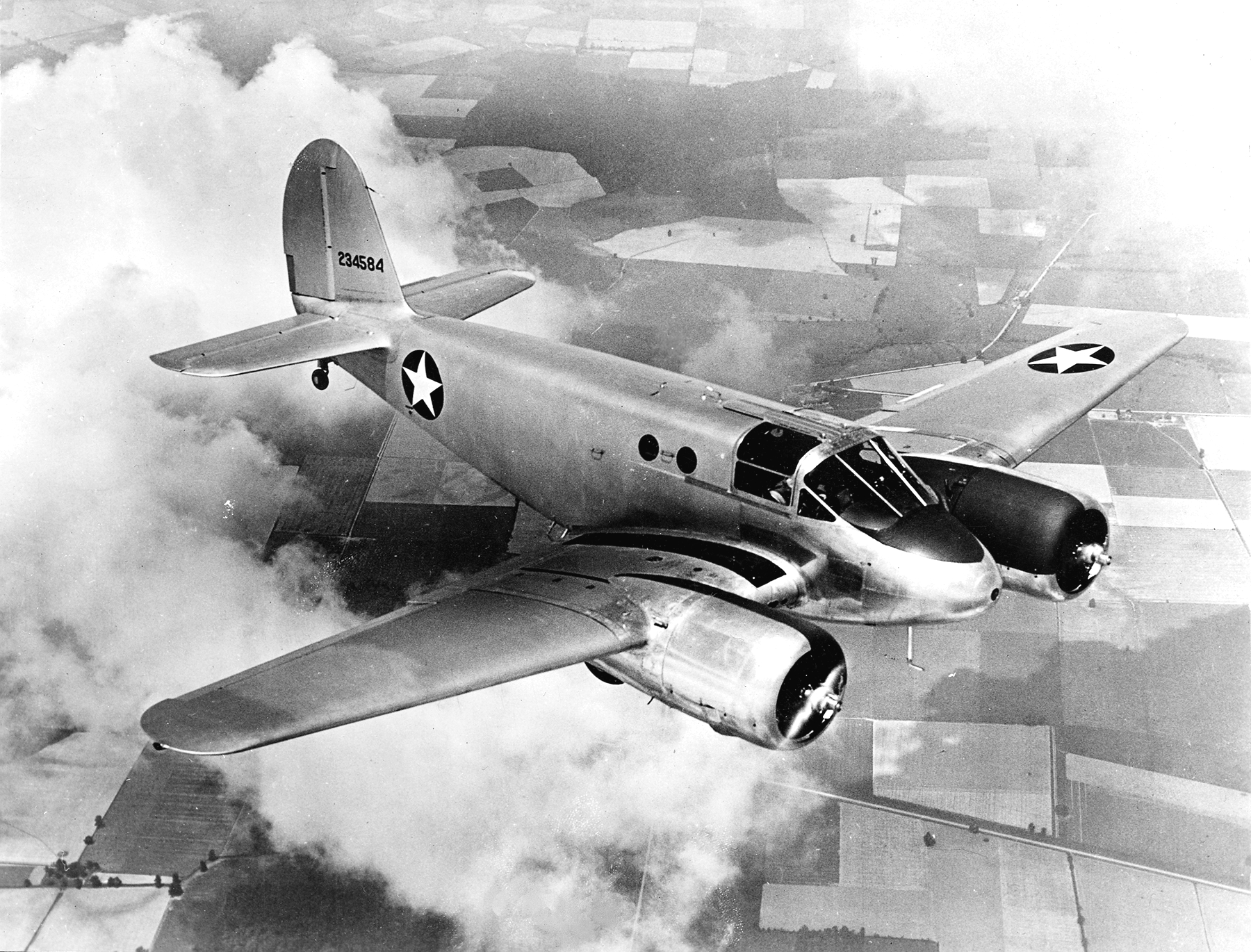
The Beechcraft AT-10 Wichita is an American World War II trainer built for the United States Army Air Forces (USAAF) by Beechcraft. It was used to train pilots for multi-engined aircraft such as bombers.
Key Information


Development
[edit]
Beechcraft began designing the Model 25 early in 1940 in response to the requirement of the then-named United States Army Air Corps (USAAC) for a small twin-engined aircraft suitable for use in training student pilots in the handling of multi-engined retractable landing gear aircraft. As there were concerns at the time about a future possible shortage of aluminium, part of the requirement was that the aircraft be built of "non-strategic" materials. Beechcraft met this requirement by designing the aircraft to be built primarily from wood.
The Model 25 prototype was given to the USAAC for evaluation, but it was destroyed in a crash on 5 May 1941. The following day Beechcraft began work on the Model 26, which was soon ready, making its first flight on 19 July the same year. The type was accepted and deliveries began to the USAAF under the designation AT-10 in February 1942 at a time when US military fortunes were at their nadir.
The type was named "Wichita" after Wichita, Kansas, the location of the Beechcraft factory. By the end of 1942, 748 had been delivered and were playing a part in training crews for the vast fleets of bomber and transport aircraft that were pouring off factory production lines all over the United States. Beechcraft production terminated in 1943 after it had delivered 1,771 AT-10s. Globe Aircraft built another 600 before production finally ceased the following year.
Operators
[edit]
Surviving aircraft
[edit]
- 41-27322 – AT-10 under restoration by AirCorps Aviation for the Cadet Air Corps Museum.[1][2]
- 42-35143 – AT-10 on static display at the National Museum of the United States Air Force in Dayton, Ohio.[3][4]
Specifications
[edit]
Data from American Warplanes of World War II [5]
General characteristics
- Crew: Two
- Length: 34 ft 4 in (10.46 m)
- Wingspan: 44 ft 0 in (13.41 m)
- Height: 10 ft 4 in (3.15 m) [6]
- Wing area: 298 sq ft (27.7 m2)
- Empty weight: 4,750 lb (2,155 kg)
- Max takeoff weight: 6,130 lb (2,781 kg)
- Powerplant: 2 × Lycoming R-680-9 air-cooled radial engines, 295 hp (220 kW) each
Performance
See also
[edit]
Aircraft of comparable role, configuration, and era
Related lists
References
[edit]Notes
[edit]- ^ "Beechcraft AT-10 Wichita". AirCorps Aviation. Retrieved 29 January 2023.
- ^ Cravens, Chuck (4 May 2017). "Cadet AirCorps Museum AT-10 Project". AirCorps Aviation. Retrieved 29 January 2023.
- ^ "Beech AT-10 Wichita". National Museum of the United States Air Force. Retrieved 29 January 2023.
- ^ "Airframe Dossier - Beech AT-10 Wichita, s/n 42-35143 USAAF, c/n 660-GF". Aerial Visuals. Retrieved 29 January 2023.
- ^ Donald 1995, p.8.
- ^ Air Force Museum Fact Sheet. National Museum of the US Air Force. Retrieved 4 Dec 2016.
- ^ a b Pelletier 1995, p. 86
Bibliography
[edit]- Donald, David (editor.) American Warplanes of World War II. London:Aerospace Publishing, 1995. ISBN 1-874023-72-7.
- Lawrence, Joseph (1945). The Observer's Book Of Airplanes. London and New York: Frederick Warne & Co.
- Pelletier, A. J. Beech Aircraft and their Predecessors. Annapolis, Maryland, USA: Naval Institute Press, 1995. ISBN 1-55750-062-2.
- Phillips, Edward H., Beechcraft - Pursuit of Perfection, A History of Beechcraft Airplanes. Eagan, Minnesota:Flying Books, 1992. ISBN 0-911139-11-7.
- Taylor, M. J. H. ed. Jane's American Fighting Aircraft of the 20th Century Mallard Press. ISBN 0-7924-5627-0
External links
[edit]
Beechcraft AT-10 Wichita
View on GrokipediaDevelopment
Design Requirements
In early 1940, the United States Army Air Corps (USAAC) issued a requirement for an advanced twin-engine trainer aircraft to facilitate the transition of pilots from single-engine fighters to more complex multi-engine bombers and transports, addressing the growing need for skilled crews amid escalating global tensions.[1][2] This specification emphasized a lightweight, cost-effective design that minimized the use of strategic materials, particularly aluminum, which was prioritized for combat aircraft production due to anticipated wartime shortages.[5][6] Beechcraft responded by initiating the design of the Model 25 in early 1940, proposing a simplified derivative of its existing Model 18 twin-engine airframe tailored to the USAAC's needs.[2][5] The proposal featured reduced metal components—limited primarily to engine cowlings and cockpit enclosures—and lighter radial engines to lower overall weight and production costs, while incorporating a predominantly wooden structure for the fuselage, wings, and other major elements to conserve scarce alloys.[1][6] This wooden construction approach enabled rapid assembly by subcontractors, including furniture manufacturers, and ensured the aircraft contained only about 97 pounds of metal, representing just 1.6% of its gross weight excluding propellers and engines.[1][5] In response to Beechcraft's proposal, the USAAC awarded an initial military contract in 1940 for development of the multi-engine trainer using non-essential materials, marking the first acceptance of an all-wood design for such a role.[1][2] This agreement supported the construction of prototypes, with subsequent expansion leading to full-scale production authorization after successful evaluations.[5][6]Prototyping and Testing
Construction of the first Beechcraft AT-10 Wichita prototype, designated as the Model 25, commenced in early 1941 at the company's facility in Wichita, Kansas, as part of efforts to meet U.S. Army Air Corps requirements for a wooden twin-engine trainer amid wartime material shortages.[2][3] The Model 25 achieved its initial flight on May 5, 1941, but was destroyed later that day in a crash during its first flight, with the cause listed as unknown.[7][2] This incident resulted in the death of U.S. Army Air Corps pilot Major George Putnam Moody.[2] Beechcraft responded swiftly, initiating construction of the revised Model 26 prototype the following day, incorporating enhancements to address the identified issues. The Model 26 completed its first flight successfully on July 19, 1941, with test pilot H.C. "Ding" Rankin and engineer John P. Gaty at the controls, demonstrating the wooden airframe's inherent stability and handling promise.[2][8] Throughout the remainder of 1941, the Model 26 underwent rigorous flight testing under U.S. Army Air Forces oversight, evaluating key aspects such as overall performance, flight handling, stall behavior, and responses to simulated engine failures on one or both powerplants. These trials confirmed the aircraft's viability as a training platform but necessitated targeted refinements, including reinforced wing spars to bolster structural resilience under load.[2][9] Following extensive flight testing throughout 1941, the U.S. Army Air Forces accepted the design in early 1942, designating it the AT-10 Wichita and authorizing full-scale production, with deliveries beginning in February 1942.[8][2]Production
Manufacturing Process
The manufacturing process of the Beechcraft AT-10 Wichita shifted to modular wooden construction to support mass production amid wartime material constraints, utilizing plywood for the primary airframe structure bonded with synthetic resin adhesives. This design avoided compound curves and hot-molding techniques, dividing the wings into three sections and the fuselage into two for simplified assembly without requiring specialized metalworking facilities. The approach leveraged readily available woodworking skills, enabling rapid fabrication on a large scale while conserving aluminum for combat aircraft.[2][5][1] Production took place at Beechcraft's expanded Wichita, Kansas plant, where an assembly line integrated major sub-assemblies to streamline final buildup. Approximately 85 percent of components were subcontracted to woodworking-specialized firms, such as furniture manufacturers, which produced prefabricated sections for delivery to the main facility; Beech then performed the final mating and outfitting. This subcontracting model addressed wartime production demands by distributing labor across local suppliers capable of handling wooden elements like spars and plywood skins, while incorporating essential parts such as engines, propellers, and instruments from regional vendors. The modular setup facilitated efficient alignment and bonding, contributing to the aircraft's overall build efficiency.[2][1][5] Quality control emphasized durability of the wooden components, including varnish applications to protect against moisture and environmental degradation, alongside structural inspections to verify integrity under load. Wartime labor challenges, including shortages of skilled personnel, were mitigated through the extensive use of subcontractors with established woodworking expertise and on-site training programs that adapted unskilled workers to assembly tasks. These measures ensured consistent output despite resource limitations, with the plywood-based design—featuring only 97 pounds of metal in the basic structure—proving resilient for training applications.[2][1][10]Output and Contractors
The Beechcraft AT-10 Wichita entered production in February 1942, with a total of 2,371 aircraft manufactured by the end of 1944.[3] Beechcraft handled the primary output, assembling 1,771 units at its Wichita, Kansas factory before ceasing production in 1943.[11] To meet surging wartime demand for twin-engine trainers, subcontractor Globe Aircraft Corporation was licensed to produce the AT-10, building 600 units at its facility in Fort Worth, Texas, beginning in 1943.[9] Production reached its peak in 1943, with over 1,000 aircraft delivered that year as training requirements intensified, before tapering off in 1944 as the Allies anticipated the war's conclusion and reduced orders for new trainers.[9] The unit cost averaged approximately $42,700 in 1940s dollars, a figure notably lower than comparable all-metal trainers owing to the AT-10's extensive use of wooden construction materials that conserved scarce strategic metals.[12]Design
Airframe Construction
The Beechcraft AT-10 Wichita featured an all-wood airframe design, necessitated by wartime aluminum shortages, which allowed for rapid production using abundant materials like spruce and plywood while minimizing strategic metal usage to just 97 pounds, or about 1.6% of the aircraft's gross weight excluding propellers and engines.[1][2] This construction emphasized simplicity and durability for training operations, with synthetic resin adhesives bonding components and modular assembly facilitating subcontracted manufacturing.[2] The fuselage measured 34 feet 4 inches in length and adopted a semi-monocoque structure, consisting of spruce longerons and stringers covered by plywood skin, divided into an aluminum alloy forward section for the cockpit and an all-wood aft section.[2][3] It accommodated two crew members in side-by-side seating within the enclosed cockpit, with wooden fuel tanks lined in neoprene for resistance to aviation fuels.[1][5] The low-wing configuration spanned 44 feet, constructed in three sections with wooden spars—likely spruce for strength—plywood ribs stiffened by spruce strips, and overall plywood covering bonded via adhesives.[2][13] Ailerons and elevators were fabric-covered and doped for lightweight responsiveness, contributing to the aircraft's empty weight of 4,750 pounds while enabling stable handling for novice multi-engine pilots.[3][2] The empennage employed a conventional tail layout with wooden vertical and horizontal stabilizers covered in plywood, while the rudder and elevators featured doped fabric surfaces to enhance control simplicity and reduce weight.[2] This design provided inherent stability suited to transitional training.[5] The landing gear was of conventional retractable type, with main wheels retracting aft into the wings (leaving tires partially exposed) and a fixed, non-steerable tailwheel, supported by aluminum alloy and steel tubing components for hydraulic operation and braking.[2] Optimized for operations at training fields, it included wooden elements in struts where feasible to align with the overall non-metallic emphasis.[5] Durability was enhanced through mahogany formers in key areas, multiple coats of dope on fabric-covered surfaces to protect against environmental wear, and the inherent resilience of plywood and spruce to operational stresses in a training environment.[2]Powerplant and Systems
The Beechcraft AT-10 Wichita utilized two Lycoming R-680-9 seven-cylinder air-cooled radial engines, each delivering 295 horsepower, mounted in wooden nacelles fitted with aluminum cowlings to optimize airflow and cooling during operation.[1][3] These engines drove two-blade Hamilton Standard metal propellers designed for efficient low-power training, with the nacelle integration ensuring streamlined aerodynamics while minimizing strategic material use.[2] The fuel system incorporated wing-mounted tanks constructed from plywood lined with neoprene synthetic rubber for durability and compatibility with aviation fuels, to support a ferry range of 660 miles.[1] Manual transfer pumps allowed fuel redistribution in engine-out emergencies, enhancing safety for multi-engine instruction without relying on complex automation.[2] Avionics were kept minimal to emphasize fundamental flight training, featuring dual controls for student-instructor pairing, basic instrumentation for attitude, altitude, and airspeed monitoring, and a simple radio system for ground-to-air communication.[2] The absence of advanced features like radar or gunsights aligned with the aircraft's role in basic twin-engine proficiency. The electrical system employed a battery to power essential components including navigation lights, engine starters, and instrumentation, with limited redundancy to reduce costs and complexity in wartime production.[3]Operational History
World War II Training
The Beechcraft AT-10 Wichita entered service with the United States Army Air Forces (USAAF) in February 1942, assigned to the Army Air Forces Training Command (AAFTC) and its regional components, such as the Central Flying Training Command headquartered at Randolph Field, Texas.[2] This deployment supported the rapid expansion of pilot training amid wartime demands, with the aircraft distributed to 16 training bases across the United States.[1] Primarily utilized in the advanced multi-engine phase of pilot instruction, the AT-10 facilitated the transition from single-engine trainers to complex multi-engine operations, emphasizing skills like asymmetric thrust management, stall recovery, instrument flying, formation flying, cross-country navigation, and emergency procedures.[2][14] These elements were integral to preparing cadets for operational roles in heavy bombers and transports, such as the B-17 Flying Fortress and C-47 Skytrain. The aircraft's design, with its forgiving handling and stable flight characteristics, made it particularly suitable for novice multi-engine students, earning praise from instructors and graduates alike.[2][1] Over half of all USAAF multi-engine trainees completed transitional training on the AT-10, significantly contributing to the production of aircrews for the Allied war effort.[1][2] A standard syllabus allocated about 70 flight hours per student within a 10-week advanced course, complemented by 60 hours of ground instruction and 19 hours of military protocol, conducted at facilities like Turner Field in Georgia and Moody Field in the same state.[2][14][15] The AT-10's effectiveness stemmed from its superior performance relative to other twin-engine trainers of the era, including responsive controls and reliable powerplants that minimized training accidents and accelerated proficiency development.[1][2] This reliability supported the USAAF's goal of producing bomber crews at scale, with the aircraft's low metal content (just 97 pounds, or 1.6% of gross weight excluding engines and propellers) allowing resources to be redirected toward combat aircraft.[1] By 1944, the AT-10 began to be phased out as wartime material shortages eased, enabling the adoption of more versatile all-metal trainers, and as training priorities shifted toward combat readiness over expansion.[14][2] Operations continued in limited capacity until April 1945, after which surviving airframes were largely surplused.[2]Post-War Fate
Following the conclusion of World War II, the majority of the Beechcraft AT-10 Wichita fleet was declared surplus by the United States Army Air Forces, with disposal managed by the War Assets Administration. In 1946, 1,930 of the 2,371 produced aircraft—representing approximately 81 percent of the total—were listed for sale at various locations across the country. These surplus AT-10s were offered at bargain prices of less than $1,500 each, far below their wartime cost of around $42,688, and were frequently acquired by buyers interested primarily in salvaging the 295-horsepower Lycoming R-680-9 radial engines for reuse in agricultural applications, such as powering crop-dusters or upgrading Stearman PT-13 trainers.[12] Most AT-10 airframes met a quick end through scrapping, as their primarily wooden construction proved susceptible to rapid deterioration when exposed outdoors in storage yards. Only the aluminum components, including cockpits and engine nacelles, retained value for reuse. The aircraft's high maintenance demands, coupled with its limited versatility beyond wartime training roles, resulted in few successful transitions to civilian operations; while a small number were registered for potential use as executive transports or utility aircraft in the late 1940s, elevated operating costs led to their early retirements by the early 1950s, with no widespread adoption.[12] No foreign military sales occurred for the AT-10 post-war, as the glut of surplus American aircraft and the aviation industry's pivot to more durable all-metal designs rendered the wooden trainer obsolete for international markets. Its legacy endures in demonstrating the feasibility of wood-based airframe construction amid wartime material shortages, influencing brief evaluations of similar techniques in early post-war trainer concepts, though all-metal alternatives ultimately prevailed. The AT-10's role in training over half of the USAAF's multi-engine pilots during the war underscored its wartime impact but did not extend to prolonged peacetime utility. As of 2025, one AT-10 (serial 41-27322) is under restoration to airworthy condition by AirCorps Aviation for the Cadet Air Corps Museum in Salina, Kansas, which would make it the world's only flying example upon completion.[12][1][5]Service and Preservation
Operators
The Beechcraft AT-10 Wichita was operated exclusively by the United States Army Air Forces (USAAF) as its primary military user during World War II.[1] Under the Army Air Forces Training Command (AAFTC), it equipped various advanced twin-engine training units across the southern and southwestern United States, including bases such as Randolph Field in Texas, Freeman Army Airfield in Indiana, Moody Field in Georgia, Blytheville Army Airfield in Arkansas, and Roswell Army Airfield in New Mexico.[2] A total of 2,371 aircraft were delivered and allocated to these flight training schools, enabling transitional instruction for over half of the USAAF's multi-engine pilots destined for bombers like the B-17 and B-29.[2] The Women Airforce Service Pilots (WASP) also flew the AT-10 at 16 domestic training bases, supporting ferry, towing, and target duties as part of their non-combat roles.[1] No foreign military entities operated the AT-10, as all production was reserved for USAAF use amid wartime material restrictions and security policies that prohibited exports.[1] Replacement training units affiliated with the Eighth Air Force in England briefly utilized the type for familiarization flights.[2] In 1947, surviving AT-10s transferred to the newly independent United States Air Force upon the reorganization of the USAAF, though the majority had already been declared surplus and retired by the war's end in 1945.[2] Limited post-war civilian operations occurred in the United States during the late 1940s, primarily involving surplus aircraft for short-term ferry flights and maintenance by domestic firms, but no sustained commercial fleets emerged due to the type's high operating costs and restricted payload capacity.[12]Surviving Examples
Fewer than five complete airframes of the Beechcraft AT-10 Wichita survive today, primarily due to widespread post-war scrapping, with the known examples either on static display or under restoration.[12][1] The National Museum of the United States Air Force preserves the only intact surviving AT-10, serial number 42-35143 (marked as 41-27193), on static display at Wright-Patterson Air Force Base in Dayton, Ohio. Acquired and restored to represent an operational aircraft from Freeman Army Airfield in Seymour, Indiana, it has been exhibited since June 1997 and showcases the type's wooden construction and twin-engine trainer configuration.[1][16] A second example, serial number 41-27322, is undergoing restoration by AirCorps Aviation in Bemidji, Minnesota, for the Cadet Air Corps Museum. Recovered as wreckage from a 1940s crash in Texas, the project incorporates parts from multiple AT-10 wrecks and uses original Beechcraft blueprints along with newly fabricated birch plywood components to achieve airworthiness—the first flyable example since World War II. As of fall 2024, significant progress includes completion of the cockpit section, main fuselage assembly, vertical fin, and horizontal stabilizer, with ongoing work on landing gear and control systems.[5][17][18] Preservation efforts face substantial challenges, including the scarcity of authentic birch plywood for the airframe's 98.4% wooden structure and the limited availability of Lycoming R-680 radial engines, compounded by the type's obsolescence after the war. No other complete airframes are documented, though fragments such as control surfaces and fuselage sections from scrapped aircraft have been sourced for the ongoing restoration.[5][1][19]Technical Specifications
General Characteristics
The Beechcraft AT-10 Wichita was designed as a twin-engine advanced trainer for the United States Army Air Forces, accommodating a crew of two: an instructor and a student pilot seated side by side in a sliding canopy cockpit.[3] The aircraft's overall length measured 34 ft 4 in (10.46 m), providing compact dimensions suitable for training operations.[1] Its wingspan extended to 44 ft 0 in (13.41 m), supporting stable flight characteristics for multi-engine instruction.[1] The height was 10 ft 4 in (3.15 m), facilitating ground handling and hangar storage.[1] The wing area totaled 298 sq ft (27.7 m²), constructed primarily from plywood to conserve strategic metals during wartime production.[5] The empty weight was 4,750 lb (2,150 kg), reflecting the lightweight wooden airframe that comprised over 98% non-metallic materials.[3] Loaded to gross weight, it reached 6,465 lb (2,932 kg), allowing for the inclusion of fuel, crew, and training equipment without exceeding operational limits.[1] Fuel was stored in wooden tanks lined with neoprene synthetic rubber, distributed across the wings.[2] Powerplant: 2 × Lycoming R-680-9 seven-cylinder air-cooled radial piston engines, 295 hp (220 kW) each.[1] As an unarmed trainer, the AT-10 carried no armament, emphasizing its role in pilot proficiency rather than combat.[3]Performance
The Beechcraft AT-10 Wichita demonstrated flight characteristics optimized for advanced multi-engine pilot training, providing stable handling and moderate performance that simulated operational twins without the risks of high-powered combat aircraft. Its maximum speed of 190 mph (306 km/h) at sea level allowed instructors to teach speed management in a controlled environment.[1] The aircraft's range of 660 mi (1,060 km) supported extended ferry flights and endurance training, while its service ceiling of 20,000 ft (6,100 m) permitted altitude acclimation without excessive engine strain from the twin Lycoming R-680-9 radials.[1] A rate of climb of 1,150 ft/min (5.8 m/s) offered responsive ascent for pattern work and emergency procedure drills.[5] These parameters contributed to the AT-10's role in building pilot confidence in twin-engine operations. Key performance metrics are summarized below:| Parameter | Value |
|---|---|
| Maximum speed | 190 mph (306 km/h) at sea level |
| Range | 660 mi (1,060 km) |
| Service ceiling | 20,000 ft (6,100 m) |
| Rate of climb | 1,150 ft/min (5.8 m/s) |
| Wing loading | 21.7 lb/sq ft (106 kg/m²) |
| Power-to-weight ratio | 0.091 hp/lb (0.15 kW/kg) |