Hubbry Logo
Abdullahi IssaAbdullahi IssaMain
Open search
Abdullahi Issa
Community hub
Abdullahi Issa
logo
8 pages, 0 posts
0 subscribers
Be the first to start a discussion here.
Abdullahi Issa
Abdullahi Issa
from Wikipedia

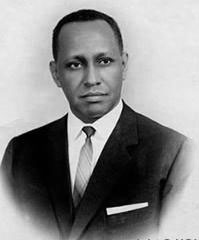
Abdullahi Issa Mohamud (Somali: Cabdullaahi Ciise Maxamuud, Arabic: عبد الله عيسى محمد (1921[1] – March 24,[citation needed] 1988) was a Somali politician. He was the Prime Minister of Italian Somalia during the trusteeship period, serving from February 29, 1949, to July 7, 1960.

Key Information

Biography

[edit]

Issa was born in 1921 in the southern town of Afgooye.[2][3][4][5]

Nicknamed "Bidaar",[2] Issa frequented an Somali primary institution in the capital, as well as a local Qur'anic school (madrassah).[5] When the Second World War broke out, he was still a student.[6]

Issa later relocated to the port of Merca at the age of sixteen, where he would work as a postal clerk from 1939 to 1941. He thereafter returned to Mogadishu and assumed a position in the Department of Economic Affairs. Following the British military occupation of Somalia in the early 1940s, Issa was relieved from his duties. He then embarked on a business career.[5]

After the turmoil of the war years, Issa joined the Somali Youth League (SYL) at its onset. He typified the Somali political elite of the period, as he was "young (age 38), intelligent, largely self-educated, confident, and determined".[7] He quickly rose through the ranks to become one of the party's leaders. In 1948, he was appointed to the SYL's central committee, and eventually as its Secretary-General.[5]

Issa later went to Paris and New York as an SYL delegate to proclaim the right of the Somali people to independence. From 1950 to 1954, he represented the SYL at the United Nations Trusteeship Council. After being appointed to office as an SYL deputy in the political elections of 1956, he was called in the same year to form Somalia's first government, thus becoming the nation's first Prime Minister.

Re-elected in 1959, he was re-confirmed as Premier, and held for some time also the portfolios of Foreign Affairs, Interior and Grace and justice. In the government formed after Somalia's independence in July 1960, Issa was later appointed Foreign Minister.[8] In this capacity, he took part in many international conventions, in particular the United Nations General Assembly and the conferences in Addis Abeba, among other cities. With the conclusion of the general election of March 1964, Issa returned to the National Assembly as an SYL deputy for Beledweyne.

A few years later, the Supreme Revolutionary Council (SRC) seized power. The new military government subsequently appointed Issa as Somalia's Ambassador to Sweden in 1974. He held the position until early 1983, when he resigned from public office after a long career in politics.[2]

Issa spent his retirement years in Rome, Italy. He died there in March 1988, and was transported to Mogadishu for burial.[2]

See also

[edit]

Notes

[edit]

References

[edit]
Revisions and contributorsEdit on WikipediaRead on Wikipedia
from Grokipedia
Abdullahi Issa Mohamud (1921 – March 1988) was a Somali politician instrumental in the country's path to independence, serving as the first of the Trust Territory of Somalia from 1956 to 1960. Born in Afgoye near , he rose through the (SYL), becoming its secretary-general from 1947 to 1956, the longest tenure in that role, during which he advocated for unification and at international forums including the . Following in 1960, Issa Mohamud was appointed Foreign Minister in the government of Abdirashid Ali Sharmarke, holding the position until 1964, and later served as Somalia's to from 1974 to 1986. His in the SYL faced internal challenges, including accusations of clannism and , as well as conflicts with leftist elements that led to expulsions within the party. In recognition of his contributions to , he received a gold medal in 1977; he died in , , with his remains returned for a in .

Early Life and Background

Birth and Family Origins

Abdullahi Issa Mohamud was born in 1921 in Afgoye, a town approximately 30 kilometers southwest of in what was then . His father, Mohamud Bidar, was a respected elder originating from the coastal town of , who passed away prior to Issa's birth, leaving the family without paternal support. Issa's mother, Marrero Dini Ahmed, hailed from Abudwaq in central and single-handedly raised him as an amid modest circumstances. The maintained ties to the Benadir region's coastal communities, where Issa was endowed with Banadiri cultural attributes, reflecting the urban, maritime influences of southern 's littoral societies rather than inland pastoral traditions. No siblings are documented in available records, underscoring the limited familial structure that shaped his early upbringing.

Education and Early Influences

Issa attended an Italian primary school in Mogadishu during his early years, acquiring proficiency in the Italian language and foundational subjects such as arithmetic. He simultaneously pursued religious education at a local Qur'anic school (madrassah), in line with customary Somali practices emphasizing Islamic learning. Fascist-era colonial policies severely curtailed educational opportunities for Somalis, limiting Issa's formal schooling to the elementary level and preventing advancement beyond basic instruction. These restrictions fostered self-education, supplemented by practical experience in administrative positions, including a role as postal clerk in Marca from 1939 to 1941, followed by work in Mogadishu's Department of Economic Affairs and later in . Among early influences, the restrictive colonial environment of shaped Issa's exposure to governance and economics through clerical work, while his upbringing as an —his father having died before his 1921 birth—likely instilled under his mother's care. This period also coincided with the waning of the Dervish resistance movement led by Mohammed Abdullah Hassan, embedding a backdrop of anti-colonial sentiment in the region's .

Political Activism and Rise

Involvement with the Somali Youth League

Abdullahi Issa joined the Somali Youth League (SYL), originally formed as the Somali Youth Club in May 1943 by students in Mogadishu to promote Somali nationalism and unity against colonial rule, shortly after its inception in 1944. As an early member, Issa contributed to transforming the group from a cultural club into a political organization advocating for independence from Italian administration in the Trust Territory of Somalia. In 1947, following the club's reorganization into the formal amid investigations by the Four Power Commission on Italian colonies, Issa was elected deputy secretary general, helping to expand the party's influence across Somali territories. By late 1947, he had ascended to the role of secretary general, a position he held for nearly a until , making him the longest-serving leader in that capacity. In this role, Issa coordinated SYL activities, including petitions to British newspapers detailing post-war hardships under Italian trusteeship and calls for . As secretary general, Issa represented the SYL internationally, notably addressing the 's First Committee in the early 1950s and securing an oral hearing for the league before the Fourth Committee in November 1952 to argue for Somali independence. In November 1953, he authored a letter on behalf of the SYL to the UN , formally requesting full independence for by 1960, emphasizing unification of Somali-inhabited regions. His leadership solidified the SYL's position as the dominant nationalist force, mobilizing support through pan-Somali irredentist goals that sought to incorporate ethnic Somali areas from neighboring , , and . Under Issa's tenure, the party navigated tensions with colonial powers and rival groups, prioritizing empirical unification efforts over factional divisions.

Advocacy for Somali Independence

Abdullahi Issa joined the Somali Youth Club in 1944 and contributed to its transformation into the (SYL) by 1947, a nationalist dedicated to achieving Somali and unification of territories under Italian, British, French, and Ethiopian control. Elected Deputy Secretary General in 1947, he soon assumed the role of Secretary General, serving until 1956 and becoming the longest-tenured leader in that position. Under his guidance, the SYL opposed the return of Italian administration post-World War II and mobilized grassroots support across clans for , emphasizing rapid over prolonged trusteeship. Issa's advocacy extended to international diplomacy, particularly through engagements at the . From 1950 to 1954, he represented the SYL at the UN Trusteeship Council in and New York, lobbying for international oversight of Somalia's transition from Italian trusteeship and petitioning against colonial abuses. In October 1949, as SYL representative, he addressed the UN General Assembly's First Committee, urging recognition of Somaliland's right to independence free from Italian rule and highlighting the SYL's vision for a unified Somali state. By November 1953, Issa penned a letter to the UN General Assembly on behalf of the SYL explicitly requesting full independence, underscoring the movement's impatience with delayed sovereignty timelines. These efforts aligned with the SYL's broader strategy of leveraging UN mechanisms to pressure administering powers, including sending delegates to New York and to present grievances and secure resolutions favorable to self-rule. Issa's leadership in these initiatives helped shift global attention toward Somali aspirations, contributing to the eventual UN-sanctioned on July 1, 1960, though his tenure as SYL head ended prior amid internal party dynamics.

Premiership (1949–1960)

Leadership During Italian Trusteeship

As Secretary-General of the Somali Youth League (SYL) from 1947 to 1956, Abdullahi Issa Mohamud led nationalist efforts during the early phase of the United Nations Italian Trust Territory of Somaliland, established on 1 December 1950 to prepare the region for independence by 1960. Issa represented the SYL at United Nations discussions, advocating for Somali unification and expedited self-rule amid tensions with the Italian administering authority, which SYL leaders accused of undue interference in local politics. In the territory's first legislative elections held in March , the SYL emerged victorious, securing a parliamentary that prompted the Italian Administrator to task Issa with . On 29 February , Issa was appointed as the first of the trusteeship government, assembling an all-Somali cabinet—the inaugural such body—through consensus among major political factions to foster stability and institutional growth. Issa's administration prioritized administrative reforms, legislative development, and preparations for self-government, including the drafting of interim constitutional frameworks and expansion of roles. Following the communal elections and subsequent parliamentary polls, he reformed a broad-based in 1959, incorporating representatives from diverse clans to mitigate factionalism while advancing toward . This pragmatic approach balanced cooperation with the AFIS—providing technical aid and investments—against SYL demands for , enabling incremental transfers of authority. Throughout his tenure until 1 July 1960, Issa's leadership emphasized national cohesion and diplomatic engagement, including negotiations with neighboring states over border issues, though internal political rivalries and Italian oversight periodically strained progress. His governments laid foundational governance structures that facilitated the transition to full and union with on 1 July 1960.

Transition to Self-Government and Independence

During the Italian trusteeship administration, which began in 1950 under oversight with the goal of achieving independence within ten years, the first steps toward self-government were taken through legislative elections held in for a 70-seat . The (SYL), led by Abdullahi Issa, secured 43 seats, enabling Issa to form a broad-based government as the territory's first . This assembly focused on building administrative capacity, including the Somalization of positions and the introduction of in 1958, while addressing economic development and clan-based political tensions. Subsequent elections in 1959 for a 90-seat further consolidated SYL dominance, with the party winning 61 seats uncontested after rival groups boycotted the process, prompting Issa to reorganize his cabinet to maintain stability. Issa's administration emphasized preparations for sovereignty, including diplomatic efforts to negotiate unification with , culminating in an April 1960 agreement among southern and northern leaders for a unitary parliamentary state. The , via Resolution 1418 (XIV) adopted on December 5, 1959, confirmed independence for the under Italian administration on July 1, 1960.) achieved independence on June 26, 1960, allowing the two territories to unite as the [Somali Republic](/page/Somali Republic) on July 1, with Issa playing a central role in facilitating the merger of their assemblies—90 southern seats with 33 northern ones—despite logistical challenges in constitutional alignment. This transition marked the end of colonial oversight and the establishment of as a sovereign nation pursuing pan-Somali unification goals.

Diplomatic Roles and Foreign Policy

United Nations Engagements

Abdullahi Issa, serving as a representative of the (SYL), actively petitioned bodies during the Italian trusteeship period to advance Somali . In June 1953, he submitted a letter to the UN President outlining SYL concerns regarding administration and governance in the territory. Earlier petitions co-signed by Issa, including one from 1952 alongside figures like Herzi Guled, addressed grievances over Italian policies in , urging UN intervention to protect local interests and expedite independence. Issa delivered statements to key UN committees advocating for Somali unification and sovereignty. He spoke before the General Assembly's First Committee, representing SYL and affiliated groups like the Hamar Youth Club, emphasizing the need for prompt trusteeship termination. Additionally, he commented on the Trusteeship Council's reports, critiquing administrative shortcomings and pressing for accelerated progress toward self-government. These interventions aligned with SYL's broader campaign, which influenced UN Resolution 289 (IV) of establishing the trusteeship and subsequent reviews leading to Somalia's timeline. As from 1956 to 1960, Issa's government engaged the Trusteeship Council on implementation of reforms. UN records from the Council's 1026th meeting reference deliberations involving his administration's resignation and transition, reflecting ongoing oversight of Somalia's path to . Following on July 1, 1960, and Somalia's UN admission in September, Issa addressed the General Assembly, marking the nation's debut in multilateral diplomacy. His speeches underscored regional unity and non-alignment, consistent with Somalia's foreign policy priorities.

Relations with Regional Powers

During his premiership and subsequent diplomatic roles, Abdullahi Issa navigated tense relations with , primarily driven by Somalia's irredentist claims to Somali-inhabited territories such as the and regions under Ethiopian control. These disputes stemmed from the Somali Youth League's advocacy for a encompassing all ethnic Somali areas, which Issa, as a longtime SYL leader, championed in international gatherings. Despite the friction, Issa accepted an invitation from the Ethiopian government in the mid-1950s, signaling willingness for dialogue amid the Italian trusteeship period. As prime minister, he visited to discuss bilateral issues, though underlying territorial ambitions persisted, foreshadowing later conflicts. In his later capacity as foreign minister from 1960 onward, Issa continued to assert Somalia's positions against , particularly during escalating border incidents. In early , amid Somali incursions into disputed areas, Issa formally warned the Ethiopian ambassador that Somalia would hold accountable for any escalation, reflecting a policy of defensive posturing backed by appeals for international mediation. These engagements highlighted Ethiopia's role as a dominant wary of Somali expansionism, contributing to the outbreak of the 1964 Ethiopian-Somali Border War shortly after. Relations with emerging neighbors like were similarly strained by Somalia's unification goals, focusing on the Northern Frontier District (NFD), a Somali-majority area under British administration. As foreign minister, Issa participated in high-level discussions urging Western powers, including the , to facilitate the NFD's transfer to Somalia before Kenya's scheduled independence in , aiming to preempt integration into a non-Somali state. This approach underscored Issa's broader strategy of leveraging diplomacy to advance pan-Somali objectives against colonial partitions, though it yielded no territorial gains and sowed seeds for post-independence hostilities. , while not a direct Horn adversary, provided indirect support through pan-Arab solidarity, aligning with Somalia's anti-colonial stance, but specific bilateral engagements under Issa remained limited to broader independence advocacy.

Post-Premiership Career and Later Years

Tenure as Foreign Minister

Abdullahi Issa Mohamud served as Somalia's first Minister of from July 1960 to 1964, appointed in the led by Abdirashid Ali Sharmarke following the country's on July 1, 1960, and union with the former . His tenure coincided with the establishment of Somalia's independent , emphasizing non-alignment while seeking economic and developmental aid from both Western and Eastern powers to build state institutions amid post-colonial challenges. Issa prioritized the "Greater Somalia" irredentist agenda, advocating diplomatically for the unification of ethnic Somali populations in adjacent territories under Ethiopian, Kenyan, and French administration, which strained relations with neighbors and fueled border tensions. In this pursuit, he represented Somalia at key international forums, including the —where the nation gained membership on September 20, 1960—the Organization of African Unity, and the , articulating positions on , , and regional stability. A notable engagement occurred on November 27, 1961, when Issa joined Sharmarke's delegation for a meeting with U.S. President , pressing for economic assistance, development support, and U.S. intervention to halt arms shipments to , which Somalia viewed as enabling aggression against Somali pastoralists and irredentist claims in the region. As clashes intensified, Issa issued formal diplomatic protests against Ethiopian incursions, warning of escalation; these efforts preceded the 1964 Ethiopian-Somali Border War, triggered by Somali support for insurgents in disputed areas. In February 1964, while traveling to a conference via , he publicly called for a plebiscite in Kenya's Northern Frontier District to resolve Somali claims there, underscoring ongoing advocacy for plebiscitary solutions to territorial disputes. Issa's diplomacy sought to balance with pragmatic outreach for aid and recognition, though limited resources and regional hostilities constrained achievements, setting the stage for Somalia's later shift toward Soviet alignment after his departure.

Withdrawal from Active Politics

Following his service as Foreign Minister from to 1964, Abdullahi Issa Mohamud was appointed Somalia's Ambassador to in 1974 under the regime of President . He retained this diplomatic post until 1983, representing Somali interests in during a period of military rule that emphasized centralized control and alignment with non-aligned or Soviet-leaning foreign policies. Issa Mohamud's withdrawal from active politics occurred in 1986, after approximately four decades of public service encompassing premiership, ministerial duties, and diplomacy. At age 65, he retired fully from governmental roles, choosing to reside in Rome, Italy, where he spent his remaining years outside the intensifying domestic conflicts and authoritarian consolidation in Somalia. No public statements from Issa Mohamud detailed specific motivations for his exit, though it aligned with the natural conclusion of a career marked by transitions across colonial trusteeship, independence, and post-independence governance.

Death and Legacy

Circumstances of Death

Abdullahi Issa died in , , in March 1988 at the age of 67. He had retired from in 1986 after serving as Somalia's ambassador to from 1974 to 1983. Issa spent his final years living a tranquil life in as a . Following his death, Issa's mortal remains were transported to Mogadishu for burial at the National Cemetery, where he was interred next to President Abdirashid Ali Shermarke. He received a state funeral attended by family members, Somali Youth League veterans, President Aden Abdulle Osman, President Mohamed Siad Barre, and other government officials.

Historical Assessment and Recognition

Abdullahi Issa is assessed by historians of as a central architect of the country's path to , having served as the longest-serving Secretary-General of the (SYL) from the late 1940s and leading its advocacy for unification of Somali-inhabited territories under Italian trusteeship. His premiership from February 1956 to July 1960 positioned him at the forefront of negotiations with Italian administrators and the , culminating in Somalia's self-governance on December 2, 1958, and full on July 1, 1960, through the merger with . This era's diplomatic engagements, including Issa's representations at UN forums, underscored his role in securing international recognition for Somali sovereignty amid influences. Post-independence, Issa's influence persisted despite the 1969 military coup under , which dissolved civilian institutions; the regime explicitly recognized his independence-era contributions and administrative experience by appointing him Somalia's Ambassador to in 1974, a post he held until resigning in early 1983. This continuity in diplomatic roles across regimes highlights a pragmatic acknowledgment of his non-partisan dedication to principles, even as Barre's socialist policies diverged from the SYL's pan-Somali ethos. Scholarly accounts credit Issa with fostering early national cohesion by prioritizing empirical governance reforms over clan divisions, though his later marginalization reflects the turbulent shifts in Somali politics. Recognition of Issa's legacy remains prominent in Somali historical narratives, where he is often invoked as a symbol of pre-civil unity and anti-colonial resolve, with his on March 24, 1988, prompting tributes emphasizing his foundational service. Limited archival depth in English-language sources has constrained broader academic analysis, but Somali-centric works portray him as instrumental in transitioning from trusteeship dependency to sovereign functionality, without reliance on unsubstantiated ideological overlays.

References

Add your contribution
Related Hubs
User Avatar
No comments yet.