


Community hub
Recent from talks
Contribute something
Nothing was collected or created yet.
Addis Ababa
View on Wikipedia
Addis Ababa (/ˌædɪs ˈæbəbə/;[6] Amharic: አዲስ አበባ, lit. 'new flower' [adˈdis ˈaβəβa] ⓘ, Oromo: Finfinnee, lit. 'fountain of hot mineral water') is the capital city of Ethiopia, as well as the regional state of Oromia.[7][8][9] With an estimated population of 2,739,551 inhabitants as of the 2007 census,[2] it is the largest city in the country and the eleventh-largest in Africa. Addis Ababa is a highly developed and important cultural, artistic, financial and administrative center of Ethiopia.[10]
Key Information


.svg)


The founding history of Addis Ababa dates back to the late 19th century by Menelik II, Negus of Shewa, in 1886 after finding Mount Entoto unpleasant two years prior.[11] At the time, the city was a resort town; its large mineral spring abundance attracted nobilities of the empire and led them to establish permanent settlement. It also attracted many members of the working classes – including artisans and merchants – and foreign visitors. Menelik II then formed his imperial palace in 1887.[12][13] Addis Ababa became the empire's capital in 1889, and subsequently international embassies were opened.[14][15] Urban development began with the 20th century, without any prior planning.[11]
Addis Ababa saw a wide-scale economic boom in 1926 and 1927, and an increase in the number of buildings owned by the middle class, including stone houses filled with imported European furniture. The middle class also imported newly manufactured automobiles and expanded banking institutions.[14] During the Italian occupation, urbanization and modernization steadily increased through a masterplan; it was hoped Addis Ababa would be a more "colonial" city and continued on after the occupation. Subsequent master plans were designed by French and British consultants from the 1940s onwards, focusing on monuments, civic structures, satellite cities and the inner-city. Similarly, the later Italo-Ethiopian masterplan (also projected in 1986) concerned only urban structure and accommodation services, but was later adapted by the 2003 masterplan.
Addis Ababa is a federally-chartered city in accordance with the Addis Ababa City Government Charter Proclamation No. 87/1997 in the FDRE Constitution.[16] Called "the political capital of Africa" due to its historical, diplomatic, and political significance for the continent, Addis Ababa serves as the headquarters of major international organizations, such as the African Union and the United Nations Economic Commission for Africa.[17]
The city lies a few kilometres west of the East African Rift, which splits Ethiopia into two, between the Nubian plate and the Somali plate.[18] The city is surrounded by the Special Zone of Oromia, and is populated by people from different regions of Ethiopia. It is home to Addis Ababa University. The city has a high human development index, and is known for its vibrant culture, strong fashion scene, high civic and political involvement of younger people, a thriving arts scene, and for being the heart of a country with one of the fastest economic growth rates in the world.[19]
History
[edit]Prehistory
[edit]A study based on DNA evidence from almost 1,000 people around the world suggests that early humans first traveled out of Africa via a place close to Addis Ababa, spreading from the region to the rest of the planet some time around 100,000 years ago.[20] The research indicated that genetic diversity decreases steadily the further one's ancestors travelled from Addis Ababa.[21]
Middle Ages
[edit]Mount Entoto, a high tableland to the north of current Addis Ababa, is one of a handful of sites put forward as a possible location for a medieval imperial capital known as Barara. This permanent fortified city was established during the early to mid-15th century and it served as the main residence of several successive emperors up to the early 16th-century reign of Libne Dengel.[22] The city was depicted standing between Mount Zuqualla and Menegasha on a map drawn by the Italian cartographer Fra Mauro in around 1450, and it was razed and plundered by Ahmed Gragn while the imperial army was trapped on the south of the Awash River in 1529, an event witnessed and documented two years later by the Yemeni writer Arab-Faqih. The suggestion that Barara was located on Mount Entoto is supported by the very recent discovery of a large medieval town overlooking Addis Ababa located between rock-hewn Washa Mikael and the more modern church of Entoto Maryam, founded in the late 19th century. Dubbed the Pentagon, the 30-hectare site incorporates a castle with 12 towers, along with 520 meters of stone walls measuring up to 5-meter high.[22] Described a "metropolis", Barara is estimated to have a population exceeding 160,000 people,[23] comparable to the largest European towns in 1500 CE, Paris and Naples.[24]
Foundation
[edit]
Founding
[edit]In 1886, settlement began in the valley south of the mountain in a place called Finfinne, a name which refers to the presence of hot springs. The site was chosen by Empress Taytu Betul. Initially, she built a house for herself near the "Filwuha" hot mineral springs, where she and members of the Shewan Royal Court liked to take mineral baths. Empress Taytu persuaded Emperor Menelik II to move the capital from cold and windy Entoto to the plains below and named the new city Addis Ababa. By the next year large plots of land (Amharic: ሰፈር , sefer) had been allocated to the major nobility, other important personages and some churches. The local Oromo tribes had their lands confiscated and many were displaced. The city was originally founded as a katama (royal camp), with the sefer laid out mirroring an army on the march. The lands of Fitawrari Habte Giyorgis were furthest to the west, while the Imperial Palace of Menelik was in the centre, bracketed on each side by the leaders of the left (Qeñazmach) and right (Grazmach) wings of the army. The rear or area to the east of the palace was allocated to a Dejazmach or another prominent noble. Many of these original lands can still be traced back to the original military grants. Each sefer continued to be settled by each noble's retainers and slaves, usually brought from the lands he controlled. Among those ethnic groups, the Amhara, the Oromo, the Gurage, the Dorze and the Tigrayans would come in the largest numbers.[25] The town grew by leaps and bounds. Not only for nobles, but also the site attracted numerous working classes including artisans, merchants, and foreign visitors.

Early residential dwelling was typically made of circular huts; walls were constructed with mud (Amharic: ጭቃ, cheka) and straw plastered on a wooden frame and thatched roofs. Addis Ababa's growth rate began with early rapid urbanization without preplanned intention. This was the time where nobilities embarked on concentrated permanent settlement, and altered by social patterns; i.e. each neighborhoods (sefer) was located on higher grounds, noncontiguous from adjacent settlements. The early social milieu contributed the contemporary admixture of a classic neighborhood. One of Emperor Menelik's contributions that are still visible today is the planting of numerous eucalyptus trees along the city streets.[26][11]

Moreover, the city held strong social organization patterns prior to the Italian invasion. According to Richard Pankhurst (1968), the city's accelerated population growth was due to factors of provisional governors and their troops, the 1892 famine, and eventually the Battle of Adwa. Another includes the 1907 land act, municipal administration in 1909, and a railway and modernized transportation system boom beginning in the 20th century, culminating in continual growth. Additional supplements, for example the laying of Ethio-Djibouti Railways and topographical factors further led the city's boundary to expand southward.[11]
20th century
[edit]Pre-Italian occupation (1916–1935)
[edit]
Gebrehiwot Baykedagn took major administrative division post, and Addis Ababa–Djibouti railways in 1916,[27] which also connects Addis Ababa with French Somaliland port of Djibouti.[28] Ras Tafari Mekonnen, later became Emperor Haile Selassie I was the most powerful figure in the city following his appointment in 1917. He transformed the city by recognizing the importance of modernization and urbanization, and he distributed wealth to support emerging class. From this point, Ras Tafari gained a legitimate power as regency council in 1918.

By 1926 and 1927, a large-scale economic revolution occurred, a surplus of coffee production began growing as a result of capital accumulation. Profiting from this wealth, the bourgeoisie benefited the city by constructing new, stone-fitted houses with imported European furniture and an importation of the latest automobiles, and expansion of banks across the locales. The total register of automobiles were 76 in 1926 and went to 578 in 1930. The first popular road transportation opened between Addis Ababa and Djibouti, about 156 km (97 mi) northward in the direction of Dessie. Initially intended to connect Italian occupied Assab with Addis Ababa in the Italo-Ethiopian Treaty of 1928, the road was considered for motor vehicle travel. The highway was important to the French railway of Djibouti and freight rate was very high with a lack of competition, and increase of cargo between Ethiopia and Assab.[29]
In 1930, the Emperor was crowned and proceeded with new technologies and building infrastructure. Among them, he installed power lines and telephones, and erected several monuments (such as Meyazia 27 Square).
Italian occupation (1936–1941)
[edit].jpg)
Following all the major engagements of their invasion, the Italian troops from the colony of Eritrea entered Addis Ababa on 5 May 1936. Along with Dire Dawa, the city had been spared the aerial bombardment (including the use of chemical weapons such as mustard gas) practiced elsewhere in Ethiopia. This also allowed its railway to Djibouti to remain intact. After the occupation, the city served as the Duke of Aosta's capital for unified Italian East Africa until 1941, when it was abandoned in favor of Amba Alagi and other redoubts during the Second World War's East African Campaign. According to Soviet estimates, 15,000 Ethiopians casualties were victims of chemical weapons, especially by sulfur mustard.[30]
The Italian ambition regarding Addis Ababa was to create a beautified colonial capital city along with a new master plan launched by seven architects such as Marcello Piacentini, Alessandro Bianchi, Enrico Del Debbio, Giuseppe Vaccaro, Le Corbusier, Ignazio Guidi and Cesare Valle. Despite contradictory and different ideas for each other, the plan was intended to focus on the general architectural plan of the city. Two preparations were approved from the master plan: the Le Corbusier and Guidi and Valle. During an invitation to Mussolini, the French Swiss architect Le Corbusier illustrated the master plan in a guideline sketch involving a traversing route monumental structure by a grand boulevard across the city from north to south, as he extracted from his 1930–1933 Radiant City concept. His two counterparts, Guildi and Valle prepared the master plan in summer 1936 likely emphasizing fascist ideology with monumental structure and no native Ethiopian participation in designing sector. Two parallel axis were drawn in European character connecting Arada/Giyorgis with the railway station to the south end five kilometers long and varied width spanning from 40 to 90 meters.[31]
On 5 May 1941, the city was liberated by Major Orde Wingate and Emperor Haile Selassie for Ethiopian Gideon Force and Ethiopian resistance in time to permit Emperor Haile Selassie's return on 5 May 1941, five years to the day after he had left.
Post-Italian occupation (1941–1974)
[edit]In the aftermath, Addis Ababa suffered from economic stagnation and rapid population growth, the inner-city affected by urban morphology initiated by Italian occupation and the peripheral area were in urban sprawl. In 1946, Haile Selassie invited famous British master planner Sir Patrick Abercrombie with goals of modelling and beautifying the city to become the capital for Africa. By this organizing model, Abercrombie launched the master plan with neighborhood units surrounded by green parkways, and he was encouraged to draw ring roads characterized by radial shapes to channel traffic pathway from the central area.[31]
His careful master plan of a major traffic route was completed by segregating neighborhood units, as he extracted from his 1943 London traffic problem. In 1959, the British consultant team named Bolton Hennessy and Partners commissioned an improvement of Abercrombie's 1954–1956 satellite towns. From the place, they did not incorporated outer area like Mekenissa and West of the old Air Port in the proposal, while Rapi, Gefersa, Kaliti and Kotebe proposed as outlet of Jimma, Ambo and Dessie respectively (the four regional highways). The Hennessy and Partners illustration would be physically larger to current size of Addis Ababa with surrounded satellite towns. In 1965, the French Mission for Urban Studies and Habitat led by Luis De Marien launched another master plan responsible to create monumental axis through Addis Ababa City Hall with an extension across Gofa Mazoria in the southern part of the city. Marien's difference to the previous Italian master plan was the use of single monumental axis while they used the double one.[31]
Haile Selassie also helped to form the Organisation of African Unity in 1963, which was later dissolved in 2002 and replaced by the African Union (AU), which is also headquartered in the city, airports and industrial parks. The United Nations Economic Commission for Africa founded in 1958, also has its headquarters in Addis Ababa. Addis Ababa was also the site of the Council of the Oriental Orthodox Churches in 1965. Pankhurst (1962) noted in a survey of total land of 212 square kilometers, 58% owned by 1,768, owing to 10,000 square meters, and 12% were given to church whereas other small areas were still acquired in the name of posthumous nobilities such as Dejazemach Wube Haile Mariam, Fitawrari Aba Koran, and a bridge named "Fitawrari Habtegiorgis" after Habte Giyorgis Dinagde.[32] According to the 1965 master plan, the city covered an area of 21,000 hectares and would increase to 51,000 hectares by 1984 master plan.[31]

In 1965, the first student march took place in response to the feudal imperial government of Haile Selassie, in which they chanted "Land for the Tiller", culminating in a Marxist–Leninist movement in Ethiopia. In addition, the 1973 oil crisis heavily impacted the city. 1,500 peasants in Addis Ababa marched to plead for food to be returned by police, and intellectual from Addis Ababa University forced the government to take a measure against the spreading famine, a report which Haile Selassie government denounced as "fabrication". Haile Selassie responded later "rich and poor have always existed and will, Why? Because there are those that work...and those that prefer to do nothing...Each individual is responsible for his misfortunes, his fate." Students around the city gathered to protest in February 1974; eventually Haile Selassie was successfully deposed from office in 1974 by a group of police officers. Later, the group named themselves Derg, officially "Provisional Military Administrative Council" (PMAC).[33] The city had only 10 woredas.[31]

The Derg administration (1974–1991)
[edit]After the Derg came to power, roughly two-third of housing stock transferred to rental housing. The population growth declined from 6.5% to 3.7%. In 1975, the Derg nationalized "extra" rental structures built by private stockholders. As a result, the Proclamationon No. 47/1975 issued weakened buildings with small amount of living was administered by kebele units, while rental houses with large quality fell under Agency for Rental Housing Administration (ARHA). If those rental properties value less than 100 birr (US$48.31), they would be put under kebele administration.[11] The administrative divisions showed an increase of woredas to 25 and 284 kebeles.[31]
Hungarian architect C.K. Polonyi was the first person to embark the city's master plan during the Derg period with assistance of the Ministry of Urban Development and Housing. He used two formula concentrating an integration Addis Ababa with suburbs of rural areas and developing inner-city. Polonyi also worked to redesign Meskel Square, which was renamed Abiyot Square by the time, implemented immediately after the name change.[31]
In 1986, the Italo-Ethiopian master plan was set up by 45 Ethiopian professional along with 75 Italian experts with 207 sectorial reports documented as references. The plan dealt with a balanced urban system and services in urban area such as water supply. Akaki incorporated to Addis Ababa to supply industrial and freight terminal services. The bureaucratic rule of the Derg postponed the master plan for eight years until 1994, which caused failure of basic issues in public service and unplanned development.[31]
Federal Democratic Republic (since 1991)
[edit]On 28 May 1991, the Ethiopian People's Revolutionary Democratic Front (EPRDF), a coalition party in course of overthrowing the Derg, seized Addis Ababa. They entered Menelik II Avenue and ordered a curfew for 24 hours. According to a witness, residents of Addis Ababa were ignorant and not terrified by the event, as the military told them everything was safe. The military went to central locations of the city (such as Hilton Hotel) and displayed banners "Peace, Solidarity, Friendship". At 5:30 am, they took control of the presidential palace and large-scale tanks were seen entering the area.[34]

A new constitution was adapted in 1994 and enacted a year later; while all cities in Ethiopia accountable rule by regional authority, Addis Ababa (Proclamation No 87/1997) and Dire Dawa (Proclamation No 416/2004) remained chartered cities, with mandates for self-governing and developmental centers.[35] The Proclamation No. 112/1995 legitimized privatization of many government buildings, with a few exceptions, and the kebele buildings remained in tenure. The kebele dwelling and their largely unplanned settings continued to incorporated core areas of Addis Ababa[clarification needed].[11]
21st century
[edit]
From the end of 1998, new project was launched by Addis Ababa City Administration naming Office for Revision of Addis Ababa Master Plan (ORAAMP), covering from 1999 to 2003. The plan goal was to meet the standard of market economy with favorable political system resembles the revised 1986 master plan in terms of urban area.[31]
2014 Addis Ababa Master Plan
[edit]A controversial plan to expand the boundaries of Addis Ababa, by 1.1 million hectares into the Oromia special zone in April 2014,[36][37] sparked the Oromo protests on 25 April 2014 against expansion of the boundaries of Addis Ababa. The government responded by shooting at and beating peaceful protesters.[38] This escalated to full blown strikes and street protests on 12 November 2015 by university students in Ginchi town, located 80 km southwest of Addis Ababa city, encircled by Oromia Region.[39][40][41] The controversial master plan was cancelled on 12 January 2016. By that time, 140 protesters were killed.[42][43][44]
Recent history
[edit]United Nations Population Projections estimated the population of metro area of Addis Ababa to be 5,228,000 in 2022, a 4.43% increase from 2021.[45] During Abiy Ahmed's premiership, Addis Ababa and its vicinities underwent Beautifying Sheger. This project is aimed to enhance the green coverage and beauty of the city. In 2018, Abiy initiated a project called "Riverside" planned to expand riverbanks for 56 kilometres (35 mi), from the Entoto Mountains to the Akaki River.[46][47][48][49][50] In October 2022, the government launched Sheger City, an urban development model that contains 12 sub-cities, 36 districts and 40 rural kebeles with its seat located in Saris area in Addis Ababa.[51][52] The project objective was to feed other satellite cities into Addis Ababa and contribute economic development within enclave. Several human rights groups as well as politicians criticized the process to build Sheger City due to inciting mass house demotions that belonged to non-Oromo ethnic group, regional disparity by violating the constitutional rights of Oromo people.[53]
Relation with Oromia Regional State
[edit]
Addis Ababa is located in the heart of the Oromia state[54][55] and the major ecosystem services to the city provided by Oromia state.[56] The city was abandoned by the Oromo since the late 19th century due to its conquest by Menelik. Oromos were physically removed from the vicinity of the city during the Haile Selassie and Derg eras.[57] Article 49(5) of the Constitution of the Federal Democratic Republic of Ethiopia states:[58][59]
"The special interest of the State of Oromia in Addis Ababa, regarding the provision of social services or the utilization of natural resources and other similar matters, as well as joint administrative matters arising from the location of Addis Ababa within the State of Oromia, shall be respected. Particulars shall be determined by law."
In 2000, Oromia's capital was moved from Addis Ababa to Adama.[60] Because this move sparked considerable controversy and protests among Oromo students, the Oromo Peoples' Democratic Organization (OPDO), part of the ruling EPRDF coalition, on 10 June 2005, officially announced plans to move the regional capital back to Addis Ababa.[61] Due to the historical and natural connection between the city and the Oromo people, the Oromia Government has asserted its ownership of Addis Ababa.[62][63] Both the current mayor of Addis Ababa, Adanech Abebe, and the former mayor, Takele Uma Banti are from the former ruling party of Oromia.[64]
Geography
[edit]

Addis Ababa lies at an elevation of 2,355 metres (7,726 ft) and is a grassland biome, located at 9°1′48″N 38°44′24″E / 9.03000°N 38.74000°E.[65] The city lies at the foot of Mount Entoto and forms part of the watershed for the Awash. From its lowest point, around Bole International Airport, at 2,326 metres (7,631 ft) above sea level in the southern periphery, Addis Ababa rises to over 3,000 metres (9,800 ft) in the Entoto Mountains to the north.
Subdivision
[edit]The city is divided into 10 boroughs, called subcities (Amharic: ክፍለ ከተማ, kifle ketema), and 99 wards (Amharic: ቀበሌ, kebele).[66][67] The 10 subcities are:
| Nr | Subcity | Area (km2) | Population | Density | Map |
|---|---|---|---|---|---|
| 1 | Addis Ketema[68] | 7.41 | 271,644 | 36,659.1 | 
|
| 2 | Akaky Kaliti[69] | 118.08 | 195,273 | 1,653.7 | 
|
| 3 | Arada[70] | 9.91 | 225,999 | 23,000 | 
|
| 4 | Bole[71] | 122.08 | 328,900 | 2,694.1 | 
|
| 5 | Gullele[72] | 30.18 | 284,865 | 9,438.9 | 
|
| 6 | Kirkos[73] | 14.62 | 235,441 | 16,104 | 
|
| 7 | Kolfe Keranio[74] | 61.25 | 546,219 | 7,448.5 | 
|
| 8 | Lideta[75] | 9.18 | 214,769 | 23,000 | 
|
| 9 | Nifas Silk-Lafto[76] | 68.30 | 335,740 | 4,915.7 | 
|
| 10 | Yeka[77] | 85.46 | 337,575 | 3950.1 | 
|
*Lemi-Kura sub-city was added as the eleventh sub-city of Addis Ababa in 2020
Climate
[edit]| Addis Ababa | ||||||||||||||||||||||||||||||||||||||||||||||||||||||||||||
|---|---|---|---|---|---|---|---|---|---|---|---|---|---|---|---|---|---|---|---|---|---|---|---|---|---|---|---|---|---|---|---|---|---|---|---|---|---|---|---|---|---|---|---|---|---|---|---|---|---|---|---|---|---|---|---|---|---|---|---|---|
| Climate chart (explanation) | ||||||||||||||||||||||||||||||||||||||||||||||||||||||||||||
| ||||||||||||||||||||||||||||||||||||||||||||||||||||||||||||
| ||||||||||||||||||||||||||||||||||||||||||||||||||||||||||||
Addis Ababa has a subtropical highland climate (Köppen: Cwb) with precipitation varying considerably by the month.[79] The city has a complex mix of alpine climate zones, with temperature differences of up to 10 °C (18 °F), depending on elevation and prevailing wind patterns. The high elevation moderates temperatures year-round, and the city's position near the Equator means that temperatures are very constant from month to month. As such the climate would be maritime if its elevation was not taken into account, as no month is above 22 °C (72 °F) in mean temperatures.
Mid-November to January is a season for occasional rain. The highland climate regions are characterised by dry winters, and this is the dry season in Addis Ababa. During this season the daily maximum temperatures are usually not more than 23 °C (73 °F), And the night-time minumum temperatures will range from 5°C to 10°C and can drop to freezing. The short rainy season is from February to May. During this period, the difference between the daytime maximum temperatures and the nighttime minimum temperatures is not as great as during other times of the year, with minimum temperatures in the range of 10–15 °C (50–59 °F). At this time of the year, the city experiences warm temperatures and pleasant rainfall. The long wet season is from June to mid-September; it is the coldest time of the year. This period coincides with summer, but the temperatures are much lower than at other times of year because of the frequent rain and hail and the abundance of cloud cover and fewer hours of sunshine. This time of the year is characterised by dark, chilly and wet days and nights.[citation needed] The autumn which follows is a transitional period between the wet and dry seasons.
The highest temperature on record was 30.6 °C (87.1 °F) 26 February 2019, while the lowest temperature on record was 0 °C (32 °F), recorded on multiple occasions.[80]
| Climate data for Addis Ababa (1991–2020, extremes 1898–present) | |||||||||||||
|---|---|---|---|---|---|---|---|---|---|---|---|---|---|
| Month | Jan | Feb | Mar | Apr | May | Jun | Jul | Aug | Sep | Oct | Nov | Dec | Year |
| Record high °C (°F) | 28.8 (83.8) |
30.6 (87.1) |
30.0 (86.0) |
30.2 (86.4) |
29.6 (85.3) |
29.0 (84.2) |
29.1 (84.4) |
28.0 (82.4) |
25.6 (78.1) |
27.1 (80.8) |
29.7 (85.5) |
26.5 (79.7) |
30.6 (87.1) |
| Mean daily maximum °C (°F) | 23.9 (75.0) |
25.3 (77.5) |
25.8 (78.4) |
25.4 (77.7) |
25.3 (77.5) |
23.6 (74.5) |
21.2 (70.2) |
20.9 (69.6) |
21.9 (71.4) |
23.3 (73.9) |
23.3 (73.9) |
23.1 (73.6) |
23.6 (74.5) |
| Daily mean °C (°F) | 16.3 (61.3) |
17.6 (63.7) |
18.6 (65.5) |
18.8 (65.8) |
18.8 (65.8) |
17.5 (63.5) |
16.5 (61.7) |
16.4 (61.5) |
16.6 (61.9) |
16.5 (61.7) |
15.9 (60.6) |
15.5 (59.9) |
17.1 (62.8) |
| Mean daily minimum °C (°F) | 8.6 (47.5) |
9.9 (49.8) |
11.6 (52.9) |
12.2 (54.0) |
12.2 (54.0) |
11.7 (53.1) |
11.9 (53.4) |
11.8 (53.2) |
11.3 (52.3) |
9.7 (49.5) |
8.3 (46.9) |
7.5 (45.5) |
10.6 (51.1) |
| Record low °C (°F) | 0.0 (32.0) |
0.0 (32.0) |
0.0 (32.0) |
2.5 (36.5) |
4.0 (39.2) |
4.2 (39.6) |
5.4 (41.7) |
5.7 (42.3) |
3.9 (39.0) |
0.0 (32.0) |
0.0 (32.0) |
0.0 (32.0) |
0.0 (32.0) |
| Average rainfall mm (inches) | 13.0 (0.51) |
33.7 (1.33) |
66.3 (2.61) |
91.2 (3.59) |
76.0 (2.99) |
118.9 (4.68) |
238.3 (9.38) |
241.8 (9.52) |
132.2 (5.20) |
32.2 (1.27) |
5.3 (0.21) |
7.5 (0.30) |
1,056.4 (41.59) |
| Average rainy days (≥ 0.1 mm) | 3 | 5 | 7 | 10 | 10 | 20 | 27 | 26 | 18 | 4 | 1 | 1 | 132 |
| Average relative humidity (%) | 52 | 51 | 53 | 59 | 55 | 68 | 78 | 80 | 75 | 57 | 53 | 53 | 62 |
| Mean monthly sunshine hours | 266.6 | 206.2 | 241.8 | 210.0 | 238.7 | 174.0 | 111.6 | 133.3 | 162.0 | 248.0 | 267.0 | 288.3 | 2,547.5 |
| Mean daily sunshine hours | 8.6 | 7.3 | 7.8 | 7.0 | 7.7 | 5.8 | 3.6 | 4.3 | 5.4 | 8.0 | 8.9 | 9.3 | 7.0 |
| Source 1: Météo Climat[81][80]Ethiopian Meteorological Institute (rainfall)[82] | |||||||||||||
| Source 2: World Meteorological Organisation (rainy days 1981–2010),[83] Deutscher Wetterdienst (humidity 1951–1990, and sun 1985–1998)[84] | |||||||||||||
Demographics
[edit].jpg)
As of the 2007 population census conducted by the Ethiopian national statistics authorities, Addis Ababa has a total population of 2,739,551 urban and rural inhabitants. For the capital city 662,728 households were counted living in 628,984 housing units, which results in an average of 5.3 persons to a household. Although all Ethiopian ethnic groups are represented in Addis Ababa because it is the capital of the country, the largest groups include the Amhara (47.05%), Oromo (19.51%), Gurage (16.34%), Tigrayan (6.18%), Silt'e (2.94%), and Gamo (1.68%). Languages spoken as mother tongues include Amharic (70.99%), Afaan Oromo (10.72%), Gurage (8.37%), Tigrinya (3.60%), Silt'e (1.82%) and Gamo (1.03%). The religion with the most believers in Addis Ababa is Ethiopian Orthodox with 43% of the population, while 33% are Muslim, 20% Protestant, and 0.48% Catholic.[85]
- Ethiopian Orthodox (74.6%)
- Muslim (16.2%)
- P'ent'ay (7.80%)
- Catholic (0.50%)
- Traditional faiths (0.10%)
- Other (0.80%)
In the previous census, conducted in 1994, the city's population was reported to be 2,112,737, of whom 1,023,452 were men and 1,089,285 were women. At that time, not all of the population were urban inhabitants; only 2,084,588 or 98.7% were. For the entire administrative council there were 404,783 households in 376,568 housing units, with an average of 5.2 persons per household. The major ethnic groups included the Amhara (48.27%), Oromo (19.24%), Gurage (13.54%; 9.40% Sebat Bet, and 4.14% Sodo), Tigrayan 7.65%, Silt'e 3.98%, and foreigners from Eritrea 1.34%. Languages spoken included Amharic (72.64%), Afaan Oromo (10.01%), Gurage (6.45%), Tigrinya (5.41%), and Silt'e 2.29%. In 1994 the predominant religion was also Ethiopian Orthodox with 82.0% of the population, while 12.67% were Muslim, 3.87% Protestant, and 0.78% Catholic.[87]
| Year | Pop. | ±% |
|---|---|---|
| 1984 | 1,412,575 | — |
| 1994 | 2,112,737 | +49.6% |
| 2007 | 2,739,551 | +29.7% |
| 2023 | 3,945,000 | +44.0% |
| source:[88] | ||
Languages
[edit]Standard of living
[edit]According to the 2007 national census, 98.64% of the housing units of Addis Ababa had access to safe drinking water, while 14.9% had flush toilets, 70.7% pit toilets (both ventilated and unventilated), and 14.3% had no toilet facilities.[89] In 2014, there were 63 public toilets in the city, with plans to build more.[90] Values for other reported common indicators of the standard of living for Addis Ababa as of 2005[update] include the following: 0.1% of the inhabitants fall into the lowest wealth quintile; adult literacy for men is 93.6% and for women 79.95%, the highest in the nation for both sexes; and the civic infant mortality rate is 45 infant deaths per 1,000 live births, which is less than the nationwide average of 77; at least half of these deaths occurred in the infants' first month of life.[91][needs update]
The city is partially powered by water at the Koka Reservoir.
Economy
[edit].jpg)
The economic activities in Addis Ababa are diverse. According to official statistics from the federal government, some 119,197 people in the city are engaged in trade and commerce; 113,977 in manufacturing and industry; 80,391 homemakers of a different variety; 71,186 in civil administration; 50,538 in transport and communication; 42,514 in education, health and social services; 32,685 in hotel and catering services; and 16,602 in agriculture. In addition to the residents of rural parts of Addis Ababa, the city dwellers also participate in animal husbandry and the cultivation of gardens. 677 hectares (1,670 acres) of land is irrigated annually, on which 129,880 quintals of vegetables are cultivated.[citation needed] It is a relatively clean and safe city, with the most common crimes being pickpocketing, scams and minor burglary.[92] The city has recently been in a construction boom with tall buildings rising in many places. Various luxury services have also become available and the construction of shopping malls has recently increased. According to Tia Goldenberg of IOL, area spa professionals said that some people have labelled the city, "the spa capital of Africa."[93]
The Ethiopian Airlines has its headquarters on the grounds of Addis Ababa Bole International Airport in Addis Ababa.[94]

Development
[edit]The city hosts the We Are the Future centre, a child care centre that provides children with a higher standard of living. The centre is managed under the direction of the mayor's office, and the international NGO Glocal Forum serves as the fundraiser and program planner and coordinator for the WAF child centre in each city. Each WAF city is linked to several peer cities and public and private partners to create a unique international coalition.
Launched in 2004, the program is the result of a strategic partnership between the Glocal Forum, the Quincy Jones Listen Up Foundation, and Mr Hani Masri, with the support of the World Bank, UN agencies and major companies.
Tourism
[edit]Tourism is a growing industry within Addis Ababa and Ethiopia as a whole. In July 2015, the European Council on Tourism and Trade named Ethiopia the best nation for inbound tourism.[95] The COVID-19 pandemic and Tigray War caused a decrease in tourism.
Zoo
[edit]
Addis Ababa Zoo kept 15 lions in 2011. Their hair samples were used in a genetic analysis, which revealed that they were genetically diverse. It was therefore proposed to include them in a captive breeding programme.[96]
Law and government
[edit] |
Government
[edit]Under the Ethiopian Constitution of 1995, the city of Addis Ababa is one of the two federal cities that are accountable to the Federal Government of Ethiopia. The other city with the same status is Dire Dawa in the east of the country and both are federal cities. Earlier, following the establishment of the federal structure in 1991 under the Transitional Charter of Ethiopia, the City Government of Addis Ababa was one of the then-new 14 regional governments. However, that structure was changed by the federal constitution in 1995 and as a result, Addis Ababa does not have statehood status.
The administration of Addis Ababa city consists of the Mayor, who leads the executive branch, and the City Council, which enacts city regulations. However, as part of the Federal Government, the federal legislature enacts laws that are binding in Addis Ababa. Members of the City Council are directly elected by the residents of the city and the council, in turn, elects the Mayor among its members. The term of office for elected officials is five years. However, the Federal Government, when it deems necessary, can dissolve the City Council and the entire administration and replace it with a temporary administration until elections take place next. Residents of Addis Ababa are represented in the federal legislature, the House of Peoples' Representatives. However, the city is not represented in the House of Federation, which is the federal upper house constituted by the representatives of the member states. The executive branch under the Mayor comprises the City Manager and various branches of civil service offices.
Adanech Abebe is serving as the mayor of Addis Ababa since 2020, preceded by Takele Uma Banti. She is the first woman to hold mayorship since its creation in 1910. Before Takele, the Federal Government appointed Berhane Deressa to lead the temporary caretaker administration that served from 9 May 2006 to 30 October 2008 following the 2005 election crisis. In the 2005 national election, the ruling EPRDF party suffered a major defeat in Addis Ababa. However, the opposition who won in Addis Ababa did not take part in the government both on the regional and federal levels. This situation forced the EPRDF-led Federal Government to assign a temporary administration until a new election was carried out. As a result, Berhane Deressa, an independent citizen, was appointed.
Former mayors of Addis Ababa include Arkebe Oqubay (2003–06), Zewde Teklu (1985–89), Alemu Abebe (1977–85) and Zewde Gebrehiwot (1960–69).
Crime
[edit]Addis Ababa is considered to be extremely safe in comparison to the other cities in the region.[97] However, there are a number of crimes within the city including theft, scams, mugging, robbery and others. Rural-urban migration and unemployment has been preliminary factors affecting the city by elevating crime rate.[98]
The Addis Ababa Federal Police is the main department of the Federal Police established in 2003.[99]
Places of worship
[edit].jpg)

Among the places of worship, there are predominantly Christian churches and temples: Seventh-day Adventist Church, Ethiopian Orthodox Tewahedo Church, Ethiopian Evangelical Church Mekane Yesus (Lutheran World Federation), Ethiopian Kale Heywet Church, Ethiopian Catholic Archeparchy of Addis Ababa (Catholic Church), Ethiopian Full Gospel Believers' Church[100] and also Muslim mosques.
In most churches, Emperor Haile Selassie employed political propagandic panel that demonstrate his imperial power, cult of personality and ultranationalist views. Saint George's Cathedral has central of subjects involving incident of Second Italo-Ethiopian War that he struggled for independence. This church named after an Ark (tabot) carried during Battle of Adwa.[101] It was once ruined by Fascist Italian government in 1937 but was immediately reconstructed after liberation of Ethiopia in 1941. The church, located at the northern end of Churchill Road—is unique octagonal architecture—has a museum of imperial weaponry including swords and tridents and giant helmets made from the manes of lions which was used during the Italian invasion. Holy Trinity Cathedral also sits in the city serving as the headquarters of the Ethiopian Orthodox Tewahedo Church. As the largest and highest cathedral in the country, Holy Trinity Cathedral was founded in commemoration of victory against the Italian invasion, and second most important place after the Church of Our Lady Mary of Zion in Axum. Before reign of Emperor Menelik II, the church was monastery. The church served burial of major prominent people in Ethiopia, also tombs of imperial family such as Haile Selassie and his wife Menen Asfaw, the third patriarch Abuna Tekle Haymanot and Abune Paulos. Former Ethiopian Prime Minister Meles Zenawi also interred to this church. Other include British Ethiopianist and suffragette Sylvia Pankhurst also entombed here. The Ba'etta Mariam Orthodox Church embodies Menelik Palace and Mausoleum and the biggest church around the place with smaller churches stand in front of it. It is frequently visited church. The other nearby church is Gebbi Gabriel which has unique decorated cross at the dome of the church and at its entrance.[102]
From mosque, the most notable is the Grand Anwar Mosque, which was located in Merkato, at the heart of the city. It was built in 1922 by the order of Italian government.[103] Nur Mosque counted as an oldest Islamic temple recently rebuilt with Islamic architecture characterized by the use of domes, towers and piers.[102]
Architecture
[edit]
.jpeg)

A financial district is under construction in Addis Ababa.[104]
Former mayor Kuma Demeksa embarked on a quest to improve investment for the buildings in the city. Addis Ababa is the headquarters of the United Nations Economic Commission for Africa and the African Union.[105]
Notable taller architecture in Addis Ababa includes the CBE headquarters, NIB international bank, Zemen bank, Hibret bank, Huda Tower, Nani Tower, Bank Misr Building, as well as the approved Angola World Trade Center Tower, Abyssinia Bank Tower, Mexico Square Tower, and the $200m AU Conference Center and Office Complex.[106]
Notable buildings include St George's Cathedral (founded in 1896 and also home to a museum), Holy Trinity Cathedral (once the largest Ethiopian Orthodox Cathedral and the location of Sylvia Pankhurst's tomb) as well as the burial place of Emperor Haile Selassie and the Imperial family, and those who fought the Italian invasion during World War II.
In the Merkato district, which is the largest open market in Africa, is the Grand Anwar Mosque, the biggest mosque in Ethiopia built during the Italian occupation. A few meters to the southwest of the Anwar Mosque is the Raguel Church built after the liberation by Empress Menen. The proximity of the mosque and the church has symbolized the long peaceful relations between Christianity and Islam in Ethiopia. The Roman Catholic Cathedral of the Holy Family is also in the Merkato district. Near Bole International Airport is the new Medhane Alem (Savior of the World) Orthodox Cathedral, which is the second-largest in Africa.
The Entoto Mountains start among the northern suburbs. Suburbs of the city include Shiro Meda and Entoto in the north, Urael and Bole (home to Bole International Airport) in the east, Nifas Silk in the south-east, Mekanisa in the south, and Keraniyo and Kolfe in the west. Kolfe was mentioned in Nelson Mandela's Autobiography "A Long Walk to Freedom", as the place he got military training.
Addis Ababa has a distinct architectural style. Unlike many African cities, Addis Ababa was not built as a colonial settlement. This means that the city has not a European style of architecture. This changed with the Italian invasion of Ethiopia in 1936. The Piazza district in the city centre is the most evident indicator of Italian influence. The buildings are very much Italian in style and there are many Italian restaurants, as well as small cafes, and European-style shopping centres.[107]
Parks include the Africa Park, which is situated along Menelik II Avenue and Unity Park at the Palace.[108]
Other features of the city include the large Mercato market, the Jan Meda racecourse, Bihere Tsige Recreation Centre and a railway line to Djibouti.
The city is home to the Ethiopian National Library, the Ethiopian Ethnological Museum (and former Guenete Leul Palace), the Addis Ababa Museum, the Ethiopian Natural History Museum, the Ethiopian Railway Museum and National Postal Museum.

There is also Menelik's old Imperial palace which remains the official seat of government, and the National Palace formerly known as the Jubilee Palace (built to mark Emperor Haile Selassie's Silver Jubilee in 1955) which is the residence of the President of Ethiopia. Jubilee Palace was also modeled after Buckingham Palace in the United Kingdom. Africa Hall is located across Menelik II avenue from this Palace and is where the United Nations Economic Commission for Africa is headquartered as well as most UN offices in Ethiopia. It is also the site of the founding of the Organisation of African Unity (OAU), which eventually became the African Union (AU). The African Union is now housed in a new headquarters built on the site of the demolished Akaki Prison, on land donated by Ethiopia for this purpose in the southwestern part of the city. The Hager Fikir Theatre, the oldest theatre in Ethiopia, is located in the Piazza district. Near Holy Trinity Cathedral is the art deco Parliament building, built during the reign of Emperor Haile Selassie, with its clock tower. It continues to serve as the seat of Parliament today. Across from the Parliament is the Shengo Hall, built by the Derg regime of Mengistu Haile Mariam as its new parliament hall. The Shengo Hall was the world's largest pre-fabricated building, which was constructed in Finland before being assembled in Addis Ababa. It is used for large meetings and conventions. Itegue Taitu Hotel, built-in 1898 (Ethiopian Calendar) in the middle of the city (Piazza), was the first hotel in Ethiopia.
Meskel Square is one of the noted squares in the city, serving as the site for the annual Meskel at the end of September annually when thousands gather in celebration.
The fossilized skeleton and a plaster replica of the early hominid Lucy (known in Ethiopia as Dinkinesh) is preserved at the National Museum of Ethiopia.
Culture
[edit]Addis Ababa is a melting pot of different communities throughout the country's regions, along with Dire Dawa.[109] In Addis Ababa, cultural assimilation is ubiquitous and widely known.[110]
Arts and museums
[edit].jpg)
The National Museum of Ethiopia hosts many artifacts and artistic treasures in Ethiopia. It is also home of archaeological exhibition. The partial specimen of Australopithecus afarensis, and its successor Selam are noteworthy among viewed galleries in the museum. The museum also has wide-range ceremonial costumes of Solomonic dynasty, which was initiated in 1936. Arts include mostly works of Afewerk Tekle, one of the most renowned gallery, and the depiction of meeting between Solomon and Queen of Sheba.[111]
Theatres and cinemas
[edit]

Addis Ababa is home of many theatres, including the long run Hager Fikir Theatre, which served many prominent figures performance. In addition, the Ethiopian National Theatre is also located in the city's hub. It was founded by Emperor Haile Selassie in 1955, who eponymously renamed it. Historically, the Amhara culture dominated the country's art scene; rituals connected to priesthood based on Coptic church, most often using improvised art such as shinsheba and qene.
Tekle Hawariat introduced modern European dramas based on La Fontaine's fable around 1916.[112] Mattewos Bekele and Iyoel Yohannes became famous playwright, and Makonnen Endalkachew's David and Orion and King David III was renowned by that time. In the Derg era, propagandic communist pieces often conceded and several new theatres were opened until the successive government under EPRDF altered new form of cultural life with continuation of development.[113]
Notable modern cinemas including:[114]
- Children Youth Theatre
- Agona Cinema
- Haile & Alem Inter
- Cinema Yoftahe
- Sebastopol
- Matin Multiplex
Science and technology
[edit]There are variety of scientific and research institutes in Addis Ababa. The Addis Ababa Science and Technology University has a goal of to bring "Ethiopia economically and industrialized state". The university was founded in 2011 under Directive of the Council of Ministers No. 216/2011. The city is home of various scientific organizations notably the Science and Technology Information Center. Addis Ababa has a science museum built by MadaTech's exhibition crew. The national museum is 250 square feet with 30 interactive images of scientific objects. The museum was launched by Jewish-American businessman Mark Gelfand, who spent his money more than in MadaTech and sought resurrection of science museum in all over of the world.[115] Some prominent facilities of scientific and technology include the Ethiopian Biotechnology Institute, while the National Intelligence and Security Service also headquartered in Addis Ababa responsible for upholding national security of the country.
Media
[edit]
Addis Ababa has the largest mass media concentration in the country. Radio stations generally state-owned with 50 community licensed by the Ethiopian Broadcasting Authority, with four licensing opts for 29 local languages. The Ethiopian Broadcasting Corporation is a public broadcaster which has its headquarters in Addis Ababa. Private television commenced with the launch of EBS TV in 2008, and many private channels grew in the beginning of 2016. For example, Kana TV, Fana TV, LTV and JTV Ethiopia. As of October 2016, the Ethiopian Broadcasting Agency licensed with Fana Broadcasting Corporate, Walta Information Center and Arki Broadcasting Service and Ed Stelar Training as commercial FM stations. There were reached eight analogue and nine television stations in Ethiopia. Nine stations were available in Addis Ababa and were public owned.[116]
Sport
[edit]Addis Ababa serves major sporting events, notably the Jan Meda International Cross Country. It hosts four races, with senior and junior (under-20) for both sexes. The city is known for annual 10 km road event called the Great Ethiopian Run, created by athlete Haile Gebrselassie, Peter Middlebrook and Abi Masefield in late October 2000. Yet, course records were broken by Deriba Merga (28:18.61 in 2006) and Yalemzerf Yehualaw (31:55 in 2019) of both men and women respectively.
Addis Ababa is home to Addis Ababa Stadium, Abebe Bikila Stadium, named after Shambel Abebe Bikila, and Nyala Stadium. The 2008 African Championships in Athletics were held in Addis Ababa.
Education
[edit]
Emperor Menelik II introduced modern secular education to Addis Ababa in the early 20th century, a significant shift from the centuries-old education system dominated by the Ethiopian Orthodox Church. In 1906, he opened the first public school in the city. While Menelik faced disapproval from the some who were accustomed to traditional educational practices, the Emperor encouraged the expansion of educational institutions and even went as far as preparing legislation to make school attendance compulsory for boys over 12 years old.[117]
Addis Ababa University was founded in 1950 and was originally named "University College of Addis Ababa", then renamed in 1962 for the former Ethiopian emperor Haile Selassie I who had donated his Genete Leul Palace to be the university's main campus in the previous year. It is the home of the Institute of Ethiopian Studies and the Ethnological Museum. The city also has numerous public universities and private colleges including Addis Ababa Science and Technology University, Ethiopian Civil Service University, Admas University College, St. Mary's University, Unity University, Kotebe Metropolitan University and Rift Valley University.
In May 2002, a businesswoman named Zemi Yenus created a school for children with autism in the city, called the Joy Center. Within two years, it was moved to a larger building.[118]
In 2022 the new Abrehot Library was completed on former parkland opposite the Parliament Building, becoming the largest library in Ethiopia. Research indicates that the increase in Addis Ababa's private education sector is a result of the demand for quality education. In 2002/2003, privately owned schools accounted for 98%, 78%, 53%, 41%, and 67% of preschool, primary, secondary, technical and vocational, and college institutions, respectively, compared to a survey from 1994. However, adequate school enrollment is often problematic, as parents frequently prefer to enroll their children in private schools rather than government-run institutions. Private primary schools tend to be more successful in terms of resourcing, business and financial management, and educational protocols, as they often have less bureaucratic administrations.[119]
| School level | Year | |
|---|---|---|
| 1994/95 | 2001/02 | |
| Kindergarten (KGs) | 52 | 292 |
| Primary schools | – | 287 |
| Secondary schools | 5 | 31 |
| TVET schools | 0 | 7 |
| Colleges | 0 | 10 |
Transport
[edit]
.jpg)
Public transport is through public buses from three different companies (Anbessa City Bus Service Enterprise, Sheger, Alliance), Light Rail or blue and white taxis. The taxis are usually minibuses that can seat at most twelve people, which follow somewhat pre-defined routes. The minibus taxis are typically operated by two people, the driver and a weyala who collects fares and calls out the taxi's destination. Sedan taxis work like normal taxis and are driven to the desired destination on demand. In recent years, new taxi companies have appeared, which use other designs, including one large company using yellow sedan taxis and a few ride-hailing companies (Ride taxi, Feres, etc.) have become widely accessible in the city.
Road
[edit]The construction of the Addis Ababa Ring Road was initiated in 1998 to implement the city master plan and enhance peripheral development. The Ring Road was divided into three major phases that connect all the five main gates in and out of Addis Ababa with all other regions (Jimma, Bishoftu, Dessie, Gojjam and Ambo). For this project, China Road and Bridge Corporation (CRBC) was the partner of Addis Ababa City Roads Authority (AACRA).[120] The Ring Road has greatly helped to decongest and alleviate city traffic.
Intercity bus service is provided by the Lion City Bus Services.
Air
[edit]The city is served by Addis Ababa Bole International Airport, where a new terminal opened in 2003.
Railway
[edit]Addis Ababa originally had a railway connection with Djibouti City, with a picturesque French-style railway station, but this route has been abandoned. The new Addis Ababa-Djibouti Railway started operation in September 2016, running parallel to the route of the original railway line.
Light rail
[edit]
Addis Ababa opened its light rail system to the public on 20 September 2015. The system is the first of its kind in sub-Saharan Africa.
The Ethiopian Railway Corporation reached a funding agreement worth millions of dollars with the Export and Import Bank of China in September 2010 and the light rail project was completed in January 2015. The route is a 34.25-kilometre (21.28 mi) network with two lines; the operational line running from the centre to the south of the city. Upon completion, the east–west line will run from Ayat to the Torhailoch ring-road, and from Menelik Square to Merkato Bus Station, Meskel Square and Akaki.[121]
Twin towns – sister cities
[edit]


Gallery
[edit]-
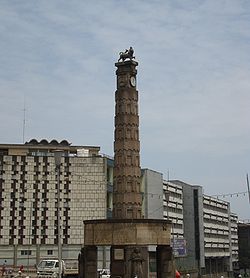 Arat Kilo monument
 -
 Addis Ababa Sheger Park
 -
 Oromia Cultural Center in Addis Ababa
 -
 Unity Park Addis Ababa
 -
 Commercial Bank of Ethiopia
 -

-

-
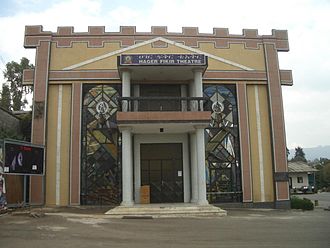 Hager Fikir Theatre (April 2006)
 -
 Ethiopian Radio and Television station
 -
 Headquarters of the Ethiopian Federal Police
 -
 Light rail overpass at Mexico Square


Notable people
[edit]- Ephraim Isaac: Scholar of Ancient Semitic Studies[125]
- Mohammed Hussein Al Amoudi: richest person in Ethiopia (worth $8.1 billion)[126]
- Haile Gebrselassie: Ethiopian long-distance runner
- Kenenisa Bekele: Ethiopian long-distance runner
- Tedros Adhanom: Director-General of the World Health Organization (WHO)
- Saladin Said: Ethiopian soccer player
- Mahder Assefa: Actress
- Mulatu Astatke: Ethiopian Jazz musician
- Mahmoud Ahmed: Ethiopian singer
- Teddy Afro: Ethiopian singer
- Bethlehem Tilahun Alemu: Founder of Sole Rebels[127]
- Eténèsh Wassié: Ethiopian azmari
- Ruth Negga: Actress[128]
- Zemi Yenus: Autism awareness advocate
See also
[edit]References
[edit]- ^ "2011 National Statistics". Csa.gov.et. Archived from the original on 30 March 2013. Retrieved 20 July 2013.
- ^ a b "Census 2007 Tables: Addis Abeba" Archived 14 November 2010 at the Wayback Machine, Tables 2.1, 2.5, 3.1, 3.2 and 3.4. For Silt'e, the statistics of reported Shitagne speakers were used, on the assumption that this was a typographical error.
- ^ "Addis Ababa Population (2025)". Retrieved 16 March 2025.
- ^ "Population Size by Sex Zone and Wereda July 2023" (PDF). Ethiopian Statistics Agency. 2023. Archived from the original (PDF) on 24 August 2023. Retrieved 19 August 2023.
- ^ "Sub-national HDI – Area Database – Global Data Lab". globaldatalab.org. Archived from the original on 25 June 2020. Retrieved 14 May 2020.
- ^ "Addis Ababa – English Definition and Meaning". Lexico.com. Archived from the original on 4 February 2022. Retrieved 28 February 2022.
- ^ Ethiopia in Brief, n.d., archived from the original on 28 December 2021, retrieved 20 April 2021
- ^ "Oromia Regional State". Ethiopia. Archived from the original on 28 July 2017. Retrieved 2 June 2020.
- ^ "| Human Development Reports". hdr.undp.org. Retrieved 9 November 2021.
- ^ "Addis Ababa | national capital, Ethiopia". Encyclopædia Britannica. Retrieved 9 February 2019.
- ^ a b c d e f "City Profile Addis Ababa" (PDF). 17 February 2022. Archived (PDF) from the original on 17 February 2022. Retrieved 17 February 2022.
- ^ "Ethiopia's Imperial Palace opened to the public after more than a century". This is africa. 30 October 2019. Archived from the original on 12 February 2022. Retrieved 12 February 2022.
- ^ "Ethiopia opens doors to its Imperial Palace for the first time". Embassy of Ethiopia, London. 16 October 2019. Archived from the original on 12 February 2022. Retrieved 12 February 2022.
- ^ a b Anacker, Caelen (16 March 2010). "Addis Ababa, Ethiopia (1886– ) •". Archived from the original on 5 January 2022. Retrieved 5 January 2022.
- ^ Benti, Getahun (2000). "A History of Addis Ababa from Its Foundation in 1886 to 1910 (review)". Northeast African Studies. 7 (2): 143–145. doi:10.1353/nas.2004.0013. ISSN 1535-6574. S2CID 144623037. Archived from the original on 2 July 2022. Retrieved 15 December 2021.
- ^ Federal Negarit Gazeta. 2003. p. 1.
- ^ "United Nations Economic Commission for Africa". UNECA. Archived from the original on 24 April 2012. Retrieved 5 May 2012.
- ^ Gizaw, Berhanu. "The origin of high bicarbonate and fluoride concentrations in waters of the Main Ethiopian Rift Valley, East African Rift system." Journal of African Earth Sciences 22.4 (1996): 391–402.
- ^ James Jeffrey. "Addis Ababa: 10 best things to do in Ethiopia's capital". CNN. Archived from the original on 1 November 2021. Retrieved 9 November 2021.
- ^ "DNA Studies Trace Migration from Ethiopia". bnd.com. St. Louis: Los Angeles Times. bnd. 22 February 2008. Archived from the original on 20 October 2007. Retrieved 20 July 2021.
- ^ Brown, David (22 February 2008). "Genetic Mutations Offer Insights on Human Diversity". The Washington Post. Archived from the original on 4 June 2011. Retrieved 23 April 2010.
- ^ a b Pankhurst, Richard (2009). "Barara, the Royal City of 15th and Early 16th Century (Ethiopia). Medieval and Other Early Settlements Between Wechecha Range and Mt Yerer". Annales d'Éthiopie. 24 (1): 209–249. doi:10.3406/ethio.2009.1394.
- ^ Vigano, Marco. "The shapes of medieval Addis Ababa". Retrieved 11 April 2025 – via Academia.
- ^ Vigano, Marco. "An Introduction to Ethiopian History, Axum to pre-Gondar, our 'Middle Ages'". Retrieved 11 April 2025 – via Academia.
- ^ Pankhurst, Richard (1982). History of Ethiopian towns from the mid 19th century to 1935. p. 203.
- ^ Pankhurst, p. 195
- ^ Zewde, Bahru (2002). Pioneers of Change in Ethiopia: The Reformist Intellectuals of the Early Twentieth Century. J. Currey. ISBN 978-0-85255-452-4. Archived from the original on 4 July 2023. Retrieved 31 May 2022.
- ^ Daily Consular and Trade Reports. Department of Commerce and Labor, Bureau of Manufactures. 1927. Archived from the original on 4 July 2023. Retrieved 29 July 2022.
- ^ Freidson, Irving (1930). Motor Roads in Africa: (except Union of South Africa). U.S. Government Printing Office. Archived from the original on 4 July 2023. Retrieved 29 July 2022.
- ^ Weapons of War: Environmental Impact: Environmental Impact. KW Publishers Pvt Ltd. 15 August 2013. ISBN 978-93-85714-71-9. Archived from the original on 4 July 2023. Retrieved 29 July 2022.
- ^ a b c d e f g h i Tufa, Dandena (2008). "Historical Development of Addis Ababa: plans and realities". Journal of Ethiopian Studies. 41 (1/2): 27–59. ISSN 0304-2243. JSTOR 41967609. Archived from the original on 19 July 2021. Retrieved 19 July 2021.
- ^ Alemayehu, Elias Yitbarek; Stark, Laura (30 November 2018). The Transformation of Addis Ababa: A Multiform African City. Cambridge Scholars Publishing. ISBN 978-1-5275-2272-5. Archived from the original on 4 July 2023. Retrieved 31 May 2022.
- ^ Kumar, B. G. (1991), Drèze, Jean; Sen, Amartya (eds.), "3 Ethiopian Famines 1973–1985: A Case-Study", The Political Economy of Hunger: Volume 2: Famine Prevention, Oxford: Oxford University Press, doi:10.1093/acprof:oso/9780198286363.001.0001, ISBN 978-0-19-828636-3, retrieved 20 March 2022
- ^ Biles, Peter (29 May 1991). "Addis Ababa falls to dawn onslaught". The Guardian. Archived from the original on 20 March 2022. Retrieved 20 March 2022.
- ^ "Addis Ababa City Government Revised Charter Proclamation" (PDF). Federal Negarit Gazeta. 22 April 2022. Archived (PDF) from the original on 4 July 2022. Retrieved 22 April 2022.
- ^ "Ethiopia's 'Master Plan' – good for development, damaging for minorities", Blog, 12 August 2014, archived from the original on 2 October 2015, retrieved 12 August 2014
- ^ The Roots of Popular Mobilization in Ethiopia, 16 June 2017, archived from the original on 21 November 2017, retrieved 16 June 2017
- ^ Ethiopia: Brutal Crackdown on Protests, 5 May 2014, archived from the original on 8 May 2014, retrieved 5 May 2014
- ^ Oromo Protests: Defiance Amidst Pain and Suffering, 16 December 2015, archived from the original on 19 December 2015, retrieved 16 December 2015
- ^ Ethiopia: Lethal Force Against Protesters, 18 December 2015, archived from the original on 22 December 2015, retrieved 18 December 2015
- ^ Country Policy and Guidance Note Ethiopia Oromos including the Oromo Protests (PDF), November 2017, archived (PDF) from the original on 2 December 2021, retrieved 22 July 2021
- ^ Ethiopia Scraps Plan for Capital Area that Sparked Protests, archived from the original on 23 September 2020, retrieved 13 January 2016
- ^ Chala, Endalk (14 January 2016), "Ethiopia scraps Addis Ababa 'master plan' after protests kill 140", The Guardian, archived from the original on 14 January 2016, retrieved 14 January 2016
- ^ "Ethiopia cancels Addis Ababa master plan after Oromo protests", BBC News, 13 January 2016, archived from the original on 13 January 2016, retrieved 13 January 2016
- ^ "Addis Ababa, Ethiopia Metro Area Population 1950-2022". www.macrotrends.net. Archived from the original on 15 March 2022. Retrieved 17 April 2022.
- ^ "The Danger of Ambition and Neglect: The Case of Beautifying Sheger Project" (in Chinese (China)). Archived from the original on 24 September 2022. Retrieved 31 August 2021.
- ^ "Arada". www.ethiopians.com. Archived from the original on 9 March 2021. Retrieved 31 August 2021.
- ^ "Riverside: green redevelopment for Addis Ababa |". en. Archived from the original on 24 September 2022. Retrieved 31 August 2021.
- ^ "Ethiopia: 'Sheger Project Signals Premier's Promise-Fulfilling' - Residents". allAfrica.com. 18 August 2020. Archived from the original on 2 June 2022. Retrieved 31 August 2021.
- ^ "addis ababa city administration latest news". casabrasilis.com.br. Archived from the original on 31 August 2021. Retrieved 31 August 2021.
- ^ "'Sheger City' plan will fuel Ethiopia tensions". Emerald Expert Briefings. oxan–db (oxan–db). 1 January 2023. doi:10.1108/OXAN-DB279805. ISSN 2633-304X.
- ^ Tasfaye, Ermias (12 April 2023). "Opposition to Oromia megacities echoes Ethiopia's master plan turmoil". Ethiopia Insight. Retrieved 3 January 2024.
- ^ "Oromia region's new Sheger city encase Addis Ababa". Ground News. 20 December 2022. Retrieved 3 January 2024.
- ^ Ethiopia PM moves to resolve Oromia – Addis Ababa boundary rift, 9 March 2019, archived from the original on 22 July 2021, retrieved 22 July 2021
- ^ Urban Centers in Oromia:Consequences of Spatial Concentration of Power in Multinational Ethiopia, January 2010, archived from the original on 22 July 2021, retrieved 22 July 2021
- ^ State of Oromia's Interest in Addis Ababa (Finfinnee): Undelivered Constitutional Promises, November 2014, archived from the original on 22 July 2021, retrieved 22 July 2021
- ^ Benti, Getahun (3 November 2002), "A Nation without a City [a Blind Person without a Cane]: The Oromo Struggle for Addis Ababa", Northeast African Studies, 9 (3): 115–131, doi:10.1353/nas.2007.0009, JSTOR 41931283, S2CID 144274717, archived from the original on 22 July 2021, retrieved 22 July 2021
- ^ A Draft Proclamation to Determine the Special Interest of the State of Oromia in Addis Ababa City, 15 January 2018, archived from the original on 22 July 2021, retrieved 22 July 2021
- ^ Commentary on the draft proclamation of special interest of state of Oromia in Addis Ababa city, 23 November 2017, archived from the original on 7 September 2021, retrieved 22 July 2021
- ^ Yohannes Mekonnen (2013). Ethiopia: the Land, its People, History and Culture. Washington, DC: New Africa Press. p. 287. ISBN 978-9987160242. Archived from the original on 4 July 2023. Retrieved 17 July 2021.
- ^ "Chief Administrator of Oromia says decision to move capital city based on study". Walta Information Center. 11 June 2005. Archived from the original on 13 June 2005. Retrieved 25 February 2006.
- ^ Ethiopians are having a tense debate over who really owns Addis Ababa, 7 July 2017, archived from the original on 3 November 2020, retrieved 19 July 2021
- ^ Abate, Abebe Gizachew (30 August 2019), "The Addis Ababa Integrated Master Plan and the Oromo Claims to Finfinnee in Ethiopia", International Journal on Minority and Group Rights, 26 (4): 620–638, doi:10.1163/15718115-02604121, S2CID 150796037, archived from the original on 19 July 2021, retrieved 19 July 2021
- ^ Standard4, Addis (21 September 2018), "News: ODP concludes conference, elects nine crucial members of its executive committee. See who is who", Addis Standard, archived from the original on 7 October 2021, retrieved 22 July 2021
{{citation}}: CS1 maint: numeric names: authors list (link) - ^ "April 30, 2012". NGA: GNS. 30 April 2012. Archived from the original on 4 May 2012. Retrieved 5 May 2012.
- ^ "Site Map". Addis Ababa City. The list in "Sub Cities" section. Archived from the original on 3 July 2013. Retrieved 11 December 2013.
- ^ "Article at unhabitat.org (map of Addis Ababa, page 9)" (PDF). Archived from the original (PDF) on 24 April 2011. Retrieved 11 December 2013.
- ^ "Addis Ketema page (Addis Ababa website)". Addisababacity.gov.et. Archived from the original on 14 December 2012. Retrieved 11 December 2013.
- ^ "Akaky Kaliti page (Addis Ababa website)". Addisababacity.gov.et. Archived from the original on 16 October 2013. Retrieved 11 December 2013.
- ^ "Arada page (Addis Ababa website)". Addisababacity.gov.et. Archived from the original on 11 January 2013. Retrieved 11 December 2013.
- ^ "Bole page (Addis Ababa website)". Addisababacity.gov.et. Archived from the original on 25 November 2013. Retrieved 11 December 2013.
- ^ "Gullele page (Addis Ababa website)". Addisababacity.gov.et. Archived from the original on 5 November 2013. Retrieved 11 December 2013.
- ^ "Kirkos page (Addis Ababa website)". Addisababacity.gov.et. Archived from the original on 3 December 2013. Retrieved 11 December 2013.
- ^ "Kolfe Keranio page (Addis Ababa website)". Addisababacity.gov.et. Archived from the original on 3 December 2013. Retrieved 11 December 2013.
- ^ "Lideta page (Addis Ababa website)". Addisababacity.gov.et. Archived from the original on 3 December 2013. Retrieved 11 December 2013.
- ^ "Nifas Silk-Lafto page (Addis Ababa website)". Addisababacity.gov.et. Archived from the original on 4 January 2013. Retrieved 11 December 2013.
- ^ "Yeka page (Addis Ababa website)". Addisababacity.gov.et. Archived from the original on 3 December 2013. Retrieved 11 December 2013.
- ^ "NMA of Ethiopia". National Meteorological Agency of the Federal Democratic Republic of Ethiopia. Archived from the original on 23 October 2011. Retrieved 9 May 2010.
- ^ "Climate: Addis Abeba (altitude: 2350m) – Climate graph, Temperature graph, Climate table". Climate-Data.org. Archived from the original on 4 April 2015. Retrieved 6 February 2015.
- ^ a b "Station Addis Abeba" (in French). Météo Climat. Archived from the original on 24 February 2021. Retrieved 31 March 2019.
- ^ "Météo Climat stats for Addis Abeba 1991–2020". Météo Climat. Retrieved 15 October 2017.
- ^ "Climate of Major Cities". National Metrology Institute of Ethiopia. Retrieved 9 May 2025.
- ^ "World Weather Information Service – Addis Ababa". World Meteorological Organisation. Archived from the original on 22 October 2013. Retrieved 31 March 2019.
- ^ "Klimatafel von Addis Abeba (Adis Ababa) / Äthiopien" (PDF). Baseline climate means (1961–1990) from stations all over the world (in German). Deutscher Wetterdienst. Archived (PDF) from the original on 31 March 2019. Retrieved 31 March 2019.
- ^ "The Conversation" Archived 14 November 2010 at the Wayback Machine, Tables 2.1, 2.5, 3.1, 3.2 and 3.4. For Silt'e, the statistics of reported Shitagne speakers were used, on the assumption that this was a typographical error.
- ^ a b "Population and Housing Census 2007 Report, National". Central Statistical Agency. 2010. Archived from the original on 4 March 2016. Retrieved 13 December 2016.
- ^ "The 1994 Population and Housing Census of Ethiopia: Results for Addis Ababa", Tables 2.1, 2.2, 2.8, 2.13A Archived 15 November 2010 at the Wayback Machine
- ^ "Population Size by Sex Zone and Wereda July 2023" (PDF). Ethiopian Statistics Agency. 2023. Archived from the original (PDF) on 24 August 2023. Retrieved 19 August 2023.
- ^ "Census 2007 Tables: Addis Abeba", Tables, 8.7, 8.8
- ^ Smith, David (28 August 2014). "Ethiopians' plight: 'The toilets are unhealthy, but we don't have a choice'". The Guardian. Archived from the original on 16 February 2017. Retrieved 10 December 2016.
- ^ Macro International Inc. "2008. Ethiopia Atlas of Key Demographic and Health Indicators, 2005." (Calverton: Macro International, 2008) Archived 5 November 2010 at the Wayback Machine, pp. 2, 3, 10 (Retrieved 30 September 2010)
- ^ Overseas Security Advisory Council – Ethiopia 2007 Crime and Safety Report[dead link].
- ^ Massages and manicures hit Addis Ababa Archived 15 June 2006 at the Wayback Machine by Tia Goldenberg. Retrieved 15 January 2010. IOL. 6 November 2007.
- ^ "Company Profile Archived 5 October 2012 at the Wayback Machine." Ethiopian Airlines. Retrieved on 3 October 2009.
- ^ Sophie Eastaugh, for. "What makes Ethiopia the world's best spot for tourism?". CNN. Archived from the original on 14 November 2016. Retrieved 14 November 2016.
- ^ Bruche, S.; Gusset, M.; Lippold, S.; Barnett, R.; Eulenberger, K.; Junhold, J.; Driscoll, C. A.; Hofreiter, M. (2012). "A genetically distinct lion (Panthera leo) population from Ethiopia". European Journal of Wildlife Research. 59 (2): 215–225. doi:10.1007/s10344-012-0668-5. S2CID 508478.
- ^ "5 Reasons to Visit Addis Ababa Now". www.fodors.com. 12 December 2014. Archived from the original on 14 November 2016. Retrieved 14 November 2016.
- ^ "Crime Victimization and its Impact" (PDF). 1 August 2022. Archived (PDF) from the original on 15 March 2023. Retrieved 1 August 2022.
- ^ "Federal Negarit Gazeta" (PDF). 8 August 2022. Archived (PDF) from the original on 19 May 2023. Retrieved 8 August 2022.
- ^ J. Gordon Melton, Martin Baumann, Religions of the World: A Comprehensive Encyclopedia of Beliefs and Practices, ABC-CLIO, USA, 2010, p. 1004-1007
- ^ Rubinkowska-Anioł, Hanna (31 January 2016). "The Paintings in St George Church in Addis Ababa as a Method of Conveying Information about History and Power". Studies in African Languages and Cultures (49): 115–141. Archived from the original on 14 May 2022. Retrieved 18 March 2022.
- ^ a b "City Walk: Religious Buildings, Addis Ababa, Ethiopia". GPSmyCity. Archived from the original on 28 March 2022. Retrieved 18 March 2022.
- ^ "The Grand Anwar Mosque". www.addisababa.travel. Archived from the original on 14 May 2022. Retrieved 18 March 2022.
- ^ Solomon, Abiy. "Ethiopia building a Financial District in Addis Ababa". Archived from the original on 11 October 2016. Retrieved 21 September 2016.
- ^ Lagasse, Paul (2018). The Columbia Encyclopedia (8th ed.). New York, NY: Columbia University Press – via Credo Reference.
- ^ Addis Today by Molalign GIRMA, 2014
- ^ "Ethiopia Capital City, About Addis Ababa Tourism and Travel". Archived from the original on 15 November 2016. Retrieved 14 November 2016.
- ^ "Unity Park (Addis Ababa) – 2021 All You Need to Know BEFORE You Go (with Photos)". Tripadvisor. Archived from the original on 26 December 2020. Retrieved 15 February 2021.
- ^ Sew, Mistir (2 August 2021). "Dire Dawa's dilemma: Sharing power in Ethiopia's eastern melting pot". Ethiopia Insight. Archived from the original on 4 July 2023. Retrieved 19 February 2022.
- ^ "Addis Ababa: Culture – Tripadvisor". en.tripadvisor.com.hk. Archived from the original on 30 January 2022. Retrieved 30 January 2022.
- ^ "Photographs of the National Museum of Ethiopia". Independent Travellers. independent-travellers.com. Archived from the original on 18 August 2017. Retrieved 21 June 2017.
- ^ Organization, World Intellectual Property (31 March 2016). National Studies on Assessing the Economic Contribution of the Copyright-Based Industries - Series no. 9. WIPO. ISBN 978-92-805-2745-2. Archived from the original on 4 July 2023. Retrieved 29 July 2022.
- ^ "Theater in Ethiopia – All Country List". 26 February 2019. Archived from the original on 19 February 2022. Retrieved 19 February 2022.
- ^ "Best Cinemas in Addis Ababa, Ethiopia – List of Cinemas Ethiopia". www.ethyp.com. Archived from the original on 19 February 2022. Retrieved 19 February 2022.
- ^ "The science museum in Addis Ababa - Ethiopia". www.madatech.org.il. Archived from the original on 28 March 2022. Retrieved 18 March 2022.
- ^ "Ethiopian Broadcasting Agency grants satellite TV licenses to three stations as it eyes digital migration". Africa Business Communities. Archived from the original on 28 March 2022. Retrieved 18 March 2022.
- ^ Mulgeta, Eteffa (19 March 2022). "Education In Ethiopia In Its Historical And Cultural Content". Foreign Curriculum Consultant Wayne County Intermediate School District Detroit, Michigan: 5–6. Archived from the original on 13 May 2022. Retrieved 26 March 2022.
- ^ Zeliadt, Nicholette (13 December 2017). "Why autism remains hidden in Africa". Spectrum. Archived from the original on 23 June 2023. Retrieved 23 June 2023.
- ^ "School Choice And Policy Response: A Comparative Context Between Private And Public Schools In Urban Ethiopia". 19 March 2022. Archived from the original on 28 March 2022. Retrieved 19 March 2022.
- ^ "International Conference on Multi-National Construction Projects: Addis Ababa Ring Road Project – A Case Study of a Chinese ..." Archived from the original on 3 March 2016. Retrieved 8 December 2010.
- ^ "Railway Gazette: Chinese funding for Addis Abeba light rail". Archived from the original on 13 October 2010. Retrieved 1 October 2010.
- ^ "Ethiopia: Addis' sister cities, historical ties". tuckmagazine.com. Tuck Magazine. 11 December 2018. Archived from the original on 12 October 2022. Retrieved 16 July 2020.
- ^ "Harare, S. Korean city strengthen ties". The Herald (Zimbabwe). 27 February 2018. Archived from the original on 12 October 2022. Retrieved 16 July 2020 – via PressReader.
- ^ Rasmeni, Mandisa (8 September 2024). "Windhoek and Addis Ababa Sign Twinning Agreement at African Urban Forum". Namibia Economist.
- ^ "Institute of Semitic Studies". instituteofsemiticstudies.org. Archived from the original on 24 December 2016. Retrieved 31 December 2016.
- ^ "Mohammed Al Amoudi". Forbes. Archived from the original on 30 December 2017. Retrieved 22 February 2020.
- ^ "Our Founder". soleRebels. Archived from the original on 1 January 2017. Retrieved 31 December 2016.
- ^ "Ruth Negga: tipped for Oscars glory". The Telegraph. 19 January 2017. Archived from the original on 14 August 2020. Retrieved 1 November 2020 – via www.telegraph.co.uk.
Further reading
[edit]- Pankhurst, Richard (2001). The Ethiopians: A History (Peoples of Africa). Wiley-Blackwell; New Ed edition. ISBN 0-631-22493-9.
External links
[edit]


| |||||||||||||||||||||


.svg)
| International | |
|---|---|
| National | |
| Geographic | |
| People | |
| Other | |

Addis Ababa
View on GrokipediaAddis Ababa is the capital and largest city of Ethiopia, founded in 1887 by Emperor Menelik II and Empress Taytu Betul as the new seat of imperial power on a site previously favored by Menelik's forebears in the central highlands.[1][2] Situated at an elevation of 2,355 meters (7,726 feet) above sea level, the city experiences a subtropical highland climate characterized by mild temperatures ranging from 9°C to 24°C (48°F to 75°F) year-round, with a pronounced rainy season from June to September.[3][4] The Amharic name "Addis Ababa" translates to "new flower," reflecting its establishment amid abundant hot springs and fertile terrain.[5] As Ethiopia's primary political, economic, and diplomatic center, Addis Ababa hosts the headquarters of the African Union, established there following the organization's predecessor, the Organisation of African Unity, which convened its founding summit in the city in 1963.[6] The metropolitan area's population is estimated at 5.96 million in 2025, driving rapid urbanization and contributing disproportionately to national economic output through services, manufacturing, and trade, though challenged by infrastructure strains and informal settlements.[7]
History
Prehistory and Ancient Foundations
The region encompassing modern Addis Ababa, situated in the Ethiopian Highlands along the upper Awash River basin, preserves evidence of early hominin activity dating to the Lower Paleolithic period, with stone tools and faunal remains indicating occupation by Homo erectus and possibly earlier species as far back as 1.8 million years ago. Key localities within this cluster, such as those at Melka Kunture approximately 45 kilometers southwest of the city, yield Acheulean handaxes, cleavers, and choppers crafted from locally sourced basalt and obsidian, alongside paleontological finds of large mammals like hippopotamus and elephant, suggesting a landscape of open woodlands and riverine environments conducive to scavenging and early tool use.[8][9] Middle Stone Age assemblages in the vicinity, spanning roughly 300,000 to 50,000 years ago, reflect technological advancements including Levallois flake production and points potentially used for hafted spears, as evidenced by sites near the Awash Valley that show recurrent human exploitation of high-altitude resources amid fluctuating Pleistocene climates. These findings, including obsidian artifacts transported over distances implying social networks, underscore adaptation to elevations around 2,000 meters, with isotopic analyses of fauna confirming cooler, wetter conditions during interglacials that supported diverse foraging strategies. Underexplored locales like Fanta, Gemeda, and Koche within or adjacent to Addis Ababa proper have revealed similar lithic scatters and hearths, pointing to persistent but low-density human presence without evidence of sedentary structures.[9][10] By the Late Stone Age and Neolithic transition around 10,000 to 5,000 years ago, the central Ethiopian Rift margins near Lake Ziway—about 160 kilometers south—exhibit microlithic tools, pottery sherds, and grinding stones indicative of intensified plant processing and early herding, though direct ties to the Addis basin remain sparse and primarily mobile hunter-gatherer patterns dominate the record. No monumental architecture or urban precursors mark the site of present-day Addis Ababa itself prior to the 19th century; instead, hot springs at Finfinne (the area's traditional Oromo name) likely served as seasonal gathering points for pastoralists, with obsidian sourcing from nearby outcrops facilitating trade and tool renewal in a landscape shaped by volcanic activity and rift tectonics. This prehistoric continuum laid ecological and resource foundations for later settlements, but the absence of dense ancient villages reflects the highlands' role as a peripheral zone relative to northern kingdoms like Aksum.[11][12]Medieval Period and Early Settlements
The region encompassing modern Addis Ababa, part of the Shewa province, featured several medieval settlements associated with the Solomonic dynasty's expansion southward from the northern highlands during the 13th to 16th centuries. These sites served as royal capitals, administrative centers, and trade hubs within the Christian kingdom of Abyssinia, reflecting a period of territorial consolidation amid conflicts with Muslim sultanates and internal dynastic shifts. Archaeological surveys, informed by the 15th-century Fra Mauro map depicting numerous towns in the area, have identified dense clusters of artifacts including wheel-made pottery, tower foundations, and cemeteries, indicating organized urban-like structures predating European contact.[13][14] Tegulet, located along the Jemma River drainage basin north of Debre Berhan (founded in 1456), emerged as a significant early capital under Emperor Amda Seyon (r. 1312–1342), who used it as a base for military campaigns against neighboring polities. The site features remnants of a "Royal Road" and extensive medieval occupational layers, underscoring its role in facilitating trade routes and governance in Shewa. Similarly, Sadai on the western slopes of Mount Wechecha (Amba Negest), south of the Entoto-Amba Range and northeast of the Awash River, included circular fortifications and was destroyed around 1530 during the conquests of Imam Ahmad Gragn, highlighting the region's vulnerability to 16th-century invasions.[13] Barara, a prominent royal city of the 15th and early 16th centuries situated between the Wechecha Range and Mount Yerer—northwest of Addis Ababa near Sost Amba (Three Peaks)—spanned over 2 square kilometers with evidence of imported ceramics, multiple cemeteries containing hundreds of tombs, and thick occupational soils exceeding 1 meter in depth. Positioned near the Germama and Kesem rivers south of Sendafa, it likely functioned as a political and possibly trade center for the Abyssinian court, with continuity from Aksumite-influenced pre-medieval periods. Recent fieldwork has confirmed these features, challenging prior assumptions of sparse highland settlement and revealing a network of interconnected medieval towns that influenced the area's later imperial development.[15][14][13] These settlements declined following the 16th-century wars, leaving the immediate Addis Ababa plateau relatively underpopulated by small villages and pastoral groups until the late 19th century, though the strategic Entoto highlands retained cultural and ritual importance tied to earlier Shewan rulers. Archaeological evidence from sites like a troglodytic complex near Addis, potentially linked to Emperor Zara Yaqob's (r. 1434–1468) birthplace at Tilqot, further attests to fortified medieval outposts in the vicinity.[14]Foundation by Menelik II
In the mid-1880s, Menelik II, then King of Shewa, relocated his base from the cooler heights of Mount Entoto to a warmer site at lower elevation to mitigate health issues associated with the highlands, including his own ailments.[16] This decision was influenced by Empress Taytu Betul, who selected the location near natural hot springs and abundant hot-season flowers, leading to the settlement's naming as Addis Ababa, meaning "new flower" in Amharic.[17] The foundational act occurred in late 1886, when Taytu constructed the first permanent residence, marking the site's transition from temporary encampment to emerging urban center.[18] By 1887, Menelik II formally established Addis Ababa as the capital of Shewa, constructing additional structures including palaces, churches, and administrative buildings, which attracted nobility, retainers, and merchants to the area.[19] Taytu Betul further contributed by founding the Entoto Maryam Church in 1885 on the nearby mountain, which served as a religious anchor and spurred pilgrimage-related settlement growth below.[17] Following Menelik's ascension as Emperor of Ethiopia in 1889, Addis Ababa expanded as the imperial capital, with land grants to loyalists and the influx of Oromo populations facilitating rapid demographic and infrastructural development.[20] The city's strategic placement in the fertile central highlands, approximately 2,355 meters above sea level, supported agricultural productivity and military logistics, underpinning its role as a political hub amid Menelik's campaigns of expansion.[16] Initial urban planning was rudimentary, centered around the emperor's compound and evolving organically through feudal land allocations rather than centralized design, reflecting the era's monarchical governance structure.[20] This foundation laid the groundwork for Addis Ababa's transformation from a royal outpost to Ethiopia's enduring political and economic core.Expansion Under Imperial Rule (Late 19th–Early 20th Century)
Following its establishment as the permanent capital in the late 1880s, Addis Ababa grew from a royal encampment into a central hub of the Ethiopian Empire under Emperor Menelik II (r. 1889–1913). The influx of nobility, military personnel, merchants, and artisans transformed the site into a multi-settlement urban area, with the royal palace serving as the focal point and surrounding tracts allocated for various ethnic and occupational groups.[21] Menelik II encouraged economic relocation by granting urban land to Harar merchants, redirecting trade flows toward the capital and fostering commercial activity.[21] Population estimates reflect this expansion, rising from about 30,000 in 1897 to 40,000–60,000 by 1909, driven by imperial policies and the city's strategic location.[21] Menelik II initiated modernization efforts, including the importation of eucalyptus saplings from Australia in the 1890s for timber and fuel, which addressed local resource shortages and supported construction of permanent structures.[22] He authorized a French company to construct a railroad linking Addis Ababa to the Red Sea port of Djibouti, enhancing import-export capabilities despite completion only in 1917 after his death.[16] In the early 20th century, under Menelik's successors and Regent Ras Tafari Makonnen (future Emperor Haile Selassie), urban development accelerated with the legalization of private land ownership around 1903, enabling speculative building and layout changes.[23] The 1920s brought an economic surge from coffee exports, spurring middle-class investments in stone houses, European-style imports, and the arrival of hundreds of automobiles by 1930, which prompted road widening and paving projects.[22] By 1935, the population approached 100,000, underscoring Addis Ababa's emergence as Ethiopia's premier emporium amid gradual infrastructural upgrades like basic electrification and water systems before the Italian occupation.[21]Italian Occupation (1936–1941)
Italian forces under Marshal Pietro Badoglio entered Addis Ababa on May 5, 1936, following the Ethiopian government's evacuation two days earlier amid the collapse of organized resistance after the Battle of Maychew.[24] [25] The city, which Emperor Haile Selassie had ordered partially destroyed to deny resources to the invaders, lay in ruins with widespread looting by retreating Ethiopian troops and civilians, leaving foreign legations sheltering refugees amid the chaos.[24] On May 9, 1936, Benito Mussolini proclaimed the annexation of Ethiopia to Italy, with King Victor Emmanuel III titled Emperor of Ethiopia, integrating the territory into Italian East Africa (Africa Orientale Italiana, AOI) alongside Eritrea and Italian Somaliland, and designating Addis Ababa as the administrative capital of this colonial entity.[25] [26] Italian governance imposed fascist structures, including military administration initially under Badoglio, who served briefly as viceroy before replacement by Rodolfo Graziani in a shift toward harsher suppression of dissent.[27] The occupiers resettled thousands of Italian civilians in urban areas, initiating infrastructure projects such as road expansions and public buildings to consolidate control and facilitate resource extraction, though these efforts were overshadowed by enforced racial segregation policies introduced in 1937 prohibiting interracial unions and imposing apartheid-like measures.[26] [28] Guerrilla resistance by Ethiopian patriots, known as Arbegnoch, persisted around Addis Ababa and in rural provinces, targeting Italian garrisons and supply lines despite reprisals that included mass executions and village burnings to deter insurgency.[26] Economic exploitation focused on agricultural exports and labor conscription, with the city serving as a hub for Italian settlers numbering several thousand by 1940, though underlying tensions from cultural impositions and resource strains fueled ongoing unrest.[26] The occupation ended with the East African Campaign of World War II; British Commonwealth forces, including South African and Indian troops under commanders like Dan Pienaar, advanced from the south and occupied Addis Ababa on April 6, 1941, encountering minimal resistance as Italian units withdrew northward.[29] Haile Selassie reentered the city on May 5, 1941—precisely five years after the Italian capture—restoring Ethiopian sovereignty under temporary British military administration until full independence in 1944.[30]Post-Liberation to Haile Selassie Era (1941–1974)
Following the liberation of Ethiopia from Italian occupation, Emperor Haile Selassie I reentered Addis Ababa on May 5, 1941, accompanied by Ethiopian and British forces that had driven out the occupiers.[31] This marked the restoration of imperial rule and initiated a period of reconstruction and modernization for the capital, which had suffered damage during the war but retained some infrastructure from the Italian era, including roads.[32] Haile Selassie prioritized urban development to symbolize Ethiopia's sovereignty and progress, commissioning expatriate architects to design key structures that blended modern elements with imperial symbolism.[33] In the immediate postwar years, infrastructure projects emphasized functionality and national prestige; the Haile Selassie I Stadium was inaugurated in 1947, serving as a venue for sports and public gatherings that reinforced communal identity.[34] By the 1950s, Addis Ababa's population began accelerating due to rural-to-urban migration, driven by economic opportunities and land pressures, transforming the city into a multiethnic hub as diverse groups settled in expanding neighborhoods.[35] Migration patterns, including from Eritrea and other regions, contributed to a population reaching approximately 729,000 by 1970, reflecting sustained growth amid limited formal planning.[36] The 1960s saw a construction surge tied to Addis Ababa's rising diplomatic prominence; the city hosted the United Nations Economic Commission for Africa (established 1958), with Haile Selassie gifting Africa Hall in the early 1960s as its headquarters, and became the site of the Organization of African Unity's founding in 1963.[37][38] These developments elevated the capital's global status, prompting investments in roads, embassies, and educational institutions like the expanded Haile Selassie I University, though uneven distribution exacerbated informal settlements.[38] By the early 1970s, persistent challenges such as housing shortages and student unrest—evident in 1965 protests at the university demanding land reforms—highlighted tensions between modernization ideals and socioeconomic realities under imperial governance.[35] Despite these, the era solidified Addis Ababa as Ethiopia's political and economic core, with architectural projects embodying Haile Selassie's vision of an African modernity independent of colonial legacies.[33]Derg Military Regime (1974–1991)
The Derg, a military council formally known as the Coordinating Committee of the Armed Forces, Police, and Territorial Army, seized power in Addis Ababa on September 12, 1974, through a coup that deposed Emperor Haile Selassie and ended the Solomonic dynasty. [39] The regime, initially led by figures including Major Mengistu Haile Mariam, abolished the monarchy in March 1975 and declared Ethiopia a socialist state, nationalizing urban land and extra housing in Addis Ababa to redistribute resources and curb private ownership. [40] This urban nationalization, enacted via proclamations in 1975, aimed to mobilize the city's population but stifled private investment and contributed to housing shortages amid rapid urbanization. [41] To consolidate control, the Derg established kebeles—urban dwellers' associations—through Proclamation No. 47 in July 1975, organizing Addis Ababa into 291 neighborhood units for surveillance, resource distribution, and political mobilization. [41] [42] These structures enforced regime loyalty, often through violent means, particularly during the Red Terror campaign from 1976 to 1978, a period of urban counter-insurgency targeting rivals like the Ethiopian People's Revolutionary Party (EPRP). [42] In Addis Ababa, kebeles detained, tortured, and executed suspected opponents, with mass killings including the slaughter of at least 1,400 demonstrators in the streets in 1976. [43] Mengistu, who assumed unchallenged leadership in February 1977 after purging rivals, symbolized the terror by smashing blood-filled bottles on his head during a public speech, signaling the regime's commitment to eradicating dissent through widespread executions estimated in the tens of thousands in the capital alone. [44] [45] The regime's policies exacerbated economic hardships in Addis Ababa, with nationalizations disrupting commerce and contributing to shortages, while ongoing civil wars drained resources. [46] By 1987, the Derg transitioned to a civilian facade as the People's Democratic Republic of Ethiopia, but repression persisted amid famines and insurgencies. [47] The regime collapsed in 1991 when Mengistu fled on May 21, allowing the Ethiopian People's Revolutionary Democratic Front (EPRDF) to enter Addis Ababa unopposed on May 28, marking the end of 17 years of Marxist rule without significant fighting in the city. [47]Federal Era Under EPRDF (1991–2018)
Following the EPRDF's overthrow of the Derg regime in May 1991, Addis Ababa retained its status as the federal capital of Ethiopia under the new ethnic federal system established by the 1995 Constitution.[48] [49] The city was designated a chartered city administration directly accountable to the federal government, separate from surrounding Oromia Region, to centralize control amid decentralization efforts.[50] This arrangement facilitated EPRDF's political dominance in the capital through strategies including resident monitoring, party mobilization, and socioeconomic programs, enabling tight governance over urban activities.[50] [51] The EPRDF era witnessed rapid population expansion in Addis Ababa, driven by rural-urban migration and natural growth, with annual rates averaging 3.7% compared to the national 2.3%.[52] By the early 2000s, the metro population exceeded 3 million, fueling urban sprawl and informal settlements, though official figures emphasized managed growth under developmental policies.[53] Economic liberalization post-1991 spurred service sector and construction booms, positioning Addis as a hub for foreign investment and infrastructure, yet growth masked underlying ethnic tensions and resource strains.[48] Major infrastructure initiatives underscored EPRDF's developmental state approach, including the Addis Ababa Light Rail Transit system, Sub-Saharan Africa's first, completed in 2015 with Chinese financing to alleviate congestion in a city strained by vehicle influx.[54] [55] The Integrated Housing Development Program (IHDP), launched in 2005, constructed over 200,000 condominium units by 2018 to address housing shortages, targeting low-income residents through subsidized sales.[56] However, these projects often involved forced evictions from inner-city areas, reallocating land for high-rise developments and exacerbating displacement without adequate compensation.[56] [53] Urban expansion plans, such as the 2015 Addis Ababa Integrated Development and Investment Master Plan, proposed extending city boundaries into Oromia farmlands to accommodate growth, but sparked widespread protests over perceived land grabs and cultural erasure.[57] [58] These demonstrations, erupting in Oromia and encircling the capital in late 2015, highlighted EPRDF's challenges in balancing federal capital imperatives with regional autonomies, contributing to political instability that pressured the regime by 2018.[57] [59] Despite achievements in physical infrastructure like roads and public housing, critiques pointed to uneven benefits, rising inequality, and authoritarian enforcement that prioritized regime control over equitable urban equity.[60] [61]Abiy Ahmed Reforms and Recent Developments (2018–Present)
Abiy Ahmed assumed the office of Prime Minister on April 2, 2018, following the resignation of Haile Mariam Desalegn amid widespread protests, initiating a series of reforms that initially stabilized and liberalized Ethiopia's political landscape, with ripple effects in Addis Ababa as the federal capital. Early measures included the release of thousands of political prisoners, partial media deregulation allowing new outlets, and economic liberalization opening sectors like telecommunications to foreign investment, which spurred investor interest in urban infrastructure projects centered in the capital. These changes contrasted with the prior EPRDF era's centralization, fostering a brief period of optimism in Addis Ababa, where public spaces hosted rallies supporting Abiy's "Medemer" philosophy of synergy, though underlying ethnic frictions persisted due to the city's status as an Oromia enclave.[62][63][64] Urban renewal became a hallmark of Abiy's agenda in Addis Ababa, exemplified by the Addis Ababa Riverside Project, which expanded riverbanks by 56 kilometers from Entoto Mountains to the Akaki River, incorporating green corridors, pedestrian walkways, and pollution controls to modernize the city's layout. The Addis Ababa Corridor Development initiative further transformed key avenues with bike lanes, tree-lined verges, plazas, and new public facilities like libraries and a renovated mayor's office, aiming to decongest the metropolis and enhance livability amid rapid population growth. By 2024, these elite-driven projects had reshaped districts across five sub-cities, covering 21.5 kilometers of renewed urban spaces, though critics noted they prioritized aesthetics over addressing slum conditions affecting millions. Economic projections for 2025/26 anticipated 10.2% national growth, with Addis Ababa benefiting from foreign-backed ventures in aviation and digital infrastructure, including the Digital Ethiopia strategy to integrate technology into urban governance.[65][66][67][68] However, political reforms faltered amid escalating ethnic tensions spilling into Addis Ababa, with clashes in 2018 between Oromo and non-Oromo groups displacing thousands and killing dozens in peripheral areas like Burayu, prompting protests in the capital where security forces killed at least five demonstrators on September 17, 2018. The Tigray War (2020–2022) indirectly threatened Addis Ababa through drone strikes and mobilization, while ongoing Oromia insurgencies by groups like the Oromo Liberation Army led to heightened security measures and sporadic violence in the city's outskirts. By 2024–2025, inter-ethnic violence had displaced over 700,000 nationwide, with Addis Ababa experiencing refugee influxes and economic strains from inflation and forex shortages, undermining initial reform gains despite Abiy's 2019 Nobel Peace Prize for Eritrea normalization. Government sources emphasize disarmament talks and macroeconomic reforms, but human rights reports document abuses by federal forces and militias, highlighting a shift toward centralization that exacerbated divisions in the multi-ethnic capital.[69][70][71][72][73]Geography and Climate
Location, Topography, and Urban Layout
Addis Ababa is situated at coordinates 9°1′48″N 38°44′24″E in the central highlands of Ethiopia, forming an administrative enclave completely surrounded by the Oromia Region.[3][74] The city occupies a grassland biome on a plateau averaging elevations around 2,355 to 2,517 meters above sea level, contributing to its temperate highland climate.[3][75] The topography features undulating terrain with the city at the base of Mount Entoto to the north, where the plateau gives way to steeper rises and interspersed valleys characteristic of the broader Ethiopian Highlands.[76] This elevation and physiographic variation, including deep chasms and elevated ridges north of the city center, influence local microclimates and drainage patterns, with rivers like the Kebena and Weyzer flowing through peripheral gullies.[76] Urban layout reflects a mix of organic growth since its 1886 founding and subsequent structured planning, organized into 11 sub-cities and further divided into woredas for administrative purposes under the Addis Ababa City Structure Plan (2017–2027).[77] The central core, encompassing historic and governmental districts, radiates outward with mixed-use corridors, though rapid expansion has led to informal settlements on the periphery and redevelopment pressures in inner zones.[78] Land use prioritizes residential expansion in sub-urban areas alongside commercial hubs, with ongoing efforts to integrate transport infrastructure like the light rail into the radial pattern.[77]Climate Patterns and Environmental Pressures
Addis Ababa exhibits a subtropical highland climate (Köppen Cwb), marked by consistently mild temperatures due to its elevation of approximately 2,355 meters above sea level, with annual averages around 15.6 °C.[79] Long-term mean maximum temperatures reach 25.8 °C, while minimums average 12.6 °C, rarely dropping below 6 °C in the coolest months or exceeding 26 °C during warmer periods.[80] [81] Daily temperature fluctuations are moderated by the high altitude, contributing to comfortable conditions year-round, though frost can occasionally occur at night in the dry season from October to February.[82] Precipitation totals approximately 1,874 mm annually, with a bimodal pattern featuring short rains (belg) from February to May and main monsoon rains (kiremt) from June to September, accounting for the bulk of the volume.[79] [4] The rainy period extends for about 9.4 months, from late January to late October, with peak monthly rainfall exceeding 250 mm during July and August, while the dry season sees minimal accumulation below 20 mm per month.[4] This variability supports agriculture in surrounding areas but exposes the city to risks of flooding during intense downpours, particularly on degraded slopes.[83] Rapid urbanization, driven by population growth exceeding 4 million residents and unchecked expansion, imposes severe environmental pressures, including deforestation and soil erosion across the city's hilly terrain.[83] Informal settlements and agricultural encroachment have stripped vegetation from slopes steeper than 16%, accelerating erosion rates and reducing soil fertility, which in turn diminishes groundwater recharge and exacerbates downstream sedimentation.[83] [84] These processes contribute to land degradation, with overgrazing and fuelwood extraction further compounding biodiversity loss and carbon sequestration deficits.[85] Water scarcity has intensified due to surging demand from urban and industrial growth outpacing supply, compounded by climate variability, inefficient management, and pollution of rivers like the Akaki, which limits usable surface and groundwater resources.[86] [87] Extraction rates have stressed aquifers, with per capita availability declining amid population pressures, while untreated wastewater and solid waste dumping degrade quality, fostering health risks and ecological imbalance.[88] [89] The city faces heightened vulnerability to droughts, heat waves, and flash floods, with 67% of inhabitants in flood-prone zones, as degraded landscapes amplify runoff and reduce natural buffering.[83] Air quality suffers from vehicular emissions and industrial effluents, though quantitative data remain limited, underscoring broader challenges in waste management and enforcement amid rapid development.[90]Demographics
Population Dynamics and Growth Trends
Addis Ababa's population has expanded dramatically from its origins as a modest imperial outpost, with estimates indicating around 15,000 residents in 1888. By 1950, the metro area had grown to approximately 392,000, reflecting early centralization under Emperor Menelik II and subsequent modernization efforts. The city's administrative area recorded 2,739,551 inhabitants in the 2007 national census conducted by Ethiopia's Central Statistical Agency, marking a more than sevenfold increase from mid-20th-century levels.[91][7][92] Recent decades have seen accelerated growth, with the metro area population reaching 5,461,000 in 2023 and 5,704,000 in 2024, corresponding to an annual increase of 4.45%. Projections estimate the metro population at 5,957,000 for 2025, sustaining a growth rate near 4.4%. This outpaces Ethiopia's national population growth of 2.6% in 2024, underscoring Addis Ababa's role as a primary urban magnet. The absence of a census since 2007 has led to reliance on projections from agencies like the UN and national statistical bodies, which consistently highlight the metro area's expansion beyond the official city boundaries into Oromia Region peripheries.[36][7][93] Net internal migration drives the majority of this increase, with rural-to-urban inflows accounting for over half of urban population changes according to World Bank analyses. Economic pull factors include job prospects in informal trade, construction, and services, while rural push elements encompass agricultural stagnation, recurrent droughts, and localized conflicts displacing households. Surveys from 2021 report that migrants comprise 42% of city residents, predominantly young and from agrarian regions like Oromia and Amhara, often arriving with limited education but seeking remittances or family networks. Natural increase remains contributory, with urban fertility rates of 3-4 children per woman exceeding replacement levels, though declining from historical highs above 5.[94][95][96]| Year | Metro Area Population | Annual Growth Rate (%) |
|---|---|---|
| 2000 | 2,573,000 | - |
| 2010 | 3,384,000 | 3.5 |
| 2020 | 4,561,000 | 4.2 |
| 2024 | 5,704,000 | 4.45 |
Ethnic and Linguistic Composition
Addis Ababa exhibits a diverse ethnic composition reflective of internal migration patterns and historical urban development, with data primarily drawn from the 2007 national census, the most recent comprehensive enumeration available due to subsequent delays in conducting full censuses. Amhara constitute the largest group at approximately 47% of the population, followed by Oromo at 19%, Gurage at 16%, and Tigrayan at around 6%.[99] Smaller proportions include groups such as Sidama, Wolayta, and Hadiya, contributing to over 80 ethnicities represented in the city, though the top four account for the majority.[7] This distribution stems from the city's founding under Amhara-led imperial rule in the late 19th century, which drew disproportionate Amhara settlement, compounded by ongoing rural-to-urban migration favoring economic opportunities in the capital.[99]| Ethnic Group | Approximate Percentage (2007 Census) |
|---|---|
| Amhara | 47% |
| Oromo | 19% |
| Gurage | 16% |
| Tigrayan | 6% |
| Others | 12% |
Religious Demographics and Social Cohesion
The religious landscape of Addis Ababa is characterized by a strong predominance of Ethiopian Orthodox Christianity, reflecting the city's historical and cultural ties to the Ethiopian Orthodox Tewahedo Church (EOTC). According to the 2007 Ethiopian census, the most recent comprehensive data available, approximately 72.8% of the population identified as Ethiopian Orthodox, 18.6% as Muslim, 6.7% as Protestant (P'ent'ay), with smaller shares for Catholics (0.4%), traditional faiths (0.7%), and others (1.0%).[101] These figures indicate a more Orthodox-heavy composition compared to the national average, where Orthodox adherents comprise about 44%. Urban migration and evangelization efforts have contributed to Protestant growth in the city, with observers noting an increase in evangelical and Pentecostal communities since 2007, potentially raising their share to 10-15% by recent estimates.[102] Social cohesion in Addis Ababa benefits from traditions of interfaith coexistence, where Orthodox Christians and Muslims often share neighborhoods and participate in mutual celebrations, fostering a pragmatic tolerance rooted in historical patterns of religious pluralism under imperial and post-imperial governance. The Inter-Religious Council of Addis Ababa (IRCAA), established to mediate disputes and promote dialogue among Christian, Muslim, and other leaders, has actively contributed to peacebuilding, including during episodes of national unrest by organizing joint statements and conflict resolution initiatives.[103] This institutional framework underscores religion's potential as a stabilizing force amid Ethiopia's ethnic federalism, where religious identities frequently overlap with ethnic ones—such as Amhara with Orthodoxy and certain Oromo subgroups with Islam or Protestantism. Nevertheless, social cohesion faces challenges from intersecting ethnic and religious divides, particularly as urban expansion draws in migrants from diverse regions, amplifying competition over resources and political representation. Incidents of tension, though less frequent in Addis than in rural areas, have arisen during broader national conflicts, including sporadic clashes linked to perceived favoritism toward the EOTC or radical elements within communities, as reported in 2022 international assessments.[102] These pressures highlight vulnerabilities where religious harmony depends on effective governance and equitable policies, rather than inherent amity alone, with empirical evidence from interfaith forums indicating sustained efforts to mitigate risks through collaborative advocacy.[104]Government and Administration
Municipal Governance Structure
Addis Ababa operates as a chartered city with administrative autonomy equivalent to Ethiopia's regional states, featuring a bicameral-like structure divided between a legislative City Council and an executive led by the Mayor. The City Council consists of directly elected members serving five-year terms, responsible for legislating city bylaws, approving annual budgets, and overseeing executive performance through standing committees on areas such as finance, planning, and public services.[105][106] The council's speaker presides over sessions and coordinates its secretariat, which handles administrative support and core processes like policy formulation and public consultations.[107] The Mayor, selected by and from the City Council, serves as the chief executive with authority to implement council decisions, manage daily operations, and appoint a cabinet of deputy mayors and bureau heads responsible for sectors including transport, housing, trade, and finance.[105][108] Adanech Abiebie has held the position since her election on September 28, 2021, for a five-year term, during which she oversees approximately 15 specialized bureaus and offices that execute municipal services such as infrastructure development, public health, and urban planning.[109][110] The Mayor's powers include directing policy enforcement, resource allocation, and coordination with federal entities, though subject to council approval for major fiscal and land-use decisions.[108][111] Decentralized governance occurs through 10 sub-cities, each functioning as a semi-autonomous unit with its own elected council, mayor, and administrative offices handling local matters like waste management, policing, and community services while reporting to the central city administration.[105] This tiered system aims to enhance responsiveness to urban needs but has faced critiques for overlapping jurisdictions and capacity constraints in sub-city execution.[112] In October 2025, the city cabinet endorsed revisions to council membership to reflect population growth exceeding 5 million residents, potentially expanding representation without altering the core executive-legislative framework.[113]Federal and Regional Relations with Oromia
Addis Ababa functions as a self-governing city administration directly accountable to the Federal Democratic Republic of Ethiopia (FDRE) under Article 47(3) of the FDRE Constitution, which establishes it as equivalent to a regional state in administrative status but subordinate to federal oversight.[114] Geographically, the city constitutes an enclave fully encircled by the Oromia Regional State, with Oromia designating Addis Ababa—referred to as Finfinne in the Oromo language—as its regional capital per Article 49(1).[114] This dual capital role underscores the interdependent yet distinct federal-regional framework, where Addis Ababa's federal designation precludes its incorporation into Oromia while allowing for coordinated governance on shared matters.[115] Article 49(5) of the Constitution explicitly affords Oromia a "special interest" in Addis Ababa, encompassing the provision of social services to residents, utilization of natural resources from adjacent Oromia territories, and joint administrative arrangements, with implementation details left to subsequent federal legislation.[114] In practice, this provision has seen limited enforcement, as no comprehensive law has fully delineated these rights, resulting in ambiguities over Oromia's role in areas like water supply, waste management, and infrastructure extending into surrounding zones.[116] Federal policy prioritizes Addis Ababa's autonomy, channeling most city-generated tax revenues—such as income and value-added taxes—to national coffers, while allocating grants based on federal formulas that constrain local fiscal independence.[117] Fiscal ties with Oromia remain undefined, exacerbating strains in resource sharing and service coordination.[118] Administrative boundaries between Addis Ababa and Oromia have been a focal point of federal-regional interaction, with overlaps in peri-urban towns like Sebeta, Burayu, and Gelan affecting land use and jurisdiction.[119] On March 9, 2019, Prime Minister Abiy Ahmed's office formed an eight-member committee, comprising representatives from both entities and federal stakeholders, to demarcate and resolve these boundaries, aiming to clarify administrative lines and mitigate encroachments.[120] [121] Despite such initiatives, coordination challenges persist, including disputes over Oromia's influence on city institutions and the enforcement of federal primacy in security and urban planning.[122]Political Controversies and Ethnic Tensions
Oromo Protests and the 2014 Master Plan
In April 2014, the Ethiopian federal government unveiled the Addis Ababa and Oromia Special Zone Integrated Development Plan, commonly known as the 2014 Master Plan, which proposed expanding the capital's administrative boundaries from approximately 540 square kilometers to over 2,000 square kilometers by incorporating adjacent Oromia Region territories, including 17 districts (woredas) and 36 towns covering about 1.1 million hectares of land.[123] [124] The plan aimed to accommodate urban growth through integrated zoning for residential, industrial, and agricultural development, with provisions for relocating affected farmers to other areas and creating job opportunities, as stated by government officials.[125] However, Oromo residents and activists contended that it constituted a unilateral land expropriation favoring urban elites, potentially displacing tens of thousands of smallholder farmers without adequate compensation or consultation, and infringing on Oromia's constitutional special interests in the capital under Article 49(5) of Ethiopia's 1995 Constitution.[126] Protests erupted on April 25, 2014, initially led by students at universities in Oromia towns such as Ambo, Wollega, and Haramaya, who marched against the plan's perceived threat to rural livelihoods and ethnic self-determination.[127] Demonstrations quickly spread to rural areas and smaller communities, with participants blocking roads, burning tires, and chanting slogans decrying the plan as a "master killer" for enabling forced evictions and cultural marginalization of Oromos, who form the regional majority but felt underrepresented in federal decision-making dominated by the Tigray People's Liberation Front-led coalition.[124] [127] A pivotal escalation occurred on April 30, 2014, in Ambo town, where federal police opened fire on crowds of over 25,000 protesters, including students from Ambo University, resulting in at least nine deaths according to official reports, though local witnesses and human rights monitors estimated dozens killed and hundreds injured or arrested.[128] [127] The government attributed the violence to "anti-peace forces" instigating chaos and defended the plan as essential for national economic integration, denying ethnic targeting while arresting thousands, including opposition figures.[127] Sustained unrest through 2014 and into 2015-2016 amplified scrutiny, with clashes claiming over 140 lives by early 2016 per contemporaneous accounts, prompting the government to suspend the boundary expansion elements of the Master Plan on January 12, 2016, while retaining aspects for coordinated development without territorial annexation.[125] The episode highlighted underlying ethnic federalism tensions, where rapid urbanization clashed with agrarian interests, and state security responses prioritized order over dialogue, contributing to broader political instability that culminated in leadership changes by 2018.[129]Urban Expansion Disputes and Evictions
The Addis Ababa Integrated Master Plan, publicly disclosed in April 2014, proposed expanding the city's footprint by incorporating over 1.1 million hectares of adjacent Oromia region territory, raising alarms among Oromo farmers and residents over anticipated evictions and loss of agricultural lands.[125] Critics, including Oromo advocacy groups, estimated the plan could displace 1 to 1.4 million ethnic Oromo inhabitants from peri-urban farms, prioritizing urban infrastructure over rural livelihoods without guaranteed relocation or compensation mechanisms.[130] These concerns fueled mass protests starting in late 2015, which highlighted ethnic grievances tied to the city's federal enclave status within Oromia, culminating in government abandonment of the plan on January 14, 2016, amid clashes that killed approximately 140 protesters.[125][131] Urban expansion disputes persisted into the Abiy Ahmed administration, with the Corridor Development Project (CDP)—initiated in December 2022—accelerating evictions for road corridors and renewal in sub-cities like Bole and Lemi Kura.[132] By April 2025, investigations identified at least 872 households forcibly evicted under CDP, involving bulldozer demolitions often without advance notice, judicial oversight, or payments matching property values, leaving residents homeless and economically vulnerable.[133] These actions, extending to 58 other Ethiopian cities, have intersected with post-2018 urban renewal drives, where informal settlements and farmland conversions displaced thousands more, frequently benefiting state-linked developers while imposing relocation to peripheral sites with inferior infrastructure.[134][135] Peri-urban evictions have centered on inadequate compensation, with farmers reporting land valuations undervaluing crops, structures, and future yields, leading to net income declines of up to 50% post-relocation in surveyed cases.[136][137] Disputes often escalate into legal challenges or protests, underscoring causal frictions between rapid urbanization—driven by population growth exceeding 5 million—and unresolved federal-regional land tenure conflicts, where Oromia asserts historical claims against Addis Ababa's expansion.[138] Such evictions, while framed by authorities as essential for modernization, have drawn scrutiny for violating international standards on housing rights, with affected parties citing arbitrary state land ownership under Ethiopia's constitution as enabling unilateral seizures.[139]State Responses and Human Rights Claims
In response to the Oromo protests that erupted in November 2014 against the Addis Ababa Integrated Master Plan's proposed expansion into Oromia, the Ethiopian federal government suspended the plan's peripheral development components on January 13, 2016, as a concession to demonstrators' demands to protect Oromo farmlands and prevent urban encroachment.[140] [141] Despite this, protests persisted, with demonstrators alleging ongoing evictions and marginalization, prompting security forces to deploy lethal measures, including live ammunition against crowds, which the government justified as necessary to counter violence targeting infrastructure and civilians.[129] [142] Escalation peaked following the October 2, 2016, stampede at the Irreecha festival in Bishoftu, where over 50 deaths occurred amid crowd unrest, leading the government to declare a nationwide state of emergency on October 9, 2016, empowering security forces with expanded arrest powers, curfews, and media restrictions to restore order across Oromia and beyond.[131] [143] During the six-month emergency (extended to ten months), authorities detained over 21,000 individuals, many in makeshift "rehabilitation" camps, targeting Qeerroo youth activists accused of instigating unrest.[144] The government attributed protest violence to "extremist" elements, including armed groups, while reporting minimal civilian casualties from security operations.[138] Human rights organizations documented extensive abuses during the crackdown, with Human Rights Watch estimating at least 400 protester deaths from security force gunfire between late 2015 and mid-2016, alongside thousands of arbitrary arrests and reports of beatings and denial of medical care in detention.[129] Amnesty International and UN experts similarly alleged excessive force, mass detentions without due process, and interference with funeral gatherings, framing these as disproportionate responses that exacerbated ethnic grievances rather than resolving land disputes.[131] [145] Ethiopian officials contested these figures, claiming many deaths resulted from protester-initiated clashes or accidents, and emphasized judicial reviews for detainees, though independent verification remained limited due to restricted access.[146] Eviction-related claims persisted into later years, with reports of forced displacements for urban projects in Addis Ababa's peripheries, often without adequate compensation, fueling accusations of rights violations tied to federal-Oromia territorial frictions.[147]Economy
Economic Growth and Key Indicators
Addis Ababa serves as Ethiopia's principal economic center, generating a disproportionate share of national output through its dominance in services, manufacturing, and trade, with the city accounting for approximately one-third of the country's manufacturing GDP.[148] The urban economy has benefited from foreign direct investment in industrial parks and infrastructure projects, contributing to accelerated expansion amid Ethiopia's broader state-led development model, which emphasizes industrialization and export-oriented growth. Real GDP growth in the services sector, which constitutes a major component of Addis Ababa's activity, reached 7.9% in fiscal year 2022/23, outpacing the national average of 7.1%.[149] Key economic indicators reflect both strengths and vulnerabilities. While city-specific GDP figures are not routinely disaggregated, Addis Ababa's per capita income exceeds the national average of $1,011 in 2022, driven by urban concentration of formal employment and diplomatic activities from hosting the African Union headquarters.[150] Unemployment remains a challenge, particularly among youth, with rates in Addis Ababa reaching 30% as of recent labor surveys, higher than rural areas due to migration and skill mismatches.[151] Inflation has eroded gains, with national consumer prices averaging 13.2% in recent periods, exacerbating cost-of-living pressures in the capital despite projected national GDP growth of 7.2% for 2025.[152] [153]| Indicator | Value | Year | Source |
|---|---|---|---|
| National GDP Growth (proxy for urban drivers) | 7.1% | FY2022/23 | AfDB[149] |
| Services Sector Growth (key to Addis) | 7.9% | FY2022/23 | AfDB[149] |
| Youth Unemployment (Addis Ababa) | 30% | Recent | Ethiopian Statistical Service[151] |
| National Inflation Rate | 13.2% | Recent | Trading Economics[153] |
| National GDP per Capita | $1,011 | 2022 | World Bank[150] |
Major Sectors: Industry, Services, and Agriculture Links
The industrial sector in Addis Ababa centers on manufacturing, which is concentrated in designated zones and parks, contributing to Ethiopia's broader push for export-led growth. Key activities include textiles, apparel, leather goods, food and beverage processing, and pharmaceuticals, with facilities like the Bole Lemi I Industrial Park—located on the city's outskirts—hosting foreign-invested factories focused on garment production for international markets.[154] Approximately 70% of Ethiopia's medium and large manufacturing enterprises are situated in and around Addis Ababa, reflecting the city's infrastructure advantages and proximity to ports via Djibouti.[155] Despite national manufacturing value added standing at about 4.4% of GDP in recent years, urban clusters in Addis Ababa drive higher local productivity through agglomeration effects, though challenges like power shortages and import dependency persist.[156] Services form the backbone of Addis Ababa's economy, leveraging its role as Ethiopia's administrative, diplomatic, and commercial hub. Public administration, finance, and real estate dominate, with the city hosting the headquarters of the National Bank of Ethiopia, Commercial Bank of Ethiopia, and African Union, alongside a burgeoning financial sector amid partial liberalization.[157] Wholesale and retail trade thrives via markets distributing imported and domestic goods, while transport services benefit from Bole International Airport and the Addis Ababa Light Rail, inaugurated in 2015 to alleviate congestion.[157] Tourism, drawing visitors to sites like the National Museum and Entoto Hill, adds to service output, though it remains underdeveloped relative to potential; nationally, services comprise around 40% of GDP, with Addis Ababa's urban density amplifying this share through high-value activities like business services for NGOs and multinationals.[158] Addis Ababa's connections to agriculture occur indirectly via processing, trade, and consumption, as the city consumes substantial rural output from Oromia and other regions without significant on-site farming. Agro-processing industries in and near the city transform commodities like coffee, oilseeds, pulses, and grains into semi-finished products, supporting national exports that were primarily unprocessed as of 2024 but targeted for value addition under government incentives.[159] Wholesale markets facilitate linkages, channeling agricultural goods into urban supply chains for food processing and retail, while industrial parks integrate backward to rural suppliers for raw inputs, fostering employment spillovers despite logistical bottlenecks like poor rural roads.[160] These ties underscore Addis Ababa's role in Ethiopia's agro-industrial strategy, where urban demand drives rural production but exposes vulnerabilities to commodity price volatility and climate impacts on hinterland yields.[159]Challenges: Inequality, Debt, and State Interventions
Addis Ababa exhibits pronounced income inequality, characterized by a stark divide between affluent districts with high-rise developments and sprawling informal settlements housing a significant portion of the urban poor. Urban poverty rates in Ethiopia, heavily concentrated in the capital, declined from 26% in 2011 to 15% in 2016 amid rapid economic expansion, yet rose to an estimated 24% by 2022 due to inflation, currency devaluation, and post-COVID shocks. [161] [162] Baseline urban poverty in Addis Ababa stood at 3.7% in 2019 but increased substantially by 2022, reflecting vulnerabilities among low-wage workers in services and informal sectors that dominate the city's employment. [163] This disparity is exacerbated by housing costs, where rents in central areas can consume an entire monthly salary for many residents while elites benefit from foreign investment inflows. [164] The city's fiscal position is strained by Ethiopia's broader public debt crisis, with external debt reaching $28.9 billion as of March 2024 and total public and publicly guaranteed debt posing risks to urban infrastructure financing. [165] High debt levels, culminating in a 2023 default, have triggered macroeconomic vulnerabilities including inflation and currency depreciation, which disproportionately affect Addis Ababa's import-dependent economy and limit municipal investments in services. [166] [167] Addis Ababa's city administration faces specific repayment challenges, managing only 1.9% of a 25.85 billion birr debt for public housing projects as of April 2025, constraining expansion of affordable units amid population growth exceeding 5 million. [168] These pressures contribute to fiscal fragmentation, where limited borrowing capacity—despite exceptions for the capital—hampers responses to urban demands. [117] State interventions, rooted in Ethiopia's shift from a developmental state model to the Homegrown Economic Reform Agenda since 2018, aim to liberalize markets but have introduced short-term disruptions in Addis Ababa. Policies such as floating the birr exchange rate and removing subsidies in 2024 spurred inflation exceeding 30%, eroding purchasing power for urban households while fostering private sector growth in services. [169] [164] Rent controls imposed by the Addis Ababa administration since August 2021 seek to mitigate housing inequality but distort markets by discouraging investment, leading to shortages in formal supply. [49] Persistent government dominance in key sectors, including state-owned enterprises financing urban projects, sustains inefficiencies, as evidenced by over-reliance on debt for infrastructure that yields uneven benefits favoring connected elites over broad-based equity. [170] These measures, while promoting competitiveness through human capital initiatives, underscore causal tensions between rapid liberalization and entrenched statist legacies, amplifying inequality without commensurate fiscal buffers. [171]Infrastructure and Urban Development
Transport Networks: Roads, Rail, and Air
Addis Ababa's transport networks encompass a mix of road, rail, and air infrastructure, shaped by rapid urbanization and economic growth, yet strained by congestion and capacity limits. Road transport dominates, with the city's ring road and arterial highways facilitating intra-urban and regional connectivity, while the light rail system provides limited mass transit relief. Bole International Airport serves as a key aviation hub, handling significant passenger and cargo volumes primarily through Ethiopian Airlines operations.[172][173] The Addis Ababa Ring Road, a 52 km multi-lane, access-controlled highway, encircles the city and links its five main entry points to regional routes, reducing central congestion by diverting through-traffic. Completed in phases with international financing, it supports freight and passenger movement but faces maintenance challenges amid expanding vehicle numbers exceeding 600,000 private cars. Recent corridor development projects have upgraded 40 km of streetscapes with improved pavements and intersections, aiming to enhance urban mobility, though implementation barriers persist. Traffic congestion remains acute, costing Ethiopia approximately 3% of GDP annually due to delays, fuel waste, and accidents, exacerbated by inadequate public transport integration and rising private vehicle use.[174][175][176] Rail transport centers on the Addis Ababa Light Rail Transit (AALRT), an electrified system spanning 34.25 km across two lines—east-west and north-south—with 39 stations, operational since September 2015 as sub-Saharan Africa's first modern light rail. The network connects industrial southern areas to the city center and extends eastward, operating up to 18 hours daily in shifts, though ridership has been hampered by operational inefficiencies and financial losses totaling 4.6 billion Ethiopian Birr by 2021. Extensions and integrations with bus services are planned but progress slowly amid funding constraints.[177][178] Bole International Airport, located 6 km southeast of the city center in the Bole district, functions as Ethiopian Airlines' primary hub, with a passenger terminal capacity of 22 million annually following its 2019 inauguration. It manages over 1 million tons of cargo yearly through a 40,000 m² facility, supporting perishable goods handling up to 336,000 tons. A new airport under construction near Bishoftu, 45 km southeast, is slated for 100 million passenger capacity with four runways, intended to alleviate Bole's constraints and bolster regional aviation growth.[179][180][181]Recent Urban Projects: Corridors and Modernization
The Addis Ababa Corridor Development Project, initiated under Prime Minister Abiy Ahmed's administration, seeks to modernize the city's infrastructure through targeted urban renewal along key arterial corridors.[182] Launched around 2020, it focuses on enhancing pedestrian walkways, bicycle lanes, green spaces, and public amenities to alleviate congestion and promote sustainable mobility, with the first phase completing 40 kilometers of upgraded streetscapes by mid-2025.[175] The initiative is self-financed by the city administration, emphasizing comprehensive redesigns that include widened sidewalks, landscaping, plazas, sports facilities, children's playgrounds, and riverbank rehabilitations spanning 5.2 kilometers in select areas.[183] Specific corridors targeted include Bole Rwanda, Kazanchis, and Entoto-Arat Kilo, where transformations feature modern lighting, retail integration, and improved traffic flow, contributing to reduced congestion and better accessibility for non-motorized transport.[184] Proponents, including Abiy Ahmed, claim these projects exemplify nationwide modernization, projecting a 2% annual GDP boost for the capital through enhanced urban efficiency and aesthetics.[182] By October 2025, over half of planned corridors in Addis Ababa were reported as operational, supporting broader goals of 600 kilometers of high-quality walkways and 200 kilometers of bike lanes by 2028.[185] However, the projects have drawn criticism for involving forced evictions and demolitions, displacing thousands from historic neighborhoods like Kazanchis, often without adequate compensation or relocation, leading to loss of cultural heritage and heightened housing costs.[186][187] Human rights groups, such as Amnesty International, have urged a pause in April 2025, citing violations in at least 58 cities including Addis Ababa, where residents faced abrupt relocations amid opaque processes favoring elite commercial interests over low-income communities.[132] Independent evaluations acknowledge infrastructure gains but note uneven benefits, with pedestrian improvements offset by increased displacement risks and minimal long-term poverty alleviation.[184][188]Environmental and Sustainability Issues
Addis Ababa faces significant environmental degradation driven by rapid urbanization, which has expanded the city's footprint from approximately 5,000 hectares in 1984 to over 50,000 hectares by 2020, converting forests, grasslands, and farmlands into built-up areas and reducing green cover by an estimated 20-30% in peri-urban zones.[189] This land-use shift exacerbates soil erosion on the city's hilly terrain and contributes to localized flooding, as informal settlements encroach on riverbanks and wetlands, diminishing natural drainage capacities; for instance, heavy rains in 2020 caused flash floods displacing thousands in low-lying districts like Lebu and Kotebe.[83] [83] Air quality represents a pressing concern, with particulate matter (PM2.5) levels frequently exceeding World Health Organization guidelines by factors of 5-10 times, primarily from vehicle exhaust—over 400,000 registered vehicles by 2021 emitting unfiltered pollutants—combined with biomass burning for cooking and open waste incineration.[190] [190] Household air pollution affects nearly 80% of residents relying on solid fuels, correlating with respiratory diseases that burden public health systems, while ambient pollution from industrial clusters in the eastern suburbs adds heavy metals and volatile organics to the mix.[191] The city's 2021 Air Quality Management Plan aims to mitigate this through emission standards and green corridors, but enforcement remains inconsistent amid growing traffic volumes projected to double by 2030.[190] Water scarcity and quality issues compound sustainability challenges, as the city's per capita supply hovers around 40-50 liters per day—far below the 100-liter urban standard—due to overexploitation of groundwater and surface sources like the Akaki River, which carries untreated effluents from 70% of households lacking proper sanitation.[87] Urban expansion has polluted aquifers with nitrates and pathogens, while climate-induced variability, including erratic rainfall and prolonged dry spells, strains reservoirs; projections indicate a 10-20% drop in available water by 2050 under moderate warming scenarios.[90] Solid waste mismanagement amplifies these problems, with daily generation exceeding 3,000 tons but collection covering only 60-70% of needs, leading to illegal dumpsites that leach contaminants into waterways and emit methane from unprocessed organics comprising 65% of refuse.[192] Sustainability initiatives, such as the Addis Ababa Climate Action Plan (2021-2025), target emission reductions and resilience building through afforestation and renewable energy integration, aligning with national efforts like the Green Legacy Initiative that planted over 20 billion trees Ethiopia-wide by 2023, including urban green belts around Addis.[193] However, causal factors rooted in unchecked informal growth and weak regulatory enforcement—evident in only partial implementation of zoning laws—undermine progress, as urban planning failures prioritize expansion over ecological limits, perpetuating a cycle where population influx (reaching 5 million by 2023) outpaces infrastructure.[90] Independent assessments highlight that while adaptation measures like flood barriers exist in pilot areas, broader vulnerabilities persist without addressing root drivers like rural-urban migration fueled by agricultural decline.[194][90]Society and Culture
Standard of Living Metrics and Poverty Realities
Addis Ababa, as Ethiopia's capital and economic hub, records standard of living metrics superior to national averages, with a Human Development Index (HDI) of 0.717 in 2022, placing it in the high human development category. This contrasts sharply with Ethiopia's national HDI of 0.492 in recent assessments, reflecting better access to education, healthcare, and income opportunities in the urban center.[195] However, these aggregates mask persistent deprivations, as rapid population growth—exceeding 5 million residents—and rural-to-urban migration strain resources, exacerbating vulnerabilities in housing and employment.[166] Monetary poverty rates in Addis Ababa rose from 18% in 2016 to approximately 24% by 2022, according to United Nations Development Programme estimates, driven by inflation, economic shocks from conflicts, and currency devaluation.[162] This urban poverty headcount remains lower than the national rate of 33.1% at the $2.15 daily line in 2021, but projections indicate national poverty climbing to 43% by 2025 amid ongoing crises, with spillover effects in the capital.[196] [197] Multidimensional poverty, encompassing health, education, and living standards, affects about 39.2% of urban Ethiopians, lower than the rural 79.7%, though Addis-specific data highlight intensities around 5.6 deprivations per poor child, compared to over 6 in arid regions.[198] [199] Income inequality in Addis Ababa has shown mixed trends, with the Gini coefficient declining from 0.40 in 1995 to 0.34 by 2011, correlating with education levels and household head occupations, though recent national estimates hover around 0.35-0.39, suggesting persistent disparities amid urban wealth concentration.[200] [201] Access to basic services bolsters metrics: improved drinking water reaches 95.3% of residents, far exceeding national figures, while electricity coverage in urban areas nears 90% through grid expansions, though frequent outages and informal connections undermine reliability.[202] [203] Sanitation lags, with many relying on shared or unimproved facilities, contributing to health risks in densely populated areas.[204] Poverty realities in Addis Ababa stem from causal factors like unchecked urbanization and an informal economy employing over 60% of the workforce, fostering slum proliferation where an estimated 70-80% of inhabitants reside in substandard housing lacking secure tenure.[162] Government initiatives, such as condominium housing schemes, aim to relocate slum dwellers but often fail to address root issues of affordability and job quality, with living costs surging in 2025—essentials like grains and utilities up sharply—eroding gains for low-income households.[205] Vulnerability to external shocks, including the 2020-2022 Tigray conflict and global inflation, has reversed prior reductions, with household surveys indicating 40-50% experiencing moderate-to-high poverty in recent years.[206] Empirical data from World Bank and UNDP sources, while comprehensive, warrant scrutiny for potential underreporting of informal deprivations due to survey methodologies favoring monetary metrics over lived hardships.[207][208]Crime Rates and Security Dynamics
Addis Ababa experiences elevated rates of property and petty crimes, with 47,890 offenses registered by the Addis Ababa City Administration Police Commission in 2023.[209] Theft and robbery dominate reported incidents, comprising over 50% of cases, including burglary, fraud, and breach of trust, often concentrated in densely populated urban zones.[210] Pickpocketing, bag snatching, and vehicle thefts are commonplace, frequently targeting foreigners in areas such as Bole Medhanealem and Bole Atlas, where opportunistic crimes exploit crowded markets and traffic congestion.[211] [212] Violent crimes, including robbery and attempts to kill, show variability across sub-cities, with data from 2018–2022 indicating fluctuations influenced by unemployment and population density; for instance, attempted killings totaled 180 cases in one analyzed period, alongside 196 burglaries.[213] National homicide rates for Ethiopia hover around 7.6–8.5 per 100,000 population as of recent estimates, though city-specific figures remain limited and likely lower than rural conflict zones due to urban policing presence.[214] [215] Underreporting persists, as victims often forgo formal complaints due to perceived inefficacy or corruption risks, skewing official statistics toward visible property offenses over interpersonal violence.[216] Security dynamics hinge on strained police-community relations, marked by low public trust stemming from inconsistent crime reduction and procedural lapses, such as arbitrary interventions.[216] [217] Community policing initiatives, implemented since the early 2010s, seek to bolster effectiveness through local collaboration, yielding modest declines in sub-city crime hotspots via joint patrols and awareness programs, though historical authoritarian legacies undermine sustained legitimacy.[218] [219] National instability, including ethnic tensions spilling into the capital, exacerbates risks of sporadic unrest, prompting heightened vigilance in districts like Addis Ketema where spatio-temporal patterns link crimes to migration and economic pressures.[213] Travel advisories from multiple governments urge high caution, citing dynamic threats from both criminal elements and potential demonstrations turning violent.[220]Cultural Institutions: Arts, Museums, and Media
The National Museum of Ethiopia, established in 1944 and located near Addis Ababa University, houses over 200,000 artifacts spanning prehistoric to modern eras, including the partial skeleton of Australopithecus afarensis known as Lucy, discovered in 1974 in the Afar region.[221] The Ethnological Museum, situated in the former palace of Emperor Haile Selassie on the university campus, exhibits cultural items from Ethiopia's diverse ethnic groups, such as textiles, tools, and religious artifacts, reflecting anthropological collections gathered since the early 20th century.[222] The Red Terror Martyrs Memorial Museum, opened in 2010, documents the atrocities of the Derg regime from 1976 to 1991, displaying photographs, personal effects, and skeletal remains of victims to commemorate an estimated 500,000 deaths during political purges.[221] The Addis Ababa Museum, founded in 1986 for the city's centenary, preserves historical photographs and exhibits tracing urban development from Emperor Menelik II's founding in 1886, including portraits of key figures like Empress Taitu.[223] The Ethiopian Science Museum, inaugurated with permanent exhibitions in 2025, features interactive displays on natural history, technology, and space exploration, including a dome theater for educational programs aimed at public engagement with STEM fields.[224] Zoma Museum, established as an extension of the Zoma Contemporary Art Centre founded over two decades ago, focuses on avant-garde installations integrating architecture and ecology, hosting international residencies and exhibitions that blend Ethiopian traditions with global contemporary practices.[225] Addis Ababa's art scene centers on private galleries promoting contemporary Ethiopian and Horn of Africa works, with Addis Fine Art, operating since 2012 in the city and London, representing over 20 artists through exhibitions emphasizing abstract and figurative paintings influenced by local socio-political themes.[226] Makush Art Gallery showcases pieces from more than 70 Ethiopian artists, including oils and sculptures, alongside framing services and cultural events to sustain a market amid economic challenges.[227] Institutions like the Alle School of Fine Arts at Addis Ababa University train students in traditional techniques such as manuscript illumination and modern media, contributing to a growing output of works exported regionally, though the scene remains nascent with fewer than 50 professional galleries as of 2022.[228][229] Ethiopia's media landscape, concentrated in Addis Ababa, features state-dominated outlets like the Ethiopian Broadcasting Corporation (EBC), which operates national television and radio since its 2015 merger, broadcasting in Amharic and other languages to reach over 50 million listeners, but under government oversight that prioritizes official narratives.[230] Private media, including newspapers such as The Reporter and FM stations like Fana Broadcasting, expanded post-2018 reforms lifting prior bans, yet face closures and arrests; for instance, over 100 digital outlets were charged as "illegal" by federal police in recent years for alleged incitement.[231] Press freedom has deteriorated amid ethnic conflicts and the 2020-2022 Tigray war, with Ethiopia ranking 141st out of 180 in the 2024 World Press Freedom Index due to journalist detentions, internet shutdowns, and self-censorship, reversing earlier liberalization gains under Prime Minister Abiy Ahmed.[230][232][233] Investigative reporting persists through outlets like Addis Standard, but risks media capture by political or business elites, exacerbated by a 2025 suspension of foreign correspondents ahead of elections.[234][235]Education and Sports
Addis Ababa serves as Ethiopia's primary center for higher education, hosting the nation's oldest and largest public university. Addis Ababa University, established in 1950 as the University College of Addis Ababa with an initial enrollment of 33 students, has grown into a key institution offering undergraduate, master's, and PhD programs across multiple campuses.[236] As of recent data, it enrolls approximately 34,286 students, including 22,593 undergraduates, 9,660 master's candidates, and 2,033 PhD students.[237] The university has produced over 222,000 graduates since its founding, contributing significantly to Ethiopia's professional workforce despite national challenges in educational access and quality.[238] The city's adult literacy rate stands at 93.8 percent, markedly higher than the national average of 51.8 percent reported in 2017, reflecting urban advantages in schooling infrastructure and economic opportunities.[239] [240] Primary school completion rates in Ethiopia hover around 69 percent for boys and 65 percent for girls as of 2021, with Addis Ababa benefiting from denser school networks but still facing issues like overcrowding and resource shortages common to the broader system.[241] Private and international schools supplement public education, though enrollment disparities persist due to costs and geographic factors within the city. Football dominates sports in Addis Ababa, with the national team, known as the Walias, playing home matches at the Addis Ababa Stadium, a venue that also hosts athletics events.[242] Ethiopia's athletics prowess, evidenced by strong performances in African youth championships—such as third place with six gold medals at the 2015 event held at the stadium—underscores the facility's role in nurturing talent from a country renowned for distance runners.[243] Local clubs like St. George compete in domestic leagues, while a new 60,000-seat national stadium and sports village, designed to FIFA and Olympic standards, is under development to elevate infrastructure.[244] Participation in sports remains challenged by limited funding and facilities outside elite levels, yet community engagement persists through football and track events.International Role
Diplomatic Significance as AU Headquarters
Addis Ababa was selected as the headquarters of the Organisation of African Unity (OAU) upon its founding on 25 May 1963, when 32 independent African heads of state convened in the city to sign its charter, establishing the organization as a platform for continental unity and decolonization efforts.[245] The choice underscored Ethiopia's historical resistance to European colonization—remaining one of only two African nations (alongside Liberia) never fully subjugated—and its emperor Haile Selassie's advocacy for Pan-African solidarity, which positioned the city as a symbol of sovereignty amid widespread independence movements.[246] This decision entrenched Addis Ababa's role as the administrative nerve center, housing the OAU's secretariat and facilitating early diplomatic initiatives like support for liberation struggles in southern Africa.[245] The OAU evolved into the African Union (AU) in 2002 through the Constitutive Act adopted in Lomé, Togo, but retained Addis Ababa as its permanent seat, where the AU Commission, Assembly of heads of state, and Executive Council convene.[245] The AU Assembly holds ordinary sessions twice annually in the city—typically in January or February and June or July—drawing leaders to deliberate on policy, peacekeeping, and integration under Agenda 2063, while extraordinary summits address crises like coups or conflicts.[245] This continuity has amplified the city's diplomatic infrastructure, including the AU Conference Center and Office Complex, operational since 2012, which supports multilingual proceedings and hosts over 50 permanent missions from member states accredited directly to the AU.[247] As host to the AU, Addis Ababa sustains one of Africa's densest concentrations of diplomatic representation, with approximately 134 missions—including embassies, high commissions, and international organizations—many dual-accredited to Ethiopia and the AU, rivaling hubs like New York or Geneva in multilateral density.[248] This presence extends to the United Nations Economic Commission for Africa (UNECA), also headquartered in the city since 1958, fostering synergies in economic diplomacy and attracting further envoys for coordination on trade, development, and security.[249] The diplomatic corps benefits from Ethiopia's provision of privileges under the Vienna Convention, including tax exemptions and secure compounds in areas like Kazanchis, though this has strained local resources amid rapid urban growth and occasional protests targeting AU facilities.[250] The AU's location bolsters Addis Ababa's influence in continental affairs, enabling Ethiopia to shape agendas on issues like non-interference versus intervention in member states' internal matters, as seen in responses to conflicts in Somalia or Sudan.[251] However, the organization's diplomatic centrality has not translated unequivocally into effective governance, with critics attributing limited enforcement powers to consensus-based decision-making and dependency on external funding, which some AU members, including Ethiopia, have sought to reform through initiatives like the 2016 Kagame Report on institutional overhaul.[246] Despite such challenges, the headquarters role cements the city's status as Africa's de facto diplomatic capital, hosting events that draw global attention and underpin Ethiopia's soft power across the continent.[245]Global Partnerships and Twin Cities
Addis Ababa maintains sister city relationships with over a dozen cities worldwide, aimed at promoting mutual cooperation in areas such as trade, culture, education, and urban development. These partnerships facilitate exchanges of expertise, joint events, and economic initiatives, reflecting the city's role as a diplomatic hub. For instance, agreements often emphasize sustainable development and people-to-people ties, though implementation varies based on geopolitical alignments and resource availability.[252][253] Notable twin cities include Beijing, China, established to enhance bilateral trade and infrastructure knowledge-sharing; Beersheba, Israel, focusing on technological and agricultural exchanges; and Chuncheon, South Korea, supporting tourism and youth programs.[252] Leipzig, Germany, has partnered since 2004, marked by cultural events, educational trips, and art installations commemorating two decades of collaboration in 2024. Johannesburg, South Africa, emphasizes regional African solidarity in economic diversification.[254] More recent agreements include Washington, D.C., United States, signed in December 2013 and renewed in 2019, leading to street naming honors and educational partnerships like those between local institutions. In April 2024, Kigali, Rwanda, formalized ties to boost intra-African cooperation in governance and services. Rizhao, China, established a partnership in August 2024 targeting sectors like technology and environmental management, while Windhoek, Namibia, signed in 2024 during an African urban forum to advance urban planning exchanges. Saint Petersburg, Russia, maintains historical links for cultural and diplomatic dialogue.[252][255][256]| Sister City | Country | Establishment Year | Key Focus Areas |
|---|---|---|---|
| Beijing | China | Pre-2018 | Trade, infrastructure |
| Beersheba | Israel | Pre-2018 | Technology, agriculture |
| Chuncheon | South Korea | Pre-2018 | Tourism, youth exchanges[252] |
| Johannesburg | South Africa | Pre-2018 | Economic diversification |
| Leipzig | Germany | 2004 | Culture, education[254] |
| Washington, D.C. | United States | 2013 | Education, urban ties[252] |
| Saint Petersburg | Russia | Pre-2018 | Cultural dialogue[252] |
| Kigali | Rwanda | 2024 | Governance, services[256] |
| Rizhao | China | 2024 | Technology, environment[253] |
| Windhoek | Namibia | 2024 | Urban planning |