


Community hub
Recent from talks
Contribute something
Nothing was collected or created yet.
Abéché
View on Wikipedia
Abéché (Arabic: أبشه, Absha) is a city in central-eastern Chad and the capital of the Ouaddaï Region. By road it is 749 kilometres (465 mi) northeast of the national capital of N'Djamena and 164 kilometres (102 mi) northwest of Adre, on the border with Sudan. Surrounded by savanna, it is one of the largest cities in the country. It has a rich Islamic heritage, situated along the trans-Saharan trade route and is an important cattle raising centre, with the principal market in the country for camel exports and rugs. As of 2012 it had a population of 76,492 people.
Key Information


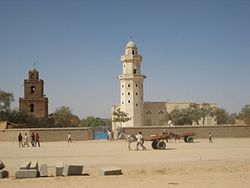
The city contains the remnants of the ancient capital, including palaces, mosques, and the tombs of former sultans.[2] The Grand Mosque on the central square (the Place de l'Indépendance), is one of the oldest and most significant mosques in the country, built in the 19th century. The city is served by Abéché Airport and contains the Lycee Franco-Arabe school.
History
[edit]From the early 19th century, Abéché was at the centre of the Islamic slave trade in Chad and an important city in the developing of the religion in the religion. Situated long the trans-Saharan trade route, many Islamic scholars and merchants travelled through the city.[3]

The city of Abéché was made capital of the Wadai Sultanate in the 1890s,[4] after the wells at Ouara, the former capital, had dried out.[5] In 1909, French troops invaded the Kingdom and established a garrison in Abéché, forcing the sultan to renounce his throne.[6] At that time, Abéché was the largest city in Chad with 28,000 people,[7] but major epidemics reduced the population to 6,000 in 1919.[8]
In 1935, the sultanate was restored by orders of the French government, and Muhammed Ouarada, heir to the throne after his father became king.[9]
On 25 November 2006, the city was taken by the Union of Forces for Democracy, a rebel group that sought to depose president Idriss Déby. Extensive looting took place during the night. On the same day, nearby Biltine was captured by the Rally of Democratic Forces, another rebel group. A day later, both cities were retaken by the Chadian army.[10]
On 30 October 2007, the city came to international attention when 17 French volunteers working for the charity Zoé's Ark were arrested there for alleged child abduction.[11]
Geography and climate
[edit]
Abéché is situated in central-eastern Chad, and by road it is 749 kilometres (465 mi) northeast of the national capital of N'Djamena, 164 kilometres (102 mi) northwest of Adre, on the border with Sudan, and roughly 90 kilometres (56 mi) southeast of Biltine.[12]
Abéché is the hottest major city in Chad.[13] It gets 336 afternoons a year above 32 °C (89.6 °F). Its rainy season is in mid-year, from June to September. The hottest months are from March to June. Köppen-Geiger climate classification system classifies its climate as a hot arid climate (BWh) due to its extreme potential evapotranspiration. It is one of the hottest cities on earth with average year-round daily high of over 36 °C or 97 °F, and an average daily mean of around 29 °C or 84 °F.[14]
| Climate data for Abéché (1961-1990 normals, extremes 1950–present) | |||||||||||||
|---|---|---|---|---|---|---|---|---|---|---|---|---|---|
| Month | Jan | Feb | Mar | Apr | May | Jun | Jul | Aug | Sep | Oct | Nov | Dec | Year |
| Record high °C (°F) | 45.0 (113.0) |
46.0 (114.8) |
47.5 (117.5) |
49.0 (120.2) |
47.5 (117.5) |
46.5 (115.7) |
44.0 (111.2) |
40.0 (104.0) |
42.0 (107.6) |
44.6 (112.3) |
43.0 (109.4) |
43.0 (109.4) |
49.0 (120.2) |
| Mean daily maximum °C (°F) | 33.6 (92.5) |
35.6 (96.1) |
38.2 (100.8) |
40.4 (104.7) |
40.0 (104.0) |
38.5 (101.3) |
34.5 (94.1) |
32.1 (89.8) |
35.1 (95.2) |
37.4 (99.3) |
35.7 (96.3) |
34.0 (93.2) |
36.3 (97.3) |
| Daily mean °C (°F) | 24.9 (76.8) |
26.9 (80.4) |
30.1 (86.2) |
32.8 (91.0) |
32.8 (91.0) |
31.7 (89.1) |
28.8 (83.8) |
27.0 (80.6) |
28.6 (83.5) |
29.7 (85.5) |
27.7 (81.9) |
25.5 (77.9) |
28.9 (84.0) |
| Mean daily minimum °C (°F) | 16.1 (61.0) |
18.2 (64.8) |
22.0 (71.6) |
25.1 (77.2) |
25.6 (78.1) |
24.9 (76.8) |
23.1 (73.6) |
21.8 (71.2) |
22.0 (71.6) |
22.0 (71.6) |
19.7 (67.5) |
16.9 (62.4) |
21.4 (70.5) |
| Record low °C (°F) | 7.1 (44.8) |
9.5 (49.1) |
11.0 (51.8) |
11.0 (51.8) |
17.0 (62.6) |
16.5 (61.7) |
15.0 (59.0) |
9.5 (49.1) |
15.5 (59.9) |
12.5 (54.5) |
11.5 (52.7) |
8.6 (47.5) |
7.1 (44.8) |
| Average precipitation mm (inches) | 0.0 (0.0) |
0.0 (0.0) |
0.1 (0.00) |
3.2 (0.13) |
12.1 (0.48) |
34.6 (1.36) |
98.1 (3.86) |
166.2 (6.54) |
53.4 (2.10) |
5.1 (0.20) |
0.1 (0.00) |
0.0 (0.0) |
372.8 (14.68) |
| Average precipitation days (≥ 0.1 mm) | 0 | 0 | 1 | 2 | 4 | 6 | 12 | 14 | 7 | 2 | 1 | 0 | 49 |
| Average relative humidity (%) | 20 | 17 | 16 | 18 | 27 | 41 | 60 | 71 | 61 | 35 | 23 | 23 | 34 |
| Mean monthly sunshine hours | 316.2 | 291.2 | 300.7 | 300.0 | 313.1 | 300.0 | 254.2 | 226.3 | 261.0 | 306.9 | 312.0 | 319.3 | 3,500.9 |
| Percentage possible sunshine | 90 | 90 | 81 | 81 | 80 | 78 | 64 | 59 | 72 | 85 | 92 | 92 | 80 |
| Source 1: NOAA[14][15] | |||||||||||||
| Source 2: WMO (precipitation days)[16] | |||||||||||||
Demographics
[edit]Demographic evolution:
| Year | Population[17] |
|---|---|
| 1988 | 40,000 |
| 1993 | 54,628 |
| 2008 | 78,191 |
| 2012 | 76,492 |
Economy
[edit]

The city is an important cattle raising centre.[2] The principal camel market in the country for exports,[18][19] the manufacture of camel-hair blankets is one of the industries of the area.[2] Abéché market is a thriving regional market, also known for its vegetables and fruit stalls, with onions and lettuce sold in abundance,[20] and spices, textiles, handmade crafts,[21] pottery and jewelry.[3]
Landmarks
[edit]Once one of the strongholds of the Arabic slave trade route, the city is known today for its markets, mosques, church, central square (the Place de l'Indépendance) and for its sultan's palace.[2] There are several notable Islamic structures in Abéché including the Grand Mosque on the central square, which is one of the oldest and most noteworthy mosques in the country, built in the 19th century, and the Wadi Fira Mosque, known for its minaret.[3]
Transportation
[edit]
It has major roads connecting it to the capital N'Djamena, as well as Sarh, and also to neighbouring Sudan.[2] The city is served by Abéché Airport which connects to city to N'Djamena and Faya-Largeau.[22]
Education
[edit]The Lycee Franco-Arabe school is located here.[2]
Notable people
[edit]- Youssouf Saleh Abbas (born 1953), Chadian political figure who was Prime Minister of Chad 2008 to 2010
- Mahamat Ahmat Alhabo (born 1953), politician
- Khayar Oumar Defallah (born 1944), politician, writer and actor
- Pape Diouf (1951-2020), football manager in Senegal
- Arabi El Goni (1920-1973), politician
- Mahamat Saleh Haroun (born 1961), director
- Mahamat Djarma Khatir (born 1943), politician
- Abderrahman Izzo Miskine (1952-2010), politician
- Tallafe (born 1981), artist
- Abdelkerim Souleyman Terio (born 1978), historian and writer
References
[edit]- ^ "World Gazetteer". Archived from the original on 11 January 2013.
- ^ a b c d e f Hoiberg, Dale H., ed. (2010). "Abéché". Encyclopædia Britannica. Vol. I: A-ak Bayes (15th ed.). Chicago, Illinois: Encyclopædia Britannica Inc. pp. 24. ISBN 978-1-59339-837-8.
- ^ a b c "Abéché, Chad – Islamic History, Architecture, and Culture". Iqrasense.com. Retrieved 8 July 2025.
- ^ "A survey of the libraries of Abéché, former capital of the Sultanate of Waday (Eastern Chad) (EAP472)". British Library. Retrieved 8 July 2025.
- ^ "Les ruines d'Ouara". World Heritage Site. Retrieved 8 July 2025.
- ^ "Public sitting held on Tuesday 22 June 1993, at 10 a.m., at the Peace Palace, President Sir Robert Jennings presiding". International Court of Justice. Retrieved 8 July 2025.
- ^ Anderson, David and Rathbone, Richard (2000). Africa's Urban Past. James Currey. p. 8. ISBN 9780852557617.
{{cite book}}: CS1 maint: multiple names: authors list (link) - ^ Azevedo, Mario J. and Decalo, Samuel (2018). Historical Dictionary of Chad. Bloomsbury Academic. p. 32. ISBN 9781538114360.
{{cite book}}: CS1 maint: multiple names: authors list (link) - ^ Anderson, Samuel DeJohn (2018). "Domesticating the Médersa: Franco-Muslim Education and Colonial Rule in Northwest Africa, 1850-1960" (PDF). UCLA. Retrieved 8 July 2025.
- ^ "Chad denies rebel move on capital". BBC News. 26 November 2006. Archived from the original on 9 September 2013.
- ^ "French charity members to be tried by Chad criminal court". Mg.co.za. Mail & Guardian (Zambia). 10 December 2007. Retrieved 8 July 2025.
- ^ "Abéché" (Map). Google Maps. Retrieved 8 July 2025.
- ^ "Chad Climate Index". Climate Charts. Archived from the original on 18 July 2013. Retrieved 27 October 2013.
- ^ a b "Abeche Climate Normals 1961–1990". National Oceanic and Atmospheric Administration. Retrieved 18 January 2023.
- ^ "Daily Summaries Station Details". National Oceanic and Atmospheric Administration. Retrieved 18 January 2023.
- ^ "World Weather Information Service – Abeche". World Meteorological Organization. Retrieved 24 June 2015.
- ^ World Gazetteer: Chad Archived 9 February 2012 at the Wayback Machine
- ^ Wotzka, Hans-Peter, Bollig, Michael, Schnegg, Michael (2013). Pastoralism in Africa - Past, Present and Future. Berghahn Books. p. 426. ISBN 9780857459091.
{{cite book}}: CS1 maint: multiple names: authors list (link) - ^ Diallo, Adama Moustafa Kardjadj, Renaud Lancelot (2019). Transboundary Animal Diseases in Sahelian Africa and Connected Regions. Springer International Publishing. p. 96. ISBN 9783030253851.
{{cite book}}: CS1 maint: multiple names: authors list (link) - ^ "The Little Market". Petut Fute. Retrieved 8 July 2025.
- ^ The City Trip Guide for Abéché (Chad). YouGuide Ltd. p. 37. ISBN 978-1-83706-084-9.
- ^ "Tchadia Airlines outlines planned network from Oct 2018". routesonline.com. Retrieved 26 September 2018.
External links
[edit] Media related to Abéché at Wikimedia Commons
.svg)
| International | |
|---|---|
| National | |
| Other | |

Abéché
View on GrokipediaAbéché is a city in eastern Chad that serves as the capital of the Ouaddaï Region and ranks as the fourth-largest urban center in the country.[1] Positioned between the Wadi Chao and Wadi Sao near the Sudanese border, it has historically functioned as a key trading and administrative hub in a semi-arid savanna environment.[1] The city gained prominence as the capital of the Wadai Sultanate, a Muslim kingdom founded around 1635 by Maba agriculturalists and Arab nomads, which exerted influence over trade routes and regional politics until French colonial forces captured it in 1912 and dismantled the citadel.[2] Today, Abéché retains cultural significance through remnants of sultanate-era structures, including palaces and mosques, while serving as a focal point for cross-border commerce and hosting substantial refugee populations from Sudanese conflicts in Darfur and the ongoing civil war.[3][2] Its strategic location has amplified its role in regional stability efforts amid recurrent instability and influxes straining local resources.[4]
History
Pre-Colonial Era
Abéché emerged as a significant settlement in the early 19th century within the territory of the Ouaddai Sultanate, a Muslim state founded around 1635 by the Maba chieftain Abd-el-Kerim, who overthrew the preceding Tungur rulers after conquering the region circa 1640.[5][6] The sultanate, initially subordinate to the Darfur Sultanate to its east, achieved independence by the 1790s through military expansion and consolidation of power over Maba agriculturalists, Arab pastoralists, and other groups in eastern Chad.[5] This polity controlled trans-Saharan trade routes, facilitating commerce in slaves, ivory, and ostrich feathers, and maintained a centralized administration under kolak (sultans) who enforced Islamic law and levied tribute from vassal communities.[7] Prior to Abéché's prominence, the sultanate's capital was Ouara (also known as Wara), established upon the state's founding and serving as the royal residence for over two centuries.[6] By the mid-19th century, environmental degradation, including the drying of Ouara's wells, prompted the relocation southward; Abéché, already an emerging oasis town approximately 100 kilometers away, was developed as the new capital around 1850–1890, with fortifications, palaces, and mosques constructed to house the court.[8][2] Under rulers like Yusuf (r. 1850s–1870s), Abéché grew into a hub of Islamic learning, attracting scholars from the Sahel and Sudan, and solidified the sultanate's role as a major pre-colonial power in Central Africa until French incursions began in the early 20th century.[6] The city's pre-colonial economy relied on agriculture, herding, and tribute systems, supporting a diverse population of Maba, Arab, and Fulani inhabitants amid ongoing raids and alliances with neighboring states.[9]Colonial Period and Independence
The conquest of Abéché by French forces marked the culmination of military campaigns against the Ouaddai Sultanate, a Muslim empire that had controlled eastern Chad for centuries. Following defeats of Ouaddai armies in engagements such as the Battle of Gouz, French troops under Colonel Moll entered the city on June 2, 1909, overcoming organized resistance from sultanate forces allied with regional powers.[10] [11] By August 13, 1909, French authorities had installed a puppet sultan, effectively subordinating local governance to colonial oversight and establishing a military garrison to secure the region.[10] This occupation followed a decade of intermittent warfare, including alliances with African auxiliaries, and integrated Abéché into the Military Territory of Chad formed in 1900, though full pacification of the broader Wadai Empire extended into 1912 amid ongoing revolts.[10] Under French colonial administration, Abéché transitioned from a sultanate capital to a peripheral administrative and military outpost in the sparsely developed eastern territories of French Equatorial Africa. The French imposed direct rule through commandants de cercle, prioritizing security against Sanusiyya-influenced uprisings and cross-border raids rather than economic investment, resulting in minimal infrastructure such as basic roads and administrative buildings.[11] [12] Local elites were co-opted or marginalized, with taxation and forced labor systems extracting resources like cotton and livestock to support colonial finances, while resistance persisted sporadically, including during the 1917-1918 revolts suppressed with aerial bombardments and mass executions.[10] Abéché's strategic position facilitated French control over trade routes to Sudan but underscored Chad's overall neglect within the empire, with governance centralized in Fort-Lamy (modern N'Djamena) after Chad's separation as a distinct colony in 1920.[12] Chad's path to independence, including Abéché's incorporation into the new republic, accelerated post-World War II amid global decolonization pressures and local political mobilization. The territory achieved self-governance in 1958 as the Republic of Chad within the French Community, culminating in full independence on August 11, 1960, under Prime Minister François Tombalbaye, who became president.[13] Abéché played no prominent role in the nationalist movements, which were dominated by southern and central elites, but retained its status as a regional hub under the independent administration, with French military presence lingering until the early 1960s.[11] The transition preserved colonial-era administrative divisions, setting the stage for ethnic tensions between the Arab-Muslim east, including Abéché, and the Christian-animated south.[10]Post-Independence Conflicts and Development
Following Chad's independence on August 11, 1960, Abéché, as the capital of the eastern Ouaddaï region, became a focal point for escalating ethnic and political tensions that fueled the country's civil wars. The city's strategic location near the Sudanese and Libyan borders positioned it as a gateway for rebel incursions and foreign interventions, exacerbating local conflicts between Arab and non-Arab communities. In December 1980, during the Chadian-L Libyan War, government forces loyal to Goukouni Oueddei recaptured Abéché from Forces Armées du Nord (FAN) troops under Hissène Habré, displacing thousands and contributing to refugee flows into neighboring Cameroon and Nigeria.[14] These clashes highlighted Abéché's role as a frontline in proxy battles involving Libyan support for northern factions, which prolonged instability and disrupted regional trade routes. The 1990s and 2000s saw Abéché repeatedly targeted amid ongoing rebellions and cross-border violence. On October 12, 1994, the Chadian government signed a peace accord with the Chadian National Front (CNF) in Abéché, aiming to integrate rebels into national structures, though sporadic fighting persisted. By November 25, 2006, United Front for Democratic Change (FUC) rebels launched a major assault on the city, overrunning its military airfield and humanitarian operations before withdrawing under French aerial support, an event that underscored Abéché's dual role as a military outpost and aid distribution hub. Intercommunal clashes between Arab and non-Arab groups intensified in 2019, killing hundreds and displacing communities around Abéché, driven by disputes over livestock and resources amid weak state presence.[14][15][16] Spillover from Sudan's conflicts has compounded Abéché's vulnerabilities, with Darfur violence since 2003 prompting over 200,000 refugees to settle in eastern Chad, straining local infrastructure and fueling proxy militia activities. The 2023 outbreak of Sudan's civil war exacerbated this, driving more than 930,000 Sudanese into Ouaddaï province by late 2024, including routes through Abéché, where armed groups exploit refugee flows for smuggling and recruitment. These influxes have heightened risks of resource competition and communal violence, with Chadian authorities closing borders intermittently to curb janjaweed incursions.[17][4] Development in Abéché has been severely constrained by chronic insecurity, limiting investments in agriculture, education, and urban infrastructure despite its status as a regional administrative center. Humanitarian aid has dominated economic activity, with Abéché serving as a base for UNHCR and NGO operations supporting refugee camps, though corruption and logistical challenges have hindered effective delivery. Efforts at stabilization, such as local ceasefires mediated in the city during the 2000s, have yielded temporary truces but failed to foster sustained growth, leaving the region with one of Chad's lowest human development indicators and persistent poverty affecting over 80% of residents.[18][19]21st-Century Instability
Abéché, as the administrative center of Ouaddaï province in eastern Chad, has been repeatedly affected by cross-border violence stemming from the Darfur conflict in Sudan since the early 2000s, with rebel groups and militias conducting raids that displaced civilians and targeted ethnic communities in the region. Human Rights Watch documented patterns of attacks by Darfur-based rebels on Chadian territory, including looting and abductions near Abéché, contributing to a humanitarian crisis that saw over 100,000 Chadians displaced alongside Sudanese refugees by 2007. These incursions were part of a broader proxy dynamic between Chad and Sudan, where eastern towns like Abéché served as staging points for retaliatory operations.[20][21] During the Chadian Civil War from 2005 to 2010, Abéché faced direct rebel assaults as opposition forces, often supported from Sudanese bases, advanced toward the capital. In November 2006, the Front Uni pour le Changement Démocratique (FUC) rebels briefly seized Abéché before being repelled by government forces, prompting Chadian troops to down a rebel aircraft in the aftermath. Similar offensives recurred, with witnesses reporting rebel attacks on government positions in Abéché as late as 2009, underscoring the city's strategic vulnerability due to its proximity to the Sudanese border and its role as a military and logistical hub.[22][23] Intercommunal tensions escalated in Abéché in January 2022 amid disputes over the appointment of a new traditional chief among the Gourane (Ouddeï) community, leading to protests that security forces suppressed with lethal force. On January 24, Chadian army and Mixed Force units fired on demonstrators, killing three people including a 12-year-old boy and injuring at least 40 others; the following day, indiscriminate shooting at a funeral in Tago Zagalo cemetery claimed 10 more lives and wounded over 40. At least 13 deaths and 80 injuries were confirmed, with 212 arrests involving reported beatings and poor detention conditions, though most were released within days; the government compensated families with approximately 731 USD each and initiated an investigation, but accountability remained limited.[24] The resurgence of war in Sudan since April 2023 has intensified instability around Abéché, with over 930,000 Sudanese refugees and returnees straining local resources in Ouaddaï province and heightening risks of intercommunal clashes over land and water. Deadly farmer-herder disputes near Abéché, such as those in Tiyo, Kidji, and Mina villages involving Arab herders and farmers, resulted in at least 27 deaths in one incident, exacerbating ethnic divisions amid the refugee influx. Chadian authorities imposed curfews and deployed additional forces, but underlying pressures from cross-border arms flows and militia activities continue to threaten escalation.[4][25]Geography
Location and Physical Features
Abéché is situated in eastern Chad as the capital of the Ouaddaï Region, at geographical coordinates approximately 13°50′N 20°50′E.[26][27] The city lies within the Sahelian belt, transitioning between the arid central plains and more elevated eastern terrains.[28] The elevation of Abéché averages around 540 meters above sea level, contributing to its semi-arid environmental profile.[26] The surrounding topography features generally flat savanna plains that rise gradually eastward toward the Ouaddaï highlands and massifs, part of Chad's broader pattern of increasing altitude away from Lake Chad in the west.[29][30] These physical characteristics include sparse vegetation adapted to low rainfall, with occasional rocky outcrops and wadis that channel seasonal runoff.[28]
Climate and Environmental Conditions
Abéché experiences a hot desert climate classified under the Köppen-Geiger system as BWh, characterized by extreme heat and minimal precipitation throughout the year.[31] Average high temperatures range from 34°C (93°F) in the cooler months of December to January to over 40°C (104°F) during the peak heat from April to June, while nighttime lows typically fall between 20°C (68°F) and 25°C (77°F).[32] Annual rainfall averages approximately 400 millimeters (15.7 inches), concentrated in a brief wet season from June to September, with August seeing the highest monthly total of about 145 mm (5.7 inches); the remainder of the year is markedly dry, with a rainless period extending over 7.6 months starting in mid-October.[32] [33] The region's aridity is exacerbated by its location in the Sahel zone, where persistent high evaporation rates outpace limited moisture inputs, leading to frequent dust storms and hazy conditions that reduce visibility and air quality.[34] Relative humidity remains low outside the wet season, often below 30%, contributing to the harsh thermal environment.[33] Wind patterns, including the harmattan winds from the northeast during the dry season, further intensify evaporation and soil drying.[34] Environmental conditions in Abéché are dominated by advancing desertification and recurrent droughts, driven by both natural variability and anthropogenic factors such as overgrazing and deforestation.[35] The absence of permanent rivers or surface water bodies forces reliance on groundwater, boreholes, and seasonal wadis, with urban water access limited—many residents depend on trucked supplies (19% usage) or traditional wells (44%), amid poor infrastructure development.[36] Climate change has amplified these pressures through erratic rainfall patterns and intensified dry spells, accelerating soil degradation and reducing vegetative cover in the surrounding semi-arid terrain.[37] [38] Periodic floods during intense wet-season storms contrast with prolonged droughts, posing risks to agriculture and pastoralism, though historical data indicate a slight increase in annual rainfall since the severe droughts of the 1970s and 1980s.[39]Demographics
Population Size and Growth
As of the 2009 Chadian census, Abéché had a population of 97,963 residents.[40] More recent projections estimate the city's population at approximately 140,000 in the mid-2020s, reflecting steady urban expansion amid Chad's national demographic trends.[41] This increase equates to an average annual growth rate of roughly 2.3% since 2009, lower than Chad's overall urban expansion rate of about 4.1% but consistent with patterns in secondary cities where migration and natural increase are tempered by limited economic pull compared to the capital.[28] High fertility rates—national crude birth rate exceeding 40 per 1,000—along with rural-to-urban migration for trade and services, have driven core growth, though the absence of post-2009 censuses introduces uncertainty in precise figures. Since April 2023, the Sudanese civil war has funneled over 930,000 refugees into eastern Chad, primarily Ouaddaï region, augmenting local populations through informal settlements and urban influxes around Abéché, though most refugees remain in border camps rather than the city proper.[4] This has accelerated pressure on Abéché's demographics, with Ouaddaï's provincial population projected to exceed 1.17 million, but city-specific data remains extrapolated from regional humanitarian assessments rather than direct enumeration.[42] Sustained high growth risks exacerbating water scarcity and sanitation deficits in the semi-arid setting, as evidenced by aquifer strain analyses.[42]Ethnic and Religious Composition
The ethnic composition of Abéché is dominated by the Maba people, a Sudanic group that forms the traditional population of the Ouaddaï region and established the historical sultanate with its capital at the city.[43] Nomadic and sedentary Arab groups, such as the Baggara, constitute a significant portion of the residents, often intermingling with Maba communities in urban and pastoral activities.[44] Smaller ethnic presences include neighboring groups like the Assangori and Daju, reflecting the city's role as a regional trade hub.[9] Religiously, Abéché's inhabitants are overwhelmingly adherents of Sunni Islam, aligned with the Sufi Tijaniyyah order prevalent in eastern Chad.[45] Among the Maba, 99.1% identify as Muslim, with Christians numbering fewer than 200 individuals out of a group population exceeding 500,000.[44] The broader Ouaddaï region maintains approximately 95% Muslim adherence, underscoring the negligible presence of Christianity, animism, or other faiths in the city proper.[44]Government and Administration
Local Governance Structure
Abéché serves as an urban commune within Chad's decentralized administrative system, which divides authority among regions, departments, and local entities such as municipalities. The Commune d'Abéché is governed by an elected municipal council responsible for local affairs, including urban planning, sanitation, public markets, and basic infrastructure maintenance.[46] The council holds regular sessions to deliberate on development priorities, as evidenced by its second ordinary session in 2025 focused on enhancing local development initiatives.[47] The mayor, elected by the municipal council, heads the executive functions of the commune and oversees implementation of council decisions. As of February 2025, the mayor is Dr. Abdelmahamoud Adam Yahya, who assumed office following a handover ceremony and has prioritized engagement with municipal services for improved governance.[48][49] This structure aligns with Chad's 1996 Constitution and subsequent decentralization laws, which devolve limited fiscal and administrative powers to communes while maintaining central oversight.[50] At the departmental level, the prefect of Ouara—where Abéché is the administrative seat—exercises supervisory authority, appointed by presidential decree to enforce national policies, manage security, and coordinate with communes on inter-jurisdictional issues. The current prefect, Dr. Abdelwahit Mahamat Daoud, installed in July 2025, has issued directives on public order and engaged local stakeholders to strengthen administrative collaboration.[51][52] Regional governance in Ouaddaï, headed by a centrally appointed governor, provides broader policy direction but defers daily municipal operations to Abéché's council and mayor, reflecting Chad's ongoing but incomplete decentralization efforts amid centralized executive dominance.[53]Political Role in National Context
Abéché functions as the administrative capital of the Ouaddaï region, exerting influence on national politics through its strategic position along Chad's volatile eastern border with Sudan, where it serves as a frontline for managing security threats and refugee inflows that could destabilize the central government in N'Djamena.[4] The city's military base has historically anchored Chadian defense efforts against incursions, hosting French troops until their withdrawal on January 11, 2025, amid terminated bilateral defense agreements, after which Turkish forces assumed control in February 2025 to support counterterrorism and border operations.[54][55] This shift underscores Abéché's evolving role in diversifying Chad's international security partnerships during its post-2021 political transition under interim President Mahamat Idriss Déby Itno.[56] Throughout Chad's civil conflicts, Abéché has repeatedly emerged as a pivotal battleground, often targeted by rebels advancing from Sudanese bases, thereby shaping national power transitions. In December 1990, Idriss Déby's forces seized the city from Hissène Habré's regime, paving the way for their capture of the capital and Déby's ascension to power.[14] Similarly, in November 2006, Union of Forces for Democracy and Development (UFDD) rebels assaulted Abéché as a key eastern hub, aiming to disrupt government logistics before pushing toward N'Djamena, though repelled with French logistical aid.[15] These episodes highlight Abéché's function as a gateway for external-backed insurgencies, compelling the central government to prioritize eastern military reinforcements to safeguard regime survival.[57] In contemporary national politics, Abéché's proximity to Sudan's ongoing civil war amplifies its significance, as cross-border violence and over 600,000 Sudanese refugees strain resources and fuel local grievances that risk national escalation.[17] Government crackdowns, such as the March 2022 clashes where security forces killed at least 13 protesters amid disputes over traditional Ouaddaï leadership, illustrate tensions between central authority and regional sultanate legacies, potentially undermining the unity government formed after Déby Itno's death in April 2021.[24][1] The establishment of a UN Human Rights sub-office in Abéché in September 2025 reflects international recognition of the city's role in stabilizing eastern Chad to avert broader political fragmentation.[58]Economy
Key Economic Activities
Abéché's economy centers on livestock husbandry and associated trade, leveraging the savanna grasslands of the Ouaddaï region for rearing cattle, sheep, goats, and camels. The city functions as a key market hub in eastern Chad, where pastoralists exchange live animals and meat products, including dried meat, which is produced locally from abundant livestock supplies.[59][60] This sector employs a significant portion of the population and supports value-added activities such as leather processing. Subsidiary activities include small-scale agriculture and commerce in commodities like gum arabic, dates, dried fish, and salt, facilitated by Abéché's position along trade routes.[61] Livestock markets drive regional exchange, with recent government initiatives establishing a Special Economic Zone in Abéché to promote meat processing and exports, aiming to capture more value from Chad's 129 million head of livestock.[62] These activities face constraints from environmental variability and security issues, yet they remain foundational, contributing to national livestock output that accounts for 18% of Chad's GDP.[63]Trade and Market Dynamics
Abéché functions as a key regional trading center in eastern Chad, leveraging its location near the Sudanese border to facilitate cross-border commerce in livestock, poultry, and other goods. Local markets emphasize informal trade networks, with livestock exchanges forming the backbone of economic activity, including cattle, goats, and indigenous chickens supplied by surrounding pastoralist communities.[64][65] Road connections to neighboring countries support the flow of products like dried meat, Arabic gum, dates, and salt, though insecurity along routes periodically disrupts volumes.[65] Livestock markets in Abéché handle significant volumes, with cattle trade contributing substantially to Chad's export balance after oil, often involving live animals destined for regional processing elsewhere. Poultry marketing involves 38 traders in the city's markets, where local chickens are wholesaled and retailed, yielding profitability margins for participants despite seasonal fluctuations. Egg provisioning relies heavily on imports, with approximately 50% sourced from Sudan, supplemented by Cameroon and limited local production, averaging sales prices around regional norms.[66][67][68] Cross-border dynamics introduce volatility, as Sudanese refugee influxes have driven localized cattle price increases, such as 37% above five-year averages in Abéché by October 2023, straining supply chains amid heightened demand. Trade remains predominantly male-dominated and cash-based, with limited formal financial instruments, reflecting broader challenges in Chad's undiversified economy. Ongoing conflicts spillover from Sudan further pressures market stability, overwhelming urban labor and commodity flows.[69][70][17]Economic Challenges and Constraints
The economy of Abéché, centered in the Ouaddaï region, grapples with entrenched structural vulnerabilities, including a heavy dependence on rain-fed agriculture and pastoralism that exposes it to recurrent droughts and floods, alongside limited diversification into manufacturing or services. Poverty rates in Ouaddaï stood at 38% in 2021, surpassing the national average of 34%, with multidimensional poverty disproportionately affecting women and rural households.[3] These conditions are compounded by inadequate infrastructure, such as unreliable electricity and poor road networks, which hinder market access and investment, perpetuating high unemployment and informal labor dominance.[71] The ongoing Sudanese civil war since April 2023 has intensified these pressures through massive refugee inflows, with over 600,000 Sudanese refugees and Chadian returnees settling primarily in Ouaddaï, effectively doubling the local population and overwhelming public services and economic capacity. In Abéché specifically, refugees now constitute approximately 30% of residents, saturating the labor market and driving down wages—for instance, in domestic work—while doubling rental prices and displacing locals, which has elevated urban poverty and petty crime rates.[3] Humanitarian aid meets only about 35% of needs as of September 2024, exacerbating food insecurity, with host communities resorting to crisis-level coping strategies amid persistent high prices and market disruptions.[3][72] Cross-border trade, a traditional economic lifeline for Abéché as a regional hub, has been severely curtailed by the Sudan conflict, blocking imports of essentials like sugar, soap, and fuel from Sudan—leading to sharp price hikes—and halting livestock exports, which caused cattle values to plummet from 100,000 CFA francs to 60,000 CFA francs per head.[3] Frequent border closures and insecurity from spillover violence further stifle commerce, while national-level issues like weak governance and elite capture limit fiscal responses or private sector growth in the east.[19][73] Overall, these factors contribute to Chad's broader economic fragility, with extreme poverty projected to affect 40.6% of the population by 2025, disproportionately burdening eastern regions like Ouaddaï.[74]Infrastructure
Transportation Networks
Abéché serves as a key transport hub in eastern Chad, primarily reliant on road and air connections due to the absence of rail infrastructure nationwide. The city's transportation networks facilitate domestic travel, humanitarian aid delivery, and limited cross-border movement, though they are constrained by poor maintenance, seasonal flooding, and security issues.[75] Abéché Airport (IATA: AEH), one of Chad's prominent secondary airports, features an asphalt runway measuring 2,800 meters in length and supports domestic flights, including scheduled services from N'Djamena three times weekly on Mondays, Wednesdays, and Fridays, with occasional Sundays, lasting approximately one hour. The facility maintains a refueling capacity of 140,000 liters per year for Jet A-1 fuel at 800 XAF per liter, enabling operations for commercial, military, and humanitarian aircraft. It handles connections to other Chadian cities and neighboring countries, though primarily domestic routes predominate.[76][77] Road networks link Abéché to the capital N'Djamena via a 1,000-kilometer paved route eastward toward Sudan, completed as part of broader corridor developments, yet travel times extend to 14-16 hours owing to deep potholes and rugged terrain. Chad's overall road system totals around 40,000 kilometers, with national and regional roads comprising 25,000 kilometers, but eastern connections suffer from underdevelopment, flooding vulnerabilities, and limited paving. Recent initiatives include a €44.16 million grant from the African Development Fund in November 2024 for constructing roads linking eastern and southern regions, alongside earlier Islamic Development Bank support for 380 kilometers since 2006. Cross-border roads to Sudan remain vital for trade and refugee flows but face ongoing insecurity and maintenance challenges.[78][79][80]Public Services Including Education and Health
Abéché's public services are constrained by limited infrastructure and the pressures of serving a growing population, including Sudanese refugees, in eastern Chad's arid environment. The Société Tchadienne d'Eau et d'Électricité (STEE) manages water and electricity distribution, but access remains inconsistent, with urban supply prioritized over rural outskirts and frequent shortages reported due to outdated systems and high demand.[81] A utility-scale solar photovoltaic plant with battery energy storage, commissioned around 2020, generates approximately 14.5 million kWh annually to address electricity deficits for the city's roughly 80,000 residents, supplementing diesel gensets amid national electrification rates below 10 percent.[82][83] Education in Abéché aligns with Chad's national system, characterized by low enrollment rates—nationally, fewer than half of school-age children attend primary school, with girls disproportionately affected.[84] Primary and secondary schools serve local and refugee populations, with over 163,000 Sudanese refugee children enrolled across eastern Chad's public institutions as of 2025, following the national curriculum; however, out-of-school rates for refugees aged 6-18 hover around 53 percent due to overcrowding and resource shortages.[85][86] Higher education includes the École Normale Supérieure d'Abéché (ENSA), a public teacher-training institution established in 2011 with a capacity of about 720 students, focusing on secondary-level pedagogy, disciplinary competencies, and psychopedagogy; it has graduated hundreds of refugee teachers, including 20 Sudanese students in 2021 and additional Sudanese women in 2025.[87][88][89] A private option, the Université Libre de Zone de Savane (ULZS), established in 2006, offers postsecondary programs but operates amid broader challenges like limited facilities and teacher shortages.[90] Health services center on the Hôpital Provincial d'Abéché, a public facility built in the 1970s with an official capacity of 289 beds, providing general internal medicine, surgery, pediatrics, and emergency care to locals, returnees, and refugees.[91][92] The hospital frequently exceeds capacity during crises, treating thousands of trauma cases from cross-border violence—over 2,300 war-wounded in Ouaddaï province alone since 2023—with support from the World Health Organization (WHO), which deployed surgeons in 2023, and the International Committee of the Red Cross (ICRC) for surgical enhancements.[93][94] Refugee-focused aid includes UAE field hospitals nearby, serving over 9,000 patients by mid-2024 with operating rooms, labs, and pharmacies, though core public capacity remains limited by staff shortages and equipment gaps in a country with severe healthcare provider deficits.[95][96]Security and Conflicts
Historical Cross-Border Violence
The cross-border violence between Chad and Sudan in the Ouaddaï region, where Abéché serves as the administrative capital, intensified during the mid-2000s amid the Darfur conflict's spillover and a proxy war in which Sudan backed Chadian rebel groups while Chad allegedly supported Darfur insurgents. Sudanese Janjaweed militias, often operating with government forces, conducted raids into eastern Chad targeting non-Arab ethnic communities such as the Masalit and Dajo, mirroring ethnic cleansing patterns in Darfur. These incursions, starting around 2003 but escalating in 2005, displaced tens of thousands and strained local resources in Ouaddaï, with Abéché becoming a hub for internally displaced persons (IDPs) fleeing border areas like Adré and Goungour.[21] Specific attacks included a September 27, 2005, Janjaweed raid near Modoyna in Ouaddaï, killing 53 to 72 civilians and prompting flight to Koloy. In December 2005, coordinated assaults by Janjaweed and Sudanese troops using helicopters targeted 22 villages in Goungour prefecture, 80 km south of Adré, resulting in 45 deaths and 15 injuries, followed by strikes on 40 villages in nearby Borota prefecture through January 2006, claiming 12 lives. These operations coincided with Chadian rebel advances from Sudan, such as the December 2005 assault on Adré by the Rally for Democracy and Liberty (RDL), which killed dozens and exposed vulnerabilities in Chadian border defenses redeployed to counter internal threats.[21][21] The proxy dynamics peaked with the November 2006 raid on Abéché by the Union of Forces for Democracy and Development (UFDD), a Sudan-based rebel faction, which targeted the airport and military installations, killing several soldiers and underscoring Sudan's alleged support for anti-government forces to destabilize President Idriss Déby's regime. Chad retaliated by accusing Sudan of orchestrating these incursions, leading to severed diplomatic ties in 2006 and intermittent clashes until a 2010 normalization agreement. The violence exacerbated ethnic tensions in Ouaddaï, arming local militias and fostering banditry that persisted beyond the immediate Darfur phase, though formal hostilities waned after 2008.[97][98]Sudanese Refugee Crisis
The outbreak of civil war in Sudan on April 15, 2023, between the Sudanese Armed Forces and the Rapid Support Forces has triggered one of Africa's largest refugee movements, with eastern Chad—particularly the Ouaddaï region encompassing Abéché—bearing the brunt as the primary border reception area.[99] By September 2025, Chad hosted 1,282,924 Sudanese refugees, alongside over 216,000 Chadian returnees from Sudan, with the majority arriving via border points near Abéché and settling in makeshift sites or formal camps in Ouaddaï.[99] [100] Abéché, as the provincial capital and logistical hub, has facilitated initial screening, registration, and aid distribution for tens of thousands of new arrivals weekly in peak influx periods.[4] Ouaddaï province, home to roughly one million residents prior to the crisis, now shelters nearly 646,000 Sudanese refugees and returnees, representing a demographic shock that has overwhelmed local capacity.[101] Key camps such as Dougui, Malkakine, and sites near Adré and Toumtouma—coordinated from Abéché—house over 300,000 displaced persons, with 61% being children under 18 facing acute needs for water, shelter, and nutrition.[102] [4] Humanitarian operations led by UNHCR, UNICEF, and WFP from Abéché bases have registered over 722,000 new Sudanese refugees since April 2023, but persistent underfunding—covering only a fraction of needs—has led to reliance on spontaneous settlements prone to flooding and disease, including cholera outbreaks in 2025. [103] The refugee surge has intensified security challenges in Abéché, with cross-border incursions by Sudanese armed elements, including Rapid Support Forces affiliates, prompting Chadian military reinforcements along the frontier.[4] Resource competition in the semi-arid region has fueled localized disputes over water, pasture, and markets, heightening risks of communal violence between host Zaghawa and Arab communities and incoming Masalit and other Darfuri groups, though Chad's government has maintained relative stability through border patrols and refugee dispersal.[4] [104] International reports note that while outright spillover war has been contained, the presence of unregulated fighters and arms flows exacerbates chronic instability, with Abéché serving as a flashpoint for potential escalation amid Sudan's unresolved conflict.[17]Ongoing Security Threats and Responses
The primary ongoing security threats in Abéché arise from the spillover of Sudan's civil war into Chad's Ouaddaï region, where cross-border incursions by militias affiliated with the Rapid Support Forces (RSF) have targeted villages and strained border stability. Since April 2023, these dynamics have displaced over 930,000 Sudanese refugees and Chadian returnees into eastern Chad, fueling inter-communal clashes between Arab populations and non-Arab groups like the Zaghawa, who predominate among the arrivals, amid competition for scarce resources such as water and pastureland.[4] [17] RSF elements, often integrated with local Chadian Arab militias, have conducted sporadic raids, exacerbating arms proliferation and illicit trade networks that sustain low-level violence.[105] [106] Internal tensions compound these external pressures, including disputes over traditional authority in Ouaddaï, such as the contested appointment of a new sultan, which triggered demonstrations in Abéché involving hundreds of protesters in December 2024 and ongoing unrest into 2025.[107] [108] These events highlight risks of politicized violence, with non-Arab returnees viewing the sultanate as aligned with pro-RSF Arab factions, potentially drawing in Sudanese combatants present among refugees.[17] While jihadist groups like Boko Haram pose threats elsewhere in Chad, their activity remains limited in the east compared to Lake Chad basin operations.[109] Chadian authorities have responded by reinforcing military presence in Abéché and along the Sudan border, including patrols to deter RSF crossings and protect key infrastructure like the local military base.[105] In January 2025, the handover of the French-operated base in Abéché to Chadian control marked a pivot to national forces, enabling sustained operations without foreign reliance.[110] Security units have quelled protests, such as those around the sultanate, through deployments that safeguarded the appointee while investigating instigators.[108] President Mahamat Idriss Déby Itno has prioritized army modernization for efficient threat neutralization, amid broader efforts to integrate regional militias into state structures to mitigate communal risks.[111] United Nations agencies, including UNHCR, support refugee screening to identify armed elements but emphasize that sustained border security depends on Chadian military capacity to prevent escalation.[112]Culture and Landmarks
Cultural Heritage and Traditions
The cultural heritage of Abéché is profoundly shaped by the legacy of the Wadai Sultanate, which relocated its capital there in 1850 and fostered Islamic scholarship, governance, and trade networks blending Arab and indigenous African elements. Predominantly Maba-speaking residents, alongside Arab and Fulani groups, preserve traditions centered on Sunni Islam, with daily practices including communal prayers and Quranic education influenced by 19th-century manuscripts produced in local libraries. Oral traditions remain vital, transmitting historical narratives of sultanate rulers and intertribal relations through griots' storytelling, accompanied by stringed instruments like the kundé and rhythmic percussion.[113][2][114] Festivals underscore communal identity, notably the annual Sultan’s Festival, which commemorates the sultanate's hereditary authority through rituals honoring past leaders, traditional dances depicting historical battles, and feasts featuring millet-based dishes like boule. The Abéché Festival highlights ethnic diversity with performances of music and rituals involving masked dancers and livestock parades, drawing from Maba and Arab customs dating to the sultanate era. Islamic observances, such as Eid al-Fitr following Ramadan, involve mass prayers at mosques and family gatherings with shared meals of sacrificed sheep, reinforcing social bonds in this 98% Muslim region.[115][116][117] Artisanal practices form another pillar, with women specializing in pottery decorated with geometric motifs symbolizing fertility and protection, a craft linked to pre-sultanate Ouaddaï settlements, while men engage in leatherworking for saddles and amulets used in nomadic herding rituals. These traditions, exhibited in local museums, face erosion from urbanization but persist in markets where bartering reflects historical caravan economies.[118][117]Notable Sites and Monuments
The Grand Mosque of Abéché, located on the central Place de l'Indépendance, represents a key architectural and religious landmark in the city. Built during the 19th century under the Ouaddai Sultanate, it exemplifies traditional Islamic design and serves as a focal point for communal prayers and reflection.[113] Its prominence underscores Abéché's historical role as a center of Islamic scholarship and trade in eastern Chad.[113] Abéché retains physical remnants of its era as the capital of the Ouaddai Sultanate (established in the early 19th century), including ruins of palaces and tombs of former sultans. These sites, scattered amid the urban landscape, offer tangible evidence of the sultanate's administrative and cultural influence, which peaked before French colonization in 1909.[119] The palace ruins, in particular, highlight fortified structures adapted to the region's defensive needs against regional rivals. The Place de l'Indépendance functions as the city's primary public square, adjacent to the Grand Mosque and used for national celebrations, such as Chad's independence anniversary on August 11. Historically known as Place Moll-Tadjaddine, it has witnessed significant local events, including responses to colonial-era incidents in the early 20th century.[120]Notable People
Youssouf Saleh Abbas (born 1953), a Chadian diplomat and politician who served as Prime Minister from April 2008 to March 2010, was born in Abéché.[121][122]Mahamat-Saleh Haroun (born 1961), a Chadian film director known for works such as A Screaming Man (2010), which received the Jury Prize at the Cannes Film Festival, was born in Abéché.[123][124]
Mahamat Ahmat Alhabo (born October 25, 1953), a Chadian politician and academic who served as Minister of Finance from 1995 to 1996 and later as Minister of Justice, was born in Abéché.[125]