Hubbry Logo
The TombsThe TombsMain
Open search
The Tombs
Community hub
The Tombs
logo
8 pages, 0 posts
0 subscribers
Be the first to start a discussion here.
The Tombs
The Tombs
from Wikipedia

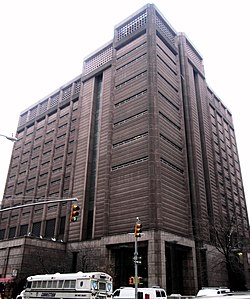
The Tombs was the colloquial name for Manhattan Detention Complex[1] (formerly the Bernard B. Kerik Complex during 2001–2006[2]), a former municipal jail at 125 White Street in Lower Manhattan, New York City. It was also the nickname for three previous city-run jails in the former Five Points neighborhood of lower Manhattan, in an area now known as the Civic Center.

Key Information

The original Tombs was officially known as the Halls of Justice, built in 1838 in an Egyptian Revival architectural style, similar in form to a mastaba.[1] It may have been this style that caused it to be called "the Tombs", although other theories exist. It was built as a replacement for the Colonial-era Bridewell Prison located in City Hall Park, built in 1735. The new structure incorporated material from the demolished Bridewell to save money.[3]

The four buildings known as The Tombs were:

  • 1838–1902, New York City Halls of Justice and House of Detention
  • 1902–1941, City Prison
  • 1941–2023, Manhattan House of Detention (became Manhattan Detention Complex South Tower in 1983)
  • 1990–2023, Manhattan Detention Complex North Tower

The two existing buildings began demolition in 2023, in preparation for a planned replacement jail building.

History

[edit]

Halls of Justice and House of Detention, 1838–1902

[edit]
An Egyptian-Revival-style building on a street corner; there are doric columns on the façade to the right of the image. There are men on the street, and work is being done using cranes, on an adjacent building out of frame to the right.
The original Egyptian-Revival-style Tombs building in a photograph from 1893. Leonard Street, left. Centre Street, right.
An etching of a man and a woman being married in a jail cell. Sunlight streams in through a small window.
Artist's depiction of the wedding of John C. Colt in The Tombs, 1842
Harry Kendall Thaw in his cell, 1912

The first complex to have the nickname was an Egyptian Revival design by John Haviland completed in 1838. There was a rumor at the time that the building was inspired by a picture of an Egyptian tomb that appeared in John Lloyd Stephens' Incidents of Travel in Egypt, although this appears to be untrue.[4][5] The building was 253 feet, 3 inches in length and 200 feet, 5 inches wide, and it occupied a full block, surrounded by Centre Street, Franklin Street, Elm Street (today's Lafayette), and Leonard Street. It initially accommodated about 300 prisoners, and $250,000 was allocated in 1835 to build it, but various cost overruns occurred prior to completion of the project.

The building site had been created by filling in the Collect Pond that was the principal water source for Colonial New York City. Industrialization and population density by the late 18th century resulted in the severe pollution of the Collect, so it was condemned, drained, and filled in by 1817. The landfill job was poorly done, however, and the ground began to subside in less than 10 years. The resulting swampy, foul-smelling conditions transformed the neighborhood into a slum known as Five Points by the time that prison construction started in 1838. The heavy masonry of Haviland's design was built atop vertical piles of lashed hemlock tree trunks in a bid for stability, but the entire structure began to sink soon after it was opened. This damp foundation was primarily responsible for its unsanitary conditions in the decades that followed. Charles Dickens wrote about the jail in American Notes: "Such indecent and disgusting dungeons as these cells, would bring disgrace upon the most despotic empire in the world!"[6]

The Tombs' formal title was The New York Halls of Justice and House of Detention, as it housed the city's courts, police, and detention facilities. It was a notable example of Egyptian Revival architecture, although opinion varied greatly concerning its actual merit. As Dickens wrote: "What is this dismal fronted pile of bastard Egyptian, like an enchanter's palace in a melodrama?"

The prison was well known for its corruption and was the scene of numerous scandals and escapes during its early history. A fire destroyed part of the building on November 18, 1842, the same day that a notorious killer named John C. Colt was due to be hanged. Apparently it was an escape attempt on Colt's part that failed, and he fatally stabbed himself in his cell.[7] Convicted murderer and New York City politician William J. Sharkey earned national notoriety for escaping from the prison disguised as a woman on November 22, 1872. He was never captured and his fate is unknown.[8]

Rebecca Salome Foster, a prison relief worker and missionary, became known as "the Tombs Angel" for her efforts to help and advocate on behalf of the many poor people held in squalid conditions at the Tombs. A monument to her, built in 1902 and put in storage in 1940, was rededicated in 2019 in the New York State Supreme Court's lobby.[6]

City Prison, 1902–1941

[edit]
The "Bridge of Sighs" connecting the 1902 Tombs prison at left with the 1894 Manhattan Criminal Courts building, looking west from Centre Street
The Bridge of Sighs c. 1896

In 1902, the 1838 building was replaced by a million-dollar City Prison featuring an eight-story Châteauesque facade with conical towers along Centre Street, bounded by Centre Street, White Street, Elm Street (today's Lafayette), and Leonard Street.[9]

The architects were Frederick Clarke Withers and Walter Dickson from Albany, who had been partners since the 1880s. This was their final major commission. In September 1900, the architects complained that construction would be delayed for a year and cost an additional $250,000 due to the unnecessary insertion of corrupt Tammany Hall architects Horgan and Slattery into the project.[10]

The building was connected to the 1892 Manhattan Criminal Courts Building with a "Bridge of Sighs", crossing four stories above Franklin Street. There was also an Annex with another 144 cells that was finished in 1884.

Manhattan House of Detention, 1941–1974

[edit]
The Manhattan House of Detention (left) was built in 1941, at the same time as the Manhattan Criminal Courthouse (right). It became the South Tower of the expanded and renamed Manhattan Detention Complex once the new North Tower opened in 1990.

The 1902 prison was replaced in 1941 by a high-rise facility across the street on the east side of Centre Street. The 795,000 square foot[11] Art Deco architecture facility was designed by architects Harvey Wiley Corbett and Charles B. Meyers.[12][13]

The facility is the northernmost of the four 15-story towers of the New York City Criminal Courts Building at 100 Centre Street, bounded by Centre Street, White Street, Baxter Street, and Hogan Place. The three southern towers are wings of a single integrated structure sharing a five-story "crown"[14] which house the city's Criminal and Supreme Courts, city offices, and various departments, including the headquarters of the Department of Corrections. The northern tower is freestanding, with the separate address of 125 White Street. It was officially named the Manhattan House of Detention for Men (MHD), although it was still referred to popularly as The Tombs.

By 1969, the Tombs ranked as the worst of the city's jails, both in overall conditions and in overcrowding. It held an average of 2,000 inmates in spaces designed for 925.[15] Inmates rioted on August 10, 1970, after multiple warnings about falling budgets, aging facilities, and rising populations, and after an informational picket of City Hall by union correctional officers drawing attention to the pressures. Rioters took command of the entire ninth floor, and five officers were held hostage for eight hours, until state officials agreed to hear prisoner grievances and take no punitive action against the rioters.[16] Despite that promise, Mayor John Lindsay had the primary troublemakers shipped upstate to the state's Attica Correctional Facility which likely contributed to the Attica Prison riot about a year later.[17]

Within a month after the riot, the New York City Legal Aid Society filed a landmark class action suit on behalf of pre-trial detainees held in the Tombs. The city decided to close the Tombs on December 20, 1974, after years of litigation and after federal judge Morris E. Lasker agreed that the prison's conditions were so bad as to be unconstitutional. They shipped the remaining 400 inmates to Rikers Island, where conditions were not much better.[18]

Manhattan Detention Complex, 1983–2023

[edit]

The Manhattan Detention Complex consisted of a South Tower, the former Manhattan House of Detention remodeled and reopened in 1983, and a North Tower across White Street, completed in 1990. The complex housed only male inmates, most of them pretrial detainees. The total capacity of the two buildings was nearly 900 people.[19]

The jail was named The Bernard B. Kerik Complex in December 2001 at the direction of New York City mayor Rudolph Giuliani.[2] Kerik was commissioner of the New York City Department of Corrections from 1998 to 2000[20][1] before becoming police commissioner.[20] New York City mayor Michael Bloomberg ordered Kerik's name removed after he pleaded guilty to two misdemeanors in 2006, committed during his tenure as a city employee.[1]

In 2019, the New York City Council announced plans to build four new jails citywide to replace Rikers Island, including a high-rise jail tower on the site of the Tombs.[21] The New York Daily News reported that the city planned to close the complex prior to the end of November 2020.[22] The demolition of the Tombs attracted criticism from landlords, local residents, and prison-reform advocates.[21][23] Opponents claimed the redevelopment would harm local residents and businesses.[21] An injunction preventing the jail tower's construction was issued by the New York Supreme Court in 2020 but was overturned the next year.[24] Two artists also filed a lawsuit to preserve artwork that was displayed on the Tombs' facade, but U.S. district judge Lewis A. Kaplan declined to grant an injunction,[25] and seven murals were subsequently removed.[26] The demolition of the Tombs was finally approved in April 2023[27][28] but was paused after further objections.[29] Demolition continued despite objection by local residents and was completed in August 2024.[30][31]

Notable people

[edit]

In November 2000, 16 people associated with the Opie and Anthony radio show were arrested and held in The Tombs overnight during a promotion for "The Voyeur Bus", a mostly glass bus carting topless women through Manhattan with a police escort.[32]

References

[edit]

Further reading

[edit]
[edit]
Revisions and contributorsEdit on WikipediaRead on Wikipedia
from Grokipedia
The Tombs is the colloquial name for the Manhattan Detention Complex, a New York City jail facility in Lower Manhattan primarily used for pre-trial detention of accused individuals. The nickname derives from the original structure, officially the Halls of Justice and House of Detention, built between 1835 and 1840 on the site of the former Collect Pond in an Egyptian Revival style resembling an ancient mausoleum. Designed with influences from Egyptian tomb architecture, the granite edifice featured distinctive elements such as Egyptian-style columns and a "Bridge of Sighs" connecting to the courthouse for condemned prisoners. Intended to hold around 200 inmates, the facility quickly became overcrowded, routinely housing over 400 by the amid chronic dampness from its marshy foundation, poor ventilation, and inadequate sanitation, conditions repeatedly condemned by grand juries as unhealthy. It served as a key detention center, processing approximately 50,000 prisoners annually, including separate sections for males, females, and juveniles, as well as a with courtyard gallows for public executions until the adoption of the . The original building was replaced in 1902 due to structural decay, and subsequent iterations faced ongoing issues of violence, riots, and overcrowding, with the modern complex at 125 White Street retaining the infamous moniker despite plans for borough-based jail reforms.

History

Origins and Halls of Justice (1838–1902)

The New York Halls of Justice and House of Detention, later nicknamed The Tombs, was constructed between 1835 and 1838 on the site of the former , a filled-in freshwater body that had previously served as a dumping ground and contributed to ongoing dampness issues. Designed by English-born architect John Haviland in the Egyptian Revival style, the facility consolidated the city's criminal courts, police headquarters, and house of detention into a single complex. Built of granite quarried stone, the structure measured 253 feet long by 200 feet deep and occupied the block bounded by Centre, (later Lafayette), , and Franklin Streets. Upon completion in 1838, the building opened as the principal jail for , replacing outdated facilities like the Bridewell jail, with an initial capacity for about 200 inmates though it soon exceeded this due to rising urban crime rates. The nickname "The Tombs" emerged from its resemblance to an ancient Egyptian mausoleum, reinforced by its somber, monolithic appearance and subterranean-like cells. Operations included housing accused persons awaiting trial, inmates pending execution, and vagrants, alongside active police and judicial functions in the upper halls. However, the low-lying site's instability caused the structure to settle unevenly, leading to cracked walls, flooded basements, and persistent health hazards such as disease outbreaks from poor ventilation and sanitation. Throughout its tenure until 1902, The Tombs became infamous for , with cell blocks often holding far beyond capacity, proliferation, and inadequate oversight, drawing repeated condemnations from grand juries for unfitness. Notable incidents included frequent escapes via weak points in the aging masonry and public scandals over inmate mistreatment, though it also served as a site for high-profile cases involving figures from New York's underworld. By the early 1900s, structural decay and urban expansion necessitated replacement; in September 1902, the remaining prisoners—numbering around 400—were transferred to new facilities, marking the end of operations and paving the way for demolition.

City Prison Period (1902–1941)

The City Prison, commonly known as The Tombs, opened in September 1902 at 101 Centre Street in Lower Manhattan, replacing the dilapidated original structure built in 1838. Designed initially by the firm Withers & Dickson and modified by Horgan & Slattery, the new facility adopted a Chateauesque style incorporating Gothic and Renaissance elements, featuring an eight-story facade with conical towers. It included 320 cells arranged in two four-tier corridors, each equipped with a cot, table, washbasin, toilet, and electric light, alongside administrative offices, hospital cells, a library, chapels, and a rooftop exercise area. Primarily functioning as a pre-trial detention center, the prison confined accused individuals awaiting trial or sentencing, processing approximately 50,000 prisoners annually. Designed for 320 inmates, it frequently exceeded capacity due to persistent overcrowding, reaching 669 prisoners in 419 cells by 1930. Early operations emphasized modernization, including a school for youthful offenders established in to support rehabilitation efforts. A connecting bridge, reminiscent of the earlier "," linked the prison to the criminal courts. Notable detainees included , heir to a railroad fortune, who was confined there following his June 25, 1906, shooting of architect atop ; Thaw was escorted across the Bridge of Sighs to a cell in the homicide tier. His high-profile trials for the murder, spanning 1907 and 1915, drew intense media scrutiny while he remained incarcerated at the facility. Overcrowding intensified from 1911 onward, rendering the structure inadequate despite initial improvements over its predecessor. The continued operations until 1941, when it was supplanted by a new high-rise detention center amid broader efforts to address urban jail conditions.

Manhattan House of Detention Era (1941–1974)

In 1941, the City Prison structure was replaced by a new facility at 125 White Street, officially designated the Manhattan House of Detention for Men, though it retained the longstanding nickname "The Tombs" among the public. This Art Deco-style building, constructed between 1938 and 1941 as part of the New York County Criminal Court complex, primarily functioned as a short-term detention center for male pre-trial detainees, including those awaiting , , or . Early records from 1941 to 1943 document routine operations tracking inmate categories such as those held pending or awaiting bills of , reflecting its role in supporting the local criminal justice system amid New York City's growing urban population. The facility's capacity was designed for approximately 1,000 inmates, but by the late , chronic —often exceeding limits by hundreds—combined with deteriorating infrastructure, elevated it to one of the most criticized municipal jails in the country. faced inadequate medical care, including the absence of operational machines and sterilizers as of 1971, when the population reached nearly 1,500 despite a rated capacity of under 1,000. These conditions fueled unrest, with a series of riots beginning at the Manhattan House of Detention in August 1970 and spreading to other city facilities, driven by demands for better treatment and amid reports of and . Legal challenges intensified scrutiny, including a 1972 lawsuit contesting confinement standards that argued the environment violated constitutional protections against . Federal Judge Morris E. Lasker ultimately ordered the facility's closure by August 10, 1974, citing pervasive overcrowding and other constitutional deficiencies as rendering it unfit for continued use. The approximately 400 remaining inmates were transferred to , marking the end of operations at the site until a later reopening under a different configuration.

Manhattan Detention Complex Operations (1983–2023)

The Manhattan Detention Complex, comprising the remodeled South Tower (formerly the Manhattan House of Detention) and the newly constructed North Tower, resumed operations in 1983 following a $42 million renovation of the South Tower to address structural and sanitary deficiencies identified in prior federal oversight. The South Tower reopened that year with upgraded facilities for housing, while the North Tower, designed by Urbahn Associates in a utilitarian concrete style, opened in 1990 to expand capacity amid rising pretrial detainee volumes driven by New York City's crack epidemic and felony arrest surges in the 1980s. The complex, operated by the New York City Department of Correction (DOC), exclusively detained adult male inmates, primarily those held pretrial on charges processed through Manhattan Criminal Court, with daily transports facilitated via the adjacent "Bridge of Sighs" passageway to the 100 Centre Street courthouse. Intake procedures involved classification by risk level, medical screening via NYC Health + Hospitals Correctional Health Services, and assignment to general population or enhanced security tiers, though persistent overcrowding—exacerbated by citywide jail populations peaking above 20,000 in the early 1990s—strained resources and led to dormitory-style housing in some areas. Daily protocols emphasized containment and court readiness, with inmates subjected to multiple headcounts, restricted recreation in enclosed yards, and limited visitation under armed supervision to mitigate escape risks and inter-inmate conflicts. Security measures included metal detectors, pat-down searches, and segregation units for violent or high-profile detainees, yet reports documented recurrent assaults, such as stabbings over contraband or gang affiliations, contributing to a reputation for brutality that echoed the facility's historical precedents. DOC programming focused on basic rehabilitation, offering limited GED classes, substance abuse counseling, and vocational training through partnerships, though participation rates remained low due to short stays averaging under 30 days for most pretrial cases. Population trends mirrored broader DOC declines post-1990s crime drop, falling from near-capacity strains in the 1980s (when citywide intakes exceeded 100,000 annually) to under 900 detainees by the 2010s, influenced by plea bargaining efficiencies and reduced felony prosecutions. By the 2000s and 2010s, operational challenges shifted toward mental health management, with over 30% of inmates requiring psychiatric intervention amid rising suicide attempts citywide, prompting enhanced monitoring protocols but yielding mixed efficacy as verified by federal monitors. Bail reform legislation in 2019 further reduced admissions, lowering average daily populations to historic lows by 2023, while COVID-19 protocols in 2020–2022 imposed quarantines and reduced programming, exposing ventilation inadequacies in the aging South Tower. Despite these adaptations, inmate grievances highlighted inadequate legal access and commissary delays, with DOC data indicating over 500 use-of-force incidents annually in the complex during peak years, often involving corrections officers responding to improvised weapons. The facility's role as a short-term holding site underscored its mandate under New York law for pretrial security without emphasis on long-term correction, though critics from legal aid groups argued that systemic delays in trials prolonged detentions beyond constitutional norms.

Closure, Demolition, and Planned Replacement (2020–Present)

In October 2020, New York City officials announced the closure of the Manhattan Detention Complex, known as The Tombs, by the end of November as part of the broader initiative to phase out Rikers Island and establish borough-based jails. The facility, which housed pre-trial male detainees, ceased operations amid longstanding concerns over deteriorating infrastructure and alignment with the city's $8.6 billion plan—later expanded—to replace Rikers by 2027. Inmates were transferred primarily to Rikers Island and other city facilities, leaving the site vacant. Demolition of the complex's two main buildings—an L-shaped structure at 124-125 White Street in —began in early 2023 at a projected cost of $125 million. By August 2024, the entire facility had been razed, with full completion anticipated by January 2025 despite reports of construction-related damage to adjacent buildings, including the Chung Pak senior housing complex. The process, managed by Gramercy Group, faced criticism for elevated and structural impacts on nearby properties during the teardown. The site is designated for a new 16-story detention center as the component of the borough-based jails program, with preliminary renderings released in 2025 showing the first four floors allocated for community centers and retail space, followed by jail facilities on levels five through 16. Construction contracts were awarded in November 2024, advancing the project toward completion by the 2027 Rikers closure deadline, though local opposition in persists over the facility's scale, traffic impacts, and community disruption. Alternative proposals, such as repurposing the site for and relocating detention functions to a shuttered federal facility, have been floated but not adopted by city officials. As of late 2025, the project proceeds amid ongoing debates about feasibility and neighborhood effects.

Architecture and Site

Original Egyptian Revival Design

The original Tombs, formally known as the Halls of Justice, was designed by architect John Haviland and completed in 1838 in the Egyptian Revival style. This design drew inspiration from ancient Egyptian tombs depicted in John Lloyd Stephens' 1837 travelogue Incidents of Travel in Egypt, Arabia Petraea, and the Holy Land, which included etchings of monumental mausolea, as well as broader influences like the Ptolemaic Temple at Dendera. The style's motifs, evoking death and permanence, aligned with the prison's function, leading contemporaries to dub it "The Tombs" despite its temple-like facade. Constructed from grey Maine granite, the fortress-like edifice spanned 253 feet in length and 200 feet in depth, filling an entire block bounded by Centre, Elm, Franklin, and Leonard Streets in Lower Manhattan. Key features included a massive portico with giant columns bearing lotus capitals, papyrus-stalk columns at entryways, and tall, narrow windows that enhanced its monolithic, one-story appearance externally. Broad steps on Centre Street provided access to the main entrance, flanked by pylons that reinforced the mausoleum aesthetic. Erection began in 1835 on the site of the former Collect Pond, a marshy area filled with landfill, requiring innovative foundations of hemlock pilings driven into quicksand and a underlying raft of mud-embedded planks to mitigate settling. Internally, the structure enclosed a central courtyard with segregated cell blocks: the men's facility held 150 cells measuring 10 by 6 feet each, alongside separate wings for women and juvenile detainees. These engineering adaptations addressed the site's unstable soil but foreshadowed long-term structural issues that prompted demolition in 1902.

Later Structures and Urban Integration

In 1902, the original Egyptian Revival structure was demolished and replaced by a new city prison at the same site on Centre Street, featuring a massive gray edifice with a chateau-like appearance constructed from reused . This replacement retained the colloquial name "The Tombs" despite its divergent from the prior tomb-inspired design. The 1902 building integrated into Lower Manhattan's judicial precinct through a rebuilt "," a covered elevated passageway linking it to the adjacent Criminal Courts Building on the west side of Centre Street. Spanning four stories above , the bridge enabled secure, concealed transfers of detainees to courtrooms, minimizing exposure to the surrounding urban environment and reflecting practical adaptations for a dense . By 1941, escalating demands prompted further reconstruction, with the facility shifting northward to 125 White Street as the Manhattan House of Detention, a steel-framed structure designed to house pre-trial inmates amid growing city populations. This relocation preserved proximity to the courts, approximately one block away, sustaining the integrated workflow between detention and adjudication while accommodating vertical expansion in a constrained urban footprint. Subsequent modifications, including the 1983 reopening of the Manhattan Detention Complex with added tower elements, emphasized fortified perimeters and subterranean levels for inmate processing, embedding the complex deeper into Chinatown's fabric without disrupting street-level commerce. These evolutions prioritized functional connectivity to judicial operations over aesthetic continuity, prioritizing causal efficiency in prisoner management within New York's evolving skyline.

Site Location and Historical Context

The Manhattan Detention Complex, commonly known as the Tombs, occupied 125 White Street in Lower Manhattan's Civic Center neighborhood, bounded by Centre Street to the east, Lafayette Street (formerly Elm Street) to the west, Leonard Street to the south, and White Street to the north. This location was directly atop the filled-in site of Collect Pond, a natural freshwater body that served as New York City's primary water source during the colonial era until industrial pollution rendered it unusable by the early 19th century. Collect Pond, separated from the by a marshy strip, became contaminated by nearby tanneries, slaughterhouses, and other industries, prompting the city to fill it with garbage and landfill starting around 1800 and completing the process by 1811. The resulting unstable, marshy ground transformed the area into the infamous Five Points district, marked by overcrowding, poverty, and high crime rates, before municipal authorities repurposed the city-owned land for institutional development. This subsidence-prone foundation would later cause significant structural problems for buildings constructed there, including the original edifice. In 1838, the city erected the Halls of Justice and House of Detention on this site, designed in Egyptian Revival style to evoke a sense of permanence and isolation befitting a detention facility. The selection centralized courts, police, and detention functions, moving them from older structures like the Bridewell jail, and leveraged the site's availability amid urban expansion pressures. Subsequent iterations of the complex, including a 1902 replacement and later towers, maintained occupation of the same foundational area, perpetuating the nickname "the Tombs" derived from the original building's tomb-like appearance.

Operational Role

Pre-Trial Detention Mandate

The Manhattan Detention Complex, commonly known as The Tombs, functioned primarily as a facility under the New York City Department of Correction, holding individuals arrested within who could not secure release on , own , or other conditional terms pending , , or sentencing. This mandate aligned with the broader operational framework of 's borough-based jails, which are constitutionally distinguished from state prisons by detaining presumptively innocent accused persons rather than convicted offenders serving extended sentences. From its origins as the Halls of Justice in 1838, the facility served as 's central booking and short-term holding site for criminal suspects processed through the adjacent Criminal Courts Building at , accommodating an estimated 50,000 detainees annually in the late 19th and early 20th centuries. The pre-trial focus stemmed from New York Penal Law provisions and local ordinances governing pretrial release under Article 510, which presume release unless flight risk, , or other compelling factors justify detention; The Tombs thus housed those deemed ineligible for alternatives, often comprising and arrestees awaiting preliminary hearings or indictments. Federal court rulings, such as Rhem v. Malcolm (1974), explicitly recognized this role, certifying class actions on behalf of "unconvicted detainees" at the then-Manhattan House of Detention and affirming that conditions must not punish those held solely for inability to post . By the 1970s, over 90% of inmates were pre-trial, with average stays of 60-90 days exacerbated by court backlogs, contrasting with post-conviction facilities like for sentenced individuals transferred after plea or verdict. Operational protocols reinforced this mandate through segregated housing for pre-trial populations, including mental health evaluations under the city's Act amendments and compliance with the prohibiting punitive conditions for unconvicted persons, as upheld in subsequent litigation like Cooper v. Morin (1977). The facility's capacity, peaking at around 1,000 beds in its final decades, prioritized proximity to Manhattan's courts to facilitate rapid transport for appearances, minimizing disruptions from longer-distance transfers seen in other jurisdictions. This judicial adjacency underscored its custodial rather than rehabilitative purpose, with no formal programming for long-term inmates, though short-term misdemeanor sentences occasionally overlapped until policy shifts post-1980s funneled most convicted low-level offenders to alternative facilities.

Security Measures and Daily Protocols

The Manhattan Detention Complex implemented multi-layered security measures to manage pre-trial detainees, including physical searches, , and risk-based classifications. New arrivals underwent intake procedures involving medical screening, fingerprinting, photography, strip searches, and mandatory clothing exchanges into facility uniforms to detect and prevent entry. Following documented violence, the Department of Correction (DOC) augmented these with expanded security camera installations and reformed entrance protocols to curb flow and enhance monitoring of housing units and visitor areas. High-risk were placed in Centrally Monitored Cases (CMC) status, entailing heightened restraints, frequent reviews every 28 days, and separation based on factors like escape history or alerts; similarly, Enhanced Supervision Housing (ESH) isolated those posing credible threats to staff or others, with provisions for rehabilitative access. Mail and packages faced routine inspections, with subject to confiscation and owner notification within 24 hours. Daily operations adhered to standardized DOC protocols emphasizing order and court readiness, given the facility's role in short-term pre-trial holding. Inmates experienced nightly lock-ins from 9:00 PM to 5:00 AM, punctuated by headcounts between 7:00–8:00 AM and 3:00–4:00 PM, limiting movement to supervised periods. Meals followed heart-healthy guidelines, with supervised distribution of lunch and dinner mandatory; special diets for medical, religious, or vegan needs required approval via sick call or chaplaincy. Recreation consisted of one hour daily, preferably outdoors absent weather or security constraints, under staff oversight to mitigate risks in a population prone to transient tensions. Visitation protocols differentiated pre-trial detainees, allowing three sessions weekly (including one evening or weekend slot) for up to three visitors, with attorney access extended from 8:00 AM to 8:00 PM daily; all visits incorporated searches and behavioral monitoring. Court transports formed a core routine, prioritizing rapid arraignments amid central booking demands, though frequent headcounts and lockdowns occasionally delayed proceedings.

Staff and Inmate Demographics

The Detention Complex, known as the Tombs, functioned primarily as a facility for male adults processed through Manhattan criminal courts, housing over 90% male inmates throughout its operational history from 1983 to 2023. Its rated capacity stood at 898 beds, though average daily populations varied; for instance, in late amid closure plans, it held 434 inmates. Approximately 87% of the broader jail population, including at the Tombs, consisted of pretrial detainees, with the remainder serving short sentences under one year. Inmate racial and ethnic demographics mirrored systemic patterns in New York City jails, where individuals accounted for 43% of those incarcerated despite comprising 15% of the local population, Hispanics about 35%, and around 20%. These disparities stemmed from higher arrest and detention rates for violent and drug-related offenses in minority communities, though facility-specific breakdowns for the Tombs were not publicly detailed in official reports. Age distributions typically skewed young, with most inmates aged 18-35, reflecting pretrial caseloads dominated by and charges. Staffing at the Tombs included 748 correction officers as of October 2020, supporting daily operations in a high-security environment. Department of Correction uniformed personnel, who staffed facilities like the Tombs, numbered around 9,000 overall, with correction officers comprising the majority: approximately 58% male and 42% female, 60% , 24% , and the rest or other groups. These demographics evolved from recruitment efforts amid chronic understaffing and high turnover rates in urban jails, where officer-to-inmate ratios often exceeded national averages.

Conditions and Criticisms

Overcrowding and Physical Deterioration

The Manhattan Detention Complex, commonly known as the Tombs, experienced persistent since its early operations, often doubling or more its intended capacity and straining . In , officials attributed overcrowding to delays in judicial processing, with Recorder Smyth noting that the facility's congestion stemmed from insufficient throughput rather than an absolute lack of space. By 1911, Commissioner of Correction reports highlighted "tremendous overcrowding," prompting calls for psychiatric evaluation of amid the crush. In 1926, the Prison Board formally condemned the Tombs for severe overcrowding alongside inadequate medical care, warning of risks to public safety from unchecked inmate interactions. Conditions intensified in the mid-20th century, with citywide jail populations in reaching 7,900 against a designed capacity of 4,200, including the Tombs as a key pre-trial facility. A 1970 survey of 907 Tombs revealed widespread complaints of crowded, unsanitary cells, where four out of five reported insufficient space for basic movement. That August, the facility held 1,992 prisoners—more than double its rated 932 capacity—triggering a seizure over the inhuman density. By September 1971, post-riot counts showed even higher occupancy than pre-uprising levels, perpetuating cycles of unrest and . Such excesses, driven by New York City's high arrest volumes and practices, systematically outpaced maintenance efforts, as evidenced by federal oversight noting deterioration from the mid-1960s onward. Physical deterioration compounded these pressures, with the original 1838 Egyptian Revival structure showing decay almost immediately due to poor on unstable and relentless overuse. Subsequent rebuilds, including the 1902 iteration, inherited foundational flaws like and water infiltration, leading to chronic leaks, mold proliferation, and structural weakening when paired with . By the 1970s, the 1941-era towers at exhibited accelerating wear—cracked walls, failing plumbing, and inadequate ventilation—exacerbated by doubled populations that accelerated fixture breakdowns and sanitation failures. Reports from uprisings and oversight bodies consistently linked these issues to causal : excess density hastened material fatigue, while deferred repairs stemmed from budget priorities favoring operations over capital improvements, rendering cells increasingly uninhabitable over decades.

Violence, Riots, and Health Issues

Inmate violence at the Manhattan Detention Complex, known as the Tombs, has been persistent, with assaults often involving improvised weapons such as shanks fashioned from metal scraps. A investigative report detailed recurring stabbings and beatings among pre-trial detainees, attributing the frequency to and inadequate supervision, where inmates described daily threats escalating into group attacks that left victims requiring off-site medical intervention. These incidents reflect broader patterns in jails, where violence contributes to a cycle of retaliation, as guards struggle to monitor housing units housing hundreds in close quarters. Major riots have punctuated the facility's history, most notably in amid systemic and racial tensions. On , , approximately inmates seized control of multiple floors, smashing furniture, flooding cells, and taking correction officers hostage for several hours before state troopers intervened with and rifles, resulting in injuries to dozens but no immediate fatalities. This event was part of a wave of uprisings across detention centers that year, driven by complaints over poor food, medical neglect, and indeterminate sentencing for those unable to post , with inmates demanding reforms like better visitation and reduced isolation. A subsequent October revolt further highlighted guard-inmate clashes, underscoring failures in de-escalation protocols that allowed minor disputes to erupt into facility-wide chaos. Health issues among Tombs inmates stem primarily from infectious disease transmission in unsanitary conditions and untreated mental illnesses exacerbated by confinement. Reports indicate that up to 20% of detainees in the New York City jail system, including the Tombs, suffer from serious mental health disorders, leading to elevated suicide rates; for instance, a 1971 incident involved a convicted robber with documented psychiatric issues hanging himself in his cell due to lapses in monitoring. Physical ailments, such as injuries from falls or fights, affect a significant portion, with 39% of reported cases in city jails requiring external care beyond on-site facilities, often due to delayed triage in understaffed clinics. Chronic problems like tuberculosis and HIV proliferate in the pre-trial population, where short stays discourage preventive screening, compounded by architectural flaws that trap moisture and hinder ventilation. These conditions have resulted in multiple in-custody deaths annually across the system, including at the Tombs, frequently linked to untreated withdrawal or self-harm rather than external violence.

Policy Failures Contributing to Conditions

Chronic underinvestment in and for the original Tombs facility exacerbated physical deterioration and health hazards, as the low-lying location on a former site led to persistent dampness and structural instability from the outset. Built between and 1840 on unstable soil, the was repeatedly condemned by grand juries for unhealthiness, with inadequate ventilation and contributing to disease outbreaks among inmates. This neglect stemmed from municipal policies prioritizing cost over habitability, resulting in a facility unfit for long-term use despite early warnings. Policies governing amplified , with the facility designed for 200 inmates but routinely housing far more due to reliance on cash bail and delayed trials, fostering tensions that erupted in violence. By the mid-20th century, the Tombs held populations exceeding capacity by multiples, leading to the 1970 uprising where inmates seized a floor in protest of substandard conditions, including poor food, medical care, and sanitation. These issues reflected broader failures in prosecutorial efficiency and bail practices that prolonged detentions without addressing root causes like case backlogs. In the contemporary era, systemic oversight lapses within the New York City Department of Correction have perpetuated violence and self-harm, as documented in federal investigations revealing inadequate screening of correction officers with histories of misconduct and failure to enforce use-of-force protocols. A 2014 Department of Justice report under the Civil Rights of Institutionalized Persons Act highlighted deliberate indifference to inmate safety across city jails, including the Manhattan Detention Complex, where staff-on-inmate assaults and unchecked gang activity thrived due to understaffing and poor training. Court-mandated reforms, such as the 2015 Nunez settlement aimed at curbing excessive force, have been repeatedly violated, with a 2024 federal contempt finding citing 18 breaches, including falsified reporting and staffing shortages that enabled ongoing brutality. These deficiencies arise from policy inertia, including union contracts shielding problematic personnel and political delays in implementing accountability measures, directly causal to elevated injury rates and deaths.

Notable Detainees and Events

High-Profile Inmates

, the wealthy heir to a coal and railroad fortune, was detained in The Tombs for over ten months after shooting architect on the rooftop of on June 25, 1906. Thaw's confinement in a cell on the homicide tier included privileges afforded by his family's influence, such as frequent visits from his mother and catered meals from upscale restaurants like , which contrasted sharply with conditions for ordinary inmates. He was ultimately deemed insane and committed to the Matteawan State Hospital for the Criminally Insane rather than executed or imprisoned long-term. Edward S. Stokes, a financier and former associate of robber baron , was held in The Tombs' after fatally shooting Gould's business partner James Fisk Jr. on January 6, 1872, amid a dispute over a railroad venture and a romantic rivalry involving actress . Stokes furnished his cell lavishly with carpets, artwork, and fine linens at his own expense, receiving daily visitors and meals from outside, which highlighted disparities in treatment based on wealth during the . After multiple trials, he was convicted of manslaughter and sentenced to four years at Prison. William M. "Boss" Tweed, the influential leader of Tammany Hall's political machine notorious for systemic corruption in 19th-century , was arrested and initially sent to The Tombs following his post-Civil War indictments for and involving millions in public funds. Tweed's detention there was brief before transfer to the , where he later died in while serving a 12-year sentence. Other notable 19th-century detainees included , brother of firearms inventor , who murdered printer on September 17, 1841, over a publishing dispute and was held in a condemned cell where he married before dying by apparent suicide on November 18, 1842, hours before his scheduled hanging. Gang leaders from the Whyo Gang, such as Danny Lyons (executed August 21, 1886) and Danny Driscoll (executed January 23, 1888), were confined and hanged in the prison yard for murders committed during the gang's reign of extortion and violence in the Five Points slums. Financier , who defrauded the Marine National Bank of approximately $2 million in the 1880s, spent months in The Tombs before transfer to . In the modern era, the facility has held pre-trial detainees from criminal cases, including figures like following his May 25, 2018, arrest on rape and sexual assault charges, though transfers to occurred post-arraignment for extended custody. These cases underscore The Tombs' continued role in detaining prominent individuals awaiting trial, often under heightened security due to public scrutiny.

Significant Incidents and Escapes

On August 10, 1970, approximately 800 inmates at the Manhattan House of Detention, known as the Tombs, initiated a by seizing control of the ninth floor and taking several correction officers for eight hours, protesting , inadequate medical care, and delays in trials. The uprising involved smashing furniture, breaking windows, and setting fires, requiring police intervention to restore order; it highlighted systemic failures in , contributing to subsequent class-action lawsuits that exposed unconstitutional conditions. The unrest escalated in early October 1970, with riots spreading from a facility to the Tombs on October 2, where inmates seized multiple floors, took 18 to 23 hostages, and damaged property across the building, including setting bedding ablaze. These events, part of a wave of jail rebellions preceding the , resulted in injuries to staff and inmates but no fatalities at the Tombs; they prompted federal oversight and accelerated demands for facility reforms. In a failed escape attempt on October 29, 1926, inmates initiated a at the Tombs, leading to the deaths of Peter A. Mallon, Keeper Jeremiah Murphy, and three prisoners amid attempts to smuggle contraband for breakout. This incident underscored vulnerabilities in internal security protocols at the time. One of the most audacious escapes occurred on November 19, 1873, when convicted murderer J. Sharkey, a Tammany Hall operative, walked out of the Tombs at midday disguised as a , with assistance from visitor Maggie Jourdan who supplied the attire during a permitted visit. Sharkey, sentenced for killing a political rival in a street brawl, evaded recapture entirely, his fate remaining unknown despite a nationwide manhunt. On October 23, 1972, seven inmates charged with felonies executed the first successful escape from the modern Tombs structure by exploiting a neglected area damaged during the 1970 riots, tunneling or slipping through unsecured sections after weeks of preparation; initial reports noted all remained days later, prompting tightened security measures. This breach exposed lingering infrastructural weaknesses from prior unrest.

Legacy and Impact

Influence on Criminal Justice Practices

The Tombs, as New York's primary pretrial detention facility from 1838 onward, exemplified systemic flaws in urban criminal justice, particularly the abuse of bail practices where unregulated bondsmen issued fraudulent "straw bail" using fictitious property, enabling many defendants to evade trial. By the 1890s, high bail amounts often functioned as de facto acquittals for those unable to pay, prompting reforms such as the 1894 shift to corporate surety companies to replace individual bondsmen and reduce fraud. These changes aimed to standardize bail processes but highlighted broader pretrial detention inequities, influencing subsequent bail reform efforts in New York, including the establishment of night courts in 1911 to expedite minor cases and curb professional bondsmen exploitation. Administrative delays at the facility, including the "" of thousands of indictments—such as over 20,000 unprosecuted by —underscored prosecutorial inefficiencies and contributed to prolonged detentions without , deviating from contemporaneous penal ideals emphasizing isolation, structured labor, and rehabilitative diets. Instead, operations relied on informal negotiations between inmates and officials, fostering a chaotic environment that prioritized containment over correction and exposed the limits of early reformist models in high-volume urban settings. In the , chronic overcrowding and substandard conditions—evident in reports of filth, , and inadequate ventilation—sparked riots, such as the 1970 uprising tied to racial tensions and poor management, which galvanized advocacy for detainees' rights. The landmark Rhem v. Malcolm litigation (filed 1970) resulted in a 1974 federal ruling by Judge Morris E. Lasker declaring conditions unconstitutional under the Eighth Amendment, mandating reforms like improved sanitation and reduced population density. Rather than comply fully, opted for closure in 1974, transferring inmates to and mooting further orders, a decision that established a for judicially compelled facility shutdowns over remediation in cases of entrenched neglect. This outcome influenced national discourse on , reinforcing arguments for alternatives to incarceration amid delays and emphasizing federal courts' role in enforcing minimal standards, though it also illustrated challenges in sustaining reforms post-closure as issues migrated to other sites. The Tombs' legacy thus underscored causal links between poor detention practices and violations, informing later policies prioritizing bail reduction and speedy trials to mitigate similar abuses.

Cultural and Media Depictions

The Tombs has been portrayed in 19th-century literature as a symbol of and punitive excess, with John Josiah Munro's "The New York Tombs: Inside and Out!" (circa 1880s), written by the facility's former chaplain, offering vivid firsthand reminiscences of its operations and inmate experiences, framing it as a site of stories "stranger than fiction." Similarly, "The Mysteries of the Tombs: A Journal of Thirty Days Imprisonment" provides an insider's account of daily life within its confines, highlighting the psychological toll of detention. In mid-20th-century , Meyer Berger's two-part New Yorker series "The Tombs—I" and "The Tombs—II" (August and September 1941) chronicled its historical evolution from the 1838 Egyptian Revival structure to contemporary operations, emphasizing architectural notoriety and failures. Film depictions include scenes in "American Gangster" (2007), where the complex represents New York's criminal underbelly during the heroin trade. Independent shorts like "The Tombs" (2011), directed by Jerry LaMothe, dramatize a detainee's three-day ordeal in the central booking system, underscoring procedural inefficiencies and interpersonal tensions. Documentary footage from , captured by filmmakers inside the facility, preserves visual records of its overcrowded and volatile environment prior to major reforms. These representations collectively reinforce The Tombs' enduring image as a microcosm of American penal system's challenges, from structural squalor to human suffering.

Debates on Necessity Versus Reform

In the context of New York City's broader jail reform efforts, debates over the Manhattan Detention Complex (commonly known as The Tombs) have centered on balancing the facility's role in against calls for systemic changes to reduce incarceration. Proponents of necessity argue that a centralized detention site in is essential for efficient processing of arrestees through central booking and rapid transport to nearby courthouses, minimizing logistical burdens and ensuring public safety by holding individuals deemed flight risks or dangers to the community. Preventive detention practices, as outlined in New York , emphasize judicial authority to remand suspects based on of potential harm, a function that The Tombs historically supported amid rising concerns over following 2019 bail reforms that restricted safety considerations in release decisions. Reform advocates, including city officials and advocacy groups, have pushed for closure of the aging complex due to its documented structural decay and operational inefficiencies, culminating in the New York City Department of Correction's announcement on October 9, 2020, to shutter The Tombs by late November that year as part of consolidating resources and reducing overtime amid a declining jail population. This move aligned with the 2019 City Council mandate to close by 2027, replacing it with borough-based facilities, including a planned 29-story tower at the Tombs site to maintain detention capacity closer to courts while improving conditions. Critics of unchecked , however, highlight empirical risks, such as proposals to empower judges with greater for safety-based remands to counteract perceived leniency in pretrial release, which some analyses link to localized crime spikes post-bail changes. Opposition to replacement construction has intensified community debates, with Chinatown residents and abolitionist groups protesting the new Manhattan jail since 2020, citing environmental reviews and neighborhood impacts, leading to lawsuits that delayed groundbreaking until demolition advanced toward early 2025. By October 2025, former Governor advocated rebuilding Rikers over scattered borough jails, arguing the latter's $16 billion cost and logistical complexities undermine effective detention without addressing core public safety needs. Empirical studies on pretrial alternatives remain contested, with some data indicating supervised release does not elevate reoffending rates, yet others stressing detention's role in mitigating risks for high-threat individuals, informing ongoing tensions between abolitionist ideals and pragmatic retention of reformed facilities.

References

Add your contribution
Related Hubs
User Avatar
No comments yet.