Hubbry Logo
Aboyne CastleAboyne CastleMain
Open search
Aboyne Castle
Community hub
Aboyne Castle
logo
8 pages, 0 posts
0 subscribers
Be the first to start a discussion here.
Aboyne Castle
Aboyne Castle
from Wikipedia

Aboyne Castle is a 13th-century[1] castle in Aberdeenshire, Scotland 0.75 mi (1.21 km) north[2] of the town of Aboyne (Grid Reference NO5299).[3] The location of Aboyne Castle was selected for its strategic position near the River Dee and controlling the northern end of one of the Mounth crossings.[4][5] Aboyne Castle was formerly derelict,[6] but was restored by the present Marquess of Huntly in 1979.

Key Information

Architecture

[edit]

The castle was constructed by the Bysets, lords of Strathdee and Aboyne, before 1233, as a motte and bailey. Edward I sent instructions for its fortification in 1307.[6] It was later turned into a stone keep. In 1671, Charles Gordon, 1st Earl of Aboyne rebuilt the west wing as a tower house, parts of which are still visible. His son, the 2nd Earl, added a mansion house in 1701: George Gordon, 9th Marquess of Huntly added an east wing in 1801.[7] In 1869, kitchen improvements were made using granite and stepped gables. The Mansion House was updated in the 1880s by Sir Cunliffe Brooks by adding baronial-style ornamentation. George Truefitt did some restoration work in the later part of the 19th century. The castle was remodelled in 1986 by Ian Begg.[8]

Historical picture of the castle

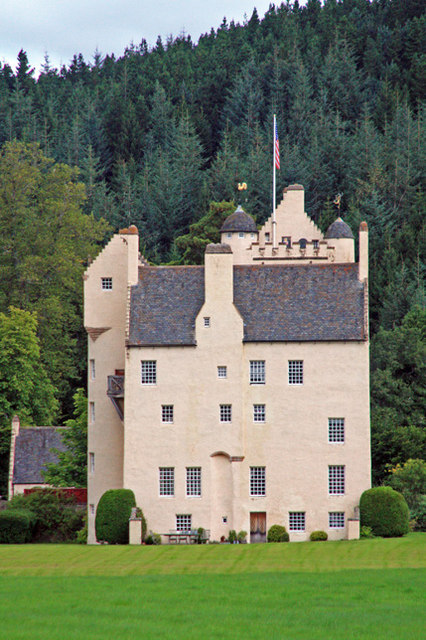
The structure is three storeys with a basement and attic. The east elevation is symmetrical, while the north (entrance), south, and west are asymmetrical. A heraldic panel is located between the second and third windows of the north elevation, as is a decorative ironwork finial and a weathercock finial. There is a baronial tower house, an angled tower to the north-west, a four-storey basement, and an attic tower to the north. The oldest section of the castle is the north-west which incorporates a balustrade atop a five-storey circular tower that is corbelled to square. This tower was replicated later at the north-east.[6] The castle is harled and lime washed. Eaves are courses, there are several turrets,[2] a possible secret passageway, and a monk's room.[9]

There are a number of small-pane windows, as well as a grey slate roof with tiled ridge. A doorway to the principal floor is reached by stone steps, and a small-pane glazed timber door is located to the right of the basement. Immediately to the north of the castle, there is a harled wall with an enclosed courtyard.[8]

Ownership

[edit]

In 1242, after the expulsion from Scotland of John and Walter Byset of Clan Bissett, who had been accused of the murder of Patrick, Earl of Atholl, at Haddington, East Lothian,[4] Aboyne Castle passed to the Knights Templar in that year.[2] It passed next to the Frasers of Cowie, before passing yet again, this time by marriage, to Sir William de Keith, Great Marischal of Scotland, around 1355. In 1449, Keith's great-granddaughter, Joan, brought the castle by marriage to Alexander Gordon, 1st Earl of Huntly (1449).[2] Its present owner is the Marquess of Huntly, whose family has owned it since the early 15th century.[6]

Grounds

[edit]
Left: Gatehouse; Right: Entrance driveway

There is a large extent of planted policies on both sides of the River Dee, including ornamental plantations and the Loch of Aboyne.[2]

On the Upper Dee, Aboyne Castle grounds are used as a fly-fishing fish beat. It is fished in agreement with Glen Tanar Estate (Craigendinnie Beat).[10] Within the Aboyne Castle Policies, there is included an artificial, islet-studded Loch of Aboyne measuring 3 × 213 fur.[1] The burn of Aboyne has kept its ancient name, Allach, only near the castle where the Allach Bridge was built over the burn.[2]

A nineteenth century cowstead on the estate has been upgraded as an entertainment venue as Coos' Cathedral, specialising in weddings. It was the location used for the ceremonies in Love Is Blind: UK Season 2.[11]

Relic

[edit]

The Formaston Stone, a relic of historical importance, is preserved. Dating from between 800 and 1000, it has a mirror symbol, a decorated Celtic cross, and an Ogham inscription.[1]

Preservation

[edit]

Aboyne Castle, including its gateway, courtyard, and northern boundary walls became a category B listed building on 24 November 1972.[8] Several other structures became listed building such as the early 19th century walled garden, garden house and the Wee House, listed at category C(s) on 30 March 2000;[12] and the triple span, segmental-arched Allach Bridge, constructed in 1787 of coursed grey granite, category B on 30 March 2000.[13]

References

[edit]
Revisions and contributorsEdit on WikipediaRead on Wikipedia
from Grokipedia
Aboyne Castle is a 17th-century Scottish baronial tower house located approximately 0.5 miles north of the village of Aboyne in Aberdeenshire, Scotland, overlooking the River Dee and serving as the historic seat of the Gordon family, Marquesses of Huntly and Earls of Aboyne. Originally established as a motte-and-bailey castle in the 13th century by the Bisset family to control the strategic Pass of the Mounth, the site was fortified under instructions from King Edward I of England in 1307. Following the Bissets' exile in 1242 for the murder of the Earl of Atholl, the property passed to the Knights Templar, then to the Frasers and Keiths before being acquired by the Gordons through marriage in the early 15th century, around 1449 (with a period of non-Gordon ownership in the late 19th and early 20th centuries before repurchase). The current structure, a three-storey and attic T-plan tower with a four-storey north tower and northwest angle turret, was rebuilt in 1671 by Charles Gordon, 1st Earl of Aboyne, after earlier fortifications were likely damaged during the Wars of the Three Kingdoms; it features harled lime-washed walls, crowstepped gables, and a round-arched gateway bearing the Huntly arms. During the 17th century, the castle played a role in regional conflicts, being captured in 1640 by Archibald Campbell, Marquess of Argyll, for the against forces led by the Gordons. Subsequent alterations included 19th-century Gothic Revival additions by architect George Truefitt and a major restoration in the 1970s and 1980s by Ian Begg, which reverted much of the structure to its 17th-century form after periods of dereliction; the estate also includes walled gardens, a , and boundary walls. Designated a Category B in 1972, Aboyne Castle remains privately occupied by the Gordon family and is not open to the public.

History

Medieval Origins

Aboyne Castle is situated approximately 0.75 miles (1.2 km) north of village in , , at coordinates 57.0846°N 2.7833°W, overlooking a strategic crossing of the pass near the River Dee. The castle's medieval origins trace back to the early , when it was established by the Bysets (also spelled Bissets), lords of Strathdee and , as a motte-and-bailey structure designed for defense and control of the region. This wooden fortification, typical of the period, featured an earthen motte topped with a keep and surrounded by a bailey enclosed by a and , serving as a key outpost amid the rugged terrain. The Bysets' tenure ended abruptly in 1242 following their expulsion from Scotland, prompted by the alleged involvement of John and Walter Byset in the murder of Patrick, Earl of Atholl. As a result, the castle and associated lands were forfeited and transferred to the Knights Templar, who established a preceptory there to manage their estates in northern Scotland. The Templars held the property until their order's suppression in the early 14th century, after which ownership shifted to the Frasers of Cowie. During the Wars of Scottish Independence, the castle gained military significance when, in 1307, King Edward I of ordered its to secure English control in the northeast. This included the conversion of the motte's wooden keep into a more durable stone structure, enhancing its defensive capabilities against Scottish resistance. By around 1355, following the marriage of Margaret Fraser, heiress of the Cowie Frasers, to Sir William de Keith, the Great Marischal of , the castle passed into Keith hands, marking the close of its early medieval phase.

Gordon Acquisition and Early Modern Period

In 1449, Aboyne Castle passed into the possession of the Gordon family through the marriage of Alexander Seton (who adopted the surname Gordon), 1st Earl of Huntly, to Joan, the great-granddaughter and heiress of Sir William de Keith, the previous owner. This union integrated the castle into the extensive Gordon estates in Aberdeenshire, where it served as a key residence for the Earls of Huntly and their successors, the Marquesses of Huntly, facilitating the family's influence in the region during the late medieval and early modern eras. The Gordons, staunch supporters of the Scottish Crown, utilized the castle's strategic location near the River Dee to manage local affairs and defend against rival clans. During the 16th century, Aboyne Castle remained a vital Gordon stronghold amid escalating clan conflicts, including feuds with Protestant neighbors like the and tensions with the Crown under Protestant monarchs. As Catholic loyalists, the Gordons faced repercussions, such as the 1562 defeat of the 4th Earl at the Battle of Corrichie, though the castle itself avoided direct assault at that time. By the early , amid the Wars of the , the castle was captured in 1640 by Archibald Campbell, 1st Marquess of , on behalf of the , and repurposed as a headquarters against Royalist forces led by the Gordons. This event underscored the castle's role in the broader Gordon-Covenanter conflicts, reflecting the family's divided allegiances during the turbulent 1640s. The creation of the Viscountcy of Aboyne in 1632 for George Gordon, 2nd , further elevated the site's status within the , with the title drawn directly from the castle and surrounding lands. In 1660, following the Restoration, Charles Gordon, fourth son of the 2nd , was elevated to 1st of Aboyne, prompting significant modifications to the castle. He rebuilt the west wing in 1671, incorporating a circular-plan tower that marked an evolution toward a more defensible design suited to the period's needs. This adaptation reinforced Aboyne Castle's function as a while adapting to post-Civil War stability.

19th and 20th Century Developments

In the early , the castle underwent significant expansion under the stewardship of the Gordon family. George Gordon, 5th Earl of Aboyne (later 9th ), constructed an east wing in 1801, enhancing the structure's capacity and integrating it further into the family's residential complex. Later in the century, in 1869, architect George Truefitt oversaw the replacement of the outdated kitchen facilities with a new granite-built department featuring stepped gables, commissioned by the 10th to modernize the domestic quarters. Truefitt returned for additional restoration work in the late , preserving and updating elements of the castle while it remained under Gordon ownership. By the 1880s, the estate faced financial pressures, leading to the sale of Aboyne Castle in 1888 to Sir William Cunliffe Brooks, a banker and MP whose daughter later married into the Gordon family, facilitating its eventual return to the Marquesses of . Brooks, who also owned the nearby Glen Tanar estate, commissioned further improvements during his tenure, including baronial-style updates to the mansion house that aligned with Victorian tastes for romanticized Scottish architecture. Following the Second World War, the castle experienced a decline in use as a primary family residence amid changing social and economic conditions for the , contributing to a period of neglect that left it derelict by the mid-20th century. Restoration efforts began in 1979 under the 12th , aiming to revive the property as a habitable seat. In 1986, architect Ian Begg led a major remodelling, applying harling to the exterior for protection and weatherproofing while emphasizing the castle's 17th-century form. These interventions halted further decay and repositioned Aboyne Castle within the enduring Gordon lineage.

Architecture

Original Design and Construction

Aboyne Castle was originally constructed before 1233 by the Bysets, a Scoto-Norman family who held the lordship of Strathdee and Aboyne, as a motte-and-bailey fortification designed for strategic defense in medieval Aberdeenshire. This layout featured a raised earthen motte topped with a wooden keep, surrounded by a bailey enclosure protected by a ditch and wooden palisades, typical of early Norman-style defenses adapted to the Scottish landscape. The site's selection capitalized on natural defenses, including proximity to the River Dee, which provided a formidable barrier against attackers, while the surrounding terrain of hills and wetlands further enhanced its defensibility. Early construction relied on local earthworks for the motte and bailey, with timber for palisades and structures, emphasizing rapid erection for frontier control amid feudal conflicts. Around 1307, during the Wars of Scottish Independence, the castle underwent conversion to a more permanent stone keep under orders from King Edward I of England, who sought to strengthen English-held fortifications in the region. The resulting structure was a basic three-storey tower with a , built using rough stones typical of early medieval Scottish , offering improved resistance to compared to the preceding wooden elements. Defensive features included retained earthworks, possible remnants of wooden palisades integrated into the stone base, and an approach via and across a former lake island site, with the north entrance fortified by outer and inner gates. These enhancements, combined with the River Dee's natural moat-like role and the elevated terrain, solidified the castle's position as a key defensive outpost in northeast .

Major Rebuildings and Additions

In 1671, Charles Gordon, 1st Earl of , undertook a major rebuilding of the castle's , constructing a three-storey rectangular with attic and incorporating a circular-plan tower at the northwest corner. This work utilized rough boulder stones embedded in lime, with local lairds contributing by carting lime from Fortrie, and included additions such as balustrading on the peel. The structure featured crowstepped gables and ogee-roofed stair towers, reflecting early modern Scottish defensive architecture built upon the medieval stone keep core, along with a round-arched gateway bearing the arms. Subsequent expansions in the early included the addition of a mansion house in 1701 by John Gordon, 2nd Earl of , which provided more comfortable residential spaces adjacent to . By 1801, George Gordon, 5th Earl of (later 9th ), added an east wing, extending the castle eastward and contributing to its evolving asymmetrical layout. In the mid-19th century, further significant alterations occurred under architect George Truefitt, who in demolished the ruinous old kitchen department and erected a new kitchen block at the northwest corner. This addition housed servant bedrooms, a servants' hall, and a crowned by a pyramidal , employing local in a 'cherry-cocking' technique for durability and aesthetic integration. The late 19th century saw additional baronial-style updates following Sir William Cunliffe Brooks's purchase of the castle in 1888, including the addition of a four-storey north tower, corbelled towers, and turrets to evoke a more romantic Scottish baronial character. These changes, executed by Truefitt, transformed the overall plan into a T-shaped configuration with harled and lime-washed walls, emphasizing crowstepped gables and defensive motifs while adapting the medieval base for Victorian-era living.

Restoration and Modern Features

The restoration of Aboyne Castle began in 1979 under the direction of the , who acquired the derelict property and initiated efforts to revive it as a habitable residence. This work marked a significant turning point, transforming the long-abandoned structure into a functional family home while respecting its historical baronial character. In 1986, Scottish architect Ian Begg undertook a comprehensive remodelling that preserved key original elements, such as the angle turrets and crowstepped gables, while incorporating levels to enhance the building's usability. Begg's design returned the castle to its 17th-century form, featuring a three-storey layout with basement and , a T-plan configuration, and features like conical roofs on the turrets and a crenellated . Modern utilities were integrated during this phase to support contemporary living, including updates to heating and electrical systems, alongside the addition of a timber on the west . Today, Castle stands as a private residence owned by the Gordon family, with no public access permitted. The restoration efforts have maintained the 19th-century baronial style in its overall aesthetic, ensuring continuity with earlier architectural updates.

Ownership

Pre-Gordon Owners

The lands of , including the site of the castle, were initially held by the Bysets (also spelled Bissets), a powerful Scoto-Norman family that acquired the baronies under King William the Lion in the late . As lords of and Strathdee, the Bysets constructed the original medieval fortifications on the site during the 13th century to assert control over the thanage, which encompassed feudal rights to local resources and judicial authority in the region. Walter de Byset, a prominent member of the family, further strengthened their ties to the area by founding a preceptory of Templar at Maryculter around 1221–1236, granting lands and establishing privileges linked to . In 1242, following accusations that John and Walter Byset were involved in the murder of Patrick, , the family was expelled from , and their Aboyne estates were forfeited to , briefly serving as a royal residence. The Knights Templar subsequently acquired ownership of the Aboyne lands and castle, holding them from 1242 into the early , during which time they maintained feudal oversight of the barony, including rights to teinds and of the local church. This period of Templar control ended with the order's suppression in around 1308–1312, after which the properties reverted to royal disposition. By 1337, the lands had passed to Sir Alexander Fraser of Cowie, who held under royal grant, exercising baronial rights over associated territories such as , Glenmuick, and Glentanner. Around 1351, Margaret Fraser, daughter of Sir Alexander, married Sir William de Keith, the Great Marischal of Scotland, bringing as her portion and transferring feudal superiority to the Keith family. Sir William retained control until 1407, when he was compelled by Regent Robert, Duke of Albany, to resign the barony to , in exchange for other lands, thereby concluding the pre-Gordon era of ownership.

The Gordon Family and Current Ownership

The Gordon family's association with Aboyne Castle began in 1449, when the castle passed into their possession through the marriage of Seton, who adopted the surname Gordon upon inheriting of his mother Elizabeth Gordon, to Joan de Keith, great-granddaughter of the previous owner, Sir William de Keith. , created 1st Earl of in the same year, established the family's longstanding hold on the property, which has remained a key seat of the Gordons, later Earls and Marquesses of , for over five centuries. Ownership progressed through successive generations of the Huntly line, with the castle serving as a primary residence for the . In 1660, Charles Gordon, fourth son of George Gordon, 2nd , was created 1st and Lord Gordon of Strathavon and Glenlivet, further embedding the title and estate within the family's structure; the earldom merged with the marquessate in 1836 upon the death of the 5th . The property continued under the family's direct control through the 18th and early 19th centuries, notably during the tenure of George Gordon, 9th (styled 5th until 1836), who faced financial strains that impacted the estate. In the late 19th century, mounting debts led the 11th , Charles Gordon, to sell Aboyne and surrounding lands in 1888 to Sir William Cunliffe-Brooks, 1st , a banker and father-in-law to the marquess through his daughter Amy's marriage to Charles; however, Brooks granted the Gordons a life tenancy, allowing the family to retain occupancy during their lifetimes. After the expiration of the life tenancy, the castle changed hands but returned to the possession of the later in the , who oversaw its restoration in the 1970s and 1980s to its 17th-century form after a period of dereliction. As of November 2025, Aboyne Castle remains the private property of Granville Charles Gomer Gordon, 13th Marquess of Huntly (born 1944), who succeeded in 1987 and serves as Chief of ; the estate's continuous Gordon tenure since the , aside from the late 19th- to mid-20th-century interlude, underscores its role in the family's inheritance and heritage, preserved as a rather than public access.

Grounds and Estate

Landscape and Natural Features

The landscape surrounding Aboyne Castle is characterized by its proximity to the River Dee, which flows through the for approximately 15 miles and has historically contributed to the estate's scenic appeal and strategic importance by guarding key crossings in . The river's wooded banks and varied terrain enhance the natural beauty of the area, with the castle's position offering commanding views of the valley. The estate's wooded policies encompass extensive ornamental plantations spanning 2,144 acres, primarily planted with Scotch fir but including significant stands of , , , , , and other ornamental to create a setting around the castle. These plantations, developed as part of the 19th-century estate management, form a large extent of planted ground on both sides of the River Dee, blending utility with aesthetic enhancement of the policies. Central to the natural features is the Loch of , an artificial lake measuring 3 by 2½ furlongs and covering about 32 acres, created within the castle policies and featuring wooded islets that add to its ornamental character. The loch serves as a recreational asset, particularly for fly-fishing, with its shallow waters supporting populations amid the serene, landscaped environment. Gardens on the estate underwent significant historical development in the early , exemplified by the walled garden—a rectangular-plan structure of with flat —that remains in use for cultivation and continues to reflect the era's practices associated with the castle. This enclosed garden, along with its ancillary buildings like the garden house, was integral to the estate's self-sufficiency and aesthetic design during the period.

Built Structures and Modern Uses

The Allach Bridge, constructed in 1787, serves as a key access point within the Aboyne Castle estate, spanning the Tarland Burn with a triple-arched in coursed grey featuring segmental arches and a datestone marked "EA 1787." Originally built to connect the estate from the now-demolished East Lodge to the castle, it exemplifies 18th-century estate infrastructure with its dentil-moulded and flat-coped parapets. The estate's and , located north of the main , form an enclosed ancillary space bounded by harled walls with flat coping, providing a secure entry via a round-arched gateway adorned with the and angle bartizans. Extending from this are rubble boundary walls to the north, southwest, and east, which incorporate an ogee-roofed summerhouse—also known as the garden house—along the eastern section, enhancing the estate's functional and ornamental layout. Coos' Cathedral, built in 1889 as a cattle steading on the estate, has evolved into a prominent rustic barn venue for private events, particularly weddings, set within the historic grounds of Royal Deeside. It gained international visibility as the exclusive wedding location for all couples in Netflix's Love Is Blind: UK Season 2, filmed in 2024, highlighting its adaptation for contemporary celebrations. In the , the estate's structures supported private recreation and events, including fly-fishing on the River Dee beats with agreements allowing access to pools on both banks for spring salmon and sea trout. These uses underscore the transition of the grounds from utilitarian estate features to venues for leisure and gatherings, framed by ornamental plantations that enhance their scenic integration.

Preservation and Relics

Listing and Conservation Efforts

Aboyne Castle, including its gateway, courtyard, northern boundary walls, and ancillary structures, received Category B status on 24 November 1972 from , recognizing its special architectural and historic interest as a 17th-century baronial with later modifications. This designation was prompted by the castle's dereliction in the , which threatened its structural integrity. Additional elements of the estate have also been protected through listings. The walled garden and garden house, dating to the early and featuring rubble construction with associated outbuildings, were designated as Category C listed on 30 March 2000. Similarly, the Allach Bridge, a triple-span segmental-arched of coursed dated 1787 and originally providing access to the , received Category B listing on the same date. Restoration efforts from 1979 to 1986, led by the , focused on halting the castle's dereliction and returning it to a 17th-century form, including remodeling by Begg in 1986. These works addressed decay in and ancillary features, ensuring the site's long-term viability under private ownership. As a privately held property, faces ongoing conservation challenges in balancing heritage preservation requirements—such as regular mandated by its listings—with its status as a residence, necessitating careful management to prevent future deterioration.

Historical Artifacts

One of the most significant historical artifacts associated with is the Formaston Stone, a fragment of a Class II Pictish symbol stone dating to between 800 and 1000 AD. This granite cross-slab, measuring approximately 1.12 meters in height, 0.43 meters in width, and 0.12 meters in depth, features carvings in deep false relief and incision on one broad face, including a outlined by roll molding with a large closed armpit, a rimmed mirror symbol with a long handle and boss, and part of an interlace-filled cross-shaft. The stone also bears two vertical inscriptions running parallel to the edges: "MAQQoiTALLUORRH" and "NAHHTVROBBACCAANNEVV," where "MAQQ" likely denotes " of" or "descendant of" in an early medieval context. Discovered prior to 1874 in the kirkyard of St. Adamnan's Church at Formaston, a site within the Castle estate east of the castle itself, the stone was relocated to the castle grounds by 1883, reflecting its early recognition as a tied to the property. It was later transferred to Museum in 1974 for preservation and returned to in 2002, where it is now displayed in the vestibule of Victory Hall. The artifact's Pictish symbols and script provide direct evidence of pre-castle activity in the area, illustrating the site's occupation during the early medieval period by the , a known for their distinctive stone carvings that blended pagan and emerging Christian motifs. No other major relics from the Templar period (when the estate was granted to the Knights Templar around 1239–1242) have been documented, underscoring the Formaston Stone's unique role in highlighting the site's deeper prehistoric and early medieval layers. This stone serves as a key testament to the cultural transitions in northeastern , bridging Pictish traditions with later Christian influences long before the castle's construction in the .

References

Add your contribution
Related Hubs
User Avatar
No comments yet.