


Community hub
Recent from talks
Contribute something
Nothing was collected or created yet.
Ace Cafe
View on Wikipedia
The Ace Cafe is a historic transport cafe located near Wembley, North West London, England. Situated next to the North Circular Road, it is historically a notable venue in motorcycle culture. The original cafe opened in 1938 and closed in 1969. It re-opened on the original site in 1997 as a cafe, functions, and entertainment venue.
Key Information


Location
[edit]The Ace Cafe is located on a leg on the western side of the North Circular Road, off the junction with Beresford Avenue. On the A406 it is between the Hanger Lane gyratory and the Wembley A404 junction. It is east of the Alperton neighbourhood, close by Stonebridge and the Park Royal industrial estate, just west of Stonebridge Park station and the Brent Viaduct.
Apart from the cafe on the original site in London, Ace Cafe London have opened cafes in other countries: Ace Corner Lahti, Finland (opened in June 2011), Ace Cafe Lucerne, Switzerland (opened in June 2015), Ace Cafe Beijing, China (opened in July 2015), Ace Cafe Barcelona, Spain (opened in April 2017), and Ace Cafe Orlando, United States of America (opened in May 2017).[1]
History
[edit]

The Ace Cafe opened in 1938 to accommodate traffic on the then-new North Circular Road. It was built on an area between the Grand Union Canal and Stonebridge Park Depot. The cafe was rebuilt in 1949, after an air raid on the nearby Willesden railway marshalling yards caused damage during the Second World War. Events in the postwar environment made the Ace a success – the emergence of teenage motorcyclists, and an increase in traffic. As the cafe was open 24 hours a day, young people started to meet at the cafe to socialise with their motorcycles, and listen to rock'n'roll on juke boxes. Several bands and motorcycle enthusiast groups were formed at the Ace Cafe. During its heyday in the 1950s and 1960s, it would attract large groups of rockers in the evening and at weekends. Biker Reverend Bill Shergold would visit the cafe and invite young people to join his 59 Club, a motorcycle group that promoted "positive values".[2]
The cafe closed in 1969, shortly after the opening of Scratchwood Services (now London Gateway services) at what was then the southern end of the M1 motorway. The ground floor of the building became a tyre sales and fitting shop.[3] The first floor was occupied by a vehicle delivery company. By 1994, a renewed interest in the rocker culture led to an Ace Cafe reunion, organised by Mark Wilsmore with support from original 59 Club members.[2][3] The cafe reopened in 1997, with complete refurbishment completed by September 2001.[4] Rockers and motorcyclists from various countries attend themed meetings. It is no longer open 24-hours but the cafe now has an extensive calendar of events for both motorbike and classic car owners. Hosting events such as monthly meets for both bikes and cars, as well as being licensed for weddings and civil partnerships.[5][6]
Film and media
[edit]
The Ace Cafe was used as a location in the 1964 film The Leather Boys, Sidney J. Furie's British gay-interest kitchen sink drama, starring Rita Tushingham.[7]
In the past it has been used for the Channel 5 TV programme Fifth Gear in the seasons 10 to 13 (September 2006 until March 2008), and for ITV programme Used Car Roadshow. It has also featured in the BBC television series By Any Means with Charley Boorman; mentioned as a favourite for Ewan McGregor by his wife in the documentary, Long Way Down; and the 2008 film Freebird.
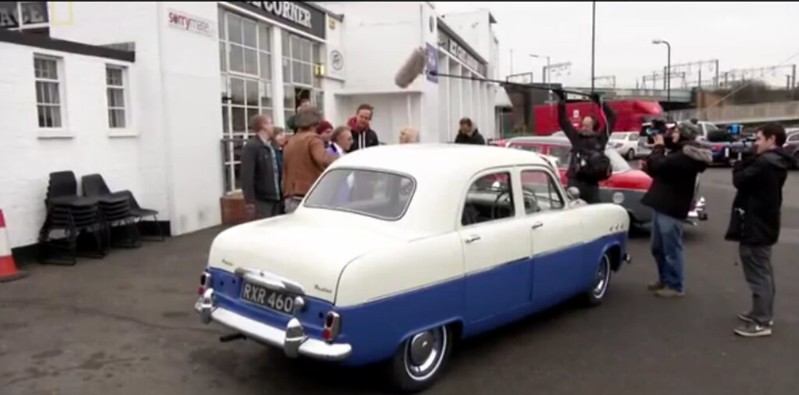
The cafe also featured in an edition of Car SOS – Series 1, Episode 9, presented by Tim Shaw, filmed during 2012 and shown in the UK on at least one TV channel – National Geographic. The episode depicted the secret restoration of a decaying Ford Zodiac Mk1, which was then unveiled and presented to the unsuspecting owner in the car park, close to the building entrance.[8][9]
Motoring TV presenters Edd China and Mike Brewer filmed at Ace Cafe on a Hot Rod night in early 2014 during a sequence to sell a Chevrolet Camaro, part of Wheeler Dealers series 11.[10][11]
The music video for "You Go Your Way" (released 2024) by Perrie was filmed at Ace Cafe.[12]
Awards
[edit]The Ace Cafe won London Borough of Brent's "Best Bar None" award for local bars in 2009.[13]
See also
[edit]Notes
[edit]- ^ "History". Ace Cafe London. 2017. Retrieved 17 April 2021.
- ^ a b The Rev William Shergold: biker priest, The Times, 23 May 2009
- ^ a b Motor Cycle News 23 March 1994, p. 48 Ace Cafe to open for rocker bash. "Famous rockers' haunt, the Ace Cafe, is to "re-open" 25 years after its closure for an anniversary meeting...Triumph fan Mark Wilsmore has arranged for an exhibition and all-day party at the site in September. The cafe closed in 1969 and now houses a tyre depot on London's North Circular Road". Accessed and added 2014-10-05
- ^ "Roman Catholic Church of St Joseph, non Civil Parish - 1431030 | Historic England".
- ^ "Monthly Meets". Ace Cafe London. Retrieved 1 April 2025.
- ^ The Ace Cafe on Brent council local authority website. Retrieved 2013-12-24
- ^ Raymond Murray, Images in the dark: an encyclopedia of gay and lesbian film and video, TLA Publications, 1994, ISBN 1-880707-01-2, p. 414
- ^ "Mustard Video: At last, I'm ready to hit the road in my restored Zodiac". Norwich Advertiser. March 2013. Retrieved 24 December 2013.
- ^ "Film production crew and Ford Zodiac at Ace Cafe" (JPG). farm9.staticflickr.com. Retrieved 24 December 2013.
- ^ Discovery TV stills showing purchase and refurbishment of Camaro Retrieved 2014-04-23
- ^ Amateur video of Wheeler Dealer presenters at Ace Cafe Camaro sale Retrieved 2014-04-23
- ^ "Perrie Edwards Taps 'Brat' Producer For New Single About Finding Strength In Relationships". Grazia. Retrieved 29 December 2024.
- ^ "Ace Cafe wins top prize at Brent's Best Bar None awards 2009". bbnuk.com. Archived from the original on 25 December 2013. Retrieved 24 December 2013.
References
[edit]- Ramsey, Winston. The Ace Cafe Then and Now, 2002. ISBN 978-1-870067-43-0
- Stuart, Johnny; (1987). Rockers!. Plexus Publishing Ltd. ISBN 0-85965-125-8
- Duckworth, Mick, (2011). "Ace Times". Redline Books. ISBN 978-0-9555278-6-9
External links
[edit]
- Official website
- "Coming of Age at the Ace Cafe - Exhibition at the Coventry Transport Museum, June–October 2011". Coventry Transport Museum. 2011. Archived from the original on 26 January 2012. Retrieved 26 January 2012.
- Company financial report
Ace Cafe
View on GrokipediaGeography and Presence
Location
The Ace Cafe is situated at Ace Corner, North Circular Road, Stonebridge, London NW10 7UD, with precise coordinates of 51°32′28″N 0°16′40″W.[8] This location places it in northwest London, approximately 2 miles from Wembley Stadium, adjacent to the Hanger Lane gyratory, and near the A40 Western Avenue.[9] The site's selection was influenced by the construction of the North Circular Road in the 1920s and 1930s, which created a vital arterial bypass for traffic around London, attracting transport cafes to serve lorry drivers and travelers along this new route.[10][11] The original building, constructed in 1938, exemplifies 1930s roadside architecture with Art Deco influences, characterized by streamlined forms and prominent neon signage that illuminated the facade for nighttime visibility.[12] Damaged by bombing during World War II, it was rebuilt in 1949, retaining much of its pre-war exterior design.[11] Following its revival in 1997, the core structure was preserved to maintain historical authenticity, though modifications included interior alterations such as bricking up original floor-to-ceiling windows to accommodate displays of cultural memorabilia.[13] Transportation access to the site is facilitated by nearby London Underground stations, including Stonebridge Park on the Bakerloo Line (a 10-minute walk via North Circular Road) and Alperton on the Piccadilly Line (about 1.5 miles away).[14][15] The cafe's positioning aligns with post-World War II suburban expansion in the Stonebridge area, where redevelopment efforts in the 1950s introduced new housing blocks and infrastructure to address war damage and population growth along key transport corridors.[16] This geography supported its role as a convenient roadside stop for motorcycle enthusiasts navigating London's outer suburbs.International Branches
The Ace Cafe brand began its international expansion in the 2010s through a licensing model managed by Ace Cafe London Limited, allowing local operators to adopt the iconic motorcycle and rock 'n' roll theme while adapting to regional contexts.[17][18] This approach, overseen by director and owner Mark Wilsmore and co-owner George Tsuchnikas, has established franchises in Europe, Asia, and North America, emphasizing community gatherings for enthusiasts without direct corporate ownership of overseas sites.[19][20] The first international branch opened in Lahti, Finland, in 2011 as the inaugural outpost beyond London. Located at Veistämönkatu 1, 15140 Lahti, it features a large terrace overlooking Lake Vesijärvi and is co-located with Finland's Motorcycle Museum, which houses over 100 exhibits and hosts annual themed displays such as Harley-Davidson anniversaries.[21][22] Operated under license by local management, the site integrates Scandinavian design with the brand's classic aesthetic, offering free parking and Wi-Fi to attract regional biker events. As of 2025, it remains fully operational, with regular programming through the summer months.[21] In 2015, two branches debuted simultaneously: one in Lucerne, Switzerland, and another in Beijing, China. The Swiss location, at Sonnmatthof 2, 6023 Rothenburg, opened in mid-2015 under owner Dany Kunz and emphasizes regional Swiss cuisine alongside motor-themed gatherings for cars and bikes in a freedom-oriented atmosphere.[23][24] It includes indoor and outdoor spaces for events, adapting the brand to alpine enthusiast culture. The Beijing outpost, situated in the 751 D-Park art district at Train Square 751, Jiu Xian Qiao Road, Chaoyang District, launched with a grand opening in July 2015 and incorporates R&B styling within a creative industrial setting to appeal to China's growing motorcycle community.[18][25] Both sites operate via licensing agreements and continue to function actively in 2025, with no reported closures.[26] The expansion continued in 2017 with openings in Barcelona, Spain, and Orlando, Florida, USA. Barcelona's branch, at Carrer de les Ciències 105, 08908 L'Hospitalet de Llobregat, debuted in April and serves as a hub for European petrolheads, featuring spaces for classic vehicles and community meetups that blend Mediterranean vibrancy with the brand's heritage.[27][28] In the US, the original Orlando site at 100 West Livingston Street opened in May 2017 but closed in May 2023 due to operational challenges.[29] It relocated and reopened on October 17, 2025, in Sanford at 115 North Laurel Avenue, following a $3.6 million renovation that includes a full restaurant, retail area, live music stages, and event spaces tailored to American car and bike culture.[30][31] This new venue partners local operators Steve Glum and Sean Kelley with brand owner George Tsuchnikas under the licensing framework. As of November 2025, all listed branches are operational, with the Sanford relocation marking the only significant post-2020 change and no further expansions announced.[32][26]Historical Development
Origins and Early Operations
The Ace Cafe was established on 21 October 1938 by entrepreneur Vic Edenborough as a simple roadside transport café, or "greasy spoon," catering primarily to motorists and lorry drivers along the newly constructed North Circular Road in northwest London.[33] Positioned adjacent to the Grand Union Canal and Stonebridge railway depot, the café featured basic facilities including fuel pumps and operated around the clock to serve the growing volume of arterial road traffic.[1][34] In its early years, the Ace focused on providing affordable, hearty British fare such as tea, toast, eggs, and simple fry-ups to sustain lorry drivers, early commuters, and travelers navigating Britain's expanding road network.[1][35] This modest menu reflected the practical needs of working-class patrons in an era when such cafés became vital pit stops amid the interwar economic recovery.[36] The onset of World War II profoundly affected the site; on 16 November 1940, during the Blitz, the building suffered severe bomb damage from an air raid targeting the nearby Willesden marshalling yards, partially destroying the structure.[33][1] Despite this, the café avoided full closure, continuing operations in a temporary prefabricated building to support wartime transport demands, though full reconstruction would follow the war's end.[34] This period aligned with broader 1930s trends in Britain, where mass production techniques drove a doubling of car ownership from about one million to two million vehicles, spurring the proliferation of roadside amenities like the Ace to accommodate increasing motor traffic.[37]Post-War Reconstruction and Rocker Era
Following the devastation of World War II, during which an air raid on nearby Willesden railway marshalling yards severely damaged the original structure, the Ace Cafe was rebuilt in 1949 as a modern facility equipped with advanced catering and kitchen amenities, including fluorescent lighting, to serve the growing post-war road traffic.[38][39] This reconstruction transformed the cafe from a simple transport stop into a more accommodating venue with expanded seating areas, appealing to a burgeoning youth demographic seeking social spaces amid Britain's economic recovery.[1] By the mid-1950s, the cafe experienced a surge in popularity among motorcycle enthusiasts known as ton-up boys, who aimed to reach speeds of 100 mph ("the ton") on modified bikes, often racing along the North Circular Road before gathering at the Ace for all-night sessions.[1][2] The introduction of a jukebox around this period amplified its allure, featuring rock 'n' roll tracks by artists such as Bill Haley and Elvis Presley, which fueled energetic dances and solidified the cafe's role in the emerging coffee bar culture—a network of 24-hour venues where young people escaped post-war austerity through music and camaraderie.[2][7] Throughout the late 1950s and into the 1960s, the Ace became a central hub for early biker gangs and the rocker subculture, embodying youth rebellion against societal norms through leather-clad gatherings, bike maintenance, and defiant speeds that drew media scrutiny.[2][7] Tensions escalated with rival mods—scooter-riding youths favoring soul music and tailored fashion—leading to sporadic clashes that highlighted broader subcultural divides, though the Ace remained a predominantly rocker stronghold.[2] Police frequently intervened with arrests for traffic violations and noise complaints, reflecting authorities' efforts to curb the cafe's rowdy atmosphere amid rising concerns over juvenile delinquency.[40]Closure and Revival
By the late 1960s, the Ace Cafe experienced a decline due to shifting youth trends away from the rocker subculture, the rise of the car industry, and the expansion of the motorway network, which diminished the appeal of roadside cafes like the Ace along the North Circular Road.[3] These factors, combined with a shrinking British motorcycle industry amid competition from Japanese manufacturers and higher costs for imported steel, led to reduced patronage and the cafe's closure in December 1969.[41] The original owners sold the site for industrial redevelopment shortly after, and within two weeks, it was stripped and repurposed as a tyre depot and garage, marking the end of its era as a biker hub.[42] The building remained in industrial use as a tyre depot for the next 25 years, falling into disrepair and serving no connection to its motorcycle heritage.[39] In 1993, Mark Wilsmore, a former London police officer and motorcycle enthusiast familiar with the cafe's legacy, proposed an annual reunion event to commemorate its closure; the inaugural gathering took place in September 1994 on the original grounds, drawing over 300 veteran rockers from the 1950s and 1960s who shared stories and reignited interest in the site.[1] This event demonstrated strong public support and directly inspired efforts to revive the cafe, culminating in Wilsmore purchasing the property and securing planning permission for partial reopening. The Ace Cafe partially reopened in 1997 under Wilsmore's ownership, focusing on restoring key original features to evoke its historical atmosphere while adapting to modern regulations.[5] Challenges included refurbishing the dilapidated structure, reinstalling period-appropriate elements like the iconic neon sign and jukebox to attract returning patrons, and navigating local development restrictions that limited initial operations to weekends.[34] By 2001, full refurbishment was complete, stabilizing the business as a renewed cultural landmark and bridging its post-war legacy with contemporary motorcycle gatherings.[1]Cultural Impact
Role in Youth and Motorcycle Subculture
The Ace Cafe emerged as a pivotal social nexus for the ton-up boys and rockers, youth subcultures that defined 1950s-1960s Britain through their pursuit of speed and defiance of post-war austerity. Ton-up boys, named for their ambition to reach 100 miles per hour ("do the ton") on motorcycles, embodied a maverick ethos, gathering at transport cafes like the Ace to modify bikes, race informally, and foster camaraderie away from societal constraints.[43] Rockers, often overlapping with ton-up boys, adopted a distinctive fashion of black leather jackets, denim jeans, and boots—styles inspired by American films like The Wild One (1953)—which symbolized rugged individualism and rebellion against conformity.[2] Their music preferences centered on American rock 'n' roll artists such as Elvis Presley, Eddie Cochran, and Gene Vincent, with the Ace's jukebox serving as a catalyst for impromptu dances and record-spinning races that amplified the cafe's vibrant atmosphere.[43] The Ace Cafe's legacy profoundly shaped global biker culture, inspiring the formation of motorcycle clubs and enduring events that echo its original spirit. It became the birthplace of the cafe racer motorcycle style, where riders stripped and tuned British bikes like Triumphs and Nortons for speed, influencing custom builds worldwide and leading to clubs such as the 59 Club, founded in 1959 as a youth organization that later developed a motorcycle section connected to the rocker scene at the Ace Cafe, to channel energy into organized activities.[7][44] Annual anniversary runs, starting with the 1994 Reunion that drew 12,000 participants and evolving into a multi-day international gathering, have sustained this influence, attracting enthusiasts from Europe, the United States, and beyond to celebrate rock 'n' roll and high-speed heritage.[45] In broader societal terms, the Ace Cafe symbolized post-war youth rebellion and counterculture, representing freedom and velocity in an era of rebuilding and restriction. It provided a space for working-class youth to escape drab routines, challenging authority through visible acts of speed and style that contrasted with the emerging Mod subculture and sparked moral panics over juvenile delinquency.[2] This role positioned the cafe as an icon of non-conformist expression, where motorcycle gatherings underscored a quest for autonomy amid Britain's transition to affluence.[43] Post-2020, the Ace Cafe's influence has evolved within modern custom bike scenes, embracing diverse demographics including women and international riders while reviving cafe racer aesthetics. The resurgence of cafe racers among hipster and urban riders has incorporated global influences, blending vintage British designs with contemporary Japanese and Italian customs, drawing a more inclusive crowd to events.[46] Women's participation has grown, building on initiatives like the 2015 world-record female biker meet at the Ace, with recent gatherings featuring international female clubs and diverse riders from Asia and the Americas, reflecting a shift toward broader accessibility in biker subculture.[7]Representation in Film and Media
The Ace Cafe has been depicted in several films as a quintessential hub for motorcycle culture and youth rebellion. In the 1964 British drama The Leather Boys, directed by Sidney J. Furie and starring Rita Tushingham and Dudley Sutton, the cafe serves as a key meeting point for "ton-up boys" and rockers, capturing the era's subcultural energy through scenes of burn-ups and social interactions.[47] The 2008 comedy Freebird, directed by Jon Ivay and featuring Gary Stretch and Geoff Bell, portrays the cafe as a backdrop for a motorcycle club's adventures, emphasizing themes of camaraderie and mischief among riders.[48] Television programs have frequently showcased the Ace Cafe to highlight automotive and motorcycle heritage. It appeared in episodes of the Channel 5 series Fifth Gear between 2006 and 2008, where presenters reviewed classic bikes and discussed the cafe's historical significance to British motorcycling.[49] The cafe was also featured in Car SOS Series 1, Episode 9 (2012), a restoration segment on National Geographic Channel that focused on reviving a vintage vehicle at the iconic location. Additionally, Wheeler Dealers included the Ace Cafe in a 2014 episode involving vehicle trading and customization, underscoring its role as a modern gathering spot for enthusiasts.[50] In music and contemporary media, the Ace Cafe continues to symbolize rock 'n' roll and biker ethos. Former Little Mix member Perrie Edwards filmed the music video for her 2024 single "You Go Your Way" at the cafe, depicting a high-energy, one-shot sequence outside the venue that has garnered over 3 million views and renewed online interest in its legacy.[51][52] The cafe has influenced numerous rock 'n' roll documentaries, such as the BBC's exploration of British motorcycles and the 1950s-1960s rocker scene, where it is presented as the epicenter of caffeine-fueled races and jukebox-fueled nights.[53] These portrayals have played a crucial role in perpetuating the Ace Cafe's mythology as a timeless icon of rebellion and community. Post-2020 coverage in podcasts and online biker media, including discussions on platforms like Spotify's Brown Car Guy about ULEZ impacts on riders and ADV Cannonball episodes recorded on-site, reinforces its enduring appeal amid modern challenges. The 2025 Ace Cafe Reunion continued this tradition, attracting thousands for multi-day events celebrating its heritage.[54][55][45]Modern Operations
Events and Activities
Ace Cafe London hosts a variety of regular events that blend its motorcycle heritage with contemporary appeal, including monthly bike and car meets typically held on the third Saturday of each month, attracting enthusiasts for displays and social gatherings.[56] Rock 'n' roll nights feature live music performances, while the venue is licensed to host weddings and civil partnerships, often incorporating custom car and bike shows as part of the festivities. These events draw crowds year-round, with specialized gatherings like Ton Up Days and themed nights such as German Night or Mod n' Mini Night enhancing the programming.[57] The cafe's menu emphasizes classic greasy spoon fare with a nod to its 1950s origins, offering all-day breakfasts featuring eggs, bacon, sausages, and black pudding, alongside hearty options like fish and chips, bangers and mash, and homemade curries.[58] Burgers, including specialties such as the Bacon Burger topped with grilled back bacon or the Breakfast Burger with fried eggs, form a core of the offerings, served with chips in generous portions.[59] Milkshakes and other cold beverages complement the desserts, cakes, and pastries, maintaining an affordable, nostalgic dining experience.[60] Facilities at Ace Cafe London support its role as a vibrant social hub, including a jukebox stocked with rock 'n' roll tracks that echoes the venue's historical soundtrack, and a dedicated stage for live band performances during events.[61] A merchandise shop sells branded apparel, memorabilia, and motorcycle-related items, while partnerships with nearby accommodations facilitate extended stays for visitors attending meets or weddings.[41] In response to the COVID-19 pandemic, Ace Cafe London implemented measures to operate as a COVID-19 Secure venue, allowing controlled gatherings with limits on group sizes to six people to prevent mixing.[62] During stricter restrictions, the cafe introduced virtual meets, inviting fans to submit photographs and memories for weekly online features to maintain community engagement.[63] Post-2020, programming has expanded to include more family-friendly activities, such as inclusive car meets and daytime events, while preserving traditional biker gatherings.[64]Awards and Recognition
In 2009, the Ace Cafe received the overall "Best Bar None" award from the London Borough of Brent, along with a shared gold award in the best bar category, honoring its responsible management, operation, and community contributions as a licensed premises.[65] The venue's cultural and transport heritage has been formally acknowledged through preservation efforts, including the iconic neon sign from its post-war reconstruction, which contributes to its heritage recognition as a significant site in British motorcycle history.[66] In 2019, the Ace Cafe was awarded a "Red Wheel" plaque by the National Transport Trust, recognizing it as the 115th UK site for its legacy in transport development and as a pivotal gathering place for youth motorcycle subculture; founder Mark Wilsmore also received a certificate of appreciation from Brent Council for services to transport heritage.[67][68] Post-2020 recognitions include partnerships with international events such as the Auto Photo Awards in 2024, highlighting the brand's global influence, while its international franchises, including the branch that opened in October 2025 in Sanford, Florida, following a $3.6 million investment, extend this heritage status worldwide without specific formal awards to date.[69][70][31] The Ace Cafe features prominently in official British rock 'n' roll and motorcycle histories, such as Winston Ramsey's "The Ace Cafe: Then and Now" (2005), which documents its enduring impact on cultural preservation.[71]References
- https://commons.wikimedia.org/wiki/File:Ace_Cafe_London_Ace_Corner_North_Circular_Road_London_NW10_7UD_%282%29.jpg