Recent from talks
Nothing was collected or created yet.
Adam McPhee
View on Wikipedia
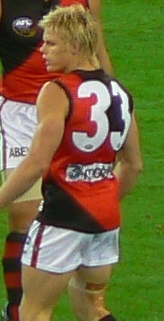
Adam McPhee (born 6 October 1982) is an Australian rules football player who played for the Fremantle Football Club and the Essendon Football Club in the Australian Football League (AFL). He is a versatile player who has played both as a forward, defender and tagging role, with high-profile clashes with Gary Ablett, Jr. and Chris Judd in 2010.[2]
Key Information
Australian Football League career
[edit]First stint at Fremantle
[edit]McPhee was originally recruited by Fremantle from the Dandenong Stingrays in the TAC Cup with the 39th selection in the 2000 AFL draft. He made his AFL debut in 2001 and was nominated for the AFL Rising Star award that year. By the end of 2002, McPhee played 25 games in total for the Dockers. He was then traded to Essendon in his home state of Victoria in a three-way deal also involving Brisbane. Essendon had previously hoped to draft him late in the 2000 draft, but Fremantle had picked him ahead of where Essendon had expected him to be taken.[3]
Essendon years
[edit]In McPhee's first year at Essendon he played every game and his tough approach earned him the club's "most courageous player" award. However it was in 2004 that McPhee really made his mark as an AFL player. In that year he was selected on the half-back flank in the All-Australian team, won the W.S. Crichton Medal as Essendon's best and fairest player and was Essendon's highest vote getter in the Brownlow Medal.[4]
In 2005, McPhee was restricted to only 14 games through injury and could not repeat his feats of 2004.[5]
On 30 July 2006, McPhee played his 100th senior game at the Telstra Dome. It was capped off with a win over the Brisbane Lions which broke, what was at the time, the club's longest streak without a win in its history, when he took a spectacular mark and also kicked a magnificent goal on the run.[6] He missed out on the honour the previous week because of a one match suspension served for striking St Kilda's Robert Harvey in an attempted spoil.[7]
On 25 April 2009, in the Anzac Day match, McPhee celebrated his 150th game with a five-point victory over Collingwood.[8]
Return to Fremantle
[edit]After long discussions about a new contract with the Bombers, McPhee did not sign a new contract with Essendon by the 2.00pm deadline on 10 November 2009. Many believe McPhee left Essendon due to a fall out with the Coach of Essendon at the time, Matthew Knights. McPhee was expected to nominate to be drafted to another club and as expected, his former club Fremantle selected him with their selection in the pre-season draft. The possible move to Fremantle had been heavily criticised in some circles, partly as a result of the club's recent history in drafting mature-age recruits, but it has been applauded in other circles as the club gave up virtually nothing to land him.[9] His first match against his old club Essendon saw him hit the post twice, drop marks and kick out of bounds on the full right in front of Bombers fans who booed him consistently throughout the match. Despite his clangers, Fremantle managed to upset Essendon by 44 points.[10][11]
After McPhee's tough start in his return to Fremantle, he improved as the season went on after a change in role. McPhee played his best football for the Dockers towards the end of the season as a run-with player (tagger), a role which requires stopping the influence of the opposition team's most damaging players. McPhee's best game came against Hawthorn in the Elimination final, keeping Hawks champion Luke Hodge to just 13 disposals, and only 5 in the first three quarters.
In 2012 McPhee returned to the backline under new coach Ross Lyon, but mainly played on the smaller forwards.[12]
At the end of the 2012 season, a month after signing a one-year contract extension, McPhee retired from AFL football for family reasons. While there was much speculation he would return to his former club, the Essendon Football Club, he returned to Melbourne to work for his father-in-law's company.[12] He continues to play football and as of 2015 is playing for St Mary's in the Geelong Football League.[13]
Statistics
[edit] G
|
Goals | K
|
Kicks | D
|
Disposals | T
|
Tackles |
B
|
Behinds | H
|
Handballs | M
|
Marks |
| Season | Team | No. | Games | Totals | Averages (per game) | Votes | ||||||||||||
|---|---|---|---|---|---|---|---|---|---|---|---|---|---|---|---|---|---|---|
| G | B | K | H | D | M | T | G | B | K | H | D | M | T | |||||
| 2001 | Fremantle | 17 | 14 | 5 | 3 | 116 | 65 | 181 | 61 | 32 | 0.4 | 0.2 | 8.3 | 4.6 | 12.9 | 4.4 | 2.3 | 0 |
| 2002 | Fremantle | 17 | 11 | 4 | 1 | 71 | 37 | 108 | 46 | 17 | 0.4 | 0.1 | 6.5 | 3.4 | 9.8 | 4.2 | 1.5 | 0 |
| 2003 | Essendon | 33 | 24 | 10 | 7 | 177 | 140 | 317 | 98 | 67 | 0.4 | 0.3 | 7.4 | 5.8 | 13.2 | 4.1 | 2.8 | 0 |
| 2004 | Essendon | 33 | 21 | 15 | 9 | 237 | 125 | 362 | 125 | 56 | 0.7 | 0.4 | 11.3 | 6.0 | 17.2 | 6.0 | 2.7 | 12 |
| 2005 | Essendon | 33 | 14 | 9 | 4 | 185 | 72 | 257 | 113 | 32 | 0.6 | 0.3 | 13.2 | 5.1 | 18.4 | 8.1 | 2.3 | 6 |
| 2006 | Essendon | 33 | 20 | 8 | 9 | 234 | 113 | 347 | 142 | 56 | 0.4 | 0.5 | 11.7 | 5.7 | 17.4 | 7.1 | 2.8 | 0 |
| 2007 | Essendon | 33 | 22 | 7 | 4 | 279 | 166 | 445 | 181 | 68 | 0.3 | 0.2 | 12.7 | 7.5 | 20.2 | 8.2 | 3.1 | 6 |
| 2008 | Essendon | 33 | 20 | 18 | 12 | 188 | 119 | 307 | 143 | 55 | 0.9 | 0.6 | 9.4 | 6.0 | 15.4 | 7.2 | 2.8 | 1 |
| 2009 | Essendon | 33 | 21 | 16 | 8 | 207 | 164 | 371 | 136 | 55 | 0.8 | 0.4 | 9.9 | 7.8 | 17.7 | 6.5 | 2.6 | 1 |
| 2010 | Fremantle | 9 | 23 | 9 | 17 | 179 | 140 | 319 | 95 | 107 | 0.4 | 0.7 | 7.8 | 6.1 | 13.9 | 4.1 | 4.7 | 0 |
| 2011 | Fremantle | 9 | 12 | 9 | 12 | 86 | 61 | 147 | 40 | 33 | 0.8 | 1.0 | 7.2 | 5.1 | 12.3 | 3.3 | 2.8 | 0 |
| 2012 | Fremantle | 9 | 21 | 2 | 0 | 235 | 109 | 344 | 124 | 36 | 0.1 | 0.0 | 11.2 | 5.2 | 16.4 | 5.9 | 1.7 | 0 |
| Career | 223 | 112 | 86 | 2194 | 1311 | 3505 | 1304 | 614 | 0.5 | 0.4 | 9.8 | 5.9 | 15.7 | 5.8 | 2.8 | 26 | ||
References
[edit]- ^ Quayle, Emma (4 November 2002). "Bomber Smokey, a real trailblazer". The Age.
- ^ Versatile McPhee brings plenty to Dockers' cause
- ^ Quayle, Emma (21 August 2004). "Dons' Operation McPhee". The Age.
- ^ Moncrief, Marc (30 September 2004). "McPhee named Bombers' best". The Age.
- ^ Lane, Samantha (20 November 2005). "McPhee on the run again". The Sunday Age.
- ^ Boulton, Martin (30 July 2006) See the Bombers fly up, up to a much wanted win
- ^ "McPhee facing one-match ban". ABC News (Australian Broadcasting Corporation). 17 July 2006. Retrieved 11 March 2019.
- ^ "Malthouse fumes: We let Anzacs down". ABC News (Australia). 26 April 2009. Retrieved 20 March 2021.
- ^ McPhee will be a free hit at the Dockers, The Roar, Retrieved on 27 November 2009
- ^ Dockers break drought by beating Bombers
- ^ "Torrid return to Victoria for luckless Docker Adam McPhee". Archived from the original on 10 April 2010. Retrieved 4 April 2010.
- ^ a b Duffield, Mark (20 November 2012). "Why McPhee called it quits". The West Australian.
- ^ Wade, Nick (7 March 2015). "GFL: St Mary's brings in Adam McPhee but is still the great unknown of the upcoming season". Geelong Advertiser. Retrieved 25 March 2015.
- ^ "Adam McPhee stats". AFL Tables. Retrieved 1 October 2019.
External links
[edit]- Adam McPhee's playing statistics from AFL Tables
- Adam McPhee at AustralianFootball.com
- Adam McPhee's WAFL playing statistics at WAFLFootyFacts.net
Adam McPhee
View on GrokipediaEarly life and junior career
Background and family
Adam McPhee was born on 6 October 1982 in Melbourne, Australia.[4] McPhee's initial exposure to Australian rules football came through local clubs in the Melbourne suburbs, where he developed his early interest in the sport as a junior. He played with the Narre Warren Junior Football Club, a community-based organization that has nurtured several AFL talents over the years.[10][11] During his first pre-season with Fremantle in 2001, McPhee earned the nickname "Smokey," which became associated with him throughout his career.[12]Junior football and development
McPhee began his competitive junior football career with the Narre Warren Junior Football Club, a local outfit in Melbourne's south-eastern suburbs, where he developed foundational skills in the sport.[13] He progressed to the Dandenong Stingrays in the TAC Cup, Victoria's leading under-18 competition, during the late 1990s, establishing himself as a promising talent within the club's system.[14] His consistent performances at this level led to selection in the Victoria Metro under-18 representative team for the 2000 AFL National Under-18 Championships, where he featured in key matches including the grand final against Vic Country. Standing at 190 cm and weighing 89 kg by age 18, McPhee exhibited the physical presence of a versatile athlete capable of contributing across multiple positions, such as on the wing and in defense, during his junior years. Participation in the 2000 AFL Draft Combine further highlighted his development, marking a significant milestone toward national draft eligibility as recruiters noted his potential for professional pathways.[15]AFL career
First stint at Fremantle (2001–2002)
McPhee was selected by Fremantle with the 39th pick in the 2000 AFL National Draft, recruited from the Dandenong Stingrays in Victoria's TAC Cup competition.[16][4] He made his AFL debut in round 9 of the 2001 season against Sydney on May 27, at the SCG, where he recorded 15 disposals and five marks in a 35-point loss.[17] In his debut year, McPhee established himself as a versatile utility, rotating through forward, midfield, and defensive roles, including occasional tagging assignments on opposition wingers.[2] He played 14 games, kicking five goals, and impressed with his marking ability and courage under pressure, earning a nomination for the AFL Rising Star award in round 13 after a 15-disposal performance against Essendon.[2][4] In 2002, McPhee featured in 11 games, adding four goals to his tally while continuing to adapt to varied positions, often contributing from half-forward and providing rebound from defense.[2] Over his two seasons at Fremantle, he appeared in 25 games and kicked nine goals in total, showing promise but facing challenges in securing a consistent senior role amid a competitive list.[2] At the end of the 2002 season, McPhee was traded to Essendon as part of a complex three-way deal involving Brisbane and Fremantle, which saw Blake Caracella move from Essendon to Brisbane, Des Headland from Brisbane to Fremantle, and McPhee head to his home state of Victoria; Essendon also acquired Damian Cupido from Brisbane in the exchange.[4][18]Essendon years (2003–2009)
McPhee joined Essendon at the end of the 2002 AFL trade period in a three-way deal involving Fremantle and Brisbane Lions, where the Bombers acquired him along with Damian Cupido in exchange for players and draft picks, including pick 55 to Fremantle.[19][20] He made an immediate impact, debuting in Round 1 of 2003 against the Brisbane Lions and playing all 24 home-and-away games that season as a courageous wingman and defender, earning the club's Most Courageous Player award.[4] Over his seven seasons at Essendon, McPhee appeared in 142 games and kicked 83 goals, adapting to the Bombers' high-pressure system while showcasing versatility across half-back, wing, and occasional forward roles.[2][4] His breakout year came in 2004, when McPhee evolved from a tagging and defensive role into a key half-back flanker, playing 21 games and contributing 15 goals with strong marking and rebounding ability. He won Essendon's best-and-fairest award, the W.S. Crichton Medal, polling 322 votes ahead of Jason Johnson (315), and was selected in the All-Australian team as well as representing Australia in the International Rules series.[6] McPhee also received the Most Improved Player and Cheer Squad awards that year, solidifying his status as a rising leader.[4] Injuries limited McPhee to 14 games in 2005, but he rebounded in 2006 with 20 appearances, continuing his development into a reliable defender-forward swingman.[2] By 2007, he played every game, recording a club-high 180 marks and finishing fifth in the Crichton Medal count, further emphasizing his aerial strength and run from the backline.[4] McPhee's role expanded in 2008 and 2009 to include more forward time, booting 18 and 16 goals respectively, including a milestone 150th career game on Anzac Day 2009 against Collingwood.[2][4] McPhee featured in Essendon's 2004 elimination final loss to Melbourne, providing defensive stability in a team effort that ended a finals drought.[2] Following the 2009 season, McPhee requested a trade back to Fremantle amid contract negotiations, citing family reasons for his desire to return west; he was delisted by Essendon to facilitate entry via the pre-season draft, ending his Bombers tenure after rejecting a two-year extension.[4][8][21]Return to Fremantle (2010–2012)
After being delisted by Essendon, McPhee was selected by Fremantle with pick 3 in the 2010 AFL pre-season draft, securing a three-year contract that returned him to the club where he had begun his career.[22] The move provided a fresh start in a midfield role under coach Mark Harvey.[23] In 2010, McPhee established himself as a versatile utility player, often deployed in a tagging role against high-profile opponents such as Gary Ablett Jr. and Chris Judd, contributing to Fremantle's combative, contested style of play. He played 23 games, averaging 13.9 disposals and 4.7 tackles per match, while kicking 9 goals, as the Dockers finished seventh and qualified for their first finals series since 2006.[2] McPhee's leadership was evident early in the season, as he aimed to mentor Fremantle's younger squad amid a push for improved midfield depth and intensity.[9] McPhee's 2011 season was disrupted by a posterior cruciate ligament injury in his left knee sustained during a round eight loss to West Coast, sidelining him for 6-8 weeks and limiting him to 12 games.[24] Despite the form dip and reduced output—averaging 12.3 disposals and kicking another 9 goals—Fremantle again reached the elimination finals, finishing sixth on the ladder.[2] He faced additional scrutiny from the AFL match review panel for incidents including a high hit on St Kilda's Sam Gilbert and a striking charge against Carlton, though these did not result in extended suspensions.[25] Under new coach Ross Lyon in 2012, McPhee shifted primarily to the backline, where he experienced a resurgence as a veteran defender, playing 21 games and averaging 16.4 disposals per match while providing stability to Fremantle's defense during their run to a preliminary final.[26] His goal tally dropped to 2 for the season, reflecting his repositioning, but his experience helped the team achieve their best campaign since 2006. At the end of the year, McPhee signed a one-year contract extension, only to announce his immediate retirement on 19 November 2012, citing family priorities and a reluctance to relocate again for another club.[7] Over his three seasons back at Fremantle, he played 56 games and kicked 20 goals, bringing his AFL career total to 223 games.[2]Playing style, achievements, and honors
Playing positions and style
Adam McPhee was renowned for his versatility across multiple positions throughout his AFL career, primarily operating as a half-forward, half-back defender, and tagger, with occasional stints on the wing and in the midfield. Standing at 190 cm and weighing 89 kg, his physical attributes allowed him to compete effectively in aerial contests and provide run from defence or forward lines, adapting to team needs without compromising his output.[27][28][29] McPhee's playing style was characterized by aggressive tagging, strong marking ability, and leadership in contested situations, making him a reliable utility who could neutralize opposition threats while contributing to his team's structure. He excelled in shutdown roles, notably restricting high-profile midfielders such as Chris Judd and Lenny Hayes; for instance, in a 2010 match against St Kilda, McPhee limited Hayes to just 17 possessions—Hayes' season low—and only one touch in the final quarter, while holding him to four clearances overall. His marking prowess was evident in defensive setups, where he averaged 181 marks across 22 games in 2007, often launching transitions from the back half. In contested balls, McPhee displayed courage and consistency, frequently winning possessions under pressure to maintain team momentum.[30][31][4][2] McPhee evolved from a raw, running junior prospect into a polished AFL utility, transitioning from wingman duties in his early Essendon years to a dominant half-back role by 2004, where his adaptability earned All-Australian recognition. This development highlighted his growth in tactical awareness and physical maturity, enabling him to handle tagging assignments like those against Judd while maintaining versatility across half-forward and defensive flanks in later seasons.[4][28][29]Major awards and team contributions
During his time at Essendon, Adam McPhee achieved significant individual recognition, including selection on the half-back flank in the 2004 All-Australian team, highlighting his defensive prowess and versatility in just his second season with the club.[32] That same year, he won the W.S. Crichton Medal as Essendon's best and fairest player, polling the highest votes with 322 ahead of Jason Johnson (315 votes), a testament to his consistent impact across 21 games.[6] These honors underscored his rapid rise and contribution to Essendon's resurgence, where his explosive marking and run from defense were pivotal in the team's push to the finals series, finishing eighth on the ladder before a semi-final elimination loss.[6][33] Earlier in his career with Fremantle, McPhee earned a nomination for the AFL Rising Star award in 2001 after debuting that season and playing 14 games, recognizing his potential as a versatile utility.[4][2] Over his 223-game AFL career, which yielded 112 goals, McPhee's longevity and adaptability across clubs exemplified his team-oriented approach, providing stability in both backline and forward roles.[2] Upon returning to Fremantle from 2010 to 2012, McPhee played 56 games and embraced a leadership role among a younger squad, contributing to the Dockers' development into a finals contender by 2010 and beyond through his experience and professionalism.[7] His mentorship of emerging players, including guidance on preparation and game sense, helped foster a more mature playing group, as noted by club officials who praised his significant off-field influence during this period.[7] McPhee's overall legacy lies in his dual-club impact, bridging defensive reliability with forward pressure to support team successes without dominating the spotlight.Personal life and post-retirement
Family and retirement decision
McPhee was married to Bree, and the couple had two young sons, Taj and Cove, at the time of his retirement announcement.[34][7] Throughout his career, McPhee's family had provided strong support for his AFL pursuits, including periods away from Melbourne, but by late 2012, he prioritized spending more time with them in their home city.[7][35] In November 2012, shortly after signing a one-year contract extension with Fremantle following the season, McPhee decided to retire immediately and forgo any further playing opportunities, citing the need for greater family proximity as the primary motivation over continuing his AFL career.[34][36] He expressed that while he believed he could have played at least one or two more seasons at a high level, the emotional pull of being closer to Bree and his sons outweighed professional commitments, stating that "family comes first over AFL."[35][36] McPhee also noted the challenge of balancing the demands of football with family life, particularly after multiple relocations, including his return to Fremantle in Perth after earlier years with Essendon in Melbourne.[7] By the time of his announcement, McPhee and his family had already relocated from their home in Cottesloe, Perth, back to Melbourne, marking a deliberate shift toward family stability.[36] In media statements, he reflected on the difficulty of leaving Fremantle, where he had enjoyed a career resurgence, but emphasized the fulfillment of being present for his children's daily lives as a rewarding trade-off.[37][38] This decision underscored his view that the game he loved could not supersede the people he loved most.[37]Post-AFL career and activities
Following his retirement from the AFL at the end of the 2012 season, McPhee returned to Melbourne and transitioned into local football. He joined Greenvale Football Club in the Essendon District Football League, where he played and served as assistant coach from November 2012 to September 2013, before taking on the role of senior coach from late 2013 until October 2014.[4][39][40] He stepped down from coaching to focus on his family following the premature birth of his third son, Bodhi, in 2014.[40] McPhee continued his involvement in amateur football by playing for St Mary's in the Geelong Football League starting in 2015, recruited primarily as a forward but contributing across multiple roles.[41][42] He sustained a hamstring injury early in the season but remained active with the club that year.[43] No further reports of his participation in organized amateur football have emerged after 2015.[4] In his professional life, McPhee entered the construction industry, taking on roles that built on his post-retirement experiences. He currently serves as a Site Manager at Plan Group, a Melbourne-based construction firm specializing in commercial and residential projects, where he oversees site establishment, compliance with health, safety, environment, and quality standards.[44] Through 2025, McPhee has maintained a low public profile, with no reported involvement in AFL-related comebacks or major events, prioritizing a stable career and family life.[4]Career statistics
AFL regular season statistics
Adam McPhee's AFL regular season statistics reflect his versatility across clubs and roles, with a career total of 223 games, 112 goals, 2,194 kicks, 1,311 handballs, 3,505 disposals, 1,304 marks, and 614 tackles.[2]| Season | Club | GP | Goals | Kicks | Handballs | Disposals | Marks | Tackles |
|---|---|---|---|---|---|---|---|---|
| 2001 | Fremantle | 14 | 5 | 116 | 65 | 181 | 61 | 32 |
| 2002 | Fremantle | 11 | 4 | 71 | 37 | 108 | 46 | 17 |
| 2003 | Essendon | 24 | 10 | 177 | 140 | 317 | 98 | 67 |
| 2004 | Essendon | 21 | 15 | 237 | 125 | 362 | 125 | 56 |
| 2005 | Essendon | 14 | 9 | 185 | 72 | 257 | 113 | 32 |
| 2006 | Essendon | 20 | 8 | 234 | 113 | 347 | 142 | 56 |
| 2007 | Essendon | 22 | 7 | 279 | 166 | 445 | 181 | 68 |
| 2008 | Essendon | 20 | 18 | 188 | 119 | 307 | 143 | 55 |
| 2009 | Essendon | 21 | 16 | 207 | 164 | 371 | 136 | 55 |
| 2010 | Fremantle | 23 | 9 | 179 | 140 | 319 | 95 | 107 |
| 2011 | Fremantle | 12 | 9 | 86 | 61 | 147 | 40 | 33 |
| 2012 | Fremantle | 21 | 2 | 235 | 109 | 344 | 124 | 36 |
Career totals and notable performances
Over his 12-season AFL career spanning 2001 to 2012, Adam McPhee amassed 223 games and 112 goals, showcasing his versatility across multiple positions for Fremantle and Essendon.[2] His overall statistics included 3,505 disposals (averaging 15.7 per game), 2,194 kicks, 1,311 handballs, and 1,304 marks.[2]| Club | Games | Goals | Disposals | Kicks | Handballs | Marks |
|---|---|---|---|---|---|---|
| Fremantle | 81 | 29 | 1,099 | 687 | 412 | 366 |
| Essendon | 142 | 83 | 2,406 | 1,507 | 899 | 938 |
| Total | 223 | 112 | 3,505 | 2,194 | 1,311 | 1,304 |

