Recent from talks
Nothing was collected or created yet.
Corey Enright
View on Wikipedia
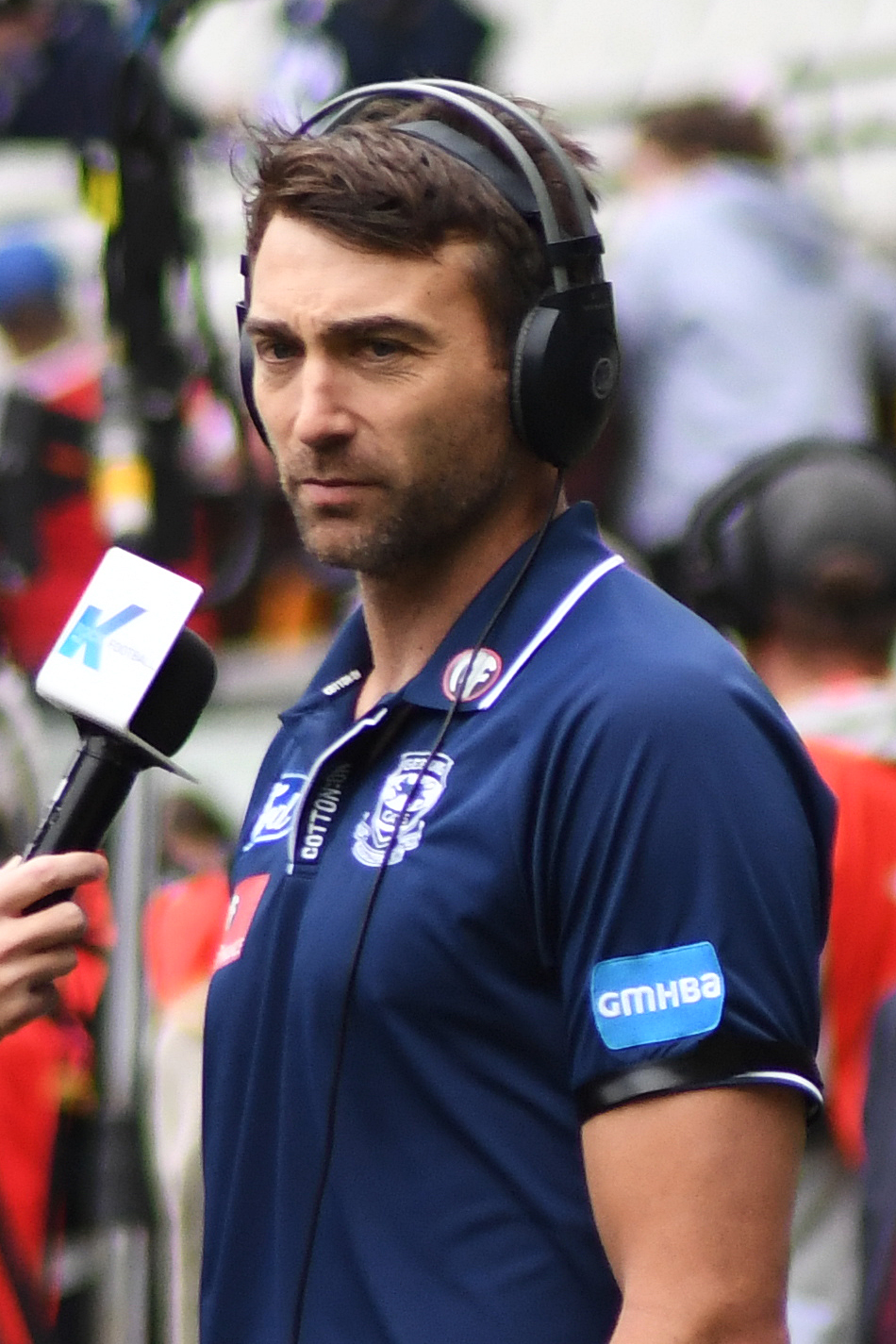
Corey Enright (born 14 September 1981) is a former professional Australian rules footballer who played for the Geelong Football Club in the Australian Football League (AFL). He has played the third-most games for Geelong. Enright is currently defence coach at St Kilda, after coaching at Geelong from 2017 to 2020.[1]
Key Information
Early life
[edit]Enright grew up in the town of Kimba, South Australia[2] and played for the Kimba District Tigers in the Eastern Eyre Football League. He was recruited from the Port Adelaide Magpies, selected by Geelong with the 47th overall pick in the 1999 National Draft.[3]
Playing career
[edit]Like many of his teammates, Enright was outstanding in 2007. He was among the Cats best in the Grand Final win over Port Adelaide, gathering 29 possessions.
The 2008 season saw Enright become a household name with his first All-Australian selection. He was again pivotal in the Grand Final, recording 25 disposals in the Cats' 26-point loss to Hawthorn.
In 2009 after another superb season down back, Enright got his second All-Australian team selection, this time starting on the field. Enright was also voted by his peers to be the league's most underrated player, as he had begun to make a name for himself as one of the league's most reliable non-key defenders with his superb overhead skills and cool, calm head.
2010 saw a third successive selection in the All-Australian team in which he followed up with a fourth successive selection in 2011,[2] the last three selections as a starting back pocket.
At Geelong Corey also won his two Club Best and Fairest "Carji Greeves" Medals in the Premiership Years 2009 and 2011.[4]
Enright joins an elite AFL group who have won multiple club best and fairest medals in premiership years. This group includes Leigh Matthews, Kevin Bartlett, Jason Dunstall, Simon Black, Michael Voss and Josh Gibson.
On the night of the 2011 Carji Greeves Medal presentation, coach Chris Scott introduced Corey Enright as "still the most underrated player in the competition".[5]
Enright made Geelong history after overtaking the previous record of 325 games held by Ian Nankervis in round 19, 2016 against the Western Bulldogs at Simonds Stadium. On 3 September 2021, in the Cats' semi-final against Greater Western Sydney, his record was overtaken by Joel Selwood. (Then overtaken again by Tom Hawkins in 2024)
After the conclusion of the 2016 season, Enright announced his retirement from the AFL.[6]
Statistics
[edit] G
|
Goals | K
|
Kicks | D
|
Disposals | T
|
Tackles |
B
|
Behinds | H
|
Handballs | M
|
Marks |
| Season | Team | No. | Games | Totals | Averages (per game) | ||||||||||||
|---|---|---|---|---|---|---|---|---|---|---|---|---|---|---|---|---|---|
| G | B | K | H | D | M | T | G | B | K | H | D | M | T | ||||
| 2001 | Geelong | 44 | 17 | 5 | 5 | 116 | 87 | 203 | 56 | 20 | 0.3 | 0.3 | 6.8 | 5.1 | 11.9 | 3.3 | 1.2 |
| 2002 | Geelong | 44 | 16 | 3 | 2 | 180 | 117 | 297 | 54 | 27 | 0.2 | 0.1 | 11.3 | 7.3 | 18.6 | 3.4 | 1.7 |
| 2003 | Geelong | 44 | 22 | 3 | 6 | 240 | 174 | 414 | 117 | 40 | 0.1 | 0.3 | 10.9 | 7.9 | 18.8 | 5.3 | 1.8 |
| 2004 | Geelong | 44 | 9 | 0 | 1 | 67 | 41 | 108 | 27 | 15 | 0.0 | 0.1 | 7.4 | 4.6 | 12.0 | 3.0 | 1.7 |
| 2005 | Geelong | 44 | 15 | 8 | 6 | 168 | 109 | 277 | 79 | 23 | 0.5 | 0.4 | 11.2 | 7.3 | 18.5 | 5.3 | 1.5 |
| 2006 | Geelong | 44 | 22 | 11 | 2 | 327 | 164 | 491 | 139 | 64 | 0.5 | 0.1 | 14.9 | 7.5 | 22.3 | 6.3 | 2.9 |
| 2007 | Geelong | 44 | 24 | 9 | 5 | 323 | 226 | 549 | 139 | 51 | 0.4 | 0.2 | 13.5 | 9.4 | 22.9 | 5.8 | 2.1 |
| 2008 | Geelong | 44 | 25 | 6 | 2 | 299 | 282 | 581 | 133 | 70 | 0.2 | 0.1 | 12.0 | 11.3 | 23.2 | 5.3 | 2.8 |
| 2009 | Geelong | 44 | 25 | 4 | 2 | 343 | 285 | 628 | 142 | 71 | 0.2 | 0.1 | 13.7 | 11.4 | 25.1 | 5.7 | 2.8 |
| 2010 | Geelong | 44 | 24 | 1 | 1 | 360 | 222 | 582 | 136 | 69 | 0.0 | 0.0 | 15.0 | 9.3 | 24.3 | 5.7 | 2.9 |
| 2011 | Geelong | 44 | 23 | 1 | 0 | 330 | 183 | 513 | 144 | 64 | 0.0 | 0.0 | 14.3 | 8.0 | 22.3 | 6.3 | 2.8 |
| 2012 | Geelong | 44 | 22 | 2 | 3 | 283 | 179 | 462 | 126 | 53 | 0.1 | 0.1 | 12.9 | 8.1 | 21.0 | 5.7 | 2.4 |
| 2013 | Geelong | 44 | 22 | 1 | 4 | 324 | 166 | 490 | 152 | 41 | 0.0 | 0.2 | 14.7 | 7.5 | 22.3 | 6.9 | 1.9 |
| 2014 | Geelong | 44 | 22 | 8 | 4 | 255 | 207 | 462 | 114 | 61 | 0.4 | 0.2 | 11.6 | 9.4 | 21.0 | 5.2 | 2.8 |
| 2015 | Geelong | 44 | 21 | 0 | 1 | 301 | 183 | 484 | 148 | 60 | 0.0 | 0.0 | 14.3 | 8.7 | 23.0 | 7.0 | 2.9 |
| 2016 | Geelong | 44 | 23 | 4 | 2 | 322 | 220 | 542 | 130 | 66 | 0.2 | 0.1 | 14.0 | 9.6 | 23.6 | 5.6 | 2.9 |
| Career[7] | 332 | 66 | 46 | 4238 | 2845 | 7003 | 1836 | 795 | 0.2 | 0.1 | 12.8 | 8.6 | 21.3 | 5.5 | 2.4 | ||
Coaching career
[edit]Enright joined Geelong's coaching team for the 2017 season, beginning as a development coach before becoming an assistant coach and helping Geelong reach finals in each year of his tenure. Ahead of the 2022 season, Enright joined St Kilda as an assistant coach.[1]
References
[edit]- ^ a b "Enright joins St Kilda". saints.com.au. Retrieved 17 September 2021.
- ^ a b Faulkner, Andrew (1 October 2011). "Shining star Corey Enright uncomfortable under bright lights". The Australian.
- ^ "Corey Enright - GEELONGCATS.com.au". Archived from the original on 12 April 2013. Retrieved 4 April 2013.
- ^ Gullan, Scott (6 October 2011). "Corey Enright top Cat again". Herald Sun.
- ^ "Corey Enright 'most underrated player in the competition', says Chris Scott". Australian Associated Press. 8 October 2011.
- ^ Cherny, Daniel (5 October 2016). "Geelong Cats star Corey Enright announces his AFL retirement". The Age. Fairfax Media. Retrieved 5 October 2016.
- ^ "Corey Enright". AFL Tables. Retrieved 9 August 2014.
External links
[edit]- Corey Enright's profile on the official website of the Geelong Football Club
- Corey Enright's playing statistics from AFL Tables
Corey Enright
View on GrokipediaEarly life
Upbringing in South Australia
Corey Enright was born on 14 September 1981 in Kimba, South Australia, to parents Garry and Maxine Enright, within a tight-knit farming community on the Eyre Peninsula.[7][8] The family resided on Enright Street, named after his grandfather, a stonemason who contributed significantly to the town's infrastructure alongside other relatives who were prominent builders.[9] Enright grew up alongside his siblings, brother Mark and sister Marni, in an environment where family support and community ties were central.[10][11] Kimba, a rural service town with a population of approximately 600, revolves around agriculture, particularly dryland farming and wheat production, which shapes the local economy and lifestyle.[8][10] The town's remote location, roughly halfway between Perth and Sydney on the Eyre Highway, limits access to urban amenities such as cinemas or large shopping centers, fostering a strong emphasis on community activities and outdoor pursuits amid its vast, open landscapes.[8] This setting, marked by the iconic Big Galah roadside attraction, instilled in Enright a resilient, grounded perspective from an early age.[10] Enright's father, Garry, a former captain-coach in the local football league, played a key role in nurturing his son's interest in sport, often sharing stories of his own involvement in community games.[9] From childhood, Enright was known for his relentless energy, frequently seen with a football in hand, reflecting the pervasive influence of Australian rules football in the town's social fabric.[9] His earliest encounters with the game occurred through school activities at the local Kimba Area School and informal community events, where football served as a primary outlet for recreation and social bonding in the resource-scarce rural setting.[12][8]Junior football development
Enright's junior football journey began in his hometown of Kimba, South Australia, where his rural upbringing instilled a strong sense of determination that fueled his early passion for the game. He joined the Kimba District Tigers in the Eastern Eyre Football League as a junior, quickly emerging as an eye-catching talent despite his initially scrawny physique.[10] By the age of 15, Enright had progressed to senior football with the Kimba District Tigers, completing three seasons at that level while still a teenager and demonstrating remarkable maturity on the field.[13] He became a regular representative for the Eastern Eyre colts in zone carnivals, competing under coach Peter Woolford and gaining exposure to higher-level competition that honed his fundamental skills.[14] At 17, Enright was widely regarded as the region's top player, capping his local tenure by winning the 1999 Mail Medal as the best and fairest in the Eastern Eyre Football League.[15] Zoned to the Port Adelaide Magpies due to his Eyre Peninsula origins, Enright transitioned to their SANFL under-19 setup in 1998 and 1999, where he made several appearances and began refining his defensive prowess through more structured environments.[16] Although specific training regimens from this period are not well-documented, his time splitting duties between Kimba and Port Adelaide exposed him to varied coaching styles that emphasized decision-making and positional play, laying the groundwork for his future specialization as a defender.[16] Enright also represented broader South Australian youth selections, including Eyre Peninsula teams in interstate-style zone carnivals, further accelerating his development against interstate opposition.[11]Playing career
Draft selection and debut
Enright was selected by the Geelong Football Club with the 47th pick in the 1999 AFL National Draft, recruited from the Port Adelaide Magpies in South Australia, where he had impressed in junior and reserves football despite not participating in national championships.[17] Geelong's recruiting boss, Stephen Wells, viewed him as a versatile prospect capable of playing as a defender or forward, noting his suitable size and adaptability, though initial expectations were modest for the 18-year-old from the small country town of Kimba.[16] This selection originated from a trade pick acquired by Geelong from North Melbourne in exchange for captain Leigh Colbert.[18] Upon arriving at Geelong in late 1999, Enright faced significant adjustment challenges, including severe homesickness that prompted his parents to visit the club and meet with coach Mark Thompson to discuss his potential departure.[19] Supported by the club's player welfare officer Paul Brown, who integrated him through non-football activities, Enright spent the 2000 pre-season training with the senior list but primarily developed with Geelong's VFL affiliate team, playing a full season there to build physicality and game sense amid initial injuries and form struggles.[19][3] By the end of 2000, he had adapted better, earning recognition as one of the club's better first-year players in development.[20] Enright made his AFL debut in round 2 of the 2001 season against St Kilda at Colonial Stadium (now Etihad Stadium), where Geelong secured a 29-point victory with a final score of 17.13 (115) to 13.8 (86).[21] In the match, the 19-year-old recorded 5 kicks, 4 handballs for 9 disposals, 1 mark, and 2 tackles, contributing solidly in defense during his first senior appearance.[21] He went on to play 17 games that season, establishing himself as a reliable back-pocket option.[2] Despite his breakthrough in 2001, Enright encountered ongoing challenges in securing a consistent senior role during 2002, managing only 16 AFL games while spending time in the VFL to refine his versatility and defensive positioning.[2] These early years highlighted his resilience, as he navigated the transition from country football to the professional level, gradually earning more opportunities through persistent development.[16]Tenure with Geelong Cats
Enright evolved into one of Geelong's premier half-back flankers during the mid-2000s, renowned for his run-and-carry ability, intercept marking, and precise kicking that facilitated swift transitions from defense to attack, while also providing lockdown pressure on opposition small forwards.[22] His role became integral to the Cats' defensive structure, often sweeping across half-back to read the play and initiate counter-attacks, a style that defined Geelong's high-pressure, possession-based game plan under coach Mark Thompson.[3] Enright played a pivotal role in Geelong's 2007 premiership, the club's first flag in 44 years, appearing in all finals matches including the qualifying final against North Melbourne where he recorded 18 disposals and five marks to help secure a 106-point victory.[23] In the Grand Final against Port Adelaide, he gathered 29 disposals, including 14 kicks and four marks, standing among the Cats' best performers in their record 119-point triumph.[24] His composure under pressure exemplified the defensive resilience that underpinned Geelong's dominant season. The 2009 premiership campaign showcased Enright's consistency, as he featured in 25 games without major interruption, contributing 22 disposals and three marks in the Grand Final win over St Kilda by 12 points.[25] That year, his defensive reads and rebounding were crucial to maintaining Geelong's ladder-topping form, earning him a shared Carji Greeves Medal with Gary Ablett Jr. on 740 votes from coaches' assessments across all matches.[26] Enright's leadership grew prominent by 2011, when he joined the club's leadership group alongside Jimmy Bartel, Joel Corey, James Kelly, and Harry Taylor, guiding younger players through a season of high expectations.[27][28] He captained the backline effectively in the premiership decider against Collingwood, amassing 25 disposals with six marks to anchor the defense in a 38-point victory, while his outright Carji Greeves Medal win with 150 votes—seven ahead of Joel Corey—highlighted his season-long impact of 23 games and elite defensive metrics.[29][30] Individually, Enright's prime years yielded four consecutive All-Australian selections from 2008 to 2011, recognizing his status as one of the competition's top interceptors and rebounders, with selections in the back pocket or half-back positions, followed by additional selections in 2013 and 2016.[31] Following the 2009 flag, Enright faced setbacks including a medial knee ligament strain in the 2013 qualifying final loss to Fremantle, which sidelined him for the preliminary final despite intensive rehabilitation efforts for a potential return.[32] He staged a strong comeback in subsequent seasons, resuming his half-back role and contributing to Geelong's finals appearances, demonstrating resilience that extended his career into his mid-30s.[33]Retirement from playing
In the 2016 season, Enright played 23 games for Geelong, earning his sixth All-Australian selection and contributing significantly to the team's run to the preliminary final.[2][34] His performance included breaking the club's games record with his 326th appearance in round 19 against the Western Bulldogs, surpassing Ian Nankervis' long-standing mark of 325 games.[35] The season culminated in a 37-point preliminary final loss to Sydney on September 24, where Enright, visibly emotional and in tears as he left the field, played what would become his farewell match.[36][34] Enright officially announced his retirement on October 4, 2016, at age 35, after 332 games and 17 seasons with the Geelong Cats, citing the physical demands of the game after such a long career and a desire to spend more time with his family.[35][34] He reflected on the privilege of representing Geelong and the support from his family as pivotal in his decision, noting that the emotional weight of the preliminary final had signaled it was time to step away.[27] Tributes poured in from teammates, club officials, and fans upon the announcement, celebrating Enright's understated leadership and defensive prowess. Geelong coach Chris Scott lauded him as irreplaceable, emphasizing his influence on younger players and his role in three premierships that left Enright with a sense of a fulfilled career.[34][35] Enright himself delivered a heartfelt speech thanking the club, staff, and supporters, while fans affectionately referenced his childhood nickname "Boris"—earned due to his hyperactive nature reminiscent of tennis star Boris Becker—and hailed him as one of the Cats' greatest-ever defenders.[37][38] At the time of his retirement, Enright stood at 187 cm tall and weighed 90 kg, having kicked 66 goals across his career.[2][39]Career statistics
AFL playing statistics
Corey Enright played 332 games for the Geelong Cats in the Australian Football League (AFL) from 2001 to 2016, scoring 66 goals and 46 behinds.[2] His career averages included 21.3 disposals, 5.5 marks, and 2.4 tackles per game, reflecting his consistent performance as a half-back flanker.[2] These figures underscore his reliability in defense, where his low goal tally of 0.2 per game aligned with his primary role restricting opposition forwards.[2] The following table summarizes Enright's season-by-season statistics, focusing on key metrics such as games played, goals, disposals, marks, and tackles.| Year | Games | Goals | Disposals | Marks | Tackles |
|---|---|---|---|---|---|
| 2001 | 17 | 5 | 203 | 56 | 20 |
| 2002 | 16 | 3 | 297 | 54 | 27 |
| 2003 | 22 | 3 | 414 | 117 | 40 |
| 2004 | 9 | 0 | 108 | 27 | 15 |
| 2005 | 15 | 8 | 277 | 79 | 23 |
| 2006 | 22 | 11 | 491 | 139 | 64 |
| 2007 | 24 | 9 | 549 | 139 | 51 |
| 2008 | 25 | 6 | 581 | 133 | 70 |
| 2009 | 25 | 4 | 628 | 142 | 71 |
| 2010 | 24 | 1 | 582 | 136 | 69 |
| 2011 | 23 | 1 | 513 | 144 | 64 |
| 2012 | 22 | 2 | 462 | 126 | 53 |
| 2013 | 22 | 1 | 490 | 152 | 41 |
| 2014 | 22 | 8 | 462 | 114 | 61 |
| 2015 | 21 | 0 | 484 | 148 | 60 |
| 2016 | 23 | 4 | 542 | 130 | 66 |
| Career Total | 332 | 66 | 7083 | 1836 | 795 |
