



Community hub
Recent from talks
Contribute something
Nothing was collected or created yet.
Adaptive filter
View on WikipediaAn adaptive filter is a system with a linear filter that has a transfer function controlled by variable parameters and a means to adjust those parameters according to an optimization algorithm. Because of the complexity of the optimization algorithms, almost all adaptive filters are digital filters. Adaptive filters are required for some applications because some parameters of the desired processing operation (for instance, the locations of reflective surfaces in a reverberant space) are not known in advance or are changing. The closed loop adaptive filter uses feedback in the form of an error signal to refine its transfer function.
Generally speaking, the closed loop adaptive process involves the use of a cost function, which is a criterion for optimum performance of the filter, to feed an algorithm, which determines how to modify filter transfer function to minimize the cost on the next iteration. The most common cost function is the mean square of the error signal.
As the power of digital signal processors has increased, adaptive filters have become much more common and are now routinely used in devices such as mobile phones and other communication devices, camcorders and digital cameras, and medical monitoring equipment.
Example application
[edit]The recording of a heart beat (an ECG), may be corrupted by noise from the AC mains. The exact frequency of the power and its harmonics may vary from moment to moment.
One way to remove the noise is to filter the signal with a notch filter at the mains frequency and its vicinity, but this could excessively degrade the quality of the ECG since the heart beat would also likely have frequency components in the rejected range.
To circumvent this potential loss of information, an adaptive filter could be used. The adaptive filter would take input both from the patient and from the mains and would thus be able to track the actual frequency of the noise as it fluctuates and subtract the noise from the recording. Such an adaptive technique generally allows for a filter with a smaller rejection range, which means, in this case, that the quality of the output signal is more accurate for medical purposes.[1][2]
Block diagram
[edit]The idea behind a closed loop adaptive filter is that a variable filter is adjusted until the error (the difference between the filter output and the desired signal) is minimized. The Least Mean Squares (LMS) filter and the Recursive Least Squares (RLS) filter are types of adaptive filter.

Adaptive Filter. k = sample number, x = reference input, X = set of recent values of x, d = desired input, W = set of filter coefficients, ε = error output, f = filter impulse response, * = convolution, Σ = summation, upper box=linear filter, lower box=adaption algorithm


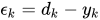
There are two input signals to the adaptive filter: and which are sometimes called the primary input and the reference input respectively.[3] The adaptation algorithm attempts to filter the reference input into a replica of the desired input by minimizing the residual signal, . When the adaptation is successful, the output of the filter is effectively an estimate of the desired signal.


- which includes the desired signal plus undesired interference and
- which includes the signals that are correlated to some of the undesired interference in .
- k represents the discrete sample number.
The filter is controlled by a set of L+1 coefficients or weights.
- represents the set or vector of weights, which control the filter at sample time k.
- where refers to the 'th weight at k'th time.
- represents the change in the weights that occurs as a result of adjustments computed at sample time k.
- These changes will be applied after sample time k and before they are used at sample time k+1.
![{\displaystyle \mathbf {W} _{k}=\left[w_{0k},\,w_{1k},\,...,\,w_{Lk}\right]^{T}}](https://wikimedia.org/api/rest_v1/media/math/render/svg/927bf9a780012f1a80bb6608a3ff410221a7b43e)


The output is usually but it could be or it could even be the filter coefficients.[4](Widrow)
The input signals are defined as follows:

- where:
- g = the desired signal,
- g' = a signal that is correlated with the desired signal g ,
- u = an undesired signal that is added to g , but not correlated with g or g'
- u' = a signal that is correlated with the undesired signal u, but not correlated with g or g',
- v = an undesired signal (typically random noise) not correlated with g, g', u, u' or v',
- v' = an undesired signal (typically random noise) not correlated with g, g', u, u' or v.

The output signals are defined as follows:
- .
- where:
- = the output of the filter if the input was only g',
- = the output of the filter if the input was only u',
- = the output of the filter if the input was only v'.



Tapped delay line FIR filter
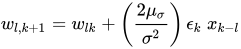
[edit]If the variable filter has a tapped delay line Finite Impulse Response (FIR) structure, then the impulse response is equal to the filter coefficients. The output of the filter is given by
-
- where refers to the 'th weight at k'th time.

Ideal case
[edit]In the ideal case . All the undesired signals in are represented by . consists entirely of a signal correlated with the undesired signal in .



The output of the variable filter in the ideal case is
- .

The error signal or cost function is the difference between and
- . The desired signal gk passes through without being changed.

The error signal is minimized in the mean square sense when is minimized. In other words, is the best mean square estimate of . In the ideal case, and , and all that is left after the subtraction is which is the unchanged desired signal with all undesired signals removed.
![{\displaystyle [u_{k}-{\hat {u}}_{k}]}](https://wikimedia.org/api/rest_v1/media/math/render/svg/cbc75695df122bd9dc20a1832864efec904c1446)


Signal components in the reference input
[edit]In some situations, the reference input includes components of the desired signal. This means g' ≠ 0.
Perfect cancelation of the undesired interference is not possible in the case, but improvement of the signal to interference ratio is possible. The output will be
- . The desired signal will be modified (usually decreased).

The output signal to interference ratio has a simple formula referred to as power inversion.
- .
- where
- = output signal to interference ratio.
- = reference signal to interference ratio.
- = frequency in the z-domain.
- where
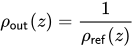


This formula means that the output signal to interference ratio at a particular frequency is the reciprocal of the reference signal to interference ratio.[5]
Example: A fast food restaurant has a drive-up window. Before getting to the window, customers place their order by speaking into a microphone. The microphone also picks up noise from the engine and the environment. This microphone provides the primary signal. The signal power from the customer's voice and the noise power from the engine are equal. It is difficult for the employees in the restaurant to understand the customer. To reduce the amount of interference in the primary microphone, a second microphone is located where it is intended to pick up sounds from the engine. It also picks up the customer's voice. This microphone is the source of the reference signal. In this case, the engine noise is 50 times more powerful than the customer's voice. Once the canceler has converged, the primary signal to interference ratio will be improved from 1:1 to 50:1.
Adaptive Linear Combiner
[edit]
Adaptive linear combiner showing the combiner and the adaption process. k = sample number, n=input variable index, x = reference inputs, d = desired input, W = set of filter coefficients, ε = error output, Σ = summation, upper box=linear combiner, lower box=adaption algorithm. 
Adaptive linear combiner, compact representation. k = sample number, n=input variable index, x = reference inputs, d = desired input, ε = error output, Σ = summation.


The adaptive linear combiner (ALC) resembles the adaptive tapped delay line FIR filter except that there is no assumed relationship between the X values. If the X values were from the outputs of a tapped delay line, then the combination of tapped delay line and ALC would comprise an adaptive filter. However, the X values could be the values of an array of pixels. Or they could be the outputs of multiple tapped delay lines. The ALC finds use as an adaptive beam former for arrays of hydrophones or antennas.
-
- where refers to the 'th weight at k'th time.
LMS algorithm
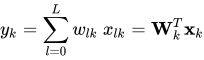
[edit]If the variable filter has a tapped delay line FIR structure, then the LMS update algorithm is especially simple. Typically, after each sample, the coefficients of the FIR filter are adjusted as follows:[6]
- for

-
- μ is called the convergence factor.

The LMS algorithm does not require that the X values have any particular relationship; therefore it can be used to adapt a linear combiner as well as an FIR filter. In this case the update formula is written as:

The effect of the LMS algorithm is at each time, k, to make a small change in each weight. The direction of the change is such that it would decrease the error if it had been applied at time k. The magnitude of the change in each weight depends on μ, the associated X value and the error at time k. The weights making the largest contribution to the output, , are changed the most. If the error is zero, then there should be no change in the weights. If the associated value of X is zero, then changing the weight makes no difference, so it is not changed.
Convergence
[edit]μ controls how fast and how well the algorithm converges to the optimum filter coefficients. If μ is too large, the algorithm will not converge. If μ is too small the algorithm converges slowly and may not be able to track changing conditions. If μ is large but not too large to prevent convergence, the algorithm reaches steady state rapidly but continuously overshoots the optimum weight vector. Sometimes, μ is made large at first for rapid convergence and then decreased to minimize overshoot.
Widrow and Stearns state in 1985 that they have no knowledge of a proof that the LMS algorithm will converge in all cases.[7]
However under certain assumptions about stationarity and independence it can be shown that the algorithm will converge if

- where
- = sum of all input power
- where

- is the RMS value of the 'th input

In the case of the tapped delay line filter, each input has the same RMS value because they are simply the same values delayed. In this case the total power is

- where
- is the RMS value of , the input stream.[7]
- where

This leads to a normalized LMS algorithm:
- in which case the convergence criteria becomes: .

Nonlinear Adaptive Filters
[edit]The goal of nonlinear filters is to overcome limitation of linear models. There are some commonly used approaches: Volterra LMS, Kernel adaptive filter, Spline Adaptive Filter [8] and Urysohn Adaptive Filter.[9][10] Many authors [11] include also Neural networks into this list. The general idea behind Volterra LMS and Kernel LMS is to replace data samples by different nonlinear algebraic expressions. For Volterra LMS this expression is Volterra series. In Spline Adaptive Filter the model is a cascade of linear dynamic block and static non-linearity, which is approximated by splines. In Urysohn Adaptive Filter the linear terms in a model
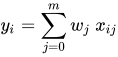
are replaced by piecewise linear functions
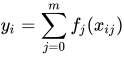
which are identified from data samples.
Applications of adaptive filters
[edit]Filter implementations
[edit]See also
[edit]References
[edit]- ^ Thakor, N.V.; Zhu, Yi-Sheng (1991-08-01). "Applications of adaptive filtering to ECG analysis: noise cancellation and arrhythmia detection". IEEE Transactions on Biomedical Engineering. 38 (8): 785–794. doi:10.1109/10.83591. ISSN 0018-9294. PMID 1937512. S2CID 11271450.
- ^ Widrow, Bernard; Stearns, Samuel D. (1985). Adaptive Signal Processing (1st ed.). Prentice-Hall. p. 329. ISBN 978-0130040299.
- ^ Widrow p 304
- ^ Widrow p 212
- ^ Widrow p 313
- ^ Widrow p. 100
- ^ a b Widrow p 103
- ^ Danilo Comminiello; José C. Príncipe (2018). Adaptive Learning Methods for Nonlinear System Modeling. Elsevier Inc. ISBN 978-0-12-812976-0.
- ^ M.Poluektov and A.Polar. Urysohn Adaptive Filter. 2019.
- ^ "Nonlinear Adaptive Filtering". ezcodesample.com.
- ^ Weifeng Liu; José C. Principe; Simon Haykin (March 2010). Kernel Adaptive Filtering: A Comprehensive Introduction (PDF). Wiley. pp. 12–20. ISBN 978-0-470-44753-6.
Sources
[edit]- Hayes, Monson H. (1996). Statistical Digital Signal Processing and Modeling. Wiley. ISBN 978-0-471-59431-4.
- Haykin, Simon (2002). Adaptive Filter Theory. Prentice Hall. ISBN 978-0-13-048434-5.
- Widrow, Bernard; Stearns, Samuel D. (1985). Adaptive Signal Processing. Englewood Cliffs, NJ: Prentice Hall. ISBN 978-0-13-004029-9.
Adaptive filter
View on GrokipediaFundamentals
Definition and Purpose
An adaptive filter is a digital filter whose coefficients are automatically adjusted in real time to optimize performance based on the characteristics of the input signal and a desired response.[5] This self-adjusting process enables the filter to converge toward an optimal state without requiring prior knowledge of the signal statistics.[5] Unlike fixed filters, adaptive filters operate as nonlinear systems in practice, as their parameter updates depend on the ongoing input-output relationship, violating the superposition principle.[6] The primary purpose of adaptive filters is to process non-stationary signals, where statistical properties such as mean, variance, or spectral content vary over time, rendering conventional fixed-coefficient filters ineffective.[2] By dynamically tracking these changes, adaptive filters support a wide range of signal processing applications, including noise cancellation in audio systems, echo suppression in telecommunications, and interference mitigation in biomedical signals, all without needing explicit models of the environment.[6] This adaptability is particularly valuable in real-world scenarios where signals are corrupted by unpredictable noise or distortions.[5] Key components of an adaptive filter include the input signal, which drives the filter; the desired signal, representing the ideal output; the error signal, defined as the difference between the desired signal and the filter's output; and a mechanism for updating the filter coefficients based on this error.[5] The optimization typically minimizes the mean square error (MSE), computed as the expected value of the squared error signal, serving as the objective function to guide coefficient adjustments.[2][6]Historical Development
The origins of adaptive filters trace back to the mid-20th century, building on foundational work in control theory and optimal filtering for stationary signals. Norbert Wiener's 1949 development of the Wiener filter provided the theoretical basis for linear prediction and noise reduction in stationary environments, laying the groundwork for subsequent adaptive extensions to handle non-stationary conditions. In the late 1950s and early 1960s, researchers began addressing dynamic systems through adaptive mechanisms, with early contributions emerging from control engineering and pattern recognition efforts. A pivotal transition occurred in 1960 when Bernard Widrow and Marcian Hoff introduced the Adaptive Linear Neuron (ADALINE) at Stanford University, marking one of the first practical adaptive filtering systems for pattern recognition and signal processing. This work, motivated by the need for self-adjusting circuits in non-stationary environments, led to the formulation of the Least Mean Squares (LMS) algorithm, which enabled iterative weight updates based on error minimization and became a cornerstone for adaptive systems.[7] Widrow's ongoing research in the 1960s further refined these concepts, emphasizing gradient-descent methods for real-time adaptation in applications like noise cancellation.[8] Key milestones in the 1970s and 1980s solidified adaptive filtering as a distinct field. The 1985 publication of Adaptive Signal Processing by Widrow and Samuel D. Stearns synthesized decades of progress, detailing LMS implementations and introducing broader applications in digital signal processing.[9] Concurrently, the Recursive Least Squares (RLS) algorithm gained prominence in the 1980s for its superior convergence properties compared to LMS, particularly in scenarios requiring rapid adaptation, as explored in works on recursive estimation techniques. These developments, building on earlier least-squares methods dating to Carl Friedrich Gauss in 1795, addressed stability and performance challenges in adaptive systems.[10] In the post-2000 era, adaptive filters evolved through integration with machine learning paradigms. Around 2008, kernel methods emerged with the Kernel Least-Mean-Square (KLMS) algorithm by Weifeng Liu, Puskal Pokharel, and José C. Príncipe, extending LMS to nonlinear Hilbert spaces for improved handling of complex data patterns.[11] By the 2020s, hybrids combining adaptive filtering with deep neural networks addressed nonlinear problems more effectively, as demonstrated in frameworks where neural architectures learn update rules for traditional adaptive filters, enhancing generalization in signal processing tasks.[12] For instance, as of 2025, deep neural network-driven approaches have been proposed to improve generalization in adaptive filtering.[13] Influential figures like Widrow, Hoff, and Liu continue to shape this trajectory, bridging classical signal processing with contemporary AI advancements.Principles and Models
General Block Diagram
The general block diagram of an adaptive filter illustrates a feedback system designed to dynamically adjust its parameters in response to changing input conditions. It consists of four primary signals: the input signal , the desired signal , the filter output , and the error signal . The filter processes to produce , which is then subtracted from to generate . This error feeds back into the adaptation mechanism, forming a closed loop that enables the filter to self-optimize over time. In this architecture, the primary input typically represents a corrupted or observed signal containing the information of interest along with interference, such as noise or echoes. The desired signal serves as a reference or guiding signal, ideally embodying the clean target output that the filter aims to approximate. For instance, in noise cancellation scenarios, may include the desired signal plus uncorrelated noise, while provides a correlated reference for subtraction. The adaptation loop operates by using the error to iteratively update the filter's coefficients, with the objective of minimizing the mean squared error (MSE), defined as . This process ensures the filter converges toward an optimal configuration that reduces discrepancies between and . The filter output is computed as , where are the time-varying adaptive weights and is the filter order. A common realization of this structure employs a tapped delay line to generate the delayed versions of .Tapped Delay Line FIR Filter
The tapped delay line finite impulse response (FIR) filter represents the predominant structure for implementing linear adaptive filters due to its straightforward design and effective performance in dynamic environments. This configuration employs a chain of unit delay elements, denoted as , to generate a set of delayed versions of the input signal , forming the tap signals , where denotes the filter length or number of taps. Each tap is scaled by a corresponding time-varying weight for , and these weighted taps are subsequently summed to yield the filter output . In vector notation, the structure is expressed as where is the input tap vector and is the weight vector. This tapped delay line realizes the variable filter component of the general adaptive filter block diagram, enabling the filter to approximate unknown systems through weight adjustments.[14][15] A key benefit of the tapped delay line FIR structure lies in its inherent stability, arising from the absence of feedback loops, which eliminates the risk of instability associated with pole placement in recursive filters. Unlike infinite impulse response (IIR) designs, the FIR configuration guarantees bounded-input bounded-output stability regardless of weight values, making it particularly suitable for adaptive applications where weights evolve over time. Additionally, the structure supports a linear phase response when weights are symmetrically constrained, ensuring that all frequency components of the input signal experience uniform group delay and preserving waveform integrity without distortion. The finite memory characteristic further enhances its appeal, as the output depends solely on the most recent input samples, limiting the influence of distant past inputs and facilitating efficient real-time processing.[1][16] The selection of filter length requires careful consideration of performance trade-offs. Increasing enhances the filter's ability to model complex impulse responses with greater accuracy, potentially improving steady-state error in applications like system identification. However, this comes at the expense of higher computational complexity, as each adaptation iteration scales linearly with , elevating both arithmetic operations and memory demands. Moreover, larger typically prolongs convergence time during adaptation, as more weights must be optimized, thereby balancing modeling capability against practical constraints in resource-limited systems.[17]Adaptive Linear Combiner
The adaptive linear combiner serves as a core building block in adaptive signal processing, producing an output that is a weighted sum of multiple input signals.[18] This structure is particularly suited for scenarios involving vector-valued inputs from diverse sources, enabling the system to adaptively combine them to achieve desired signal processing goals. The mathematical model for the adaptive linear combiner is expressed as where is the output at discrete time , for represents the set of input signals, and denotes the corresponding adaptive weights.[18] The linearity of this combination assumes that the output depends proportionally on the inputs through the weights, which supports efficient adaptation techniques relying on gradient descent principles. In practice, the weights are initialized to zero or small random values to avoid bias and facilitate convergence during the adaptation phase. This model finds prominent use in beamforming applications, where signals from an array of sensors are linearly combined to steer the response toward a desired direction while nulling interferers.[19] For instance, in adaptive antenna arrays, the combiner processes multichannel inputs to enhance signal-to-noise ratio in communication systems.[19] Unlike the single-input tapped delay line FIR filter, which relies on time-delayed versions of one signal, the adaptive linear combiner handles independent inputs from multiple channels, providing greater flexibility for spatial or multi-source processing.Algorithms
Least Mean Squares (LMS) Algorithm
The least mean squares (LMS) algorithm is a foundational stochastic gradient descent method for adaptive filtering, originally developed for adjusting weights in pattern recognition systems and later extended to signal processing applications.[20] It iteratively minimizes the mean square error (MSE) between the desired signal and the filter output by updating filter coefficients based on instantaneous error estimates, making it computationally efficient and robust without requiring prior knowledge of signal statistics.[21] The core update rule of the LMS algorithm is given by where is the coefficient vector at time , is the step size parameter, is the error signal with desired input and filter output , and is the input signal vector.[21] This rule approximates the steepest descent direction using the instantaneous gradient of the squared error, , rather than the exact expected gradient , where is the input autocorrelation matrix and is the cross-correlation vector; this stochastic approximation enables real-time adaptation at the cost of noisier convergence compared to batch methods.[21] The step size critically influences both stability and convergence speed of the LMS algorithm. For mean-square stability, it must satisfy , where is the largest eigenvalue of ; a conservative practical bound, assuming white input noise with power and filter length , is , ensuring the algorithm converges in the mean while avoiding divergence.[21] Larger values accelerate initial convergence toward the Wiener solution but increase excess MSE due to gradient noise, necessitating a trade-off based on application requirements such as signal stationarity and noise levels.[21] A prominent variant, the normalized LMS (NLMS) algorithm, addresses variations in input signal power by normalizing the step size, yielding the update where is a small regularization constant to prevent division by zero, and (often around 0.25 for stability).[21] This normalization makes the effective step size independent of input amplitude, improving robustness in non-stationary environments like acoustic echo cancellation, though it incurs a minor computational overhead from the norm calculation.[21]Other Adaptive Algorithms
The Recursive Least Squares (RLS) algorithm represents a deterministic approach to adaptive filtering, rooted in principles akin to the Kalman filter, where filter coefficients are updated to minimize a weighted linear least squares cost function over a sliding window of past data.[22] The core update mechanism computes a gain vector , with denoting the inverse correlation matrix that evolves recursively, and serving as a forgetting factor to emphasize recent observations.[22] This structure enables rapid convergence, often achieving steady-state performance in fewer iterations than stochastic methods, though it incurs a computational complexity of operations per iteration, where is the filter order, making it suitable for applications tolerant of higher processing demands.[23] The Affine Projection Algorithm (APA) builds on gradient-descent principles by constraining weight updates to lie within an affine subspace spanned by multiple recent input vectors, thereby enhancing convergence in scenarios with highly correlated input signals.[24] Unlike single-point updates, APA incorporates past error vectors to form a projection matrix, yielding improved tracking of non-stationary channels while balancing complexity at per iteration, where (typically small, e.g., 2–5) controls the trade-off between speed and resource use.[25] This makes APA particularly advantageous in communication systems, such as acoustic echo cancellation, where input correlations can degrade simpler algorithms. Kalman filter-based methods frame adaptive filtering within a state-space model, treating filter coefficients or system parameters as evolving states subject to process noise, with recursive prediction and correction steps to track time-varying dynamics. By estimating both states and noise covariances online, these filters excel in environments with abrupt changes, such as mobile channel equalization, offering optimal minimum-variance estimates under Gaussian assumptions.[26] Their flexibility comes at the expense of tuning noise parameters, but they provide a unified framework for incorporating prior system knowledge.| Algorithm | Computational Complexity | Convergence Characteristics |
|---|---|---|
| LMS | Slow, especially with correlated inputs | |
| RLS | Fast, near-optimal in stationary conditions | |
| APA | Faster than LMS for correlated inputs, good tracking | |
| Kalman | or | Optimal for time-varying systems under Gaussian noise |