Hubbry Logo
AerogramAerogramMain
Open search
Aerogram
Community hub
Aerogram
logo
8 pages, 0 posts
0 subscribers
Be the first to start a discussion here.
Aerogram
Aerogram
from Wikipedia
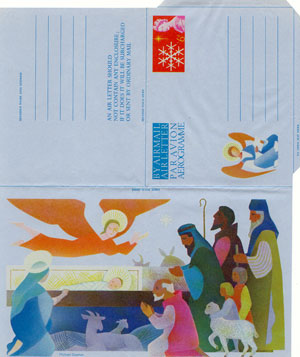
GB Christmas Aerogram (one of two issued in 1967)

An aerogram, aerogramme, aérogramme, air letter or airletter is a thin lightweight piece of foldable and gummed paper for writing a letter for transit via airmail, in which the letter and envelope are one and the same. Most postal administrations forbid including items inside these light letters, which are usually sent abroad at a preferential rate, and enclosing items may cause the mail to go at the higher letter rate.

The use of the term aerogramme was officially endorsed at the 1952 Universal Postal Union Postal Union Congress in Brussels.[1] Thereafter, the term air letter quickly faded from use.

Most aerograms have an imprinted stamp indicating the prepayment of postage, which meets the definition of being postal stationery. However, some countries, such as Zimbabwe and Ireland, sell unstamped aerograms. Unstamped aerograms are referred to as formular aerograms and can be issued by postal authorities or private companies. Senders are required to write their name and address on the reverse.[citation needed]

History

[edit]
The first issued aerogramme – Iraq 1933

Lieutenant Colonel R. E. Evans first saw the air letter form in Iraq, whilst touring the Commands after his arrival in the Middle East theatre. It had been introduced into the Iraqi postal service in 1933 by the then Inspector General of Posts and Telegraphs, Major Douglas William Gumbley CBE DSO Royal Engineers. The original form, on thin paper sized 124 mm x 99 mm, greyish in colour, with bluelined framing and with the designation legend on the front. It had an embossed effigy of Faisal I of Iraq and was printed by Bradbury Wilkinson.[2]

The aerogram was largely popularized by its use during the Second World War (1939–1945). Lieutenant Colonel R. E. Evans, Royal Engineers, Assistant Director Army Postal Service Middle East Force (MEF), proposed that a lightweight self-sealing letter card that weighed only 1/10 oz (2.8 g) be adopted by the British Army for air mail purposes. He recommended its use to Anthony Eden, the Secretary of State for War during his visit to the Middle East, in late 1940. By January the following year, General Archibald Wavell, 1st Earl Wavell, the Commander-in-Chief, MEF was told by Eden that "Your Assistant Director Army Postal Services may forthwith introduce an Air Mail Letter Card Service for the Middle East. Use British stamps from all countries, including Egypt.".[3]

On 1 March 1941, the air mail service between the Middle East and the UK was started, using a combination of British Overseas Airways flying boats and military transport. The private nature of the air letter ensured its popularity among its users and that popularity, with its lightness, brought about its continued use as the civilian air letter (aerogramme) and the British military "bluey". (see British Forces Post Office for further information). The aerogramme cost 6d to send anywhere in the world from 1943 to 1966, increasing to 9d until the decimalisation of British currency in 1971, then increasing gradually to 45p (decimal), 18 times the introductory price, in 2006.[4]

On 29 April 1947, the US introduced a 10 cent Air Letter Sheet. The same imprinted stamp with the propeller plane was used until updated with a jet airliner image in 1958. The US issued a total of 25 aerograms until 1999.[5] The production of United States aerograms has ceased.[6] Linn's Stamp News in late 2006 reported that the United States Postal Service had announced that as the supply of aerograms on hand at post offices were exhausted the stock would not be replenished. It quotes David Failor, Postal Service executive director of stamp services as explaining, "Demand for these has been next to nothing for the past five years."[7]

With the decline in postal communication,[8] aerograms have been withdrawn by various postal services. Royal Mail in the United Kingdom discontinued the aerogram in 2012[citation needed]. Japan Post Holdings announced its aerogram service would end on 30 September 2023.[9] As of July 2024, they were still provided by Australia Post and Hongkong Post.[10][11]

Historically, as the aerogram was the least expensive form of international postal communication, users often went to extreme lengths to make best use of the space available including writing in different colours, in different directions, and printing on the sheets minimising font size and margins.

See also

[edit]

References

[edit]

Further reading

[edit]
[edit]
Revisions and contributorsEdit on WikipediaRead on Wikipedia
from Grokipedia
An aerogram, also known as an aerogramme or air letter, is a thin sheet of lightweight designed to be written on, folded, and sealed to form its own for international correspondence, with no enclosures permitted to maintain its low weight and cost efficiency. Typically measuring 7¼ by 3⅝ inches (18.4 by 9 cm) when folded, it features gummed edges for sealing without tape or stickers and usually includes an imprinted stamp indicating prepaid postage, classifying it as postal stationery. This format allows for a single, compact item that combines the letter and envelope, optimized for air transport at a fixed, economical rate. The aerogram originated as an innovation in international postal services during the early , with the term "aerogramme" officially endorsed by the Universal Postal Union at its 1952 Congress in to standardize its use worldwide. It gained widespread popularity during , particularly in Britain, where it was introduced as a convenient and lightweight means for civilians to communicate with military personnel overseas, reducing shipping volume and costs for the postal system. The issued its first aerogram on April 29, 1947, initially called an "air letter sheet," following the wartime precedent and aligning with global airmail advancements. By the mid-20th century, many countries produced their own versions, often with unique designs, imprinted denominations, and multilingual instructions like "Via Air Mail / Par Avion," facilitating efficient global correspondence during an era before widespread . Aerograms were valued for their simplicity and affordability, with U.S. postage fixed at $0.75 for delivery to any country until the service's decline. They supported optional services like registry or recorded delivery where available at the destination, but strict rules prohibited additions or alterations to preserve uniformity. Although private manufacturers could produce them with U.S. Postal Service permits using specific weights and formats, the official service ended in the in 2007. Although discontinued in many countries, including the in 2007 and in 2023, aerograms remain available in some nations such as and as of 2025, and are collectible items in , emblematic of mid-20th-century postal innovation and international connectivity.

Definition and Characteristics

Overview

An aerogram, also known as an aerogramme or air letter, is a thin, sheet of foldable and gummed paper that functions as both the writing surface for a letter and its own for international transmission. This design minimizes postal weight, allowing for reduced handling costs and faster air transport. The primary purpose of an aerogram is to facilitate affordable and efficient long-distance communication, particularly across borders, by qualifying for preferential postage rates due to its compact, low-weight format. Enclosures or inserts are strictly prohibited to preserve this weight advantage; any aerogram containing additional items is reclassified as a standard letter, incurring higher postage rates or possible return to sender. Postal authorities issue aerograms in variants, including stamped versions with preprinted indicia indicating postage payment and unstamped formular types that require senders to affix their own stamps. Aerograms saw widespread use during wartime for their practicality in overseas correspondence.

Physical Specifications

Aerograms adhere to standardized physical specifications established by the (UPU) to ensure compatibility with international handling and to minimize transportation costs through uniformity. The folded form must be rectangular, with maximum dimensions of 110 mm in width by 220 mm in length (tolerance of ±2 mm) and minimum dimensions of 90 mm by 140 mm, where the length is at least the width multiplied by √2 to maintain proportional efficiency in sorting and transit. Typically, aerograms originate from an unfolded sheet measuring 148 mm by 210 mm (equivalent to A5 size), which folds compactly to the required envelope dimensions without enclosures, though national variations exist—for instance, Chunghwa Post in Taiwan uses an unfolded size of 215 mm by 284 mm (including sealing areas) that complies with UPU folded limits. The paper is lightweight, with weights ranging from 40 to 50 gsm in many designs to ensure the total folded and stamped item weighs under 5 grams, facilitating low airmail rates; representative examples include 84 gsm light blue paper for international aerograms from Chunghwa Post and 18-pound (approximately 67 gsm) bond paper specified by the U.S. Postal Service. The material consists of thin, durable , often or white, selected for its resistance to tearing and abrasion during mechanical handling and long-distance , without slippery finishes that could interfere with . Folding is enabled by pre-scored or perforated lines along designated creases, allowing the single sheet to transform into a self-contained ; all edges are gummed for secure sealing on all sides without additional adhesives or materials, as per UPU guidelines.

History

Origins in the 1930s

The aerogram, initially known as the air mail letter sheet, was invented in 1933 in by Major Douglas William Gumbley, a British officer and Inspector General of Posts and Telegraphs, to address the prohibitive costs of services in the . Gumbley's design aimed to create a standardized, lightweight form that maximized efficiency on long-range flights, where variable letter weights made traditional correspondence uneconomical for widespread use. This innovation arose from the pressing need for reliable, cost-effective communication in remote colonial regions, where ground mail services were often slow and unreliable due to vast distances and challenging terrain. The growing airmail networks, including routes pioneered by connecting to the and beyond, further underscored the demand for such a solution to support administrative and personal correspondence in these areas. The Iraqi postal service issued the world's first printed air mail letter sheet on 15 June 1933, following Gumbley's copyright registration in on 15 February 1933, with production handled by Bradbury Wilkinson & Co. Limited. Availability was restricted to specific airmail routes, primarily those linking to , , and other regional destinations, reflecting the nascent stage of international air postal infrastructure. Early adoption faced significant limitations, including confined distribution within Iraq and a complete absence of international standardization, which hindered broader use. Production was limited to just a few thousand units initially, making the sheets scarce even at the time and underscoring their experimental nature before any wartime expansion.

Adoption

The introduced the Air Mail Letter Card (AMLC), designated Army Form W3077, in April 1941 specifically for forces stationed in the to facilitate rapid and cost-effective communication back to the via the Forces Air Mail service. This lightweight, foldable , printed on thin paper and measuring approximately 201 x 246 mm when unfolded, allowed soldiers to write letters that could be sealed without an , minimizing weight and space for transport at a concessionary rate of 3d per item. The design featured a simple format with instructions for folding and sealing, emphasizing efficiency amid wartime logistical challenges such as limited aircraft capacity and stringent requirements. The service rapidly gained traction due to its role in addressing airmail shortages and enabling monitored correspondence that supported troop morale without compromising ; one "privilege letter" per per week was distributed free of unit-level (though subject to base review), requiring a declaration of non-sensitive content. By mid-1944, free issuance had escalated to two forms per every seven days, reflecting surging demand, and the format was extended beyond the to other key theaters including and , as well as to and Allied forces. In December 1943, the terminology shifted from AMLC to "Air Letter" to standardize usage, with locally printed variants introduced in various theaters to cut production and transport costs. The military drew inspiration from the British model, conducting initial trials of comparable air letter sheets for overseas forces in 1942 and 1943 as part of broader efforts to streamline wartime postal operations. These experiments, aligned with the launch of processes that utilized specialized lightweight letter sheets for microfilming and , tested the feasibility of folded to reduce bulk and expedite delivery, ultimately informing the postwar civilian aerogram issued in 1947. Throughout the conflict, air letters integrated into Allied postal systems, with designs occasionally incorporating patriotic motifs—such as symbolic vignettes evoking national resilience and victory—to reinforce and boost sender morale.

Post-War Standardization

Following , the issued its first civilian aerogram on April 29, 1947, designated as Form 5-A and featuring an imprinted 10-cent stamp depicting a DC-4 Skymaster . This lightweight, foldable sheet served as both letter and , designed for efficient transmission, and remained available in various designs until the final U.S. aerogram issuance in 1999. The global standardization of aerograms advanced significantly at the 13th (UPU) Congress held in from May 4 to July 15, 1952, where the term "aerogramme" was officially endorsed alongside uniform standards for international exchange. This endorsement formalized the aerogramme as a distinct category of prepaid, lightweight postal stationery intended for airmail, promoting consistency in format and handling across member nations. Post-war adoption proliferated rapidly, with many countries issuing aerogrammes by the to facilitate affordable international correspondence. In the , civilian aerogrammes introduced in 1944 continued seamlessly into the post-war era, with specialized issuances such as the 1948 form and the 1953 design, maintaining the 6d rate until 1966. and similarly embraced the format; Australia's aerogrammes, first available to civilians in 1944, accounted for approximately half of all outbound overseas by 1948, evolving to align with UPU terminology in 1953. Key UPU developments included regulations establishing uniform weight limits for letter-post items up to 2 kilograms, with aerogrammes designed to remain lightweight with no enclosures permitted, ensuring minimal weight for eligibility and streamlined cross-border processing. These measures, effective from the 1953 implementation of the Acts, enhanced interoperability and reduced costs for global airmail networks.

Design and Production

Format and Layout

Aerogrammes are designed as a single rectangular sheet of lightweight paper, typically measuring between 90 x 140 mm and 110 x 220 mm, with a at least 1.4 times the width and a tolerance of ±2 mm, allowing for efficient writing and folding into a compact . The front side, intended as the outer when folded, features a designated panel on the right half for the recipient's details, postage, and service notations, while the left half may include space for additional messages or attachments; the reverse side provides the primary writing area, often divided into panels to accommodate the sender's message facing inward upon folding. Pre-printed instructions, such as "Write on this side only" or multilingual equivalents, guide users on proper usage, ensuring the sheet remains unsealed until the message is complete. Folding follows a standardized process to transform the sheet into a self-contained , usually involving three creases to create a triangular or rectangular form that measures approximately 7-1/4 x 3-9/16 inches when sealed. The design incorporates gummed flaps along three edges—typically the top and sides—for secure closure without additional adhesives like tape, prohibiting any enclosures to maintain the lightweight profile essential for . This folding mechanism ensures the writing remains protected inside, with the address panel visible externally, and the overall structure conforms to postal handling requirements set by issuing authorities. Visual elements emphasize functionality and compactness, including ruled lines across the writing areas to facilitate neat handwriting on the thin paper stock. A space for the sender's return address is allocated in the upper left of the address side, often bordered for clarity, while perforated margins appear on some models to allow easy removal of excess edges if printed in larger formats. The front prominently displays the term "Aerogramme" or its national equivalent, along with air mail indicators like "Par Avion," printed in bold to denote its specialized status. Variations in design maintain the core blueprint but incorporate thematic enhancements, such as decorative borders or illustrations of , maps, or cultural motifs, to add visual appeal without compromising the single-sheet efficiency. For instance, British aerogrammes from the featured pictorial elements like the alongside functional lines, while others prioritized plain layouts for broader usability across postal networks. These adaptations, approved by national postal operators, ensure universal compatibility under guidelines while reflecting local production styles.

Stamps and Security Features

Aerograms, as a form of postal stationery, typically feature an imprinted stamp or indicium that prepays the postage, ensuring the item qualifies for international transmission only when properly folded and sealed. For instance, the issued its first aerogram on April 29, 1947, with a 10-cent bright red indicium depicting a DC-4 Skymaster , valid exclusively in its folded state to maintain lightweight compliance for rates. This design remained in use until 1958, printed by the using a gravure process. Similarly, Canada's initial aerogram in 1947 bore a 10-cent King George VI indicium, produced by national printers like Le Comptoir National d'Impression. Denominations on these imprinted stamps were calibrated to () international rates, such as Fiji's 7d value in 1947 or Australia's 5c Queen Elizabeth II indicium in the 1960s. In contrast, some countries issued unstamped or formular aerograms, which required the sender to affix a separate of equivalent value. and are notable examples, where these variants were sold by postal authorities or private firms and obligated users to apply stamps matching current tariffs before mailing. These formular types, often pre-formatted with folding lines and gummed edges, allowed flexibility but demanded user compliance to avoid surcharges. To deter misuse and counterfeiting, aerograms incorporated several security measures. Printed warnings, such as "IF ANYTHING IS ENCLOSED THIS LETTER WILL BE SENT BY ORDINARY MAIL," were standard on many designs, including Fiji's post-1951 issues, enforcing UPU rules against enclosures that would increase weight and disqualify privileges. Perforations along folding lines facilitated proper assembly while preventing unauthorized alterations, as seen in early Australian and Fijian examples. Additionally, watermarked paper provided anti-forgery protection; Fiji's 1940s aerograms used "IMPERIAL AIR MAIL" watermarks, while the Federation of and Nyasaland's initial issues employed "KENT VALE PARCHMENT" paper with embedded markings. Production of aerograms was handled by national printing facilities or approved private contractors to ensure quality and security. In , private manufacturers like Shipping Newspapers Ltd produced unstamped variants under Postmaster-General approval (e.g., number 9), while Fiji's were lithographed on specialized paper. These processes tied indicia values directly to fluctuating international rates set by the UPU, promoting uniformity across issuing countries.

Usage and Postal Handling

Preparation and Mailing

To prepare an aerogram, the sender begins by writing the message on one side of the lightweight sheet, ensuring the content remains concise to maintain the item's minimal weight and dimensions. The sheet, typically printed on one side with folding guides and postal indicia, allows for the letter to be inscribed directly without additional . Enclosures such as photographs or separate notes are strictly prohibited, as they would disqualify the item from aerogram treatment and subject it to standard letter rates and handling. Once the message is complete, the sender folds the sheet along pre-printed lines to form a compact shape, usually measuring approximately 7-1/4 by 3-9/16 inches when folded, with three gummed flaps aligning for closure. The folding process follows the designated creases to ensure a secure, flat packet suitable for transport. Sealing is achieved by moistening the gummed edges of the flaps and pressing them together; the use of tape, stickers, or any external adhesives is not permitted, as it violates postal standards and may result in rejection or reclassification. Addressing occurs on the designated panel of the folded : the recipient's full name and international are placed on the right half in clear, legible characters, while the sender's is written or printed on the upper-left half. This layout complies with (UPU) conventions for international readability and processing. No additional markings or enclosures should obscure these areas. For mailing, the completed aerogram is deposited at a counter or authorized mailbox, where it is processed as international through global postal networks. It receives priority handling via air transport but lacks inherent tracking unless optional registered service is added, depending on the originating postal authority's offerings. Compliance with these steps ensures the aerogram qualifies for its preferential lightweight rate and efficient delivery.

Rates and International Agreements

Aerograms were subject to preferential postage rates compared to standard airmail letters due to their standardized lightweight design. For example, in 1947, the rate was 10 cents, compared to 15 cents per half-ounce for international letters to many destinations. The Universal Postal Union (UPU) played a central role in coordinating aerogram rates and handling through international agreements, with the 1952 Congress officially endorsing the term "aerogramme" and establishing standards for uniform terminal dues—payments between postal operators for inbound mail delivery—and exchange protocols among member states to facilitate efficient cross-border processing. These UPU provisions ensured consistent treatment of aerograms as a subset of letter-post items, promoting while allowing national postal services to set domestic origination rates. National variations in pricing were common, reflecting local economic conditions and postal policies, though UPU guidelines aimed to minimize discrepancies; for instance, the introduced a 6d rate for forces air letters in , which was later extended to civilians and remained preferential relative to standard letters at 2s 9d per half-ounce. Non-compliance with UPU weight or format standards could result in surcharges, treating the item as a regular letter subject to higher fees and potential return to sender. In terms of handling, aerograms were routed through international airmail hubs under UPU protocols, integrating into existing air networks for priority transport, with customs declarations required only if contents raised regulatory concerns, as they were generally treated as personal correspondence without enclosures.

Decline and Legacy

Factors Leading to Decline

The decline of aerograms from the late onward was driven primarily by the emergence of electronic communication technologies, including fax machines in the and in the , which provided faster, more cost-effective alternatives to physical international . These innovations led to widespread "electronic diversion," where users shifted from postal services to digital methods for correspondence, resulting in a sharp reduction in overall mail volumes. For instance, U.S. Postal Service data shows first-class mail, which included international categories, dropped 50% from 92 billion pieces in 2008 to 46 billion in 2023, largely due to this shift. This broader trend in postal communication exacerbated cost inefficiencies for aerograms, which maintained a fixed preferential rate but became less viable as general airmail postage costs increased and production for low volumes proved uneconomical. Aerograms, designed as , self-contained sheets, represented a niche service with minimal handling compared to standard letters, but their usage dwindled to insignificant levels relative to total international mail. The U.S. Postal Service ceased issuing new aerogram designs in 1999 and fully discontinued the service on May 14, 2007, citing insufficient demand. Postal administrations worldwide followed suit amid similar pressures. The United Kingdom's removed aerograms from sale in April 2012 and prohibited their use after October 31, 2012, as part of amendments to international postal schemes reflecting the overall decline in letter-post items. ended sales and handling of aerograms on September 30, 2023, stating that declining demand made the service unsustainable, though existing stock could be exchanged or sent as standard mail. Culturally, the novelty of aerograms as a compact, airmailed form of personal letter faded with the rise of instantaneous digital messaging like , which offered immediacy without the constraints of limited writing space or postal delays, further diminishing their appeal among younger generations.

Current Availability and Collectibility

As of November 2025, aerograms remain available for purchase from a limited number of postal services worldwide. continues to offer international aerogrammes featuring designs with Australian flora and fauna, priced at A$3.35 for economy service to all zones. Similarly, sells aerogrammes for HK$3.40 each, with a current design issued in 2018 by artist Shirman LAI, printed via in the . These offerings typically include scenic or thematic motifs suited for international correspondence, though production volumes are low and geared toward niche users. Several major postal administrations have discontinued aerogram services in recent decades, with no significant revivals reported by late 2025. The ended sales in 2006, allowing only previously purchased aerogrammes to be mailed at first-class rates thereafter. The United Kingdom's ceased production in 2012 amid broader shifts in international mail formats. terminated aerogram sales effective September 30, 2023, as part of revisions to international postage rates and services. In , aerograms hold considerable collectible value due to their historical and design varieties, often cataloged under specialized sections. The assigns numbers UC10 through UC65 to aerograms, encompassing 25 distinct issues from 1947 to 1999 that reflect evolving themes and postage values. Collectors prize mint or unused examples for their imprinted stamps and folding mechanisms, with rarer variants commanding premiums in auctions and dealer markets. While primarily a historical artifact today, aerograms occasionally appear in special editions targeted at tourists or for commemorative purposes in regions where they persist, such as scenic designs for international travelers in and . However, their overall role has diminished to that of a philatelic relic rather than a practical mailing option.

References

Add your contribution
Related Hubs
User Avatar
No comments yet.