Hubbry Logo
Al-Sadiq MosqueAl-Sadiq MosqueMain
Open search
Al-Sadiq Mosque
Community hub
Al-Sadiq Mosque
logo
8 pages, 0 posts
0 subscribers
Be the first to start a discussion here.
Al-Sadiq Mosque
Al-Sadiq Mosque
from Wikipedia

The Al Sadiq Mosque (or Wabash Mosque) was commissioned in 1922 in the Bronzeville neighborhood in city of Chicago.[1] The Al-Sadiq Mosque is one of America's earliest built mosques and the oldest standing mosque in the country today.[2][better source needed] This mosque was funded with the money predominantly donated by African-American Ahmadi Muslim converts.

Key Information

Chicago Muslim Mission

[edit]
Muhammad Sadiq – First Muslim missionary in the United States

Mufti Muhammad Sadiq arrived in America on February 15, 1920, and established in 1921 the Headquarters of the Ahmadiyya Muslim Community. Muhammad Sadiq started a monthly magazine called The Muslim Sunrise, which contained articles on Islam, contemporary issues of conscience, and the names of new converts. This magazine still exists.[3] Muhammad Sadiq attracted thousands of converts in his short stay in America, most notably in Detroit and Chicago between 1922 and 1923.[4]

The Ahmadiyya Muslim Community continued to grow and established more than 40 missions throughout America.[4] Four Ahmadi mosques can be found in the region today, with demographics that are a mixture of African-American, Indo-Pakistani, White, and Latino. Chicago served as the movement's national headquarters until 1950,[5] when it was moved to the American Fazl Mosque in Washington, D.C. In 1994 the Ahmadiyya Muslim Community's USA headquarters were moved to Masjid Bait ur Rahman in Silver Spring, MD.

See also

[edit]

References

[edit]

Further reading

[edit]
[edit]
Revisions and contributorsEdit on WikipediaRead on Wikipedia
from Grokipedia
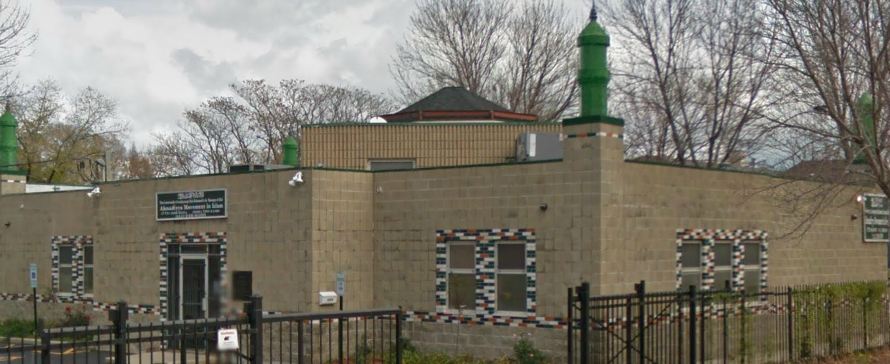
The Al-Sadiq Mosque (also known as Wabash Mosque or Masjid Al-Sadiq) is a historic in the Bronzeville neighborhood of , . Established in 1922 by Ahmadiyya missionary Mufti Muhammad Sadiq, it is recognized as one of the oldest standing in the United States and served as the headquarters of the Chicago Muslim Mission, an early center for spreading among . Originally converted from a two-story residential building at 4448 S. Wabash Avenue, the site has since been rebuilt into a small, sand-colored structure featuring a pointed roof and two green minarets, reflecting modest Islamic architectural elements. The remains an active for the Muslim Community and symbolizes the pioneering role of in early 20th-century America, particularly in fostering Muslim communities in urban centers like . As of 2024, it continues to host prayers and community events, preserving its historical legacy.

Overview

Location

The Al-Sadiq Mosque is situated at 4448 S. Wabash Avenue in , , within the Bronzeville neighborhood on the city's South Side. Bronzeville emerged as a historically African American community during the early , serving as a primary destination for the Great Migration, when hundreds of thousands of Black Americans relocated from the South to seeking economic opportunities and fleeing oppression between 1916 and 1970. The neighborhood became renowned for its cultural vibrancy, fostering a thriving hub of Black-owned businesses, arts, and institutions that defined urban African American life. The mosque occupies a central position in the historic Black Belt district—also known as the Black Metropolis—which shaped the area's social and economic fabric and continues to influence community connections around the site. As of 2025, the Al-Sadiq Mosque remains well-integrated into Chicago's urban landscape, with easy access via public transportation options such as CTA bus routes (including the #29 State and #X29 Express) and the Green Line 'L' train at nearby stations like 43rd Street and 47th Street. Ongoing revitalization efforts in Bronzeville, including the development of the Bronzeville Trail for pedestrian and cycling paths and new initiatives, enhance its connectivity and role within the city's evolving South Side infrastructure.

Establishment

The Al-Sadiq Mosque was established in 1922 in , , marking it as America's oldest purpose-built standing mosque still in operation. It was spearheaded by Mufti Muhammad Sadiq, an Muslim missionary from who arrived in the United States in 1920 to propagate the teachings of the movement. The mosque was named Al-Sadiq, meaning "the truthful" or "the honest" in , in honor of its founder, reflecting his pivotal role in early Islamic missionary work in America. The primary purpose of the mosque was to serve as a dedicated center for Ahmadiyya outreach and community building, particularly targeting African American populations in the early 20th century amid broader efforts to introduce Islam to underserved communities in urban America. Located in the Bronzeville neighborhood, it functioned as the official headquarters for the Ahmadiyya Muslim Community in the United States until 1950, providing a space for worship, education, and missionary activities. This establishment represented a strategic expansion of the Ahmadiyya mission, emphasizing inclusive propagation that resonated with African Americans seeking spiritual and social alternatives during that era. Initial funding for the mosque came predominantly from donations by African American converts to the movement, who contributed through their involvement in the mission's efforts. These contributions enabled the acquisition and of a two-story building at 4448 South Wabash Avenue, transforming it into a functional and mission house without reliance on external institutional support. This community-driven financing underscored the mosque's roots in local conversion and participation, fostering a sense of ownership among early adherents.

History

Founding

The origins of Al-Sadiq Mosque trace back over 200 years, with its foundation stone laid by the Sufi saint Khawaja Noor Muhammad Maharvi, a revered spiritual mentor to the Abbasi rulers of . Maharvi, who died in 1791, is associated with the mosque's establishment during the late , possibly under the reign of Nawab Muhammad Bahawal Khan II (r. 1772–1809), serving as an initial devotional site in the Shahi Bazar area. This founding reflects the early integration of Sufi traditions with the princely state's religious patronage, laying the groundwork for its role as a central congregational hub.

Construction and Early Operations

Construction and expansions occurred sporadically through the 19th and early 20th centuries under successive of . A major rebuilding effort was commissioned in 1935 by Nawab Sir Sadiq Muhammad Khan Abbasi V upon his return from , transforming the modest structure into a grand Indo-Islamic edifice at state expense. The project, inspired by the in , incorporated imported white marble from and intricate detailing, though it was never fully completed due to the princely state's integration into in 1947. From its early operations, the mosque functioned as the principal site for Friday prayers and community gatherings, accommodating thousands and symbolizing the Abbasi dynasty's commitment to Islamic piety in southern Punjab.

Evolution and Key Events

Post-independence, Al-Sadiq Mosque continued as a key religious and cultural landmark in , with ongoing minor additions and maintenance under provincial oversight. It endured as one of the last major architectural projects of the Abbasi era before the state's dissolution in 1955, preserving its historical significance amid Pakistan's evolving socio-political landscape. As of 2025, the mosque remains partially incomplete, with recent enhancements to its entrance pavilion, and serves as a self-sustaining site through on-site sales, ensuring its upkeep without external funding. No major controversies or disruptions have been recorded, though its incomplete state highlights the interrupted legacy of princely patronage.

Architecture

Exterior Design

The Al-Sadiq Mosque's exterior design reflects a modest adaptation of Islamic architectural motifs to early 20th-century American urban , originally constructed as a two-story building in 1922. The facade featured a prominent , a large central dome, and two thin, spindle-like faux minarets, which served as symbolic elements evoking traditional mosque forms while fitting the scale of Chicago's residential . This initial structure blended European-style house elements with added Islamic features, such as the dome installed by early convert Andrew Jacob, to create a purpose-built funded by African American supporters. Over time, the mosque underwent significant visual modifications, transitioning from the original two-story mission house to a smaller, more streamlined contemporary form. The current exterior is a compact, sand-colored building with a pointed and two prominent minarets, emphasizing simplicity and visibility within its urban setting. These changes, likely occurring in the mid-20th century, preserved the site's role as a community landmark while updating the appearance to better align with modern interpretations of Islamic design. The mosque occupies a corner lot at the northwest intersection of West 45th Street and South Wabash Avenue in Chicago's Bronzeville neighborhood, integrating seamlessly into the area's rectilinear street grid established in the late 19th century. Surrounding grounds are minimal, typical of dense urban plots, with access primarily via sidewalks and limited on-site parking accommodated through adjacent street spaces, facilitating pedestrian-oriented community use amid Bronzeville's historic residential and commercial fabric. This layout underscores the mosque's adaptation to American city planning, where the structure aligns with building lines and maintains a low-profile presence without expansive courtyards.

Interior Features

The Al-Sadiq Mosque features a two-story layout, with the first floor dedicated to the main hall serving as the primary worship area for congregants. The hall is equipped with essential furnishings for , including an arch and standard items such as prayer rugs, reflecting early descriptions of its completion in 1922. The hall is oriented toward the in and includes a to indicate the direction for salat, accommodating Friday congregational prayers and daily worship in line with Islamic tradition. The second floor houses additional functional spaces, including classrooms for and community rooms for meetings and study sessions, supporting the mosque's role as a center for learning and social engagement within the Ahmadiyya community. These areas facilitate programs on Islamic teachings and language, extending the mosque's utility beyond worship. Decorative elements in the interior emphasize a minimalistic aesthetic influenced by Ahmadiyya principles, prioritizing simplicity and focus on over elaborate ornamentation, with features like subtle on walls and traditional prayer rugs covering the floors. This design aligns with broader Ahmadiyya architectural approaches that favor functional elegance in prayer spaces.

Significance

Role in Local Islam

Al-Sadiq Mosque serves as the principal in , accommodating 50,000 to 60,000 worshippers and functioning as a central hub for , , and spiritual gatherings in southern . Established over 200 years ago with its foundation laid by Sufi saint Noor Muhammad Maharvi, it embodies enduring religious devotion tied to the Chishtia Sufi tradition and the patronage of the Abbasi . The 1935 renovations commissioned by Sadiq Muhammad Khan V after his enhanced its role as a symbol of piety and architectural legacy, making it one of the largest mosques in and a focal point for major observances like and Friday congregations. The mosque's design and location in the historic Shahi Bazar underscore its importance in preserving Indo-Islamic heritage while fostering community unity among diverse Muslim populations in the region. It continues to host religious lectures, Quranic studies, and Sufi commemorations, reinforcing its position as a vital institution for Islamic practice in Bahawalpur.

Community and Cultural Impact

Al-Sadiq Mosque acts as a cultural landmark, symbolizing the fusion of religious devotion, artistic excellence, and communal values in Bahawalpur's history as a former princely state. Its white marble facade, intricate calligraphy, and expansive courtyards draw visitors interested in Pakistan's architectural and Sufi heritage, contributing to local tourism efforts. The on-site handicraft stores on the ground floor support traditional craftsmanship, generating revenue for maintenance and promoting economic self-sufficiency without reliance on external funding. In the community, the mosque facilitates social cohesion through events such as charitable distributions during and interfaith interactions, reflecting the Nawabs' legacy of patronage and . As of 2025, Punjab provincial initiatives aim to promote Bahawalpur's historical sites, including Al-Sadiq Mosque, to enhance and preserve its significance for future generations. This enduring impact highlights its role in bridging Bahawalpur's past with contemporary cultural identity in southern .

References

Add your contribution
Related Hubs
User Avatar
No comments yet.