Alexander Stirling Calder
View on Wikipedia
Alexander Stirling Calder (January 11, 1870 – January 7, 1945) was an American sculptor and art teacher. He won a silver medal at the World's Fair of 1904 for his statue of Philip François Renault and led the sculpture program for the 1915 Panama-Pacific Exposition after the death of Karl Bitter. His notable works include the Samuel Gross statue, George Washington on the Washington Square Arch in New York City, the Swann Memorial Fountain in Philadelphia, the Depew Memorial Fountain in Indianapolis, and the Leif Erikson Memorial in Reykjavík, Iceland.
Key Information


He taught sculpture at the Pennsylvania Museum School of Industrial Art, the Throop Polytechnic Institute, and the National Academy of Design. His father, Alexander Milne Calder, and son Alexander Calder were also sculptors.
Early life and education
[edit]Calder was born on January 11, 1870, in Philadelphia,[1] the oldest of six boys,[2] to sculptor Alexander Milne Calder and Margaret Stirling. He attended city public schools and enrolled at the Pennsylvania Academy of the Fine Arts (PAFA) in Fall 1885, at age 15. He studied under Thomas Eakins for several months, until the teacher's forced resignation in February 1886. Calder remained at PAFA, studying under Thomas Anshutz and James P. Kelly. Two of his sculptures were accepted for PAFA's 1887 annual exhibition, a rare honor for a student.[3]: 170 He worked from 1889 to 1890 as a demonstrator of anatomy at the academy[4] and graduated in 1890.[5]
His father designed and was then in the midst of executing, the extensive sculpture program for Philadelphia City Hall. Calder worked as an apprentice on the project during the summers, and is reported to have modeled an arm for one of the figures. He made his first trip to Europe in Summer 1889, and returned there to study the following year.[3]: 170
Calder moved to Paris with Charles Grafly in Fall 1890, and studied at the Académie Julian under Henri Michel Chapu. The following year, he was accepted at the École des Beaux-Arts, where he entered the atelier of Alexandre Falguière.[6][3]: 170
Career
[edit]
In 1892, he returned to Philadelphia and began his career as a sculptor in earnest. His first major commission, won in a national competition, was for the Samuel Gross statue for the National Mall in Washington, D.C. Another early commission was for a set of twelve statues of Presbyterian clergymen for the facade of the Witherspoon Building in Philadelphia.[6][3]: 170
He worked as an instructor in modeling at the Pennsylvania Museum School of Industrial Art from 1900 to 1906.[6][7] In 1904, he won a silver medal at the World's Fair of 1904 in St. Louis, Missouri, for his statue of Philip François Renault.[1]
He suffered from tuberculosis and moved to Arizona in 1906 to recover his health. After his health recovered, he moved to Pasadena, California, and his family joined him.[6] In Pasadena, he modeled architectural sculpture for the Throop Polytechnic Institute (now the California Institute of Technology). He returned to the east coast in 1910 and settled in Croton-on-Hudson, New York.[3]: 171 He taught at the National Academy of Design from 1910 to 1917 and was elected an academician in 1913.[6]
He was placed in charge of the sculpture program for the 1915 Panama-Pacific Exposition in San Francisco, California, after the death of Karl Bitter.[1][8] He obtained a studio in New York City and employed the services of model Audrey Munson who posed for him as the model for the Star Maiden statue. For the exposition, Calder completed three massive sculpture groups, The Nations of the East and The Nations of the West, which crowned triumphal arches, and a fountain group, The Fountain of Energy. Following Bitter's sudden death in April 1915, Calder completed the Depew Memorial Fountain in Indianapolis, Indiana.[1]
.jpg)
Hermon Atkins MacNeil and Calder were commissioned to create sculptures for the Washington Square Arch in New York City. George Washington as Commander-in-Chief, Accompanied by Fame and Valor (1914–1916) was sculpted by MacNeil; and George Washington as President, Accompanied by Wisdom and Justice (1917–18) by Calder. These are sometimes referred to as Washington at War and Washington at Peace.[9]
He sculpted a number of ornamental works for Villa Vizcaya, the James Deering estate outside Miami, Florida.[1] These included the famous Italian Barge (1917–1919), a stone folly in the shape of a boat, projecting into Biscayne Bay.[10]
He taught at the Art Students League of New York from 1918 to 1922.[6]
Two of his major commissions of the 1920s were the Swann Memorial Fountain in Logan Circle,[11] and the architectural sculpture program for the University of Pennsylvania Museum of Archaeology and Anthropology.[12]
He was one of a dozen sculptors invited to compete in Oklahoma's Pioneer Woman statue competition in 1926–27,[13] which was won by Bryant Baker. In 1927, he was also commissioned by the Berkshire Museum to sculpt the woodwork and fountain of the museum's Ellen Crane Memorial Room in Pittsfield, Massachusetts.[14]
In 1929, he won the national competition for a monumental statue of Leif Eriksson, to be the gift of the United States to Iceland in commemoration of the 1000th anniversary of the Icelandic Parliament.[8]
Personal life
[edit]Calder married portrait painter Nanette Lederer[15] on February 22, 1895, and they lived in Philadelphia for the first decade of their marriage. They had two children: Margaret Calder Hayes and Alexander Calder.[3]: 171
Calder died on January 7, 1945, and was interred at West Laurel Hill Cemetery in Bala Cynwyd, Pennsylvania.[16]
Legacy
[edit]Works from Alexander Stirling Calder will be displayed at a new museum under construction for his son's work in Philadelphia.[17]
Selected works
[edit]| Title | Image | Year | Location/GPS Coordinates | Material | Height | Notes |
|---|---|---|---|---|---|---|
| Dr. Samuel D. Gross Memorial[18] | 
|
1895–1897 | Thomas Jefferson University, Philadelphia, Pennsylvania 39°56′53″N 75°09′30″W / 39.94794167°N 75.15820278°W |
bronze | 111 in (280 cm) | .jpg) From 1897 to 1970, the statue stood on the National Mall in Washington, D.C.: |
| Bust of Major General John F. Hartranft[19] | 
|
1898 | Smith Memorial Arch, West Fairmount Park, Philadelphia, Pennsylvania 39°58′39″N 75°12′24″W / 39.9775°N 75.206667°W |
bronze | 36 in (91 cm) | Gen. Hartranft was a U.S. Medal of Honor recipient for the First Battle of Bull Run. |
| Class of 1892 Drinking Fountain[20] (The Scholar and the Football Player) |
1900 | Quadrangle Dormitories, University of Pennsylvania, Philadelphia, Pennsylvania 39°57′03″N 75°11′50″W / 39.950806°N 75.197306°W, |
bronze | 21 in (53 cm) | _(14578112798).jpg) | |
| Overmantel frieze: The Boar Hunt | .jpg)
|
c.1900 | Keil Hall, Mercersburg Academy, Mercersburg, Pennsylvania 39°49′37″N 77°53′57″W / 39.8270°N 77.8991°W |
carved oak | Modeled by Calder, carved by John J. Maene.[21] | |
| Sewell Cross[22] Major General William Joyce Sewell Monument |

|
1901 | Harleigh Cemetery, Camden, New Jersey 39°55′26″N 75°05′23″W / 39.923889°N 75.089722°W |
green granite | 20 ft (6.1 m) | Modeled by Calder, carved by Leland & Hall Company. Gen. Sewell was a U.S. Medal of Honor recipient for the Battle of Chancellorsville. Calder was awarded PAFA's 1905 Walter Lippincott Prize for the Sewell Cross.[3]: 171 |
| Man Cub: "Sandy" Calder at Age 3 | 
|
1901–02 | Pennsylvania Academy of the Fine Arts, Philadelphia, Pennsylvania |
plaster (original lost) |
45 in (110 cm) | PAFA purchased Calder's plaster original in 1905, and used it to make a 1906 bronze cast.[23] The plaster was either returned to Calder or lost (by 1941).[3]: 172 A 1922 bronze cast is at the Metropolitan Museum of Art.[24] |
| Sundial[25] | 
|
1903–1905 | Fairmount Park Horticultural Center, West Fairmount Park, Philadelphia, Pennsylvania 39°58′59″N 75°12′45″W / 39.983150°N 75.212600°W |
marble | 56.5 in (144 cm) | Located in the Sunken Gardens: |
| Missouri: The Queen of Rivers[26] | _(14598348608).jpg)
|
1904 | Louisiana Purchase Exposition, St. Louis, Missouri |
plaster | Calder won a silver medal for his sculpture at the 1904 World's Fair.[3]: 170 | |
| Philip François Renault[27] | 
|
plaster | ||||
| Calder Cross[28] William Hickman Harte Memorial Cross |

|
c.1905 | Chippiannock Cemetery, Rock Island, Illinois 41°28′54″N 90°34′40″W / 41.481667°N 90.577778°W |
granite | 102 in (260 cm) | Master William Hickman Harte was a Union naval officer who died in the June 17, 1862 Battle of Saint Charles, following the sinking of the USS Mound City. Fifty years later, Harte's son located his Arkansas grave, and commissioned this cenotaph for their home town cemetery.[29] |
| Henry Charles Lea Monument[30] | 
|
1911 | Laurel Hill Cemetery, Philadelphia, Pennsylvania 40°00′15″N 75°11′25″W / 40.0042°N 75.1902°W |
bronze |  The seated figure is Clio, the Muse of History: | |
| Stretching Girl[31] | c.1911 | National Academy of Design, Manhattan, New York City |
bronze | 36 in (91 cm) | Calder's NAD diploma piece, presented following his election as an Academician in 1913.[32] Robert Henri painted Calder's NAD diploma portrait.[32] Another bronze cast is at the Crystal Bridges Museum of American Art in Bentonville, Arkansas.[33] | |
| An American Stoic: Portrait of Najinyankte[34][35] | 1912 | Rhode Island School of Design Museum, Providence, Rhode Island |
bronze | 28 in (71 cm) | A standing Sioux man wrapped in a blanket. | |
| Star Maiden[36] | 
|
1913–1915 | Oakland Museum, Oakland, California |
bronze | 51 in (130 cm) | .jpg) |
| Fountain of Energy (destroyed) |    
|
1913–1915 | Panama–Pacific International Exposition, San Francisco, California |
staff |  outstretched arms have severed the lands and let the waters pass. Upon his mighty shoulders stand Fame and Glory, heralding the coming of a conqueror. Energy, the Power of the Future, the Superman, approaches."[37] | |
 The Eastern Hemisphere, and a large reclining male figure with the head of a bull, The Western Hemisphere: | ||||||
| 4 sculpture groups were clustered around the globe: The Atlantic Ocean, The Pacific Ocean, The North Sea, The South Sea    
| ||||||
12 Nerieds riding dolphins were spaced around the pool's perimeter: 
| ||||||
| The Nations of the East[38] (destroyed) |  
|
1913–1915 | atop The Arch of the Rising Sun, Panama–Pacific International Exposition, San Francisco, California |
staff | ||
| The Nations of the West[39] (destroyed) |  
|
1913–1915 | atop The Arch of the Setting Sun, Panama–Pacific International Exposition, San Francisco, California |
staff |  | |
 | ||||||
| Depew Memorial Fountain | 
|
1915–1917 | University Park, Indianapolis, Indiana 39°46′19″N 86°09′25″W / 39.771944°N 86.156944°W |
bronze | Crowning figure: 90 in (230 cm) |
 Bitter's 1915 maquette for the fountain: |
| George Washington as President, Accompanied by Wisdom and Justice[9] |

|
1917–18 | Washington Square Arch, Washington Square, Manhattan, New York City 40°43′52″N 73°59′53″W / 40.73099°N 73.99805°W |
marble | 12 ft (3.7 m) | .jpg) Hermon Atkins MacNeil modeled Washington at War (1914–16). The pair flank the north side of the arch. |
| The Great Stone Barge[40][41] (Delights and Terrors of the Sea) |

|
1917–1919 | "Villa Vizcaya" (James Deering estate), Coconut Grove, Florida 25°44′38″N 80°12′37″W / 25.743753°N 80.210232°W |
limestone |  The eroded sculptures were used to cast concrete replicas in 1981.[43] | |
| Garden sculpture | 
|
.jpg)    
| ||||
| The Little Dear with the Tiny Black Swan (Leda and the Swan)[44] |

|
1918–1921 | Denver Art Museum, Denver, Colorado |
bronze | 28 in (71 cm) | A 60.25 in (153.0 cm) version is a promised gift to Crystal Bridges Museum of American Art.[45] |
| Swann Memorial Fountain[46] (Fountain of Three Rivers) |

|
1920–1924 | Logan Circle, Philadelphia, Pennsylvania 39°57′29″N 75°10′15″W / 39.95795°N 75.170819°W |
bronze | Central figures: 11 ft (3.4 m) |
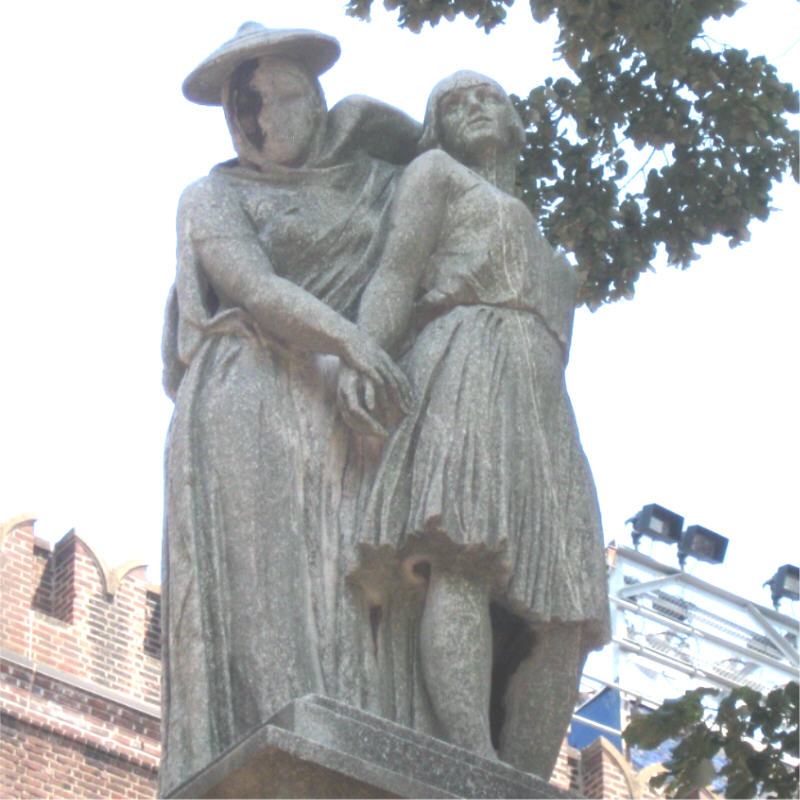
 The female allegorical figures represent the Schuylkill River and the Wissahickon Creek. The male Lenni Lenape figure represents the Delaware River. |
| Naiad with Tragic Mask[47] Model for a Fountain |

|
c.1920 | Pennsylvania Academy of the Fine Arts, Philadelphia, Pennsylvania |
painted plaster | 16.25 in (41.3 cm) | A bronze cast is at the Reading Public Museum in Reading, Pennsylvania.[48] A larger plaster version is at the Montclair Art Museum in Montclair, New Jersey.[49] |
| Scratching Her Heel[50] | 
|
1921 | Metropolitan Museum of Art, Manhattan, New York City |
bronze | 12 in (30 cm) | Another bronze cast is at the Telfair Museum of Art in Savannah, Georgia.[51] |
| The Last Dryad[52] | 
|
1921 | Philadelphia Museum of Art, Philadelphia, Pennsylvania |
plaster | 70.5 in (179 cm) |  |
| Shakespeare Memorial[53] (Tragedy and Comedy, Hamlet and the Fool) |

|
1923–1926 | In front of the Free Library of Philadelphia, Logan Square, Philadelphia, Pennsylvania 39°57′34″N 75°10′16″W / 39.9595°N 75.171°W |
bronze | 91.5 in (232 cm) |  Touchstone and Prince Hamlet: Another bronze cast is at Brookgreen Gardens.[54] |
| Head of George Bellows[55] | 1925 | Conner-Rosenkranz Gallery, Manhattan, New York City |
plaster | 14.5 in (37 cm) | A bronze cast is at the New York Historical Society.[56] | |
| Our Lady and the Holy Child[57] (A Study in French Gothic Style) |

|
1926 | St. Mary's of Redford Church, Detroit, Michigan |
marble | 7 ft (2.1 m) | Located in a niche behind the High Altar.[58] |
| Pioneer Woman (Self-Reliant)[59] | 
|
1926–27 | Woolaroc Museum, Bartlesville, Oklahoma 36°38′32″N 96°05′45″W / 36.642339°N 96.095964°W |
bronze | 40 in (100 cm) | One of twelve bronze models created by American sculptors for the 1927 Pioneer Woman statue competition. Bryant Baker won the commission. His heroic-sized Pioneer Woman was dedicated in 1930, in Ponca City, Oklahoma. Calder received a $10,000 honorarium for his model.[60] |
| Bust of John James Audubon[61] | 
|
1927 | Hall of Fame for Great Americans, Bronx Community College, Bronx, New York City 40°51′31″N 73°54′52″W / 40.858611°N 73.914444°W |
bronze | ||
| Leif Eriksson Memorial[62] |  
|
1929–1932 | Hallgrímskirkja Cathedral, Reykjavík, Iceland |
bronze | 139 in (3.5 m) |  founding of the Althing, Iceland's parliament. The statue appeared on a U.S. postage stamp and an Icelandic coin. Calder's plaster model is at the Smithsonian American Art Museum.[63]  View from the cathedral's tower, looking west to the Atlantic Ocean: |
| Cruel Nature: Self-Portrait at Age 60[65][66] | 
|
c.1930 | National Portrait Gallery, Washington, D.C. |
terra cotta | 12.5 in (32 cm) | |
| Robert Henri: The Painter-Teacher with the Gift of Friendship[67][68] (Posthumous Bust of Robert Henri) |

|
1934 | Pennsylvania Academy of the Fine Arts, Philadelphia, Pennsylvania |
plaster (unlocated)[69] |
32 in (81 cm) | Calder and Henri (1865–1929) had been friends since 1885, when both were first-year students at PAFA.[3]: 174 Calder's widow had a bronze cast made of the bust in 1947, which she donated to PAFA.[3]: 174 |
| Posthumous Bust of John Singer Sargent[70] | 
|
c.1934 | Bronx Community College, Bronx, New York City |
plaster | ||
| Introspection | 
|
c.1935 | plaster | |||
| Continental Post Rider[71] | 
|
1936 | William Jefferson Clinton Federal Building, Washington, D.C. |
aluminum | 51.5 in (131 cm) | |
| Bust of William Penn[72] | 
|
1936 | Hall of Fame for Great Americans, Bronx Community College, Bronx, New York City 40°51′31″N 73°54′52″W / 40.858611°N 73.914444°W |
bronze | ||
| Nature's Dance[73][74] (The Dance of Life) |

|
1938 | Brookgreen Gardens, Murrells Inlet, South Carolina 33°31′14″N 79°05′59″W / 33.520556°N 79.099722°W |
Indiana limestone | 80 in (200 cm) | |
| Bishop William White[75][76] | 
|
1940 | Washington Memorial Chapel, Valley Forge, Pennsylvania 40°06′16″N 75°26′17″W / 40.104528°N 75.437944°W |
bronze | The Right Reverend White was the first bishop of the American Episcopal Church. Calder's last major commission. | |
| Bust of Winston Churchill[77] | 
|
1943 | plaster | Inscription: "HAVE FAITH, HAVE HOPE, DELIVERANCE IS SURE." JULY 14, 1941. |
Architectural sculpture
[edit]- Twelve cast stone figures of Presbyterian clergymen, Witherspoon Building, Philadelphia, Pennsylvania, 1898–99, Joseph Miller Huston, architect.
- Six of the figures were removed in 1961, and relocated to the garden of the Presbyterian Historical Society.[78]
-
 Reverend Marcus Whitman
 -
 Reverend James Caldwell
 -
 Reverend Samuel Davies
 -
 Reverend John McMillan
 -
 Reverend John Witherspoon
 -
 Reverend Francis Makemie


- Six spandrel figures, cast concrete, Throop Polytechnic Institute (now California Institute of Technology), Pasadena, California, 1906–1909, Myron Hart & Elmer Grey, architects.[79]
- Nature and Art, Energy and Law, Science and Imagination[80]
- Oakland Civic Auditorium, Oakland, California, 1914, John J. Donovan, architect.[81]
- The Riches of the Earth – Seven terra cotta, half-domed friezes within the arched entrances.Category:Riches of the Earth (1915) by Alexander Stirling Calder – Wikimedia Commons
- Missouri State Capitol, Jefferson City, Missouri, 1924, Tracy and Swartwout, architects.
- South Frieze, limestone, 6 ft (1.8 m) x 138 ft (42 m), depicts Missouri history in 13 bas relief panels.[82] The frieze flanks the tops of the central portico's columns and continues behind them.
- North Frieze, limestone, bas relief panels depict Native Americans and Europeans.[83] The frieze flanks the tops of the central columns and continues inside the curved portico.
-
 Throop Polytechnic Institute, c.1910.
 -
 Oakland Civic Auditorium, c.1917
 -
 Half-domed frieze
 -
 Missouri State Capitol, south façade.
 -
 Missouri State Capitol, north facade.

.jpg)

.jpg)

- Four figures of famous actresses, marble, I. Miller Building, Broadway and West 46th Street, Manhattan, New York City, 1927–1929:
-
 I. Miller Building facade
 -
![Ethel Barrymore as Ophelia[84]](//upload.wikimedia.org/wikipedia/commons/thumb/4/43/W_46th_St_Duffy_Square_20_-_I._Miller_Building.jpg/250px-W_46th_St_Duffy_Square_20_-_I._Miller_Building.jpg) Ethel Barrymore as Ophelia[84]
Ethel Barrymore as Ophelia[84] -
![Rosa Ponselle as Norma[85]](//upload.wikimedia.org/wikipedia/commons/thumb/e/e6/W_46th_St_Duffy_Square_16_-_I._Miller_Building.jpg/250px-W_46th_St_Duffy_Square_16_-_I._Miller_Building.jpg)
-
![Marilyn Miller as Sunny[86]](//upload.wikimedia.org/wikipedia/commons/thumb/0/02/W_46th_St_Duffy_Square_19_-_I._Miller_Building.jpg/250px-W_46th_St_Duffy_Square_19_-_I._Miller_Building.jpg)
-
![Mary Pickford as Little Lord Fauntleroy[87]](//upload.wikimedia.org/wikipedia/commons/thumb/f/f9/W_46th_St_Duffy_Square_18_-_I._Miller_Building.jpg/250px-W_46th_St_Duffy_Square_18_-_I._Miller_Building.jpg)

![Ethel Barrymore as Ophelia[84]](https://en.wikipedia.org/wiki/File:W_46th_St_Duffy_Square_20_-_I._Miller_Building.jpg)
![Rosa Ponselle as Norma[85]](https://en.wikipedia.org/wiki/File:W_46th_St_Duffy_Square_16_-_I._Miller_Building.jpg)
![Marilyn Miller as Sunny[86]](https://en.wikipedia.org/wiki/File:W_46th_St_Duffy_Square_19_-_I._Miller_Building.jpg)
![Mary Pickford as Little Lord Fauntleroy[87]](https://en.wikipedia.org/wiki/File:W_46th_St_Duffy_Square_18_-_I._Miller_Building.jpg)

- Sculpture program for University of Pennsylvania Museum of Archaeology and Anthropology, Philadelphia, Pennsylvania, completed 1931, Wilson Eyre, Frank Miles Day, and Cope & Stewardson, architects:
Medallions
[edit]- Life as a Dance (c.1938), Metropolitan Museum of Art, Manhattan, New York City[95]


References
[edit]Citations
- ^ a b c d e Marter, Joan M. (2011). The Grove Encyclopedia of American Art - Volume 1. Oxford University Press. pp. 395–396. ISBN 978-0-19-533579-8. Retrieved August 28, 2025.
- ^ Perl 2017, p. 9.
- ^ a b c d e f g h i j k Gadzinski, Cunningham, Panhorst et al.
- ^ Perl 2017, p. 20.
- ^ Perl 2017, p. 19.
- ^ a b c d e f Tolles, Thayer (2001). American Sculpture in the Metropolitan Museum of Art - Volume II. A Catologue of Artists Born Between 1865 and 1885. New York: Metropolitan Museum of Art. p. 528. ISBN 0-87099-923-0. Retrieved August 27, 2025.
- ^ John William Leonard, ed., Men and Things: A Biographical Dictionary of Contemporaries (New York: L. R. Hamersly & Company, 1908), p. 374.
- ^ a b Perloff, Susie. "Generations of Alexander Calder art a trinity of blessings for Philadelphia". whyy.org. WHYY. Retrieved August 27, 2025.
- ^ a b "Washington Arch: George Washington as President, Accompanied by Wisdom and Justice, (sculpture)". siris-artinventories.si.edu. Smithsonian. Retrieved August 29, 2025.
- ^ Pressman, Heather; Schulz, Danielle (2021). The Art of Access - A Practical Guide for Museum Accessibility. Lanham, Maryland: Rowman & Littlefield. p. 53. ISBN 9781538130506. Retrieved August 31, 2025.
- ^ Baltzell, E. Digby (1996). Puritan Boston and Quaker Philadelphia. New York: Routledge. ISBN 9781351495332. Retrieved August 27, 2025.
- ^ Pezzatti, Alessandro; Hickman, Jane; Fleischman, Alexandra. "A Brief History of the Penn Museum". Penn Museum. Retrieved August 31, 2025.
- ^ ‘’Exhibition of Models for a Monument to the Pioneer Woman’’ at the Chicago Architectural Exhibition, East Galleries, Art Institute of Chicago, June 25 to August 1, 1927
- ^ Salmon, Felix (October 4, 2017). "The Lost Masterpieces of Norman Rockwell Country". www.newyorker.com. Conde Nast. Retrieved August 31, 2025.
- ^ Perl 2017, p. 3.
- ^ "Alexander Stirling Calder". remembermyjourney.com. webCemeteries. Retrieved August 26, 2025.
- ^ Salisbury, Stephan; Dobrin, Peter (February 20, 2020). "Alexander Calder will finally get a prime museum site on the Parkway, across from Barnes and Rodin". www.inquirer.com. The Philadelphia Inquirer. Retrieved August 27, 2025.
- ^ "Dr. Samuel Gross, (sculpture)". siris-artinventories.si.edu. Smithsonian. Retrieved August 29, 2025.
- ^ "The Smith Memorial: Major General John Frederick Hartranft, (sculpture)". siris-artinventories.si.edu. Smithsonian. Retrieved August 29, 2025.
- ^ "A Drinking Fountain, (sculpture)". siris-artinventories.si.edu. Smithsonian. Retrieved August 29, 2025.
- ^ Anna Margaretta Archambault, A Guide Book of Art, Architecture, and Historic Interest in Pennsylvania (Philadelphia: John C. Winston Company, 1924), p. 250.
- ^ "The Sewell Cross, (sculpture)". siris-artinventories.si.edu. Smithsonian. Retrieved August 29, 2025.
- ^ "Man Cub, (sculpture)". siris-artinventories.si.edu. Smithsonian. Retrieved August 29, 2025.
- ^ "Alexander Stirling Calder | Man Cub | The Metropolitan Museum of Art". Metmuseum.org. Retrieved August 10, 2014.
- ^ "Sundial, (sculpture)". siris-artinventories.si.edu. Smithsonian. Retrieved August 29, 2025.
- ^ "The Missouri, the Queen of the Rivers, (sculpture)". siris-artinventories.si.edu. Smithsonian. Retrieved August 29, 2025.
- ^ "Philippe Francois Renault, (sculpture)". siris-artinventories.si.edu. Smithsonian. Retrieved August 29, 2025.
- ^ "Calder Cross, (sculpture)". siris-artinventories.si.edu. Smithsonian. Retrieved August 29, 2025.
- ^ Minda Powers-Douglas, Chippiannock Cemetery (Arcadia Publishing, 2010), p. 98.[1]
- ^ "Henry Charles Lea Monument, (sculpture)". siris-artinventories.si.edu. Smithsonian. Retrieved August 29, 2025.
- ^ "Stretching Girl, (sculpture)". siris-artinventories.si.edu. Smithsonian. Retrieved August 29, 2025.
- ^ a b David B. Dearinger, Paintings & Sculpture at the National Academy of Design, Volume 1: 1826–1925 (Hudson Hills Press, 2004), p. 84.
- ^ Stretching Girl, from Crystal Bridges Museum of American Art.
- ^ "Najinyankte, (sculpture)". siris-artinventories.si.edu. Smithsonian. Retrieved August 29, 2025.
- ^ An American Stoic, from Bonham's Auction House.
- ^ "Star Figure, (sculpture)". siris-artinventories.si.edu. Smithsonian. Retrieved August 29, 2025.
- ^ Stella G. S. Perry, The Sculpture and Mural Decorations of the Exposition: A Photo Survey of the Art of the Panama–Pacific International Exposition (San Francisco: Paul Elder and Company, Publishers, 1921), p. 16.[2]
- ^ "The Nations of the East, (sculpture)". siris-artinventories.si.edu. Smithsonian. Retrieved August 29, 2025.
- ^ "The Nations of the West, (sculpture)". siris-artinventories.si.edu. Smithsonian. Retrieved August 29, 2025.
- ^ "Stone Barge, (sculpture)". siris-artinventories.si.edu. Smithsonian. Retrieved August 30, 2025.
- ^ Woodward, Kellie (October 15, 2009). "Vizcaya Museum Shop: The Stone Barge, Alexander Stirling Calder, and the Internet". Vizcayamuseumshop.blogspot.com. Retrieved August 10, 2014.
- ^ Perl 2017, p. 14.
- ^ "Delights and Terrors of the Sea, (sculpture)". siris-artinventories.si.edu.com. Smithsonian. Retrieved August 30, 2025.
- ^ "Leda and the Swan, (sculpture)". siris-artinventories.si.edu. Smithsonian. Retrieved August 30, 2025.
- ^ The Little Dear with the Tiny Black Swan, from Crystal Bridges Museum of American Art.
- ^ "Swann Memorial Fountain, (sculpture)". siris-artinventories.si.edu. Smithsonian. Retrieved August 30, 2025.
- ^ Naiad with Tragic Mask, from PAFA.
- ^ Naiad with Mask, from Reading Public Museum.
- ^ "Naiad with a Mask, (sculpture)". siris-artinventories.si.edu. Smithsonian. Retrieved August 31, 2025.
- ^ "Alexander Stirling Calder | Scratching Her Heel | The Metropolitan Museum of Art". Metmuseum.org. Retrieved August 10, 2014.
- ^ "Scratching Her Heel, (sculpture)". siris-artinventories.si.edu. Smithsonian. Retrieved August 31, 2025.
- ^ "Philadelphia Museum of Art – Collections Object : The Last Dryad". Philamuseum.org. February 17, 2007. Retrieved August 10, 2014.
- ^ "Shakespeare Memorial, (sculpture)". siris-artinventories.si.edu. Smithsonian. Retrieved August 31, 2025.
- ^ Tragedy and Comedy, from SIRIS.
- ^ George Bellows, from SIRIS.
- ^ George Wesley Bellows, from SIRIS.
- ^ Our Lady and the Holy Child, from SIRIS.
- ^ Our Lady and the Holy Child, from Andy Hoxie via Flickr.
- ^ Pioneer Woman, from SIRIS.
- ^ "Oil Magnate Refuses to Forget Land That Brought Him Wealth: There Were Women Pioneers Too". The Christian Science Monitor. April 6, 1927. p. 5A.
- ^ John James Audubon, from SIRIS.
- ^ "Reykjavik – Leifur Eiríksson". Vanderkrogt.net. Retrieved August 10, 2014.
- ^ Leif Ericson, from SIRIS.
- ^ Leif Ericson, from SIRIS.
- ^ Self-mask, from SIRIS.
- ^ A. Stirling Calder Self-Portrait, from National Portrait Gallery.
- ^ Robert Henri, from PAFA.
- ^ Bust of Robert Henri, from SIRIS.
- ^ Model of Bust of Robert Henri, from SIRIS.
- ^ Bust of John Singer Sargent, from SIRIS.
- ^ Continental Post Rider, from SIRIS.
- ^ William Penn, from SIRIS.
- ^ Nature's Dance, from SIRIS.
- ^ "Brookgreen Gardens South Carolina Sculpture". Tsos.org. January 3, 2003. Archived from the original on March 3, 2016. Retrieved August 10, 2014.
- ^ [3] Archived March 26, 2012, at the Wayback Machine
- ^ Right Reverend William White, from SIRIS.
- ^ Winston Churchill, from SIRIS.
- ^ Witherspoon Building Figures, from SIRIS.
- ^ A. Stirling Calder, "The Relationship of Sculpture to Architecture," The American Architect, vol. 68, no. 2346 (8 December 1920), p. 778.
- ^ Spandrel figures, from SIRIS.
- ^ Oakland Auditorium Panels, from SIRIS.
- ^ South Frieze, from SIRIS.
- ^ Pediment at Missouri State Capitol, from SIRIS.
- ^ Ethel Barrymore as Ophelia, from SIRIS.
- ^ Rosa Ponselle as Norma, from SIRIS.
- ^ Marilyn Miller as Sunny, from SIRIS.
- ^ Mary Pickford as Little Lord Fauntleroy, from SIRIS.
- ^ flondo™ (March 26, 2009). "Lion's Head Fountain and Pompeian Dancing Satyr | Flickr – Photo Sharing!". Flickr. Retrieved August 10, 2014.
- ^ taurenia (February 18, 2009). "Penn Museum Door Lintels | Flickr – Photo Sharing!". Flickr. Retrieved August 10, 2014.
- ^ "The University Of Pennsylvania Museum Of Archaeology and Anthropology | Flickr – Photo Sharing!". Flickr. September 8, 2007. Retrieved August 10, 2014.
- ^ "Museum Gate and Asia Sculpture | Flickr – Photo Sharing!". Flickr. August 4, 2007. Retrieved August 10, 2014.
- ^ "Africa Sculpture | Flickr – Photo Sharing!". Flickr. September 8, 2007. Retrieved August 10, 2014.
- ^ "Image: aaae4.jpg, (800 × 800 px)". philart.net. Retrieved September 6, 2015.
- ^ bikehikedive (nugun) [deleted] (September 21, 2007). "America Sculpture | Flickr – Photo Sharing!". Flickr. Retrieved August 10, 2014.
- ^ "The Dance of Life, (sculpture)". siris-artinventories.si.edu. Smithsonian. Retrieved August 31, 2025.
Sources
- Armstrong, Tom (1976). 200 Years of American Sculpture. Whitney Museum of Art. ISBN 0-87923-185-8.
- Fairmount Park Art Association, Sculpture of a City: Philadelphia's Treasures in Bronze and Stone, Walker Publishing Co., Inc, New York. NY 1974
- Falk, Peter Hastings, ed., Who was Who in American Art, Sound View Press, Madison Connecticut, 1985
- Gadzinski, Cunningham, Panhorst et al., American Sculpture in the Museum of American Art of the Pennsylvania Academy of the Fine Arts, Museum of American Art of the Pennsylvania Academy of the Fine Arts, Philadelphia, Pennsylvania 1997
- Hoeber, Arthur (September 1910). "Calder – A "Various" Sculptor: A Man Of Craftmanship And Brains". The World's Work: A History of Our Time. XX: 13377–13388. Retrieved July 10, 2009.
- Opitz, Glenn B ed., Mantle Fielding's Dictionary of American Painters, Sculptors & Engravers, Apollo Book, Poughkeepsie NY, 1986
- Perl, Jed (2017). Calder: The Conquest of Time - The Early Years: 1898-1940. Alfred A. Knopf. ISBN 9780307272720.
- Proske, Beatrice Gilman, Brookgreen Gardens Sculpture, Brookgreen Gardens, South Carolina, 1968
Further reading
[edit]- Bach, Penny Balkin, Public Art in Philadelphia, Temple University Press, Philadelphia, Pennsylvania, 1992
- Calder, A. Sterling, Thoughts of A. Stirling Calder on Art and Life, Privately published, New York, 1947
- Craven, Wayne, Sculpture in America, University of Delaware Press, 1984
- Hayes, Margaret Calder Three Alexander Calders, Paul S Eriksson Publisher, Middlebury, Vermont, 1977 ISBN 0-8397-8017-6
External links
[edit]

- Works by or about Alexander Stirling Calder at the Internet Archive
- Biography at West Laurel Hill Cemetery web site
- Alexander Stirling Calder at Find a Grave
| Sculpture |
|
|---|---|
| Associated people |
|
| International | |
|---|---|
| National | |
| Artists | |
| Other | |

![[3]](http://sirismm.si.edu/juley_b2/J0050141_b.jpg)