Hubbry Logo
Alexandra TrusovaAlexandra TrusovaMain
Open search
Alexandra Trusova
Community hub
Alexandra Trusova
logo
8 pages, 0 posts
0 subscribers
Be the first to start a discussion here.
Alexandra Trusova
Alexandra Trusova
from Wikipedia

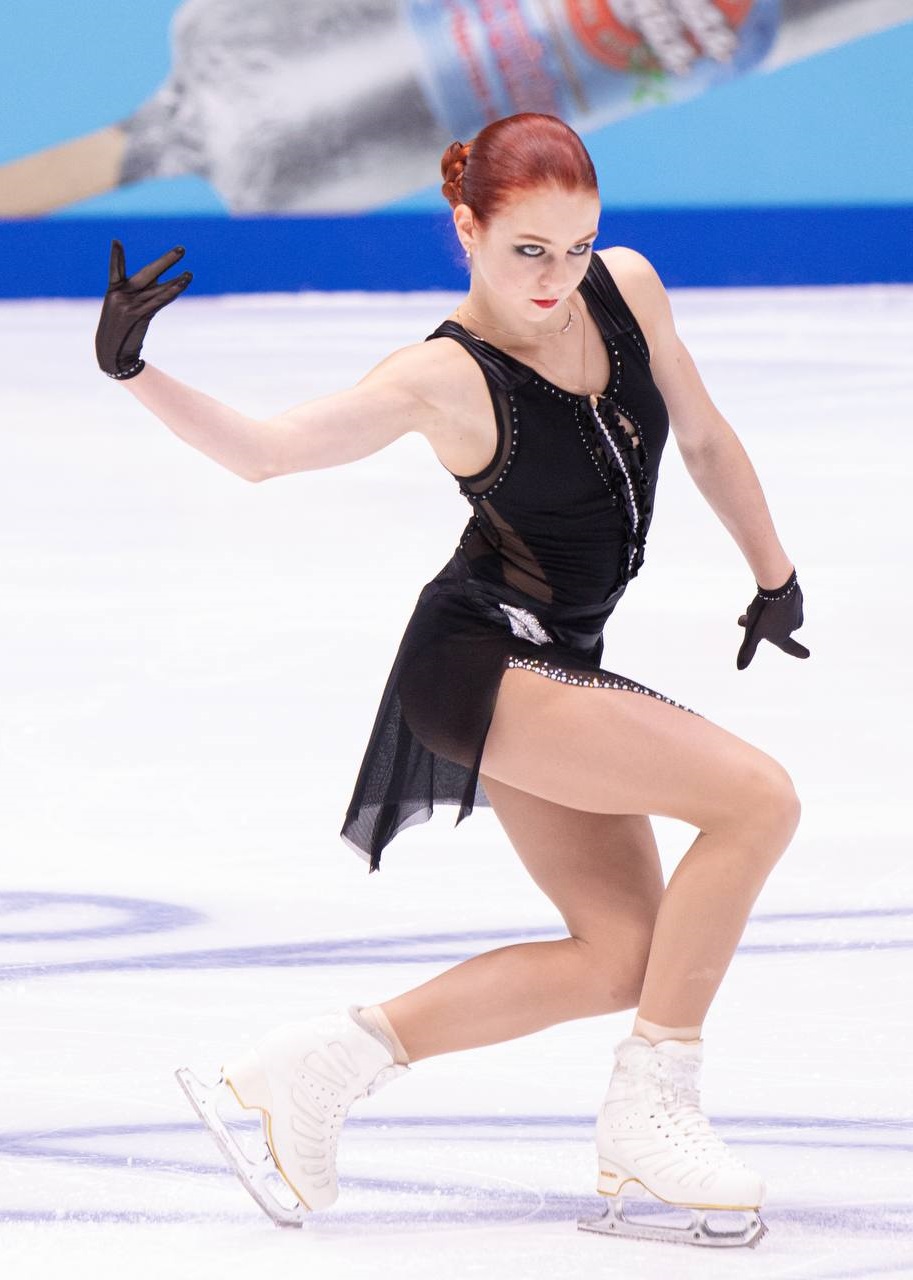
Alexandra "Sasha" Vyacheslavovna Ignatova (née Trusova; Russian: Александра Вячеславовна Игнатова née Трусова, IPA: [ɐlʲɪˈksandrə ˈtrusəvə]; born 23 June 2004) is a Russian figure skater. She is the 2022 Olympic silver medalist, the 2021 World bronze medalist, a European silver[2] (2022) and bronze (2020) medalist, the 2019 Grand Prix Final bronze medalist, the 2019 Skate Canada champion, the 2019 Rostelecom Cup champion, the 2019 CS Ondrej Nepela Memorial champion, the 2021 U.S. Classic champion, and the 2021 Skate America champion. Domestically, she is the 2022 Russian national champion, the 2019 silver medalist, and the 2020 and 2021 bronze medalist. At the junior level, she has been a two-time Junior World Champion (2018 and 2019), the 2018 Junior Grand Prix Final champion, the 2019 Junior Grand Prix Final silver medalist, a four-time champion on the Junior Grand Prix series, and a two-time Russian Junior national champion.

Key Information

Trusova is credited for leading the ladies figure skating technical revolution and being the new face of women's figure skating[3] by becoming the first female skater to land the quad Lutz, quad flip, and quad toe loop jumps; the second to land the quad Salchow (after Miki Ando); and the first to land two and three ratified quads in a free skate, achieved at the 2018 Junior World Championships and the 2019 Nepela Trophy, respectively.[4][5][6] She is also the first woman to land a quad at the Olympic Winter Games, and the first woman to land four and five quads in a free skate, achieved at the Beijing Winter Olympics 2022. She currently holds four Guinness World Records, the fourth in recognition of her landed quadruple flip at the 2019 ISU Grand Prix Final.[7] Her technical score of 92.35 points in the free skate at the 2018 Junior Worlds was the highest recorded in women's singles skating at the junior and senior level until the GOE (Grade of Execution) system was changed at the end of 2017–18 season.

Additionally, Trusova is recognized as the youngest woman to become a World Junior champion and a Junior Grand Prix Final champion following her wins at the 2018 World Junior Championship and the 2018 Junior Grand Prix Final at the age of 13.[8] At the 2018 JGP Lithuania, she became the first female skater to land a quadruple jump in combination after performing a quad toe loop and triple toe loop.[9] At the 2018 JGP Armenia, she became the first female skater to land a quad Lutz jump in international competition.[10] She is also the first female skater to backload a quad in combination, which she accomplished at Skate Canada 2019, landing a quad Toe in combination with a triple Salchow. Trusova currently has the second highest free skating score of any female skater, with 177.13. Trusova is the first and only female skater competing with four different quadruple jumpstoe loop, Salchow, flip and Lutz—and the first to score above 100 points in technical elements, with 100.20 in the free skate at 2019 Skate Canada and an Olympic record 106.16 at the 2022 Olympics.

Personal life

[edit]

Sasha Trusova was born on 23 June 2004 in Ryazan.[11] She has two younger brothers, Egor and Ivan. A passionate dog lover, Trusova owns seven dogs: a chihuahua named Tina, who often accompanied her to competitions;[12] a husky named Jack; a miniature royal poodle named Lana, which she received at the Rostelecom Cup in recognition of her victory at the 2019 World Junior Figure Skating Championships and for landing her first triple Axel in practice; a basenji named Alita; a second miniature poodle named Cruella (nicknamed Ella);[13] a Bichon Frisé named Selma; and most recently, a toy poodle named Smoke. Both Ella and Selma were gifts from fans in China.

A short biography detailing her career throughout her teenage years was published in Russian under the title Alexandra Trusova. The Girl Who Fights Gravity: And Changes the World of Women’s Figure Skating, with an English translation released in March 2021.[14][15]

Trusova was in a relationship with Mark Kondratiuk, the 2022 Beijing Olympic team event bronze medalist, from May 2022 until the summer of 2023.[16][17] In late 2023, she began a relationship with fellow Russian figure skater Makar Ignatov.  On June 17, 2024, Trusova and Ignatov announced their engagement, and they were married on August 17, 2024, after which Trusova adopted the surname Ignatova.[18]

On March 22, 2025, the couple publicly announced via Instagram that they were expecting their first child. On August 6, 2025, the couple welcomed their first child, a son named Mikhail.[19] Trusova started recovery shortly after giving birth, and began regaining her jumps, currently working on triple jumps in combinations.[20]

Career

[edit]

Early career

[edit]

Trusova began learning to skate in 2008 at the age of four.[11] She initially trained in Ryazan under the guidance of Olga Shevtsova before relocating to Moscow in 2015, where she was coached by Alexander Volkov.[21] In 2016, she joined the Khrustalny (Crystal) rink, where she began training under Eteri Tutberidze and Sergei Dudakov.[11]

Trusova placed fourth at the 2017 Russian Junior Championships, finishing sixth in the short program and fourth in the free skate.[22]

2017–2018 season: Junior international debut

[edit]
2018 World Junior Championships podium. Left to right: Alena Kostornaia; Alexandra Trusova; Mako Yamashita

Trusova debuted internationally in August 2017 at a 2017–18 ISU Junior Grand Prix (JGP) competition in Brisbane, Australia. Ranked first in both the short program and free skate, she won the gold medal ahead of teammate Anastasia Gulyakova.[23] She landed an underrotated quadruple Salchow in her free program. Her total score of 197.69 points was the third highest ever achieved by a women's single skater on the junior level at the time, behind only Alina Zagitova and Marin Honda. She then finished first at JGP Belarus and qualified for the Junior Grand Prix Final.[24][25]

At the 2017–18 Junior Grand Prix Final, Trusova scored 73.25 points, breaking the junior women's world record for the short program. In the free skate, she scored 132.36 points, approximately half a point less than what her teammate and training partner, Alena Kostornaia, scored. However, Trusova won the overall competition due to her 1.5 point-lead from the short program.[26] In January 2018, Trusova won the gold medal at the 2018 Russian Junior Championships after placing first in the short program and third in the free skate. She again narrowly beat her training partner and silver medalist, Kostornaia, by a margin of 0.6 points.[27]

In March 2018, Trusova competed at the 2018 Junior Worlds, where she won the gold medal after placing first in both the short program and free skate. Her free skate score of 153.49 points set the new world record for the junior free program, and her total score of 225.52 points was also the new world record for the junior combined total score. At the competition, Trusova became the first female skater to land the quad toe loop, the second to land the quad Salchow behind Miki Ando, and the first to land two ratified quads in a free skate.[4] Her quadruple jump was the first ratified in 16 years since Ando's in 2002. Trusova's technical score of 92.35 points in the free skate at the 2018 Junior World was the highest recorded in women's figure skating at the time at both the junior and senior levels. Her total score of 225.52 would have placed her first in the senior women's World Championships that year as well, despite significantly lower program component scores and the absence of a choreographic sequence.[28] This is the first time anything like this has ever happened with someone from juniors.[citation needed]

2018–2019 season: Second Junior World title

[edit]
Trusova at the 2019 World Junior Championships

Trusova began the season by competing in the 2018 Junior Grand Prix (JGP) series. At her first Junior Grand Prix event of the season, she won the gold medal in Kaunas, Lithuania. She ranked first in both the short program and the free skate and won the gold medal by 30 points over silver medalist Kim Ye-lim.[29] As of September 2018, her scores at the competition are the highest achieved in an international junior women's competition. There, Trusova became the first female skater to land a quad in combination—a quad toe loop and triple toe loop that received 16.14 points. She also became the first female skater to attempt a quad Lutz in a competition, which she landed but not ratified due to under rotation.[9][30]

At her second Junior Grand Prix event of the season, she won another gold medal in Yerevan, Armenia. Again she placed first in both the short program and free skate, winning the gold medal by 33 points over silver medalist and teammate Alena Kanysheva. Trusova surpassed her own free skate world record score and became the first female skater to land a quadruple Lutz in international competition (teammate Anna Shcherbakova landed two quadruple Lutz jumps several days earlier in a domestic competition).[10] With two Junior Grand Prix gold medals, Trusova qualified for the 2018–19 Junior Grand Prix Final.[31]

At the JGP Final, she won the silver medal after placing second in both the short program and free skate.[32] This time, she was outscored by Kostornaia by approximately 2.5 points. In the free skate, Trusova landed a clean quad toe loop but stepped out of her first quad Lutz and fell on a second, underrotated quad Lutz.[33]

At the 2019 Russian Championships, Trusova placed second in the short program and second in the free skate, winning the silver medal overall.[34] In the free skate, she landed a quad Lutz but fell on an underrotated quad toe loop, finishing behind Shcherbakova by 0.07 points. Trusova stated after the competition that she planned to work more on her quad jumps before the 2019 Junior World Championships.[35]

Trusova successfully defended her Junior World title at the 2019 World Junior Championships, placing second in the short program to Shcherbakova and winning the free skate.[36]

2019–2020 season: Senior international debut

[edit]
Trusova at the 2019 Skate Canada

Trusova made her international senior debut at the 2019 CS Ondrej Nepela Memorial, where she won the gold medal and set several new world records. In the free skate, she became the first woman ever to land three quadruple jumps when she landed a quad Lutz and two quad toe loops, the second of which was in combination. She set a new free skate record of 163.78 points and a new combined total record of 238.69 points. Her technical element score (TES) of 98.34 points in the free skate was also the new world record. She earned 14.72 points for her quadruple Lutz, a new record for the highest valued single jump by a female skater which was phenomenal.

On October 5, Trusova skated in the team competition at the Japan Open, where she won the event with four quads—a quad Salchow, quad Lutz, quad toe-triple toe combination, and quad toe-Euler-triple Salchow combination—scoring over 160 points. Since it was not an official ISU competition, her historic number of quads landed was not officially recognized as the first in international competition.

Trusova made her ISU Grand Prix debut at the 2019 Skate Canada International, where she won the gold medal after placing third in the short program and first in the free skate.[37][38] At the competition, having performed quad toe loop-triple toe loop and quad toe loop-Euler-triple Salchow combinations, she became the first woman to land two quad-triple jump combinations in one program at an ISU-sanctioned international competition. She also became the first woman to land a quad-triple jump combination in the second half of the free skate. At the same competition, she set the new free skating record of 166.62 points and a new combined total record of 241.02 points. Her TES of 100.20 points in the free skate was also the new world record.[39] At her second Grand Prix, the 2019 Rostelecom Cup, Trusova placed second in the short program behind Evgenia Medvedeva.[40] She placed first in the free skate despite falling on her opening quad Salchow attempt and another fall on a triple combination and won her second Grand Prix gold medal.[41]

Alexandra Trusova with Yuzuru Hanyu at the 2019 Skate Canada.

Trusova's results qualified her for the Grand Prix Final in Turin. Skating in the short program, Trusova opted to attempt the triple Axel in competition for the first time but underrotated it and fell. Consequently, she placed fifth in the segment, fourteen points behind first-place Kostornaia. Trusova said that the decision to introduce the triple Axel had been taken in light of its being landed "more or less consistently" in practices in the preceding week and remarked, "I like to risk, and without risking, I wouldn't achieve what I have by this moment".[42] In the free skate, Trusova attempted the quad flip in competition for the first time, landing it cleanly, alongside a quad Lutz and a quad toe loop, but doubled an intended quad Salchow and fell on a second quad toe attempt. She became the first female skater to attempt five quads in a free skate and the first to attempt four different types of quads. Third in the free, won the bronze medal behind Kostornaia and Shcherbakova.[43]

At the 2020 Russian Championships, Trusova placed third in the short program, opting not to attempt the triple Axel.[44] The free skate proved a struggle, with two falls on her quad Lutz and quad flip attempts and doubling on her first attempted quad toe loop. She eventually landed her second quad toe attempt, as well as her remaining triple jumps, and remained in third place. She was "not pleased" with the performance and said she hoped to master the quad loop by the end of the season.[45]

Competing at the 2020 European Championships, Trusova doubled and turned out of a planned triple Axel. She scored 74.95 points and placed third in that segment behind Kostornaia and Shcherbakova.[46] In the free skate, she fell on two planned quads but landed her quad toe-triple toe combination successfully. She placed third overall behind her two teammates and won the bronze medal.[47] Trusova was also assigned to compete at the 2020 World Championships in Montreal, which were cancelled as a result of the COVID-19 pandemic.

On May 6, 2020, it was announced by Russian media outlets Nevasport and Sport24 that Trusova had decided to part ways with coach Eteri Tutberidze in favor of joining Evgeni Plushenko's academy. Trusova was joined in the departure by coach Sergei Rozanov, as well as novice training-mates Veronika and Alyona Zhilina.[48][49] According to Sport24, Trusova chose to leave the Tutberidze group due to lack of attention from Tutberidze herself during the months following the cancellation of the World Championships, as well as her overall dissatisfaction with her position in the training group.[49]

2020–2021 season: World bronze medal

[edit]

Trusova performed at the 2020 Russian Test Skates and successfully executed a quad toe in combination.[50] At the second stage of the Russian Cup held in Moscow, Trusova made a mistake on her triple Axel jump in the short program and placed third behind Kamila Valieva and Daria Usacheva. However, in the free skate, Trusova cleanly executed two quadruple toe-loops, one in combination, and won the free skate to win gold. At the fourth stage in Kazan, she stepped out on her opening triple Axel in the short program and placed second behind Kostornaia. In the free skate, Trusova cleanly landed three quads but fell on a fourth, as well as one a triple jump. Despite these mistakes, Trusova scored 171.21 points and won her second straight competition.[51]

Alexandra Trusova at the 2020 Rostelecom Cup.

In the short program at the 2020 Rostelecom Cup, Trusova fell on a downgraded triple Axel and, as a result, placed third behind Kostornaia and Elizaveta Tuktamysheva with a score of 70.81, which was her lowest international result since September 2017.[52] She encountered similar problems in the free skate, falling four times and receiving negative grades of execution on two other jumping passes. Her final score of 198.93 saw her drop down to fourth place, unprecedented for Trusova in international competition, and her first off-podium finish since the 2017 Russian Junior Championships.[53]

Competing at the 2021 Russian Championships, Trusova placed fourth in the short program behind Shcherbakova, Valieva, and Usacheva.[54] She landed two quad Lutzes in the free skate, placing third in the segment and winning the bronze medal. Speaking afterward about dealing with injury, she said that "two quads in the long program is very little for me, and I'll try to do more, but for today, this was the maximum content that I was able to do".[55]

With the European Championships cancelled, Trusova instead participated in the 2021 Channel One Trophy, a televised team event. Trusova was elected for the Time of Firsts team captained by Evgenia Medvedeva and placed fourth in the short program, the only woman on her team to skate cleanly.[56] In the free skate, she made errors on both quad Lutz attempts, placing third in the segment, and her team finished in second place overall.[57]

Trusova was selected to compete for the Russian Federation at the 2021 World Championships in March 2021 in Stockholm, where she was considered a favorite to make the podium.[58] In the short program, Trusova placed twelfth after putting a hand down on her triple Lutz due to overrotation, consequently failing to execute the second part of her jump combination.[59] In her free skate, she attempted five quads, falling on two of them; however, due to the high base value of her program, mistakes by other medal contenders, and her successful landing of three of her quads, Trusova was able to finish third overall for the bronze medal, 8.57 points ahead fourth-place skater Karen Chen. On the podium alongside Shcherbakova and Tuktamysheva, this was only the second time that a single country had swept the women's podium at the World Championships, after the United States in 1991.[60] On May 1, it was announced that Trusova was returning to the Sambo-70 training center under previous coach Tutberidze.[61]

2021–2022 season: Olympic silver medal

[edit]
Trusova skating to Cruella

Trusova picked music from the American film Cruella for her free program, having watched it three times beforehand and persuading her coaches. She debuted her programs for the Olympic season at the 2021 Russian Test skates in September held in Chelyabinsk, where she cleanly executed a five-quad free program for the first time in a public event. However, she said afterward, "this is not a competition, so I'm not completely satisfied".[62] The following week, Trusova competed at the 2021 U.S. Classic at the Skating Club of Boston, where she made mistakes on four out of five planned quads but narrowly took the gold medal over South Korean skater Park Yeon-jeong.[63] In late October, it was reported that Trusova had suffered a leg injury shortly before the 2021 Skate America, which did not allow her to train at her maximum. Despite the injury, Trusova decided to compete and placed first in the short program with a personal best of 77.69 and won the free skate by opening with a quad Lutz.[64] In early November, Trusova decided to withdraw from her second Grand Prix assignment, the 2021 NHK Trophy.[65]

Returning to competition at the 2022 Russian Championships, Trusova placed fifth in the short program after botching her triple Axel attempt. She rallied in the free skate despite two jump errors, placing second in the segment and winning the silver medal behind Kamila Valieva. Speaking afterward, she noted "the quad toe did not work" but was "still happy with the result".[66] On 13 January 2023, Valieva was stripped of her gold medal for doping (trimetazidine) and Trusova was elevated to gold.[67][68] At the European Championships in Tallinn, Trusova placed third in the short program despite falling on her triple Axel attempt again. She landed two out of her four planned quads in the free skate, winning her second European bronze medal. Despite medaling, she said she was "not happy with the skate" due to the errors.[69] On January 20, Trusova was officially named to the Russian Olympic team.[70]

Competing in the women's event short program at the 2022 Winter Olympics, Trusova fell on an underrotated triple Axel attempt and received an edge call on her triple flip but still placed fourth in the segment, 5.24 points behind third-place Kaori Sakamoto.[71] In the free program, Trusova landed all five of the quads planned in her program, albeit receiving an edge call on her quad flip and negative grade of execution on her quad toe-loop and final solo quad Lutz. She placed first in the segment, setting Olympic scoring records of 106.16 for the technical component and 177.13 overall. However, she placed second overall behind teammate Shcherbakova, winning a silver medal in the event. Trusova became the first woman to land a quad flip and land a quad Lutz at the Olympics, the first woman to land four and five quads in competition, as well as the first woman to land four and five quads in one program at the Olympics.[72]

In early March 2022, the ISU banned all figure skaters and officials from Russia and Belarus from attending the World Championships due to the Russia's full-scale invasion of Ukraine in late February, as a result of which Trusova was not allowed to participate in the competition at the end of March.[73]

2022–2023 season: A New Era

[edit]
Alexandra Trusova

Trusova opened her fourth senior season at the September 2022 Russian test skate event held in Moscow. She skated the short program segment, debuting a new program to Annie Lennox's cover of "I Put a Spell on You" by Jay Hawkins, but withdrew from the free skate due to an ongoing back injury.

On 1 October, it was reported by TASS that Trusova had again decided to part ways with coaches Eteri Tutberidze, Daniil Gleikhengauz, and Sergei Dudakov, this time in favor of joining Svetlana Sokolovskaya's group at CSKA.[74]

As Russia remained banned from international competition during the 2022-2023 season, Trusova opted to compete on the Russian Grand Prix series (a series of all-Russian competitions in the same format as the international Grand Prix series). Trusova was assigned to the second and fifth stages of the series.

At the second stage of the Russian Grand Prix Series Trusova debuted two new programs. She ranked second in the short program behind Adelia Petrosian. In the free skate she attempted one quad lutz, but fell on the attempt, ranking third in the free skate and third overall behind Petrosian and Sofia Samodelkina.

At the fifth stage of the Russian Grand Prix held in Samara, Trusova ranked third in the short program after singling what was intended to be a double axel. In the free skate she again attempted one quad lutz, though it was again unsuccessful. She ranked second in the free skate segment and second overall.

Trusova withdrew from both the 2023 Russian Championships and the 2023 Russian Grand Prix Final.[75]

2024–2025 season: The awaited comeback

[edit]

It was announced that Trusova, now Ignatova, would partake in the 2024 Russian test skates, and that she had returned to training with Plushenko at his skating academy, Angels of Plushenko.

Alexandra Trusova (2023)

Ignatova debuted two new programs at the 2024 Russian Test Skates, both of which were choreographed by Nikita Mikhailov. Her short program was set to the J2 and Ilza version of the song "Bésame Mucho". She cleanly landed a double axel and a triple flip, but struggled on the third jumping pass, doubling out of the second half of the intended triple-triple combination. In the free skate, Ignatova attempted one quad lutz though the attempt was unsuccessful. She again struggled with her triple lutz-triple toeloop combination, making similar errors to the short program. Speaking to press after her free skate Ignatova said “The performance was bad, definitely, but better than in training, it was really bad in training. But before going to Novogorsk I didn't make any mistakes in the short. These are trial runs for me, I haven't decided yet whether I'll come back.”

It was announced in October 2024 that Ignatova would not make a comeback in the upcoming competitive season. An article written by RIA Novosti explained that although Ignatova would continue to train at the Angels of Plushenko Academy, she did not intend to skate competitively during the 2024-2025 season.

2025-2026 season: Trusova announces her return to competitive ice

[edit]

On the 19th of January 2026, Alexandra was listed as a participant, along side previous training mate Kamila Valieva, for the Russian Jumping Tournament in February.[76]

On the 20th of January 2026, Ignatova announced she has returned to training with Eteri Tutberitze. Alexandra shared in a YouTube video, "I decided to go to Eteri Georgievna because I trained with her for most of my career and it's more comfortable to practice and perform with her." She continues to say, "I want to comeback. I want to make my dream come true. Let's not say which one it is."[77]

Sasha participated in the Russian Jumping Championship. In the women's quarter-finals she finished in 9th place, unable to advance to the semi-finals. In the duets category, where she was paired with her husband Makar Ignatov, the pair finished in 5th place overall.[78]

Skating technique

[edit]
A jump combination of a quadruple toe loop, euler and triple salchow at the Rostelecom Cup.

Trusova's skating technique is distinguished by her ability to compete with a significant repertoire of quad jumps unrivaled by other female competitors as of 2022.[79] Such ability has made her especially competitive in her free skate performances due to the higher scoring of quad jumps in women's competition. The ISU currently does not allow quads in the women's short program, leading Trusova to rely on the execution of her quads exclusively during her free skate programs.[80] At the 2021 World Championships, she had planned five quad jumps in her free skate, managing to land three of them successfully and moving her from twelfth place after the short program to the bronze medal following her free skate.[79]

At the 2018 JGP Lithuania, Trusova became the first female skater to land a quadruple jump in combination: a quad toe loop with a triple toe loop.[9] A few weeks later, she was the first female skater to land a quadruple Lutz jump in international competition, ratified at the 2018 JGP Armenia.[10] Trusova is the first and currently only female skater competing with four different types of quadruple jumpstoe loop, Salchow, flip, and Lutz.[9][10]

In May 2022, Trusova spoke in an interview of her desire to train to be the first person to do a quintuple jump in competition.[81] When asked about the training, Trusova stated that in 2021 she did train the quintuple jump using the 'fishing pole' harness apparatus used in Russia. She currently prefers to attempt the jumps without using any harnesses, which she describes as awkward and creating impediments to improving her ability to master the new jump. In the interview, Trusova stated that the quintuple jump might be approached as a priority over her trying the quad Axel (which men have already tried in competition) because she has not yet mastered the triple Axel for use in competition.[81]

Business and industry endorsements

[edit]

Trusova has represented Adidas as a brand ambassador since 2018. She has appeared in numerous digital advertisements for the brand,[82] including a 30-second advertisement for their "Impossible is Nothing" campaign in April 2021.[83] She became a brand ambassador for the Japanese-produced Ajinomoto product Amino Vital in July 2020.[84] In January 2021, Swiss luxury watch brand Maurice Lacroix announced Trusova as the latest Friend of the Brand to join their ML Crew.[85] Trusova also became a spokesperson for the Russian-Belarusian brand of dairy products Verkhovye.[86] She partnered with Canadian jewelry brand Brilliance & Melrose in October 2021.[87] Trusova formerly used nude Risport Royal Pro boots, but as of late 2021 uses white Edea Piano boots with the same Jackson Ultima Matrix Supreme blades.[88]

Programs

[edit]
Trusova performing her exhibition at the 2019 World Junior Championships
Season Short program Free skating Exhibition
2024–2025
  • Balder
    by Power-Haus, Christian Reindl, and Lucie Paradis
  • They Beat Us, We Fly
    by Jahan Polliyeva, Andrei Ktitarev, and Alla Pugacheva
    performed by Anastasiya Spiridonova
    choreo. by Nikita Mikhailov
2023–2024 Did not compete this season
2022–2023
[89][90][91]
  • Ainsi bas la vida
    by Indila
    choreo. by Nikita Mikhailov


2021–2022
[92]

Frida

Cruella

Wonder Woman


2020–2021
[93]

Romeo and Juliet

2019–2020
[94]

Peer Gynt

Game of Thrones


2018–2019
[95]

Kill Bill Vol. 1

The Fifth Element

  • Unstoppable
    by Sia

2017–2018
[11]
2016–2017
  • Your Heart Is As Black As Night
    by Melody Gardot
2015–2016
2014–2015

Records and achievements

[edit]
Trusova at the 2017–18 JGP Final.
  • At 13 years old, born on June 23, she is the youngest woman to win at the Junior World Championships and Junior Grand Prix Final, a distinction previously held by then 13-year-old Yulia Lipnitskaya, who was born on June 5.[96]
  • First woman to land a quad Lutz jump in international competition.[10]
  • First woman to land a quad in combination (the quad toe loop + triple toe loop).[9]
  • First woman to land a quad toe loop.[4]
  • First woman to land two quads in the free skate.[4]
  • First woman to land two different types of quads.[4]
  • First woman to land three different triple jumping pass combinations in the free skate with the second jump ending in a 3Salchow, 3Loop, and 3Toe.[4]
  • Second woman to land a clean quad Salchow behind Miki Ando.[4]
  • She became the first woman to ever land three quads in an ISU sanctioned international competition when she landed 4Lz, 4T+3T and 4T at the 2019 CS Ondrej Nepela Memorial.
  • She set the new free skating record of 163.78 points and also the new combined total record of 238.69 points. Her technical element score (TES) of 98.34 points in free skating was also the new world record at the 2019 CS Ondrej Nepela Memorial.
  • She earned 14.72 points for her quadruple Lutz, which was the new record for the highest valued single jump at the 2019 CS Ondrej Nepela Memorial.
  • She became the first woman to land four quads, and also the first woman to land three different quads, when she landed 4S, 4Lz, 4T+3T, and a 4T+1Eu+3S in the free skate at the 2019 Japan Open.
  • She also became the first woman to land two quad jumps and a triple jump combination in one program at the 2019 Japan Open.
  • She became the first woman to land a quad jump and a triple jump combination in the second half of the free skate at the 2019 Japan Open.
  • She became the first woman ever to land two quad jumps and a triple jump combination in one program in ISU sanctioned international competition when she jumped 4T+3T and 4T+1Eu+3S at the 2019 Skate Canada.
  • She became the first woman to land a quad jump and a triple jump combination in the second half of the free skate at the 2019 Skate Canada.
  • She set the new free skating record of 166.62 points and also the new combined total record of 241.02 points. Her technical element score (TES) of 100.20 points in free skating was also the new world record at the 2019 Skate Canada
  • She became the first woman to attempt five quads in her free skate at the 2019–20 Grand Prix of Figure Skating Final.
  • She became the first woman to land a quad flip in a competition at the 2019–20 Grand Prix of Figure Skating Final
  • She held a technical score of 92.35 points in the free skate, the highest ever recorded in women's figure skating on both the junior and senior level until the GOE system was changed.
  • She set a new record for the highest valued single jump when she scored a 15.71 on her quad flip European championships 2022
  • She became the first woman ever to land 4 and 5 quads in competition when she landed 4F, 4S, 4T, 4Lz+3T, and 4Lz at the Winter Olympics 2022. She is also currently the only woman to even attempt 4 and 5 quads due to her ability to land a variety of them.
  • First and currently, the only woman to land 3 and 4 different types of quads, which she accomplished at the Winter Olympics 2022.
  • First skater (among both men and women) to land a 4Lz+3T combination in the second half of free skating, which she accomplished at the Winter Olympics 2022. Scoring 19.90 (BV 17.27 + GOE 2.63),[97] she also set the new record of highest valued combination jump by a woman.

Senior world record scores

[edit]

Trusova has set four world record scores.

Women's combined total[98]
Date Score Event Note
26 October 2019 241.02 2019 Skate Canada This record was later broken by Alena Kostornaia at the 2019–20 Grand Prix Final
21 September 2019 238.69 2019 CS Nepela Memorial She broke the previous record held by Alina Zagitova by 0.26 points.
Women's free skating[99]
Date Score Event Note
26 October 2019 166.62 2019 Skate Canada She became the first woman ever to achieve a technical element score
(TES) above 100 points (100.20 points). Broken by Kamila Valieva at the 2021 CS Finlandia Trophy.
21 September 2019 163.78 2019 CS Nepela Memorial She broke the previous record held by Alina Zagitova by about 5 points.

Junior world record scores

[edit]

Trusova has set six junior world record scores under the new +5/-5 GOE (Grade of Execution) system.

Junior women's combined total[98]
Date Score Event Note
9 March 2019 222.89 2019 World Junior Championships Broken by Kamila Valieva the following year.
7 September 2018 221.44 2018 JGP Lithuania She broke the previous record held by Anna Shcherbakova by more than 16 points.
Junior women's free skating[99]
Date Score Event Note
9 March 2019 150.40 2019 World Junior Championships Broken by Kamila Valieva the following year.
12 October 2018 146.81 2018 JGP Armenia At this competition, Trusova became the first woman to land a 4Lz jump.
7 September 2018 146.70 2018 JGP Lithuania She broke the previous record held by Alena Kostornaia by more than 14 points.
Trusova became the first woman to 4T+3T combo at this competition.
Junior women's short program[100]
Date Score Event Note
6 September 2018 74.74 2018 JGP Lithuania She broke the previous record held by Anna Shcherbakova by about 1.6 points.

Historical junior world record scores

[edit]

Trusova had set three junior world record scores before season 2018–19. However, because of the introduction of the new +5/-5 GOE (Grade of Execution) system to replace the previous +3/-3 GOE system, the ISU decided that all statistics would start from zero from the 2018–19 onwards and that all previous statistics would be historical.[101]

Junior women's combined total[102]
Date Score Event Note
10 March 2018 225.52 2018 World Junior Championships Standing junior world record score until the GOE system was changed on 1 July 2018.
Trusova became the first junior woman to score above 210 points and 220 points.
She broke the previous record held by Alina Zagitova by about 17 points.
Junior women's short program[103]
Date Score Event Note
7 December 2017 73.25 2017–18 Junior Grand Prix Final Standing junior world record score until the GOE system was changed on 1 July 2018.
Trusova broke the previous record set by Alena Kostornaia, which was skated only ten minutes earlier.
Junior women's free skating[104]
Date Score Event Note
10 March 2018 153.49 2018 World Junior Championships Standing junior world record score until the GOE system was changed on 1 July 2018.
Trusova became the first junior woman to score above 140 points and 150 points in free skating.
She broke the previous record held by Alina Zagitova by more than 15 points.

Competitive highlights

[edit]
External videos
video icon Alexandra's short program performance at the 2022 Olympics in Beijing
video icon Alexandra's free skate performance at the 2022 Beijing Olympics
Trusova (right) with Alena Kostornaia (left) at the 2018 World Junior Championships

GP: Grand Prix; CS: Challenger Series; JGP: Junior Grand Prix

International[105]
Event 16–17 17–18 18–19 19–20 20–21 21–22 22–23
Olympics 2nd
Worlds C 3rd
Europeans 3rd C 2nd
GP Final 3rd
GP Skate America 1st
GP Skate Canada 1st
GP Rostelecom Cup 1st 4th
GP NHK Trophy WD
CS Ondrej Nepela 1st
U.S. Classic 1st
International: Junior[105]
Junior Worlds 1st 1st
JGP Final 1st 2nd
JGP Armenia 1st
JGP Australia 1st
JGP Belarus 1st
JGP Lithuania 1st
National[21]
Russian Champ. 2nd 3rd 3rd 1st WD
Russian Junior Champ. 4th 1st 1st
Russian Cup Final 3rd J 2nd J
Russian Youth Champ. 3rd[106]
GPR Velvet Season 3rd
GPR Volga Pirouette 2nd
Team events[21]
Japan Open 1st T
1st P
Channel One Trophy 2nd T
3rd P
TBD = Assigned; WD = Withdrew; C = Event cancelled; B = ISU ban
Levels: J = Junior
T = Team result; P = Personal result. Medals awarded for team result only.

Detailed results

[edit]

Senior level

[edit]
Trusova executing a Cantilever at the 2019 Rostelecom Cup

Small medals for short and free programs awarded only at ISU Championships. Personal bests highlighted in bold. Previous ISU world best are italicized.

2022–2023 season
Date Event SP FS Total
19–20 November 2022 2022 Cup of Russia Series, 5th Stage 3
69.50
2
144.30
2
213.80
29–30 October 2022 2022 Cup of Russia Series, 2nd Stage
2
70.20
3
138.35
3
208.55
2021–22 season
Date Event SP FS Total
15–17 February 2022 2022 Winter Olympics 3
74.60
1
177.13
2
251.73
10–16 January 2022 2022 European Championships 2
75.13
2
159.23
2
234.36
21–26 December 2021 2022 Russian Championships 5
74.21
1
174.44
1[68]
248.65
22–24 October 2021 2021 Skate America 1
77.69
1
154.68
1
232.37
22–26 September 2021 2021 Cup of Russia Series, 1st Stage
domestic competition
1
74.53

WD

WD
15–19 September 2021 2021 U.S. Classic 1
74.75
1
142.05
1
216.80
2020–21 season
Date Event SP FS Total
22–28 March 2021 2021 World Championships 12
64.82
1
152.38
3
217.20
5–7 February 2021 2021 Channel One Trophy 4
77.86
3
163.33
2T/3P
241.19
25–26 December 2020 2021 Russian Championships 4
75.76
3
170.61
3
246.37
20–22 November 2020 2020 Rostelecom Cup 3
70.81
4
128.12
4
198.93
8–12 November 2020 2020 Cup of Russia Series
domestic competition
2
77.42
1
171.21
1
248.63
10–13 October 2020 2020 Cup of Russia Series, 2nd Stage
domestic competition
3
75.77
1
164.82
1
240.59
2019–20 season
Date Event SP FS Total
24–25 January 2020 2020 European Championships 3
74.95
3
150.39
3
225.34
26–29 December 2019 2020 Russian Championships 3
76.46
3
149.88
3
226.34
5–8 December 2019 2019–20 Grand Prix Final 5
71.45
3
161.73
3
233.18
15–17 November 2019 2019 Rostelecom Cup 2
74.21
1
160.26
1
234.47
25–27 October 2019 2019 Skate Canada International 3
74.40
1
166.62
1
241.02
5 October 2019 2019 Japan Open
1
160.53
1T
19–21 September 2019 2019 CS Ondrej Nepela Memorial 1
74.91
1
163.78
1
238.69

Junior level

[edit]
Trusova at the 2019 World Junior Championships.
Trusova at the 2017–18 JGP Final.

Small medals for short and free programs awarded only at ISU Championships. Previous ISU world best highlighted in bold. Historical ISU world best highlighted in bold with a * mark.

2018–19 season
Date Event Level SP FS Total
21–26 March 2019 2019 Russian Winter Spartakiad
domestic competition
Junior 2
77.43
1
176.90
1
254.33
4–10 March 2019 2019 World Junior Championships Junior 2
72.49
1
150.40
1
222.89
1–4 February 2019 2019 Russian Junior Championships Junior 7
69.55
1
164.44
1
233.99
19–23 December 2018 2019 Russian Championships Senior 2
74.96
2
154.75
2
229.71
6–9 December 2018 2018–19 JGP Final Junior 2
74.43
2
140.77
2
215.20
9–10 November 2018 2018 Cup of Russia Series, 4th Stage, Kazan
domestic competition
Senior 2
74.53
1
157.71
1
232.24
10–13 October 2018 2018 JGP Armenia Junior 1
74.19
1
146.81
1
221.00
5–8 September 2018 2018 JGP Lithuania Junior 1
74.74
1
146.70
1
221.44
2017–18 season
Date Event Level SP FS Total
5–11 March 2018 2018 World Junior Championships Junior 1
72.03
1
153.49*
1
225.52*
19–23 February 2018 2018 Russian Cup Final
domestic competition
Junior 6
65.78
1
143.14
2
208.92
23–26 January 2018 2018 Russian Junior Championships Junior 1
74.25
3
137.84
1
212.09
7–10 December 2017 2017–18 JGP Final Junior 1
73.25*
2
132.36
1
205.61
21–25 November 2017 2017 Cup of Russia Series, 5th Stage, Moscow
domestic competition
Junior 2
69.13
1
135.57
2
204.70
27–31 October 2017 2017 Cup of Russia Series, 3rd Stage, Sochi
domestic competition
Junior 1
70.19
1
129.11
1
199.30
20–24 September 2017 2017 JGP Belarus Junior 1
69.72
1
126.60
1
196.32
23–26 August 2017 2017 JGP Australia Junior 1
65.57
1
132.12
1
197.69
2016–17 season
Date Event Level SP FS Total
1–5 February 2017 2017 Russian Junior Championships Junior 6
64.95
4
129.65
4
194.60

References

[edit]
[edit]
Revisions and contributorsEdit on WikipediaRead on Wikipedia
from Grokipedia

Alexandra Vyacheslavovna Trusova (born 23 June 2004) is a Russian figure skater competing in women's singles, distinguished for her technical innovation in executing multiple quadruple jumps, which elevated the sport's athletic standards. She secured the silver medal in the women's singles at the 2022 Winter Olympics, representing the Russian Olympic Committee, with a free skate score of 177.13 points after landing three of five attempted quads. Trusova also earned bronze at the 2021 World Figure Skating Championships and multiple medals in European Championships and Grand Prix events, including golds at Skate Canada and Rostelecom Cup in 2019. As a junior, she dominated with victories at the 2018 World Junior Championships, where she became the first woman to land a quadruple toe loop and two quads in one program. Trusova holds Guinness World Records for the first female quadruple flip in competition at the 2019 Grand Prix Final and the first quadruple Lutz at the 2018 Junior Grand Prix. Her training under coaches like Eteri Tutberidze contributed to personal bests, including a total score of 251.73 at the Olympics, though she has navigated coaching changes and post-competition challenges.

Early Life and Background

Family Origins and Childhood

Alexandra Trusova was born on 23 June 2004 in , , a city in the approximately 200 kilometers southeast of . Her parents, Vyacheslav Trusov and Svetlana Trusova, raised her in Ryazan, where the family maintained strong ties to the local community; Vyacheslav, a former , became actively involved in supporting her early development in sports. Trusova has two younger brothers, contributing to a family environment centered on discipline and achievement, with her parents emphasizing structured routines from an early age. Trusova began in 2008 at the age of four, training initially at a local rink in under basic instruction that focused on fundamental skills like balance and edges. Her parents, recognizing her aptitude, enrolled her in sessions that aligned with her natural athleticism, though 's facilities were limited compared to those in . By age seven, the family started commuting her to for supplementary training rounds, allowing exposure to higher-level coaching without an immediate full relocation; this pattern of parental investment in travel and oversight marked her , blending regional roots with emerging competitive demands. During this period, Trusova balanced skating with standard schooling and family life in , where her hobbies included reading, reflecting a relatively grounded upbringing amid growing athletic commitments.

Entry into Figure Skating

Alexandra Trusova began lessons in her hometown of , , at the age of four in 2008. Her entry into the sport followed an initial interest sparked by gifted by her parents, after which they enrolled her in local classes to channel her enthusiasm for gliding and movement. This early start allowed her to build foundational skills on the ice amid the limited facilities of a regional city, where she trained under coaches focused on basic technique and discipline. By 2015, recognizing her potential, Trusova relocated to for advanced training opportunities, initially under Alexander Volkov before joining Eteri Tutberidze's group in 2016, marking her transition from novice to competitive prospect. This move exposed her to a more rigorous environment, emphasizing technical precision and jump development that would define her career.

Competitive Career

Junior Development (2015–2019)

Trusova placed fourth at the 2017 Russian Junior Championships, held in January 2017, in her initial appearance at the national junior level. She then debuted on the ISU Junior Grand Prix series in the 2017–18 season, winning gold at the event in , , on August 25–26, 2017, with a total score of 197.69 points after placing first in both segments; during the free skate, she landed a quadruple Salchow, the first by a female skater in an ISU junior event. She followed with another victory at the Minsk Arena Cup in on September 6–9, 2017, scoring 196.32 points overall. These results qualified her for the 2017–18 Junior Grand Prix Final in , , where she claimed gold on December 7–10, 2017, totaling 205.61 points despite placing second in the free skate. At the 2018 World Junior Championships in , , from March 5–11, Trusova won the ladies' title with 225.52 points, leading after the short program (72.03) and first in the free skate (153.49), where she executed two quadruple jumps—a Salchow and a toe loop—becoming the first woman to land two quads in a senior ISU competition, though at junior level. She also secured the Russian junior national title in January 2018 with 212.09 points. In the 2018–19 season, Trusova won both her Junior Grand Prix assignments: gold in , (September 5–8, 2018; 221.44 points, personal best short program 74.74), and gold in , (September 12–15, 2018; 221.00 points). At the Junior Grand Prix Final in , , on December 6–9, 2018, she earned silver with 215.20 points. She repeated as Russian junior champion in January 2019, scoring a then-junior free skate of 164.44 points for a total of 233.99. Trusova defended her World Junior title at the 2019 Championships in , , from March 4–10, winning gold with 222.89 points after placing second in the short program (72.49) and first in the free skate (150.40, personal best), landing a quadruple Lutz in the latter—the first by a in . Her junior development featured rapid technical progression, particularly in executing multiple quadruple jumps, establishing her as a pioneer in women's .

Senior Breakthrough (2019–2021)


Trusova transitioned to senior competition in the 2019–20 season, marking her international debut at the CS Ondrej Nepela Trophy in September 2019, where she won gold with a total score of 238.69 points, establishing new world records in the free skate (163.78 points) and combined total. This performance highlighted her technical prowess, featuring multiple quadruple jumps.
In the ISU Grand Prix series, Trusova secured gold at [Skate Canada International](/page/Skate Canada International) in October 2019, overcoming a fourth-place short program to win the free skate and the overall title by nearly 11 points. She followed with another victory at the Cup in November 2019, defeating with a combined score of 234.47 points and qualifying for the Grand Prix Final. At the Grand Prix Final in 2019, she claimed bronze with 233.18 points, notably landing the first quadruple flip by a in competition during her free skate, where she attempted five quads. Domestically, she placed third at the 2019 Russian Championships with 226.34 points. At the 2020 European Championships in January, Trusova earned bronze with 225.34 points, placing third in both segments despite a doubled triple Axel attempt in the short program. The 2020 World Championships were cancelled due to the , limiting further international opportunities that season. In the 2020–21 season, amid restricted events, she again finished third at the Russian Championships in December 2020. Trusova competed at the Rostelecom Cup in 2020, placing fourth overall. She concluded the season with bronze at the 2021 World Championships in , scoring 217.20 points and placing first in the free skate. Throughout this period, her programs emphasized quadruple jumps, including Lutz, flip, and Salchow, solidifying her role in advancing technical standards in women's .

Olympic Season and Peak (2021–2022)

Trusova opened the 2021–2022 season with a victory at the U.S. International Figure Skating Classic on September 18, 2021, earning a total score of 216.80 points in the senior women's event. She followed this with a gold medal at the ISU Grand Prix Skate America in Las Vegas from October 22–24, 2021, where her short program score of 77.69 points placed her first after that segment. At the Russian National Championships in Chelyabinsk from December 21–26, 2021, Trusova finished third overall with 246.37 points, including a fourth-place short program of 75.76 points and a third-place free skate of 170.61 points, behind and . She secured bronze at the European Championships in , , from January 10–16, 2022, placing third among a dominant Russian contingent. Named to the team on January 20, 2022, Trusova contributed to the ROC's gold medal in the team event at the Winter Olympics from February 4–7, 2022, participating in the women's segments alongside teammates Valieva and Shcherbakova. In the individual women's event, she placed fourth in the short program on February 15 after falling on a triple Axel attempt, scoring 82.05 points. Trusova achieved silver in the free skate on February 17, 2022, with a total score of 251.73 points, attempting five quadruple jumps and landing four (including Lutz and flip variations) despite two falls and an under-rotation penalty, skating to "I Wanna Be Your Dog" by The Stooges. This performance marked her as the first woman to land four quads in an Olympic free skate, though she finished behind Shcherbakova's gold-medal total of 255.95 points, highlighting the influence of program components and execution deductions on final placements. Immediately after, Trusova expressed profound disappointment, stating in a poolside interview, "I hate this sport. I hate all of it," amid tears, citing her efforts in pursuing technical difficulty without corresponding reward. This season encapsulated her technical zenith, with unprecedented quad combinations, though judging emphasized holistic scoring over raw difficulty.

Post-Olympic Challenges and Hiatus (2022–2024)

Immediately after the Beijing Olympics on February 17, 2022, Trusova exhibited profound emotional distress upon receiving the silver medal, despite executing five quadruple jumps in her free program—a historic achievement for a female skater. She was overheard stating, "I hate this sport. I won't go onto the ice again. Ever," reflecting intense frustration over not securing gold, as all top three medalists were Russian teammates. Trusova later clarified her outburst as an emotional response influenced by prolonged separation from family and pets during the Olympic bubble, amid ongoing scrutiny from the Kamila Valieva doping case. The suspended Russian athletes from international events in March 2022, following Russia's invasion of , effectively barring Trusova from competitions like the World Championships and limiting her to domestic Russian series. This geopolitical restriction curtailed opportunities for global exposure and titles, contributing to stagnation for top Russian skaters. On , 2022, Trusova departed Eteri Tutberidze's group to join , motivated by concerns that Tutberidze's rigorous training methods were harming her health and increasing injury risks. The switch occurred amid reports of insufficient personalized attention post-Olympics, exacerbating her post-competition recovery challenges. Trusova resumed limited domestic participation, competing in the Russian Cup Final (Stage 5) on November 21, 2022, where she placed second with a total score of 213.80 points, including a free skate tally of 144.30. However, she did not contest the 2023 Russian Championships or subsequent national events, signaling diminishing competitive engagement. By August 31, 2023, Trusova confirmed no intention to compete in the 2023–24 season, entering a formal hiatus attributed to personal recovery needs and the motivational void from international exclusion. This period underscored broader challenges for Russian figure skaters, including psychological toll from high-stakes performances and systemic barriers to progression.

2024–2025 Attempted Return and Life Transition

In late 2024, Trusova expressed intentions to resume competitive training and prepared for participation in Russia's national test skates, stating that returning to the training regimen proved less challenging than anticipated despite a prolonged hiatus. She underwent intensified sessions leading up to these events, reflecting a deliberate effort to rebuild technical proficiency amid ongoing restrictions barring Russian athletes from international ISU competitions. These plans intersected with significant personal developments, including her to fellow figure skater Makar Ignatov and the birth of their in August 2025. Trusova, who had long desired motherhood, prioritized family expansion, noting in September 2025 that she had accepted her Olympic achievements without regret and viewed her skating career as complete in its accomplishments. This shift marked a transition from elite athletic pursuits to domestic life, though she admitted missing the adrenaline of quadruple jumps and the competitive environment. Following delivery, Trusova returned to the ice within 10 days, describing the physical readjustment as manageable but emotionally taxing due to heightened anxiety over performance and maternal responsibilities. By October 2025, she indicated no immediate competitive ambitions, focusing instead on postpartum recovery and potential further family growth, while occasionally skating recreationally to maintain connection to the sport. This period underscored a broader pivot, with Trusova emphasizing fulfillment in non-athletic roles over sustained professional demands.

Skating Technique

Jump Innovations and Technical Milestones

Trusova pioneered the integration of multiple quadruple jumps into women's competitive programs, establishing several firsts that elevated technical standards in the discipline. She became the first female skater to land two quadruple jumps in a single competitive program at the 2018 World Junior Championships in , , on March 10, executing a quadruple Salchow and a quadruple toe loop, the latter marking the first such toe loop by a woman in international competition. Her prior debut of the quadruple Salchow occurred domestically in April 2017, building on earlier female attempts like Miki Ando's 2002 Salchow but advancing consistency and combinations. In October 2018, Trusova achieved the first ratified quadruple Lutz by a female skater during the free skate at the ISU Junior Grand Prix in , , on October 12, a jump previously limited to male competitors due to its technical demands. She further innovated combinations, becoming the first woman to land a quadruple toe loop-triple toe loop at the 2018 JGP . By 2019, she expanded her repertoire to include the quadruple flip, debuting it as the first female execution on December 7 at the ISU Grand Prix Final in Torino, , where she incorporated three quads into her free skate for a technical element score exceeding previous benchmarks. Trusova's progression culminated in attempts for four distinct quads—toe loop, Salchow, Lutz, and flip—in senior competitions, with a landmark five-quad free skate at the 2021 Russian test skates in on September 12, landing all despite program demands. At the 2022 Olympics, she attempted five quads, including a backloaded quadruple in combination, landing two cleanly amid edge calls and falls, underscoring the physical limits tested by her approach. These milestones, verified through protocols, shifted judging emphasis toward technical density over prior triple-jump norms, though they highlighted execution risks like under-rotation scrutiny.

Program Elements and Artistic Execution

Trusova's competitive programs emphasized technical difficulty, particularly through a high volume of quadruple jumps integrated into both short and free programs. In her senior career, she routinely planned three to five quads per free skate, including combinations such as 4Lz+3T and 4S+3T, alongside triple jumps like 3F and 3Lo. Her spins typically achieved level 4, featuring features like difficult positions and changes of foot, while step sequences incorporated intricate patterns to meet the required levels under ISU rules. For instance, at the 2019–20 Grand Prix Final, her free program included a 4F, marking the first such jump by a in , contributing to a technical element score (TES) of over 80 points. These elements were designed to maximize base value and GOE (grade of execution) potential, often at the expense of program length transitions. Her short programs, constrained by ISU requirements to one quad and specific triple combinations, showcased precision in elements like the 3A (attempted in exhibitions) or , paired with a flying and choreographic sequence emphasizing speed and edges. Trusova's execution of these was noted for clean air positions and rotations, though occasional underrotations or edge calls on quads affected scores, as seen in her 2021–22 season where protocol deductions averaged under 2 points per program despite ambitious content. and footwork served primarily to fulfill technical requirements rather than as standalone highlights, with her camel-layback combinations earning positive GOE for speed but limited innovation in positions. Artistic execution in Trusova's programs received lower program component scores (PCS) relative to her TES dominance, averaging 65–72 out of 100 across major events, compared to peers like Anna Shcherbakova's higher marks in skating skills and interpretation. Critiques highlighted a functional approach to choreography, with programs like the 2021–22 free skate to Cruella soundtrack prioritizing jump placement over fluid transitions or expressive gestures, resulting in a PCS deficit of 4.29 points to Shcherbakova despite a 5.67-point TES lead in the Olympic free skate. This reflected a broader trend in her training under Eteri Tutberidze, where technical risk outweighed interpretive depth, as Trusova herself stated a preference for "difficult technical content" to compensate for potential errors. Facial expressions and body lines were often described as athletic rather than emotive, limiting scores in components like interpretation of music (typically 7.0–8.0 range). Choreography, frequently by Daniil Gleikhengauz, incorporated thematic elements—such as edgy motifs in Kill Bill or rebellious flair in Cruella—but was executed with 99% adherence to coach directives, per Trusova's assessment, yielding programs strong in unity but critiqued for lacking personal artistry.

Coaching and Training Dynamics

Collaboration with Eteri Tutberidze

Trusova joined 's coaching group at the Sambo-70 club in in 2016, following initial training with other coaches where she first attempted but failed to land a at age 10. Under Tutberidze's emphasis on high technical content and competitive intensity, Trusova quickly advanced, landing the first ratified quadruple Salchow by a female skater in October 2018 at the Alpen Trophy and adding a quadruple Lutz later that season, achievements that positioned her as a pioneer in women's jumping. This period yielded junior titles including the 2018 and 2019 World Junior Championships, where she set records for total score and quads in the free skate. Tutberidze's training regimen, described by Trusova as competition-oriented and strength-building through rigorous repetition, facilitated her senior debut successes such as gold at the 2019 Skate and Cup, contributing to three Grand Prix golds overall. However, the demanding methods, which prioritized jump volume over long-term physical preservation, correlated with patterns of injury and early peaks among Tutberidze's athletes, including Trusova's own struggles with back issues by 2021. In May 2020, Trusova temporarily departed for Evgeni Plushenko's group, seeking a technique-focused approach amid frustrations with unmet podium expectations despite superior technical content compared to teammates. She rejoined Tutberidze in May 2021, crediting the return with restoring competitive edge for the 2022 Olympics, where she earned silver by landing five quads in the free skate—the first woman to do so—though her short program errors and emotional reaction post-event highlighted tensions. The ended definitively in October 2022 when Trusova moved to , citing the toll of Tutberidze's intense training on her health, including a back injury that forced withdrawal from Russian test skates. Tutberidze later reflected that Trusova sought environmental change due to fatigue, underscoring how the coach's high-pressure system, while yielding technical dominance, often prompted athlete exits once physical limits emerged.

Shifts in Coaching and Methodological Critiques

In May 2020, Trusova departed from Eteri Tutberidze's group at the Sambo-70 club to train under at his academy, a move reportedly motivated by a desire for a training environment emphasizing foundational technique and preparatory work over immediate competitive results. This shift occurred amid growing scrutiny of Tutberidze's methods, though Trusova returned to Tutberidze's group in May 2021, less than a year before the Olympics, prioritizing the competitive edge associated with that coaching structure for her Olympic preparation. Following her silver medal at the and subsequent emotional distress, Trusova left Tutberidze's group again on October 1, 2022, transitioning to Sokolovskaya's coaching team in . This second departure from Tutberidze came after Trusova sustained injuries, including back issues that sidelined her for much of the 2022–2023 season, and amid reports of interpersonal tensions within the group post-Olympics. Sokolovskaya's approach, which has supported skaters through longer competitive careers with a focus on sustained development rather than rapid peaking, represented another methodological pivot for Trusova, though she competed sparingly under this new regime before entering a hiatus. Methodological critiques of these coaching shifts frequently target Tutberidze's high-volume, intensity-driven regimen, which emphasizes early mastery of quadruple jumps and rigorous daily loads—often exceeding six hours—to achieve technical dominance in women's singles. Observers, including former skaters and analysts, argue this model contributes to physical breakdowns, as evidenced by Trusova's post-2021 injury patterns and the broader pattern among Tutberidze trainees, where athletes like and retired in their early 20s due to chronic issues such as stress fractures and eating disorders linked to weight control pressures. Trusova herself contrasted the styles in a 2023 interview, describing Tutberidze's as "more competition-oriented" and Plushenko's as technique-focused, implying the former's demands accelerated her physical toll while enabling feats like her five-quadrant free skate at the Olympics. Proponents of Tutberidze's methods counter that they reflect the causal demands of modern scoring systems favoring difficulty over artistry, producing verifiable results—such as Trusova's world junior titles and Olympic podium—without evidence of systemic rule violations beyond doping cases unrelated to training per se. However, the empirical trend of short career spans under this system, with few trainees sustaining elite performance past age 18, underscores critiques of insufficient emphasis on recovery, , and psychological support, factors Trusova's repeated shifts suggest she sought to address through alternatives like Plushenko's and Sokolovskaya's more holistic frameworks. These changes highlight a tension in elite Russian skating between innovation-driven success and , with Trusova's exemplifying the trade-offs.

Controversies

2022 Olympic Reaction and Medal Dispute

Following her fourth-place finish in the short program on February 15, 2022, due to a fall on a triple Axel attempt, Trusova delivered a free skate on featuring five quadruple jumps—two Lutz, two Salchow, and one toe loop—including two under-rotated but still credited elements—earning a technical element score (TES) of 92.35 points, the highest in the event. However, her program component score (PCS) of 70.90 lagged behind gold medalist Anna Shcherbakova's 74.62 despite Trusova's higher-risk content, resulting in a total free skate score of 141.35 and an overall with 225.76 points, 1.35 behind Shcherbakova. Trusova's immediate reaction was one of profound distress, as she collapsed in outside the rink, audibly stating in Russian, "I hate this sport. I won't go to the podium... Everyone has a , everyone, but not me," referring to her teammates' team event golds and Shcherbakova's win while protesting the outcome. Initially refusing the ceremony, she relented under coach Eteri Tutberidze's urging but later told reporters she was "not happy with the result," emphasizing satisfaction with her execution but implying flaws in the judging's emphasis on PCS over TES despite her unprecedented technical achievement as the first woman to land five quads in Olympic competition. The controversy extended to the team event, where Trusova's contributions helped the (ROC) secure a provisional gold on February 7, 2022, but Kamila Valieva's failed drug test from December 25, 2021, for led to the International Olympic Committee's withholding of medals pending investigation. On August 2, 2024, the upheld Valieva's four-year suspension retroactive to December 2021, disqualifying her Olympic performances and finalizing ROC's demotion to bronze, with the awarded gold and silver; Trusova received the downgraded team medal in this redistribution. Trusova has since maintained in interviews that her individual performance warranted gold, critiquing the scoring system's undervaluation of technical difficulty in favor of subjective components, though the defended the results as compliant with established criteria prioritizing overall program quality.

Involvement in Russian Skating Scandals and Judging Biases

Trusova competed as part of the (ROC) team in the events at the 2022 Winter Olympics, where the team's in the team event, awarded on February 4, 2022, was provisionally suspended following teammate Kamila Valieva's positive doping test for , disclosed on February 8, 2022. The medal was ultimately stripped by the on January 31, 2024, due to Valieva's violation, though Trusova's individual tests returned negative results. This outcome implicated the Russian skating system in broader doping scandals, echoing revelations from the 2016 McLaren report on state-sponsored enhancements in Russian sports, which highlighted systemic issues affecting multiple disciplines including . In the women's individual event, Trusova's finish on February 17, 2022, after attempting five quadruple jumps in the free skate—the first woman to do so—sparked debates over judging priorities. She won the free skate segment with 177.13 points to Anna Shcherbakova's 175.75 but could not overcome a short program deficit, finishing with a total of 251.41 behind Shcherbakova's 256.57. Trusova's post-performance outburst, including cries of "I hate this " and "I was happy with the skate but not with the result," was widely interpreted as frustration with judging that elevated Shcherbakova's program components over Trusova's technical execution. These events underscored persistent allegations of judging biases favoring Russian skaters through subjective program component scores (PCS), which assess artistry, transitions, and interpretation—areas where technical specialists like Trusova, with jump-centric programs, often score lower internationally despite domestic inflation. Russian figure skating's dominance, including multiple Olympic podium sweeps by Tutberidze-coached athletes like Trusova, has been linked to historical "bloc judging" patterns, where judges from Eastern European nations vote cohesively to boost compatriots, as criticized in prior Olympics such as the controversial women's gold awarded to amid similar PCS disparities. While the 2004 ISU judging overhaul aimed to mitigate such influences via anonymous panels and statistical trimming, empirical patterns in scores for Russian skaters persist, raising questions about the system's neutrality in rewarding innovation versus conventional artistry.

Personal Life

Relationships and Marriage

Trusova was previously in a relationship with Russian figure skater Mark Kondratyuk, which lasted over a year starting around 2022 before ending due to his unwillingness to commit to serious long-term plans. She began dating Russian pair skater Makar Ignatov in late 2023, with their relationship gaining public attention in early 2024. Ignatov, then training in , relocated to to train under coach to be closer to Trusova. The couple became engaged in June 2024 and married on August 17, 2024, in the region, after which Trusova adopted Ignatov's surname, becoming Alexandra Ignatova. In an following their , the couple described their partnership as built on mutual support amid demanding training schedules, with Ignatov noting he informed Trusova early of his serious intentions to avoid . On March 22, 2025, Ignatova and Ignatov announced she was pregnant with their first child, later revealing the baby would be a boy. As of October 2025, no further updates on the birth have been publicly confirmed by the couple.

Health Issues, Injuries, and Family Developments

Trusova has sustained multiple injuries throughout her competitive career, primarily related to the physical demands of landing quadruple jumps. In October 2021, she competed at despite a foot in her landing leg that limited her training capacity, ultimately winning gold. She subsequently withdrew from the later that month due to the same or a related lower-body . In September 2022, a back forced her withdrawal from a competition. More recently, in a January 2024 interview, Trusova described a severe leg where she could not bear weight on her right leg during practice, unresponsive to painkillers or injections, attributing it to excessive jumping volume while relearning elements like the triple axel. Hip and back injuries continued to affect her training in subsequent seasons. In a September 2024 interview, Trusova noted recurrent issues including , hip problems, and occasional unspecified health complications that caused missed sessions, though she maintained fitness outside of practice. A hip injury prior to the 2023-2024 season left her unable to walk initially, complicating preparation. These injuries contributed to her withdrawal from a show in February 2025 due to ongoing health concerns. On the family front, Trusova married fellow Russian figure skater Makar Ignatov in 2024, adopting the Ignatova. The couple announced the birth of their son in August 2025, with Trusova sharing initial photos shortly thereafter. She has cited a long-standing desire for early motherhood, influenced by her mother's priorities, having wanted children since age 16. Trusova comes from a with two younger brothers, Egor and , and her parents supported her early skating career relocation from to at age 13. Postpartum recovery has delayed her potential return to competitive or professional skating, with Trusova expressing in September 2025 that physical fitness rebuilding would precede any quadruple jumps.

Legacy and Influence

Technical Revolution in Women's Skating

Alexandra Trusova pioneered the inclusion of quadruple jumps in women's , becoming the first female skater to land two such jumps in a competitive free skate at the 2018 ISU World Junior Championships on March 10, 2018, with a quad Salchow and quad toe loop. This performance set a new technical benchmark, as prior to Trusova, women rarely attempted quads in competition due to the physical demands and risks involved. Her success under coach highlighted advancements in training methodologies that emphasized power, rotation speed, and aerial awareness from a young age. Trusova expanded her repertoire by landing the first ratified quad Lutz by a woman at the 2018 Lombardia Trophy on September 15, 2018, followed by the quad flip at the 2019–20 ISU Grand Prix Final on December 8, 2019. These achievements marked her as the first to execute each of the quad Lutz, flip, and toe loop in competition, diversifying the jump content beyond the more common Salchow and toe loop. By landing three quads in a senior international free skate at on October 26, 2019—a quad Salchow-triple toe, quad toe, and quad Lutz-triple toe combination—she shattered the free skate world record with 172.42 points, compelling competitors worldwide to incorporate higher technical difficulty to remain viable. At the 2022 Winter Olympics on February 17, 2022, Trusova attempted five quads in her free skate, landing four (including a quad Lutz, quad flip, and two quad toe loops), which established a new record for the highest base value in women's free skating history at 95.39 points. This pushed the technical scoring ceiling, as her programs routinely featured combinations like quad Lutz-triple toe and quad Salchow-triple toe, contributing to a quad revolution where Russian skaters dominated by integrating multiple quads, forcing a reevaluation of program construction toward greater amplitude and risk. Trusova's feats, verified under ISU judging, elevated the sport's athletic demands, though they also sparked debates on sustainability given the injury rates associated with such intensity.

Broader Impact and Post-Competitive Activities

Trusova's prominence in the "quad squad" alongside teammates like and amplified global scrutiny of Russian figure skating's intensive models, contributing to debates on the physical and mental of high-risk elements in women's events. Her post-free skate reaction at the 2022 Olympics—declaring "I hate this " amid tears—highlighted the emotional strain of elite competition, prompting wider conversations about athlete welfare and the need for psychological support in the discipline. This moment, witnessed by millions, underscored causal pressures from national expectations and judging dynamics, influencing for reforms in skater support systems. After the Olympics, Trusova departed Eteri Tutberidze's group in October 2022 to train with , seeking a less rigid environment amid reported methodological differences. She married fellow Russian figure skater Makar Ignatov on August 17, 2024, adopting the surname Ignatova. In July 2024, she announced plans for a competitive return, participating in Russia's national team test skates on September 14–15, where she performed a short program to "." Trusova gave birth to their son, Mikhail, on August 6, 2025, pausing her training regimen. By late October 2025, approximately two months postpartum, she resumed on-ice activities, reporting no significant difficulties in regaining form but noting heightened anxiety due to new maternal responsibilities. In prior interviews, she expressed occasional involvement in coaching children and openness to future roles in the sport, though she has ruled out . Trusova has emphasized self-reliant strategies, stating she has never consulted a and relies on personal resilience.

Programs

Short Programs

Trusova's short programs typically featured a combination of technical elements, including triple jumps and, in later seasons, triple Axel attempts, set to music that ranged from upbeat and dramatic in her junior years to more lyrical selections as a senior skater. Choreography was primarily developed by in collaboration with coach during her time at the Sambo-70 school. Her personal best short program score was 77.69, achieved at the , where she executed clean jumps including a triple Lutz-triple toe .
SeasonMusic SelectionNotable Performances and Elements
2017–2018"Big Spender" from Sweet Charity by Cy Coleman (covered by Peggy Lee)Set junior world record score of 73.25 at ISU Junior Grand Prix Final in Nagoya, Japan, on December 7–10, 2017, with triple Lutz-triple toe loop combination.
2018–2019Medley from Kill Bill: "Bang Bang (My Baby Shot Me Down)" by Nancy Sinatra and "Battle Without Honor or Humanity" by Tomoyasu HoteiPerformed at World Junior Championships in Zagreb, Croatia, scoring 70.10 on March 4–10, 2019; emphasized dramatic flair with step sequences.
2019–2020Peer Gynt by Edvard Grieg (including "Solveig's Song" and "In the Hall of the Mountain King")Debuted triple Axel attempt at Skate Canada International in Kelowna, Canada, on October 25–27, 2019, scoring 74.40 despite under-rotation; integrated orchestral drama.
2020–2021Medley: "Love Story" by Francis Lai and "Appassionata" by Secret GardenLyrical program highlighted in Russian Cup events; focused on musical interpretation over power, as noted by Trusova in interviews emphasizing adaptation to slower tempo.
2021–2022Frida soundtrack: "Benediction and Dream" by Elliot Goldenthal (performed by Lila Downs) and "Solo Tu" by CaifanesLed field at Skate America on October 22–24, 2021, with 77.69 score; at 2022 Olympics, scored 74.60 on February 15, 2022, after fall on triple Axel, placing fourth before free skate recovery.
2022–2023"I Put a Spell on You" (blues rendition with female vocals)Shown at test skates; limited competitive use post-Olympics amid coaching changes and reduced senior appearances.
In her short programs, Trusova prioritized technical density within ISU requirements, often incorporating a triple Axel or high-value combinations to maximize base value, though execution variability affected placements like her Olympic short program deduction for the fall. Post-2022, competitive outings diminished, with focus shifting toward exhibitions and non-competitive skating.

Free Skates

Trusova's free skate programs prioritized technical execution, incorporating up to five quadruple jumps to maximize scoring potential under ISU rules allowing three jumping passes with extra features. In her 2017–2018 junior season, she skated to "Summer" from Max Richter's recomposed The Four Seasons, during which she became the first female skater to land a quadruple Salchow in international competition at the 2018 World Junior Championships. Transitioning to senior level in 2019–2020, Trusova's free skates featured medleys such as selections from Game of Thrones, enabling dynamic choreography around her jumps; she landed two quads (Lutz and flip) en route to victory at the 2019 Skate Canada International. Her 2020–2021 season included attempts at four quads, highlighted by a free skate at the Russian National Test Skates on September 12, 2021, where she successfully landed five: two toe loops, a Salchow, a Lutz, and a flip. In the 2021–2022 Olympic season, Trusova performed to music from the Cruella soundtrack, including "Call Me Cruella" by Florence + the Machine and "I Wanna Be Your Dog" covering Iggy Pop's track. At the 2022 Winter Olympics, her free skate included five quads—Lutz, flip, Salchow (two), and toe loop—yielding a technical score of 95.39 based on the highest program base value in women's history, contributing to her silver medal despite a fall on a triple loop combination. Earlier that season at the 2021 World Championships, she attempted five quads in the free skate, landing three (two toe loops and a Salchow), advancing from 12th after the short program to fifth overall. These performances underscored her role in advancing quadruple jump density in women's free skating.

Records and Achievements

World Record Progressions

Alexandra Trusova set multiple (ISU) world records in ladies' singles during the 2019–20 season, driven by her pioneering quadruple jumps in the free skate. On , 2019, at the Ondrej Nepela in , , she established new benchmarks with a free skate score of 163.78 points and a combined total of 238.69 points, surpassing prior marks held by skaters without quadruple jumps. Trusova updated these records on October 26, 2019, at in , , achieving a free skate score of 166.62 points—the highest in women's history at the time—and a combined total of 241.02 points. Her technical element score (TES) of 100.20 in that free skate marked the first instance of exceeding 100 points in TES for a women's free program, reflecting the elevated difficulty from three landed quadruple jumps despite an early fall. These achievements contributed to a rapid progression in women's records, with Trusova's scores holding until surpassed by contemporaries employing similar high-risk, high-reward strategies. Additionally, she earned for technical feats, including the first quadruple Lutz by a female on October 12, 2018, at the ISU Junior Grand Prix in , , and the first quadruple flip on December 7, 2019, at the ISU Grand Prix Final in Torino, Italy.

Major Titles and Honors

Trusova secured the in women's singles at the XXIV Olympic in on February 17, 2022, representing the , after placing second in the free skate with five quadruple jumps, for a total score of 251.73 points. She won the bronze medal at the 2021 ISU in , finishing third overall with 217.20 points. At the European Championships, Trusova claimed bronze medals in both 2020 (Graz, total 225.72 points) and 2022 (Tallinn, total 234.36 points). She placed third at the 2019–20 ISU Grand Prix Final in Torino. As a junior, Trusova dominated the ISU World Junior Championships, winning gold in 2018 (Sofia, total 225.52 points, setting a junior free skate record of 153.49) and defending her title in 2019 (Zagreb, total 222.89 points). She also took gold at the 2017–18 ISU Junior Grand Prix Final in Nagoya. Nationally, Trusova earned three medals at the : silver in 2022 () and bronze in both 2020 and 2021. She won gold at three ISU Grand Prix events, including in 2019.
CompetitionYearPlacement
Olympic Winter Games2022Silver
World Championships2021
European Championships2020, 2022
Grand Prix Final2019–20
World Junior Championships2018, 2019Gold
Junior Grand Prix Final2017–18Gold

Competitive Highlights

International EventSeasonPlacement
Olympic Winter Games2021–222nd
World Championships2020–213rd
European Championships2021–223rd
European Championships2019–203rd
Grand Prix Final2019–203rd
2021–221st
Rostelecom Cup2019–201st
Skate Canada2019–201st
World Junior Championships2018–191st
World Junior Championships2017–181st
Trusova also achieved podium finishes in various national championships, including silver at the 2021–22 Russian Championships.

References

Add your contribution
Related Hubs
User Avatar
No comments yet.