


Community hub
Recent from talks
Knowledge base stats:
Talk channels stats:
Members stats:
Alexandroff extension
In the mathematical field of topology, the Alexandroff extension is a way to extend a noncompact topological space by adjoining a single point in such a way that the resulting space is compact. It is named after the Russian mathematician Pavel Alexandroff. More precisely, let X be a topological space. Then the Alexandroff extension of X is a certain compact space X* together with an open embedding c : X → X* such that the complement of X in X* consists of a single point, typically denoted ∞. The map c is a Hausdorff compactification if and only if X is a locally compact, noncompact Hausdorff space. For such spaces the Alexandroff extension is called the one-point compactification or Alexandroff compactification. The advantages of the Alexandroff compactification lie in its simple, often geometrically meaningful structure and the fact that it is in a precise sense minimal among all compactifications; the disadvantage lies in the fact that it only gives a Hausdorff compactification on the class of locally compact, noncompact Hausdorff spaces, unlike the Stone–Čech compactification which exists for any topological space (but provides an embedding exactly for Tychonoff spaces).
A geometrically appealing example of one-point compactification is given by the inverse stereographic projection. Recall that the stereographic projection S gives an explicit homeomorphism from the unit sphere minus the north pole (0,0,1) to the Euclidean plane. The inverse stereographic projection is an open, dense embedding into a compact Hausdorff space obtained by adjoining the additional point . Under the stereographic projection latitudinal circles get mapped to planar circles . It follows that the deleted neighborhood basis of given by the punctured spherical caps corresponds to the complements of closed planar disks . More qualitatively, a neighborhood basis at is furnished by the sets as K ranges through the compact subsets of . This example already contains the key concepts of the general case.

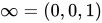








Let be an embedding from a topological space X to a compact Hausdorff topological space Y, with dense image and one-point remainder . Then c(X) is open in a compact Hausdorff space so is locally compact Hausdorff, hence its homeomorphic preimage X is also locally compact Hausdorff. Moreover, if X were compact then c(X) would be closed in Y and hence not dense. Thus a space can only admit a Hausdorff one-point compactification if it is locally compact, noncompact and Hausdorff. Moreover, in such a one-point compactification the image of a neighborhood basis for x in X gives a neighborhood basis for c(x) in c(X), and—because a subset of a compact Hausdorff space is compact if and only if it is closed—the open neighborhoods of must be all sets obtained by adjoining to the image under c of a subset of X with compact complement.


Let be a topological space. Put and topologize by taking as open sets all the open sets in X together with all sets of the form where C is closed and compact in X. Here, denotes the complement of in Note that is an open neighborhood of and thus any open cover of will contain all except a compact subset of implying that is compact (Kelley 1975, p. 150).






The space is called the Alexandroff extension of X (Willard, 19A). Sometimes the same name is used for the inclusion map

The properties below follow from the above discussion:
In particular, the Alexandroff extension is a Hausdorff compactification of X if and only if X is Hausdorff, noncompact and locally compact. In this case it is called the one-point compactification or Alexandroff compactification of X.

Recall from the above discussion that any Hausdorff compactification with one point remainder is necessarily (isomorphic to) the Alexandroff compactification. In particular, if is a compact Hausdorff space and is a limit point of (i.e. not an isolated point of ), is the Alexandroff compactification of .


Hub AI
Alexandroff extension AI simulator
(@Alexandroff extension_simulator)
Alexandroff extension
In the mathematical field of topology, the Alexandroff extension is a way to extend a noncompact topological space by adjoining a single point in such a way that the resulting space is compact. It is named after the Russian mathematician Pavel Alexandroff. More precisely, let X be a topological space. Then the Alexandroff extension of X is a certain compact space X* together with an open embedding c : X → X* such that the complement of X in X* consists of a single point, typically denoted ∞. The map c is a Hausdorff compactification if and only if X is a locally compact, noncompact Hausdorff space. For such spaces the Alexandroff extension is called the one-point compactification or Alexandroff compactification. The advantages of the Alexandroff compactification lie in its simple, often geometrically meaningful structure and the fact that it is in a precise sense minimal among all compactifications; the disadvantage lies in the fact that it only gives a Hausdorff compactification on the class of locally compact, noncompact Hausdorff spaces, unlike the Stone–Čech compactification which exists for any topological space (but provides an embedding exactly for Tychonoff spaces).
A geometrically appealing example of one-point compactification is given by the inverse stereographic projection. Recall that the stereographic projection S gives an explicit homeomorphism from the unit sphere minus the north pole (0,0,1) to the Euclidean plane. The inverse stereographic projection is an open, dense embedding into a compact Hausdorff space obtained by adjoining the additional point . Under the stereographic projection latitudinal circles get mapped to planar circles . It follows that the deleted neighborhood basis of given by the punctured spherical caps corresponds to the complements of closed planar disks . More qualitatively, a neighborhood basis at is furnished by the sets as K ranges through the compact subsets of . This example already contains the key concepts of the general case.
Let be an embedding from a topological space X to a compact Hausdorff topological space Y, with dense image and one-point remainder . Then c(X) is open in a compact Hausdorff space so is locally compact Hausdorff, hence its homeomorphic preimage X is also locally compact Hausdorff. Moreover, if X were compact then c(X) would be closed in Y and hence not dense. Thus a space can only admit a Hausdorff one-point compactification if it is locally compact, noncompact and Hausdorff. Moreover, in such a one-point compactification the image of a neighborhood basis for x in X gives a neighborhood basis for c(x) in c(X), and—because a subset of a compact Hausdorff space is compact if and only if it is closed—the open neighborhoods of must be all sets obtained by adjoining to the image under c of a subset of X with compact complement.
Let be a topological space. Put and topologize by taking as open sets all the open sets in X together with all sets of the form where C is closed and compact in X. Here, denotes the complement of in Note that is an open neighborhood of and thus any open cover of will contain all except a compact subset of implying that is compact (Kelley 1975, p. 150).
The space is called the Alexandroff extension of X (Willard, 19A). Sometimes the same name is used for the inclusion map
The properties below follow from the above discussion:
In particular, the Alexandroff extension is a Hausdorff compactification of X if and only if X is Hausdorff, noncompact and locally compact. In this case it is called the one-point compactification or Alexandroff compactification of X.
Recall from the above discussion that any Hausdorff compactification with one point remainder is necessarily (isomorphic to) the Alexandroff compactification. In particular, if is a compact Hausdorff space and is a limit point of (i.e. not an isolated point of ), is the Alexandroff compactification of .