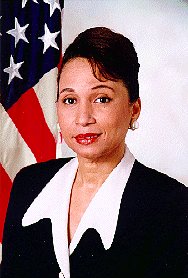

Alexis Herman
View on Wikipedia
Alexis Margaret Herman (July 16, 1947 – April 25, 2025) was an American political figure who served as the 23rd United States secretary of labor from 1997 to 2001 under President Bill Clinton. She was the first Black American to hold the position. She was previously Assistant to the President and Director of the White House Office of Public Engagement.
Key Information


Herman grew up in Mobile, Alabama. After college, she worked to improve employment opportunities for black laborers and women. She then joined the administration of Jimmy Carter, working as director of the Labor Department's Women's Bureau. She became active in the Democratic party, working in the campaigns of Jesse Jackson and then serving as chief of staff for the Democratic National Committee under Ronald H. Brown. She joined the cabinet of President Bill Clinton in 1997.
Following the defeat of Al Gore in the 2000 presidential election, Herman remained active in Democratic politics, in addition to her participation in the private sector, serving on the boards of corporations such as Coca-Cola and Toyota.
Early life and education
[edit]Herman was born on July 16, 1947, in Mobile, Alabama, the daughter of politician Alex Herman and schoolteacher Gloria Caponis,[1] and raised in a Catholic household.[2] Her father became Alabama's first black ward leader.[3] She later recounted how members of the white supremacist group, the Ku Klux Klan, assaulted her father when she was five years old.[4][5]
When Herman was growing up in Mobile, schools remained racially segregated.[2] Her parents opted to send Alexis to parochial school, including Heart of Mary High School, in part because the teachers included white nuns and priests, and thus would expose her to greater diversity.[2]
As a sophomore, she was suspended from school for questioning the Archdiocese of Mobile's exclusion of black students from religious pageants in which white students participated. Following a week of objection from the parents of Herman's fellow black classmates, she was re-admitted.[3]
After graduating from high school, Herman attended Edgewood College in Madison, Wisconsin, and Spring Hill College in Mobile.[6][7] She transferred to Xavier University of Louisiana in New Orleans, where she became an active member of the Gamma Alpha Chapter of the Delta Sigma Theta sorority[8] and graduated with a Bachelor of Arts in Sociology in 1969.[9][10]
Career
[edit]After college, Herman returned to Mobile to help desegregate their parochial schools, including the school she herself attended.[11][3] She was then a social worker with Catholic Charities in Pascagoula, Mississippi, where she advocated for the city's shipyard to offer training to unskilled black laborers.[2] After Pascagoula, Herman moved to Atlanta, Georgia, where she worked as a director of the Southern Regional Council's Black Women's Employment Program, a program designed to promote minority women into managerial or technical jobs.
Later, working at New-York-based consulting firm RTP, Herman led programs designed to provide apprenticeships for women in nontraditional jobs. At RTP, she met Ray Marshall. After Jimmy Carter became president in 1977, he and his incoming Labor Secretary Marshall asked Herman to be director of the Labor Department's Women's Bureau.[3] At age 29, she was the youngest person to hold the position,[12][13] which required her to work towards improving business opportunities for women.[14] She worked to encourage corporations to hire more minority women, with companies like Coca-Cola, Delta Airlines, and General Motors making increased diversity a priority in their hiring process.[15][16]
In 1981, at the end of the Carter administration, Herman left her job in the Labor Department and founded the consulting firm A.M. Herman & Associates.[3] Herman and the firm worked with corporations on a variety of marketing and management issues, including how to develop training programs, marketing strategies, and organizational strategies.[3][17][18] She managed the convention team for Jesse Jackson in his 1984 and 1988 bids for the Democratic Party's presidential nomination.[3] Her role working for Jackson's campaign led Herman to serve as chief of staff to Democratic National Committee Chairman Ronald H. Brown, and later as vice chair of the 1992 Democratic National Convention.[19][3]
Director of the Office of Public Liaison
[edit]After Bill Clinton's victory in the 1992 Presidential election, Herman became deputy director of the Presidential Transition Office.[20] Clinton then appointed her director of the White House Office of Public Liaison, where she was responsible for the administration's relations with interest groups.[21] In that role, Herman repeatedly organized informal dinners to advance White House initiatives or assuage key groups.[21] She earned the support of the National Association for the Advancement of Colored People and the Congressional Black Caucus as part of her outreach efforts.[3] Herman also earned the respect of members of the business community as part of her effort to gain support for the Clinton Administration's trade deal, the North American Free Trade Agreement.[3]

Herman's time as director also included the death of Commerce Secretary, and Herman's former boss at the Democratic National Committee, Ronald Brown, in a plane crash. As director, Herman made arrangements for public and private grieving following the death. The tragedy strengthened Herman's bond with President Clinton, who like Herman, had been close to Brown.[19]
Secretary of Labor
[edit]In 1996, President Clinton announced his intention to nominate Herman as Secretary of Labor to replace outgoing Secretary Robert Reich.[11][19] Labor unions publicly supported the nomination, although they had mostly supported other potential nominees such as Harris Wofford, Esteban Edward Torres, and Alan Wheat.[19] Herman's U.S. Senate confirmation was delayed twice. The first resulted from questions regarding her role in organizing White House coffees Clinton used as fundraisers. The second was because Senate Republicans refused to allow a vote on her nomination, as part of their opposition to a proposed executive order related to federal construction projects, which Clinton eventually abandoned.[22][23] With the delays over, the Senate Labor Committee held its hearing on her nomination on March 18, 1997.[24][25] Then on April 30, 1997, the Senate voted to confirm by a vote of 85–13.[26] Herman was sworn in on May 9, 1997.[27] She became the first Black-American, and the fifth woman, to serve in the position.[27][28]
As Secretary of Labor, Herman oversaw the U.S. Department of Labor, which at the time employed 17,000 people and operated on a $39-billion annual budget.[29] The Department of Labor is tasked with enforcing a variety of workplace laws and regulations, including safety issues and anti-discrimination.[30] During Herman's tenure, American unemployment was at its lowest level in decades.[30]

Herman earned praise from her peers for her handling of the 1997 United Parcel Service (UPS) workers strike, the largest strike in the United States in two decades.[27][21][30] After the strike began in August, Herman met privately with the Teamsters' president Ron Carey and the UPS chairman to frame the issues. She was an instrumental mediator in the talks, and the strike was settled after 15 days.[21] Herman's role in resolving the strike raised her public profile as she began to pursue her agenda as Secretary.[14]
As secretary, Herman supported the 1996 and 1997 raises to the minimum wage, increasing it by $0.90 to $5.15 per hour by September 1997.[31][32] Herman argued the wage hike increased the buying power of workers.[32] She later opposed a 1999 Republican-supported plan to raise the minimum wage over three years, instead supporting a two-year time-table for an increase.[33] Herman also opposed the legislation as it included tax cuts without offsets.[34][33]
Among Herman's responsibilities as secretary was the enforcement of child labor laws.[30] During her tenure, the Department of Labor fined toy store chain Toys "R" Us $200,000 for violating laws restricting the type of work that may be done, and the number of hours that may be worked by underage employees.[35] It found more than 300 teenage employees were working more and later hours than permitted, and Toys "R" Us agreed to stop the practices.[35]
Herman supported the United States' participation in the International Labor Organization's Child Labor Convention, a treaty designed to protect children under 18 years old from slavery, trafficking, bondage, and other abuses.[36] She also defended the United States' support of a provision to allow for voluntary military service of those under 18 years old, a practice allowed in the United States, Great Britain, Germany, and the Netherlands.[37] Opponents, including other nations, trade unions, and Amnesty International urged tougher provisions; however, Herman contended the focus of the treaty should be on forced labor, not voluntary military service.[38]
Attorney General Janet Reno appointed Independent Counsel Ralph I. Lancaster Jr., in May 1998, to investigate Herman after businessman Laurent J. Yene alleged she accepted kickbacks while working at the White House.[37][39][40] Reno was skeptical of Yene's allegations following a preliminary FBI investigation, but she believed the law obligated her to appoint independent counsel where she could not affirm the claims were without merit.[40] Following a twenty-three month investigation, Independent Counsel Lancaster concluded that Herman had broken no laws and cleared her of all wrongdoing.[41][37] She was the fifth Clinton cabinet officer to be investigated by independent counsel, and the fourth cleared of all wrongdoing.[37][40] The Independent Counsel investigations of the cabinet members cost $95 million and did not uncover any felonies, leading Congress to allow the Independent Counsel Act to expire in June 1999 without re-authorization.[40]
Herman was active in Al Gore's 2000 campaign for president.[42] During the Florida election recount, Herman was part of the team planning a transition to a Gore Administration. ABC News and The New York Times considered her a likely candidate to remain in Gore's White House if he won.[43][42] Elaine Chao replaced her as Secretary of Labor in the George W. Bush administration.[30]
Post-government
[edit]
Herman served as co-chair of Democratic presidential nominee John Kerry's transition team during the 2004 presidential election.[44] In 2005, Howard Dean, serving as Democratic National Committee Chairman, appointed Herman and lawyer James Roosevelt, Jr. co-chairs of its Rules and Bylaws Committee.[45][46][47][48] The position put Herman and Roosevelt at the center of a dispute between the campaigns of democratic primary candidates Barack Obama and Hillary Clinton over whether to seat delegates from Michigan and Florida at the 2008 Democratic National Convention.[45] Herman endorsed Hillary Clinton in the 2016 Democratic Party Presidential primaries and served as Deputy Parliamentarian at the 2016 Democratic National Convention.[49][50]
From 2001 to 2006, Herman was chairwoman of The Coca-Cola Company's Human Resources Task Force. The following year, Coca-Cola made her a director. Herman served on Toyota's Diversity Advisory Board.[13] In 2006, the company appointed her to head a special task force to ensure the company's compliance with anti-discrimination standards following the resignation of Toyota North America's CEO, after being named the defendant in a sexual harassment lawsuit.[51] Herman served on the boards of other major companies, including Cummins, MGM Resorts International, Entergy, Sodexo, and was the chairman and CEO of New Ventures, Inc.[52]
In 2010, Herman was appointed to the board of the Clinton Bush Haiti Fund, a charitable organization founded by Bill Clinton and George W. Bush to aid Haiti following a magnitude 7.0 Mw earthquake in January of that year.[53] Herman was also involved with civic groups including the National Urban League and the National Epilepsy Foundation.[54]
Honors
[edit]Herman was awarded more than 30 honorary doctorate degrees[9] from academic institutions.[55] In 1994, she received an honorary degree from her alma mater, Xavier University, and served as the commencement speaker.[9]
Personal life and death
[edit]Herman was Queen of Carnival for the Mobile Area Mardi Gras Association in 1974.[56][57][58] Her father had served as King of Carnival in his youth.[57]
Herman married physician Charles Franklin Jr. in February 2000 at the Washington National Cathedral.[59] Franklin had three children from previous marriages. He died in 2014 following an extended illness.[60]
Herman died in Washington, D.C. on April 25, 2025, at the age of 77.[61]
Xavier University established The Alexis Herman ’69 Memorial Fund to honor her legacy.[9]
See also
[edit]

References
[edit]- ^ Simmonds, Yussuf (May 29, 2008). "Alexis M. Herman - Los Angeles Sentinel". Los Angeles Sentinel. Retrieved December 21, 2017.
- ^ a b c d Wines, Michael (May 12, 1997). "Alexis Herman: Friends Helped Labor Nominee Move Up, Then Almost Brought Her Down". partners.nytimes.com. Retrieved January 15, 2018.
- ^ a b c d e f g h i j Smothers, Ronald (December 21, 1996). "Alexis Herman: Social-Worker Roots and Political Experience". partners.nytimes.com. Retrieved January 13, 2018.
- ^ "Cabinet Secretary Alexis Herman". NPR.org. March 15, 2007. Retrieved December 30, 2017.
- ^ "Alexis Herman recalls her father's beating by the KKK". USA Today. September 21, 2017. Retrieved December 30, 2017.
- ^ Henry, Diana (Fall 2016). "Edgewood College Magazine". issuu. p. 7. Retrieved December 30, 2017.
- ^ Bracks, Lean'tin (February 1, 2012). African American Almanac: 400 Years of Triumph, Courage and Excellence. Visible Ink Press. ISBN 9781578593804.
- ^ "Notable Deltas". Delta Sigma Theta Sorority, Inc. Archived from the original on January 20, 2010. Retrieved December 12, 2007.
- ^ a b c d Alumni News (May 2, 2025). The Xavier Community Mourns the Passing of Alexis Herman (’69). Xavier University. Retrieved June 11, 2025.
- ^ "Hall of Secretaries: Alexis M. Herman". United States Department of Labor. December 9, 2015. Retrieved December 30, 2017.
- ^ a b Lacey, Marc; Silverstein, Stuart (December 21, 1996). "Herman: A Power Behind the Throne". Los Angeles Times. ISSN 0458-3035. Retrieved December 23, 2017.
- ^ "Women in Government: A Slim Past, But a Strong Future". Ebony: 89–92, 96–98. August 1977.
- ^ a b "Workplace Diversity, Inclusion & Recognition". Toyota USA. Retrieved January 13, 2018.
- ^ a b Thurman, Skip (August 21, 1997). "Role in UPS Strike Lifts Herman's Low Profile". Christian Science Monitor. ISSN 0882-7729. Retrieved January 27, 2018.
- ^ "Cabinet Secretary Alexis Herman". NPR.org. March 15, 2007. Retrieved January 28, 2017.
- ^ Snodgrass, Mary Ellen (October 24, 2016). American Women Speak: An Encyclopedia and Document Collection of Women's Oratory [2 volumes]. ABC-CLIO. p. 349. ISBN 9781440837852.
- ^ Smith, Jessie Carney; Phelps, Shirelle (1996). Notable Black American Women. VNR AG. p. 288. ISBN 9780810391772.
- ^ Snodgrass, Mary Ellen (2016). American Women Speak: An Encyclopedia and Document Collection of Women's Oratory [2 volumes]. ABC-CLIO. p. 349. ISBN 9781440837852.
- ^ a b c d Merida, Kevin; Swoboda, Frank (December 21, 1996). "Washingtonpost.com: After Pitched Battle, Herman Wins Out". www.washingtonpost.com. Retrieved December 23, 2017.
- ^ "Clinton Presidential Transition, Dec 7 1992 | Video | C-SPAN.org". C-SPAN.org. December 7, 1992. Retrieved December 30, 2017.
- ^ a b c d Merida, Kevin (August 20, 1997). "Washingtonpost.com: For Alexis Herman, a Proving Ground". www.washingtonpost.com. Retrieved December 27, 2017.
- ^ "Herman Sworn in as Labor Secretary". Washington Post. May 10, 1997. ISSN 0190-8286. Retrieved December 23, 2017.
- ^ Dewar, Helen (April 30, 1997). "Labor Secretary-Designate Caught in Power Struggle". Los Angeles Times. ISSN 0458-3035. Retrieved January 27, 2018.
- ^ Doring, Mike (March 19, 1997). "Labor Nominee Breezes Through Hearing". tribunedigital-chicagotribune. Retrieved January 27, 2018.
- ^ "Secretary Labor Confirmation Hearing, Mar 18 1997". C-SPAN.org. March 18, 1997. Retrieved January 27, 2018.
- ^ Harris, John F.; Swoboda, Frank (May 1, 1997). "Washingtonpost.com: Herman Confirmed for Cabinet After Concession by President". www.washingtonpost.com. Retrieved December 24, 2017.
- ^ a b c "Washingtonpost.com: Politics -- The Administration, Alexis M. Herman". www.washingtonpost.com. 1998. Retrieved December 24, 2017.
- ^ "Alexis M. Herman". clintonwhitehouse4.archives.gov. Retrieved December 23, 2017.
- ^ Mustard, David B. (2003). Racial Justice in America: A Reference Handbook. ABC-CLIO. p. 124. ISBN 9781576072141.
- ^ a b c d e Taylor, T. Shawn (January 28, 2001). "Secretary Of Labor". tribunedigital-chicagotribune. Retrieved January 21, 2018.
- ^ Pellegrini, Frank (September 1, 1997). "Lowest-Rate Workers Get Labor Day Raise". Time. ISSN 0040-781X. Retrieved January 20, 2018.
- ^ a b "Minimum wage jumps to $5.15". www.cnn.com. September 1, 1997. Retrieved January 20, 2018.
- ^ a b Associated Press (November 2, 1999). "2 in Cabinet Push Minimum Wage Bill Veto". Los Angeles Times. ISSN 0458-3035. Retrieved January 20, 2018.
- ^ "Senate Passes GOP Wage Hike". cbs.com. November 9, 1999. Retrieved January 20, 2018.
- ^ a b Associated Press (December 2, 1999). "Toys R Us Slapped With $200,000 Fine for Hundreds of Child Labor Violations". Los Angeles Times. ISSN 0458-3035. Retrieved January 22, 2018.
- ^ "U.S. Signs Child Labor Treaty". CBSNews.com. December 2, 1999. Retrieved January 22, 2018.
- ^ a b c d "Another Cabinet Member Cleared". tribunedigital-chicagotribune. April 8, 2000. Retrieved January 21, 2018.
- ^ Olson, Elizabeth (June 18, 1999). "U.N. Agency Adopts Treaty on Child Labor". The New York Times. ISSN 0362-4331. Retrieved January 22, 2018.
- ^ "Clinton Questioned About Herman". tribunedigital-chicagotribune. September 8, 1999. Retrieved January 21, 2018.
- ^ a b c d Jackson, Robert L. (April 6, 2000). "Labor Secretary Cleared After Bribery Probe". Los Angeles Times. ISSN 0458-3035. Retrieved January 22, 2018.
- ^ Lewis, Neil A. (April 6, 2000). "Labor Secretary Is Cleared in Inquiry on Kickbacks". The New York Times. ISSN 0362-4331. Retrieved December 27, 2017.
- ^ a b Seelye, Katharine Q.; Broder, John M. (November 23, 2000). "Counting the Vote: The Vice President; Gore Has Decided to Start Engines of His Transition". The New York Times. ISSN 0362-4331. Retrieved December 30, 2017.
- ^ ABC News (December 3, 2000). "Bush Meets Congressional Leaders". ABC News. Retrieved December 30, 2017.
- ^ Fournier, Ron (October 21, 2004). "Kerry maps postelection plan - The Boston Globe". archive.boston.com. Retrieved December 30, 2017.
- ^ a b Parsons, Christi (May 30, 2008). "Inside a party's family feud". tribunedigital-chicagotribune. Retrieved January 21, 2018.
- ^ Cook, Nancy (May 29, 2008). "Who's Who on the Rules and Bylaws Committee". NPR.org. Retrieved January 21, 2017.
- ^ MyDD: Vote Counting the DNC Rules & Bylaws Committee Archived June 4, 2008, at the Wayback Machine
- ^ Crowley, Candy; Hornick, Ed; Mooney, Alexander; Preston, Mark; Rubin, Josh; Schneider, Bill (May 31, 2009). "It's decision day for Democrats". cnn.com. Archived from the original on May 31, 2008. Retrieved June 21, 2018.
- ^ Cottman, Michael (February 3, 2016). "Clinton Gains Support From 170 African American Women Leaders". NBC News. Retrieved January 23, 2018.
- ^ Nagle, Kate (July 25, 2016). "NEW: Raimondo Named One of Six Democratic Convention Co-Chairs". GoLocalProv. Retrieved January 23, 2018.
- ^ Kageyama, Yuri (May 9, 2006). "Toyota President Steps Down Amid Lawsuit". The Washington Post. ISSN 0190-8286. Retrieved January 27, 2018.
- ^ "Alexis Herman Former Secretary of Labor". www.energy.gov. Retrieved July 6, 2018.
- ^ "Clinton Bush Haiti Fund Appoints Board of Directors and CEO". Hope Through Healing Hands. March 10, 2010. Retrieved January 27, 2018.
- ^ Venable, Cecilia Gutierrez (September 16, 2013). "Herman, Alexis Margaret (1947-- )". www.blackpast.org. Retrieved January 27, 2018.
- ^ "Diversity Leadership Congress: The Honorable Alexis M. Herman". web.mit.edu. Archived from the original on June 16, 2022. Retrieved July 3, 2018.
- ^ "Mobile Area Mardi Gras Association". www.mamga.com. Archived from the original on February 24, 2012. Retrieved January 21, 2017.
- ^ a b Hoffman, Roy (February 19, 2012). "MAMGA queen 1940 looks back at age 90 on the elegance and festivity of first black Mardi Gras". AL.com. Retrieved January 16, 2018.
- ^ Hoffman, Roy (January 19, 2010). "JaMarcus Russell to be crowned King Elexis I by Mobile Area Mardi Gras Association". AL.com. Retrieved January 16, 2017.
- ^ Grove, Lloyd (February 15, 2000). "The Reliable Source". Washington Post. ISSN 0190-8286. Retrieved December 23, 2017.
- ^ "Charles L. Franklin Jr.'s Obituary on The Washington Post". legacy.com. June 6, 2015. Retrieved December 23, 2017.
- ^ Sandomir, Richard (April 27, 2025). "Alexis Herman, First Black Secretary of Labor, Dies at 77". The New York Times. Retrieved April 27, 2025.
External links
[edit]
- Alexis Herman at IMDb
- U.S. Department of Labor Biography
- Private Attorney Chosen To Investigate Alexis Herman, CNN, AllPolitics, May 26, 1998
- Clinton questioned in Alexis Herman investigation, CNN, September 8, 1999
- Congressional Record—Senate S3409, April 22, 1997
- Jonathan Karl on the possible 'sleeper case' in the election dispute, CNN, December 3, 2000
- Appearances on C-SPAN

Director of the Office of Public Liaison | ||
|---|---|---|
 | ||

| International | |
|---|---|
| National | |
| Other | |

Alexis Herman
View on GrokipediaEarly Life and Education
Family Background and Childhood in Segregated Alabama
Alexis Margaret Herman was born on July 16, 1947, in Mobile, Alabama, during the height of Jim Crow segregation, a system enforcing racial separation in public facilities, schools, and voting across the South.[1][8] Her father, Alex Herman, worked as a mortician and became one of the first Black individuals elected to Alabama's Democratic Party organization after Reconstruction, successfully challenging the party's exclusionary practices through litigation.[9] Her mother, Gloria Broadus Caponis Herman, served as a schoolteacher specializing in reading instruction, instilling in the family a commitment to education amid pervasive racial barriers.[10] The Hermans, devout Catholics, enrolled Alexis in segregated parochial schools in Mobile, where public education for Black children was markedly inferior due to underfunding and discriminatory policies.[11] As a young child around age five, she witnessed Ku Klux Klan members physically assaulting her father in their home, an incident emblematic of the violent enforcement of white supremacy in the segregated South, where such groups targeted Black political participation.[8][12] This environment, characterized by legal disenfranchisement and routine racial violence, shaped her early awareness of systemic inequalities, though her parents' activism and professional roles provided a measure of community influence and relative stability.[13]Academic Pursuits and Influences
Herman completed her secondary education at Heart of Mary High School, a Catholic institution in Mobile, Alabama, graduating in 1965.[6] Following high school, she briefly enrolled at Edgewood College in Madison, Wisconsin, but soon returned to Mobile to participate in civil rights efforts, including work with the local YWCA to desegregate businesses and public facilities.[14] This early activism interrupted her initial college pursuits, reflecting the pressing social justice issues of the era that shaped her path toward sociology.[15] She subsequently transferred to Xavier University of Louisiana, a historically Black Catholic institution in New Orleans, where she earned a Bachelor of Arts degree in sociology in 1969.[1] [16] The sociology major aligned with her experiences in the segregated South and burgeoning involvement in community organizing, fostering an academic focus on social structures, inequality, and labor dynamics amid the civil rights movement's peak.[6] While specific faculty mentors from Xavier are not prominently documented in her biographical accounts, the university's emphasis on service, ethics, and empowerment for Black students likely reinforced her commitment to public service and advocacy.[17] In 1994, Xavier awarded her an honorary degree and invited her as commencement speaker, honoring her as an alumna exemplar.[1]Pre-White House Career
Civil Rights Activism and Social Work
Following her graduation from Xavier University in New Orleans with a Bachelor of Arts in sociology in 1969, Alexis Herman commenced her professional career as a social worker with Catholic Charities in Mobile, Alabama.[6] In this role, she focused on creating employment training programs targeted at unemployed youth, particularly out-of-school young men and women lacking skills, amid the persistent racial segregation in Southern labor markets.[6] [5] Her efforts emphasized practical interventions to bridge gaps in job access, reflecting the broader civil rights imperative to dismantle economic barriers enforced by Jim Crow policies.[18] Herman's fieldwork involved traveling throughout the Deep South, where she directly confronted employers to advocate for the hiring and training of young Black workers in industries such as shipbuilding.[18] A key initiative placed participants in apprenticeships at the Ingalls Shipbuilding yard in Pascagoula, Mississippi, approximately 60 miles from Mobile, enabling entry into skilled trades previously reserved for white workers due to discriminatory practices.[5] [15] This hands-on advocacy constituted her primary engagement in civil rights during the late 1960s and early 1970s, aligning with the movement's shift toward economic justice following landmark legislation like the Civil Rights Act of 1964 and the Voting Rights Act of 1965.[19] Her approach prioritized verifiable outcomes in job placement over public protests, though it required navigating resistance from employers accustomed to exclusionary hiring.[18] These experiences were profoundly shaped by her upbringing in segregated Mobile, where her father, Andrew Herman, served as a civil rights activist, Democratic ward leader, and union organizer, exposing her to the realities of racial injustice from childhood.[20] Herman's social work thus embodied a causal link between familial activism and personal commitment to equal opportunity, fostering skills in negotiation and program development that addressed root causes of unemployment among Black youth in the post-civil rights era.[6] By 1977, this foundation propelled her into federal service under President Jimmy Carter.[1]Federal Roles under Carter
In 1977, President Jimmy Carter appointed Alexis Herman as director of the Women's Bureau within the U.S. Department of Labor, a position she held until 1981.[1] At age 29, she became the youngest individual to serve in that role, recruited by Labor Secretary Ray Marshall to lead efforts advocating for working women's equity in employment, wages, and workplace conditions.[1][2] The Women's Bureau, established by statute in 1920, conducts research on women's labor issues and promotes policies to expand their economic participation, including through data collection on workforce trends and collaboration with employers on training programs. Herman's tenure emphasized increasing women's access to professional and technical positions, particularly for women of color in male-dominated industries. She advocated for corporate hiring initiatives, contributing to the placement of the first women of color in such roles at companies including General Motors, Delta Airlines, and Coca-Cola.[5][14] These efforts aligned with the Carter administration's broader push for affirmative action and equal employment opportunity enforcement under the Equal Employment Opportunity Commission, amid rising female labor force participation rates that grew from 46.3% in 1977 to 51.7% by 1981. Her work focused on practical interventions like employer outreach and program development rather than major legislative overhauls, reflecting the bureau's advisory rather than regulatory mandate. Throughout her service, Herman coordinated with other federal agencies to address barriers such as occupational segregation, where women were concentrated in lower-paying clerical and service jobs comprising over 40% of female employment in the late 1970s. No large-scale controversies or ethical probes marked her directorship, though the era's economic stagflation— with unemployment averaging 6.5% from 1977 to 1981—challenged broader labor equity goals by limiting job growth. Her leadership laid groundwork for subsequent women's workforce advocacy, transitioning her toward private consulting upon leaving office in January 1981.[5]Roles in the Clinton Administration
Director of the White House Office of Public Liaison
Alexis Herman served as Assistant to the President for Public Liaison from 1993 to 1996 in the Clinton administration.[14] Appointed shortly after Bill Clinton's inauguration, she became the first African American woman to hold the position.[21] In this role, Herman oversaw the White House's outreach to external constituencies, including labor unions, business groups, women's organizations, civil rights advocates, and other interest groups.[6] Her responsibilities included coordinating communications and building coalitions to advance the administration's domestic policy agenda, such as welfare reform initiatives and economic recovery efforts.[20] Herman's tenure emphasized grassroots organizing and relationship-building, drawing on her prior experience in Democratic Party operations and civil rights activism.[22] She facilitated White House interactions with diverse stakeholders, helping to garner support for Clinton's early legislative priorities amid partisan opposition.[1] Notable activities included organizing events and consultations that bridged divides between administration officials and external advocates, contributing to the mobilization of voter bases for midterm elections.[6] Her approach focused on inclusive engagement, though specific quantifiable outcomes, such as policy passage rates directly attributable to her office, remain undocumented in primary records. No major ethical controversies or criticisms were publicly associated with Herman's time in the Public Liaison role, unlike later scrutiny during her Labor Secretary nomination.[23] The position's influence was primarily advisory and connective, supporting the administration's broader public engagement strategy without direct policymaking authority.[14] Herman's effectiveness in this capacity was later cited by Clinton as a key factor in her elevation to Secretary of Labor in 1997.[1]Tenure as Secretary of Labor
Alexis Herman was sworn in as the 23rd United States Secretary of Labor on May 1, 1997, following her Senate confirmation on April 30, 1997, and nomination by President Bill Clinton on December 20, 1996.[1][24][25] She became the first African American to lead the Department of Labor, serving until January 20, 2001.[26] Herman's priorities centered on equipping workers for economic transitions, including skills training, workforce development, and creating secure, high-quality workplaces amid rapid technological and global changes.[1] Under her leadership, the Department enforced child labor regulations more stringently, issuing a $200,000 fine to Toys "R" Us for violations and advancing international child labor standards.[27] She supported the proposed OSHA ergonomics standard to address repetitive strain injuries, though it faced significant business opposition and was later repealed.[28] Herman also mediated the 1997 United Parcel Service strike, facilitating a resolution that preserved part-time jobs while granting full-time positions to some workers.[5] Additionally, she drove the Welfare-to-Work initiative to transition welfare recipients into employment, aligning with 1996 welfare reforms.[29][30] The tenure coincided with a robust economic expansion, during which the civilian unemployment rate fell from 5.0 percent in 1997 to 3.99 percent in 2000, reflecting broader factors like technological innovation and fiscal policies rather than isolated departmental actions.[31][32] Herman's service included ethical scrutiny; the Department of Justice and an independent counsel investigated allegations of influence peddling and illegal campaign contributions involving her prior business ties to African businessman Laurent Yene, who claimed she received consulting fees funneled through associates.[33][34] Independent counsel Daniel A. Stein ultimately cleared her in April 2000, finding insufficient evidence of wrongdoing.[7] Republican critics in Congress cited these probes and prior contract allocation concerns during her confirmation, though no charges resulted.[8]Major Policies and Legislative Efforts
As Secretary of Labor, Alexis Herman led the development and passage of the Workforce Investment Act of 1998, signed into law by President Bill Clinton on August 7, 1998, which consolidated over 70 overlapping federal job training programs into a streamlined framework emphasizing one-stop career centers, individualized training accounts, and performance-based accountability to align worker skills with employer demands.[20][13][15] Herman's department implemented welfare-to-work policies under the 1996 Personal Responsibility and Work Opportunity Reconciliation Act, launching initiatives that placed over 1 million former recipients into jobs by fiscal year 2000 through job search assistance, skill training, and employer partnerships focused on sustainable employment rather than temporary aid.[35][36] On child labor, she directed heightened enforcement, increasing investigations by 20% annually and imposing record fines totaling $3.5 million in 1999 alone for violations, while domestically cracking down on sweatshop operations; internationally, her advocacy contributed to U.S. ratification of International Labour Organization Convention No. 182 in November 1999, targeting the worst forms of child labor such as forced work and trafficking through binding global commitments.[37][14] Herman also promoted family-friendly policies, issuing guidance from the Women's Bureau in 1998 to assist employers in establishing equal pay audits and flexible scheduling compliant with the Family and Medical Leave Act, aiming to reduce gender wage gaps documented at 76 cents on the dollar for women overall.[38][39]Economic Outcomes and Labor Market Data
During Alexis Herman's tenure as Secretary of Labor from May 1997 to January 2001, the U.S. economy experienced robust expansion, characterized by falling unemployment and strong job creation amid the dot-com boom and favorable monetary policy. The civilian unemployment rate declined from an annual average of 4.9% in 1997 to 4.0% in 2000, marking the lowest levels in three decades and reflecting a tight labor market that pressured employers to hire more broadly, including from previously marginalized groups.[40] Nonfarm payroll employment grew by approximately 10.4 million jobs over this period, with annual gains averaging 2.5-3%—including 2.3 million in 1997, 3.0 million in 1998, 2.7 million in 1999, and 2.3 million in 2000—driven by sectors like technology, finance, and services rather than manufacturing, which saw slower growth.[41]| Year | Unemployment Rate (Annual Avg., %) | Nonfarm Payroll Jobs Added (Millions) | Labor Force Participation Rate (Annual Avg., %) |
|---|---|---|---|
| 1997 | 4.9 | 2.3 | 67.1 |
| 1998 | 4.5 | 3.0 | 67.1 |
| 1999 | 4.2 | 2.7 | 67.0 |
| 2000 | 4.0 | 2.3 | 67.1 |