



Community hub
Recent from talks
Contribute something
Nothing was collected or created yet.
Algebraic integer
View on WikipediaIn algebraic number theory, an algebraic integer is a complex number that is integral over the integers. That is, an algebraic integer is a complex root of some monic polynomial (a polynomial whose leading coefficient is 1) whose coefficients are integers. The set of all algebraic integers A is closed under addition, subtraction and multiplication and therefore is a commutative subring of the complex numbers.
The ring of integers of a number field K, denoted by OK, is the intersection of K and A: it can also be characterized as the maximal order of the field K. Each algebraic integer belongs to the ring of integers of some number field. A number α is an algebraic integer if and only if the ring is finitely generated as an abelian group, which is to say, as a -module.
![{\displaystyle \mathbb {Z} [\alpha ]}](https://wikimedia.org/api/rest_v1/media/math/render/svg/28420682be585a0ee588c7eb13e7971e01cb1283)

Definitions
[edit]The following are equivalent definitions of an algebraic integer. Let K be a number field (i.e., a finite extension of , the field of rational numbers), in other words, for some algebraic number by the primitive element theorem.


- α ∈ K is an algebraic integer if there exists a monic polynomial such that f(α) = 0.
- α ∈ K is an algebraic integer if the minimal monic polynomial of α over is in .
- α ∈ K is an algebraic integer if is a finitely generated -module.
- α ∈ K is an algebraic integer if there exists a non-zero finitely generated -submodule such that αM ⊆ M.
![{\displaystyle f(x)\in \mathbb {Z} [x]}](https://wikimedia.org/api/rest_v1/media/math/render/svg/cb8266c32dfc2904dc4331ea8906ad341a05ce1c)
![{\displaystyle \mathbb {Z} [x]}](https://wikimedia.org/api/rest_v1/media/math/render/svg/0d4da3ac703cc7721ebba91a53f6752de7157124)

Algebraic integers are a special case of integral elements of a ring extension. In particular, an algebraic integer is an integral element of a finite extension .

Note that if P(x) is a primitive polynomial that has integer coefficients but is not monic, and P is irreducible over , then none of the roots of P are algebraic integers (but are algebraic numbers). Here primitive is used in the sense that the highest common factor of the coefficients of P is 1, which is weaker than requiring the coefficients to be pairwise relatively prime.
Examples
[edit]- The only algebraic integers that are found in the set of rational numbers are the integers. In other words, the intersection of and A is exactly . The rational number a/b is not an algebraic integer unless b divides a. The leading coefficient of the polynomial bx − a is the integer b.
- The square root of a nonnegative integer n is an algebraic integer, but is irrational unless n is a perfect square.
- If d is a square-free integer then the extension is a quadratic field of rational numbers. The ring of algebraic integers OK contains since this is a root of the monic polynomial x2 − d. Moreover, if d ≡ 1 mod 4, then the element is also an algebraic integer. It satisfies the polynomial x2 − x + 1/4(1 − d) where the constant term 1/4(1 − d) is an integer. The full ring of integers is generated by or respectively. See Quadratic integer for more.
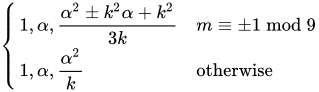
- The ring of integers of the field , α = 3√m, has the following integral basis, writing m = hk2 for two square-free coprime integers h and k:[1]
- If ζn is a primitive nth root of unity, then the ring of integers of the cyclotomic field is precisely .
- If α is an algebraic integer then β = n√α is another algebraic integer. A polynomial for β is obtained by substituting xn in the polynomial for α.


![{\displaystyle F=\mathbb {Q} [\alpha ]}](https://wikimedia.org/api/rest_v1/media/math/render/svg/18fe97465addcc1c7d3f2a3a68e369894145b652)

![{\displaystyle \mathbb {Z} [\zeta _{n}]}](https://wikimedia.org/api/rest_v1/media/math/render/svg/77d56918ae77f0c6d51f8404ce9240aacca9780e)
Finite generation of ring extension
[edit]For any α, the ring extension (in the sense that is equivalent to field extension) of the integers by α, denoted by , is finitely generated if and only if α is an algebraic integer.
![{\displaystyle \mathbb {Z} [\alpha ]\equiv \left\{\sum _{i=0}^{n}\alpha ^{i}z_{i}|z_{i}\in \mathbb {Z} ,n\in \mathbb {Z} \right\}}](https://wikimedia.org/api/rest_v1/media/math/render/svg/bd0afabb0e882508f14afd72027f19ccdfad4358)
The proof is analogous to that of the corresponding fact regarding algebraic numbers, with there replaced by here, and the notion of field extension degree replaced by finite generation (using the fact that is finitely generated itself); the only required change is that only non-negative powers of α are involved in the proof.
The analogy is possible because both algebraic integers and algebraic numbers are defined as roots of monic polynomials over either or , respectively.
Ring
[edit]The sum, difference and product of two algebraic integers is an algebraic integer. In general their quotient is not. Thus the algebraic integers form a ring.
This can be shown analogously to the corresponding proof for algebraic numbers, using the integers instead of the rationals .
One may also construct explicitly the monic polynomial involved, which is generally of higher degree than those of the original algebraic integers, by taking resultants and factoring. For example, if x2 − x − 1 = 0, y3 − y − 1 = 0 and z = xy, then eliminating x and y from z − xy = 0 and the polynomials satisfied by x and y using the resultant gives z6 − 3z4 − 4z3 + z2 + z − 1 = 0, which is irreducible, and is the monic equation satisfied by the product. (To see that the xy is a root of the x-resultant of z − xy and x2 − x − 1, one might use the fact that the resultant is contained in the ideal generated by its two input polynomials.)
Integral closure
[edit]Every root of a monic polynomial whose coefficients are algebraic integers is itself an algebraic integer. In other words, the algebraic integers form a ring that is integrally closed in any of its extensions.
Again, the proof is analogous to the corresponding proof for algebraic numbers being algebraically closed.
Additional facts
[edit]- Any number constructible out of the integers with roots, addition, and multiplication is an algebraic integer; but not all algebraic integers are so constructible: in a naïve sense, most roots of irreducible quintics are not. This is the Abel–Ruffini theorem.
- The ring of algebraic integers is a Bézout domain, as a consequence of the principal ideal theorem.
- If the monic polynomial associated with an algebraic integer has constant term 1 or −1, then the reciprocal of that algebraic integer is also an algebraic integer, and each is a unit, an element of the group of units of the ring of algebraic integers.
- If x is an algebraic number then anx is an algebraic integer, where x satisfies a polynomial p(x) with integer coefficients and where anxn is the highest-degree term of p(x). The value y = anx is an algebraic integer because it is a root of q(y) = an − 1
n p(y /an), where q(y) is a monic polynomial with integer coefficients. - If x is an algebraic number then it can be written as the ratio of an algebraic integer to a non-zero algebraic integer. In fact, the denominator can always be chosen to be a positive integer. The ratio is |an|x / |an|, where x satisfies a polynomial p(x) with integer coefficients and where anxn is the highest-degree term of p(x).
- The only rational algebraic integers are the integers. That is, if x is an algebraic integer and then . This is a direct result of the rational root theorem for the case of a monic polynomial.


See also
[edit]References
[edit]- ^ Marcus, Daniel A. (1977). Number Fields (3rd ed.). Berlin, New York: Springer-Verlag. ch. 2, p. 38 and ex. 41. ISBN 978-0-387-90279-1.
- Stein, William. Algebraic Number Theory: A Computational Approach (PDF). Archived (PDF) from the original on November 2, 2013.

Algebraic integer
View on GrokipediaDefinitions
Formal Definition
An algebraic integer is a complex number that satisfies for some monic polynomial , meaning there exists a polynomial of the form with for all and .[10][11] A monic polynomial is one whose leading coefficient (the coefficient of the highest-degree term) is $1\mathbb{Z}x - kk \in \mathbb{Z}\mathbb{Z}$ to algebraic extensions, preserving properties such as closure under addition and multiplication.[10][11] This definition distinguishes algebraic integers from the broader class of algebraic numbers, which are complex numbers that are roots of non-zero polynomials with rational coefficients (not necessarily monic or with integer coefficients). For instance, is an algebraic number as a root of , but it is not an algebraic integer.[10][11] Equivalently, is an algebraic integer if and only if its minimal polynomial over —the monic polynomial of least degree in having as a root—lies in , meaning it has integer coefficients.[10][11]Equivalent Characterizations
An element in a ring extension is said to be integral over if there exists a monic polynomial such that .[12] This general notion of integrality captures the idea of "integer-like" behavior in more abstract settings, where the coefficients lie in the base ring . Algebraic integers are precisely the complex numbers that are integral over .[12] A key equivalent characterization arises from module theory: is an algebraic integer if and only if the ring is a finitely generated -module.[13] This means there exist finitely many elements such that every element of can be expressed as an integer linear combination with . The equivalence holds because the existence of a monic polynomial in with root implies that powers of satisfy a linear relation over , bounding the module's generators; conversely, finite generation allows construction of such a polynomial via the Cayley-Hamilton theorem applied to the multiplication-by- map.[13] In the context of algebraic number fields, the algebraic integers coincide with the integral closure of in the field. Specifically, for an algebraic number field (a finite extension of ), the algebraic integers in are exactly those elements of that are integral over .[12] This integral closure forms a ring, denoted , which plays a central role in the arithmetic of . For quadratic fields where is a square-free integer not equal to 0 or 1, an explicit criterion determines which elements are algebraic integers. Consider an element with , . The minimal polynomial of over is derived from its conjugates: the other root is , so Multiplying through by yields the polynomial . For to be an algebraic integer, this polynomial must be monic after normalization, requiring the coefficients of the monic form to lie in . Thus, (so divides ) and (so divides ).[12][14] This criterion allows direct verification without computing the full ring of integers, which is if and if .[12]Examples
Elementary Examples
The rational integers, that is, all elements of , are algebraic integers, as each integer satisfies the monic polynomial with integer coefficients.[2] Simple examples of algebraic integers beyond the rationals include quadratic algebraic integers such as , which is a root of the monic polynomial ; , the imaginary unit, which satisfies ; and the golden ratio , which is a root of . The real cube root of 5, denoted \sqrt{{grok:render&&&type=render_inline_citation&&&citation_id=3&&&citation_type=wikipedia}}{5}, is also an algebraic integer, as it satisfies the monic polynomial with integer coefficients.[5] In each case, the minimal polynomial is monic with integer coefficients, confirming their integrality.[15] Not every algebraic number is an algebraic integer; for instance, is an algebraic number as a root of , but it fails to be an algebraic integer because no monic polynomial with integer coefficients has as a root—its minimal polynomial over is not monic when cleared of denominators.[16]Examples from Number Fields
In the quadratic number field , the ring of algebraic integers is the Gaussian integers , where . These elements satisfy monic polynomials with integer coefficients, such as being a root of . A notable example is , which has norm and is a prime element in up to units, as its norm is a prime in .[17][18] In the cyclotomic field , where is a primitive cube root of unity satisfying , the ring of algebraic integers is the Eisenstein integers . This ring consists of elements integral over , forming a Euclidean domain under the norm .[19] For a general quadratic number field with or square-free and not equal to 1, the ring of integers depends on the congruence class of modulo 4. If , the ring is ; if , it is . As a specific example, in where , the ring of integers is , generated by the golden ratio , which satisfies the monic equation .[20] In the th cyclotomic field , generated by a primitive th root of unity satisfying the th cyclotomic polynomial , the ring of algebraic integers is , the smallest ring containing and . This ring has -basis , where is Euler's totient function, and it is the full integral closure of in .[21]Ring Extensions
Finite Generation
A fundamental property of algebraic integers is that adjoining a single such element to the integers yields a finitely generated module over . Specifically, if is an algebraic integer of degree , then the ring is finitely generated as a -module with basis .[22] This follows from the fact that satisfies a monic minimal polynomial of degree with integer coefficients, allowing higher powers of to be expressed linearly in terms of the basis elements using integer coefficients.[23] This finite generation extends naturally to rings generated by finitely many algebraic integers. If are algebraic integers, then the ring is finitely generated as a -module, as it can be constructed inductively: adjoining each to the previously generated ring preserves finite generation since each step adds a finitely generated submodule.[22] For instance, is finitely generated for algebraic integers and , and subrings like or inherit this property as submodules.[22] This finite generation property is a cornerstone of commutative algebra, influencing later results such as Hilbert's basis theorem on Noetherian rings and Noether's normalization lemma for finite extensions of polynomial rings.[24] It underscores the module-finiteness inherent in integral extensions over , distinguishing algebraic integers from more general algebraic numbers. In contrast, adjoining a non-integral algebraic number like to produces , which is not finitely generated as a -module; elements such as for require infinitely many generators.[23] This highlights the role of the monic integer polynomial condition in ensuring finite generation.Integral Extensions
In commutative algebra, a ring extension is called an integral extension if every element is integral over , meaning that satisfies a monic polynomial equation with coefficients in .[25] Specifically, there exist and such that This notion generalizes the concept of algebraic integers, where elements integral over are precisely the algebraic integers.[25] Integral extensions exhibit several key properties that facilitate their study in algebraic number theory and beyond. First, integrality is transitive: if and are integral extensions, then is integral.[25] Second, if is Noetherian and is integral over , then is finitely generated as an -module.[25] These properties ensure that integral extensions behave well under composition and maintain finite structure when starting from Noetherian base rings like . A fundamental example arises in the context of algebraic integers: if is an algebraic integer, then the ring extension is integral, as every element of is a polynomial in with integer coefficients and thus satisfies a monic polynomial over via the minimal polynomial of .[26] More generally, adjoining multiple algebraic integers yields integral extensions of . The lying-over theorem provides a crucial connection between the prime ideals of and in an integral extension : for every prime ideal of , there exists a prime ideal of such that .[25] This theorem implies that primes in the base ring "lift" to primes in the extension, preserving the spectrum in a controlled way. In the special case where is a Dedekind domain (such as the ring of integers of a number field), the lying-over theorem, combined with other properties like going-up and going-down, ensures unique factorization of ideals into primes, underpinning the arithmetic of algebraic number fields.[26] The modern theory of integral extensions traces its origins to Richard Dedekind's foundational work in the 1871 supplements to Dirichlet's Vorlesungen über Zahlentheorie, where he first rigorously defined integral elements in algebraic number fields using monic polynomials and developed the associated ring-theoretic framework to resolve issues in ideal factorization.[26]Ring Structure
The Ring of All Algebraic Integers
The ring of all algebraic integers, denoted , comprises all elements of the algebraic closure of the rational numbers that are roots of monic polynomials with coefficients in . This ring arises as the direct limit of the rings of integers over all finite extensions , ordered by inclusion, with transition maps given by the natural embeddings. Every algebraic integer lies in for some number field containing its minimal field of definition, allowing it to embed into the corresponding ring of integers.[12] is integrally closed in , serving as the maximal integral extension of within the algebraic numbers.[27] As a domain, it possesses the Bézout property: every finitely generated ideal is principal.[28] However, is not a principal ideal domain, as it is not Noetherian, owing to the existence of infinite strictly ascending chains of ideals.[29] In arithmetic geometry, facilitates the study of universal arithmetic structures, such as local-global principles for solving Diophantine equations over algebraic integers, extending classical Hasse principles beyond individual number fields.[30]Integral Closure in Fields
In algebraic number theory, for a number field of degree , the ring of integers is defined as the integral closure of in , consisting precisely of those elements that are integral over . This means satisfies a monic polynomial with coefficients in . As a subring of , contains and is contained in , serving as the maximal order in with respect to integrality over .[31] Computing explicitly depends on the structure of . For quadratic fields with a square-free integer not equal to 0 or 1, the ring takes an explicit form: it is when or , and when . In cubic fields, computation typically begins with a primitive element whose minimal polynomial over is known; one then determines if equals by calculating the index using discriminant formulas derived from the polynomial, adjusting the basis if the index exceeds 1 to include additional integral elements. For higher-degree fields, advanced algorithms such as the Round 2 method, originally developed by Zassenhaus, systematically find an integral basis by iteratively testing potential integral elements and refining modules over .[32] Key structural properties follow from this definition. The ring is a finitely generated -module of rank , admitting a -basis known as an integral basis. Moreover, is a Dedekind domain, meaning it is an integrally closed Noetherian domain of dimension 1. The integral closure of in is unique as a subring, and more generally, in algebraic field extensions, the integral closure of an integrally closed domain like is unique up to isomorphism over the base.[33]Properties
Basic Arithmetic Properties
Algebraic integers form a ring under the usual addition and multiplication of complex numbers. Specifically, the sum and product of any two algebraic integers are themselves algebraic integers. To see this, suppose and are algebraic integers satisfying monic polynomials of degrees and with integer coefficients, respectively. Consider the -module , which is finitely generated by the basis . For or , multiplication by maps into itself, implying is an algebraic integer by the characterization that algebraic integers are precisely the elements for which is a finitely generated -module.[3] In a number field , the norm and trace of an algebraic integer take integer values. Let be the embeddings of into , where . The trace and the norm are both integers, as they are the negative of the coefficient of and times the constant term in the monic minimal polynomial of over , respectively, which has integer coefficients since is an algebraic integer.[34] These maps are additive for the trace and multiplicative for the norm, providing key tools for studying arithmetic in .[35] The units in the ring of integers of a number field consist of elements with multiplicative inverses also in . By Dirichlet's unit theorem, the unit group is finitely generated of rank , where is the number of real embeddings of and is the number of complex embeddings, and it takes the form , with the finite group of roots of unity in . This structure arises from the logarithmic embedding of units into , whose image is a lattice of full rank in a hyperplane, reflecting the regulator as the volume of the fundamental domain.[36] The Galois group of the algebraic closure over acts on the ring of all algebraic integers by sending each element to its conjugates, preserving the ring structure. Any maps an algebraic integer , root of a monic polynomial with integer coefficients, to , which satisfies the same polynomial since coefficients are fixed by , hence is also an algebraic integer. This action is a ring automorphism, maintaining addition and multiplication.[37]Discriminants and Ideals
In the ring of integers of a number field of degree over , the discriminant is a fundamental invariant defined relative to an integral basis as , where denotes the field trace; this determinant is an integer independent of the choice of basis.[38] The absolute value of the discriminant provides a measure of the ramification of prime ideals in , with smaller discriminants often corresponding to less ramified extensions and simpler arithmetic structure.[38] Rings of algebraic integers are Dedekind domains, in which every nonzero ideal factors uniquely as a product of prime ideals, restoring a form of unique factorization at the ideal level despite potential failures for individual elements.[39] This ideal factorization theorem underpins much of algebraic number theory, enabling the study of arithmetic via ideals rather than elements alone.[39] The ideal class group of is the quotient of the group of fractional ideals by the subgroup of principal ideals, measuring the deviation from being a principal ideal domain (PID); its order, the class number , is finite.[40] Finiteness follows from Minkowski's geometry of numbers, which guarantees that every ideal class contains an integral ideal of norm at most the Minkowski bound , where is the number of complex conjugate pairs in the embeddings of ; thus, divides the number of ideals of norm up to , yielding an explicit though crude upper bound like for suitable constants .[40] When , is a PID; notable examples include the Gaussian integers for and the Eisenstein integers for with , both of which admit Euclidean algorithms ensuring unique factorization.[41][42] Recent advances in computational algebraic number theory have refined bounds and algorithms for class numbers, particularly for quadratic fields. For instance, explicit upper bounds on for real quadratic fields with large fundamental units have been derived using estimates on -functions and squarefree values, improving on classical limits for up to or more via optimized sieving and modular methods.[43] These developments, building on software like PARI/GP and SageMath, enable efficient computation of class groups for fields with discriminants exceeding , facilitating searches for fields with small class numbers.[44]References
- Let C denote the complex num- bers. Definition 1: An algebraic integer is a number x ∈ C that satisfies an integer monic polynomial. That is xn + an ...