Hubbry Logo
Ample line bundleAmple line bundleMain
Open search
Ample line bundle
Community hub
Ample line bundle
logo
7 pages, 0 posts
0 subscribers
Be the first to start a discussion here.
Ample line bundle
Ample line bundle
from Wikipedia

In mathematics, a distinctive feature of algebraic geometry is that some line bundles on a projective variety can be considered "positive", while others are "negative" (or a mixture of the two). The most important notion of positivity is that of an ample line bundle, although there are several related classes of line bundles. Roughly speaking, positivity properties of a line bundle are related to having many global sections. Understanding the ample line bundles on a given variety amounts to understanding the different ways of mapping into projective spaces. In view of the correspondence between line bundles and divisors (built from codimension-1 subvarieties), there is an equivalent notion of an ample divisor.

In more detail, a line bundle is called basepoint-free if it has enough sections to give a morphism to projective space. A line bundle is semi-ample if some positive power of it is basepoint-free; semi-ampleness is a kind of "nonnegativity". More strongly, a line bundle on a complete variety is very ample if it has enough sections to give a closed immersion (or "embedding") of into a projective space. A line bundle is ample if some positive power is very ample.

An ample line bundle on a projective variety has positive degree on every curve in . The converse is not quite true, but there are corrected versions of the converse, the Nakai–Moishezon and Kleiman criteria for ampleness.

Introduction

[edit]

Pullback of a line bundle and hyperplane divisors

[edit]

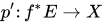
Given a morphism of schemes, a vector bundle (or more generally a coherent sheaf on ) has a pullback to , where the projection is the projection on the first coordinate (see Sheaf of modules#Operations). The pullback of a vector bundle is a vector bundle of the same rank. In particular, the pullback of a line bundle is a line bundle. (Briefly, the fiber of at a point is the fiber of at .)

The notions described in this article are related to this construction in the case of a morphism to projective space

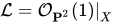
with the line bundle on projective space whose global sections are the homogeneous polynomials of degree 1 (that is, linear functions) in variables . The line bundle can also be described as the line bundle associated to a hyperplane in (because the zero set of a section of is a hyperplane). If is a closed immersion, for example, it follows that the pullback is the line bundle on associated to a hyperplane section (the intersection of with a hyperplane in ).

Basepoint-free line bundles

[edit]

Let be a scheme over a field (for example, an algebraic variety) with a line bundle . (A line bundle may also be called an invertible sheaf.) Let be elements of the -vector space of global sections of . The zero set of each section is a closed subset of ; let be the open subset of points at which at least one of is not zero. Then these sections define a morphism

In more detail: for each point of , the fiber of over is a 1-dimensional vector space over the residue field . Choosing a basis for this fiber makes into a sequence of numbers, not all zero, and hence a point in projective space. Changing the choice of basis scales all the numbers by the same nonzero constant, and so the point in projective space is independent of the choice.

Moreover, this morphism has the property that the restriction of to is isomorphic to the pullback .[1]

The base locus of a line bundle on a scheme is the intersection of the zero sets of all global sections of . A line bundle is called basepoint-free if its base locus is empty. That is, for every point of there is a global section of which is nonzero at . If is proper over a field , then the vector space of global sections has finite dimension; the dimension is called .[2] So a basepoint-free line bundle determines a morphism over , where , given by choosing a basis for . Without making a choice, this can be described as the morphism

from to the space of hyperplanes in , canonically associated to the basepoint-free line bundle . This morphism has the property that is the pullback .

Conversely, for any morphism from a scheme to a projective space over , the pullback line bundle is basepoint-free. Indeed, is basepoint-free on , because for every point in there is a hyperplane not containing . Therefore, for every point in , there is a section of over that is not zero at , and the pullback of is a global section of that is not zero at . In short, basepoint-free line bundles are exactly those that can be expressed as the pullback of by some morphism to a projective space.

Nef, globally generated, semi-ample

[edit]

The degree of a line bundle L on a proper curve C over k is defined as the degree of the divisor (s) of any nonzero rational section s of L. The coefficients of this divisor are positive at points where s vanishes and negative where s has a pole. Therefore, any line bundle L on a curve C such that has nonnegative degree (because sections of L over C, as opposed to rational sections, have no poles).[3] In particular, every basepoint-free line bundle on a curve has nonnegative degree. As a result, a basepoint-free line bundle L on any proper scheme X over a field is nef, meaning that L has nonnegative degree on every (irreducible) curve in X.[4]
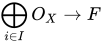
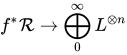
More generally, a sheaf F of -modules on a scheme X is said to be globally generated if there is a set I of global sections such that the corresponding morphism

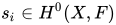
of sheaves is surjective.[5] A line bundle is globally generated if and only if it is basepoint-free.

For example, every quasi-coherent sheaf on an affine scheme is globally generated.[6] Analogously, in complex geometry, Cartan's theorem A says that every coherent sheaf on a Stein manifold is globally generated.

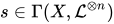
A line bundle L on a proper scheme over a field is semi-ample if there is a positive integer r such that the tensor power is basepoint-free. A semi-ample line bundle is nef (by the corresponding fact for basepoint-free line bundles).[7]

Very ample line bundles

[edit]

A line bundle on a proper scheme over a field is said to be very ample if it is basepoint-free and the associated morphism

is an immersion. Here . Equivalently, is very ample if can be embedded into a projective space of some dimension over in such a way that is the restriction of the line bundle to .[8] The latter definition is used to define very ampleness for a line bundle on a proper scheme over any commutative ring.[9]

The name "very ample" was introduced by Alexander Grothendieck in 1961.[10] Various names had been used earlier in the context of linear systems of divisors.

For a very ample line bundle on a proper scheme over a field with associated morphism , the degree of on a curve in is the degree of as a curve in . So has positive degree on every curve in (because every subvariety of projective space has positive degree).[11]

Definitions

[edit]

Ample invertible sheaves on quasi-compact schemes

[edit]

Ample line bundles are used most often on proper schemes, but they can be defined in much wider generality.

Let X be a scheme, and let be an invertible sheaf on X. For each , let denote the ideal sheaf of the reduced subscheme supported only at x. For , define Equivalently, if denotes the residue field at x (considered as a skyscraper sheaf supported at x), then where is the image of s in the tensor product.

Fix . For every s, the restriction is a free -module trivialized by the restriction of s, meaning the multiplication-by-s morphism is an isomorphism. The set is always open, and the inclusion morphism is an affine morphism. Despite this, need not be an affine scheme. For example, if , then is open in itself and affine over itself but generally not affine.

Assume X is quasi-compact. Then is ample if, for every , there exists an and an such that and is an affine scheme.[12] For example, the trivial line bundle is ample if and only if X is quasi-affine.[13]

In general, it is not true that every is affine. For example, if for some point O, and if is the restriction of to X, then and have the same global sections, and the non-vanishing locus of a section of is affine if and only if the corresponding section of contains O.
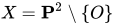
It is necessary to allow powers of in the definition. In fact, for every N, it is possible that is non-affine for every with . Indeed, suppose Z is a finite set of points in , , and . The vanishing loci of the sections of are plane curves of degree N. By taking Z to be a sufficiently large set of points in general position, we may ensure that no plane curve of degree N (and hence any lower degree) contains all the points of Z. In particular their non-vanishing loci are all non-affine.

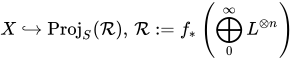
Define . Let denote the structural morphism. There is a natural isomorphism between -algebra homomorphisms and endomorphisms of the graded ring S. The identity endomorphism of S corresponds to a homomorphism . Applying the functor produces a morphism from an open subscheme of X, denoted , to .


The basic characterization of ample invertible sheaves states that if X is a quasi-compact quasi-separated scheme and is an invertible sheaf on X, then the following assertions are equivalent:[14]

  1. is ample.
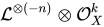
  2. The open sets , where and , form a basis for the topology of X.
  3. The open sets with the property of being affine, where and , form a basis for the topology of X.
  4. and the morphism is a dominant open immersion.
  5. and the morphism is a homeomorphism of the underlying topological space of X with its image.
  6. For every quasi-coherent sheaf on X, the canonical map is surjective.
  7. For every quasi-coherent sheaf of ideals on X, the canonical map is surjective.
  8. For every quasi-coherent sheaf of ideals on X, the canonical map is surjective.
  9. For every quasi-coherent sheaf of finite type on X, there exists an integer such that for , is generated by its global sections.
  10. For every quasi-coherent sheaf of finite type on X, there exists integers and such that is isomorphic to a quotient of .
  11. For every quasi-coherent sheaf of ideals of finite type on X, there exists integers and such that is isomorphic to a quotient of .

On proper schemes

[edit]

When X is separated and finite type over an affine scheme, an invertible sheaf is ample if and only if there exists a positive integer r such that the tensor power is very ample.[15][16] In particular, a proper scheme over R has an ample line bundle if and only if it is projective over R. Often, this characterization is taken as the definition of ampleness.

The rest of this article will concentrate on ampleness on proper schemes over a field, as this is the most important case. An ample line bundle on a proper scheme X over a field has positive degree on every curve in X, by the corresponding statement for very ample line bundles.

A Cartier divisor D on a proper scheme X over a field k is said to be ample if the corresponding line bundle O(D) is ample. (For example, if X is smooth over k, then a Cartier divisor can be identified with a finite linear combination of closed codimension-1 subvarieties of X with integer coefficients.)

Weakening the notion of "very ample" to "ample" gives a flexible concept with a wide variety of different characterizations. A first point is that tensoring high powers of an ample line bundle with any coherent sheaf whatsoever gives a sheaf with many global sections. More precisely, a line bundle L on a proper scheme X over a field (or more generally over a Noetherian ring) is ample if and only if for every coherent sheaf F on X, there is an integer s such that the sheaf is globally generated for all . Here s may depend on F.[17][18]

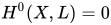
Another characterization of ampleness, known as the CartanSerreGrothendieck theorem, is in terms of coherent sheaf cohomology. Namely, a line bundle L on a proper scheme X over a field (or more generally over a Noetherian ring) is ample if and only if for every coherent sheaf F on X, there is an integer s such that

for all and all .[19][18] In particular, high powers of an ample line bundle kill cohomology in positive degrees. This implication is called the Serre vanishing theorem, proved by Jean-Pierre Serre in his 1955 paper Faisceaux algébriques cohérents.

Examples/Non-examples

[edit]
  • The trivial line bundle on a projective variety X of positive dimension is basepoint-free but not ample. More generally, for any morphism f from a projective variety X to some projective space over a field, the pullback line bundle is always basepoint-free, whereas L is ample if and only if the morphism f is finite (that is, all fibers of f have dimension 0 or are empty).[20]
  • For an integer d, the space of sections of the line bundle O(d) over is the complex vector space of homogeneous polynomials of degree d in variables x,y. In particular, this space is zero for d < 0. For , the morphism to projective space given by O(d) is
by
This is a closed immersion for , with image a rational normal curve of degree d in . Therefore, O(d) is basepoint-free if and only if , and very ample if and only if . It follows that O(d) is ample if and only if .
  • For an example where "ample" and "very ample" are different, let X be a smooth projective curve of genus 1 (an elliptic curve) over C, and let p be a complex point of X. Let O(p) be the associated line bundle of degree 1 on X. Then the complex vector space of global sections of O(p) has dimension 1, spanned by a section that vanishes at p.[21] So the base locus of O(p) is equal to p. On the other hand, O(2p) is basepoint-free, and O(dp) is very ample for (giving an embedding of X as an elliptic curve of degree d in ). Therefore, O(p) is ample but not very ample. Also, O(2p) is ample and basepoint-free but not very ample; the associated morphism to projective space is a ramified double cover .
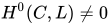
  • On curves of higher genus, there are ample line bundles L for which every global section is zero. (But high multiples of L have many sections, by definition.) For example, let X be a smooth plane quartic curve (of degree 4 in ) over C, and let p and q be distinct complex points of X. Then the line bundle is ample but has .[22]

Criteria for ampleness of line bundles

[edit]

Intersection theory

[edit]

To determine whether a given line bundle on a projective variety X is ample, the following numerical criteria (in terms of intersection numbers) are often the most useful. It is equivalent to ask when a Cartier divisor D on X is ample, meaning that the associated line bundle O(D) is ample. The intersection number can be defined as the degree of the line bundle O(D) restricted to C. In the other direction, for a line bundle L on a projective variety, the first Chern class means the associated Cartier divisor (defined up to linear equivalence), the divisor of any nonzero rational section of L.

On a smooth projective curve X over an algebraically closed field k, a line bundle L is very ample if and only if for all k-rational points x,y in X.[23] Let g be the genus of X. By the Riemann–Roch theorem, every line bundle of degree at least 2g + 1 satisfies this condition and hence is very ample. As a result, a line bundle on a curve is ample if and only if it has positive degree.[24]

For example, the canonical bundle of a curve X has degree 2g − 2, and so it is ample if and only if . The curves with ample canonical bundle form an important class; for example, over the complex numbers, these are the curves with a metric of negative curvature. The canonical bundle is very ample if and only if and the curve is not hyperelliptic.[25]

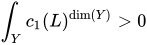
The Nakai–Moishezon criterion (named for Yoshikazu Nakai (1963) and Boris Moishezon (1964)) states that a line bundle L on a proper scheme X over a field is ample if and only if for every (irreducible) closed subvariety Y of X (Y is not allowed to be a point).[26] In terms of divisors, a Cartier divisor D is ample if and only if for every (nonzero-dimensional) subvariety Y of X. For X a curve, this says that a divisor is ample if and only if it has positive degree. For X a surface, the criterion says that a divisor D is ample if and only if its self-intersection number is positive and every curve C on X has .

Kleiman's criterion

[edit]

To state Kleiman's criterion (1966), let X be a projective scheme over a field. Let be the real vector space of 1-cycles (real linear combinations of curves in X) modulo numerical equivalence, meaning that two 1-cycles A and B are equal in if and only if every line bundle has the same degree on A and on B. By the Néron–Severi theorem, the real vector space has finite dimension. Kleiman's criterion states that a line bundle L on X is ample if and only if L has positive degree on every nonzero element C of the closure of the cone of curves NE(X) in . (This is slightly stronger than saying that L has positive degree on every curve.) Equivalently, a line bundle is ample if and only if its class in the dual vector space is in the interior of the nef cone.[27]

Kleiman's criterion fails in general for proper (rather than projective) schemes X over a field, although it holds if X is smooth or more generally Q-factorial.[28]

A line bundle on a projective variety is called strictly nef if it has positive degree on every curve. Nagata (1959) and David Mumford constructed line bundles on smooth projective surfaces that are strictly nef but not ample. This shows that the condition cannot be omitted in the Nakai–Moishezon criterion, and it is necessary to use the closure of NE(X) rather than NE(X) in Kleiman's criterion.[29] Every nef line bundle on a surface has , and Nagata and Mumford's examples have .

C. S. Seshadri showed that a line bundle L on a proper scheme over an algebraically closed field is ample if and only if there is a positive real number ε such that deg(L|C) ≥ εm(C) for all (irreducible) curves C in X, where m(C) is the maximum of the multiplicities at the points of C.[30]

Several characterizations of ampleness hold more generally for line bundles on a proper algebraic space over a field k. In particular, the Nakai-Moishezon criterion is valid in that generality.[31] The Cartan-Serre-Grothendieck criterion holds even more generally, for a proper algebraic space over a Noetherian ring R.[32] (If a proper algebraic space over R has an ample line bundle, then it is in fact a projective scheme over R.) Kleiman's criterion fails for proper algebraic spaces X over a field, even if X is smooth.[33]

Openness of ampleness

[edit]

On a projective scheme X over a field, Kleiman's criterion implies that ampleness is an open condition on the class of an R-divisor (an R-linear combination of Cartier divisors) in , with its topology based on the topology of the real numbers. (An R-divisor is defined to be ample if it can be written as a positive linear combination of ample Cartier divisors.[34]) An elementary special case is: for an ample divisor H and any divisor E, there is a positive real number b such that is ample for all real numbers a of absolute value less than b. In terms of divisors with integer coefficients (or line bundles), this means that nH + E is ample for all sufficiently large positive integers n.

Ampleness is also an open condition in a quite different sense, when the variety or line bundle is varied in an algebraic family. Namely, let be a proper morphism of schemes, and let L be a line bundle on X. Then the set of points y in Y such that L is ample on the fiber is open (in the Zariski topology). More strongly, if L is ample on one fiber , then there is an affine open neighborhood U of y such that L is ample on over U.[35]

Kleiman's other characterizations of ampleness

[edit]

Kleiman also proved the following characterizations of ampleness, which can be viewed as intermediate steps between the definition of ampleness and numerical criteria. Namely, for a line bundle L on a proper scheme X over a field, the following are equivalent:[36]

  • L is ample.
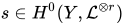
  • For every (irreducible) subvariety of positive dimension, there is a positive integer r and a section which is not identically zero but vanishes at some point of Y.
  • For every (irreducible) subvariety of positive dimension, the holomorphic Euler characteristics of powers of L on Y go to infinity:
as .

Generalizations

[edit]

Ample vector bundles

[edit]

Robin Hartshorne defined a vector bundle F on a projective scheme X over a field to be ample if the line bundle on the space of hyperplanes in F is ample.[37]

Several properties of ample line bundles extend to ample vector bundles. For example, a vector bundle F is ample if and only if high symmetric powers of F kill the cohomology of coherent sheaves for all .[38] Also, the Chern class of an ample vector bundle has positive degree on every r-dimensional subvariety of X, for .[39]

Big line bundles

[edit]

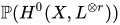
A useful weakening of ampleness, notably in birational geometry, is the notion of a big line bundle. A line bundle L on a projective variety X of dimension n over a field is said to be big if there is a positive real number a and a positive integer such that for all . This is the maximum possible growth rate for the spaces of sections of powers of L, in the sense that for every line bundle L on X there is a positive number b with for all j > 0.[40]


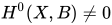
There are several other characterizations of big line bundles. First, a line bundle is big if and only if there is a positive integer r such that the rational map from X to given by the sections of is birational onto its image.[41] Also, a line bundle L is big if and only if it has a positive tensor power which is the tensor product of an ample line bundle A and an effective line bundle B (meaning that ).[42] Finally, a line bundle is big if and only if its class in is in the interior of the cone of effective divisors.[43]
Bigness can be viewed as a birationally invariant analog of ampleness. For example, if is a dominant rational map between smooth projective varieties of the same dimension, then the pullback of a big line bundle on Y is big on X. (At first sight, the pullback is only a line bundle on the open subset of X where f is a morphism, but this extends uniquely to a line bundle on all of X.) For ample line bundles, one can only say that the pullback of an ample line bundle by a finite morphism is ample.[20]

Example: Let X be the blow-up of the projective plane at a point over the complex numbers. Let H be the pullback to X of a line on , and let E be the exceptional curve of the blow-up . Then the divisor H + E is big but not ample (or even nef) on X, because


This negativity also implies that the base locus of H + E (or of any positive multiple) contains the curve E. In fact, this base locus is equal to E.

Relative ampleness

[edit]

Given a quasi-compact morphism of schemes , an invertible sheaf L on X is said to be ample relative to f or f-ample if the following equivalent conditions are met:[44][45]

  1. For each open affine subset , the restriction of L to is ample (in the usual sense).
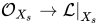
  2. f is quasi-separated and there is an open immersion induced by the adjunction map:
    .
  3. The condition 2. without "open".

The condition 2 says (roughly) that X can be openly compactified to a projective scheme with (not just to a proper scheme).

See also

[edit]

General algebraic geometry

[edit]

Ampleness in complex geometry

[edit]

Notes

[edit]

Sources

[edit]
[edit]
Revisions and contributorsEdit on WikipediaRead on Wikipedia
from Grokipedia
In , an ample line bundle on a quasi-compact scheme is an invertible sheaf L\mathcal{L} such that the associated sheaf of graded algebras d0H0(X,Ld)\bigoplus_{d \geq 0} H^0(X, \mathcal{L}^{\otimes d}) is finitely generated, and the natural X\Projd0H0(X,Ld)X \to \Proj \bigoplus_{d \geq 0} H^0(X, \mathcal{L}^{\otimes d}) is an onto its image, effectively XX projectively via sections of high tensor powers. Equivalently, L\mathcal{L} is ample if there exist sufficiently many global sections in some power Ld\mathcal{L}^{\otimes d} whose principal open sets XsX_s (for sH0(X,Ld)s \in H^0(X, \mathcal{L}^{\otimes d})) form an affine cover of XX. This concept captures a notion of positivity central to the study of projective varieties and schemes, generalizing the role of the hyperplane bundle OPn(1)\mathcal{O}_{\mathbb{P}^n}(1) on projective space, which is ample and generates embeddings. Introduced in the mid-20th century, the term originates from Jean-Pierre Serre's work, where he characterized ample line bundles cohomologically: L\mathcal{L} is ample if, for every coherent sheaf F\mathcal{F} on XX, there exists n0>0n_0 > 0 such that for all nn0n \geq n_0, FLn\mathcal{F} \otimes \mathcal{L}^{\otimes n} is generated by global sections. This criterion aligns with geometric ampleness, as high powers ensure vanishing of higher cohomology groups Hi(X,FLn)=0H^i(X, \mathcal{F} \otimes \mathcal{L}^{\otimes n}) = 0 for i>0i > 0 and n0n \gg 0, by Serre's vanishing theorem. Ample line bundles satisfy several equivalent criteria, including numerical ones like the Nakai-Moishezon condition (intersection numbers positive on subvarieties) over fields of characteristic zero, and metric conditions over the complex numbers, where L\mathcal{L} admits a hermitian metric with positive curvature. They are preserved under tensor products with flexible sheaves (those generated by global sections) and remain ample when restricted to closed subschemes or pulled back under proper morphisms. On curves, ampleness reduces to positive degree, while on higher-dimensional varieties, it ensures the variety is projective. The notion extends to vector bundles, where a bundle EE is ample if its projectivization carries an ample tautological , facilitating generalizations like ample subvarieties and q-ample divisors for partial vanishing. Ample bundles underpin key results in , such as the basepoint-free theorem and Kodaira embedding theorem, and play a foundational role in moduli problems and positivity studies in .

Introduction

Projective varieties and line bundles

A over an kk is defined as an that is isomorphic to a closed subvariety of some Pkn\mathbb{P}^n_k. This construction embeds the variety into a space where allow for a compact, well-behaved geometry, facilitating the study of global properties through polynomial equations. are integral, meaning they are irreducible and reduced, and they provide a foundational setting for much of classical . Line bundles on a variety XX are invertible sheaves L\mathcal{L}, which are locally free OX\mathcal{O}_X-modules of rank one, equipped with transition functions that are invertible elements in the structure sheaf. The global sections H0(X,L)H^0(X, \mathcal{L}) form a finite-dimensional over kk when XX is projective, enabling the bundle to encode geometric data such as . The Pic(X)\mathrm{Pic}(X) classifies isomorphism classes of line bundles under , and it is closely related to the divisor class group, where each line bundle corresponds to the class of a Cartier divisor via the map OX(D)L\mathcal{O}_X(D) \cong \mathcal{L}. On a smooth projective curve, the degree of a LOX(D)\mathcal{L} \cong \mathcal{O}_X(D) is defined as the degree of the divisor DD, providing an invariant that measures the bundle's "size" and influences its section space. The study of line bundles on curves was motivated by early work in and , particularly the , which relates the dimension of global sections of a to its degree and the of the , thereby guiding the construction of embeddings into . This , originally formulated by Riemann in 1857 and proved by Roch in 1865, highlighted how sufficiently positive could yield enough sections to embed the curve projectively. In general, for a XX and a L\mathcal{L} with a basis {s0,,sn}\{s_0, \dots, s_n\} of global sections, these sections induce a ϕL:XPkn\phi_{\mathcal{L}}: X \to \mathbb{P}^n_k defined by x[s0(x)::sn(x)]x \mapsto [s_0(x) : \dots : s_n(x)], where the map is well-defined away from the base locus of the sections. Such morphisms preserve the projective structure and allow line bundles to serve as tools for realizing varieties within .

Very ample bundles and embeddings

A line bundle L\mathcal{L} on a projective variety XX over an is very ample if the associated ϕL:XPN\phi_{|\mathcal{L}|}: X \to \mathbb{P}^N, where N=h0(X,L)1N = h^0(X, \mathcal{L}) - 1, defined by the complete linear system L|\mathcal{L}| is a closed . This sends a point xXx \in X to the line in H0(X,L)H^0(X, \mathcal{L})^* consisting of sections vanishing at xx, or equivalently, to the projective coordinates given by a basis of global sections evaluated at xx. Equivalently, on a projective variety XX, a line bundle L\mathcal{L} is very ample if and only if there exists a closed embedding i:XPNi: X \hookrightarrow \mathbb{P}^N such that LiOPN(1)\mathcal{L} \cong i^* \mathcal{O}_{\mathbb{P}^N}(1), the pullback of the tautological hyperplane bundle on projective space. This characterization underscores the role of very ample bundles as the strongest form of positivity, directly realizing XX as a projective subvariety via its sections. A canonical example occurs on projective space Pn\mathbb{P}^n, where the line bundle OPn(d)\mathcal{O}_{\mathbb{P}^n}(d) for any integer d1d \geq 1 is very ample. For d=1d = 1, it induces the identity embedding PnPn\mathbb{P}^n \hookrightarrow \mathbb{P}^n. For d>1d > 1, the morphism is the Veronese embedding vd:PnP(n+dd)1v_d: \mathbb{P}^n \hookrightarrow \mathbb{P}^{\binom{n+d}{d}-1}, which maps a point [x0::xn][x_0 : \cdots : x_n] to the point whose coordinates are all monomials of degree dd in the xix_i. The ϕL\phi_{|\mathcal{L}|} is defined using the complete L|\mathcal{L}|, the projectivization of the of global sections H0(X,L)H^0(X, \mathcal{L}), assuming L|\mathcal{L}| is basepoint-free so that the map is defined everywhere on XX. To see that ϕL\phi_{|\mathcal{L}|} is an embedding, it suffices to verify injectivity and that it is a closed immersion; the latter follows from projectivity. Injectivity arises because the global sections separate points and s: for distinct points p,qXp, q \in X, there exists sH0(X,L)s \in H^0(X, \mathcal{L}) such that s(p)=0s(p) = 0 but s(q)0s(q) \neq 0 (or vice versa), and for any pXp \in X and nonzero vTpXv \in T_p X, there exists sH0(X,L)s \in H^0(X, \mathcal{L}) with s(p)=0s(p) = 0 but the differential dsp(v)0ds_p(v) \neq 0.

Progression to ample bundles

While very ample line bundles on a provide a closed into , many line bundles that intuitively behave "positively" fail to be very ample themselves, as their global sections may not separate points or tangent vectors sufficiently. However, tensor powers of such bundles often rectify this limitation, achieving very ampleness for sufficiently high exponents and thereby embedding the variety projectively. This observation motivates a broader notion of positivity in , shifting focus from immediate embeddability to asymptotic behavior under tensoring. A L\mathcal{L} on a XX is thus defined to be ample if there exists a positive kk such that Lk\mathcal{L}^{\otimes k} is very ample. This criterion, introduced by Serre, relaxes the stringent embedding condition of very ampleness (where k=1k = 1 suffices) to one where higher powers embed XX, capturing a wider class of line bundles that generate the and facilitate key vanishing results. Central to this progression is Serre's vanishing theorem, which states that if L\mathcal{L} is ample on XX, then for any coherent sheaf F\mathcal{F} on XX, the higher cohomology groups Hi(X,FLk)=0H^i(X, \mathcal{F} \otimes \mathcal{L}^{\otimes k}) = 0 for all i>0i > 0 and sufficiently large kk. This cohomological property underscores the positivity of ample bundles, ensuring that high powers become globally generated and basepoint-free. Complementing this, the Nakai-Moishezon criterion provides a numerical perspective, roughly asserting that L\mathcal{L} is ample if its intersection numbers with subvarieties are positive—specifically, (LdimVV)>0(\mathcal{L}^{\dim V} \cdot V) > 0 for every subvariety VXV \subseteq X—highlighting geometric ampleness through (detailed further in characterizations).

Definitions

Ample on projective varieties

In the classical setting, consider a projective variety XX over an kk. A L\mathcal{L} on XX is called ample if there exists a positive nn such that Ln\mathcal{L}^{\otimes n} is very ample. This condition is equivalent to the existence of some n>0n > 0 such that the morphism ϕLn:XPN\phi_{|\mathcal{L}^{\otimes n}|}: X \to \mathbb{P}^N, where N=h0(X,Ln)1N = h^0(X, \mathcal{L}^{\otimes n}) - 1 and ϕLn\phi_{|\mathcal{L}^{\otimes n}|} is induced by the complete linear system Ln|\mathcal{L}^{\otimes n}|, is a closed embedding, with LnϕLnOPN(1)\mathcal{L}^{\otimes n} \cong \phi_{|\mathcal{L}^{\otimes n}|}^* \mathcal{O}_{\mathbb{P}^N}(1). Ample line bundles are closed under tensor products: if L\mathcal{L} and M\mathcal{M} are ample on XX, then so is LM\mathcal{L} \otimes \mathcal{M}. To see this, choose positive integers r,sr, s such that Lr\mathcal{L}^{\otimes r} and Ms\mathcal{M}^{\otimes s} are very ample; then (LM)rs=(Lr)s(Ms)r(\mathcal{L} \otimes \mathcal{M})^{\otimes rs} = (\mathcal{L}^{\otimes r})^{\otimes s} \otimes (\mathcal{M}^{\otimes s})^{\otimes r}, and the tensor product of very ample line bundles is very ample since it corresponds to the pullback of OPN(a)OPM(b)OPN×PM(a,b)\mathcal{O}_{\mathbb{P}^N}(a) \otimes \mathcal{O}_{\mathbb{P}^M}(b) \cong \mathcal{O}_{\mathbb{P}^N \times \mathbb{P}^M}(a, b), which is very ample relative to the product embedding. Moreover, ample line bundles are preserved under pullback along projective morphisms: if f:YXf: Y \to X is a of projective varieties and L\mathcal{L} is ample on XX, then fLf^* \mathcal{L} is ample on YY. This follows from the fact that such pullbacks preserve the very ampleness of sufficiently high tensor powers, as projective morphisms between projective varieties admit factorizations involving projective bundles where the property holds by the definition. By definition, ample line bundles on varieties are invertible sheaves of rank one.

General definition on schemes

In the scheme-theoretic setting, the notion of an ample invertible sheaf extends the classical definition from projective varieties to more general quasi-compact and quasi-separated schemes. Let XX be a quasi-compact quasi-separated scheme and L\mathcal{L} an invertible sheaf on XX. Following the approach in Grothendieck's (EGA), L\mathcal{L} is ample if there exists an integer n>0n > 0 such that the natural morphism X\ProjX(k0Lkn)X \to \Proj_X(\bigoplus_{k \geq 0} \mathcal{L}^{\otimes kn}) is a closed immersion, where \ProjX\Proj_X denotes the relative over XX applied to the associated graded sheaf of OX\mathcal{O}_X-algebras k0Lk\bigoplus_{k \geq 0} \mathcal{L}^{\otimes k}. This condition ensures that XX embeds as a closed subscheme into a projective bundle over itself, generalizing the embedding into projective space for varieties. Equivalently, the sets Xf={xXf(x)0}X_f = \{x \in X \mid f(x) \neq 0\} for homogeneous elements fΓ(X,Lm)f \in \Gamma(X, \mathcal{L}^{\otimes m}) with m>0m > 0 form an affine open cover of XX. An equivalent formulation, emphasized in Hartshorne's Algebraic Geometry, defines L\mathcal{L} as ample on a noetherian scheme XX if, for every coherent sheaf F\mathcal{F} on XX, there exists an integer n00n_0 \geq 0 (depending on F\mathcal{F}) such that FLn\mathcal{F} \otimes \mathcal{L}^{\otimes n} is globally generated for all nn0n \geq n_0. This cohomological criterion highlights ampleness as a positivity condition ensuring that tensor powers of L\mathcal{L} "generate" the category of coherent sheaves asymptotically. For quasi-compact schemes, ampleness requires XX to admit such an L\mathcal{L}, and the two definitions (Proj embedding and global generation) coincide under mild assumptions like noetherianness or quasi-separatedness. For a proper scheme XX over a field kk via the structure morphism f:X\Speckf: X \to \Spec k, an invertible sheaf L\mathcal{L} on XX is ample if the global sections H0(X,Ln)H^0(X, \mathcal{L}^{\otimes n}) induce a closed immersion XPkNX \hookrightarrow \mathbb{P}^N_k for sufficiently large nn, where N=dimH0(X,Ln)1N = \dim H^0(X, \mathcal{L}^{\otimes n}) - 1. This reduces to the classical case where ampleness implies XX is projective over kk, as the global sections H0(X,Ln)H^0(X, \mathcal{L}^{\otimes n}) provide the embedding coordinates. In this setting, the Proj construction over \Speck\Spec k yields a closed immersion XPkNX \hookrightarrow \mathbb{P}^N_k for some NN, up to tensor power. A key consequence is that if an ample invertible sheaf L\mathcal{L} exists on XX, then XX is projective over its base (e.g., separated and proper over \Speck\Spec k), as the closed immersion into the Proj forces properness and separatedness. This implication holds more generally for morphisms, where relative ampleness ensures projectivity relative to the base.

Basic properties of ample bundles

Ample line bundles satisfy several fundamental algebraic that highlight their role in ensuring projectivity and positivity on schemes. If L\mathcal{L} and M\mathcal{M} are ample invertible sheaves on a scheme XX, then their tensor product LM\mathcal{L} \otimes \mathcal{M} is also ample. Moreover, if L\mathcal{L} is ample, then so is Lk\mathcal{L}^{\otimes k} for every integer k1k \geq 1. Pullbacks preserve ampleness under certain morphisms. Specifically, for a finite surjective f:YXf: Y \to X of proper schemes over a , an invertible sheaf L\mathcal{L} on XX is ample if and only if its fLf^*\mathcal{L} is ample on YY. Similarly, under an open immersion i:UXi: U \to X, if L\mathcal{L} is ample on XX, then the restriction iLi^*\mathcal{L} (or LU\mathcal{L}|_U) is ample on UU. On smooth projective varieties over an , there is a direct correspondence between ample line bundles and divisors via the degree on curves: an invertible sheaf L\mathcal{L} is ample if and only if, for every irreducible curve CXC \subset X, the degree of LC\mathcal{L}|_C is positive. In the , the set of ample classes forms an open cone in the real Néron-Severi group N1(X)RN^1(X)_{\mathbb{R}}. Finally, on an affine scheme, no line bundle is ample.

Globally generated and basepoint-free sheaves

A sheaf F\mathcal{F} of OX\mathcal{O}_X-modules on a scheme XX is globally generated if the natural map OXZH0(X,F)F\mathcal{O}_X \otimes_{\mathbb{Z}} H^0(X, \mathcal{F}) \to \mathcal{F} is surjective. This means that at every point xXx \in X, the evaluation map on stalks OX,xH0(X,F)Fx\mathcal{O}_{X,x} \otimes H^0(X, \mathcal{F}) \to \mathcal{F}_x is surjective, so the global sections generate F\mathcal{F} locally as an OX\mathcal{O}_X-module. For a line bundle LL on XX, global generation is equivalent to the complete linear system L|L| being basepoint-free, meaning that for every point xXx \in X, there exists a global section sH0(X,L)s \in H^0(X, L) that does not vanish at xx. In other words, the sections have no common zeros, ensuring that the fibers of LL are generated by global sections at every point. On a XX over a field, a LL is globally generated if and only if there exists a ϕ:XPN\phi: X \to \mathbb{P}^N (for some NN) such that LϕOPN(1)L \cong \phi^* \mathcal{O}_{\mathbb{P}^N}(1). This pullback characterization highlights that global generation corresponds to LL being the pullback of the tautological line bundle on some , without requiring the morphism to be an . Given a globally generated line bundle LL on a projective variety XX with r=dimH0(X,L)1r = \dim H^0(X, L) \geq 1, the global sections define a morphism ϕL:XPr1\phi_L: X \to \mathbb{P}^{r-1} via the map sending xXx \in X to the line in H0(X,L)H^0(X, L)^* consisting of sections vanishing at xx. This morphism is well-defined everywhere precisely because LL is basepoint-free, and it satisfies LϕLOPr1(1)L \cong \phi_L^* \mathcal{O}_{\mathbb{P}^{r-1}}(1). A canonical example is the tautological line bundle OPn(1)\mathcal{O}_{\mathbb{P}^n}(1) on projective space Pn\mathbb{P}^n, whose global sections are the linear forms x0,,xnx_0, \dots, x_n, which generate the stalk at every point since no hyperplane contains all of Pn\mathbb{P}^n. Very ample line bundles are globally generated, as their sections embed the variety into projective space.

Nef and semi-ample line bundles

A nef provides a numerical criterion for positivity that weakens the geometric conditions of ampleness. On a XX, a LL is nef if its first satisfies c1(L)C0c_1(L) \cdot C \geq 0 for every irreducible CXC \subset X. This condition captures the idea that LL intersects curves non-negatively, reflecting a form of "non-negativity" in the on XX. The concept of a semi-ample introduces an asymptotic weakening, focusing on the behavior of powers of LL. Specifically, LL is semi-ample if there exists a positive kk such that LkL^{\otimes k} is globally generated, meaning the natural evaluation map H0(X,Lk)OXLkH^0(X, L^{\otimes k}) \otimes \mathcal{O}_X \to L^{\otimes k} is surjective. Equivalently, some power LkL^{\otimes k} is basepoint-free, ensuring that the complete Lk|L^{\otimes k}| defines a morphism from XX to projective space without base points. Globally generated sheaves, such as these powers, are referenced as a prerequisite for this generation property. Asymptotically, LL is semi-ample if and only if the morphism XProj(k0H0(X,Lk))X \to \mathrm{Proj}\left( \bigoplus_{k \geq 0} H^0(X, L^{\otimes k}) \right) defined by the associated graded algebra is projective. On projective varieties, these notions form a chain of implications: every ample line bundle is semi-ample, and every semi-ample line bundle is nef. The first follows since powers of an ample bundle are very ample, hence globally generated; the second holds because a globally generated line bundle induces a morphism to projective space on which curve degrees are non-negative, implying nefness. These implications are strict in general, with equality holding in the Kähler case under the numerical equivalence for positivity. However, nef does not imply semi-ample; for instance, on the blowup of P2\mathbb{P}^2 at a point, certain boundary classes in the nef cone, such as limits of pullback ample bundles adjusted by the exceptional divisor, yield nef bundles whose powers remain non-globally generated.

Big line bundles

In , a line bundle LL on a XX of dimension nn is defined to be big if its is positive, where the volume is given by \vol(L)=limkh0(X,Lk)kn>0.\vol(L) = \lim_{k \to \infty} \frac{h^0(X, L^{\otimes k})}{k^n} > 0. This limit exists and equals the leading coefficient of the Hilbert polynomial of LL. The notion of bigness generalizes ampleness, as every ample line bundle is big, since the space of sections of high powers of an ample bundle grows polynomially with degree exactly nn. On projective varieties, bigness admits a numerical characterization analogous to the Nakai-Moishezon criterion for ampleness: LL is big if and only if for every irreducible subvariety YXY \subseteq X of positive dimension pp, the intersection number (c1(L)pY)>0(c_1(L)^p \cdot Y) > 0. This condition captures the idea that LL "fills up" the variety in a strong positivity sense across all dimensions. However, big line bundles need not be nef themselves. For example, on a projective surface, one can construct a big line bundle LL with L2>0L^2 > 0 (ensuring bigness via the surface criterion) but LC<0L \cdot C < 0 for some irreducible curve CC, such as in blow-up models where LL has negative degree on an exceptional divisor while maintaining overall positive self-intersection. The cone of big classes in the Néron-Severi space, known as the big cone, forms the interior of the pseudoeffective cone, so its closure generates the pseudoeffective cone, which contains all effective divisor classes.

Criteria and Characterizations

Cohomological criteria

One key cohomological criterion for ampleness is provided by Serre's theorem, which characterizes ample line bundles on projective varieties in terms of vanishing of higher cohomology groups. Specifically, for a projective variety XX over a field and a line bundle L\mathcal{L} on XX, L\mathcal{L} is ample if and only if for every coherent sheaf F\mathcal{F} on XX and every i>0i > 0, the cohomology group Hi(X,LkF)=0H^i(X, \mathcal{L}^{\otimes k} \otimes \mathcal{F}) = 0 for all sufficiently large kk. The direction that ampleness implies such vanishing is known as Serre's vanishing theorem. In the complex analytic setting, Kodaira's vanishing theorem offers a related criterion, stating that if XX is a compact equipped with a Kähler metric and L\mathcal{L} is an ample holomorphic on XX, then Hi(X,ΩXjL)=0H^i(X, \Omega_X^j \otimes \mathcal{L}) = 0 for all i+j>dimXi + j > \dim X and i,j0i, j \geq 0, or equivalently in the case j=dimXj = \dim X, Hi(X,KXL)=0H^i(X, K_X \otimes \mathcal{L}) = 0 for i>0i > 0, where KXK_X is the . This theorem relies on the existence of a positive metric on L\mathcal{L} and to establish the vanishing via Bochner-type arguments. A refinement in the complex case is the Akizuki-Nakano vanishing theorem, which strengthens Kodaira's result by asserting that if L\mathcal{L} is an ample holomorphic line bundle on a compact complex manifold XX, then the Dolbeault cohomology groups Hp,q(X,L)=0H^{p,q}(X, \mathcal{L}) = 0 for p+q>dimXp + q > \dim X. For the general scheme-theoretic setting, the cohomological criterion extends to proper schemes over an affine base via pushforward considerations: a line bundle L\mathcal{L} on a proper scheme f:XSpec(A)f: X \to \operatorname{Spec}(A) with AA affine is ample if and only if for every coherent sheaf F\mathcal{F} on XX and i>0i > 0, Hi(X,LkF)=0H^i(X, \mathcal{L}^{\otimes k} \otimes \mathcal{F}) = 0 for k0k \gg 0, which implies that the higher direct images Rif(LkF)=0R^i f_*(\mathcal{L}^{\otimes k} \otimes \mathcal{F}) = 0 on Spec(A)\operatorname{Spec}(A). The proof of Serre's theorem leverages Castelnuovo-Mumford regularity, a notion that quantifies the minimal twist required for a coherent sheaf to have vanishing higher cohomology; for an ample line bundle, high powers ensure regularity for any coherent sheaf, leading to the desired vanishing.

Numerical and intersection criteria

Numerical criteria for the ampleness of a line bundle LL on a projective variety XX rely on intersection theory, where the first Chern class c1(L)c_1(L) is considered in the Chow group A(X)A^*(X) or the Néron-Severi group, and intersection products are defined via the ring structure on the Chow ring, associating to cycles their degrees when the dimension matches that of XX. These products allow numerical invariants like self-intersections and mixed intersections to test positivity properties essential for ampleness. The Nakai-Moishezon criterion provides a comprehensive intersection-theoretic characterization: a line bundle LL on a projective variety XX of dimension nn is ample if and only if for every irreducible subvariety YXY \subseteq X, the intersection number (c1(L)dimYY)>0(c_1(L)^{\dim Y} \cdot Y) > 0. This condition ensures that LL restricts positively on all subvarieties, capturing the global positivity required for ampleness. Originally established for surfaces by Nakai and extended to higher dimensions by Moishezon, the criterion generalizes the basic case on curves, where LL is ample if and only if its degree deg(L)=c1(L)[C]>0\deg(L) = c_1(L) \cdot [C] > 0 for the curve C=XC = X. Kleiman's criterion offers an equivalent formulation using mixed intersections with a fixed ample bundle: LL is ample if and only if, for some (equivalently, every) ample line bundle HH on XX, the intersection numbers c1(L)ic1(H)ni>0c_1(L)^i \cdot c_1(H)^{n-i} > 0 for all i=1,,ni = 1, \dots, n. In particular, this implies the top self-intersection c1(L)n>0c_1(L)^n > 0. This criterion highlights the position of c1(L)c_1(L) in the interior of the ample cone in the Néron-Severi space, providing a practical test via comparisons with known ample classes. These criteria extend to projective schemes, including singular varieties, through the use of cycle classes in the Chow groups, with refinements in the 1980s confirming their validity without requiring assumptions, as developed in the framework of on singular spaces.

Openness and stability properties

The set of ample classes in the Néron–Severi real vector space N1(X)RN^1(X)_{\mathbb{R}} of a projective variety XX forms an open , known as the ample cone Amp(X)\operatorname{Amp}(X). This openness follows from Kleiman's criterion, which characterizes ampleness numerically via positive intersections with all subvarieties, combined with the closedness of the dual Kleiman–Mori cone of effective curves. The proof relies on the semicontinuity of intersection forms under flat morphisms. Specifically, for a fixed effective cycle class αNk(X)\alpha \in N_k(X), the pairing c1(L),α\langle c_1(L), \alpha \rangle is upper semicontinuous in families of line bundles LL, ensuring that positivity conditions defining ampleness hold in an open neighborhood. This semicontinuity arises from the behavior of Chern classes and cycle classes in flat families, preserving the strict inequality for ample classes nearby. (Hartshorne's Algebraic Geometry discusses related semicontinuity for cohomology, underpinning intersection theory.) Ampleness is stable under small deformations of the variety. If LL is ample on XX, then for a flat family XB\mathcal{X} \to B with X=XbX = \mathcal{X}_b and a L\mathcal{L} on X\mathcal{X} restricting to LL on XX, L\mathcal{L} remains ample on fibers Xb\mathcal{X}_{b'} for bb' sufficiently close to bb. This preservation stems from the openness of the ample cone and the upper semicontinuity of the Néron–Severi rank, ensuring the deformed class stays in the interior. Kleiman further characterized ampleness asymptotically: a line bundle LL on XX is ample if and only if its asymptotic intersection numbers with every effective cycle are positive, meaning limm1mk(c1(L)kZ)>0\lim_{m \to \infty} \frac{1}{m^k} (c_1(L)^k \cdot Z) > 0 for every kk-dimensional subvariety ZZ. Post-2000 research has extended these properties to ample cones in moduli spaces of vector bundles. For instance, in the moduli space of Gieseker semistable sheaves on P2\mathbb{P}^2, the ample cone is generated by specific tautological bundles and admits a chamber structure determined by Bridgeland stability conditions, reflecting walls where stability flips occur. Similarly, on K3 surfaces, the ample cone of the moduli space of stable sheaves decomposes into chambers corresponding to different polarization types, with ampleness preserved across Noether–Lefschetz loci under deformations.

Other characterizations

A line bundle L\mathcal{L} on a projective scheme XX over kk is ample if and only if the natural X\Projk0LkX \to \Proj\bigoplus_{k \geq 0} \mathcal{L}^{\otimes k} induced by the surjection from the \SymL\Sym \mathcal{L}^\vee to the graded algebra k0H0(X,Lk)\bigoplus_{k \geq 0} H^0(X, \mathcal{L}^{\otimes k}) is a closed immersion after passing to a sufficiently high Veronese subring, i.e., for some m0m \gg 0, the to \Projd0H0(X,L(md))\Proj\bigoplus_{d \geq 0} H^0(X, \mathcal{L}^{\otimes (md)}) is a closed immersion. This characterization extends the Proj construction used for very ample bundles, where the full graded algebra suffices without Veronese regrading. Equivalently, L\mathcal{L} is ample if and only if there exists an integer m0m \gg 0 such that mLm\mathcal{L} is very ample, i.e., the morphism f:XPkNf: X \to \mathbb{P}^N_k associated to the complete linear system mL|m\mathcal{L}| is a closed immersion with mLfOPkN(1)m\mathcal{L} \cong f^* \mathcal{O}_{\mathbb{P}^N_k}(1), ensuring that L\mathcal{L} inherits positivity from the tautological ample bundle O(1)\mathcal{O}(1) via tensor powers. In this setup, the morphism ff embeds XX projectively while preserving ampleness under . Another characterization arises from the geometry of sections: L\mathcal{L} is ample if and only if the complete linear system Lk|\mathcal{L}^{\otimes k}| separates points and tangent vectors on XX for all sufficiently large kk, meaning that for distinct points p,qXp, q \in X, there exists a section sH0(X,Lk)s \in H^0(X, \mathcal{L}^{\otimes k}) vanishing at pp but not at qq, and for any pXp \in X and tangent vector vTpXv \in T_p X, there exists ss vanishing at pp whose differential does not annihilate vv. This separation property ensures that high powers of L\mathcal{L} define embeddings into projective space, mirroring the defining feature of very ampleness but relaxed to asymptotic behavior. Abstractly, in the Néron-Severi space N1(X)RN^1(X)_{\mathbb{R}}, the class [L][\mathcal{L}] generates the ample cone \Amp(X)\Amp(X) positively in the sense that the ample cone consists of all finite positive R\mathbb{R}-linear combinations of classes of ample line bundles like [L][\mathcal{L}], forming an open convex cone whose interior captures ampleness. This numerical perspective aligns the geometric notion with , where ampleness corresponds to positive generation within the cone dual to the Mori cone of curves. These equivalences hold over algebraically closed fields, where cohomological and numerical criteria align seamlessly; over general bases, subtleties arise, such as the need for base change to verify separation or immersion properties faithfully.

Examples

Positive examples from classical geometry

In classical algebraic geometry, the projective space Pn\mathbb{P}^n over an algebraically closed field provides a fundamental example of ample line bundles. The tautological line bundle OPn(1)\mathcal{O}_{\mathbb{P}^n}(1) is very ample, as it realizes the identity embedding of Pn\mathbb{P}^n into itself via the complete linear system of its global sections, which are the homogeneous linear coordinates. Consequently, OPn(d)\mathcal{O}_{\mathbb{P}^n}(d) is ample for every positive integer d>0d > 0, since powers of very ample (hence ample) line bundles remain ample. On , which are smooth projective of one, every of positive degree exemplifies ampleness. For a complete nonsingular CC over a field kk, a is ample if and only if its degree is positive; this holds in particular for elliptic curves, where the degree condition ensures that high tensor powers generate global sections sufficient to embed the curve projectively. Thus, any LL on an elliptic curve EE with degL>0\deg L > 0 is ample. Abelian varieties offer translation-invariant ample line bundles as key examples. On an abelian variety AA over a field kk, a LL is ample if it is nondegenerate, meaning the kernel K(L)K(L) of the induced on the dual abelian variety is finite. A prominent case is the principal polarization, where LL has a unique effective up to translation, known as the theta Θ\Theta; the associated OA(Θ)\mathcal{O}_A(\Theta) is ample and translation-invariant, inducing an ϕL:AA^\phi_L: A \to \hat{A} of degree equal to the dimension of its space of global sections. The Grassmannian Gr(k,n)\mathrm{Gr}(k, n), parametrizing kk-dimensional subspaces of an nn-dimensional vector space VV, features the Plücker line bundle as a canonical ample example. This bundle, denoted OGr(k,n)(1)\mathcal{O}_{\mathrm{Gr}(k,n)}(1) or the determinant of the tautological quotient bundle, generates the Picard group Z\mathbb{Z} and is very ample, embedding Gr(k,n)\mathrm{Gr}(k,n) into P(kV)\mathbb{P}(\wedge^k V) via Plücker coordinates that map each kk-plane to the projectivized wedge product of a basis. Toric varieties illustrate ample line bundles through sums of torus-invariant divisors. On a projective toric variety XΣX_\Sigma defined by a fan Σ\Sigma in Zd\mathbb{Z}^d, a torus-invariant Cartier divisor D=ρΣ(1)aρDρD = \sum_{\rho \in \Sigma(1)} a_\rho D_\rho (with aρ>0a_\rho > 0 for all rays ρ\rho) corresponds to an ample line bundle OX(D)\mathcal{O}_X(D) if its associated support function ϕD\phi_D is strictly convex on Σ\Sigma, ensuring that the polyhedron PD={mMRm,uρaρ ρ}P_D = \{ m \in M_\mathbb{R} \mid \langle m, u_\rho \rangle \geq -a_\rho \ \forall \rho \} lies in the strictly positive orthant and intersects every maximal cone. For instance, on Pn\mathbb{P}^n as a , the hyperplane divisor yields such an ample bundle.

Non-examples and boundary cases

A classic example of a nef that is not ample arises on the product of two projective lines, P1×P1\mathbb{P}^1 \times \mathbb{P}^1. The O(1,0)\mathcal{O}(1,0) is the of OP1(1)\mathcal{O}_{\mathbb{P}^1}(1) from the first factor via the projection. It is nef because its degree is non-negative on every , but it is not ample since its degree is zero on fibers of the second ruling, i.e., curves of bidegree (0,1)(0,1). On the blowup X=BlpP2X = \mathrm{Bl}_p \mathbb{P}^2 of P2\mathbb{P}^2 at a point pp, the OX(HE)\mathcal{O}_X(H - E), where HH is the of OP2(1)\mathcal{O}_{\mathbb{P}^2}(1) and EP1E \cong \mathbb{P}^1 is the exceptional divisor, provides another boundary case. This bundle is nef, as its first intersects every irreducible curve non-negatively: it has degree $1ononE, degree &#36;0 on the strict transforms of lines through pp, and degree $1onthestricttransformsoflinesnotpassingthroughon the strict transforms of lines not passing throughp.However,itisnotamplebecauseitsselfintersectioniszero,sopowersdonotembed. However, it is not ample because its self-intersection is zero, so powers do not embed X$ projectively. K3 surfaces offer examples of effective divisors that are nef but fail to be ample. Consider a K3 surface SS admitting an elliptic over P1\mathbb{P}^1 with generic fiber FF. The class [F][F] is effective (as the fibration is a union of effective fibers) and nef, since SS has trivial and [F][F] has non-negative intersection with every curve. Yet [F][F] is not ample because its self-intersection vanishes: F2=0F^2 = 0. Such boundary cases occur precisely when the Picard rank of SS is at least $2$, allowing for divisors orthogonal to an ample class in the Néron-Severi group. On non-projective varieties, such as the affine line A1\mathbb{A}^1, the trivial line bundle OA1\mathcal{O}_{\mathbb{A}^1} illustrates a fundamental boundary. While OA1\mathcal{O}_{\mathbb{A}^1} is trivial (hence locally ample on affines), it cannot be ample globally because ampleness requires some power to be very ample, the scheme projectively into PN\mathbb{P}^N, but A1\mathbb{A}^1 admits no such projective as it is affine and quasi-affine. For singular schemes, the distinction between nef and ample can be more pronounced than on smooth varieties. An example from the study of Hilbert schemes of points on a smooth surface shows that an ample line bundle on the singular symmetric product Symn(S)\mathrm{Sym}^n(S) (for n2n \geq 2) pulls back via the Hilbert-Chow morphism to a big and nef but not ample line bundle on the smooth Hilbert scheme SS^{}, illustrating how singularities influence ampleness criteria.

Generalizations

Ample vector bundles

The notion of an ample on a generalizes the concept of an ample line bundle to higher-rank settings, capturing positivity conditions that ensure generation of sections in high symmetric powers. This concept was introduced by in 1966. For a EE of rank r1r \geq 1 on a scheme XX, EE is defined to be ample if the tautological line bundle OP(E)(1)\mathcal{O}_{P(E)}(1) on the projectivization P(E)P(E) is ample. This definition extends the case of line bundles, where r=1r=1 and P(E)XP(E) \cong X, so that ampleness of EE coincides directly with that of the line bundle itself. A key characterization of ampleness relies on symmetric powers: EE is ample if and only if, for every F\mathcal{F} on XX, there exists an integer n0>0n_0 > 0 such that for all nn0n \geq n_0, the sheaf FSymn(E)\mathcal{F} \otimes \mathrm{Sym}^n(E) is globally generated. Equivalently, the symmetric powers Symn(E)\mathrm{Sym}^n(E) themselves are ample for sufficiently large nn, and conversely, if Symk(E)\mathrm{Sym}^k(E) is ample for some k>0k > 0, then EE is ample. These properties ensure that ample vector bundles behave analogously to ample line bundles in terms of varieties via sections. Ampleness is preserved under tensor products with ample line bundles: if EE is an ample vector bundle and LL is an ample line bundle on XX, then ELE \otimes L is also ample. More generally, in characteristic zero, the tensor product of two ample vector bundles is ample. In the complex analytic setting on a projective manifold, if a holomorphic vector bundle admits a Hermitian metric whose is positive in the sense of Griffiths (meaning the curvature tensor satisfies Θh(u,uˉ)>0\Theta_h(u, \bar{u}) > 0 for all nonzero holomorphic vectors uu), then the bundle is ample. The converse—that every ample vector bundle admits such a positively curved metric—remains a due to Griffiths. A classical example is the TPnT\mathbb{P}^n on Pn\mathbb{P}^n, which is ample as it decomposes as a of ample line bundles (the relative O(1)\mathcal{O}(1) bundles over Grassmannians in its ). This ampleness reflects the high positivity of Pn\mathbb{P}^n among .

Q-ample and rational variants

In , a Q-divisor on a projective variety XX is defined to be ample if there exists a positive mm such that mDmD is linearly equivalent to an ample Cartier divisor on XX. This rational variant extends the classical notion of ampleness from coefficients to rational ones, allowing for finer control in numerical and intersection-theoretic criteria while preserving key positivity properties, such as the vanishing of higher groups for twists by sufficiently large multiples. For line bundles, the corresponding Q-ample notion applies to Q-Cartier divisors, where a line bundle L=OX(D)L = \mathcal{O}_X(D) associated to a Q-Cartier divisor DD is Q-ample if some tensor power LmL^{\otimes m} corresponds to an ample Cartier divisor. More precisely, DD is Q-ample if mDmD is Cartier and ample for some m>0m > 0, enabling the bundle to capture rational positivity that integer line bundles may not. This framework ensures that Q-ample line bundles behave analogously to ample ones in embedding theorems and generation of global sections, but over the rational Néron-Severi group. Ample Q-divisors and Q-ample line bundles generate the ample cone rationally: the interior of the ample cone in N1(X)QN^1(X)_\mathbb{Q} consists precisely of numerical classes of ample Q-divisors, providing a dense rational basis for the full real ample cone. For instance, on orbifold varieties, Q-ample divisors arise naturally in crepant resolutions, where the pullback of an ample Q-divisor from the orbifold to the resolved space remains Q-ample, facilitating curve counting invariants and equivalence between orbifold and resolved geometries. In the for klt pairs, ample Q-divisors play a central role in scaling techniques and birational transformations.

Ampleness in derived categories

In the bounded derived category Db(\cohX)D^b(\coh X) of coherent sheaves on a projective scheme XX, an object EE is called ample if there exists an ample line bundle FF on XX such that for every object GDb(\cohX)G \in D^b(\coh X), the higher cohomology groups of the complex \RHom(E,FkG)\RHom(E, F^k \otimes G) vanish, i.e., Hi(\RHom(E,FkG))=0H^i(\RHom(E, F^k \otimes G)) = 0 for all i0i \neq 0 and all sufficiently large k0k \gg 0. This condition generalizes the classical Serre vanishing theorem, where tensoring with high powers of an ample line bundle resolves higher , ensuring that EE acts as a "projective-like" generator in high twists. The vanishing implies that \RHom(E,Fk)\RHom(E, F^k \otimes -) is represented by its zeroth cohomology, making the functor exact and detecting the structure of the category through finite-dimensional Hom-spaces. Classical ample line bundles extend naturally to this setting: if LL is an ample line bundle viewed as an object in Db(\cohX)D^b(\coh X), then taking F=LF = L satisfies the condition, as \RHom(L,LkG)\RHom(OX,Lk1G)\RHom(L, L^k \otimes G) \simeq \RHom(\mathcal{O}_X, L^{k-1} \otimes G), and Serre vanishing ensures the higher Ext groups \Exti(OX,Lk1G)=0\Ext^i(\mathcal{O}_X, L^{k-1} \otimes G) = 0 for i>0i > 0 and k0k \gg 0. More generally, any shift LL or direct summand of powers of ample line bundles inherits ampleness, bridging the abelian category of coherent sheaves to its derived enhancement. Ample objects play a key role in Fourier-Mukai transforms, where ampleness is preserved under such equivalences. For instance, on an AA, the symmetric Fourier-Mukai transform with Poincaré kernel maps an ample line bundle LL on AA to an ample L^\hat{L} on the dual A^\hat{A}, with rank equal to h0(A,L)h^0(A, L), maintaining the generating properties across the equivalence Db(\cohA)Db(\cohA^)\opD^b(\coh A) \simeq D^b(\coh \hat{A})^\op. A fundamental theorem states that on a projective scheme XX, ample objects generate the : specifically, for an ample line bundle LL, the thick triangulated subcategory generated by {Lnn0}\{ L^{\otimes n} \mid n \geq 0 \} (under shifts, cones, and direct summands) is the entire Db(\cohX)D^b(\coh X), as the twists detect all nonzero objects via nonzero Hom-spaces in some degree. This generation occurs in at most dimX+1\dim X + 1 steps for smooth projective varieties, extending Beilinson's resolution on . Post-2010 developments incorporate the Balmer to study ampleness in tensor-triangulated categories. For a smooth projective variety XX with ample ωX\omega_X, the tensor structure LX\otimes_{L_X} on Db(\cohX)D^b(\coh X) induced by the tensor is the unique such structure making OX\mathcal{O}_X the unit and ωX\omega_X invertible, as determined by the Balmer \Spc(Db(\cohX))X\Spc(D^b(\coh X)) \cong X. This uniqueness relies on the classifying tensor ideals corresponding to supports, with ample objects ensuring the category is compactly generated and the recovers the underlying .

Relative Ampleness

Definition in morphisms of schemes

In the setting of a morphism of schemes f:XSf: X \to S, where ff is proper, a L\mathcal{L} on XX is defined to be ff-ample (or relatively ample over SS) if the restriction LXs\mathcal{L}|_{X_s} is ample on every geometric fiber Xs=f1(s)X_s = f^{-1}(s) for sSs \in S. This condition ensures that ampleness behaves fiberwise, leveraging the properness of ff to guarantee that each fiber is a proper scheme over the residue field at ss, on which the classical notion of ampleness applies. More generally, this is tied to the associated graded OS\mathcal{O}_S- A=n0f(Ln)\mathcal{A} = \bigoplus_{n \geq 0} f_*(\mathcal{L}^{\otimes n}) being such that the XProjf(A)X \to \mathrm{Proj}_f(\mathcal{A}) is a closed immersion over SS. A standard example arises in the case of a projective bundle π:P(E)S\pi: \mathbb{P}(E) \to S, where EE is a locally free sheaf of finite rank on SS; here, the tautological relative OP(E)(1)\mathcal{O}_{\mathbb{P}(E)}(1) is π\pi-ample. This illustrates how relative ampleness extends the embedding properties of projective spaces to families over a base scheme SS.

Criteria for relative ampleness

A line bundle L\mathcal{L} on a scheme XX is relatively ample with respect to a proper morphism f:XSf: X \to S if some power Lk\mathcal{L}^{\otimes k} induces a closed immersion into a projective space bundle over SS. This notion generalizes absolute ampleness, where SS is a point, and analogous criteria exist for testing relative ampleness. One key cohomological test for relative ampleness draws from the absolute case, where Serre's criterion states that a line bundle is ample if higher cohomology groups vanish for sufficiently large powers twisted by arbitrary coherent sheaves. In the relative setting, a necessary condition is the fiberwise version: for every sSs \in S, the restriction LXs\mathcal{L}|_{X_s} is ample on the fiber XsX_s, meaning Hi(Xs,LkXs)=0H^i(X_s, \mathcal{L}^k|_{X_s}) = 0 for all i>0i > 0 and k0k \gg 0. This fiberwise ampleness holds if and only if the higher direct images Rif(Lk)=0R^i f_*(\mathcal{L}^{\otimes k}) = 0 for i>0i > 0 and k0k \gg 0, by the relative Serre vanishing theorem, which applies under suitable hypotheses such as ff being projective. For a projective morphism f:XSf: X \to S, a line bundle L\mathcal{L} on XX is ff-ample if and only if for every coherent sheaf F\mathcal{F} on XX, there exists m0>0m_0 > 0 such that Rif(FLm)=0R^i f_* (\mathcal{F} \otimes \mathcal{L}^{\otimes m}) = 0 for all i>0i > 0 and mm0m \geq m_0, and the natural evaluation map ff(FLm)FLmf^* f_* (\mathcal{F} \otimes \mathcal{L}^{\otimes m}) \to \mathcal{F} \otimes \mathcal{L}^{\otimes m} is surjective for m0m \gg 0. This ensures that the associated relative Proj construction yields an isomorphism over SS, embedding XX projectively relative to SS. An intersection-theoretic test, analogous to Kleiman's numerical criterion in the absolute case, provides another characterization: L\mathcal{L} is ff-ample if its degree is positive on every nonzero effective relative cycle class in the Chow group of X/SX/S. This relative Kleiman criterion holds for projective morphisms and implies that ampleness can be detected numerically via intersections with one-dimensional relative cycles. The set of relatively ample line bundles forms an open subset of the relative Picard scheme PicX/S\operatorname{Pic}_{X/S}, provided it exists; this openness follows from the corresponding property for fiberwise ampleness and the continuity of pushforward operations under base change. Over a base SS where the relative Picard functor is representable, the ample locus is the complement of the boundary of the relative ample cone in the Néron-Severi space. In the Hilbert HilbPd(X/S)\operatorname{Hilb}^d_{P}(X/S) parameterizing flat families of subschemes of degree dd and Hilbert polynomial PP relative to SS, with XX projective over SS via an ample OX(1)\mathcal{O}_X(1), the determinant of the universal quotient bundle on the universal family is relatively ample over the Hilbert . This OHilb(1)\mathcal{O}_{\operatorname{Hilb}}(1) ensures the scheme is projective over SS and plays a key role in embedding families of subschemes.

Applications to families and moduli

In the context of projective families, relative ampleness plays a crucial role in constructing and parameterizing subschemes via the Hilbert scheme. Consider a projective morphism XSX \to S equipped with a relatively ample line bundle OX(1)\mathcal{O}_X(1). The Hilbert functor HilbP(X/S)\mathrm{Hilb}_P(X/S), which parameterizes flat families of subschemes of XX over SS-schemes with Hilbert polynomial PP, is representable by a projective scheme HilbP(X/S)\mathrm{Hilb}_P(X/S) over SS. This projectivity arises because the relative ampleness of OX(1)\mathcal{O}_X(1) allows for a linearization of the action in the Grassmannian of quotients, bounding cohomology and enabling the use of flattening stratifications to ensure properness and finiteness. For moduli spaces of vector bundles, the ampleness of a line bundle on the moduli space is intimately tied to the stability condition of the bundles it parameterizes. Given a projective variety XX and an ample line bundle HH on XX, the moduli space MH(r,c1,c2)M_H(r, c_1, c_2) of HH-stable vector bundles of rank rr and Chern classes c1,c2c_1, c_2 is a projective scheme, as established by the boundedness and openness of stability, which allow GIT quotients to yield projective varieties. Here, the ampleness of the determinant line bundle (or a suitable polarization) on MHM_H ensures the space is projective and reflects the μ-stability with respect to HH, implying that points in the moduli correspond to bundles where no subsheaf destabilizes the slope. This connection is foundational, as varying HH alters the stability notion and thus the moduli components. Ampleness is preserved under versal deformations in the setting of polarized varieties. For a polarized variety (X,L)(X, L) with LL ample, the versal deformation space carries a universal family XT\mathcal{X} \to T with a relative L\mathcal{L} that restricts to LL on the central fiber and remains relatively ample over TT. This preservation follows from the openness of ampleness in flat families and the construction of the versal space, ensuring that nearby fibers inherit the projective embedding properties. In particular, for primitively polarized K3 surfaces, smooth versal LL-deformations maintain the relative degree and ampleness of L\mathcal{L}. A key example arises in Brill-Noether theory on the universal curve. Over the moduli space Mg\mathcal{M}_g of genus gg curves, the universal curve CMg\mathcal{C} \to \mathcal{M}_g admits a relative ample line bundle ωC/Mg\omega_{\mathcal{C}/\mathcal{M}_g}^\vee, the dualizing sheaf, which parameterizes linear series via the relative Picard scheme. Relative ampleness ensures the determinantal construction of Brill-Noether loci WdrPicd(C)W^r_d \subset \mathrm{Pic}^d(\mathcal{C}) is proper and projective, allowing the expected dimension formula ρ(g,r,d)=g(r+1)(gd+r)\rho(g,r,d) = g - (r+1)(g - d + r) to govern the geometry, with non-emptiness for general curves when ρ0\rho \geq 0. This setup linearizes the study of maps to projective space in families. Recent developments as of 2025 highlight the role of relative ampleness in mirror symmetry, particularly relating to Lagrangian fibrations. In relative mirror symmetry for log Calabi-Yau varieties (X,D)(X, D) with anticanonical DD, a Lagrangian on the complement XDX \setminus D mirrors a relative ample line bundle on the B-side, encoding wall-crossing phenomena and SYZ duality. This connection extends classical SYZ predictions, where the relative polarization corresponds to the of the , facilitating for non-Fano pairs.

References

Add your contribution
Related Hubs
User Avatar
No comments yet.