


Community hub
Recent from talks
Contribute something
Nothing was collected or created yet.
Anatinae
View on Wikipedia
| Anatinae Temporal range:
| |
|---|---|

| |
| Pacific black duck (Anas superciliosa) | |
Scientific classification 
| |
| Kingdom: | Animalia |
| Phylum: | Chordata |
| Class: | Aves |
| Order: | Anseriformes |
| Family: | Anatidae |
| Subfamily: | Anatinae Leach, 1820 |
| Type species | |
| Anas platyrhynchos | |
| Genera | |
|
See text | |
The Anatinae are a subfamily of the family Anatidae (swans, geese and ducks). Its surviving members are the dabbling ducks, which feed mainly at the surface rather than by diving. The other members of the Anatinae are the extinct moa-nalo, a young but highly apomorphic lineage derived from the dabbling ducks.
There has been much debate about the systematical status and which ducks belong to the Anatinae. Some taxonomic authorities only include the dabbling ducks and their close relatives, the extinct moa-nalos. Alternatively,[1] the Anatinae are considered to include most "ducks", and the dabbling ducks form a tribe Anatini within these. The classification as presented here more appropriately reflects the remaining uncertainty about the interrelationships of the major lineages of Anatidae (waterfowl).[2]
Systematics
[edit] | This section needs additional citations for verification. (September 2011) |
The dabbling duck group, of worldwide distribution, was delimited in a 1986 study[3] to include eight genera and some 50–60 living species. However, Salvadori's teal is almost certainly closely related to the pink-eared duck, and other genera are likewise of unresolved affiliation.[2][4] The peculiar marbled duck, formerly tentatively assigned to the dabbling ducks, is thought to be a diving duck or even a distinct subfamily.[2]
This group of ducks has been so named because its members feed mainly on vegetable matter by upending on the water surface, or grazing, and only rarely diving. These are mostly gregarious ducks of freshwater or estuaries. These birds are strong fliers and northern species are highly migratory. Compared to other types of duck, their legs are located more towards the centre of their bodies. They walk well on land, and some species feed terrestrially.
"Puddle ducks" generally feed on the surface of the water or feed on very shallow bottoms. They are not equipped to dive down several feet like their diving counterparts. The most prominent difference between puddle ducks and divers is the size of the feet. A puddle duck's feet are generally smaller because they do not need the extra propulsion to dive for their forage.
Another distinguishing characteristic of puddle ducks when compared with diving ducks is the way in which they take flight when spooked or are on the move. Puddle ducks spring straight up from the water, but diving ducks need to gain momentum to take off, so they must run across the water a short distance to gain flight.
Traditionally, most ducks were assigned to either the shelducks, the perching ducks, and the dabbling and diving ducks; the latter two were presumed to make up the Anatinae. However, the perching ducks turned out to be a paraphyletic assemblage of various tropical waterfowl that happened to evolve the ability to perch well in their forested habitat. Several of these, such as the Brazilian teal, were subsequently assigned to the Anatinae.
As for the diving ducks, mtDNA cytochrome b and NADH dehydrogenase subunit 2 sequence data[2] indicates that they are fairly distant from the dabbling ducks. The morphological similarities[3] are due to convergent evolution.
In addition, the genus Anas, as traditionally defined, is not monophyletic; several South American species belong to a distinct clade which would include the Tachyeres steamer-ducks.[2] Other species, such as the Baikal teal, should also be considered distinct.

Genera
[edit]The following genera are (with one exception) unequivocal dabbling ducks:
- Amazonetta – status not fully resolved, most likely a dabbling duck
- Sibirionetta – Baikal teal
- Spatula
- Mareca
- Lophonetta – crested duck
- Speculanas – bronze-winged duck
- Anas
The three known genera and four known species of moa-nalos all became extinct around AD 1000. They formerly occurred on the Hawaiian Islands and were derived from dabbling ducks, possibly even from a close ancestor of the mallard:
Subfossil remains of a small, flightless dabbling duck have been recovered on Rota in the Mariana Islands.[5] These cannot be assigned to a known genus, but probably are closest to Anas. A most bizarre duck-like bird, Talpanas lippa has been found on the Hawaiian island of Kauai.[6] Because of its unique apomorphies (it seems to have had small eyes high and far back on its head), the placement of this anatid is likewise unresolved; only dabbling ducks and true geese are with certainty known to have colonized the Hawaiian archipelago.
Another bizarre insular anatine was Bambolinetta from the Late Miocene of Tuscana, then part of the Tuscano-Sardinian insular landmass. Flightless or at least a poor flyer, it instead shows adaptations for wing-propelled diving, occupying a similar ecological niche to that of penguins and plotopterids.
Frequently placed into the Anatinae are these genera, whose relationships must be considered uncertain at present:
- †Chenoanas?
- †Dunstanetta (Johnstone's duck)
- †Lavadytis
- †Pinpanetta
- †Tirarinetta
- Oxyurini (stiff-tailed ducks)
- Heteronetta (black-headed duck)
- Nomonyx (masked duck)
- Oxyura
- Biziura – Oxyurini?
- Aix – Tadorninae?
- Cairina – may be paraphyletic, with one species in Tadorninae and the other closer to diving ducks
- Callonetta – Tadorninae?
- Chenonetta – Tadorninae?
- Pteronetta – may belong into a distinct clade with Cyanochen
- Nettapus – part of ancient Gondwanan lineage?
- Mergini - (seaducks)
On the other hand, the following genera, usually considered to belong into the Tadorninae, may actually be dabbling ducks:
-
 Baikal teal (Sibirionetta formosa)
 -
 Indian spot-billed duck (Anas poecilorhyncha) in Hyderabad, India
 -
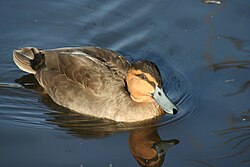 Philippine duck (Anas luzonica)
 -
 Mallard (Anas platyrhynchos) (female)
 -
 Mallard (Anas platyrhynchos) with six ducklings
 -
 Knob-billed duck (Sarkidiornis melanotos): a misplaced dabbling duck?
.jpg)
_in_Hyderabad_W2_IMG_8867.jpg)

.jpg)


References
[edit]- ^ Terres, John K. & National Audubon Society (1991): The Audubon Society Encyclopedia of North American Birds. Reprint of 1980 edition. New York: Wings Books. ISBN 0-517-03288-0
- ^ a b c d e Johnson, Kevin P.; Sorenson, Michael D. (1999). "Phylogeny and biogeography of dabbling ducks (genus Anas): a comparison of molecular and morphological evidence" (PDF). Auk. 116 (3): 792–805. doi:10.2307/4089339. JSTOR 4089339.
- ^ a b Livezey, Bradley C. (1986). "A phylogenetic analysis of recent anseriform genera using morphological characters" (PDF). Auk. 103 (4): 737–754. doi:10.1093/auk/103.4.737.
- ^ Sraml, M.; Christidis, L.; Easteal, S.; Horn, P.; Collet, C. (1996). "Molecular Relationships Within Australasian Waterfowl (Anseriformes)". Australian Journal of Zoology. 44 (1): 47–58. doi:10.1071/ZO9960047.
- ^ Steadman, David William (1999). "The Prehistory of Vertebrates, Especially Birds, on Tinian, Aguiguan, and Rota, Northern Mariana Islands" (PDF). Micronesica. 31 (2): 319–345. Archived from the original (PDF) on 2004-07-05.
- ^ Burney, David A.; James, Helen F.; Burney, Lida Pigott; Olson, Storrs L.; Kikuchi, William; Wagner, Warren L.; Burney, Mara; McCloskey, Deirdre; Kikuchi, Delores; Grady, Frederick V.; Gage, Reginald II; Nishek, Robert (2001). "Fossil Evidence for a Diverse Biota from Kauaʻi and Its TransformationSince Human Arrival". Ecological Monographs. 71 (4): 615–641. doi:10.2307/3100038. hdl:10088/109. JSTOR 3100038.
| Authority control databases: National |
|---|

Anatinae
View on GrokipediaTaxonomy and Systematics
Etymology and Definition
Anatinae is a subfamily within the family Anatidae, comprising the true ducks and related groups, including dabbling ducks (tribe Anatini), diving ducks like pochards (Aythyini), sea ducks (Mergini, including mergansers), perching ducks (Cairini), shelducks and sheldgeese (Tadornini), steamer ducks (Tachyerini), the torrent duck (Merganettini), and stiff-tailed ducks (Oxyurini).[5] These ducks are adapted to a variety of aquatic environments, with feeding habits ranging from surface dabbling to deep diving. The name Anatinae originates from the Latin word anas, meaning "duck," combined with the taxonomic suffix "-inae," which denotes a subfamily rank in biological nomenclature.[6] This etymological root reflects the group's central position among duck-like birds, with Anas serving as the type genus for many species within the subfamily.[7] Anatinae encompasses approximately 110 species across 30 genera, consisting of freshwater, marine, and coastal ducks that exhibit a cosmopolitan distribution.[5] The subfamily was first formally described by Nicholas Aylward Vigors in 1825.[8] Key revisions to its taxonomy occurred in the 20th century, notably through the comprehensive classification of the Anatidae by Jean Delacour and Ernst Mayr in 1945, which emphasized morphological and behavioral traits, and subsequent phylogenetic analyses by Bradley C. Livezey in the 1980s and 1990s that refined genus-level relationships using comparative morphology.[9][10]Classification and Phylogeny
The subfamily Anatinae is placed within the family Anatidae of the order Anseriformes, encompassing true ducks and related clades across 8 tribes. Molecular phylogenies indicate that Anatinae forms a monophyletic group sister to the subfamilies Anserinae (geese and swans) and Dendrocygninae (whistling ducks) within Anatidae, with internal diversification into tribes such as Tadornini (shelducks), Cairini (perching ducks, e.g., Cairina like the Muscovy duck), Anatini (dabbling ducks), Aythyini (pochards), Mergini (sea ducks and mergansers), and others. This placement is supported by analyses of mitochondrial genes like cytochrome b and ND2, as well as multi-locus nuclear data, which resolve Anatinae as distinct but closely allied to other waterfowl lineages.[3][11] Phylogenetic reconstructions reveal a core structure within Anatinae, with basal clades comprising perching and shelduck-like forms (e.g., Cairina and Tadorna in Cairini and Tadornini), followed by branching into dabbling ducks (Anatini, including mallard-like Anas species and teals), diving ducks (Aythyini), sea ducks (Mergini), and stiff-tailed ducks (Oxyurini). Key studies using concatenated mitochondrial and nuclear sequences confirm the monophyly of Anatinae and highlight its internal diversification, with Anas forming a large polytomy resolved through multi-locus approaches into subgroups like pintails, wigeons, and teals. Comprehensive avian phylogenies further corroborate this topology, estimating divergence times and supporting Anatinae's position as a derived clade within waterfowl evolution.[3][11] The evolutionary origins of Anatinae trace back to the Miocene epoch, approximately 20–10 million years ago, emerging from early anseriform ancestors amid expanding wetland habitats in Eurasia and North America that facilitated adaptive radiation into diverse foraging niches. Fossil evidence, such as the early Miocene Anas blanchardi from France, documents primitive Anatinae forms with dabbling adaptations, while diversification accelerated in the late Miocene linked to climatic shifts promoting paludal environments. Total evidence analyses, integrating morphological and molecular data, date the crown Anatidae to around 19 million years ago in the Early Miocene, with Anatinae's radiation following shortly thereafter.[12][13] Taxonomic challenges in Anatinae arise primarily from extensive hybridization, particularly within the Anas complex, where gene flow blurs species boundaries and complicates delimitation—e.g., between mallards (A. platyrhynchos) and congeners like the Mexican duck (A. diazi). Recent genetic studies post-2010 have addressed this through multi-locus phylogenies, leading to taxonomic revisions such as the elevation of the Baikal teal (Sibirionetta formosa, formerly in Anas) to its own genus based on deep mitochondrial divergences from other teals. These findings underscore hybridization's role in Anatinae evolution while refining phylogenetic frameworks via genomic data.[14][15]Physical Characteristics
Morphology and Anatomy
Anatinae, the subfamily of true ducks, exhibit a body size range typically spanning 25-85 cm in length and 150-5000 g in weight, encompassing species from small ones like the cotton pygmy goose to larger ones such as the Falkland steamer duck and Muscovy duck.[16][17] Sexual dimorphism is common, with males often larger than females in body mass and size, though the degree varies by species such as the mallard where males average 1.2-1.5 kg compared to females at 0.9-1.1 kg.[16] Key anatomical features of Anatinae support their aquatic lifestyles, including broad wings adapted for flight, with variations in aspect ratio for different foraging strategies—rapid takeoffs in dabbling species and sustained flight in migratory sea ducks.[16] Their bills are typically broad and flattened, often with lamellate structures for straining food in dabbling species, while diving and sea ducks exhibit adaptations like serrated edges in mergansers for catching fish or robust forms in steamer ducks for crushing shellfish.[17][16] Webbed feet, with fully webbed anterior toes and a small elevated hallux, are positioned centrally on the body to facilitate waddling on land and paddling in water, with stronger lobed toes in some diving species for propulsion underwater.[16] Skeletally, they possess a keeled sternum that anchors powerful flight muscles, along with robust coracoids and humeri that enhance wing stability during foraging flights.[18] Specialized adaptations include spatulate bills in species like the northern shoveler, which broaden at the tip to strain small prey from water more effectively.[16] In males, the speculum—a patch on the secondary wing feathers—displays iridescent coloration produced by structural nanostructures rather than pigments, creating interference patterns visible during nuptial displays.[19] Variations occur among Anatinae genera, particularly in perching ducks such as the wood duck, which have shorter legs and stronger claws on their feet compared to ground-nesting species, aiding in tree-nesting and perching; diving ducks like pochards have more compact bodies for underwater foraging.[20]Plumage Variation
In the subfamily Anatinae, sexual dimorphism in plumage is prevalent, with males typically displaying ornate, brightly colored breeding plumages adapted for mate attraction and display, while females exhibit cryptic, mottled brown patterns that provide camouflage in wetland environments. This dimorphism is most pronounced in genera such as Anas, where males acquire vivid alternate plumages in autumn, featuring iridescent elements like the metallic green head of the mallard (Anas platyrhynchos), produced through structural coloration via multilayer photonic nanostructures in the feather barbules combined with melanin granules for contrast.[21][22] Following breeding, males undergo a prebasic molt into an "eclipse" plumage, characterized by dull brown tones resembling those of females, which enhances concealment during the vulnerable flightless period.[22] Plumage variation across genera reflects adaptations to specific ecological niches, particularly for camouflage and species recognition. In the genus Anas, both females and eclipse males often show mottled, heterogeneous patterns of buff, brown, and black feathers that disrupt outlines against marshy or vegetated backgrounds, facilitating stationary crypsis in foraging habitats.[23] A key identifying feature in many Anatinae species is the speculum, a vivid iridescent patch on the secondary wing feathers, typically blue-green due to thin-film interference in the feather structure, which serves as a visual cue for conspecific identification during flight.[22] Exceptions to strong dimorphism occur in monomorphic genera like Amazonetta, where both sexes of the Brazilian teal (Amazonetta brasiliensis) share a similar grayish-brown body plumage with greenish-blue wing specula, differing primarily in bill coloration rather than feather patterns.[24] Molting patterns in Anatinae are synchronized with seasonal cycles, featuring an annual definitive prebasic molt that includes a simultaneous replacement of all primary flight feathers, rendering adults flightless for approximately 3-4 weeks post-breeding to minimize predation risk while concealed in dense cover.[25] This catastrophic wing molt typically occurs in late summer for males and earlier for females, coinciding with the eclipse phase to align plumage with non-breeding needs. In contrast, ducklings hatch with a dense layer of natal down feathers—fine, unbranched structures lacking vanes—that trap air for superior thermal insulation, essential for thermoregulation in aquatic environments before the first prejuvenal molt transitions them to contour feathers.[26]Distribution and Habitat
Global Distribution
The subfamily Anatinae has a near-cosmopolitan distribution across all continents except Antarctica, with notable absence from extreme desert environments due to their dependence on aquatic habitats.[5] This widespread range reflects their adaptability to temperate, subtropical, and tropical zones, though diversity is unevenly distributed globally. The highest species diversity occurs in the Holarctic realm, particularly in Eurasia and North America, where genera such as Anas (with approximately 31 species) support high diversity, driven by post-glacial expansions and ecological opportunities in wetland-rich landscapes.[27] In the Holarctic region, species like the mallard (Anas platyrhynchos) exemplify broad dominance, with native populations spanning Europe, Asia, and North America in temperate and subtropical wetlands.[28] Australasian endemics, such as the grey teal (Anas gracilis), are confined to open wetlands in Australia, New Zealand, Papua New Guinea, and nearby islands, highlighting regional isolation.[29] In the Neotropics, representatives like the ringed teal (Callonetta leucophrys) occupy south-central South American marshes and forests, contributing to localized diversity in the Southern Hemisphere.[30] Introduced populations have further expanded Anatinae ranges, notably the mallard in Australia and New Zealand, where it has established feral groups through human-mediated releases, often hybridizing with native species.[27] Vagrant occurrences, such as the Baikal teal (Sibirionetta formosa) in Europe, occasionally link distant populations, though these are rare and typically involve overshooting migrants from Asian breeding grounds.[31] Historically, Anatinae distributions were shaped by post-glacial colonization of northern hemispheres following the Pleistocene, with multiple independent radiations from southern or tropical origins into the Holarctic, as evidenced by phylogenetic patterns in genera like Anas.[27] Island endemics, such as the Hawaiian duck (Anas wyvilliana), illustrate vulnerability in isolated ranges, with populations restricted to Hawaiian wetlands and threatened by hybridization with introduced mallards, underscoring risks to biogeographic uniqueness.[32]Habitat Preferences
Species of the Anatinae subfamily primarily inhabit shallow freshwater wetlands, including marshes, rivers, ponds, and flooded grasslands, where water depths typically range from 6 to 18 inches to facilitate surface feeding and tipping behaviors in dabbling species (tribe Anatini).[33] However, habitat preferences vary across tribes: diving ducks (Aythyini) favor deeper lakes and ponds for submerging to feed, while sea ducks (Mergini) occupy coastal marine environments, bays, and estuaries.[34] Perching ducks (Cairini) often use wooded riparian zones.[35] Within these habitats, Anatinae utilize specific microhabitats for various activities; for instance, nesting often occurs in dense emergent vegetation such as cattails or bulrushes along wetland edges, while some species like the wood duck (Aix sponsa) select tree cavities in riparian zones for cavity nesting.[36] Foraging microhabitats include flooded grasslands and moist-soil areas, where ducks exploit seasonal inundations for seeds and insects. Certain species exhibit tolerance for brackish coastal marshes, as seen in the mottled duck (Anas fulvigula), which thrives in intermediate salinity wetlands along the Gulf Coast.[37] Anatinae demonstrate adaptations to fluctuating environments, such as nomadic movements in response to seasonal wetland drying in arid regions, allowing species like the Pacific black duck (Anas superciliosa) to relocate to persistent water sources.[38] Urban adaptation is evident in widespread species like the mallard (Anas platyrhynchos), which readily occupies city parks, stormwater ponds, and manicured lakes, leveraging human-modified landscapes for year-round residency.[39] Habitat threats to Anatinae include extensive wetland drainage for agriculture and development, which has reduced available shallow marshes across North America and Europe, directly impacting breeding and foraging success.[40]Behavior and Ecology
Foraging and Diet
Members of the Anatinae subfamily exhibit diverse foraging strategies adapted to their respective tribes. Dabbling ducks in the tribe Anatini primarily employ surface feeding in shallow waters, including dabbling at the water's surface and upending to reach submerged resources up to about 30 cm deep. These birds use their specialized bills equipped with comb-like lamellae—transverse ridges along the inner edges—to filter and strain food particles from water or mud, effectively separating small items like seeds and invertebrates while expelling sediment. This tactile foraging method allows efficient capture of prey without full submersion. In contrast, diving ducks of the tribe Aythyini (e.g., pochards) submerge to forage on benthic resources in deeper waters, while sea ducks in the tribe Mergini (e.g., mergansers) dive to pursue fish and invertebrates. Perching ducks (Cairini) often forage in trees or on land, and stiff-tailed ducks (Oxyurini) use underwater pursuits for aquatic prey.[5][41] The diet of Anatinae is generally omnivorous but varies by tribe, with many species consuming a mix of plant and animal matter. For example, dabbling ducks (Anatini) typically comprise 50-80% plant matter such as seeds, aquatic vegetation (e.g., Potamogeton species), and grasses, with the remaining 20-50% consisting of animal foods including insects, mollusks, and crustaceans. Seasonal variations occur in these species, with higher proportions of invertebrates (up to 70-90% in some like mallards and pintails during breeding) providing essential protein for reproduction, shifting to predominantly plant-based in winter (e.g., over 80% seeds in mallards and teal). Sea ducks (Mergini), however, are often more piscivorous, focusing on small fish alongside invertebrates.[5][42] Foraging behaviors include the characteristic tail-up posture during upending in Anatini, which makes the rear end visible above water, as well as terrestrial grazing in species like shelducks (Tadorna spp.), which feed on grassland invertebrates and plants away from water. In urban environments, many Anatinae exhibit nocturnal foraging to avoid human disturbance, often feeding on supplemented foods or natural resources in city ponds and parks.[43] Ecologically, members of Anatinae play key roles in wetlands, including seed dispersal for wetland and terrestrial plants through endozoochory, particularly by dabbling ducks (Anatini), transporting viable diaspores across broad landscapes, including species not previously recognized as animal-dispersed. Their consumption of aquatic invertebrates contributes to natural pest control by reducing populations of insects and mollusks in wetlands. However, high densities in agricultural areas can lead to overgrazing of forage crops and damage to fields, resulting in economic losses for farmers.[4][42][44]Reproduction and Social Behavior
Members of the Anatinae subfamily typically exhibit seasonal monogamy, forming pair bonds during the non-breeding period that last through the breeding season, with females selecting mates based on elaborate displays and plumage characteristics.[45] This mating system involves minimal paternal investment beyond mate guarding prior to incubation, allowing males to pursue additional reproductive opportunities.[45] However, promiscuity occurs in many species, particularly through forced extra-pair copulations (FEPCs), which constitute up to 40% of observed copulations in some populations and serve as a secondary male reproductive tactic.[45] In mallards (Anas platyrhynchos), for example, FEPCs involve aggressive pursuit and overpowering of females, resulting in fertilization rates of 6-11% of eggs in successive clutches, as demonstrated in captive studies where 8% of progeny were sired by non-pair males.[46] Male courtship displays often include head-pumping, a rhythmic bobbing of the head performed by both sexes as a precopulatory signal, frequently preceding successful pair copulations in species like mallards and other dabbling ducks.[47] Nesting habits vary across Anatinae, with most dabbling ducks in the genus Anas constructing ground nests as shallow scrapes lined with vegetation and down feathers, concealed in dense cover near water.[5] Perching ducks, such as wood ducks (Aix sponsa), prefer cavity nests in trees or artificial boxes, providing protection from ground predators.[48] Clutch sizes typically range from 8 to 12 eggs, laid at intervals of about 24 hours, though this can vary with female age and environmental conditions.[5] Incubation, performed solely by the female, lasts 23 to 28 days in most species, beginning after the final egg is laid to ensure synchronous hatching.[5] Ducklings in Anatinae are precocial, hatching with downy plumage, open eyes, and the ability to forage independently shortly after emerging from the nest.[5] Females provide brooding and protection, leading broods to water and alerting them to threats, while males often desert the family unit shortly after hatching or even before incubation concludes, shifting investment toward remating or molt.[45] This maternal care is crucial during the initial 4 weeks, when duckling survival rates are highest under female supervision, dropping by up to 23% in cases of premature abandonment due to increased predation risk.[49] In some species, such as canvasbacks (Aythya valisineria) and wood ducks, brood amalgamation or creching occurs post-hatching, where multiple broods merge into larger groups tended by one or more females, enhancing survival through diluted predation risk and improved foraging efficiency.[50] Outside the breeding season, Anatinae ducks form large flocks numbering in the thousands to hundreds of thousands, facilitating resource location and predator vigilance through collective behavior.[51] During breeding, males display aggression to defend territories and mates, employing displays like threatening postures and chases to deter rivals.[51] Many species migrate in family groups led by the female, with broods joining larger flocks en route to wintering grounds, maintaining social cohesion through vocalizations and formations.[51]Genera and Species Diversity
List of Genera
The subfamily Anatinae comprises approximately 112 species distributed across 31 genera in 8 tribes, as recognized in recent taxonomic assessments.[5] This diversity reflects adaptations ranging from surface-feeding dabbling ducks (tribe Anatini) to deep-diving sea ducks (tribe Mergini) and specialized forms like stiff-tailed ducks (tribe Oxyurini). Detailed phylogeny and genus boundaries continue to be refined through molecular studies, with splits in genera like Anas into Spatula, Mareca, and Sibirionetta based on genetic evidence.[3] The International Ornithological Congress (IOC) World Bird List (version 14.2, 2025) provides the current standard classification for these taxa. The following table summarizes the 8 tribes, their genera counts, approximate species numbers, and key characteristics:| Tribe | Genera Count | Approximate Species | Characterization |
|---|---|---|---|
| Tadornini (shelducks and sheldgeese) | 5 | 14 | Large, often colorful ducks with goose-like traits; inhabit coastal and freshwater areas, feeding on aquatic plants and invertebrates. |
| Tachyerini (steamer ducks) | 1 | 4 | Aggressive, flightless or poorly flying ducks from South America; powerful swimmers that "steam" across water while feeding on marine prey. |
| Cairini (perching ducks) | 9 | 13 | Arboreal-nesting species with strong feet for perching; found in woodlands and wetlands, with diets including fruits, seeds, and insects. Examples: Cairina (Muscovy duck), Sarkidiornis (comb duck). |
| Merganettini (torrent duck) | 1 | 1 | Torrent duck (Merganetta); specialized for fast-flowing rivers in the Andes, with hooked bill for catching aquatic insects. |
| Anatini (dabbling ducks) | 4 | 40 | Surface-feeders like mallards (Anas), wigeons (Mareca), shovelers (Spatula); broad bills for filtering from water surface, highly migratory. |
| Aythyini (diving ducks, pochards) | 2 | 15 | Diving species like redheads (Aythya); feed on submerged plants and invertebrates in deeper waters. |
| Mergini (sea ducks) | 7 | 18 | Marine and freshwater divers including eiders (Somateria), scoters (Melanitta), mergansers (Mergus); serrated bills for fish and mollusks. |
| Oxyurini (stiff-tailed ducks) | 3 | 8 | Small diving ducks with stiff tail feathers for underwater propulsion; inhabit freshwater, feeding on aquatic vegetation and insects. Examples: Oxyura (stifftails). |
Conservation Status
The majority of species within the Anatinae subfamily are classified as Least Concern by the International Union for Conservation of Nature (IUCN), reflecting stable or abundant populations for common taxa like the mallard (Anas platyrhynchos) and northern pintail (Anas acuta). However, a significant minority face elevated risks, with approximately 25% of Anatidae species (encompassing Anatinae) categorized as Vulnerable, Endangered, or Critically Endangered, including notable examples such as the Hawaiian duck (Anas wyvilliana), listed as Endangered by the U.S. Fish and Wildlife Service due to its small population of fewer than 2,200 individuals confined to reduced habitats in Hawaii.[52] Similarly, the Laysan duck (Anas laysanensis) is Critically Endangered, with 500–680 mature individuals restricted to a 2 km² area on Laysan Island, making it highly susceptible to stochastic events.[53] The Madagascar pochard (Aythya innotata) exemplifies extreme peril, classified as Critically Endangered after being presumed extinct in the wild for nearly two decades until its rediscovery in 2006; captive breeding and reintroduction efforts have increased the total population (wild and captive) to around 180 individuals as of 2025, though the wild population remains at high extinction risk with only 33–47 mature individuals.[54] Primary threats to Anatinae species include widespread habitat loss from wetland drainage and conversion for agriculture and urbanization, with global wetland area declining by 64% since 1900, severely impacting breeding and foraging sites.[55] Hunting exerts substantial pressure, particularly in North America, where regulated harvests exceed 10 million ducks annually across the U.S. and Canada, potentially affecting migratory populations if not managed sustainably.[56] Hybridization with invasive species, such as feral mallards, poses a genetic threat to endemic taxa; for instance, it endangers the Hawaiian duck by diluting its distinct lineage through introgression on islands like Oʻahu. Conservation measures focus on habitat protection and species recovery, with over 2,400 Ramsar-designated wetlands worldwide safeguarding key Anatinae sites and supporting migratory flyways through international agreements like the East Asian-Australasian Flyway Partnership. Captive breeding and translocation programs have been pivotal, as seen in the successful relocation of 28 Laysan ducks from Midway Atoll to Kure Atoll in 2025 to bolster population resilience,[57] and ongoing efforts for the Madagascar pochard involving habitat restoration at Lake Sofia. Flyway initiatives, coordinated by organizations such as Ducks Unlimited and the U.S. Fish and Wildlife Service, enable continent-scale monitoring and adaptive management to track population dynamics and mitigate threats across breeding, migration, and wintering grounds. Population trends vary regionally: temperate-zone species like those in North America exhibit relative stability, with total breeding duck estimates holding at around 34 million in 2025, comparable to long-term averages despite fluctuations.[58] In contrast, tropical and subtropical populations are declining, with Anatinae taxa in regions like the East Asian Flyway showing steady decreases since the 1950s due to intensified habitat pressures. Climate change exacerbates these trends by altering breeding grounds through warmer temperatures and shifting migration patterns, prompting northward range expansions in some North American species over the past 60 years.References
- https://en.wiktionary.org/wiki/Anatinae