


Community hub
0 subscribers8 pages, 0 posts
Recent from talks
All channels
Be the first to start a discussion here.
Be the first to start a discussion here.
Be the first to start a discussion here.
Be the first to start a discussion here.
Contribute something
Welcome to the community hub built to collect knowledge and have discussions related to Anthemideae.
Nothing was collected or created yet.
Anthemideae
View on Wikipediafrom Wikipedia
| Anthemideae | |
|---|---|

| |
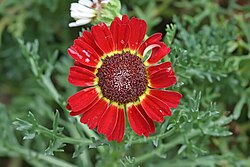
| Ismelia carinata | |
Scientific classification 
| |
| Kingdom: | Plantae |
| Clade: | Tracheophytes |
| Clade: | Angiosperms |
| Clade: | Eudicots |
| Clade: | Asterids |
| Order: | Asterales |
| Family: | Asteraceae |
| Subfamily: | Asteroideae |
| Tribe: | Anthemideae Cass. |
| Type genus | |
| Anthemis L.
| |
| Genera[1] | |
|
About 111, see text | |
Anthemideae is a tribe of flowering plants in the subfamily Asteroideae, which is part of the family Asteraceae. They are distributed worldwide, with concentrations in central Asia, the Mediterranean Basin, and southern Africa.[2] Most species of plant known as chamomile belong to genera of this tribe.
As of 2006 there were about 1800 species classified in 111 genera.[2] In 2007 the tribe was divided into 14 subtribes,[2] including Glebionidinae, the source of hybrid garden marguerites.[3]
Genera
[edit]
.jpg)
Anthemideae genera recognized by the Global Compositae Database as March 2022:[4]
- × Anthematricaria
- × Anthemimatricaria
- Achillea L. (synonym Leucocyclus Boiss.)
- Adenanthellum B.Nord.
- Adenoglossa B.Nord.
- Ajania Poljakov (synonym Phaeostigma Muldashev)
- Ajaniopsis C.Shih
- Allardia Decne.
- Anacyclus L.
- Anthemis Mich. ex L.
- Arctanthemum (Tzvelev) Tzvelev
- Argyranthemum Webb
- Artemisia L. (synonym Artemisiella Ghafoor)
- Athanasia L.
- Brachanthemum DC.
- Brocchia Vis.
- Cancrinia Kar. & Kir.
- Cancriniella Tzvelev
- Castrilanthemum Vogt & Oberpr.
- Chamaemelum Mill.
- Chamomilla (Hall) Gray
- Chlamydophora Ehrenb. ex Less.
- Chrysanthemum L.
- Chrysanthoglossum B.H.Wilcox, K.Bremer & Humphries
- Cladanthus Cass.
- Coleostephus Cass.
- Cota J.Gay ex Guss.
- Cotula Tourn. ex L.
- Crossostephium Less.
- Cymbopappus B.Nord.
- Daveaua Willk. ex Mariz
- Elachanthemum Y.Ling & Y.R.Ling
- Endopappus Sch.Bip.
- Eriocephalus L.
- Eumorphia DC.
- Filifolium Kitam.
- Foveolina Källersjö
- Glebionis Cass.
- Glossopappus Kunze
- Gonospermum Less.
- Gymnopentzia Benth.
- Handelia Heimerl
- Heliocauta Humphries
- Heteranthemis Schott
- Heteromera Pomel
- Hilliardia B.Nord.
- Hippia L.
- Hippolytia Poljakov
- Hulteniella Tzvelev
- Hymenolepis Cass.
- Hymenostemma (Kunze) Kunze ex Willk.
- Inezia E.Phillips
- Inulanthera Källersjö
- Ismelia Cass.
- Kaschgaria Poljakov
- Lasiospermum Lag. (synonym Mataxa Spreng.)
- Lepidolopha C.Winkl.
- Lepidolopsis Poljakov
- Lepidophorum Neck. ex Cass.
- Leptinella Cass.
- Leucanthemella Tzvelev
- Leucanthemopsis (Giroux) Heywood
- Leucanthemum Mill.
- Leucoptera B.Nord.
- Lidbeckia P.J.Bergius
- Lonas Adans.
- Marasmodes DC.
- Matricaria L.
- Mauranthemum Vogt & Oberpr.
- Mausolea Bunge ex Poljakov
- Mecomischus Coss. & Durieu ex Benth. & Hook.f.
- Microcephala Pobed.
- Myxopappus Källersjö
- Nananthea DC.
- Neopallasia Poljakov
- Nipponanthemum (Kitam.) Kitam.
- Nivellea B.H.Wilcox, K.Bremer & Humphries
- Oncosiphon Källersjö
- Opisthopappus C.Shih
- Osmitopsis Cass. (synonym Bellidiastrum Less.)
- Otanthus Hoffmanns. & Link
- Otoglyphis Pomel (synonym Aaronsohnia Warb. & Eig)
- Otospermum Willk.
- Pentzia Thunb.
- Phalacrocarpum (DC.) Willk.
- Phymaspermum Less.
- Picrothamnus Nutt.
- Plagius L'Hér. ex DC.
- Polychrysum (Tzvelev) Kovalevsk.
- Prolongoa Boiss.
- Pseudoglossanthis Poljakov
- Pseudohandelia Tzvelev
- Rennera Merxm.
- Rhetinolepis Coss.
- Rhodanthemum B.H.Wilcox, K.Bremer & Humphries
- Richteria Kar. & Kir.
- Santolina L.
- Schistostephium Less.
- Sclerorhachis (Rech.f.) Rech.f.
- Soliva Ruiz & Pav.
- Sphaeromeria Nutt.
- Stilpnolepis Krasch.
- Tanacetopsis (Tzvelev) Kovalevsk.
- Tanacetum L.
- Thaminophyllum Harv.
- Trichanthemis Regel & Schmalh.
- Tridactylina (DC.) Sch.Bip.
- Tripleurospermum Sch.Bip.
- Turaniphytum Poljakov
- Tzvelevopyrethrum Kamelin
- Ugamia Pavlov
- Ursinia Gaertn.
- Vogtia Oberpr. & Sonboli
- Xylanthemum Tzvelev
References
[edit]- ^ UniProt. "Anthemideae". Retrieved 2008-06-13.
- ^ a b c Oberprieler, C., et al. (2007) A new subtribal classification of the tribe Anthemideae (Compositae). doi:10.3372/wi.37.37104 Willdenowia 37(1): 89–114.
- ^ Flores, Anita; Shaw, Julian & Watson, John (2018). "Unpicking a daisy chain". The Plantsman. New Series. 17 (4): 238–243.
- ^ "Anthemideae Cass". Global Compositae Database. Compositae Working Group (CWG). 2022. Retrieved 2022-03-31.
Further reading
[edit] Media related to Anthemideae at Wikimedia Commons
 Data related to Anthemideae at Wikispecies
- de Cassini, A. (1818). Cassini on Compositae III. Journal de Physique, de Chimie et d'Histoire Naturelle 88 196.


.jpg) | This Anthemideae article is a stub. You can help Wikipedia by adding missing information. |
Anthemideae
View on Grokipediafrom Grokipedia
Taxonomy
Etymology and History
The tribe Anthemideae derives its name from the genus Anthemis L., the type genus, which originates from the Ancient Greek ánthemon, a diminutive form of ánthos meaning "flower." This etymology reflects the small, flower-like florets typical of species in Anthemis and many other genera within the tribe.[5][6] Anthemideae was first formally described as a distinct tribe by the French botanist Henri Cassini in 1819, designated as the eleventh tribe within the family Asteraceae (then known as Compositae) in his seminal work on the family's classification. Cassini based this recognition on key morphological features such as the pappus structure and inflorescence characteristics that distinguished it from other groups. In subsequent publications, including his 1823 revision, Cassini further refined the tribal boundaries, emphasizing the tribe's coherence amid the family's overall diversity.[7][8] The taxonomic framework for Anthemideae was significantly advanced in the late 19th century through revisions by George Bentham in 1873, who integrated it into his comprehensive classification of Compositae in Genera Plantarum, treating it as one of 13 major tribes based on detailed comparative morphology of florets, achenes, and receptacles. Bentham's system highlighted the tribe's distinctiveness while noting overlaps in vegetative and fruit characters with neighboring tribes. This classification was largely upheld and expanded by Otto Hoffmann in his 1890–1894 treatment in Die natürlichen Pflanzenfamilien, where Anthemideae was affirmed as a core tribe with about 100 genera, though Hoffmann adjusted some generic placements to resolve inconsistencies in pappus and anther morphology. Early taxonomists, including Bentham and Hoffmann, grappled with confusions arising from similar achene structures—such as ribbed or papillose surfaces—shared with tribes like Gnaphalieae, occasionally leading to temporary reassignments of genera between these groups.[7][9]Phylogenetic Position
The tribe Anthemideae is placed within the subfamily Asteroideae, the largest and most diverse subfamily of Asteraceae, which constitutes the core clade of the family.[7] Within Asteroideae, Anthemideae belongs to a major clade that also includes Astereae, Calenduleae, Gnaphalieae, and Senecioneae, collectively forming one of two primary lineages in the subfamily; this clade is sister to another encompassing tribes such as Heliantheae and Eupatorieae, as resolved by analyses of nrITS sequences and plastid DNA markers like ndhF and trnL-trnF.[10] Some studies further suggest a closer sister relationship between Anthemideae and Senecioneae within this grouping, supported by nuclear and plastid phylogenomic data.[11] Molecular evidence has firmly established the monophyly of Anthemideae. A seminal study by Oberprieler and colleagues in 2007 utilized nrDNA ITS sequences from representatives across the tribe to confirm its monophyletic status and provide an initial framework for internal relationships. More recent work by Oberprieler et al. in 2022 expanded this using a combination of nuclear markers, including nrDNA ITS and ETS as well as low-copy nDNA loci (DSP, VIP5, NPF3.1), alongside plastid data, to reconstruct gene and species trees for 113 genera; this analysis resolved key internal grades, such as the Eurasian lineage (e.g., encompassing Artemisiinae) and the African lineage (e.g., related to Ursiniinae), highlighting polyphyletic patterns in some traditional subtribes.[1] The evolutionary history of Anthemideae features rapid diversification during the Miocene, coinciding with global aridification events that promoted adaptations in the Old World, particularly in Eurasian and African regions.[12] Phylogenomic estimates place the divergence of Anthemideae from other Asteroideae lineages around 40-50 million years ago in the Eocene, with the tribe's crown radiation accelerating in the mid-Miocene approximately 14 million years ago.[11][13]Subtribal Classification
The subtribal classification of Anthemideae has evolved through molecular phylogenetic studies, with a foundational framework established in 2007 comprising 14 subtribes: Achilleinae, Anthemidinae, Artemisiinae, Cotulinae, Glebionidinae, Gonosperminae, Leucantheminae, Leucanthemopsidinae, Matricariinae, Osmitopsidinae, Pentziinae, Phymasperminae, Santolininae, and Tanacetinae.[14] This classification incorporated four newly described subtribes (Osmitopsidinae, Phymasperminae, Pentziinae, and Leucanthemopsidinae) and validated Glebionidinae to replace the illegitimate Chrysantheminae, drawing on analyses of nuclear and plastid DNA sequences to resolve longstanding taxonomic uncertainties.[14] Subtribes are primarily distinguished by morphological diagnostic features, such as receptacle structure, anther appendages, and cypsela traits. For instance, Anthemidinae is characterized by epaleate receptacles and coroniform anther appendages, while other subtribes exhibit variations like paleate receptacles in Achilleinae or disciform capitula in Inulantherinae (added in later updates).[14] These features, combined with molecular data, facilitated reassignments, including the transfer of genera such as Hulteniella, Lepidolopha, Opisthopappus, and Tridactylina into Artemisiinae.[15] A 2022 update refined this system based on expanded gene-tree and species-tree reconstructions from nuclear ribosomal and low-copy nuclear markers, recognizing 19 subtribes arranged in three main evolutionary grades: the Eurasian grade (encompassing Anthemidinae and Artemisiinae), the Asian-Southern African grade (including Glebionidinae and Handeliinae), and the American grade (featuring Leucantheminae and Leucanthemopsidinae).[15] This revision incorporated additional generic transfers, such as prioritizing Otoglyphis over Aaronsohnia and reassigning Tanacetum paleaceum to Xylanthemum, to better reflect phylogenetic relationships.[15] Ongoing debates persist regarding the monophyly of certain subtribes, particularly Artemisiinae, which requires revision due to incongruent phylogenetic signals from nuclear and plastid data, compounded by evidence of hybridization and polyploidy in groups like Chrysanthemum. Recent phylogenomic analyses continue to test subtribal boundaries, highlighting the need for integrated morphological and genomic approaches to resolve these issues.Description
Morphological Characteristics
Members of the Anthemideae tribe are predominantly herbaceous, encompassing annuals, biennials, and perennials, though subshrubs and shrubs also occur._from%20Compositae_5.pdf) These plants are characteristically aromatic, owing to the presence of essential oils stored in glandular trichomes, which are typically short and biseriate._from%20Compositae_5.pdf) The leaves are generally alternate, occasionally opposite, and range from entire to deeply 3–4-pinnatisect or dissected, often appearing dentate or ericoid in certain genera._from%20Compositae_5.pdf) Stipules are reduced or absent.[16] Stems in Anthemideae exhibit variability, being erect, prostrate, or rhizomatous, and may be thick and basally villous in some subtribes such as Handeliinae._from%20Compositae_5.pdf) Root systems commonly consist of taproots, particularly in species adapted to arid environments, supporting their survival in dry habitats._from%20Compositae_5.pdf) Notable variations include a woody habit in several southern African genera, such as Athanasia, Osmitopsis, Pentzia, Eumorphia, Gymnopentzia, and Phymaspermum, which form shrubs or subshrubs.[16] Unlike many other Asteraceae tribes that feature well-developed capillary pappi for wind dispersal, Anthemideae display a tendency toward pappus reduction or absence, with forms ranging from ecornate to scaled or coronate structures.[16]Inflorescence and Flowers
The inflorescences of Anthemideae consist of capitula that are either solitary or arranged in lax to dense corymbiform, paniculiform, racemiform, or spiciform arrays, sometimes in subcapitate clusters.[3][17] Capitula are typically heterogamous and radiate or disciform, though homogamous and discoid forms occur, with diameters ranging from 1.5 to over 25 mm.[3] The involucre comprises 1–5 (or more) series of phyllaries that are persistent or deciduous, unequal, and often scarious-margined, numbering 5–60 or more per head.[3] The receptacle is flat to conic or columnar, epaleate (lacking paleae) in many subtribes or paleate with oblong to filiform, often deciduous paleae.[3][17] Florets within the capitula include 0 or 1–2 series of outer ray florets, which are pistillate and usually fertile (rarely neuter or sterile), and inner disc florets that are typically bisexual and fertile (occasionally functionally staminate).[3] Ray florets, when present, have female corollas that are ligulate with 3–5 apical teeth and colored yellow, white, or reddish to cyanic.[3] Disc florets possess bisexual corollas that are tubular and 4–5-lobed, similarly colored, though peripheral florets may lack corollas in some cases.[3] Anthers are syngenesious with obtuse to sagittate bases (ecaudate or weakly tailed in some subtribes) and apical appendages that are ovate to coroniform.[3][18] Styles feature abaxial glabrous or papillate surfaces, linear branches that are truncate to penicillate apically, and sweeping hairs that are obtuse, aiding in pollen collection and presentation.[3][7] Cypselae (fruits) are heteromorphic or monomorphic, often obovoid to prismatic, ribbed (with 2–10 ribs), papillose, or winged (1–3 wings), and terete to compressed, with pericarp thickness varying by subtribe.[19][17] The pappus is usually absent but present as scales, setae, a corona, or bristles in certain subtribes.[17][3]Distribution and Ecology
Geographic Distribution
The tribe Anthemideae, comprising approximately 115 genera and around 1,800 species, exhibits a primarily Old World distribution, with the vast majority of its diversity concentrated in Eurasia. This near-cosmopolitan tribe shows a strong extratropical bias, extending from temperate to subtropical regions but with limited presence in tropical zones. While some species have been introduced to the New World, native occurrences there are secondary and often disjunct, such as certain Artemisia taxa in western North America.[3] Primary hotspots of diversity lie in the Mediterranean Basin, Central Asia, and southern Africa, reflecting biogeographic patterns tied to arid and semi-arid environments. The Mediterranean Basin hosts a significant portion of genera, including many in the Eurasian-Mediterranean clade such as those in subtribes Anthemidinae and Leucantheminae. Central Asia serves as a key center, particularly for the genus Artemisia (with over 500 species), aligning with the Irano-Turanian floristic region. Southern Africa, especially the Cape Floristic Region, represents another major concentration, with basal subtribes like Cotulinae and Ursiniinae contributing substantial endemic genera such as Ursinia (39 species).[3][20][2] Biogeographic patterns reveal a southern hemisphere grade at the base of the phylogeny, linking southern Africa with disjunct distributions in Australia, New Zealand, and oceanic islands via genera like Cotula. Northern expansions connect Asian-South African elements to Eurasian lineages, with some southward extensions into the Americas. Endemism is notably high in the Cape Floristic Region, where multiple genera are restricted, and in the Irano-Turanian region, underscoring these areas as evolutionary cradles for the tribe.[20][21]Habitats and Adaptations
Members of the Anthemideae tribe predominantly inhabit arid and semi-arid steppes across Central Asia, Mediterranean shrublands, and coastal dunes, with significant diversity also occurring in southern African ecosystems such as the Cape Floristic Region.[7] These environments are characterized by low precipitation, high temperatures, and nutrient-poor soils, allowing the tribe to exhibit wide environmental tolerance across the Old World.[13] Some species, particularly in the genus Achillea, extend into wetter niches like marshes and wet meadows, demonstrating the tribe's ecological versatility.[22] Adaptations to these challenging habitats include drought tolerance mechanisms such as deep root systems in genera like Artemisia, which enable access to subsurface water in dry soils, and small, resinous leaves that reduce transpiration and provide protection against desiccation.[23] Chemical defenses, primarily sesquiterpene lactones and other terpenoids, deter herbivores and pathogens, enhancing survival in resource-limited steppes and shrublands.[24] Pollination strategies vary, with many species relying on insect vectors in Mediterranean habitats, while wind pollination predominates in arid Central Asian lineages, reflecting responses to sparse pollinator availability.[25] In fire-prone southern African regions, certain genera exhibit resprouting abilities, facilitating post-fire recovery in shrublands. Contemporary threats to Anthemideae populations include habitat loss due to agricultural expansion in the Mediterranean Basin, where conversion to croplands and vineyards fragments shrubland ecosystems. In introduced ranges, such as North America, species like Achillea millefolium display invasive potential, outcompeting natives in disturbed grasslands and meadows.[26] Additionally, overgrazing and erosion in southern Africa exacerbate degradation for endemic genera like Marasmodes.[20]Diversity
Number of Genera and Species
The tribe Anthemideae encompasses approximately 111 genera and 1,800 species, as estimated in a comprehensive subtribal classification (Oberprieler et al., 2007). More recent phylogenetic analyses have refined this to 115 genera, with species numbers at approximately 1,800, incorporating discoveries and reclassifications particularly within hyper-diverse groups like Artemisia, which now includes over 500 species (Oberprieler et al., 2022; Hind et al., 2022; Plants of the World Online, 2024).[15][27] Diversity within Anthemideae is markedly uneven, featuring around 10 monotypic genera alongside a few exceptionally species-rich ones, such as Artemisia with more than 500 species; this disparity highlights the tribe's evolutionary hotspots in arid and Mediterranean regions (Oberprieler et al., 2007). Since 2010, molecular phylogenetic studies have prompted the recognition of additional genera through taxonomic splits, increasing the total genus count by 5–10 and underscoring ongoing refinements in classification (Oberprieler et al., 2022).[15]Notable Genera
The genus Artemisia is the largest within Anthemideae, encompassing over 500 species of aromatic woody herbs and shrubs primarily distributed across the temperate and subtropical regions of the Northern Hemisphere, with extensions into southern Africa and parts of South America.[28] These plants are characterized by their silvery-gray foliage, often covered in glandular trichomes that produce essential oils, and capitula typically featuring yellowish disk florets without ray florets in many species.[29] Anthemis, the type genus of the tribe, includes approximately 130 species of annual and perennial herbs centered in the Mediterranean region, extending to parts of Europe, Asia, and Africa.[30] Distinguishing features include daisy-like inflorescences with white or yellow ray florets surrounding central disk florets, and leaves that are often pinnatisect or bipinnatisect, contributing to its role as a model for studying tribal diversity.[31] Notable examples include A. nobilis, recognized for its compact habit and fragrant foliage. Achillea comprises more than 100 species of rhizomatous perennial herbs native to temperate zones of the Northern Hemisphere, particularly Europe and Asia.[32] These plants feature finely dissected leaves and flat-topped corymbs of small capitula with white to pink ray florets, adapting well to dry, open habitats. The genus Arctotheca consists of 6 species of prostrate perennial herbs endemic to southern Africa, including Mozambique and South Africa.[33] They are distinguished by their succulent leaves with toothed margins and solitary, radiate capitula borne on long peduncles, reflecting adaptations to coastal and sandy environments. Chrysanthemum includes over 30 species of perennial herbs mainly from Asia, with a center of diversity in China and extensions to Europe and North America.[34] Key traits encompass variable leaf shapes from entire to lobed and showy capitula with colorful ray florets, often in shades of yellow, pink, or white. The tribe's generic diversity also features monotypic genera such as Ismelia, which contains a single annual species (I. carinata) endemic to Morocco, characterized by its viscid stems and yellow-rayed capitula.[35] Recent taxonomic revisions have led to splits from Artemisia, recognizing segregate genera like Seriphidium and Ajania based on phylogenetic evidence, enhancing understanding of evolutionary radiations within the subtribe Artemisiinae.[36]Economic Importance
Medicinal and Culinary Uses
Plants in the Anthemideae tribe have been utilized for centuries in traditional medicine, particularly for their anti-inflammatory, antimicrobial, and antimalarial properties, with several species serving as sources of bioactive compounds like flavonoids and sesquiterpenes. Matricaria chamomilla, commonly known as chamomile, is widely employed in herbal teas for its anti-inflammatory effects, attributed to the flavonoid apigenin, which modulates inflammatory pathways and promotes relaxation.[37][38] Extracts from this species have demonstrated efficacy in reducing symptoms of generalized anxiety disorder in clinical trials, where oral administration led to significant decreases in anxiety scores over 8 weeks, with a response rate comparable to conventional treatments.[39][40] Chamomile's culinary application is prominent in infusions and beverages, where it aids digestion and provides mild sedative benefits without notable adverse effects in short-term use.[37] Artemisia annua stands out for its role in modern pharmacotherapy, yielding artemisinin, a sesquiterpene lactone that inhibits Plasmodium parasites responsible for malaria, a discovery recognized with the 2015 Nobel Prize in Physiology or Medicine awarded to Tu Youyou for extracting this compound from traditional Chinese herbal practices.[41] This antimalarial has drastically reduced global mortality rates from the disease, forming the basis of artemisinin-based combination therapies recommended by the World Health Organization.[42] Culinary uses of Artemisia species are limited due to bitterness, but some, like Artemisia dracunculus (tarragon), are incorporated as herbs for flavoring dishes, though primarily valued for potential digestive support rather than primary nutrition.[43] Achillea millefolium, or yarrow, has traditional applications in wound healing, where its astringent and hemostatic properties accelerate tissue repair and reduce bleeding, supported by in vitro studies showing enhanced antibacterial activity against skin pathogens.[44][45] Tanacetum species, such as Tanacetum parthenium (feverfew) and Tanacetum vulgare (tansy), are used as digestive aids to alleviate stomach aches, ulcers, and gastrointestinal discomfort, with extracts exhibiting anti-inflammatory effects on the digestive tract.[46][47] Essential oils from Santolina species demonstrate antimicrobial properties, inhibiting bacterial and fungal growth, which has led to their incorporation in traditional remedies for infections and as natural preservatives in culinary preparations.[48][49] Safety considerations are crucial, as excessive consumption of certain species can pose risks; for instance, Artemisia absinthium (wormwood) contains thujone, a neurotoxin that may cause convulsions, hallucinations, and renal issues with chronic high-dose intake, prompting regulatory limits in herbal products and absinthe.[50][51] Overall, while Anthemideae plants offer valuable therapeutic potential, clinical validation and dosage guidelines are essential to mitigate toxicity.[50]Ornamental and Other Uses
Species in the Anthemideae tribe, particularly those in the genus Chrysanthemum, are extensively cultivated as ornamental plants, serving as popular cut flowers and garden perennials worldwide. The global trade in chrysanthemums reached $837 million in 2023, supporting a significant portion of the broader cut flower industry valued at approximately $39 billion in 2024.[52][53] These plants are prized for their diverse flower forms, colors, and long vase life, making them staples in floral arrangements for events and holidays. Genera such as Anthemis and Achillea are favored in rock gardens and xeriscapes due to their exceptional drought tolerance and ability to thrive in well-drained, poor soils under full sun conditions.[54][55][56] In agricultural contexts, Anthemideae species contribute to forage and land management in arid environments. Artemisia tridentata, commonly known as big sagebrush, provides valuable winter forage for livestock, comprising up to 30% of cattle diets in sagebrush steppe regions of North America, which supports grazing management while enhancing habitat productivity.[57][58] Beyond ornamentals and agriculture, Anthemideae plants have diverse industrial and historical applications. Essential oils extracted from Achillea species, such as Achillea millefolium, are employed in natural perfumery as middle notes, imparting herbaceous, woody aromas that blend well with chamomile, lavender, and sage oils.[59][60] Historically, tribe members like chrysanthemums have been used for their insecticidal properties, with pyrethrin compounds from Chrysanthemum cinerariifolium serving as natural insecticides for centuries, while some species, including Matricaria and Tanacetum, provided yellow dyes for textiles.[61][62] However, certain Artemisia species, such as Artemisia vulgaris (mugwort), pose invasive management challenges in North America, where they form dense colonies that outcompete natives, requiring integrated control strategies like mechanical removal and herbicide application to mitigate spread in disturbed areas.[63][64][65]References
- https://en.wiktionary.org/wiki/Anthemis