Hubbry Logo
TanacetumTanacetumMain
Open search
Tanacetum
Community hub
Tanacetum
logo
8 pages, 0 posts
0 subscribers
Be the first to start a discussion here.
Tanacetum
Tanacetum
from Wikipedia

Tanacetum
Tanacetum vulgare
Scientific classification Edit this classification
Kingdom: Plantae
Clade: Tracheophytes
Clade: Angiosperms
Clade: Eudicots
Clade: Asterids
Order: Asterales
Family: Asteraceae
Subfamily: Asteroideae
Tribe: Anthemideae
Genus: Tanacetum
L. (1753)
Type species
Tanacetum vulgare L.
Species

About 160, see text

Synonyms[1][2][3][4]
  • Balsamita Mill.
  • Pyrethrum Zinn
  • Gymnocline Cass.
  • Pyrethrum Medik.
  • Spathipappus Tzvelev
Tanacetum corymbosum

Tanacetum is a genus of about 160 species of flowering plants in the aster family, Asteraceae, native to many regions of the Northern Hemisphere.[5] They are known commonly as tansies.[4][5][6] The name tansy can refer specifically to Tanacetum vulgare, which may be called the common tansy or garden tansy for clarity.[6] The generic name Tanacetum means 'immortality' in Botanical Latin, since tansy was once placed between the burial sheets of the dead to repel vermin.[7]

Other familiar species include costmary (T. balsamita) and feverfew (T. parthenium).

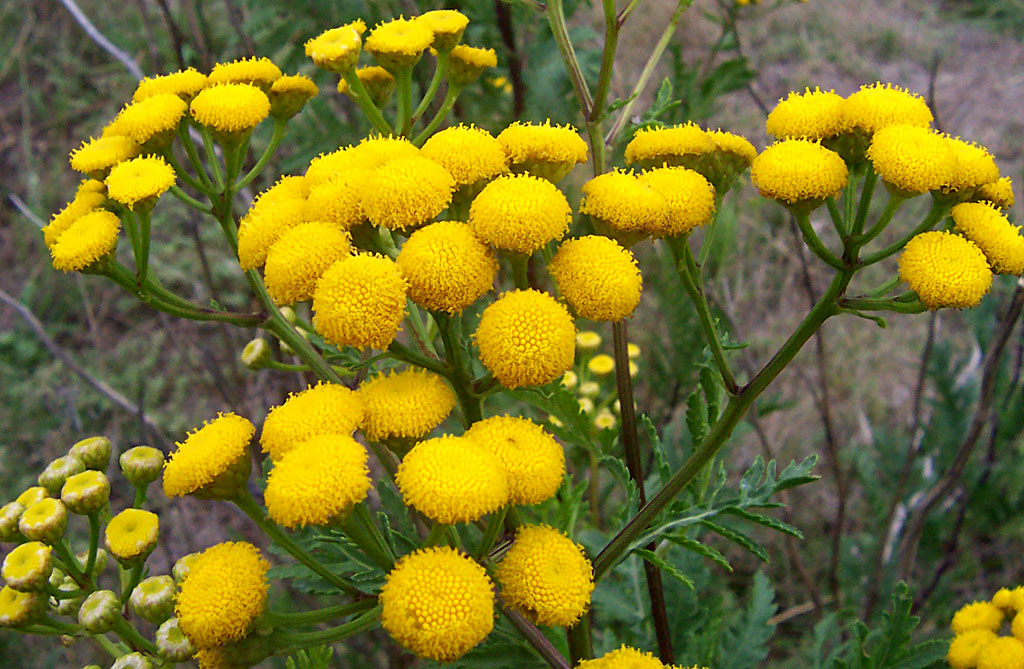
Tansies are mainly perennial herbs, but some are annuals and subshrubs. Some are a few centimeters tall and some reach 1.5 metres (4 ft 11 in). They vary in form, with one or more branching stems growing erect or prostrate, usually from rhizomes. They are hairy to hairless in texture, and most are aromatic. The leaves are alternately arranged, the blades sometimes borne on petioles. They are usually deeply lobed and may have toothed edges. Most species have flowers in loose or dense inflorescences. The flower has layers of distinct phyllaries around its base and may be flat to hemispheric in shape. The flower has many yellow disc florets, sometimes over 300. Some species have ray florets in shades of yellow, or white with yellowish bases. Some species lack true ray florets but have flat yellowish disc florets that look like rays. The fruit is a ribbed, glandular cypsela, usually with a pappus on the end.[5]

Selected species

[edit]

Species include:[2][8][9]

[edit]

References

[edit]
Revisions and contributorsEdit on WikipediaRead on Wikipedia
from Grokipedia
is a of approximately 160 species of flowering plants in the family, belonging to the tribe (), and consisting primarily of or subshrubs that are often aromatic and range from 5 to 150 cm in height. These plants typically feature alternate, pinnately lobed leaves, and their inflorescences form clusters of radiate or discoid flower heads with yellow disk florets and sometimes white or yellow ray florets. Fruits are cypselas equipped with a pappus of scales. Native to temperate regions worldwide, including the Mediterranean Basin, northern America, southwestern and eastern Asia (such as Türkiye and ), , and parts of , species of Tanacetum are distributed across diverse habitats from dunes to meadows. The genus exhibits a mix of annuals, perennials, and subshrubs, with stems that can be prostrate to erect and glabrous or hairy. Among the most notable species are Tanacetum vulgare (common tansy), valued historically for treating digestive issues and ; (feverfew), widely used for prevention and as an ; Tanacetum balsamita (costmary), employed in culinary applications; and (Dalmatian pyrethrum), a source of natural insecticides like pyrethrins. Traditionally, Tanacetum species have been utilized in folk for conditions such as , infections, wounds, and , owing to their rich profile including lactones, , and phenolic acids.

Description

Morphology

Tanacetum species are primarily perennial herbs, though some are annuals or subshrubs, typically ranging from 5 to 150 cm in height, and are often rhizomatous with an aromatic quality due to the presence of secretory structures. The stems are usually solitary or few, erect or prostrate to ascending, branched from the base or upper portions, and glabrous to hairy, with hairs that may be basifixed, medifixed, or occasionally stellate. Leaves are alternate, either basal and cauline or solely cauline, with petiolate or sessile bases; blades are generally obovate to spatulate and 1–3-pinnately lobed, giving a feathery or fern-like appearance in many , while ultimate margins are entire, crenate, or dentate, and surfaces are glabrous or hairy. This pinnate dissection, combined with glandular trichomes, contributes to the aromatic nature of the foliage across the genus. Inflorescences consist of capitula (flower heads) that are usually radiate but sometimes disciform, arranged in lax to dense corymbiform arrays or rarely solitary, with each head containing numerous florets. Ray florets, when present, number 10–21 or more and are pistillate, fertile, or neuter, with pale yellow to white corollas; peripheral pistillate florets in disciform heads can reach 8–30. Disk florets are bisexual and fertile, numbering 60–300 or more per head, with yellow, tubular corollas that have narrowly funnelform to campanulate throats and deltate lobes. Fruits are cypselae that are obconic or columnar, circular in cross-section, and typically 1–2 mm long, featuring 4–12 ribs and gland-dotted faces that may be glabrous; the pappus is either coroniform or absent. Specific anatomical features include abundant glandular trichomes on leaves, phyllaries, florets, and cypselae, which secrete terpenoids responsible for the strong odors characteristic of the , while secretory canals occur in some ' cortex. Rhizomes are common, particularly in perennials like T. vulgare, aiding vegetative spread.

Reproduction

Tanacetum species typically exhibit a summer flowering , with most blooming from to early autumn depending on and local . For instance, in temperate regions, flowering often occurs from through , with peak bloom in for species like Tanacetum huronense. The inflorescences consist of numerous capitula that open sequentially in an acropetal manner, starting from the periphery and progressing inward, which prolongs the flowering period per plant. Within each capitulum, the florets are predominantly hermaphroditic, though the outermost ones may function as female, lacking fully developed stamens. Pollination in Tanacetum is primarily entomophilous, relying on a variety of including bees, flies, , and moths that are attracted to the and abundant offered by the disc florets. Many , such as Tanacetum vulgare, are self-incompatible, promoting through sporophytic self-incompatibility mechanisms that prevent self-fertilization. However, some taxa exhibit self-compatibility, allowing for autogamous under conditions of limited activity. Seed production is prolific, with individual capable of generating thousands of achenes per ; for example, Tanacetum vulgare can produce up to 50,000 annually under optimal conditions. The achenes, which lack a pappus, are primarily dispersed by , falling short distances from the parent , but can also be moved by over limited ranges, water along streams, or externally by animals and birds. In addition to , many Tanacetum species propagate vegetatively through rhizomes, enabling formation. Tanacetum vulgare, for instance, develops extensive, shallow rhizomes within the upper soil layers that fragment easily, facilitating spread and persistence in disturbed habitats. This dual reproductive strategy enhances the genus's invasiveness and adaptability across diverse environments.

Taxonomy

Etymology

The genus name Tanacetum originates from word athanasia, meaning "," likely alluding to the plant's long-lasting dried flowers or its historical use in and preservation rituals in ancient cultures. This derivation passed through as tanazita or athanacetum, reflecting the plant's perceived enduring qualities. The name Tanacetum was formally established by in his in 1753, where he described several under the genus. Common names for within Tanacetum often stem from their medicinal associations or sensory characteristics. The widely used name "," applied especially to T. vulgare, derives from tanaceta, a variant of tanacetum, and entered English via tanesie around the 13th century. For T. parthenium, the common name "feverfew" comes from feferfuge, meaning "fever-chaser" or "fever-reducer," based on the Latin febrifugia (from febris, fever, and fugare, to drive away), highlighting its traditional role in treating fevers.

Taxonomic history

The genus Tanacetum was established by Carl Linnaeus in the second volume of Species Plantarum in 1753, where he described approximately 10 species based primarily on morphological characteristics such as dissected leaves and capitula with white ray florets. Initially, many species now assigned to Tanacetum were included within the broader genus Chrysanthemum, reflecting the limited taxonomic resolution of the time for the Asteraceae family. During the 19th and early 20th centuries, significant revisions occurred as botanists transferred numerous species from Chrysanthemum and Pyrethrum to Tanacetum, driven by distinctions in achene morphology, pappus structure, and inflorescence patterns. A key advancement came in 1873 when George Bentham and Joseph Dalton Hooker formally recognized Tanacetum as a distinct genus within the tribe Anthemideae in their Genera Plantarum, emphasizing its unique combination of aromatic foliage and rayed flower heads. This classification helped delineate Tanacetum from related genera, though ongoing synonymy persisted, such as Tanacetum vulgare L., previously known as Chrysanthemum tanacetum L. or Chrysanthemum vulgare (L.) Bernh. In the , the species count for Tanacetum has fluctuated between approximately 50 and 200, largely due to extensive synonymy and debates over generic boundaries within . Key consolidative works, such as the subtribal classification by Oberprieler, Himmelreich, and Vogt in 2007, have stabilized the genus at around 160 by integrating morphological and early molecular evidence, while addressing inclusions like Tanacetum parthenium (L.) Sch. Bip., historically treated under Chrysanthemum parthenium (L.) Bernh. and subject to ongoing taxonomic regarding its segregation into a separate genus. These adjustments underscore the genus's polyphyletic tendencies and the need for continued revision based on integrative taxonomy.

Phylogenetic position

Tanacetum is firmly placed within the tribe of the subfamily Asteroideae in the family, specifically in the subtribe Anthemidinae. This positioning is supported by extensive molecular phylogenetic analyses using nuclear (nrDNA) markers such as ITS and ETS, along with DNA (cpDNA) regions like ndhF and trnL-trnF. Within , Tanacetum forms part of a core clade in Anthemidinae, showing close relationships to genera such as , Cota, and Xylanthemum, while being phylogenetically distinct from (in an unresolved position) and Artemisia (in Artemisiinae). Molecular studies have revealed that early concepts of Tanacetum were polyphyletic, with some species like T. tatsienense nesting within the subtribe Artemisiinae and others, such as T. microphyllum, forming independent lineages. However, the core clade is well-supported by nrDNA ITS sequences, forming a paraphyletic group that includes nested genera like Gonospermum, Lugoa, and Xylanthemum. Analyses of ITS (518 ) and cpDNA trnH-psbA (544 ) regions using demonstrate low sequence divergence across the genus, indicating recent , with evidence of hybridization contributing to its morphological diversity. Infrageneric structure is divided into well-supported sections, such as Sect. Tanacetum, which comprises aromatic herbaceous species like T. vulgare, and Sect. Parthenium, characterized by feverfew-like taxa including T. parthenium, with additional clades like Sect. Asterotricha (marked by stellate hairs) and Sect. Hemipappus (with discoid capitula). These divisions are corroborated by combined molecular data, though in peripheral sections suggests ongoing taxonomic revisions. Evolutionary origins of Tanacetum trace to the Mediterranean Basin, aligning with the broader circum-Mediterranean diversification of Anthemideae, where the most recent common ancestor of the tribe dates to the mid-Miocene around 13.8–15 million years ago. Subsequent radiations have extended the genus into Asia and, through introductions, North America, driven by low genetic divergence and adaptive shifts in arid and temperate habitats.

Distribution and habitat

Geographic range

The genus Tanacetum is primarily native to the temperate regions of the Northern Hemisphere, with its center of diversity in the Mediterranean Basin, extending across Europe, western Asia, North Africa, and parts of North America. Native occurrences span northern Africa in countries such as Algeria, Morocco, and Tunisia; much of Europe including the Baltic States, Belarus, and central European Russia; and temperate Asia including Saudi Arabia, China (various regions), Japan, Korea, Kazakhstan, Kyrgyzstan, Tajikistan, Turkmenistan, Uzbekistan, Mongolia, and the Russian Far East and Siberia. In western Asia, the genus is well-represented in areas like Afghanistan, Cyprus, Iran, Iraq, Lebanon, Syria, Turkey, and the Caucasus regions. In North America, native species occur in subarctic and temperate zones, including eastern Canada (e.g., New Brunswick, Newfoundland, Ontario, Québec), north-central U.S.A. (e.g., Wisconsin), northeastern U.S.A. (e.g., Maine, Michigan), northwestern U.S.A. (e.g., Oregon, Washington), southwestern U.S.A. (e.g., California), Western Canada (e.g., Alberta, British Columbia, Manitoba, Saskatchewan), and Subarctic America (e.g., Alaska, Yukon). Several Tanacetum species have been introduced beyond their native ranges and have become widespread, often as invasives, particularly in , , and . For instance, T. vulgare (common tansy), native to from to , has escaped cultivation and naturalized across the and , where it invades disturbed areas like roadsides and riparian zones. Similarly, T. parthenium (feverfew), native to southeastern (including the ) and extending to the western Himalaya through regions like the , , , and , has become a global weed, introduced to , , , , and . Biogeographic hotspots for Tanacetum diversity are concentrated in western , particularly and (eastern ), where environmental conditions support high and . alone hosts over 30 species of the , making it one of the primary centers of diversity within the Irano-n biodiversity . In , multiple endemic and native taxa contribute to regional variation, reflecting the area's role as a transitional zone between European and Asian floras.

Ecological preferences

Tanacetum species primarily inhabit disturbed and open areas such as roadsides, meadows, riverbanks, waste places, hedgerows, and riparian zones, often colonizing chalky steppes and hilly terrains in temperate regions. They show a preference for well-drained, neutral to alkaline soils, including loams, sands, and coarse substrates with low and levels ranging from dry to moist. These habitats reflect the genus's to environments with moderate disturbance, where the can establish without intense competition. The genus exhibits broad climate adaptations, thriving in temperate to subtropical zones across the , with tolerance for , poor soils, and varying elevations from to over 5,000 feet. Many favor cooler continental climates, while others, such as Tanacetum artemisioides, extend into subarctic and subalpine biomes in regions like the . For instance, Tanacetum vulgare demonstrates resilience to cold stratification for seed germination and grows across elevations up to 5,200 feet in , underscoring the genus's versatility in fluctuating temperature and precipitation regimes. Biotic interactions play a key role in Tanacetum ecology, with species exhibiting allelopathic effects that inhibit seed germination and growth of nearby plants, such as reducing soybean germination by up to 20% and sunflower by 96%, though impacts vary by recipient species. They serve as hosts to aphids and other insects, where chemotypic variations influence herbivore preferences—for example, Macrosiphoniella tanacetaria aphids favor α-thujone/β-thujone dominant chemotypes while avoiding others. Additionally, Tanacetum supports pollinators through nectar resources attractive to flies, hover flies, butterflies, moths, and bees, with nectar-dwelling microbes enhancing pollinator visitation in species like T. vulgare. In terms of invasive , Tanacetum vulgare exemplifies rapid in non-native grasslands via prolific production (up to 100,000 seeds per square meter annually) and vegetative spread through rhizomes, enabling it to outcompete native and reduce forage value by approximately 50% in invaded public lands. This species shows enhanced growth and reproductive output in introduced ranges like compared to native European populations, facilitating dominance in disturbed sites and contributing to shifts in community structure.

Species

Diversity

The genus Tanacetum comprises approximately 160 accepted of flowering plants, though estimates vary between 134 and 174 due to ongoing taxonomic revisions and the inclusion of infraspecific taxa. These species exhibit diverse life forms, including annuals, herbaceous perennials, and subshrubs, with heights ranging from a few centimeters to over 1.5 meters. Infrageneric classification within Tanacetum remains controversial, with proposals dividing the into 4 to 18 sections based on morphological and molecular ; for instance, Podlech (1986) recognized 18 sections for on the , while other systems propose fewer, such as 7–10, including Sect. Tanacetum (characterized by dissected leaves and corymbose inflorescences) and sections resembling Achillea in habit. Hybrids are common, particularly among closely related , contributing to taxonomic challenges through intermediate morphologies and genetic that complicate delimitation. Patterns of diversity are highest in southwestern Asia, particularly in Iran and Turkey, where over 50 species occur, including numerous endemics adapted to montane and steppe habitats. Morphological variation is prominent in leaf dissection, ranging from entire to deeply pinnatisect forms, and in inflorescence architecture, from compact capitula to loose corymbs up to 20 cm across, reflecting adaptations to local environmental pressures. Cytogenetic studies confirm a base chromosome number of x=9 across the genus, with diploid (2n=18) and polyploid levels observed, supporting its position within the Anthemideae tribe. While most Tanacetum species are widespread and not conservation-dependent, certain endemics face vulnerability from habitat loss in arid and mountainous regions; for example, the recently described T. isfahanicum, restricted to central , is at risk due to and in its limited habitats. Overall, at least three species meet IUCN criteria for endangered status, highlighting the need for targeted protection of narrow-range taxa.

Selected species

Tanacetum vulgare, commonly known as common tansy, is a rhizomatous native to , typically reaching heights of 1 to 5 feet (30-150 cm) with fern-like, aromatic leaves and clusters of yellow, button-like flower heads blooming from to . It has become a widespread invasive in , forming dense stands in disturbed habitats such as roadsides, pastures, and stream banks, where it outcompetes native vegetation through prolific seed production (up to 50,000 seeds per plant) and rhizomatous spread. Historically valued for its aromatic properties, the plant contains toxic compounds like , rendering it hazardous to livestock and humans if ingested in large quantities. Tanacetum parthenium, or feverfew, is a bushy, aromatic herbaceous perennial originating from the and regions, growing 1 to 3 feet (30-90 cm) tall with pinnately lobed, strongly scented leaves and small, daisy-like white flower heads (about 3/4 inch wide) in dense corymbs from to . Native to southeastern and southwestern Asia, it has naturalized widely in and , thriving in full sun and well-drained soils as a common ornamental in gardens and a traditional medicinal plant, particularly noted for its role in relief. Its compact, mounded growth habit makes it suitable for borders and herb gardens. Tanacetum balsamita, known as costmary or alecost, is a tall perennial herb native to and western Asia (including the ), attaining 3 to 6 feet (90-180 cm) in height with silvery-green, oval to elliptic leaves that emit a distinctive minty-balsamic aroma. The produces small, button-like flowers in to and spreads via rhizomes, often found in disturbed areas after escaping cultivation. Its fragrant foliage has been traditionally incorporated into beverages like English ales and teas for flavoring. Among other notable species, Tanacetum coccineum, the painted daisy, is a low-growing herbaceous prized for ornamental use, featuring fern-like green foliage and colorful flower heads in shades of red, , , or white on stems up to 24 inches (60 cm) tall, blooming in . Native to the and widely cultivated, it prefers well-drained soils and adds vibrant color to garden borders. Tanacetum macrophyllum, or rayed , is a herb endemic to parts of and eastern Europe, characterized by larger leaves and rayed flower heads, growing in temperate habitats and occasionally cultivated for its ornamental qualities. Selected Tanacetum species exhibit notable variations in height, from the compact 1-3 feet of T. parthenium to the taller 3-6 feet of T. balsamita, influencing their suitability for different scales. Aroma profiles differ markedly, with T. vulgare offering a camphoraceous scent, T. balsamita a minty-balsam note, and T. parthenium a pungent fragrance, all derived from essential oils in the foliage. Invasiveness varies significantly, as T. vulgare aggressively colonizes disturbed sites across continents, while species like T. coccineum and T. parthenium remain more contained in cultivation without widespread ecological disruption.

Uses

Medicinal applications

Tanacetum species, particularly T. parthenium (feverfew) and T. vulgare (), have been employed in for various therapeutic purposes. Historically, feverfew has been used to alleviate migraines and symptoms, attributed to its parthenolide, which contributes to its effects. Tansy has traditionally served as an to stimulate and as an for relieving abdominal cramps and digestive spasms. However, due to its toxicity, particularly from content, tansy is not recommended for internal use and can cause severe effects including convulsions and uterine bleeding, especially during . Modern clinical evidence supports the prophylactic use of feverfew for prevention, with randomized controlled trials demonstrating a reduction in attack frequency by approximately 1.9 per month compared to 1.3 with , at daily doses of 200-400 mg of standardized leaf extracts. properties have been observed in other Tanacetum species, potentially aiding conditions like , though evidence remains preliminary beyond feverfew. The medicinal efficacy of Tanacetum species stems from bioactive compounds including sesquiterpenoid lactones like parthenolide, essential oils such as and , flavonoids, and coumarins. These compounds exert effects through mechanisms like inhibition of (NF-κB) pathways and prostaglandin synthesis, reducing and modulating immune responses. Common preparations include capsules containing 100-300 mg of dried leaf extract standardized to 0.2-0.4% parthenolide, taken up to four times daily for prophylaxis, or 50-150 mg of dried leaf daily. Standardization ensures consistent parthenolide content, as variations can affect therapeutic outcomes. Tinctures may be used at 1-2 ml twice daily, but consult a healthcare provider for appropriate dosing.

Other uses

Tanacetum species have found application in culinary traditions, particularly as flavorings with a bitter, aromatic profile. Tanacetum vulgare, commonly known as tansy, was historically used to impart a bitter taste to ales and beers before the widespread adoption of hops, balancing the malt's sweetness and contributing to beverage preservation. Its leaves were also chopped for use in salads, omelets, and savory dishes like meat pies, though such practices have declined due to the plant's toxicity. Similarly, T. balsamita (costmary) served as a pot herb, with its mint-lemon scented leaves added sparingly to soups, stews, salads, and desserts for subtle flavoring. Tansy-flavored puddings or "tansies" were once prepared for Easter meals in European folklore, but this custom is now rare owing to safety concerns. In ornamental gardening, several Tanacetum species are valued for their daisy-like flowers and ease of cultivation. T. parthenium (feverfew), with its white-petaled blooms, is commonly planted in cottage gardens, mixed borders, and rock gardens, where it self-seeds readily and adds a delicate, pollinator-attracting display. T. coccineum (painted daisy) features vibrant , , or flowers on compact plants, making it suitable for border edges and drought-tolerant landscapes in full sun to partial shade. Once established, it requires minimal watering and thrives in well-drained soils, enhancing garden aesthetics while resisting dry conditions. Industrially and agriculturally, Tanacetum extracts provide practical benefits, especially in pest management and material processing. T. cinerariifolium (Dalmatian pyrethrum) is a of pyrethrins, natural insecticides extracted from its flowers, used in household, horticultural, and agricultural applications due to their low persistence and safety for humans and mammals compared to synthetics. Essential oils from T. vulgare exhibit repellent properties against insects, including mosquitoes, due to volatile compounds like , supporting their use in natural formulations. In , tansy deters pests such as flea beetles, ants, flies, and cabbage worms when interplanted with crops like brassicas and tomatoes, reducing damage without synthetic pesticides. Flowers of various species yield natural dyes, producing yellow to greenish hues on textiles like wool and silk, as demonstrated in studies on plant-fiber interactions. Culturally, Tanacetum holds symbolic significance in , often linked to themes of and protection. The genus name derives from the Greek athanasia (""), reflecting ancient beliefs that preserved bodies from decay during or conferred , as in myths where the youth Ganymede consumed it for divine longevity. Its dried flowers, which retain color and form, were used in preservatives and dyes, reinforcing associations with endurance and safeguarding in traditional practices.

Cultivation and toxicity

Cultivation

Tanacetum species are herbaceous perennials that thrive in temperate garden settings, with many cultivated for ornamental, medicinal, or purposes. Propagation is straightforward and typically occurs through seeds, division, or cuttings, depending on the species. For seed propagation, sow in spring after the last , lightly covering the seeds in a moist, well-drained medium; germination usually takes 7-14 days for at around 70°F (21°C), or 10-20 days for T. coccineum. Perennial species like T. vulgare and T. parthenium can be divided in early spring or fall by separating rhizomatous clumps, each with roots and shoots, and replanting at 12-18 inches apart to encourage vigorous growth. Softwood cuttings from non-flowering stems, rooted in moist soil or water under mist, are effective for ornamentals such as T. parthenium, rooting in 1-2 weeks. Optimal growing conditions mimic the genus's preference for open, sunny sites with well-drained soils. Most species require full sun (at least 6 hours daily) for best flowering, though partial shade is tolerated in hotter climates; T. coccineum performs well in USDA zones 3-7, while T. parthenium suits zones 5-10, and T. vulgare extends to zone 3. Soils should be loamy or sandy with good drainage, 6.0-7.2, and moderate fertility—amend heavy clay with to prevent . Space plants 12-18 inches (30-45 cm) apart to allow for clumping growth; once established, they have low needs, requiring only during prolonged dry spells, as they are drought-tolerant but prefer consistent moisture during establishment. Pests such as and spider mites can affect Tanacetum, particularly in dry conditions, but the ' natural pyrethrins provide some resistance; monitor and treat infestations with or . Maintenance is low to moderate, involving deadheading spent flowers to prevent excessive self-seeding and control invasiveness—species like T. vulgare and T. parthenium can spread aggressively if unmanaged. Prune back foliage in late fall or early spring to promote new growth, and divide overcrowded clumps every 2-3 years; harvest leaves and flowers during peak bloom for drying or use, clipping stems to encourage bushiness. Popular cultivars enhance ornamental value, such as T. parthenium 'Aureum' (also known as Golden Feather), a dwarf form with chartreuse foliage and white daisy-like flowers, reaching 8-12 inches tall. For T. coccineum, selections like 'Robinson's Red' offer scarlet blooms in late spring to midsummer, while 'Brenda' provides magenta-pink flowers for extended summer displays. To manage potential invasiveness in gardens, opt for sterile hybrids or regularly remove seedlings, maintaining plants as contained clumps rather than allowing unchecked spread.

Toxicity

Tanacetum species contain several toxic compounds, primarily in their essential oils, with concentrations varying by species, plant part, and environmental factors; for instance, the leaves and flowers of Tanacetum vulgare (common tansy) have higher levels of thujone, a neurotoxin comprising up to 77.4% of the oil (19.4% α-thujone and 58.0% β-thujone). Thujone modulates GABA-gated chloride channels, leading to neurotoxic effects, while parthenolide, a sesquiterpene lactone in Tanacetum parthenium (feverfew), acts as a contact allergen at concentrations of 0.6-0.9% in flowers. Tanacetone, another ketone in T. vulgare oils, contributes to the overall toxicity profile alongside thujone, though specific concentrations are less documented and vary similarly. In humans, ingestion of thujone-rich Tanacetum parts can cause convulsions, disturbances, and spontaneous , particularly posing risks to pregnant women due to its and properties; a dose as low as 15 mg of has impaired attention and cognitive function. The oral LD50 for in animal models, indicative of thresholds, ranges from 192 mg/kg in rats to 230 mg/kg in mice. Handling T. parthenium may induce delayed from parthenolide exposure, with strong sensitizing potential confirmed in experimental models. For animals, Tanacetum vulgare is toxic to livestock such as and when consumed in large quantities, potentially causing liver and damage, though poisoning incidents are rare due to the plant's unpalatability and strong aroma. Sheep and tolerate the plant and have been used for biological control of its invasive growth. High doses in induce seizures and increased mortality, mirroring neurotoxic effects observed in larger animals. Management of Tanacetum toxicity emphasizes limited safe external applications, such as diluted oils for non-ingestive uses, while avoiding internal consumption; pregnant individuals and handlers should exercise particular caution. In the , regulatory limits restrict to 0.5 mg/kg in foods and beverages, with higher allowances of 5 mg/kg in alcoholic drinks under 25% volume and 35 mg/kg in , to mitigate neurotoxic risks from herbal products.

References

Add your contribution
Related Hubs
User Avatar
No comments yet.