


Community hub
Recent from talks
Contribute something
Nothing was collected or created yet.
North American Numbering Plan
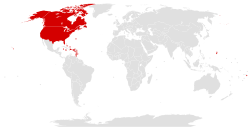
View on Wikipedia Countries participating in the North American Numbering Plan | |
| Format | NXX NXX-XXXX |
|---|---|
| Country code | 1 |
| International access | 011 |
| List of area codes | |
The North American Numbering Plan (NANP) is an integrated telephone numbering plan for twenty-five regions in twenty countries, primarily in North America and the Caribbean. This group is historically known as World Numbering Zone 1 and has the country code 1. Some North American countries, most notably Mexico, do not participate in the NANP.
The concepts of the NANP were devised originally during the 1940s by the American Telephone and Telegraph Company (AT&T) for the Bell System and the independent telephone companies in North America in Operator Toll Dialing. The first task was to unify the diverse local telephone numbering plans that had been established during the preceding decades, with the goal to speed call completion times and decrease the costs for long-distance calling, by reducing manual labor by switchboard operators. Eventually, it prepared the continent for direct-dialing of long-distance calls by customers, first possible in 1951, which expanded across the nation during the decades following. AT&T continued to administer the continental numbering plan and the technical infrastructure until the end of the Bell System, when operation was delegated to the North American Numbering Plan Administration (NANPA), a service that has been procured from the private sector by the Federal Communications Commission (FCC) in the United States. Each participating country forms a regulatory authority that has plenary control of local numbering resources.[1] The FCC also serves as the U.S. regulator. Canadian numbering decisions are made by the Canadian Numbering Administration Consortium.[2]
The NANP divides the territories of its members into numbering plan areas (NPAs) which are encoded numerically with a three-digit telephone number prefix, commonly termed the area code.[3] Each telephone is assigned a seven-digit telephone number unique only within its respective numbering plan area. The telephone number consists of a three-digit central office (or exchange) code and a four-digit station number. The combination of an area code and the telephone number serves as a destination routing address in the public switched telephone network (PSTN). The North American Numbering Plan conforms with International Telecommunication Union (ITU) Recommendation E.164, which establishes an international numbering framework.[4]
History
[edit]
From the Bell System's beginnings in 1876 and throughout the first part of the 20th century, telephone networks grew from essentially local or regional telephone systems. These systems expanded by growing their subscriber bases, as well as enlarging their service areas by implementing additional local exchanges that were interconnected with tie trunks. It was the responsibility of each local administration to devise telephone numbering plans that accommodated the local requirements and growth.[5] As a result, the North American telephone service industry developed into an unorganized set of many differing local numbering systems. The diversity impeded the efficient operation and interconnection of exchanges into a nationwide system for long-distance telephone communication. By the 1940s, the Bell System set out to unify the various existing numbering plans to provide a unified, systematic concept for routing telephone calls across the nation, and to provide efficient long-distance service that eventually did not require the involvement of switchboard operators.
In October 1947, AT&T published the first nationwide numbering plan in coordination with the independent telephone operators. The plan divided most of North America into eighty-six numbering plan areas (NPAs). Each NPA was assigned a unique three-digit code, typically termed NPA code or simply area code. These codes were first used in Operator Toll Dialing by long-distance operators in establishing calls via trunks between toll offices. The goal of automatic service required additional technical advances in the latest generation of toll-switching systems, completed by the early 1950s, and installation of new toll-switching systems in most numbering plan areas. The first customer-dialed direct call using an area code was made on November 10, 1951, from Englewood, New Jersey, to Alameda, California.[6] Direct distance dialing (DDD) was introduced subsequently across the country. By the early 1960s, DDD had become commonplace in cities and most towns in the United States and Canada. By 1967, the number of assigned area codes had grown to 129.[7]
The status of the network of the 1960s was reflected by a new name used in technical documentation: North American Integrated Network.[7] By 1975, the numbering plan was referred to as the North American Numbering Plan,[8] resulting in the well-known initialism NANP, as other countries sought or considered joining the standardization.
Foreign expansion
[edit]Although Bermuda and the Caribbean islands had been assigned the area code 809 as early as 1958 by the administrators at AT&T, individual participating countries or territories had no autonomy over their numbering plan as they received centrally assigned central office prefixes that needed to be unique from those of other countries with the same area code. Regions in Mexico with high call volumes to and from the US were assigned functional area codes as early as 1963, for the purpose of call routing, but a nationwide system of participation in the NANP eventually failed.[citation needed]
During the decades following, the NANP expanded to include all of the United States and its territories, Canada, Bermuda, and seventeen nations of the Caribbean.[9][10]
At the request of the British Colonial Office, the numbering plan was first expanded to Bermuda and the British West Indies because of their historic telecommunications administration through Canada as parts of the British Empire and their continued associations with Canada, especially during the years of the telegraph and the All Red Line system.[citation needed]
Not all North American polities participate in the NANP. Exceptions include Mexico, Greenland, Saint Pierre and Miquelon, the Central American countries and some Caribbean countries (Cuba, Haiti, the French Caribbean and the Dutch Caribbean other than Sint Maarten). The only Spanish-speaking jurisdictions in the system are the Dominican Republic and Puerto Rico. Mexican participation was planned,[11] but implementation stopped after three area codes (903, 905, 706) had been used, and Mexico opted for an international numbering format, using country code 52.[12] The area codes in use were subsequently withdrawn in 1991.[13]
Sint Maarten, a Dutch Caribbean constituent, joined the NANP in September 2011, being assigned area code 721.[14] Sint Maarten shares the island of St. Martin with the French Collectivity of Saint Martin which, like the rest of the French Caribbean, is not a NANP member.[15]
Administration
[edit]The NANP is administered by the North American Numbering Plan Administrator (NANPA, formerly Administration).[16] This function is overseen by the Federal Communications Commission, which assumed the responsibility upon the federally mandated breakup of the Bell System. The FCC periodically solicits private sector contracts for the role of the administrator.
Before the breakup of the Bell System, administration of the North American Numbering Plan was performed by AT&T's Central Services Organization. In 1984, this function was transferred to Bell Communications Research (Bellcore), a company created by the divestiture mandate to perform services for the newly created local exchange carriers. On January 19, 1998, the NANPA function was transferred to the IMS division of Lockheed Martin in Washington, D.C.[17] In 1999, the contract was awarded to Neustar, a company created from Lockheed for this purpose. The contract was renewed in 2004, and again in 2012.[18] On January 1, 2019, Somos assumed the NANPA function with a one-year bridge contract granted by the FCC with the goal of consolidating the NANPA function with the Pooling Administrator and identifying a long-term contractor.[19][20] On December 1, 2020, Somos secured the $76 million contract for a term of eight years against one other bidder.[21]
Numbering plan
[edit]The long-range vision of the architects of the North American Numbering Plan was a system by which telephone subscribers in the United States and Canada could themselves dial and establish a telephone call to any other subscriber without the assistance of switchboard operators. While the dialing of telephone calls by subscribers was common-place in many cities across the continent for local destinations, long-distance telephone calls had to be patched through manually by telephone operators at typically multiple intermediate toll offices using a system known since 1929 as the General Toll Switching Plan.[22] The immediate goal for improvement in the time of call establishment was to provide technology for the originating toll operators to dial calls directly to the destination. This system was known as Operator Toll Dialing.[23]
Operator Toll Dialing required a nationwide telephone numbering plan that unified all local numbering plans into a consistent universal system. Local numbering plans, many of which required only four or five digits to be dialed, or even fewer in small communities, needed to be expanded. but the goal was to enable local telephone companies to make as few changes as possible in their systems.
Numbering plan areas and central offices
[edit]The new numbering plan divided the North American continent into regional service areas, termed numbering plan areas (NPAs). The divisions conformed primarily to the jurisdictional boundaries of the U.S. states and the Canadian provinces,[24] though some states or provinces needed to be divided into multiple areas. NPAs were created in accordance with principles deemed to maximize customer understanding and minimize dialing effort, while reducing plant cost.[25] Each NPA was identified by a unique three-digit code number, termed the numbering plan area code (NPA code, or short, area code), which was prefixed to the local telephone number when calling from one NPA to another. Calling within the same numbering plan area did not require dialing the area code, a feature today termed seven-digit dialing and today abandoned in numbering plan areas with multiple area codes.
The telephone exchanges—in the Bell System they were officially termed central offices—became local exchange points in the nationwide system. Each of them was also assigned a three-digit number unique within its NPA. The combination of NPA code and central office code served as a destination routing code for use by operators to reach any central office through the switching network.[24] Due to the numerical structure of the numbering system, each NPA was technically limited to 540 central offices.[25]
Although the limitation to 540 central offices required the most populous states to be divided into multiple NPAs, it was not the sole reason to subdivide a state. An important aspect was the existing infrastructure for call routing, which had developed during preceding decades, often independently of state boundaries. The rules of determining areas also attempted to avoid cutting across busy toll traffic routes, so that most toll traffic remained within an NPA, and outgoing traffic in one area would not be tributary to toll offices in an adjacent area.[26][24] As a result, New York state was initially divided into five areas, the most of any state. Illinois, Ohio, Pennsylvania, and Texas were assigned four NPAs each, and California, Iowa, and Michigan received three. Six states (Indiana, Kansas, Massachusetts, Minnesota, Missouri, Wisconsin) and two provinces (Ontario, Quebec) were divided into two NPAs.
Traditionally, central office switching systems were designed to serve as many as ten thousand subscriber numbers. Thus, subscribers were assigned four-digit line or station numbers. This rounded the total number of digits in a subscriber telephone number to ten: a three-digit area code, a three-digit central office code, and four digits for each line. This fixed format defined the North American Numbering Plan as a closed numbering plan,[27][28] as opposed to developments in other countries where the number of digits was not fixed.

It was already common practice for decades that the digits 0 and 1 could not appear in the first two digits of the central office codes, because the system of using the first two letters of familiar names for central offices did not assign letters to these digits. The digit 0 was used for operator assistance, and 1, which is essentially a single pulse of loop interruption, was automatically ignored by most switching equipment of the time.[24] Therefore, the 0/1 rule for the area code provided a convenient means to distinguish seven-digit dialing from ten-digit dialing.[citation needed]
The use of telephone exchange names as part of telephone numbers had been a well-established practice, and this was preserved for convenience and expediency in the new network design. The letter-to-digit translations were printed on the face of every rotary dial in the metropolitan areas, according to a scheme designed by W.G. Blauvelt in 1917, that had been used in the Bell System in large metropolitan areas since the early 1920s.[29] The network reorganization standardized this system to using a two-letter and five-digit (2L-5N or 2-5) representation of telephone numbers in most exchanges in North America,[30] or to using an equivalent all-numeric seven-digit numbering plan, as was practiced by some independent telephone companies.
Initial numbering system
[edit]In 1947, AT&T completed the new design for a nationwide toll network that established the original North American area codes. The new numbering plan provided for 152 area codes, each with a capacity to serve as many as 540 central offices.[31] Originally, only eighty-six area codes were assigned. New Jersey received the first NPA code in the new system, area code 201.[32] The second area code, 202, was assigned to the District of Columbia. The allocation of area codes was readjusted as early as 1948 before the implementation of the plan commenced. For example, the Indiana numbering plan area 317 was divided, which essentially provided a larger numbering pool in the Indiana suburbs of Chicago (area code 219).
Initially, states divided into multiple numbering plan areas were assigned area codes with the digit 1 in the second position, while areas that comprised entire states or provinces received codes with 0 as the middle digit. This rule was abandoned by the early 1950s,[24] as NPAs with digit 0 in the middle had to be divided, beginning with New Jersey's 201. However, all area codes assigned until 1995 had none other than the digits 0 and 1 in this position.
The eight codes of the form N11 (N=2–9) were reserved as service codes. The easily recognizable codes of the form N00 were available in the numbering plan, but were not initially included in assignments.[7] Additional area code patterns were later assigned for other services; for example, the area codes N10 were implemented for the Teletypewriter Exchange Service (TWX).[33]
Dialing procedures
[edit]The closed numbering plan did not require the subscriber to dial all digits. When dialing a local call or a call within the same numbering plan area, the area code was omitted in seven-digit dialing. In some cases, even fewer digits sufficed for local calling. Ten-digit dialing was only necessary for foreign area calls to subscribers in another state or numbering plan area.[34] Exceptions existed for communities on NPA boundaries, so that uniform local dialing was still possible in historically established communities.
All-number calling
[edit]| 000 — 099 | These 200 codes were used as toll center and system codes. | |||
| 100 — 199 | ||||
| Area codes |
Service codes |
Area codes |
Central office codes | |
|---|---|---|---|---|
| 200 — 210 | 211 | 212 — 219 | 220 — 299 | |
| 300 — 310 | 311 | 312 — 319 | 320 — 399 | |
| 400 — 410 | 411 | 412 — 419 | 420 — 499 | |
| 500 — 510 | 511 | 512 — 519 | 520 — 599 | |
| 600 — 610 | 611 | 612 — 619 | 620 — 699 | |
| 700 — 710 | 711 | 712 — 719 | 720 — 799 | |
| 800 — 810 | 811 | 812 — 819 | 820 — 899 | |
| 900 — 910 | 911 | 912 — 919 | 920 — 999 | |
| 152 area codes 8 special service codes |
640 CO codes | |||
All-number calling was a telephone numbering plan introduced in 1958,[36] that converted telephone numbers with exchange names to a numeric representation of seven digits.
The original plan of 1947 had been projected to be usable beyond the year 2000. However, by the late 1950s it became apparent that it would be outgrown by about 1975.[37] The limitations for the usable leading digits of central office codes, imposed by using common names for central office names, and their leading two characters as guides for customer dialing could no longer be maintained when opening new central offices. By 1962 it was forecast that in 1985 the number of telephones in the nation would equal its population of 280 million and increase to 600 million telephones for 340 million people in 2000.[30] As a result, a few North American telephone administrations, notably New York Telephone Co., first introduced letter combinations that could not be associated with a familiar pronounceable central office name. Finally, they sought the elimination of central office names and letter codes, and introduced all-number calling (ANC).
The all-number calling plan increased the number of permissible central office prefixes from 540 to potentially 800, but the first two digits of the central office code were still restricted to the range 2 to 9, and the eight combinations that ended in 11 were reserved as special calling codes.[30] This expanded the numbering pool for central office codes to 640, and resulted in the partitioning of the prefix space (000—999).[35]
Interchangeable central office codes
[edit]As the numbering plan grew during the 1960s using all-number calling, plan administrators at AT&T identified that by c. 1973 some of the largest area codes in urban centers might run out of central office prefixes to install more individual access lines. For relief in these cases, they finally eliminated the requirement that the middle digit of the central office code could not be 0 or 1. This resulted in the format of interchangeable central office codes, N X X, where N=2–9 and X=0–9. The first cities that required this action, in 1974, were the cities of Los Angeles with area code 213 and New York with 212. This change also required modification of the local dialing procedures to distinguish local calls from long-distance calls with area codes.
Requiring 1 to be dialed before the full number in some areas provided for area codes of the form N10, such as 210 in the San Antonio, Texas, area and 410 in eastern Maryland. Therefore, someone calling from San Jose, California, to Los Angeles before the change would have dialed 213-555-0123 and after the change 1-213-555-0123, which permitted the use of 213 as an exchange prefix in the San Jose area. The preceding 1 also ideally indicates a toll call; however, this is inconsistent across the NANP because the FCC has left it to the U.S. state public utilities commissions to regulate for traditional landlines, and it has since become moot for mobile phones and digital VoIP services that offer nationwide calling without the extra digit.[citation needed]
Interchangeable NPA codes
[edit]In 1995, the North American Numbering Plan Administrator eliminated the requirement that the middle digit of an area code had to be either 0 or 1, implementing fully interchangeable NPA and central office codes, that had already been anticipated since the 1960s, when interchangeable central office codes were sanctioned.
Modern plan
[edit]The NANP numbering format is summarized in the ten-digit notation NXX NXX-XXXX, where N denotes any of the digits 2–9, and X denotes any digit 0–9.
| Component | Name | Number ranges | Notes |
|---|---|---|---|
| NXX often denoted NPA |
Numbering plan area code | The first NXX block is the numbering plan area code. When the second and third digits are the same, the code is an easily recognizable code (ERC). ERCs designate special services; e.g., 800 for toll-free service. The NANP is not assigning area codes with 9 as the second digit.[38] | Covers Canada, the United States, parts of the Caribbean Sea, and some Atlantic and Pacific islands. |
| NXX | Central office code | The second NXX block is the central office code. Permissible numbers exclude easily recognizable codes N11, used for special services. | Also called exchange code |
| XXXX | Line number | A unique four-digit number for each NPA, from 0000 to 9999 | Also called station code |
Using 0 or 1 as the first digit of an area code or central office code is invalid; these are trunk prefixes. 9 in the middle position of the NPA is reserved for North American Numbering Plan expansion.
For example, 234 235-5678 is a valid telephone number; with area code 234, central office prefix (exchange) 235, and line number 5678. The number 234 911-5678 is invalid, because the central office code must not be in the form N11. 314 159-2653 is invalid, because the office code must not begin with 1. 123 234-5678 is invalid, because the NPA must not begin with 0 or 1.[39][40][41][42]
Each three-digit area code has a capacity of 7,919,900 telephone numbers (7,918,900 in the United States).
Despite widespread use as fictional telephone numbers in the form NXX 555-XXXX, only line numbers 0100 through 0199 are reserved for this purpose, while 1212 and 4334 are the only assigned uses for directory assistance and other functions.[43]
The country code for all countries participating in the NANP is 1. The prefix digit 1 is also used within the NANP for long-distance dialing.
Telephone number formatting
[edit]NANP telephone numbers are formally rendered as NPA-NXX-XXXX, but (NPA) NXX-XXXX is common, as are others forms of punctuation. The parentheses were used originally to indicate that the area code was not necessary for local dialing. The NPA-part of the number has the formal format NXX, since 1995 identical to the format of central office codes.
The Government of Canada's Translation Bureau also recommends using hyphens between groups; e.g. 250-555-0199.[44]
Under the international formatting rules for telephone numbers, per recommendation E.164 by the International Telecommunication Union (ITU), a NANP number is rendered as +1NPANXXXXXX, without spaces or punctuation, e.g., +12505550199. The plus sign indicates that the country code follows immediately and that the user may have to dial another prefix per the dialing conventions in the country of origin. This selects international network access. The NANP prescribes the prefix 011 for this purpose.
Non-geographic services
[edit]The North American Numbering Plan recognizes the need for non-geographic services by designating certain numbering blocks for such purposes. Many of these telephone numbers are selected from the easily recognizable codes (ERCs).
System-wide toll-free calling, for which the receiving party is billed for the call, uses the number range with area codes of the form 8XX.
Area code and central office prefixes for other non-geographic services have the form 5XX-NXX. As of January 2021, the codes 500, 521, 522, 533, 544, 566, 577, 588, 523, 524, 525, and 526 have been designated.[45] These codes are used for fixed or mobile devices, and not assigned to rate centers. As addresses, they may or may not traverse the public switched telephone network (PSTN). Applications include the use as personal 500 numbers.
Some carrier-specific services have used area code 700. In Canada, area code 600 is used for non-geographic applications. Area code 900 has been used for high-toll 900 numbers.
Cellular mobile services
[edit]The North American Numbering Plan does not reserve special non-geographic area codes exclusively for cellular phones, as is customary in some other national telephone administrations. Only one regional exception exists in area code 600 in Canada.
For cellular services, telephone numbers in the NANP are allocated within each area code from central offices serving only cellular networks. Calls to them are billed at the same rate as any other call in the same rate center. Consequently, the caller pays pricing model adopted in other countries, in which calls to cellular phones are charged at a higher nationwide rate, but incoming mobile calls are not charged to the mobile user, could not be implemented. Instead, North American cellular telephone subscribers may also be charged for receiving calls (subscriber pays). In the past, this has discouraged mobile users from publishing mobile telephone numbers, but in the 21st century, most users selected bundle pricing plans that included an allotment of minutes expected to be used in the billing period, rather than being charged per call, and most U.S. carriers today offer unlimited calling plans.[46]
Local number portability between fixed and wireless services within a region allows users to switch to mobile service while keeping fix-line telephone numbers.
Growth
[edit] | This section needs additional citations for verification. (February 2014) |
Canada and the United States have experienced rapid growth in the number of area codes, particularly between 1990 and 2005. The widespread adoption of fax, modem, and mobile phone communication, as well as the deregulation of local telecommunication services in the United States during the mid-1990s, increased the demand for telephone numbers.
The Federal Communications Commission allowed telecommunication companies to compete with the incumbent local exchange carriers for services, usually by forcing the existing sole service provider to lease infrastructure to other local providers. Because of the original design of the numbering plan and the telephone switching network that assumed only a single provider, number allocations had to be made in 10,000-number blocks even when many fewer numbers were required for each new vendor. Due to the proliferation of service providers in some numbering plan areas, many area codes were threatened with exhaustion of numbering resources. The number blocks of failed service providers often remained unused, as no regulatory mechanism existed to reclaim and reassign these numbers.
Area codes are added by two principal methods, number plan area splits and overlays. Splits were implemented by dividing an area into two or more regions, one of which retained the existing area code and the other areas receiving a new code. In an overlay, multiple codes are assigned to the same geographical area, obviating the need for renumbering of existing services. Subtle variations of these techniques have been used as well, such as dedicated overlays, in which the new code is reserved for a particular type of service, such as cellular phones and pagers, and concentrated overlays, in which a part of the area retained a single code while the rest of the region received an overlay code. The only service-specific overlay in the NANP was area code 917 (New York City) when it was first installed; such service-specific area code assignments were later prohibited by the Federal Communications Commission.
Most area codes of the form N10, originally reserved for AT&T's Teletypewriter eXchange (TWX) service, were transferred to Western Union in 1969 and were freed for other use in 1981 after conversion to Telex II service was complete. The last of these, 610, was assigned to Canada, but reassigned in 1992. These new area codes, as well as a few other codes used for routing calls to Mexico, were used for telephone area code splits during the late 1980s and early 1990s, as all other area codes using the original plan had been consumed.
After the remaining valid area codes were used up by expansion, in 1995 the rapid growth in the need for more area codes forced the NANPA to allow the digits 2 through 8 to be used as a middle digit in new area code assignments, with 9 being reserved as a last resort for potential future expansion. At the same time, local exchanges were allowed to use 1 or 0 as a middle digit. The first area codes without a 1 or 0 as the middle digit were area code 334 in Alabama and area code 360 in Washington, which both began service on January 15, 1995. This was followed quickly by area code 520 serving Arizona on March 19, 1995.
By 1995, many cities in the United States and Canada had more than one area code, either from dividing a city into different areas (NPA split) or having more than one code for the same area (NPA overlay). The overlay method requires that the area code must be dialed in all cases, even for local calls, while the split plan may permit seven-digit dialing within the same area. The transition to ten-digit dialing typically starts with a permissive dialing phase, which is widely publicized, during which dialing all ten digits is optional. After a period of several months, mandatory dialing begins, when seven-digit dialing is no longer permissible. Atlanta was the first U.S. city to require mandatory ten-digit dialing throughout the metropolitan area, coinciding roughly with the 1996 Summer Olympics held there. Atlanta was used as the test case not only because of its size, but also because it had the world's largest fiber-optic network at the time, five times larger than that of New York, and it was home to BellSouth (now part of AT&T), then the Southeastern Regional Bell Operating Company, with AT&T's fiber optics manufacturing facility within the city.
Growth problems
[edit]Depending on the techniques used for area code and central office code relief, the effect on telephone users varies. In areas in which overlays were used, this generally avoids the need for converting telephone numbers, so existing directories, business records, letterheads, business cards, advertising, and "speed-dialing" settings can retain the same telephone numbers, while the overlay is used for new number allocations. The primary effect on telephone users is the necessity of remembering and dialing ten-digit numbers when only seven-digit dialing was previously needed.
Dividing numbering plan areas instead of overlaying generally avoids the requirement for mandatory area code dialing within the new regions, but at the expense of having to convert a region to the new code, which necessitates updating records and directories to accommodate the new numbers. A transition period prior to splitting provides a period of "permissive dialing" during which seven-digit dialing is still permitted. Also, many splits involved significant technical issues, considering municipal boundaries and tributary trunking arrangements.
As an example, in 1998, the area code 612, assigned to the Minneapolis – Saint Paul Twin Cities, was divided to create area code 651 for St. Paul and the eastern metropolitan area. The Minnesota Public Utilities Commission mandated that the new boundary exactly follow municipal boundaries, which were distinctly different from telephone exchange boundaries, and that all subscribers keep their seven-digit numbers. These two goals were directly at odds with the reason for the division, namely to provide additional telephone numbers. More than forty exchanges had territory that straddled the new boundary. As a result, prefixes were duplicated in both area codes, which counteracted much of the benefit of the division, with only 200 of 700 prefixes in area 612 transferring entirely to area 651. In less than two years, area code 612 again exhausted its supply of telephone numbers, and necessitated a three-way division in 2000, creating the new area codes 763 and 952. The division again followed political boundaries, rather than rate center boundaries, resulting in additional split prefixes; a few numbers were transferred from 612 to 651 to 763 in less than two years.
Decrease of growth rate
[edit]Recognizing that the proliferation of area codes was due largely to the telecom deregulation act and the assignment of numbers in blocks of ten thousand, the FCC instructed NANPA, by then administered by Neustar, to alleviate the numbering shortage. As a result, number pooling was piloted in 2001 as a system for allocating local numbers to carriers in blocks of 1,000 rather than 10,000. Because of the then design of the switched telephone network, this was a considerable technical obstacle. Number pooling was implemented with another technical obstacle, local number portability.
The program has been implemented in much of the United States by state regulators. Some cities have also implemented rate center consolidation; fewer rate centers resulted in more efficient use of telephone numbers, as carriers would reserve blocks of 1,000 or 10,000 numbers in each of multiple rate centers in the same area even if they had relatively few clients in the area.[47] (A rate center is a geographical area used by a Local Exchange Carrier (LEC) to determine the boundaries for local calling, billing and assigning phone numbers. Typically a call within a rate center is local, while a call from one rate center to another is a long-distance call.) Together with aggressive reclamation of unused number blocks from telecom providers, number pooling has reduced the need for additional area codes, so that many previously designated area splits and overlays have been postponed indefinitely.
Canada never implemented number pooling, so that even the smallest villages are rate centers and every Competitive local exchange carrier (CLEC) is assigned blocks of ten thousand numbers.
New area codes outside the contiguous United States and Canada
[edit]Before 1995, all NANP countries and territories outside the contiguous United States, Alaska, Hawaii and Canada shared the area code 809. This included Puerto Rico and the U.S. Virgin Islands. Each has since been recognized as a distinct numbering plan area. Area code 809 has been split several times and exclusively serves the Dominican Republic. The United States Pacific territories of the Northern Mariana Islands and Guam joined the NANP in 1997, and American Samoa became an NANP member in October 2004. The Dutch possession of Sint Maarten was originally scheduled to join the NANP on May 31, 2010, but the changeover was postponed to September 30, 2011.[14]
| Bermuda | before 1995: served by area code 809 | 1995: assigned area code 441 |
| Puerto Rico | before 1996: served by area code 809 | 1996: assigned area code 787 2001: overlaid with area code 939 |
| U.S. Virgin Islands | before 1997: served by area code 809 | 1997: assigned area code 340 |
| Northern Marianas | before 1997: reached via IDDD using country code 670 | 1997: assigned area code 670 |
| Guam | before 1997: reached via IDDD using country code 671 | 1997: assigned area code 671 |
| American Samoa | before October 1, 2004: reached via IDDD using country code 684 | 2004: assigned area code 684 |
| Sint Maarten | before September 30, 2011: reached via IDDD using country code 599 | 2011: assigned area code 721 |
Telephone number length expansion
[edit]The NANP exhaust analysis estimates that the existing numbering system is sufficient beyond 2049, based on the assumptions that a maximum of 674 NPAs continue to be available, and that on average 3,990 central office codes are needed per year.[48]
In case of exhaustion, various plans are discussed for expanding the numbering plan. One option is to add the digit 1 or 0 either at the beginning or at the end of the area code, or prefixing it to the seven-digit subscriber number. This would require eleven-digit dialing even for local calls between any two NANP numbers. Another proposal introduces the digit 9 into the area code in the format x9xx, so that, for example, San Francisco's 415 would become 4915. Other proposals include reallocating blocks of numbers assigned to smaller long-distance carriers or unused reserved services.[citation needed]
Dialing procedures
[edit]The structure of the North American Numbering Plan permits implementation of local dial plans in each plan area, depending on requirements. When multiple NPA codes serve an area in an overlay arrangement, ten-digit (10D) dialing is required. Seven-digit (7D) dialing may be permissible in areas with single area codes.[49] Depending on the requirement of toll alerting, it may be necessary to prefix a telephone number with 1. The NANPA publishes dial plan information for individual area codes.[50]
The standard dial plans in most cases:
| Local within area code | Local outside area code | Toll within area code | Toll outside area code | |
|---|---|---|---|---|
| Single code area, with toll alerting | 7D or 10D | 10D | 1+10D | 1+10D |
| Single code area, without toll alerting | 7D or 10D | 1+10D | 10D | 1+10D |
| Overlaid area, with toll alerting | 10D | 10D | 1+10D | 1+10D |
| Overlaid area, without toll alerting | 10D | 1+10D | 10D | 1+10D |
The number of digits dialed is unrelated to being a local call or a toll call when there is no toll alerting. Allowing 7D local dialing across an area code boundary, which was historically possible but is rare today, required central office code protection, locally if using toll alerting, across the entire area code otherwise, to avoid assignment of the same seven-digit number on both sides. Landlines occasionally require 1+10D where 10D is required, most notably in California.
Most areas permit local calls as 1+10D except for Texas, Georgia, and some jurisdictions in Canada which require that landline callers know which numbers are local and which are toll, dialing 10D for local calls and 1+10D for all toll calls.
In almost all cases, domestic operator-assisted calls are dialed 0+10D.
Special numbers and codes
[edit]Some common special numbers in the North American system:
- 0 — operator assistance
- 00 — long-distance operator assistance (formerly 2-1-1)
- 011 — access code for international direct dialing all destinations outside the NANP
- 01 — international access code using operator assistance for all destinations outside the NANP
- 101-xxxx — Carrier access code for selecting an alternative long-distance carrier; xxxx is the carrier identification code (CIC).
- 211 — local community information or social services (in some cities)
- 311 — city government or non-emergency police matters
- 411 — local telephone directory service; some telephone companies provide national directory assistance.
- 511 — traffic, road, and tourist information
- 611 — telephone line repair service (formerly 4104), wireless operator customer service (formerly 811)
- 711 — relay service for customers with hearing or speech disabilities
- 811 — local utility location services (United States), non-urgent telehealth/teletriage services in Canada (formerly telephone company business office)
- 911 — emergency telephone number — fire department, medical emergency, police
- 988 — suicide prevention helpline[51][52]
- 950-xxxx — Feature group code for access to a carrier from a non-subscriber location. The feature requires the customer dial a 950-xxxx number and enter a calling card number and destination telephone number. It was originally used for locations where 101-xxxx dialing was not possible.
- 958-xxxx (local); 959-xxxx (long distance) — Plant test numbers, such as automatic number announcement circuits. It was once common to reserve entire unused exchange prefixes or N11 numbers (4101 was ringback number on many step-by-step switches), but these have largely moved to individual unpublished numbers within the standard 958-xxxx (local) or 959-xxxx (long-distance) plant test exchanges as numbers become scarce.
- 1 (NPA) 555-1212 — non-local directory information (Canada and United States)
Vertical service codes are used for special calling features, such as:
- *51 and 1151 — a history of unanswered calls on a telephone number, useful for those who are not Caller ID subscribers
- *57 and 1157 — used to trace harassing, threatening, abusive, obscene, etc. phone calls, and keep results of trace at phone company
- *66 and 1166 — to keep retrying a busy-line (see also Called-party camp-on)
- *67 and 1167 — Caller ID Block
- *69 and 1169 — Call Return (caller may press '1' to return call after hearing number)
- *70 and 1170 — cancel call waiting on a call-by-call basis
- *71 and 1171 — three-way calling, which lets a person talk to people in two different locations at the same time
- *74 and 1174 — speed dial, which allows someone to quickly dial any of eight frequently called numbers using a one-digit code, from any phone on their line
- *75 — allows a total of 30 speed-call numbers with two digits
- *77 — activates Anonymous Call Rejection Service
- *82 and 1182 — releases Caller ID block on a call-by-call basis
- *87 — deactivates Anonymous Call Rejection Service
The four-digit numbers are not implemented in some areas. The star codes (*) are for use on Touch-Tone telephones, whereas the four-digit numbers prefixed 11xx are used on rotary dial telephones which cannot dial the * symbol.
Not all NANP countries use the same codes. For example, the emergency telephone number is not always 911: Trinidad and Tobago and Dominica use 999, as in the United Kingdom. The country of Barbados uses 211 for police force, 311 for fire, and 511 for ambulance, while Jamaica uses 114 for directory assistance, 119 for police force, and 110 for fire and ambulance services.
Despite its early importance as a share of the worldwide telephone system, few of the NANP's codes, such as 911, have been adopted outside the system. Determining that 911 requires unnecessary rotation time on rotary dial telephones, the European Union has adopted its own standardized number of 112, while countries in Asia and the rest of the world use a variety of other two- or three-digit emergency telephone number combinations. The 112 code is gaining prevalence because of its preprogrammed presence in mobile telephones that conform to the European GSM standard. The European Union and many other countries have chosen the International Telecommunication Union's 00 as their international access number instead of 011. However, the toll-free prefix 800 has been adopted widely elsewhere, including as the international toll-free country code. It is often preceded by a 0 rather than a 1 in many countries where 0 is the trunk prefix.
International dialing
[edit]While direct dialing of international calls was available in some locations in the United States by the late 1950s, a continental system was introduced as International Direct Distance Dialing (IDDD) for the territories of the North American Numbering Plan in March 1970.[53]
IDDD was implemented through extensive modifications in the switching systems to accommodate the international open numbering plan with seven to twelve digits in the national telephone numbers.[28] Access to the international network is facilitated by the dialing prefix 011, after which the country code and the national telephone number are dialed.
Number portability
[edit]The Telecommunications Act of 1996 (47 U.S.C. § 251 (b)(2)) authorizes the Federal Communications Commission (FCC) to require all local exchange carriers (LECs) to offer local number portability.[54] The FCC regulations were enacted on June 27, 1996, with changes to take effect in the one hundred largest Metropolitan Statistical Areas by October 1, 1997, and elsewhere by December 31, 1998.[55]
The FCC directed the North American Numbering Council (NANC) to select one or more private-sector candidates for the local number portability administrator (LNPA) function,[56] in a manner akin to the selection of the North American Numbering Plan Administrator (NANPA).[57]
The toll-free telephone numbers in NPA 800, 888, 877, 866, 855, 844, and 833 have been portable through the RespOrg system since 1993.[58]
Toll charges
[edit]Telephone calls between countries and territories of the NANP are not typically charged at domestic rates. For example, most long-distance plans may charge a California subscriber a higher rate for a call to British Columbia than for a call to New York, even though both destinations are within the NANP. Similarly, calls from Bermuda to U.S. destinations incur international rates. Even toll-free numbers may incur charges to callers. This is because many of the island nations implemented a plan of subsidizing the cost of local telephone services by directly charging higher pricing levies on international long-distance services.[citation needed]
Because of these higher fees, scams had taken advantage of customers' unfamiliarity with pricing to call the legacy regional area code 809. Some scams lured customers from the United States and Canada into placing expensive calls to the Caribbean, by representing area code 809 as a regular domestic, low-cost, or toll-free call. The split of 809 (which formerly served all of the Caribbean NANP points) into multiple new area codes created many new, unfamiliar prefixes which could be mistaken for U.S. or Canada domestic area codes but carried high tariffs. In various island nations, premium exchanges such as +1-876-HOT-, +1-876-WET- or +1-876-SEX- (where 876 is Jamaica) became a means to circumvent consumer-protection laws governing area code 900 or similar U.S.-domestic premium numbers.
The occurrence of these scams has been decreasing, with many of the Cable and Wireless service monopolies being opened to competition, hence decreasing rates. Additionally, many Caribbean territories have implemented local government agencies to regulate telecommunications rates of providers.[59][60]
Countries and territories
[edit]Of all states or territories, the U.S. state of California has the largest number of area codes assigned, followed by Texas, Florida and New York, while most countries of the Caribbean use only one.[61] Many Caribbean codes were assigned based on alphabetic abbreviations of the territory name, as indicated in the third column of the following table (Letter code). This follows the traditional letter assignments on telephone dials. For some Pacific islands, the NANPA area code is the same as the country code that was discontinued upon membership in the NANP.


While the United States and Canada generate substantial amounts of the tourists for the Caribbean, and are usually among the main international dialing destinations,[citation needed] most of the Caribbean was incorporated because companies such as Contel acquired Caribbean telecom systems following political independence from the United Kingdom.[1] Membership in the NANP still allows visitors between these countries to use familiar dialing procedures without international access codes. Although NANP allows businesses within the member country to use the toll-free number system, most toll-free numbers to the United States and Canada remain barred from in the Caribbean unless paid as a toll call.
Alphabetic mnemonic system
[edit]| Digit | Letters |  |
|---|---|---|
| 2 | ABC | |
| 3 | DEF | |
| 4 | GHI | |
| 5 | JKL | |
| 6 | MNO | |
| 7 | P(Q)RS | |
| 8 | TUV | |
| 9 | WXY(Z) |
Despite the abandonment of telephone exchange names in telephone numbering plans, many telephone dials and keypads maintain a tradition of alphabetic dialing. Pushbuttons from digit 2 to 9 also displays letters, which is standardized in ISO 9995-8 and, in Europe, E.161. The alphabet is apportioned to the buttons as shown in the table.
The Glenn Miller tune PEnnsylvania 6-5000 refers to telephone number PE6-5000, a number in service at the Hotel Pennsylvania (212 736-5000) in New York City until the hotel's closing in 2020. Similarly, the movie BUtterfield 8 is set in the East Side of Manhattan between roughly 64th and 86th Streets, where the telephone prefixes include 288.
The letter system was phased out, beginning by 1960, although it persisted a decade or more later in some places. It was included in Bell of Pennsylvania directories until 1983. Alphabetic phonewords remain as a commercial mnemonic gimmick, particularly for toll-free numbers. For example, dialing 1-800-FLOWERS connects to a flower distributor.
In addition to uses in advertising, alphabetic dialing has occasionally influenced the selection of area codes. For example, when area code 423 (East Tennessee) was split in 1999, the region surrounding Knoxville was assigned area code 865, chosen to represent VOL, for The Volunteer State, the nickname of Tennessee, as well as athletic teams at the University of Tennessee.[63][64] Similarly, several Caribbean area codes were chosen as an alphabetic version of a country or city name.
Fictional telephone numbers
[edit]American television programs and movies often use the central office code 555, or KLamath 5 and KLondike 5 for older periods, in fictitious telephone numbers to prevent disturbing telephone subscribers if anyone dials a telephone number seen or referred to on screen. Not all numbers beginning with 555 are fictional. For example, 555-1212 was the standard free number for directory assistance but is not currently in operation. Only 555-0100 through 555-0199 are reserved for fictional use. Where used, these are often routed to information services; Canadian telephone companies briefly promoted 555-1313 as a pay-per-use "name that number" reverse lookup during the mid-1990s.[65]
Occasionally, valid telephone numbers are used as song titles. One of the earliest examples is the 1940 swing jazz tune "Pennsylvania 6-5000" written by Glenn Miller. The 1962 Motown hit "Beechwood 4-5789" was written by Marvin Gaye for The Marvelettes, while Stax/Volt Records' Wilson Pickett scored a soul music success during the 1960s with the similarly named "634-5789". A more recent example is the 1981 song "867-5309/Jenny" by Tommy Tutone, which was the cause of a large number of prank calls.[66]
See also
[edit]References
[edit]- ^ "Contacts in the Countries Participating in the North American Numbering Plan". Retrieved 2025-03-04.
- ^ "Canadian Numbering Administrator".
- ^ "NANPA : Number Resources - NPA (Area) Codes". Archived from the original on 2015-10-09. Retrieved 2015-10-23.
- ^ The International Public Telecommunication Numbering Plan, Geneva, Switzerland: ITU, retrieved 2015-07-25[page needed]
- ^ Nunn, W. H. (1952). "Nationwide Numbering Plan". Bell System Technical Journal. 31 (5): 851–9. Bibcode:1952BSTJ...31..851N. doi:10.1002/j.1538-7305.1952.tb01412.x.
- ^ "1951: First Direct-Dial Transcontinental Telephone Call". AT&T Corporation. Retrieved 2007-06-08.
- ^ a b c AT&T (1968). Notes on Distance Dialing (Report)..
- ^ Notes on Distance Dialing (Report). AT&T. 1975..
- ^ "NANPA: North American Numbering Plan Administration - About Us". Archived from the original on 2012-06-04. Retrieved 2011-11-05.
- ^ Mehta, Stephanie N. (1999-02-26). "The Kennedy Space Center Acquires a New Area Code: 3-2-1, as in Blast Off". The Wall Street Journal.
- ^ "Section 3". Notes on the Network (Report). AT&T. 1980. p. 8.
- ^ Green book, Volume 2, Part 1, International Telegraph and Telephone Consultative Committee, International Telecommunication Union, 1973, p. 129
- ^ Phone System Changes Kill 2 of Mexico’s Area Codes, Los Angeles Times, January 31, 1991
- ^ a b c "PL-418: Introduction of NPA 721 (Sint Maarten)" (PDF). North American Numbering Plan Administration. 2011-01-05. Archived from the original (PDF) on 2012-09-07. Retrieved 2011-08-08. Updated by: "PL-423: Updated Information - Introduction of NPA 721 (Sint Maarten)" (PDF). North American Numbering Plan Administration. 2011-07-27. Archived (PDF) from the original on 2019-01-08. Retrieved 2011-08-08.
- ^ Décision no 2021-0532 de l’Autorité de régulation des communications électroniques, des postes et de la distribution de la presse en date du 8 avril 2021 modifiant la décision établissant le plan national de numérotation et ses règles de gestion, ARCEP, 8 April 2021
- ^ "About the North American Numbering Plan".[permanent dead link]
- ^ Bellcore Planning Letter PL-NANP-106, (1997-12-23)
- ^ "About NANPA". Neustar. Archived from the original on 2012-06-04. Retrieved 2015-06-23.
- ^ FCC News release: FCC selects Somos as NANPA and PA under one-year bridge contract.
- ^ "Somos, Inc. Is Awarded the North American Numbering Plan Administration and the Pooling Administration Contracts | Somos". 15 October 2018.
- ^ FCC awards $75M NANPA/PA/RNDA Services contract, G2Xchange FedCiv (2020-12-01), Retrieved 2021-05-04.
- ^ Osborne, H. S. (1930-07-01). "A General Switching Plan for Telephone Toll Service". Bell System Technical Journal. 9 (3): 429. Bibcode:1930BSTJ....9..429O. doi:10.1002/j.1538-7305.1930.tb03208.x. Retrieved 2023-07-11.
- ^ Pilliod, J.J; Ryan, H.L. (1945). "Operator Toll Dialing—A New Long Distance Method". Bell Telephone Magazine. 24: 101. Retrieved 2023-07-11.
- ^ a b c d e Notes on Nationwide Dialing (Report). AT&T. 1955.
- ^ a b Notes on the Network (Report). AT&T. 1980.
- ^ W.H. Nunn, Nationwide Numbering Plan, Bell System Technical Journal 31(5), 851 (1952)
- ^ Myers, O.; Dahlbom, C.A. (1961-11-15). "Overseas Dialing: A Step Toward Worldwide Communication". Telephone Engineer and Managment. 65 (22): 46.
- ^ a b "Section 10". Notes on the Network (Report). AT&T. 1980. p. 3.
- ^ Bell Telephone Laboratories, A History of Engineering and Science in the Bell System - The Early Years (1875-1925), M.D. Fagan (ed.), 1975, p.126
- ^ a b c Blair N.D., Cosgrove M.P. (AT&T), why all numbers?, Bell Telephone Magazine, Autumn 1962, p.10
- ^ Mabbs, Ralph (Winter 1947–1948). "Nation-Wide Operator Toll Dialing—the Coming Way". Bell Telephone Magazine. 26 (4): 181. Retrieved 2022-12-26.
- ^ "Now You Can Call, If Your Calls Don't Work Some Business Lines Aren't Set Up To Call To New Area Codes" Archived 2008-03-16 at the Wayback Machine, The Virginian-Pilot, November 1, 1995. Accessed June 8, 2007. "When the first area code, 201, was introduced in New Jersey in 1951, phone-numbering experts thought there would be enough codes with a middle digit of 0 or 1 to last well into the next century."
- ^ Statistical Abstract of the United States. 1960. p. 516. Retrieved 2019-02-01.
- ^ Greene, John (2015-01-16). "Why Did Old Phone Numbers Start With Letters?". Mental Floss. Retrieved 2019-02-01.
- ^ a b Bell Telephone Laboratories, Engineering and Operations in the Bell System (1984), p.119
- ^ Alliance for Telecommunications Industry Solutions (ATIS), Numbering and Dialing Plans within the United States (ATIS-0300076), December 2008, p.7
- ^ AT&T, All-Number Calling Being Introduced In Bell System, Bell Laboratories Record 38(12) p.470 (December 1960)
- ^ "Numbering Resources: NPA (Area) Codes". NANP. Neustar. Archived from the original on 2013-01-18. Retrieved 2021-11-13.
- ^ "CNA - North American Numbering Plan".
- ^ "NANPA : North American Numbering Plan Administration - About Us".
- ^ "NANP North American Numbering Plan useful facts".
- ^ "NANP: The North American Numbering Plan Explained". 28 December 2020.
- ^ "NANP: 555 Line Numbers".
- ^ "To Drop or Not to Drop Parentheses in Telephone Numbers". www.noslangues-ourlanguages.gc.ca. Government of Canada. 2019-12-06. Retrieved 2022-02-10.
- ^ "Planning Letter PL-558: Assigning from NPA 526 for Non-Geographic Services" (PDF). North American Numbering Plan Administrator. 28 January 2021. Retrieved 11 November 2023.
- ^ See, e.g., AT&T plans, T-Mobile Magenta plans, and Verizon unlimited plans.
- ^ "Rate Center Consolidations" (PDF). Archived (PDF) from the original on 2019-12-12. Retrieved 2025-06-19.
- ^ "April 2019 North American Numbering Plan (NANP) Exhaust Analysis" (PDF). Archived from the original (PDF) on 2020-02-19.
- ^ "Uniform Dialing Plans". North American Numbering Plan Administrator. Archived from the original on 2023-09-21.
- ^ "Area Codes Requiring 10 Digit Dialing".
- ^ "FCC Designates 988 for the National Suicide Prevention Lifeline". Federal Communications Commission. 2020-07-16. Retrieved 2021-12-06.
- ^ "Government of Canada launches three-digit suicide crisis helpline". Government of Canada. 2023-11-30. Retrieved 2024-02-01.
- ^ Notes on Distance Dialing (Report). AT&T. 1975.
- ^ 11 FCC Rcd 8353
- ^ 11 FCC Rcd 8355. The regulations are at 47 CFR 52, 47 CFR 52.20 et seq.
- ^ 47 CFR 1.1204
- ^ 11 FCC Rcd 8401
- ^ 10 FCC Rcd 12351
- ^ Administrator. "Fair Trading Commission, Barbados - Legislation".
- ^ "Telecom regulations". The Eastern Caribbean Telecommunications Authority (ECTEL). Archived from the original on 2011-07-18. Retrieved 2009-03-13.
- ^ "United States Area Codes". www.areacodehelp.com. Retrieved 2018-09-27.
- ^ "Call 658 ... Jamaica gets additional area code, 10-digit dialling becomes mandatory May 2018". 28 August 2017.
- ^ Brewer, Bill (1999-04-17). "423 Area Code To Become VOL In 9 ET Counties". Knoxville News-Sentinel. Archived from the original on 1999-10-03. Retrieved 2018-09-17 – via areacode-info.com.
- ^ "New Area Code Number Selected; (VOL) Country It Is" (PDF) (Press release). Nashville, TN: Tennessee Regulatory Authority. 1999-04-29.
- ^ "Canadian telco offers users a handy reverse directory". America's Network. 1996-05-15.
- ^ "867-5309/Jenny". Urban Legends Reference Pages. snopes.com. 2014-07-09. Retrieved 2017-06-28.
External links
[edit]


North American Numbering Plan
View on GrokipediaHistory
Origins and Early Implementation
The North American Numbering Plan (NANP) was developed in 1947 by AT&T and the Bell System to establish a standardized telephone numbering system across the United States and Canada, enabling automated direct dialing for long-distance calls and replacing operator-assisted connections.[6] This initiative addressed the growing demand for efficient nationwide telephony as telephone penetration increased post-World War II.[7] The core design of the NANP incorporated a 10-digit telephone number structure in the format NXX-NXX-XXXX, consisting of a three-digit numbering plan area (NPA) code followed by a seven-digit subscriber number, where N denotes digits 2 through 9 and X any digit 0 through 9.[8] This format was engineered for scalability to support millions of lines while optimizing rotary dial mechanics; by excluding 0 and 1 as the first digit in both NPA and central office (NXX) codes, the system reserved these for trunk signaling and reduced average dialing time, as higher digits required fewer pulses on mechanical dials.[8] In the initial rollout, 86 NPAs were allocated to cover the continental United States and Canada, with area codes assigned to avoid easily confused combinations like 22 or 33 that could lead to misdialing on rotary equipment.[9] The first area codes were designated in 1947, but full implementation of direct distance dialing across the network occurred progressively, with the first customer-dialed long-distance call in 1951 and nationwide availability by the early 1960s.[10][11] A pivotal event in the NANP's early adoption was the first customer-initiated direct-dialed long-distance call on November 10, 1951, placed from Englewood, New Jersey (NPA 201), to Alameda, California (NPA 415), demonstrating the system's operational viability.[12] This call, made by Englewood Mayor M. Leslie Denning to Alameda Mayor Frank Osborne, marked the transition to operator-free interstate dialing in select regions.[13]Expansion to Additional Territories
The North American Numbering Plan (NANP) initially focused on the United States and Canada, with expansion to additional territories beginning in the late 1950s. Prior to Caribbean expansion, Alaska (area code 907) and Hawaii (808) were added in 1957 as U.S. territories.[10] Bermuda was incorporated in 1958 to support seamless telecommunications across British territories linked to North American networks. Expansion beyond the continental core continued in 1958 when area code 809 was assigned by AT&T to Bermuda and numerous Caribbean Basin islands, aiming to foster economic integration by enabling direct distance dialing and reducing communication barriers for trade, tourism, and business ties with the U.S. and Canada.[10] This move integrated countries such as Jamaica, the Bahamas, and the Dominican Republic under the shared 809 code, allowing them to participate in the unified numbering system without immediate need for individual area codes.[14][15] By the 1960s, the Bahamas had begun utilizing the 809 code for its telephone network, reflecting growing adoption among Caribbean nations motivated by the technical advantages of NANP compatibility, including easier interconnection with North American carriers.[16] However, as demand increased, the 1990s saw further territorial growth through the creation of dedicated area codes to alleviate exhaust in 809, driven by rising telephone subscriptions and international calling volumes. The Bahamas received area code 242 in October 1996, Jamaica was assigned 876 in June 1996 (activated May 1997), and the Dominican Republic retained 809 while other islands like Anguilla (264 in 1997) and Barbados (246 in 1997) gained their own codes via coordinated international agreements with national regulators and the International Telecommunication Union (ITU).[14][17][18] These expansions, involving up to 19 Caribbean countries in initial planning, emphasized geopolitical and economic alignment during a period of regional liberalization.[10] The inclusion of additional territories faced challenges in harmonizing with global ITU standards, as Caribbean nations had to adapt local numbering schemes to fit the 10-digit NANP format, often requiring infrastructure upgrades and bilateral treaties. Today, the NANP encompasses 25 regions across 20 countries.[6]Administration and Governance
North American Numbering Plan Administrator
The North American Numbering Plan Administrator (NANPA) was established by the Federal Communications Commission (FCC) in 1995 as an independent, non-governmental entity to ensure neutral administration of numbering resources across the NANP region.[19] This followed the divestiture of AT&T and the need for impartial management beyond the prior role held by Bellcore, with the FCC designating NANPA to handle assignments under its oversight while adhering to directives from regulatory authorities in participating countries.[20] Since January 1, 2019, Somos, Inc. has served as the NANPA, succeeding Neustar, Inc., under a contract awarded by the FCC to manage NPA assignments and central office (CO) code distribution efficiently. NANPA's core responsibilities include forecasting numbering resource demand based on carrier-submitted utilization data, allocating blocks of NPAs and CO codes to telecommunications carriers to support network growth, and maintaining a centralized database that tracks all assigned and available resources for NPAs and CO codes.[21] This involves processing requests from service providers, ensuring equitable distribution while minimizing waste, and coordinating area code relief planning to address projected exhausts in specific NPAs.[22] For instance, NANPA collects monthly or semi-annual forecasts from carriers to project CO code needs, which informs broader NPA exhaustion timelines and triggers conservation measures when resources near depletion.[23] Funding for NANPA operations is provided through contributions from telecommunications providers in the United States, Canada, and certain Caribbean nations, collected via a billing and collection agent under FCC rules.[24] For fiscal year 2025 (October 2024 through September 2025), the NANP Fund size was estimated at $8.64 million, with a contribution factor of 0.0000896 applied to carriers' end-user telecommunications revenues to cover administrative costs. NANPA also issues quarterly reports on NPA exhaust projections, analyzing trends in resource utilization to guide policy recommendations, and coordinates with the North American Numbering Council (NANC) on implementation of industry guidelines and FCC directives.[25] These processes ensure proactive management, such as identifying NPAs at risk of exhaustion within three years and facilitating relief options like overlays or splits.[26]Regulatory Oversight and International Coordination
The Federal Communications Commission (FCC) serves as the primary regulatory authority for the North American Numbering Plan (NANP) in the United States, with jurisdiction established under Section 251(e)(1) of the Telecommunications Act of 1996, which grants the FCC exclusive authority over NANP elements pertaining to the United States.[27] This oversight builds on the foundational framework of the Communications Act of 1934, which created the FCC to regulate interstate and foreign communications, including telephone numbering systems.[28] The FCC's policies aim to promote competition, efficiency, and impartial administration of numbering resources within the U.S. portion of the NANP.[29] In Canada, the Canadian Radio-television and Telecommunications Commission (CRTC) provides equivalent regulatory oversight for NANP administration, approving guidelines developed by the Canadian Steering Committee on Numbering (CSCN) and ensuring compliance with national telecommunications policies.[30] The CRTC supervises the Canadian Numbering Administration Consortium (CNAC), which handles day-to-day numbering activities in alignment with NANP standards, funded through industry contributions.[31] This structure maintains consistency with U.S. regulations while addressing Canadian-specific requirements, such as resource allocation for local carriers.[32] The North American Numbering Council (NANC), established in 1996 as a Federal Advisory Committee under FCC auspices, facilitates joint policy recommendations between U.S. and Canadian regulators to ensure coordinated NANP governance.[33] The NANC advises on numbering issues, including resource optimization and exhaust mitigation, through consensus-based processes involving industry stakeholders.[34] Its recommendations help harmonize administration across the NANP region, distinct from operational execution by the NANPA.[35] Internationally, the NANP operates under the International Telecommunication Union (ITU) Recommendation E.164, with the ITU assigning the single-digit country code +1 to encompass all participating North American and Caribbean territories.[36] This coordination ensures seamless international dialing and integration of NANP members into the global numbering framework.[37] Caribbean participation, including countries like Jamaica and Barbados, is facilitated through their inclusion in the +1 code structure, supported by regional agreements that align with ITU standards and NANP administration.[38] The Telecommunications Act of 1996 played a pivotal role in NANP evolution by mandating interconnection and competition among carriers, which prompted the FCC to implement thousands-block number pooling in 2000 to conserve resources amid growing demand.[39] This policy required carriers to share blocks of 1,000 numbers within rate centers, reducing waste and extending NANP usability.[40] More recently, the National Association of Regulatory Utility Commissioners (NARUC) adopted resolutions in 2024 urging the FCC to enhance numbering efficiency, including guidance on addressing resource mismanagement and robocalling to promote sustainable telecommunications practices.[41] In 2025, NARUC continued this focus with resolutions on telephone number conservation, emphasizing white papers for ongoing resource stewardship.[42] For dispute resolution, the FCC provides arbitration mechanisms under its numbering authority, particularly for area code exhaust relief plans, where it reviews and mediates carrier proposals to introduce overlays or splits while balancing consumer impacts and resource needs.[20] This process ensures equitable implementation of relief strategies across the NANP.[1]Geographic Coverage
Participating Countries and Territories
The North American Numbering Plan (NANP) encompasses 20 countries and territories, primarily in North America and the Caribbean, all sharing the international telephone country code +1 and a unified 10-digit numbering format for telephone service.[43] This integration facilitates seamless dialing across borders for voice, data, and emergency services, with administration coordinated by the North American Numbering Plan Administrator (NANPA). The plan serves a combined population of approximately 400 million people as of 2025, dominated by the United States and Canada, which together account for over 95% of the total. At its core, the NANP covers the United States, including its 50 states, the District of Columbia, and five inhabited territories: Puerto Rico (population ~3.2 million), the U.S. Virgin Islands (~100,000), American Samoa (~45,000), Guam (~170,000), and the Northern Mariana Islands (~50,000).[43] Canada participates fully, encompassing its 10 provinces and 3 territories with a population of about 40.5 million, enabling uniform access to services like 911 emergency dialing nationwide.[44] Bermuda, a British Overseas Territory with ~65,000 residents, joined the NANP in 1960 and uses area code 441 for its integrated telecommunications infrastructure.[43] The NANP extends to 17 Caribbean and Pacific territories, each assigned one or more unique three-digit area codes (NPAs) while adhering to the overall plan's structure. These include:- Anguilla (NPA 264)
- Antigua and Barbuda (NPA 268)
- Bahamas (NPA 242)
- Barbados (NPA 246)
- British Virgin Islands (NPA 284)
- Cayman Islands (NPA 345)
- Dominica (NPA 767)
- Dominican Republic (NPAs 809, 829, 849; population ~11.2 million), where multiple NPAs support high call volumes, though local dialing within the country requires the full 10 digits since 2009 reforms[43]
- Grenada (NPA 473)
- Jamaica (NPAs 658, 876; population ~2.8 million)
- Montserrat (NPA 664)
- Saint Kitts and Nevis (NPA 869)
- Saint Lucia (NPA 758)
- Saint Vincent and the Grenadines (NPA 784)
- Sint Maarten (NPA 721)
- Trinidad and Tobago (NPA 868; population ~1.5 million)
- Turks and Caicos Islands (NPA 649)
Numbering Plan Areas and Rate Centers
The North American Numbering Plan (NANP) divides its serving territory into geographic regions known as Numbering Plan Areas (NPAs), each identified by a three-digit code in the format NXX, where N represents digits 2 through 9 and X represents any digit from 0 through 9.[45][46] This structure ensures that NPAs do not begin with 0 or 1, reserving those for other uses such as operator assistance and long-distance access.[46] As of December 2024, there are 471 active NPAs across the NANP countries and territories.[47] Examples include NPA 212, which serves Manhattan in New York City, and NPA 416, covering Toronto in Canada.[1] Within NPAs, rate centers serve as smaller geographic units that define boundaries for local calling areas and toll rating purposes.[23] A rate center is a designated area encompassing one or more wire centers, used to determine whether a call qualifies as local (and thus free or low-cost) or incurs toll charges based on distance or usage.[48][23] These centers are typically nested within a single NPA but can span multiple in cases of overlapping service areas, facilitating precise billing and interconnection among carriers.[49] To manage numbering exhaustion, NPAs employ relief strategies such as overlays, where a new NPA is introduced to cover the same geographic region as an existing one, allowing continued use of both codes with 10-digit dialing.[23] For instance, NPA 917 was overlaid on NPA 212 in New York to provide additional capacity without geographic splits.[7] The North American Numbering Plan Administrator (NANPA) centrally manages NPA assignments and maintains public tools, including reports and maps, for lookup and verification of these areas and associated rate centers.[5]Telephone Number Structure
Format and Components
The North American Numbering Plan (NANP) employs a standardized 10-digit telephone number format to facilitate consistent routing across its member countries and territories. This structure is denoted as NPA-NXX-XXXX, where the first three digits (NPA) represent the Numbering Plan Area code, commonly known as the area code; the next three digits (NXX) form the central office code or exchange prefix; and the final four digits (XXXX) designate the subscriber line number. In this notation, "N" refers to any digit from 2 to 9, while "X" encompasses any digit from 0 to 9, ensuring that the initial digit of both the NPA and NXX avoids 0 or 1 to prevent confusion with operator or long-distance access codes.[10][50] Each component serves a distinct hierarchical purpose in call routing and identification. The NPA code delineates a specific geographic region, city, or service area, enabling efficient long-distance switching by directing calls to the appropriate locality. The NXX code then routes the call to a particular telephone exchange or central office within that area, grouping lines by carrier or locality for further distribution. Finally, the XXXX line number uniquely identifies an individual subscriber's telephone line or device within the exchange, allowing precise connection to the end user. This layered design supports scalability and interoperability across the NANP's public switched telephone network.[51] Certain codes within the NANP are reserved to avoid conflicts and preserve functionality for essential services. Specifically, three-digit codes in the N11 format—where the second and third digits are both 1—are designated as service codes for special purposes, such as 911 for emergency access, 411 for directory assistance, and 611 for repair services, ensuring quick dialing without interfering with standard 10-digit numbers. Additionally, the NXX code 555 is largely reserved, with 555-1212 allocated nationally for directory assistance and the range 555-0100 through 555-0199 set aside for fictional use in media and advertising to prevent unintended calls to real subscribers.[52][53] Formatting conventions enhance readability and usability. Within NANP countries, numbers are typically presented as (NPA) NXX-XXXX, such as (212) 555-0199, though variations like NPA.NXX.XXXX or NPA-NXX-XXXX are also common in print and digital contexts. For international dialing, all NANP numbers are prefixed with the country code +1, assigned by the International Telecommunication Union (ITU) to the entire plan, resulting in formats like +1-NPA-NXX-XXXX to distinguish them globally.[54]Central Office Codes and Interchangeability
The central office code, commonly referred to as the NXX code, forms the middle three digits of a NANP telephone number and identifies a specific exchange or central office within a numbering plan area (NPA). These codes are assigned to telecommunications carriers to support the allocation of subscriber numbers, enabling efficient routing and service delivery. In each NPA, 792 NXX codes are available for use, derived from 800 potential combinations (first digit 2-9, second and third digits 0-9) after excluding those beginning with 0 or 1, as well as N11 codes reserved for special services like 211 and 911.[23] Each assigned NXX encompasses a block of 10,000 telephone numbers in the format NXX-XXXX, providing capacity for local lines, mobile services, or other endpoints under that exchange.[55] Interchangeability of NXX codes enhances resource efficiency by permitting the same code to be deployed across multiple NPAs, provided it does not create routing conflicts or overlap with protected patterns. This practice became feasible with the shift to the full NXX format in 1973, replacing the earlier NNX structure that limited the middle digit to 0 or 1; the change allowed broader reuse without technical impediments from legacy switching equipment. By 1995, complete interchangeability was solidified as NPA codes also adopted the unrestricted NXX format, aligning the structures and avoiding "vanity" reservations for easily memorable sequences like those in toll-free services (e.g., 800).[56] Assignments prioritize non-conflicting codes to maximize availability while preserving network integrity. Key rules govern NXX usage to support reliable call routing and prevent misuse. Codes beginning with 0 or 1 are prohibited for central office assignments, as they are reserved for internal network signaling and operator functions. Certain NXX ranges are also held for specialized purposes; for instance, 555-01XX is reserved nationwide for directory assistance (e.g., 555-1212) and fictional representations in media to avoid real-world disruptions.[53] Since 2000, thousands-block number pooling has further promoted interchangeability by enabling carriers to share underutilized segments of NXX blocks in 1,000-number increments within the same rate center, rather than hoarding full 10,000-number blocks. This FCC-mandated approach, administered through a national pool, allows unused thousands-blocks to be reassigned among providers, significantly reducing fragmentation and extending the lifespan of existing NXX resources.[57]Dialing Procedures
Local and Long-Distance Dialing
In areas served by a single Numbering Plan Area (NPA) code without overlays, local calls are typically dialed using the standard 7-digit format of NXX-XXXX, where NXX is the central office code and XXXX is the line number. This procedure allows callers within the same NPA to reach destinations without prefixing the area code, facilitating efficient intra-area communication across the North American Numbering Plan (NANP).[58] However, in regions with overlay NPAs, where multiple area codes serve the same geographic territory to address numbering exhaustion, mandatory 10-digit dialing is required for all local calls, using the full NPA-NXX-XXXX format. For instance, in New York City, the 917 overlay to the 212 and 718 NPAs necessitates dialing the area code plus 7 digits for local calls to distinguish between codes and route properly. This requirement stems from regulatory guidelines to prevent call blocking and ensure reliable service in densely populated, high-demand areas.[10][23] In 2021, the Federal Communications Commission (FCC) mandated a transition to 10-digit local dialing in NPAs still using 7-digit formats where 988 served as a central office code, to enable 988 as the 3-digit National Suicide Prevention Lifeline without conflict. This involved a permissive period from April 24 to October 23, 2021, during which both 7- and 10-digit dialing were accepted, followed by mandatory enforcement starting October 24, 2021, with full compliance by July 16, 2022. These changes were required in the approximately 82 NPAs where 988 was a valid central office code, with transitions completed by July 2022. As of 2025, 10-digit dialing is mandatory in overlay areas and these transitioned NPAs, while 7-digit dialing remains in many other single-NPA regions to support services like 988 and 911 without conflict.[59][60][61] For long-distance calls within the NANP, users dial 1 followed by the full 10-digit number (1-NPA-NXX-XXXX), indicating a toll call across NPAs or to non-local rate centers. To access an alternate long-distance carrier, the procedure involves dialing 101XXXX followed by 1 + the 10-digit destination number (1-NPA-NXX-XXXX), where XXXX is the carrier's four-digit Carrier Identification Code (CIC). This access code enables presubscribed or per-call selection of interexchange carriers for routing and billing.[62][63]Special Codes and Access Methods
The North American Numbering Plan (NANP) incorporates several abbreviated dialing codes to provide quick access to essential services, bypassing the standard 7- or 10-digit telephone number format. These special codes, primarily in the form of three-digit N11 sequences, were designed to facilitate emergency response, operator assistance, and community support without overloading regular lines. They represent exceptions to the typical numbering structure, allowing users to reach services efficiently across participating countries and territories.[5] N11 codes form the core of these access methods, with eight such codes reserved exclusively for special purposes under NANP administration. These codes are nationally recognized but may vary in implementation by region or carrier, ensuring they do not conflict with geographic numbering. The following table outlines the primary N11 services:| Code | Service Description |
|---|---|
| 211 | Community information and referral services, connecting callers to local social services, health resources, and support organizations.[64][52] |
| 311 | Non-emergency municipal government services, such as reporting potholes, noise complaints, or accessing city hall information.[65][64] |
| 411 | Local directory assistance, providing telephone numbers and addresses for businesses and residents.[52] |
| 511 | Traffic and traveler information, offering real-time updates on road conditions, transit schedules, and weather-related alerts.[64][66] |
| 611 | Telephone repair and customer service for the caller's local carrier, used to report outages or billing issues.[52] |
| 711 | Telecommunications relay service for deaf, hard-of-hearing, deaf-blind, or speech-disabled users, enabling communication with standard telephone users via operators.[64] |
| 811 | Utility notification for safe digging, alerting excavators to underground lines to prevent damage during construction.[64] |
| 911 | Emergency services, routing calls to local police, fire, or medical dispatchers.[65][5] |
| 988 | National Suicide and Crisis Lifeline, providing 24/7 confidential support for mental health crises, suicide prevention, and emotional distress.[61] |