


Community hub
Recent from talks
Contribute something
Nothing was collected or created yet.
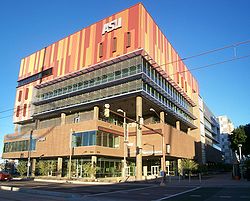
KAET (channel 8), branded Arizona PBS, is a PBS member television station in Phoenix, Arizona, United States, owned by Arizona State University and operated by ASU's Walter Cronkite School of Journalism and Mass Communication. KAET's studios are located at the Cronkite School's facility at ASU Downtown Phoenix, and its transmitter is located on South Mountain on the south side of Phoenix. Its signal is relayed across Arizona on a network of 13 translator stations.
Key Information


History
[edit]In late 1959, as it was preparing to build new facilities for itself,[3] Phoenix commercial television station KVAR offered to sell its old transmitter on South Mountain, valued at $150,000, to ASU for $30,000. The offer jumpstarted plans to build an educational television station in Phoenix and prompted the Arizona Board of Regents to authorize expenditures for the transmitter and additional equipment in January 1960.[4]
On November 8, 1960, the Federal Communications Commission granted the construction permit to ASU.[5] Having found that the call letters KASU was already in use at Arkansas State University, the call letters KAET was selected, for "Arizona Educational Television".[1] The station began broadcasting January 30, 1961, with a series of telecourses as well as programming from National Educational Television; the station's first local production was a Spanish 101 course.[6] By 1966, KAET broadcast 50 hours a week of programs.[7] It converted to color, first with network shows, with a grant for a color broadcast chain in 1967;[8] the station's lobbying for color conversion was aided when the staff delivered a color television set to university president G. Homer Durham.[6] In 1973, KAET moved from its original home in the Engineering Center to another location on the Tempe campus, the newly built Stauffer Hall communications building.[1]
Statewide expansion began in 1980 when translators on Mount Francis and Mingus Mountain, followed the next year by another on Mount Elden, were activated.[9] The decade also saw the establishment of Horizon, the station's flagship public affairs show, in 1981; the world's first broadcast of open heart surgery in 1983;[10] and the station's wall-to-wall telecast of the Evan Mecham impeachment hearings in 1988.[1] Sister radio station KBAQ signed on in 1993.

In June 1999, KAET was issued a permit to construct digital television facilities on UHF channel 29. KAET-DT went on the air in April 2001 and was licensed on June 12, 2001, becoming the fifth licensed digital television station in the state.
During the late-2000s recession, fundraising efforts at KAET fell behind projections, resulting in two major rounds of layoffs. The first round came in late October 2008, when the station, having missed its fundraising targets by hundreds of thousands of dollars, had to lay off six workers.[11][12] The second round of layoffs came in April 2009, when 13 workers were laid off.[13] The financial crisis also delayed KAET's move from its longtime home on the Tempe campus to its new headquarters in downtown Phoenix;[12] the move was completed at the end of 2009.[1]
Known for years as "Channel 8", the station began using "Arizona PBS" as a secondary brand in 2005. In 2006, KAET relaunched as "Eight, Arizona PBS" (stylized as "ei8ht" in logos); this brand was dropped in 2015 in favor of simply "Arizona PBS".
Previously under the supervision of the ASU public affairs office, though with a close association with the Cronkite School, operational control of the station was transferred to Cronkite itself in 2014.[14] KAET airs a Cronkite News newscast produced by journalism students on weeknights (along with occasional breaking news coverage), and Cronkite also houses the western bureau of the PBS NewsHour, which opened in 2019.[15]
Programming
[edit]KAET produces several of its programs in-house, such as its current events program Arizona Horizon, its Hispanic-focused current events counterpart Horizonte, and its Arizona Collection documentaries about the people, places and history of the state. The Emmy Award-winning Over Arizona, produced in 1995 with KCTS Seattle, is an aerial adventure over Arizona's diverse landscapes and was the first high-definition television program produced by an Arizona broadcast entity.
Technical information
[edit]Subchannels
[edit]The station's signal is multiplexed:
| Channel | Res. | Aspect | Short name | Programming |
|---|---|---|---|---|
| 8.1 | 720p | 16:9 | AZ PBS | Main KAET programming / PBS |
| 8.2 | 480i | Life | Arizona PBS Life | |
| 8.3 | World | World | ||
| 8.4 | AZ KIDS | PBS Kids | ||
| 8.5 | Audio only | KBAQ | Dolby Digital 5.1 simulcast of KBAQ | |
Analog-to-digital conversion
[edit]KAET's digital signal has been on the air since 2001, originally operating on UHF channel 29, and presently carries four subchannels under the Arizona PBS Digital Broadcasting brand. The station shut down its analog signal, over VHF channel 8, on April 29, 2009. The station's digital signal relocated from its pre-transition UHF channel 29 to VHF channel 8.[17]
Translators
[edit]References
[edit]- ^ a b c d e Griffiths, Lawn (January 30, 2011). "50 years of Eight: Valley's public television station still innovating". East Valley Tribune. Retrieved January 28, 2021.
- ^ "Facility Technical Data for KAET". Licensing and Management System. Federal Communications Commission.
- ^ "ASU Wants Channel 8 For Educational Use". The Arizona Republic. July 31, 1960. p. 8. Retrieved January 28, 2021.
- ^ Meibert, Virgil (January 28, 1960). "Regents Okay Plans For Educational TV On Channel 8". The Arizona Republic. p. 18. Retrieved January 28, 2021.
- ^ "History Cards for KAET". Federal Communications Commission. (Guide to reading History Cards)
- ^ a b "The Early Years of Arizona PBS". Arizona PBS. December 18, 2020. Retrieved January 28, 2021.
- ^ "Educational TV Expands Programs". Arizona Days and Ways. September 11, 1966. p. 17. Retrieved January 28, 2021.
- ^ "ASU's KAET To Go to Color". The Arizona Republic. February 9, 1967. p. 21. Retrieved January 28, 2021.
- ^ Velotta, Rick (April 3, 1981). "TIA Hopeful TV Translator System Will Be Ready April 20". Arizona Daily Sun. p. 1. Retrieved January 28, 2020.
- ^ Sefton, Dru (November 5, 2012). "KAET: 30 years from The Operation to The Latest Procedure". Current. Retrieved January 28, 2021.
- ^ Sneed, Adam (October 23, 2008). "Channel 8 feels effects of bad economic times". The State Press. Arizona State University Student Media. Archived from the original on July 18, 2012. Retrieved April 20, 2009.
- ^ a b Fenske, Sarah (November 24, 2008). "Channel Eight, Arizona's Biggest PBS Station, Needs Money to Relocate — but Have Viewers Already Moved On?". Phoenix New Times. Village Voice Media. Retrieved April 20, 2009.
- ^ Stern, Ray (April 15, 2009). "PBS Channel 8 (KAET-TV) Slashes 13 Jobs in Latest Media Layoff". Phoenix New Times. Village Voice Media. Retrieved April 20, 2009.
- ^ Newman, Logan (July 17, 2014). "Cronkite, PBS restructure to fully merge". State Press. Retrieved January 28, 2021.
- ^ Schon, Noelle (March 20, 2019). "PBS NewsHour to open its western bureau at ASU's Cronkite school". State Press. Retrieved January 29, 2021.
- ^ "RabbitEars TV Query for KAET". RabbitEars. Retrieved October 22, 2022.
- ^ "CDBS Print". FCC. Retrieved March 17, 2009.
External links
[edit]Includes English-language stations in out-of-state TV markets, but reaching a portion of Arizona | ||
| ABC | ||
| CBS | ||
| Fox | ||
| NBC | ||
| The CW | ||
| MyNetworkTV | ||
| Ion Television | ||
| PBS | ||
| Religious | ||
| Other | ||
| ATSC 3.0 | ||
| ||

History
Founding and early broadcasts
KAET, representing Arizona Educational Television, was conceived in the late 1950s as a means to extend Arizona State University's (ASU) educational resources into homes across the state, enabling students to access college-level courses via televised lectures supplemented by mailed instructional materials.[4] The station signed on the air on January 30, 1961, becoming the 56th public television station in the United States and broadcasting from ASU's Engineering Center on its Tempe campus.[2][4] Robert H. Ellis served as the inaugural general manager, with the initiative spearheaded by ASU administrator Richard Bell to leverage the emerging medium of television for formal education.[2][5] The debut broadcast schedule emphasized instructional content tailored to university students and broader audiences, featuring telecourses such as Spanish 101 taught by Dr. Quino Martinez, alongside Business Math, Child Development, and American Government.[5] Daytime programming included a community bulletin board for local announcements, children's educational segments, and audiovisual aids, while evenings offered a newscast and films on topics like the scientific method.[2][5] Early operations faced logistical hurdles, including preventing cheating in telecourses, accommodating faculty reluctance to adapt lectures to 30- or 60-minute slots, and technical mishaps such as a rattlesnake escaping during a biology class broadcast by Dr. Herbert Stahnke.[5] In its formative years, KAET expanded local production, premiering the Day in Review News program in 1962 and earning a National Academy of Television Arts and Sciences award for 300 hours of original content that same year, followed by its first regional Emmy in 1963.[4][2] Public affairs programming like Thursday at Nine emerged, and by 1968, the station acquired color studio cameras to enhance production quality.[5][2] Initially affiliated with National Educational Television (NET), KAET transitioned toward broader public broadcasting as PBS formed in 1970, gradually diversifying beyond strict telecourse reliance.[5]Expansion and programming evolution
Following its founding broadcasts centered on college-level telecourses for Arizona State University students, KAET expanded its programming scope in the late 1960s by acquiring color studio cameras in 1968 and joining PBS in 1969, which replaced cumbersome "bicycling" film distribution with landline interconnection for national content such as Sesame Street.[5][4] This shift broadened appeal beyond ASU coursework, incorporating children's programming, public affairs, and cultural series while phasing out many telecourses by the 1980s in favor of experimental local productions like instructional series on gardening and automotive topics.[5] Facilities upgrades supported this evolution, including a 1973 relocation to Stauffer Hall's B-Wing on the ASU Tempe campus and the initiation of on-air fundraising in 1975, which grew membership to 7,100 households and enabled further content diversification.[4] Signal expansion in the 1980s extended coverage beyond the Phoenix metro via translators on Mount Francis/Mingus Mountain (1980) for Prescott, in Flagstaff (1981), and Williams (1987), reaching approximately 80% of Arizona households.[2] Programming innovations included the premiere of the local public affairs series Horizon in 1981, live coverage of events like Sandra Day O'Connor's Supreme Court confirmation hearings that year and a heart surgery broadcast in 1983, alongside the Arizona School Television Project offering over 60 courses.[4][2] The transition to digital broadcasting in 2001 marked a technological leap, introducing high-definition on channel 8.1 and initial multicast channels (8.2 and 8.3), which allowed simulcasting of PBS networks like World and Create while expanding local output.[4][2] By 2009–2010, KAET completed a major facilities consolidation at the Walter Cronkite School of Journalism and Mass Communication's downtown Phoenix campus, integrating production with journalism training and enhancing news capabilities.[2][4] Programming further evolved with Spanish-language public affairs via Horizonte in 2003, food and culture series like Plate & Pour (2018) and Art in the 48 (2019), and the addition of Arizona PBS KIDS on channel 8.4 in 2017, reflecting a sustained emphasis on local relevance amid national PBS affiliations.[2]Rebranding and modern developments
In 2006, KAET underwent a significant rebranding, adopting the on-air identity "Eight, Arizona PBS" and phasing out its long-established "Channel 8" moniker to emphasize its statewide public service role.[2] This shift coincided with expanded digital broadcasting capabilities, as the station had initiated digital subchannels (8.1, 8.2, and 8.3) in 2001, enabling multicast programming including PBS affiliates like World and Kids.[2] The analog signal ceased operations on April 29, 2009, in compliance with the national DTV transition, with post-transition adjustments for certain viewers completed by late 2011.[6] By 2014, the station fully rebranded as Arizona PBS, aligning its operations more closely with the Walter Cronkite School of Journalism and Mass Communication at Arizona State University following a 2010 relocation from Tempe to Phoenix facilities.[2] This period saw enhancements in local production, including the nightly debut of Cronkite News in 2010 and the launch of the dedicated Arizona PBS KIDS subchannel in 2017 to support educational outreach.[2] In 2021, Arizona PBS expanded streaming accessibility by introducing Playlist 48, a video-on-demand service, and in April 2025, its primary HD channel became available for free streaming on Amazon Prime Video nationwide.[2][7] Recent infrastructure developments include the adoption of ATSC 3.0 (NextGen TV) in 2021 alongside other Phoenix stations, improving broadcast quality and interactivity.[8] In August 2024, Arizona PBS received a record $10 million donation from donors Sue Hart-Wadley and Searle Wadley to fund construction of a new 297-foot broadcast tower on the ASU Tempe campus, a national science program, and statewide educational initiatives, addressing aging equipment critical for signal reliability and emergency communications.[9][10] The project, the largest gift in station history, targets completion to sustain over-the-air reach amid evolving federal funding challenges for public broadcasters.[11] In August 2025, Arizona Senate President Warren Petersen petitioned the FCC to investigate KAET for alleged viewpoint discrimination, citing instances of denied access to conservative-leaning groups while granting it to others, potentially warranting license review.[12]Ownership and Operations
Affiliation with Arizona State University
KAET, branded as Arizona PBS, is owned and operated by Arizona State University (ASU), functioning as the university's primary public broadcasting outlet. Established on January 30, 1961, the station signed on as Arizona Educational Television from a trailer on ASU's Tempe campus, marking it as the 56th public television station in the United States and initially focused on delivering instructional programming to support university courses and community education.[2][13][14] This ownership structure positions KAET as the largest public television station directly managed by a university, serving nearly 2 million households across Arizona while aligning with ASU's educational and public service objectives. The station's operations integrate closely with university academic programs, particularly through the production of Cronkite News, a student-led newscast from the Walter Cronkite School of Journalism and Mass Communication, which provides hands-on training in broadcast journalism and airs as KAET's primary local news offering.[2][3] In 2010, KAET relocated from ASU's Tempe campus to the Walter Cronkite School's state-of-the-art facilities in downtown Phoenix, fostering deeper collaboration between station staff and journalism students, including shared studios, newsrooms, and production resources. This move, part of a broader ASU Media Enterprise initiative, enhanced KAET's role in experiential learning and public affairs programming. The station rebranded to Arizona PBS in 2014, with its CEO role assumed by the dean of the Cronkite School, further embedding operational leadership within ASU's academic framework.[2][15]Facilities and production capabilities
KAET's studios are housed in the Walter Cronkite School of Journalism and Mass Communication building on Arizona State University's Downtown Phoenix campus at 555 N Central Avenue.[16] The station relocated to this facility in 2010 from its previous location on the ASU Tempe campus.[17] This six-story structure integrates broadcast operations with educational spaces, including state-of-the-art TV studios, control rooms, digital TV newsrooms, an advanced multi-platform newsroom, and more than 50 digital editing bays.[18] The primary production space features a configurable 60 by 90 foot multi-use studio covering 5,300 square feet, supporting diverse video and audio productions.[19] Arizona PBS offers comprehensive production services, including video news releases, program pilots, on-location recording, workforce development videos, and audio capabilities via Central Sound such as Dolby Atmos mixing, podcast production, voice-overs, and audio restoration.[19] These resources enable both local programming and external client projects, leveraging industry-leading equipment for high-quality output.[19] KAET's broadcast transmitter is located on South Mountain in south Phoenix, facilitating coverage across the metropolitan area and beyond.[20]
Programming
National PBS affiliations
KAET functions as the flagship PBS member station for the Phoenix media market, delivering the complete national PBS primetime and daytime schedule on its primary digital subchannel 8.1.[21] This includes core distributed series such as the science documentary Nova, which explores scientific phenomena and innovations; the investigative news program Frontline, covering global issues through in-depth reporting; and the drama anthology Masterpiece, featuring adaptations of British literature and historical events.[22] These programs are sourced directly from PBS's national distribution feed, ensuring alignment with the network's standards for educational and cultural content.[21] In addition to the main channel, KAET maintains affiliations with PBS's specialized multicast services across its subchannels. Subchannel 8.3 broadcasts PBS World, a 24-hour service emphasizing international documentaries, global news, and cultural explorations from producers worldwide.[22] Subchannel 8.4 is devoted exclusively to PBS Kids, providing continuous children's programming aimed at early education and development, reaching approximately 80% of Arizona households via over-the-air signals.[21] Subchannel 8.2, branded Arizona PBS Life, carries lifestyle-oriented content including cooking, travel, and home improvement shows, mirroring the format of PBS's national Create service for adult enrichment.[22] These subchannel affiliations enhance KAET's role in distributing PBS's multicasting initiative, launched post-2009 digital transition to expand non-commercial viewing options.[2] Historically, KAET's national ties trace to its origins as a National Educational Television (NET) affiliate in 1961, transitioning to full PBS membership in 1970, after which it began airing seminal series like Sesame Street and Masterpiece Theatre.[2] Today, as Arizona PBS, the station ranks among the most-viewed public broadcasters per capita in the U.S., with around 600,000 weekly viewers engaging national content alongside local productions.[21] Access to extended episodes of flagship programs is available to members via PBS Passport, a benefit tied to the station's PBS affiliation.[22]Local news and public affairs
KAET, operating as Arizona PBS, emphasizes in-depth public affairs programming over traditional daily newscasts, distinguishing it from commercial broadcasters in the Phoenix market. Its local news efforts are integrated with Arizona State University's Walter Cronkite School of Journalism and Mass Communication, functioning as a "teaching hospital" where advanced students produce Cronkite News content, including investigative reports and daily stories broadcast on Arizona PBS channels and reaching over 1 million viewers weekly.[23][24] The station's cornerstone public affairs program is Arizona Horizon, launched in 1981 and recognized as Arizona's longest-running locally produced show, providing analysis of state politics, policy issues, and national developments affecting the region.[25] Hosted by Ted Simons for over two decades, it airs weekdays at 5 p.m. and 10 p.m., featuring panel discussions such as the Journalists' Roundtable with local reporters and occasional live audience formats for election coverage involving officials like Secretary of State Adrian Fontes and county recorders.[26][27] Arizona Horizon maintains a focus on substantive issues, including water management, economic policy, and electoral integrity, often drawing on expert guests and archival footage to contextualize events without sensationalism.[28] This format has sustained viewer trust amid criticisms of mainstream media bias, prioritizing primary source interviews over narrative-driven reporting. Special segments, such as those on community programs or art exhibits, extend its scope to cultural and civic matters relevant to Arizonans.[29] Student contributions via Cronkite News supplement Horizon with on-the-ground reporting, such as coverage of local government meetings and social issues, fostering practical training while airing verifiable, fact-checked segments on Arizona PBS platforms. This model, formalized in 2014 when the Cronkite School assumed operational oversight, ensures content aligns with journalistic standards emphasizing evidence over advocacy.[30][31]Educational and cultural content
Arizona PBS delivers educational programming tailored to children, including daily airings of PBS Kids shows focused on early learning and development, alongside ASU telecourses that offer academic credits to viewers pursuing formal education.[22][32] The station's dedicated Education team develops and distributes resources such as workshops, digital tools, and content aligned with K-12 curricula to support educators, caregivers, and parents in fostering literacy, STEM skills, and social-emotional growth.[33] Initiatives like the Educational Outreach-ASSET program integrate virtual reality simulations into teacher professional development, enhancing instructional methods for K-12 classrooms.[34] In the realm of cultural content, Arizona PBS emphasizes local arts through broadcasts featuring performances by the Phoenix Symphony, Phoenix Chorale, and ASU School of Music, often in collaboration with regional organizations.[22] The Emmy Award-winning series Art in the 48, hosted by Alberto Ríos, profiles Arizona artists and examines their contributions to community identity and creative expression.[35] Similarly, From the Vault presents archived programs hosted by Ríos that delve into Arizona's historical narratives, indigenous traditions, natural landscapes, and evolving cultural heritage.[36] Documentary productions further cultural exploration, including Over Arizona, which showcases the state's aerial vistas and geological features; Seasons of a Navajo, documenting Navajo life cycles; and River of Stone, highlighting the cultural significance of the Colorado River region.[37] These efforts align with the station's foundational commitment to addressing Arizona residents' cultural needs via public broadcasting.[38]Funding and Financial Structure
Revenue sources and public support
KAET, operating as Arizona PBS, derives the majority of its revenue from individual contributions, including memberships, major gifts, and bequests, which accounted for approximately 45% of its $29.99 million total revenue in fiscal year 2024.[39] Memberships and subscriptions generated $6.38 million (21.3%), while gifts from major individual donors contributed $7.07 million (23.6%), reflecting strong public support through viewer donations and pledge drives.[39] In fiscal year 2023, these categories combined for over 50% of the $22.07 million total, with subscriptions and memberships alone at $7.94 million (36%) and other gifts at $3.54 million (16%).[40] Federal funding via the Corporation for Public Broadcasting (CPB) provides a supplemental but notable portion, comprising about 8% of revenue in both recent fiscal years: $2.45 million in community service grants for FY2024 and $1.85 million in FY2023, with additional minor CPB allocations such as $101,000 in FY2024 for other programs.[39][40] Other grants from foundations and nonprofit associations added $1.18 million (3.9%) in FY2024, while state government sources ineligible as non-federal financial support (NFFS) contributed $4.58 million (15.3%), often tied to educational initiatives.[39] Support from Arizona State University includes indirect administrative assistance valued at $3.38 million (15%) in FY2023, alongside a general appropriation of $0.32 million (1%), though direct university allocations appear minimal at $69,000 (0.2%) in FY2024 reporting.[40][39] Corporate underwriting from businesses provided $1.07 million (3.6%) in FY2024, funding program-specific content without direct influence over editorial decisions.[39] Notable public philanthropy includes a record $10 million donation in August 2024 from an Arizona couple to fund a new broadcast tower, a national science program, and statewide educational outreach.| Revenue Category (FY2024) | Amount | Percentage |
|---|---|---|
| Memberships/Subscriptions | $6.38M | 21.3% |
| Major Individual Gifts | $7.07M | 23.6% |
| CPB Community Service Grants | $2.45M | 8.2% |
| State Government (NFFS) | $4.58M | 15.3% |
| Foundations/Nonprofits | $1.18M | 3.9% |
| Underwriting | $1.07M | 3.6% |
Federal funding dependencies and recent cuts
KAET, operated by Arizona State University as Arizona PBS, has historically relied on federal funding channeled through the Corporation for Public Broadcasting (CPB) via annual Community Service Grants. These grants, derived from congressional appropriations to the CPB under the Public Broadcasting Act of 1967, constituted approximately 13% of Arizona PBS's overall budget as of mid-2025.[41] In fiscal year 2024, KAET received $2,199,348 in such television community service funding from the CPB, supporting operations including local programming production and distribution.[42] The station's audited financial statements for 2022-2023 explicitly note a dependency on CPB grants, highlighting their role in sustaining non-commercial educational broadcasting amid diverse revenue streams like university support and private donations.[40] This federal dependency aligns with broader PBS station averages, where CPB funds typically cover 15-18% of budgets, enabling infrastructure maintenance and content acquisition while leveraging the "multiplier effect" of matching local contributions.[43] For KAET, the grants facilitated compliance with federal mandates for public service, including educational outreach and emergency information dissemination, though the station diversified funding to mitigate risks from fluctuating appropriations.[44] In May 2025, President Trump issued an executive order titled "Ending Taxpayer Subsidization of Biased Media," directing the CPB to halt direct funding to PBS and NPR, citing concerns that federal support enabled partisan content over objective public service.[45] This policy precipitated congressional action: the Rescissions Act of 2025, enacted in June and signed into law, clawed back over $1 billion in previously appropriated CPB funds for fiscal years 2026 and 2027, effectively defunding the corporation beyond September 30, 2025.[46] The CPB responded by announcing operational wind-down, issuing prorated final Community Service Grants on September 22, 2025—$15,680 per public television grantee, a fraction of prior levels—drawing from unspent reserves to fulfill statutory obligations.[47] For KAET, the cuts eliminated its primary federal revenue stream, projecting an annual loss exceeding $2 million starting fiscal year 2026, equivalent to 13% of operating costs.[41] [42] While Arizona PBS emphasized community fundraising to offset impacts—already sourcing over 80% of funds from memberships, underwriting, and grants—no immediate programming cancellations were announced, though station executives acknowledged the need for structural efficiencies amid the abrupt end to five decades of consistent federal backing.[48] The defunding, part of a broader $9.4 billion rescissions package, disproportionately affected public media reliant on CPB for rural coverage and localism, prompting debates over taxpayer subsidization of entities perceived by critics as ideologically skewed despite statutory firewalls against political interference.[49][50]Technical Information
Broadcast signal and coverage
KAET transmits its primary over-the-air signal on VHF digital channel 8 from a facility atop South Mountain in Phoenix, Arizona.[51] The transmitter operates at an effective radiated power (ERP) of 40 kW, with an antenna height of 308 feet above ground level (2,993 feet above mean sea level), yielding a predicted noise-limited coverage contour of 75.4 miles and encompassing approximately 17,837 square miles.[51] This provides reliable reception to the Phoenix metropolitan area, serving an estimated 4.2 million viewers.[51] Statewide extension of the signal relies on a network of digital translators, which relay KAET's programming to rural and remote regions.[52] Notable expansions include seven new translators activated between June 2013 and September 2013 to reach underserved communities, and a dedicated low-power translator in Yuma brought online on July 12, 2021, after installation to improve local access in southwestern Arizona.[52][53] Additional translators, such as one in the Show Low area operational since April 2014, further bolster coverage in northeastern Arizona, including Pinetop, Lakeside, Snowflake, and Taylor.[54] These facilities collectively enable over-the-air delivery to a broad swath of Arizona's population beyond the primary urban footprint.[52]Subchannels and multicast services
KAET operates multiple digital subchannels via ATSC multicast technology, allowing simultaneous transmission of diverse programming over its primary RF signal on physical channel 33 (virtual channel 8).[22] The station's subchannels include a primary high-definition feed and additional standard-definition services focused on public television content, educational programming, and local audio simulcast.[55] As of 2025, KAET's active video subchannels are:| Virtual Channel | Programming Network | Format and Content |
|---|---|---|
| 8.1 | Arizona PBS HD | 720p high-definition simulcast of main PBS schedule, featuring national programs, local news from Cronkite News, and public affairs content.[22] |
| 8.2 | Arizona PBS Life | 480i standard-definition channel offering lifestyle, encore PBS programming, and select how-to series, serving as a supplementary service to the main feed.[22][55] |
| 8.3 | Arizona PBS World | 480i channel dedicated to international news, documentaries, and global affairs from PBS World, providing in-depth coverage of historical and current events.[56][22] |
| 8.4 | PBS Kids | 480i 24/7 children's programming block with educational shows for young audiences, available via antenna and select cable providers.[22] |