


Community hub
Recent from talks
Contribute something
Nothing was collected or created yet.
Meadview, Arizona
View on Wikipedia
Meadview is an unincorporated community and census-designated place (CDP) in Mohave County, Arizona, United States, located near Lake Mead. As of the 2020 census, Meadview had 1,420 residents,[3] up from 1,224 as of 2010.[5] It was founded in the 1960s as a retirement community[6] and is still largely one, as well as a vacation spot for people coming to enjoy Lake Mead.
Key Information


Geography
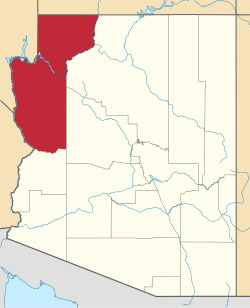
[edit]Meadview is located in northern Mohave County. It is 67 miles (108 km) north of Kingman, the county seat, via Pierce Ferry Road. From the road it is possible to see Lake Mead to the west, 3 miles (5 km) distant. Road access to the lake is 11 miles (18 km) to the north. Pearce Ferry on the Colorado River, at the west end of the Grand Canyon, is 14 miles (23 km) north of Meadview.
According to the United States Census Bureau, the Meadview CDP has an area of 31.0 square miles (80 km2), all land.[1]
Climate
[edit]According to the Köppen Climate Classification system, Meadview has a hot desert climate, abbreviated "BWk" on climate maps.[7]
| Climate data for Climate Meadview – Arizona, 1981–2010. | |||||||||||||
|---|---|---|---|---|---|---|---|---|---|---|---|---|---|
| Month | Jan | Feb | Mar | Apr | May | Jun | Jul | Aug | Sep | Oct | Nov | Dec | Year |
| Mean daily maximum °F (°C) | 56 (13) |
59 (15) |
67 (19) |
77 (25) |
87 (31) |
98 (37) |
102 (39) |
100 (38) |
93 (34) |
79 (26) |
65 (18) |
55 (13) |
78 (26) |
| Mean daily minimum °F (°C) | 33 (1) |
36 (2) |
41 (5) |
49 (9) |
60 (16) |
70 (21) |
76 (24) |
74 (23) |
65 (18) |
52 (11) |
41 (5) |
33 (1) |
53 (11) |
| Source: US Climate Data[8][9] | |||||||||||||
Demographics
[edit]
| Census | Pop. | Note | %± |
|---|---|---|---|
| 2000 | 821 | — | |
| 2010 | 1,224 | 49.1% | |
| 2020 | 1,420 | 16.0% | |
| U.S. Decennial Census[10] | |||
| Race (NH = Non-Hispanic) | % 2020[11] | % 2010[12] | Pop 2020 | Pop 2010 |
|---|---|---|---|---|
| White alone (NH) | 88.9% | 90.4% | 1,263 | 1,106 |
| Black alone (NH) | 0.5% | 0.7% | 7 | 8 |
| American Indian alone (NH) | 0.8% | 1.1% | 12 | 13 |
| Asian alone (NH) | 0.6% | 1% | 9 | 12 |
| Pacific Islander alone (NH) | 0.1% | 0.1% | 1 | 1 |
| Other race alone (NH) | 0% | 0.1% | 0 | 1 |
| Multiracial (NH) | 2.7% | 1.9% | 38 | 23 |
| Hispanic/Latino (any race) | 6.3% | 4.9% | 90 | 60 |
According to the 2010 Census, the racial composition of Meadview was as follows:
- White: 92.8% (Non-Hispanic Whites: 95.5%; Hispanic Whites: 4.9%)
- Black or African American: 0.7%
- Asian: 1.0%
- Two or more races: 2.2%
- Native American: 1.3%
- Native Hawaiian and Other Pacific Islander: 0.1%
Source:[13]
Media
[edit]Meadview is the community of license for five broadcast translator television stations and one translator radio station. The TV stations rebroadcast Phoenix stations, and are owned by Mohave County. The radio station is privately owned and rebroadcasts a radio station from Redding, California via satellite. Meadview is also within range of the major television and radio stations from Las Vegas, Nevada.
Broadcast media licensed to Meadview:
- K23DK – translator of KPNX 12 Phoenix (NBC)
- K25DH – translator of KTVK-TV 3 Phoenix (Ind)
- K36FZ – translator of KAET 8 Phoenix (PBS)
- K38GR – translator of KNXV-TV 15 Phoenix (ABC)
- K47HE – translator of KPHO-TV 5 Phoenix (CBS)
- K215DJ 90.9 – translator of KVIP-FM 98.1 Redding CA (Contemporary Christian)
- KCYE 107.9 – country station serving Las Vegas, licensed to Meadview.
Education
[edit]The CDP is in the Kingman Unified School District.[14]
References
[edit]- ^ a b "2021 U.S. Gazetteer Files: Arizona". United States Census Bureau. Retrieved May 24, 2022.
- ^ a b U.S. Geological Survey Geographic Names Information System: Meadview, Arizona
- ^ a b "P1. Race – Meadview CDP, Arizona: 2020 DEC Redistricting Data (PL 94-171)". U.S. Census Bureau. Retrieved May 24, 2022.
- ^ "Meadview AZ ZIP Code". zipdatamaps.com. 2023. Retrieved February 17, 2023.
- ^ "Meadview Info: Local History". August 28, 2006.
- ^ "Meadview Info: More History". August 28, 2006.
- ^ Climate Summary for Meadview, Arizona
- ^ "NOWData – NOAA Online Weather Data". National Weather Service. Retrieved September 8, 2015.
- ^ "Climate Meadview – Arizona". US Climate Data. Retrieved September 8, 2015.
- ^ "Census of Population and Housing". Census.gov. Archived from the original on August 1, 2018. Retrieved June 4, 2015.
- ^ "HISPANIC OR LATINO, AND NOT HISPANIC OR LATINO BY RACE (2020)". data.census.gov. U.S. Census Bureau.
- ^ "HISPANIC OR LATINO, AND NOT HISPANIC OR LATINO BY RACE (2010)". data.census.gov. U.S. Census Bureau.
- ^ "Meadview, AZ Population - Census 2010 and 2000 Interactive Map, Demographics, Statistics, Quick Facts - CensusViewer". Archived from the original on August 1, 2018. Retrieved August 1, 2018.
- ^ "2020 CENSUS - SCHOOL DISTRICT REFERENCE MAP: Mohave County, AZ" (PDF). U.S. Census Bureau. p. 1 (PDF p. 2/4). Retrieved October 4, 2024. - Text list
External links
[edit]- U.S. Geological Survey Geographic Names Information System: Meadview Census Designated Place
- Meadview Civic Association
Meadview, Arizona
View on GrokipediaHistory
Early Exploration and Settlement
The area encompassing present-day Meadview, Arizona, located along the Colorado River in northwestern Mohave County, was first traversed by European-American explorers in the early 19th century as part of expeditions seeking fur-trapping opportunities and routes to the Pacific. In August 1826, Jedediah Smith led a party of 17 men from the Great Salt Lake region southwestward through what is now southern Utah and Nevada, reaching the Colorado River near the Mohave villages along the 35th parallel, south of the modern site of Meadview, where they crossed into California.[10] This crossing marked one of the earliest documented American explorations of the lower Colorado River basin, driven by the pursuit of beaver pelts in uncharted territories.[11] Subsequent government-sponsored surveys further documented the rugged terrain and riverine features of the region. Between 1857 and 1858, Lieutenant Joseph Christmas Ives commanded an expedition for the U.S. Army Corps of Topographical Engineers, navigating the Colorado River aboard the sternwheeler Explorer from the river's mouth upstream to Black Canyon, approximately 30 miles north of Meadview. Ives's journey produced the first detailed maps and reports of the area's canyons and desert landscapes, highlighting its isolation and potential navigational challenges, though the vessel ultimately wrecked near the Nevada-Arizona border. In 1869, John Wesley Powell's pioneering Colorado River expedition passed through the lower Grand Canyon sections adjacent to the Meadview vicinity, providing ethnographic and geological insights into the Hualapai and other Indigenous peoples while emphasizing the river's formidable barriers to overland travel.[11] Settlement in the Meadview area remained sparse and transient until the mid-19th century, primarily tied to Mormon colonization efforts along the Colorado River. In the early 1860s, Jacob Hamblin explored the area and made an initial makeshift river crossing at the site later known as Pearce Ferry, approximately 17 miles upstream from modern Meadview, to facilitate the transport of settlers, supplies, and missionaries between Arizona and Nevada as part of Brigham Young's directive to expand Latter-day Saint communities. Harrison Pearce established the formal ferry operation in 1876, constructing larger flatboats capable of handling wagons and livestock and charging tolls for crossings that supported regional trade and migration until its inundation by Lake Mead in 1938, with intermittent operations thereafter.[12][13] This ferry served as the earliest semi-permanent European-American outpost in the vicinity, though no substantial agricultural or residential communities developed due to the arid environment and remoteness; the site later became a key debarkation point for Lake Mead tourism following the 1930s construction of Hoover Dam.[12][13]Founding and Development
Meadview, Arizona, was founded in the early 1960s as a planned retirement community on land adjacent to the Lake Mead National Recreation Area in Mohave County.[14] The initial land acquisition for the development occurred in 1960, with developers Frank Glindmeier and Paul Mullane leading the effort under the corporate name Revcor, an engineering firm.[14] Their vision centered on creating an affordable, scenic haven for retirees drawn to the area's proximity to Lake Mead and the Colorado River, emphasizing low-density residential lots amid desert landscapes.[14] Development progressed slowly in the mid-1960s, hampered by the discovery that portions of the purchased land fell within the boundaries of the newly established Lake Mead National Recreation Area, necessitating land exchanges with federal authorities for inland parcels.[15] Key infrastructure projects included the construction of the South Cove boat ramp between 1965 and 1966, a $1 million endeavor spanning 15 months that enhanced access to Lake Mead for boating and recreation, supporting the community's recreational appeal.[15] Paved roads and basic utilities were gradually added, transforming raw desert terrain into subdivided lots marketed to out-of-state buyers seeking a peaceful retirement lifestyle.[16] By the late 1960s, community organization accelerated with the formation of the Meadview Civic Association (MCA) in August 1970, aimed at fostering resident involvement and securing shared facilities.[14] The MCA spearheaded the construction of a clubhouse, beginning in January 1971 and completing it by July of that year, which served as a central hub for social events and governance.[14] Population growth followed, rising from around 200 residents in the early 1970s to approximately 2,000 by 1983, when the Meadview Company acquired the remaining lots to continue subdivision and sales.[14] This period marked the shift from speculative development to a more established unincorporated community, with added amenities like a fire department, library, and small businesses reinforcing its retirement-oriented identity.[14]Geography
Location and Physical Features
Meadview is a census-designated place situated in northern Mohave County, northwestern Arizona, within the Basin and Range physiographic province. Its central coordinates are approximately 36°00′08″N 114°04′06″W, placing it near the Arizona–Nevada state line to the west and adjacent to the eastern shore of Lake Mead.[12][17] The community lies within the Meadview groundwater basin, a north-south trending structural depression spanning roughly 190 square miles, measuring 16 miles in length and 6 to 7 miles in width. This basin is bounded by the Grand Wash Cliffs to the east, Wheeler Ridge to the west, the Garnet Mountains to the south, and Lake Mead to the north, with the community itself positioned near the basin's southern end.[12][17] The terrain of the Meadview area is characterized by arid desert landscape with elevations ranging from about 1,400 feet (430 m) above mean sea level at the northern margin along Lake Mead to 4,400 feet (1,340 m) on the basin floor toward the south, and up to 6,024 feet (1,836 m) on the Grand Wash Cliffs. Meadview proper sits at an elevation of approximately 3,294 feet (1,004 m).[1] The physical features include rugged canyons, steep escarpments, and prominent sandstone buttes, shaped by faulting and erosion in the Basin and Range setting. The area is drained by the ephemeral Grapevine Wash, which originates in the southern highlands and flows northward into Lake Mead, with a short perennial segment near Grapevine Spring yielding about 60 gallons per minute as observed in the 1980s. Alluvial deposits line the wash, while the surrounding uplands consist primarily of sedimentary rocks, with granitic intrusions in the southern Garnet Mountains.[12][18][12] Geologically, the Meadview region features a complex stratigraphy exposed in the Meadview North quadrangle, including middle to late Miocene sedimentary rocks such as the Hualapai Limestone, Paleozoic sedimentary strata, and Proterozoic gneisses and granitoids. A notable 4.4-million-year-old basalt flow is interbedded with Colorado River gravels near Sandy Point, reflecting the area's tectonic history of normal faulting and eastward-tilting fault blocks. These elements contribute to the diverse topography, with the community overlooking Lake Mead—the largest reservoir in the United States—and situated near the West Rim of the Grand Canyon and approximately 37 miles southeast (upstream along the reservoir) from Hoover Dam. The proximity to Lake Mead National Recreation Area underscores its position within a broader landscape of significant hydrologic and scenic features.[19][19][12]Climate
Meadview, Arizona, features a hot desert climate (Köppen BWh), characterized by arid conditions, significant diurnal temperature swings, and low overall humidity. The area receives an average of about 7 inches of precipitation annually, spread across roughly 21 rainy days, contributing to its desert landscape dominated by sparse vegetation and rocky terrain. Average annual temperatures hover around 65°F, with daytime highs reaching 79°F and nighttime lows dipping to 54°F, reflecting the region's elevation of approximately 3,300 feet above sea level.[20][21][22] Summers in Meadview are intensely hot and dry, lasting from late May through mid-September, when daily high temperatures often exceed 91°F and peak in July at around 100°F during the day, with lows near 75°F. Winters are mild yet chilly, spanning December to February, with January highs averaging 55°F and lows around 36°F, occasionally dropping below freezing at night. Spring and fall serve as transitional periods with moderate temperatures, highs in the 70s to 80s°F, though strong winds can amplify the sense of aridity. The low humidity, typically below 30% year-round, exacerbates the heat in summer and the chill in winter, while clear skies prevail for about 80% of the year.[23][22][20] Precipitation patterns exhibit a bimodal distribution, with the highest monthly totals in winter (peaking at about 1.8 inches in February from Pacific storms) and a secondary summer peak during the North American monsoon season (around 1 inch in July from thunderstorms). Snowfall is negligible, averaging less than 0.1 inches annually and rarely accumulating. These limited rains support a fragile ecosystem, but drought conditions are common, with the region experiencing prolonged dry spells that heighten wildfire risk in surrounding vegetation. Extreme temperatures can occasionally surpass 106°F in summer or fall below 27°F in winter, underscoring the climate's variability.[24][25][23]Demographics
Population Trends
Meadview, an unincorporated census-designated place in Mohave County, Arizona, has experienced gradual population growth since the early 2000s, consistent with its development as a retirement destination near Lake Mead. The 2000 U.S. Decennial Census recorded a population of 1,005 residents.[26][27] This number rose to 1,224 by the 2010 U.S. Decennial Census, marking a 21.8% increase over the decade, driven by retirees seeking affordable housing and proximity to recreational opportunities.[28] The population continued to expand, reaching 1,420 in the 2020 U.S. Decennial Census, a 16.0% rise from 2010, reflecting sustained appeal to older adults amid Arizona's broader demographic shifts toward senior migration.[3] Post-2020 estimates from the U.S. Census Bureau's American Community Survey indicate further modest growth, with the population at approximately 1,624 in the 2018-2022 5-year period, underscoring a compound annual growth rate of about 1.2% since 2000.[29]Socioeconomic Characteristics
Meadview, a small community in Mohave County, Arizona, exhibits socioeconomic traits typical of rural retirement areas, with a high median age influencing employment and income patterns. The median household income in 2022 was $57,064, reflecting a modest increase from prior years, while the per capita income stood at approximately $31,447.[30][31] Poverty affects about 14% of the population, or roughly 228 residents, marking a slight uptick from prior years and underscoring challenges in a locale with limited job opportunities.[32] According to the 2018-2022 American Community Survey, the population is predominantly White (90.2%), with Hispanic or Latino residents comprising 4.1%, and other groups including Black or African American (1.5%), American Indian and Alaska Native (1.2%), and Asian (0.8%).[33] Educational attainment among adults aged 25 and older is below national averages, with 86.5% having completed high school or equivalent, but only 7.1% holding a bachelor's degree or higher. Of the total adult population, associate degrees account for about 20.8% and bachelor's degrees for 5.7%, indicating a reliance on vocational or community college paths rather than advanced degrees.[34] This profile aligns with the community's older demographic, where formal education levels have stabilized over recent decades. The local economy supports a small labor force of around 159 employed individuals, with an unemployment rate of 29% in 2022, elevated due to the predominance of retirees and seasonal work. Key employment sectors include professional, scientific, and technical services (23.6%), construction (21.8%), and educational services (20.5%), reflecting a mix of service-oriented and manual labor roles suited to the area's proximity to Lake Mead. Self-employment is notable at 22%, often in small businesses or consulting.[35] Housing in Meadview emphasizes affordability and ownership, with a 94.3% homeownership rate and a median property value of $152,400 as of the 2018-2022 ACS estimates. Mobile homes constitute 66.8% of units, catering to the community's budget-conscious residents, while median monthly housing costs are $450, primarily for mortgages or utilities in owner-occupied dwellings. Renter-occupied units are minimal at 5.7%, highlighting the area's appeal as a stable, low-turnover residential base.[36][37]Economy
Primary Industries
Meadview's economy is characterized by a small employed workforce, reflecting its status as a retirement community with a median age of 69.1 years and a labor force participation rate significantly below national averages. In 2023, only 159 residents were employed, representing a diverse but limited set of sectors dominated by services and construction.[38] The high proportion of retirees contributes to a low overall employment rate, with many residents drawing income from pensions, Social Security, or investments rather than local jobs.[39] The primary industries in Meadview, based on 2023 American Community Survey data, include professional, scientific, and technical services, which employ 23.6% of the workforce, often involving consulting, legal, or administrative roles suited to the community's older demographic. Construction follows closely at 21.8%, driven by ongoing residential development and home maintenance in this growing retirement area near Lake Mead. Educational services account for 20.5% of employment, primarily through local public schools and related support roles.[39] These sectors underscore Meadview's reliance on personal and community services rather than heavy industry. Smaller but notable contributions come from transportation and warehousing (13.7%), supporting logistics along the nearby Colorado River corridor, and other services such as repair and personal care (8.1%). Manufacturing and arts, entertainment, and recreation each represent 5.6% of jobs, indicating minor local involvement in these areas, with manufacturing likely limited to small-scale operations.[39] Overall, the economy's scale is modest, with a median household income of $55,954 in 2023, bolstered by the influx of retirees seeking affordable desert living.[39] Self-employment is prevalent, at 22% of workers, often in professional or construction trades.[40]Tourism and Recreation
Meadview, Arizona, serves as a gateway for tourists seeking outdoor recreation in the remote Mojave Desert, primarily due to its close proximity to the Lake Mead National Recreation Area and Grand Canyon West. The community's location, approximately 70 miles north of Kingman, attracts visitors interested in water-based activities, hiking, and scenic canyon views, with accommodations including RV parks and campgrounds catering to nature enthusiasts.[41] Local tourism emphasizes low-impact exploration of the surrounding 1.5 million acres of protected lands managed by the National Park Service.[42] A primary draw is the Lake Mead National Recreation Area, located just 5 miles west of Meadview, offering boating, fishing, kayaking, swimming, and hiking along 750 miles of shoreline. Access via South Cove, about 10 miles from town, includes a primitive gravel boat launch suitable for small watercraft (four-wheel drive recommended) and primitive campsites with vault toilets for overnight stays.[1][43] The area supports diverse water sports and wildlife viewing, though visitors should check current water levels and ramp conditions due to fluctuating reservoir levels.[44] Grand Canyon West, operated by the Hualapai Tribe and situated 20 miles east of Meadview, provides thrilling tourism experiences such as the glass-bottomed Skywalk extending 70 feet over the canyon rim, 4,000 feet above the Colorado River. Additional activities include helicopter tours with optional river landings, zipline rides reaching speeds of 40 mph, and guided rafting trips on the river.[1] These attractions highlight the West Rim's dramatic landscapes, drawing over 1 million visitors annually for cultural demonstrations and panoramic viewpoints.[45] Locally, the adjacent Grapevine Mesa Joshua Tree Forest offers easy hiking on a 0.1-mile loop trail through dense stands of the iconic trees, ideal for photography and birdwatching in a high-desert ecosystem.[1] Off-roading enthusiasts explore nearby trails like the Hualapai Wash, a 6.5-mile route crossing desert terrain into the recreation area, while the area's dark skies support stargazing from remote campsites. Pearce Ferry Rapid, 10 miles northwest, serves as a launch point for advanced kayaking and the endpoint for multi-day Grand Canyon river expeditions.[46][1]Government and Infrastructure
Local Governance
Meadview is an unincorporated community in Mohave County, Arizona, meaning it lacks its own municipal government and is directly administered by the county's Board of Supervisors.[47][14] The Mohave County Board of Supervisors serves as the primary governing body, handling legislative and executive functions such as zoning, public services, and infrastructure development for unincorporated areas like Meadview.[48] The board consists of five members, each representing a supervisorial district and elected to staggered four-year terms by district voters.[48] Meadview falls within Mohave County's District 4, which encompasses northwestern portions of the county including areas near Lake Mead.[49] District 4 is represented by Supervisor Don Martin, who was elected in 2024 and focuses on issues like public lands management and recreational access relevant to Meadview's rural setting.[50] Board meetings, where decisions affecting Meadview may be discussed, occur biweekly on the first and third Mondays (or Tuesdays if a holiday falls on Monday) at 9:30 a.m. in Kingman, with public participation options available.[51] While official governance is county-level, community affairs in Meadview are supported by the Meadview Civic Association (MCA), a nonprofit property owners' organization incorporated in 1970.[52] The MCA, governed by a seven-member Board of Governors elected by members, addresses local concerns such as recreational facilities, events, and advocacy with county officials, though it holds no statutory authority.[52] Membership meetings occur quarterly on the second Saturday of January, April, July, and October at 9:00 a.m., fostering resident involvement in non-governmental initiatives.[52]Transportation and Utilities
Meadview, an unincorporated community in Mohave County, Arizona, relies primarily on county-maintained roads for access, with no major interstate highways passing directly through the area. The primary route to Meadview is Pierce Ferry Road (also known as Mohave County Road 143 or formerly Arizona Highway 25), which connects from U.S. Route 93 near milepost 42, passing through Dolan Springs before reaching the community approximately 20 miles southeast of Lake Mead. This paved county road provides essential connectivity to regional destinations, including Kingman (about 70 miles south) and Las Vegas (approximately 115 miles northwest), and facilitates access to recreational sites like Lake Mead National Recreation Area. Mohave County Public Works maintains over 2,000 miles of roads countywide, including Pierce Ferry Road, with routine activities such as pothole repairs, grading, and chip sealing to ensure safe passage, though the remote location can lead to occasional weather-related closures.[53][54][55] Public transportation options in Meadview are limited due to its rural setting, with residents and visitors predominantly using personal vehicles. Mohave County Transit operates fixed-route bus services in more populated areas like Kingman and Bullhead City, but no regular routes extend to Meadview; travel from Kingman requires a private drive of about 1.5 hours via U.S. 93 and Pierce Ferry Road. Specialized shuttles, such as Wild River Shuttle's ferry and van services, provide on-demand transport for Lake Mead boating and hiking access from Meadview's shoreline points, catering mainly to tourists.[56][57][58][59] The nearest commercial airport is Laughlin/Bullhead International Airport (IFP), approximately 90 miles southwest, while general aviation is available at Kingman Airport (PGC) about 70 miles south.[57][58][59] Utilities in Meadview are provided through a combination of local cooperatives and individual systems, reflecting the community's small scale and isolation. Potable water is supplied by the Joshua Valley Utility Company (JVUC), a Class D public water system established in 1966 and regulated by the Arizona Corporation Commission, serving around 1,050 connections via five wells, four storage tanks totaling 510,000 gallons, and approximately 60 miles of mains sourced from groundwater in the area. JVUC is upgrading to advanced metering infrastructure to reduce water loss, which currently stands at 17.2%. Electricity is delivered by the Mohave Electric Cooperative, Inc., a member-owned utility serving rural Mohave County communities including Meadview, with ongoing infrastructure enhancements such as UniSource Energy Services' proposed 10-mile, 69 kV transmission line from Antares to a new Meadview substation to bolster grid reliability and power quality; as of 2025, the project remains proposed with no set completion date.[60][61][62][63] Wastewater management relies on individual on-site septic systems rather than a centralized sewer network, with permits and inspections handled by Mohave County Development Services for conventional and alternative systems to ensure environmental compliance. Natural gas service is unavailable via pipeline in this remote area, leading most households to use propane for heating and cooking, delivered by local vendors. Solid waste collection is coordinated through private haulers under Mohave County oversight, with recycling limited to drop-off sites in nearby Kingman.[64]Education
Public Schools
Meadview, an unincorporated community in Mohave County, is served by the Kingman Unified School District #20 (KUSD), which operates 13 schools across a vast 3,000-square-mile area including remote rural regions.[65] Students from Meadview do not have a local public school and rely on district-provided transportation to attend classes, with bus routes accommodating the community's isolation near Lake Mead.[66] Elementary education for grades K-6 is provided at Mt. Tipton Elementary School, located in nearby Dolan Springs about 30 miles north. As of November 2025, the school continues to serve grades K-6, despite a proposed relocation of 6th grade in 2025 that did not proceed.[67] This school enrolls approximately 189 students and emphasizes a complete academic program with interventions for reading proficiency and enrichment activities in a supportive environment.[68] Its attendance zone explicitly includes Meadview along with Dolan Springs, White Hills, and Chloride, ensuring access for outlying families despite the travel distance.[67] Middle school students in grades 7-8 typically attend Kingman Middle School in Kingman, roughly 65 miles southeast, where the district focuses on transitional programs including athletics and clubs to support over 600 students.[66] For high school, grades 9-12 options include Lee Williams High School or Kingman High School, both in Kingman, offering career and technical education pathways alongside traditional academics for approximately 2,000 students combined as of 2024.[69][70] These assignments reflect KUSD's broad boundaries, with transportation playing a critical role in educational access for Meadview residents.[71]Higher Education Access
Residents of Meadview, a remote unincorporated community in Mohave County, Arizona, primarily access higher education through Mohave Community College (MCC), the local public institution serving the county. MCC's main Neal Campus is located in Kingman, approximately 47 miles northwest of Meadview, offering associate degrees, certificates, and transfer programs in fields such as business, health sciences, and general education. The college also maintains additional campuses in Bullhead City and Lake Havasu City, both within Mohave County, providing broader geographic reach for residents willing to travel.[72][73] To accommodate rural residents like those in Meadview, MCC emphasizes flexible delivery methods, including fully online courses and hybrid formats that allow students to complete certificates or degrees from home without daily commuting. These online options cover a wide range of subjects, from general education requirements to career-oriented programs, and are designed to fit varying schedules for working adults in isolated areas. MCC's commitment to accessibility is evident in its 50-year history of serving Mohave County's diverse communities, with enrollment supporting around 5,000 students annually across all modalities as of 2024.[74][75][76] Beyond MCC, Meadview residents can pursue bachelor's and advanced degrees at Arizona's public universities, such as Northern Arizona University (NAU) in Flagstaff or Arizona State University (ASU) in Tempe, both of which offer extensive online and distance learning programs tailored for non-traditional students. Private institutions like University of Phoenix and Grand Canyon University, with strong online presences, also cater to Mohave County residents seeking flexible higher education pathways. The College of Southern Nevada, located in Henderson, Nevada, about 113 miles west across the state line, provides another nearby option for community college-level courses, particularly appealing for those near Lake Mead.[77][78][79] Financial support enhances access for eligible Meadview residents through programs like the Arizona Promise Program, which covers tuition and fees at public universities for Arizona high school graduates meeting income and GPA criteria, thereby reducing barriers for rural students pursuing four-year degrees. This initiative, administered statewide, has helped increase postsecondary enrollment among low-income households in areas like Mohave County. Overall, while physical distance to campuses poses challenges, the combination of local community college resources and robust online offerings ensures viable higher education opportunities for the community's approximately 1,600 residents.[80][38]Media
Broadcasting Services
Meadview, a remote community in Mohave County, relies on broadcast translator stations to receive over-the-air television signals, primarily rebroadcasting programming from the Phoenix market approximately 200 miles away. These low-power translators extend coverage to the area's rugged terrain near Lake Mead, providing access to major network affiliates and public broadcasting without a full-power local TV station.[81] The following table summarizes the key digital TV translators licensed to Meadview (virtual channels reflect parent stations):| Call Sign | RF Channel | Primary Affiliation (Virtual) | Parent Station (Phoenix) | Notable Subchannels |
|---|---|---|---|---|
| K25DH-D | 25 | Independent (3TV) (3.1) | KTVK | Comet (3.2), Outlaw (3.3), This (Infomercials) (3.4), Weather Now (3.5), ION Mystery (61.3) |
| K15LR-D | 15 | CBS (CBS 5) (5.1) | KPHO-TV | Cozi TV (5.2), Dabl (5.3), Shop LC (5.4), Arizona's Family Sports (44.2) |
| K36FZ-D | 36 | PBS (Arizona PBS) (8.1) | KAET | Life (Eight Life) (8.2), World Channel (8.3), PBS Kids (8.4), KBAQ Classical Audio (8.5) |
| K23DK-D | 23 | NBC (12 News) (12.1) | KPNX | Shop LC (12.2), True Crime Network (12.3), Quest (12.4), Grit (61.2), The Nest (12.5) |
| K21NQ-D | 21 | ABC (ABC 15) (15.1) | KNXV | Antenna TV (15.2), Laff (15.3), HSN2 (15.4), Arizona 61 (61.1) |