Hubbry Logo
Army OneArmy OneMain
Open search
Army One
Community hub
Army One
logo
8 pages, 0 posts
0 subscribers
Be the first to start a discussion here.
Army One
Army One
from Wikipedia
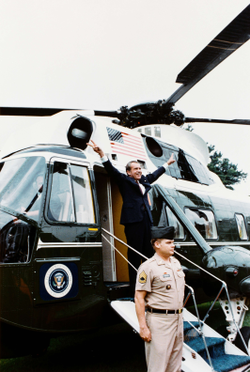
Richard Nixon boarding the helicopter in use as Army One upon his final departure from the White House. His resignation would become effective later that day.

Army One is the callsign of any United States Army aircraft carrying the president of the United States. An Army aircraft carrying the vice president is designated Army Two.

History

[edit]

From 1957 until 1976, the callsign was usually used for an Army helicopter transporting the president. Prior to 1976, responsibility for helicopter transportation of the president was divided between the Army and the U.S. Marine Corps, under the call sign Marine One, until the Marine Corps was given the sole responsibility of transporting the president by helicopter.

VH-3A tail number 150617, the same helicopter as in the above image, on display at the Nixon Library. It was in the presidential fleet from 1961 to 1976, and often flew as Army One.[1]

The best known helicopters that used the Army One callsign were Sea King VH-3A helicopters that were part of the presidential fleet from 1961 to 1976. During its presidential service, the helicopter was known either as Army One or Marine One, depending on whether Army or Marine pilots were operating the craft.[2] The helicopter, with seats for sixteen, had a seat reserved for the president and the first lady, and single, smaller seats for the two Secret Service agents who always flew with the presidential party.[3]

See also

[edit]

References

[edit]

Sources

[edit]
[edit]
Revisions and contributorsEdit on WikipediaRead on Wikipedia
from Grokipedia
Army One is the call sign used for any United States Army aircraft carrying the . From 1957 to 1976, the U.S. Army operated helicopters under this designation as part of a shared responsibility with the U.S. Marine Corps for presidential air transport, marking the primary era of its use. The U.S. 's presidential program began in 1957 when the formed the Executive Flight Detachment at Davison Army Airfield, , , to provide service for President , with the first use of an (the modified VCH-34 ) occurring in 1958. These s, featuring custom interiors with carpeting, executive seating, curtains, air conditioning, and emergency flotation devices, transported Presidents Eisenhower, Kennedy, Johnson, Nixon, and Ford, along with other dignitaries such as , Soviet Premier , and Spanish leader . Notable pilots included Major William A. Howell, the first Army presidential pilot, and Chief Warrant Officer 4 William L. Ruf, who flew early missions highlighting the aircraft's role in VIP transport. A notable use of Army One was on August 9, 1974, when Army Lieutenant Colonel Gene T. Boyer piloted President on his final departure from the amid the ; Army One continued in use until the 1976 transition, including for President . In 1976, the Marine Corps assumed exclusive responsibility for presidential helicopter operations, ending the Army's role and shifting all such flights to the Marine One call sign. Although the call sign technically remains available for any Army aircraft carrying the President, no instances of its use have been recorded since 1976 due to the Marine Corps' ongoing monopoly on these duties.

Overview

Definition and Call Sign Protocol

Army One is the radio call sign designated for any United States Army aircraft carrying the President of the United States. This designation follows U.S. military communications protocols, where the service branch name is prefixed with "One" specifically for presidential transport, analogous to Air Force One for U.S. Air Force aircraft or Marine One for U.S. Marine Corps aircraft. The call sign serves as a unique identifier in air traffic control and military radio communications to ensure secure and prioritized handling of the aircraft. The protocol for One activation is strictly tied to the President's presence: the call sign takes effect immediately upon the President boarding an Army aircraft, as confirmed by U.S. or staff, and it is used throughout the flight for all air-to-ground transmissions. Upon the President's disembarkation, the designation reverts to the aircraft's standard military tail number or routine operational identifier, such as its normal squadron callsign, to maintain standard procedures outside of presidential duty. This activation rule enhances operational security by signaling the aircraft's elevated status without revealing sensitive details during transit. The Army One call sign was first formalized in the late as part of post-World War II enhancements to presidential transportation security, coinciding with the establishment of dedicated executive flight detachments for helicopter operations. This development included rigorous vetting processes, such as clearances, which require exhaustive background investigations for all crew members to ensure unquestionable loyalty and suitability for close proximity to the President. These measures were integrated into broader U.S. military standards to protect the during air travel.

Role in Presidential Transportation

Army One served as the call sign for United States Army helicopters transporting the , providing essential short-range, vertical-lift capabilities that complemented the fixed-wing operations of . This role was particularly vital for accessing locations inaccessible to larger aircraft, such as urban areas for departures or remote sites during domestic travel. The helicopters enabled rapid, flexible mobility, allowing the President to conduct efficient short-haul trips, including transfers to nearby military bases or secure facilities without relying on ground convoys. In integration with other presidential transportation assets, Army One worked alongside Marine One helicopters from the Marine Helicopter Squadron One (HMX-1), sharing responsibilities for presidential airlift from 1957 until the Army's program ended in 1976. The U.S. Army Executive Flight Detachment, activated in 1958 at , , focused on domestic routes requiring helicopter-specific operations, such as quick hops from the to regional installations, thereby enhancing overall logistical efficiency and redundancy in the presidential travel system. This joint arrangement ensured continuous availability of rotary-wing support, with Army assets handling Army-specific missions while Marines provided complementary coverage. Security features of Army One operations emphasized rapid deployment for emergency evacuations of the President, family members, and key officials, offering quicker response times and lower exposure to ground-based threats compared to motorcades. Crew members were selected exclusively from qualified Army aviators who underwent rigorous vetting, including top-secret security clearances equivalent to standards, to ensure the highest levels of protection and operational integrity during these high-stakes flights. This focus on swift, secure vertical lift underscored Army One's niche in safeguarding presidential mobility in dynamic environments.

History

Origins and Early Usage (1957–1960s)

The inception of Army One occurred in 1957 during President Dwight D. Eisenhower's administration, as the sought to enhance presidential mobility through expanded capabilities amid demands for rapid and secure transport. This marked a shift from reliance on and motorcades, with the establishing the Executive Flight Detachment to operate dedicated VIP helicopters. The first presidential flight took place on July 12, 1957, using a Bell UH-13J . The 's initial aircraft for this role was the Sikorsky VH-34 , a modified version of the H-34 transport , which entered presidential service later that year following adaptations for executive comfort, including specialized seating and air conditioning. Under Eisenhower, Army One facilitated regular short-haul flights, primarily for trips between the and nearby sites such as the presidential retreat at in or his farm in , reducing travel time significantly compared to ground transport. These operations also extended to visits at military installations, underscoring the helicopter's utility in connecting the president to defense-related activities without the logistical constraints of longer-range . By late 1957, such flights became routine, demonstrating the practicality of rotary-wing for official duties while adhering to stringent security protocols. The transition to President John F. Kennedy's administration in 1961 saw Army One's usage intensify, with helicopters increasingly deployed for high-visibility public engagements and diplomatic missions to project American presence abroad. Kennedy, known for his energetic travel schedule, leveraged the VH-34 for efficient local movements during international itineraries, including his June 1963 trip to amid escalating tensions, where helicopters supported ground logistics and quick transfers between venues. This period highlighted the call sign's role in coordinated operations, as Army One flights complemented broader presidential air fleets. Army One's introduction represented the first consistent application of service-branch-specific call signs—such as "Army One" for U.S. Army aircraft carrying the president—standardizing communications in presidential and building on ad-hoc radio protocols from II-era transport operations. This evolution ensured clear identification and priority handling in joint military environments, setting precedents for future executive air travel designations like .

Peak Usage and Key Events (1960s–1970s)

The peak period of Army One operations occurred during the late and early under Presidents and Richard M. Nixon, marked by intensified presidential travel amid the and domestic political demands. Army helicopters, sharing duties with Marine Corps aircraft under a joint protocol, facilitated short-range hops essential for wartime oversight and retreats, capitalizing on the U.S. Army's established rotary-wing capabilities developed through military aviation advancements. Frequent shuttles from Washington, D.C., to served as a key routine, providing quick access to the presidential retreat amid escalating national tensions. Under Nixon, Army One enabled over 180 presidential flights, including international diplomacy such as the summit with Egyptian President and routine domestic transports. These missions exemplified the call sign's flexibility in a shared Army-Marine framework, with the aircraft designation switching based on the operating service. The era's culmination came on August 9, , when Nixon departed the for the final time aboard Army One—a Sikorsky VH-3A —following his Watergate resignation, marking one of the most iconic uses of the call sign before its phase-out. This flight, originating from the , symbolized the transition in presidential service while affirming Army One's prominence in high-stakes moments, with annual usage in peak years reaching dozens of flights to support the president's agenda.

Discontinuation and Transition (1976 Onward)

The discontinuation of Army One operations occurred in 1976 under President , marking the end of the U.S. Army's dedicated role in presidential transportation. This decision stemmed from a Department of Defense study that identified the joint Army-Marine Corps arrangement as excessively costly in terms of personnel and equipment, prompting consolidation into a single unit for greater efficiency. The transition process involved disestablishing the Army's Executive Flight Detachment and transferring full responsibility for presidential rotary-wing transport to the Marine Corps' Helicopter Marine Squadron One (). President Ford approved this reorganization on June 8, 1976, with implementation required by July 1, 1976, standardizing all such flights under the Marine One . The move aligned with broader military reorganizations aimed at streamlining operations and reducing redundancies in support. The last dedicated Army One flight took place in early 1976, after which Army helicopters ceased routine presidential service. Since the transition, has exclusively handled presidential helicopter missions, with Army aircraft reserved for rare backup roles, such as overseas support or temporary substitutions during Marine equipment issues, though no such instances involving the President have been recorded as using the Army One call sign post-1976. This shift ensured a unified command structure under the , enhancing operational coherence.

Aircraft and Operations

Types of Aircraft Used

The types of aircraft designated as Army One were exclusively rotary-wing helicopters drawn from U.S. Army inventories, reflecting the service's emphasis on vertical-lift capabilities for short-range presidential transport. These selections prioritized reliability in operations, immediate availability within Army units like the Executive Flight Detachment, and the inherent advantages of helicopters for vertical takeoff and landing in confined areas, distinguishing them from the typically handled by the . The inaugural Army One aircraft was the Sikorsky VH-34 Choctaw, a more robust twin-engine model that served from 1957 to 1962 under Presidents Eisenhower and . A small fleet of these piston-powered helicopters, capable of carrying up to 12 passengers, handled routine departures and arrivals, with notable flights including Kennedy's 1961 tour of . Modifications included the addition of presidential seals on the exterior, upgraded interiors for executive comfort, and basic security reinforcements to the cabin structure. From 1961 to 1976, the Sikorsky VH-3A emerged as the most prominent One platform, operated by Army pilots for Presidents Kennedy, , , and . This twin-turbine helicopter, adapted from the Navy's SH-3 antisubmarine variant, offered greater range (up to 500 nautical miles) and payload capacity for 14 passengers, making it suitable for both domestic short hops and occasional longer missions. Key enhancements encompassed reinforced cabins for ballistic protection and crash resistance, advanced inertial systems for 1970s-era precision, for quiet operation, and opulent interiors with leather seating and communication suites tailored to presidential needs. One such VH-3A, tail number 62-12111, is preserved at the as a testament to its role. A small number of VH-3A were assigned to the Army for presidential duties. No verified records indicate routine use of Sikorsky H-3 variants, which were primarily rescue platforms, though the VH-3A's shared S-61 lineage provided similar heavy-lift potential when needed.

Operational Procedures and Security

Operational procedures for One flights emphasized rapid response and coordination between and protective services. Pre-flight briefings were conducted by aviators to review mission parameters, conditions, and emergency protocols, ensuring all elements were aligned before takeoff. Routes were closely coordinated with the U.S. Secret Service to integrate ground motorcades and aerial paths, minimizing exposure risks during transit. Typical flights for local presidential transport, such as from the to nearby sites like , lasted under 30 minutes to facilitate efficient scheduling. Security measures for Army One incorporated layered defenses tailored to rotary-wing operations. A dual-pilot system was standard, with flights commanded by highly qualified Army Warrant Officers who maintained continuous control and redundancy. Escorts by additional Army helicopters provided formation flying for deception and rapid response, often using identical aircraft to obscure the primary transport. Crew requirements for Army One missions demanded exceptional qualifications and vetting. All personnel, including pilots, flight engineers, and support staff, underwent rigorous background investigations equivalent to standards, granting access to presidential support activities through continuous evaluation. Training occurred at Fort Rucker (renamed Fort Novosel in 2023), the U.S. Army's primary aviation center, where aviators received specialized instruction in rotary-wing operations, instrument flight, and high-profile mission tactics. This preparation ensured crews were proficient in secure facilities and 24-hour alert postures at bases like Anacostia Naval Station.

Significance and Legacy

Comparison to Other Presidential Call Signs

Army One, the call sign for U.S. Army helicopters transporting the President prior to 1976, differed from primarily in operational flexibility and service assignment. While Army One relied on units for short-range vertical lift, often using models like the to provide adaptable support during the early era, —post-1976—standardized presidential helicopter transport under the Marine Corps' squadron with dedicated aircraft such as the Sikorsky VH-3D and later the VH-60N . This shift in 1976 assigned sole responsibility to the , eliminating the shared duties that had previously alternated between services based on availability. In contrast to , which designates like the for long-haul missions, Army One focused exclusively on short-distance, vertical-envelope transport without overlapping roles. The VC-25 enables global reach with a 7,800-mile range, in-flight refueling, and extensive command facilities for up to 71 passengers, serving intercontinental presidential travel needs. Army One, by comparison, supported localized mobility, such as White House-to-airport transfers, emphasizing rapid deployment over endurance. These call signs reflect broader inter-service dynamics, where the Army's early involvement with Army One addressed mobility gaps in presidential operations before consolidation under the Marines reduced redundancies across branches. This transition streamlined command structures and resource allocation for VIP transport.

Impact on U.S. Military Aviation Protocols

The use of the "Army One" beginning in 1957 followed the service-specific designation precedent established with "" in 1954 after a 1953 near-collision incident, where the prefix reflects the operating military branch to ensure unambiguous communications. This system was part of FAA and DoD procedures to prioritize presidential safety and operational clarity. The joint Army-Marine Corps administration of presidential helicopter missions from 1957 to 1976 fostered standardized protocols for crew training and security vetting, requiring pilots and support personnel to meet elevated standards, including the clearance. These measures, including intensive flight proficiency evaluations and background investigations, were integrated across all services for VIP transport, enhancing overall reliability. Army One operations also informed 1970s Department of Defense directives on aviation redundancy, such as the emphasis on backup aircraft formations and decoy tactics—known as the "presidential "—to mitigate threats during executive movements. This contributed to broader policy shifts prioritizing multi-asset contingency planning in . By underscoring the strategic value of rotary-wing platforms for short-range, secure executive transport, the Army One era paved the way for advancements in helicopter technology, including enhanced countermeasures and navigation systems seen in successors like the VH-92A Patriot. These developments reinforced rotary-wing integration into joint operations, shaping contemporary U.S. military aviation standards. The legacy of Army One is also preserved through artifacts like the VCH-34 helicopters on display at the U.S. Army Aviation Museum and , .

References

Add your contribution
Related Hubs
User Avatar
No comments yet.