Hubbry Logo
Asian Monetary UnitAsian Monetary UnitMain
Open search
Asian Monetary Unit
Community hub
Asian Monetary Unit
logo
7 pages, 0 posts
0 subscribers
Be the first to start a discussion here.
Asian Monetary Unit
Asian Monetary Unit
from Wikipedia

The Asian Monetary Unit (AMU) is a basket of currencies proposed by the Japanese government's Research Institute of Economy, Trade and Industry (RIETI). It is similar to and modeled on the European Currency Unit (ECU), predecessor to the euro.[1]

The Asian Monetary Unit, which has been created as the joint project of 21st century COE project of Hitotsubashi University and RIETI, is a common currency basket composed of 13 East Asian currencies, such as ASEAN 10 plus Japan, China and South Korea. These data have been published on the website of RIETI since September 2005. After 4 years passed, a common currency basket composed of 13 AMU currencies plus three other countries, Australia, New Zealand and India, which are strongly connected with Asian countries, is newly created as "AMU-wide". The AMU-wide, which is a common currency basket composed of wider range of currencies, will be expected to use as a surveillance indicator corresponding to the extensive regional economies.

The calculation methodology[clarification needed] of the AMU-wide and AMU-wide Deviation Indicators[clarification needed] are same as those of the AMU. The benchmark period is defined as:

  • the total trade balance of member countries, and
  • the total trade balance of the member countries (excluding Japan) with Japan, and
  • the total trade balance of member countries with the rest of world

should all be relatively close to zero.[clarification needed][2]

AMU baskets

[edit]

The AMU is a basket composed of 13 currencies.[3]

AMU
Country Currency
Brunei Brunei dollar
Cambodia Cambodian riel
Indonesia Indonesian rupiah
Laos Lao kip
Malaysia Malaysian ringgit
Myanmar Burmese kyat
Philippines Philippine peso
Singapore Singapore dollar
Thailand Thai baht
Vietnam Vietnamese đồng
China Chinese Yuan (Renminbi)
Japan Japanese yen
South Korea South Korean won

See also

[edit]

References

[edit]
[edit]
Revisions and contributorsEdit on WikipediaRead on Wikipedia
from Grokipedia
The Asian Monetary Unit (AMU) is a notional regional comprising a weighted average of the currencies of the 13 ASEAN Plus Three (ASEAN+3) member economies—namely, the ten countries (, , , , , , , , , and ) plus , , and —designed to serve as a benchmark for monitoring stability and promoting monetary cooperation in . Developed as a research tool modeled after the (ECU), the AMU assigns weights primarily based on members' GDP at and intra-regional trade shares, with and holding the largest shares at approximately 34% and 28%, respectively. Originating in the mid-2000s from collaborative efforts between Japan's Research Institute of Economy, Trade and Industry () and Hitotsubashi University's Global Centers of Excellence program, led by economists including Takatoshi Ito, Eiji Ogawa, and Junko Shimizu, the AMU emerged in response to vulnerabilities exposed by the , aiming to complement frameworks like the for bilateral currency swaps. Its core mechanism involves calculating nominal and real deviation indicators (AMU DIs) from the basket's equilibrium value—initially anchored to a mix of 65% U.S. dollar and 35% —to detect misalignments that could signal competitive devaluations or loss of export competitiveness, thereby supporting coordinated policies without requiring full monetary union. Daily and monthly AMU data have been publicly disseminated since January 2000, enabling empirical analysis of regional currency dynamics and informing academic studies on optimal currency areas. Despite its utility as a instrument, the AMU has not progressed to formal institutional adoption or issuance of AMU-denominated assets, constrained by persistent challenges such as members' reluctance to cede monetary , the complications of Japan's floating yen and China's managed peg, and insufficient demand for regional bond markets to anchor its relevance. Proponents argue it could stabilize trade-weighted effective exchange rates and mitigate future crises through early warning signals, yet empirical assessments highlight economic heterogeneities—ranging from advanced economies like to emerging ones with varying and trajectories—that undermine feasibility for deeper integration absent stronger convergence. As of recent publications, continues to update AMU indicators, underscoring its role as an ongoing analytical reference rather than a realized monetary arrangement.

Definition and Purpose

Conceptual Framework

The Asian Monetary Unit (AMU) is conceptualized as a weighted basket of currencies from the ASEAN+3 economies (the ten member states plus , , and ), functioning primarily as a rather than a or . This framework draws inspiration from the (ECU), which preceded the , by aggregating national currencies into a supranational reference to monitor exchange rate deviations and foster regional monetary stability without requiring immediate currency unification. The AMU's design addresses the limitations of dollar-centric or bilateral exchange rate surveillance in Asia, where economic interdependence has intensified post-1997 Asian financial crisis, by providing a multilateral benchmark that reflects intra-regional trade weights—initially set based on 2003-2004 GDP and trade data, with holding the largest weight at approximately 30% followed by at 25%. At its core, the AMU framework operates on the principle of deviation indicators, which measure how far individual currencies diverge from their equilibrium values within the , calculated daily using market exchange rates against a reference currency like the U.S. dollar. These indicators enable policymakers to detect competitive devaluations or appreciations, signaling the need for coordinated interventions or adjustments, akin to the ECU's role in promoting convergence criteria under 's Exchange Rate Mechanism. Proponents argue this promotes "soft pegging" or managed floats against the AMU, reducing vulnerability to external shocks from dominant currencies like the dollar, while allowing flexibility for economies with varying differentials and growth—key challenges in Asia's heterogeneous , where output symmetry remains low compared to . The theoretical underpinning emphasizes causal linkages between exchange rate stability and regional resilience: empirical simulations show that AMU-referenced policies could halve effective volatility for East Asian currencies during crises, as tested against historical data from 1990-2004, by internalizing spillovers from major players like and . However, implementation hinges on credible surveillance mechanisms, integrated with initiatives like the Chiang Mai Initiative's bilateral swap arrangements (totaling $38 billion by 2005), to enforce discipline without supranational authority, reflecting realism about Asia's political divergences—such as Japan's yen internationalization goals versus China's managed —over politically driven harmonization. Critics note that without binding commitments, the AMU risks becoming a mere analytical tool, as evidenced by its limited adoption beyond research simulations.

Primary Objectives

The primary objectives of the Asian Monetary Unit (AMU) center on enhancing regional monetary cooperation among +3 economies by establishing a weighted of currencies as a common reference for and policy coordination. Proposed in 2005 by economists Eiji Ogawa and Junko Shimizu, the AMU functions primarily as a indicator to track deviations of individual member currencies from the regional average, helping to identify competitiveness imbalances and guide coordinated interventions that mitigate excessive intra-regional fluctuations. This approach aims to promote stability without immediate full monetary union, drawing parallels to the an Currency Unit's role in pre-euro . A key goal is to reduce vulnerability to external shocks from dominant currencies like the US dollar by fostering a regionally oriented benchmark that reflects the economic weights—primarily GDP and trade—of participating countries, including the 10 members plus , , and . The AMU Deviation Indicator (AMU DI), derived from the basket, quantifies how far each currency strays from equilibrium, enabling finance deputy ministers in ASEAN+3 mechanisms to assess policy sustainability and encourage adjustments toward convergence. Additionally, the AMU supports practical applications in development, such as denominating regional bonds to attract local investors, lower transaction costs, and diversify risks away from single-currency exposures. By serving as a and potential hedging tool, it indirectly advances broader integration objectives, including orderly management and reduced volatility to bolster intra-Asian trade and investment flows. These aims align with post-1997 Asian efforts to build self-reliant mechanisms, though implementation remains indicative rather than binding.

Historical Background

Early Concepts in Asian Monetary Cooperation

The marked a pivotal moment in fostering concepts for deeper Asian monetary cooperation, as regional economies grappled with rapid contagion following the Thai baht's on July 2, 1997. Prior to this, initiatives were largely confined to trade payment facilitation rather than coordinated or liquidity mechanisms, such as the established on December 9, 1974, under the Economic and Social Commission for Asia and the Pacific to enable multilateral settlements among members including , , and , thereby minimizing use of convertible currencies. These early efforts, however, lacked the ambition for stabilization or crisis lending that later proposals envisioned. In response to the crisis's escalation, formally proposed an Asian Monetary Fund (AMF) during the G7-IMF meetings in from September 20-25, 1997, spearheaded by officials including of the . The AMF was conceived as a $100 billion regional liquidity pool contributed by ten Asian members—, , , , , , , , , and the —to provide swift, automated short-term financing for balance-of-payments strains, bypassing the conditionality and delays associated with programs. This initiative drew from Japan's earlier $4 billion contribution to Thailand's $17.2 billion IMF package approved on August 11, 1997, reflecting a push for Asian-led against external shocks. The proposal encountered immediate resistance from the , led by figures like Summers, and the IMF, who contended it risked by enabling delayed reforms and duplicating global facilities, while also raising concerns over potential Japanese dominance. At the Framework Group meeting on November 18-19, 1997, the AMF was sidelined in favor of an IMF-centric framework emphasizing enhanced surveillance and structural adjustments, effectively deferring autonomous regional mechanisms. Nonetheless, the debate underscored empirical vulnerabilities exposed by —such as inadequate regional reserves and contagion via unhedged dollar exposures—and stimulated subsequent explorations of references and swap networks as precursors to stabilized regimes.

Formal Proposal and Launch (2005)

The Asian Monetary Unit (AMU) was formally proposed in 2005 by economists Eiji Ogawa and Junko Shimizu, faculty fellows at Japan's , as part of the institute's project on "The Optimal for ," led by Takatoshi Ito. This initiative aimed to foster greater monetary coordination among n economies in the aftermath of the , providing a tool to monitor stability without immediate commitment to a single currency. The AMU was conceptualized as a weighted average basket of currencies from the +3 grouping—comprising the ten member states (, , , , , , , , , and ) plus , , and —with weights based on GDP and trade shares to reflect economic interdependence. The proposal drew inspiration from the European Currency Unit (ECU), serving as a reference for deviation indicators to assess how individual East Asian currencies diverged from a regional benchmark, thereby supporting surveillance under frameworks like the Chiang Mai Initiative (CMI). Ogawa and Shimizu argued that the AMU could facilitate coordinated exchange rate policies by quantifying misalignments, potentially reducing competitive devaluations and enhancing regional financial stability. In parallel, RIETI collaborated with Hitotsubashi University's 21st Century Global Centers of Excellence (COE) program to develop practical implementations, emphasizing nominal and real effective exchange rate deviations from the AMU basket. Launch of the AMU occurred through RIETI's publication of daily and monthly data series starting in 2005, with calculations retroactively covering periods from January 2000 onward to enable historical analysis of currency movements. This data release marked the operational debut of the AMU as a non-binding surveillance instrument, accessible via RIETI's website, and was intended to inform policymakers without requiring formal adoption by ASEAN+3 finance ministers. Initial weights assigned approximately 17% to the Japanese yen, 29% to the Chinese renminbi, 14% to the South Korean won, and the remainder distributed among ASEAN currencies based on 2002-2004 averages, adjustable periodically to account for evolving economic structures. The effort positioned the AMU as an academic and policy-oriented construct rather than a tradable unit, highlighting RIETI's role in bridging research and regional integration discussions.

Integration with Regional Initiatives

The Asian Monetary Unit (AMU) integrates with regional initiatives principally via its designated role in the surveillance mechanisms of the (CMI), a bilateral and multilateral framework launched among +3 countries in May 2000 to address balance-of-payments needs post-. Under this linkage, the AMU—constructed as a GDP-weighted basket of 13 currencies from the 10 members plus , , and —along with its deviation indicators (AMU DIs), monitors intra-regional alignments and signals potential misalignments that could trigger policy discussions. This application supports the Economic Review and Policy Dialogue (ERPD) process within +3, where AMU DIs quantify deviations from baseline parities, aiding detection of over- or undervaluation relative to trade partners and external anchors like the US dollar. Empirical evaluations using daily and monthly data from January 2000 to June 2010 affirm the AMU's utility in stabilizing nominal effective exchange rates (NEER) under a hypothetical AMU peg , which reduces volatility in trade-weighted rates among compared to unilateral pegs. In practice, these indicators have been employed in simulations to assess capital flow pressures and trade imbalances, fostering coordinated responses without requiring immediate monetary policy harmonization. The integration extends to the CMI's multilateralization into the Multilateralization (CMIM) in March 2010, with a total size of $240 billion (later expanded), where AMU-based complements reserve pooling and support by highlighting regional divergences. This framework aligns the AMU with ASEAN+3's broader monetary cooperation goals, including enhancements to the Asian Bond Markets Initiative by providing a regional for bond issuance and settlement, though operational use remains analytical rather than binding. Studies note that while AMU DIs effectively warn of intra-Asian misalignments, full policy coordination faces barriers from divergent national priorities, such as varying targets and external dependencies. Overall, the AMU's function reinforces CMI/CMIM as a mechanism, with total commitments reaching $240 billion by 2014, emphasizing over supranational authority.

Composition and Calculation

Included Currencies and Weights

The Asian Monetary Unit (AMU) basket consists of the currencies from the 13 economies comprising plus , , and : (BND), (KHR), Chinese yuan (CNY), (IDR), (JPY), (KRW), Laotian kip (LAK), (MYR), (MMK), (PHP), Singapore dollar (SGD), (THB), and Vietnamese dong (VND). Weights for these currencies are computed as the simple arithmetic of each economy's share of intra-regional volumes (exports plus imports among the 13 members) and its share of the group's total GDP measured at (PPP). This method, modeled after the European Currency Unit's approach, aims to capture both interdependence and relative economic scale while avoiding over-reliance on a single metric. Benchmark weights were initially derived from 2000–2003 data, with unit values fixed using daily exchange rates from 2000 and 2001 denominated in a dollar-euro basket to establish parity. In practice, larger economies dominate: typically holds the highest weight (around 20%), followed by (13–15%) and (7–8%), while smaller ASEAN members like and receive minimal allocations (under 1% each), reflecting their limited GDP and trade contributions. Updates to weights, such as revisions proposed for recent years using 2020–2022 averages, maintain this structure but adjust for evolving economic data from sources like IMF Direction of Trade Statistics and World Bank PPP estimates.

Methodologies for Basket Construction

The Asian Monetary Unit (AMU) basket is constructed as a weighted average of the currencies from the 13 ASEAN+3 economies, comprising the 10 member states (, , , , , , , , , and ) plus , , and . This composition reflects the group's emphasis on regional , mirroring the structure of the former (ECU) in aggregating currencies to form a supranational reference unit. Weights for each currency are derived from the arithmetic average of two primary shares: the economy's portion of intra-regional volumes and its portion of aggregate regional (GDP). Intra-regional shares are calculated as the sum of each economy's exports to and imports from other ASEAN+3 members, divided by the total intra-regional ; these are typically averaged over a recent multi-year period, such as 2020–2022, to smooth volatility. GDP shares employ (PPP) valuations to mitigate distortions from nominal fluctuations, with each economy's PPP GDP divided by the group's total PPP GDP over the same averaging window. This dual-weighting approach prioritizes both interdependence and overall economic size, ensuring the basket captures causal linkages in regional spillovers rather than arbitrary allocations. The AMU value is computed daily as a nominal index, with the weighted average expressed relative to a benchmark rate established from a historical base period (e.g., 1999–2000, when intra-regional balances approximated equilibrium). This ECU-inspired defines fixed relative quantities of each in the , adjusted for central parities or market rates, yielding an effective index for surveillance. Weights are revised periodically to incorporate evolving data—most recently effective January 30, 2025—preventing obsolescence from structural shifts like rebalancing or growth divergences, though infrequent updates maintain stability for policy reference. Empirical construction also incorporates deviation indicators, where bilateral or multilateral deviations from AMU parity rates are tracked to assess misalignment; nominal versions use spot rates daily, while real versions adjust monthly for relative differentials via consumer price indices. This methodology facilitates causal analysis of stability, as deviations exceeding thresholds (e.g., 10–20%) signal potential intervention needs under cooperative frameworks.

Variations and Extensions (e.g., AMU-wide)

The Asian Monetary Unit (AMU) has been adapted into variations that expand its to encompass broader regional participation, facilitating extended and cooperation beyond the core +3 framework. These extensions maintain the core methodology of a trade-weighted average basket, akin to the , but adjust compositions to include additional economies with significant linkages to . One primary variation is the AMU-wide, which incorporates the currencies of 16 countries by adding , , and to the standard 13-currency AMU basket of ASEAN members (, , , , , , , , , ) plus , , and . This extension aims to enhance the indicator's relevance for wider monetary monitoring, reflecting increased intra-regional trade volumes; for instance, 's and 's shares in Asian trade have grown notably since the early . Deviation indicators for the AMU-wide, both nominal (daily) and real (monthly, inflation-adjusted), track misalignments from benchmark rates established during the 2000-2002 period, supporting analysis of stability across a more diverse set of economies. Another extension, the AMU-CMIM, aligns with the Multilateralization by including Hong Kong's currency alongside the core 13, forming a 14-currency basket. Developed to bolster regional financial safety nets, it serves as a tool under CMIM frameworks, where deviation indicators help identify currency pressures and inform liquidity support decisions among participants. Data for both AMU-wide and AMU-CMIM variants, computed by researchers Eiji Ogawa and Shimizu at Japan's of Economy, Trade and Industry (), have been available since January 2000 and updated monthly, enabling empirical assessments of convergence in regional exchange rates. These variations underscore efforts to adapt the AMU for practical applications, such as stabilizing nominal effective exchange rates and warning of intra-regional misalignments, though their unofficial status limits binding implementation. Studies using these extended baskets confirm that pegging to them reduces volatility in trade-weighted rates compared to unilateral dollar pegs, particularly during crises like 2008-2009.

Surveillance and Practical Applications

Role in Exchange Rate Monitoring

The Asian Monetary Unit (AMU) functions primarily as a surveillance tool within the ASEAN+3 framework to track intra-regional movements and identify potential misalignments among member currencies. By constructing a weighted of the currencies from the 13 ASEAN+3 economies—comprising the 10 members plus , , and —the AMU enables policymakers to monitor deviations of individual currencies from a common regional benchmark, thereby facilitating early detection of competitive devaluations or appreciations that could undermine trade balances. This role emerged from proposals in the mid-2000s, with the Research Institute of Economy, Trade and Industry () beginning regular publication of AMU values and deviation indicators in 2006, based on trade weights derived from intra- and extra-regional flows. Central to this monitoring process are the AMU Deviation Indicators (AMU DIs), which quantify the extent to which each constituent currency diverges from the AMU basket in nominal effective exchange rate terms, both against the regional unit and external anchors like the US dollar or a G3 basket. These indicators, calculated daily since their inception, serve as quantitative signals for surveillance under mechanisms such as the Multilateralization (CMIM), alerting authorities to thresholds—typically set at 20-30% deviations—beyond which intervention or policy adjustments may be warranted to preserve stability. Empirical analyses have demonstrated that AMU-based monitoring reduces volatility in trade-weighted effective exchange rates for export-oriented economies like , the , , and , particularly when holds higher trade weights in the basket, outperforming unilateral dollar pegs during periods of global turbulence such as the . In practice, the AMU integrates with broader ASEAN+3 surveillance efforts coordinated by the ASEAN+3 Macroeconomic Research Office (AMRO), established in Singapore in 2011, where it informs bilateral and regional policy dialogues by highlighting asymmetries in currency movements that could signal balance-of-payments pressures. For instance, during the 2013 taper tantrum episode, AMU DIs revealed widening deviations in emerging Asian currencies against the basket, prompting discussions on coordinated responses to mitigate spillover effects from US monetary tightening. Proponents argue this framework fosters disciplined exchange rate policies without requiring full monetary union, though its effectiveness depends on consistent data transparency and adherence to deviation thresholds, which have occasionally been undermined by non-participating economies or geopolitical frictions. Overall, the AMU's monitoring role underscores a pragmatic step toward regional financial resilience, emphasizing observable metrics over aspirational convergence criteria.

Linkages to Mechanisms like

The (AMU) functions as a key surveillance instrument within the (CMI), a regional liquidity support framework established by +3 finance ministers on May 7, 2000, in , , to mitigate future through bilateral and later multilateral currency swaps totaling up to $240 billion by 2014. Specifically, AMU deviation indicators—measuring bilateral exchange rate fluctuations against the AMU basket—enable monetary authorities to detect early signs of competitive devaluations or misalignments among member currencies, aligning with CMI's emphasis on ex-ante macroeconomic monitoring to prevent contagion effects observed in the 1997-1998 . This integration was formalized through research by institutions like Japan's Research Institute of Economy, Trade and Industry (RIETI), which proposed AMU-based criteria in 2006 to enhance CMI surveillance beyond traditional IMF-linked assessments. Under the Multilateralization (CMIM), operationalized on March 24, 2010, with an initial commitment of $120 billion, the AMU supports the ASEAN+3 Macroeconomic Research Office (AMRO), established in on May 7, 2011, by providing benchmarks for regional coordination and swap activation thresholds. AMRO employs AMU deviation metrics to assess intra-regional competitiveness, where deviations exceeding predefined bands (e.g., 20-30% thresholds in empirical models) signal risks warranting preemptive interventions, such as swap drawings or adjustments, thereby reducing reliance on global lenders like the IMF for up to 30% of CMIM facilities without attached conditions. Empirical applications, including daily AMU calculations since 2006, have demonstrated utility in tracking post-2008 realignments, where currencies like the showed sustained deviations, informing CMIM's evolution toward independent regional resilience. These linkages extend to broader monetary , positioning AMU as a precursor for coordinated intervention mechanisms, though implementation remains advisory rather than binding, limited by heterogeneous economic cycles and national concerns among participants including , , and . Proponents argue this framework fosters causal discipline in policies, evidenced by reduced volatility in AMU deviations during 2010-2020 relative to unilateral pegs, yet critics from academic analyses note persistent gaps in enforceability without supranational authority.

Empirical Analysis of Deviations

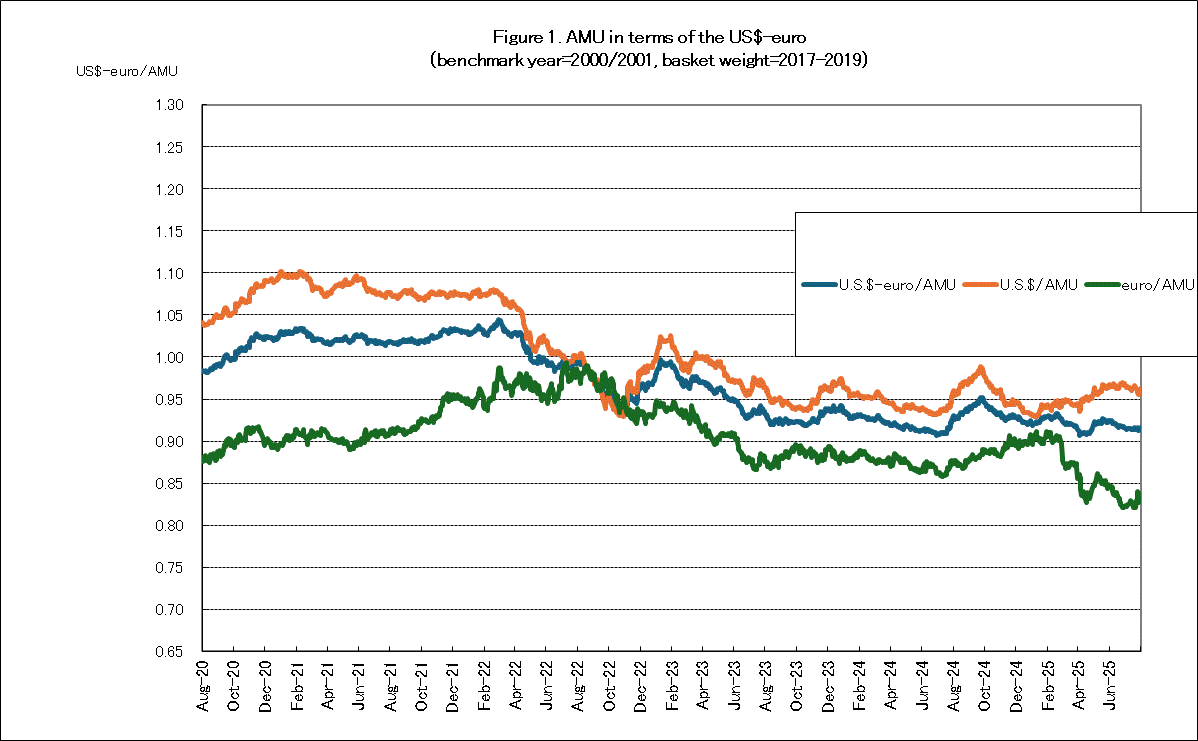
Empirical analyses of deviations from the (AMU) primarily utilize AMU Deviation Indicators (AMU DIs), which quantify the percentage divergence of individual East from their benchmark rates (typically set around 2000–2001) relative to the AMU basket. These indicators, available in nominal (daily) and real (monthly, adjusted for inflation or ) forms, facilitate surveillance of misalignments and support regional policy coordination under frameworks like the . Calculations express deviations as percentages, drawing on basket weights derived from intra-regional trade shares (e.g., 2004–2006 averages for standard AMU). Data spanning January 2000 to recent years reveal persistent and often widening deviations, with nominal AMU DIs for currencies like the , Chinese yuan, and fluctuating between -40% and +60% from August 2004 to June 2009. Real AMU DIs, which account for differential , exhibit similar variability over October 2004 to August 2009, excluding outliers like Myanmar's due to extreme values. These patterns underscore structural divergences driven by heterogeneous regimes, such as China's managed peg to the U.S. dollar amid a shift to basket referencing post-2005. Post-2001 analyses highlight weakening bilateral linkages with the for several East Asian economies, contributing to expanded multilateral deviations within the AMU framework; for instance, the AMU basket appreciated against the but depreciated relative to a dollar-euro composite by the late 2000s. The 2007–2008 Global Financial Crisis exacerbated misalignments, with East Asian currencies broadly depreciating against the due to capital reversals (e.g., unwinding of yen carry trades), while the yen strengthened; currencies like the Korean won and transitioned from overvaluation (pre-Lehman, July 2005–July 2007) to undervaluation post-collapse, amplifying volatility since late 2005. Econometric studies, including models and tests on AMU DIs, confirm a lack of convergence toward a unified regional bloc across most sample periods, with intra-East Asian movements failing to stabilize despite efforts. For example, assessments of 502 combinations post-2000 indicate non-stationary deviations, reflecting asymmetries and external shocks rather than coordinated alignment. These findings imply limited practical efficacy of AMU DIs for preempting volatility, as evidenced by rising intra-regional misalignments that heightened transmission risks.

Challenges and Criticisms

Economic and Structural Barriers

Economic disparities across Asian economies pose a fundamental obstacle to the effective implementation and utility of the Asian Monetary Unit (AMU), as the region's ratios range from 50:1 to 100:1, far exceeding 's 3:1 to 4:1 at the time of adoption. For instance, in 2004, Singapore's stood at $24,220, compared to Indonesia's $1,270 and Thailand's $2,540, reflecting heterogeneous development stages from advanced economies like to agrarian and manufacturing-dependent ones in and . These gaps, with standard deviations in living standards approximately three times those in , undermine the convergence necessary for a meaningful , as divergent growth rates and productivity levels lead to persistent real effective misalignments. Structural differences in economic composition further complicate AMU adoption, with limited symmetry in business cycles and output shocks violating key (OCA) criteria such as shock correlation and labor mobility integration. Analyses indicate low correlations in demand shocks involving , which exhibits only two significant positive correlations with other East Asian economies, exacerbating asymmetries that hinder coordinated policies. While cross-border labor mobility in is relatively high, facilitating some adjustment to shocks, the absence of fiscal transfer mechanisms—unlike in the —leaves economies vulnerable to asymmetric disturbances without supranational redistribution. Additionally, varying industrial structures, from Japan's service- and technology-oriented model to 's transformation-driven growth, generate differing inflation dynamics and policy responses, rendering AMU deviation indicators unreliable for surveillance. Financial market underdevelopment and low amplify these barriers, with intra-Asian long-term bond investments comprising less than 3% of totals in 2003, reflecting reliance on external markets and dollar-denominated liabilities stemming from the 1997-1998 Asian . Persistent mismatches, particularly in US dollars, constrain the shift toward basket pegs like the AMU, as countries such as and members grapple with liquidity risks and inadequate regulatory harmonization. Divergent regimes—from Japan's yen float to China's dollar peg, which together account for over 66% of AMU weights—create an "N-1 problem" where individual countries prefer customized baskets over a common unit, limiting the AMU's role in stabilizing intra-regional exchange rates. These structural rigidities, combined with immature bond markets, risk reducing liquidity if an AMU-linked instrument is introduced prematurely, as evidenced by temporary declines in bond markets during early integration phases.

Political and Geopolitical Hurdles

The development of the Asian Monetary Unit (AMU), a weighted basket of currencies from +3 economies proposed by the in 2006 to facilitate regional surveillance, has encountered substantial political resistance rooted in national sovereignty concerns. East Asian governments exhibit reluctance to cede control over , viewing deeper integration as a threat to domestic in managing economic shocks and fiscal priorities. This hesitation stems from the absence of supranational institutions capable of enforcing coordination, unlike the European Union's framework, leading to persistent barriers in advancing the AMU beyond a notional reference unit. Intraregional power dynamics, particularly the rivalry between and , further undermine political consensus for AMU implementation. Historical animosities and competing visions for regional leadership—exemplified by Japan's advocacy for AMU-like mechanisms during the versus China's preference for bilateral swaps—have stalled multilateral commitments. Japan's proposal for an Asian Monetary Fund at that time was effectively vetoed amid these tensions, highlighting how zero-sum geopolitical calculations prioritize bilateral influence over collective monetary tools. Geopolitical frictions, including territorial disputes in the and , erode the trust essential for binding monetary surveillance under an AMU framework. ASEAN members' divided responses to China's assertiveness, coupled with Japan's alignment with U.S. security interests, fragment incentives for integration, as smaller economies fear in great-power contests. The enduring U.S. influence, manifested through commitments and opposition to exclusive regional financial architectures, reinforces this fragmentation by discouraging deviations from dollar-centric systems. Unlike Europe's post-World War II reconciliation-driven integration, East Asia lacks a unifying political imperative, with diverse regime types—from authoritarian to democratic—complicating alignment on AMU . This diversity fosters skepticism toward shared mechanisms, as evidenced by the limited uptake of AMU-denominated instruments despite technical feasibility studies since 2006. Ongoing U.S.- strategic competition exacerbates these hurdles, prompting Asian states to hedge via diversified partnerships rather than risk entrapment in a nascent regional monetary order.

Technical and Implementation Issues

The construction of the Asian Monetary Unit (AMU) basket faces significant challenges in determining appropriate currency weights, with proposals varying between GDP at (PPP), market exchange rates, intraregional trade shares, or contributions to mechanisms like the , leading to asymmetries where dominant economies such as (up to 53% PPP-based weight in 2000 data) overshadow smaller currencies. These asymmetries impose disproportionate intervention burdens on countries with minor weights during deviation corrections, necessitating periodic revisions every three years and caps like a 33.3% upper limit on any single currency to mitigate dominance. Consensus on selection criteria remains elusive, as weights must reflect currencies' roles in regional transactions and cooperation, yet divergent economic structures complicate agreement. Calculation methodologies for the AMU, modeled after the (ECU), involve summing weighted currency amounts converted to a common unit like the USD (RMU =ΣαjSj= Σ α_j S_j), but historical base periods (e.g., 2000) often fail to capture equilibrium s, distorting reference points for indicators. indicators based on these baskets obscure bilateral movements through aggregation, as offsetting deviations in multi- shocks mask individual misalignments, and the absence of an external anchor exacerbates the "N-1 problem" in intra-regional surveillance, requiring supplementary global tracking. Logarithmic approximations in computations further deviate from raw data, while symmetric weights amplify noise from minor currencies and asymmetrical ones mute signals from large economies like , , and Korea (collectively ~75% weight). Data requirements pose ongoing hurdles, including timely access to high-frequency exchange rates and economic indicators across diverse ASEAN+3 members, where less developed economies suffer from inconsistent reporting that undermines real-time AMU computation and surveillance. Heterogeneous regimes—ranging from managed floats to pegs—distort indicator accuracy, as fixed-rate currencies exhibit artificial stability while floating ones introduce volatility not reflective of fundamentals. Implementation demands a centralized body for index maintenance, akin to preliminary ACU designs, but lacks resolution on forward- versus backward-looking base periods, which yield conflicting deviation signals and hinder practical policy coordination.

Reception, Impact, and Future Prospects

Policy and Academic Responses

Policymakers in have shown cautious interest in the Asian Monetary Unit (AMU), primarily as a reference for regional surveillance rather than a binding mechanism, following proposals in the early 2000s amid efforts to enhance post-1997 . Japan's and international bureaus advocated for an AMU as a tool to monitor deviations and support coordinated policies under frameworks like +3, with initial discussions in 2006 linking it to the Initiative's bilateral swap arrangements. However, the concept faced resistance, notably from , leading to its deprioritization in ASEAN+3 research agendas by the late 2000s, as broader monetary integration was deemed premature without deeper fiscal convergence. No central bank has formally adopted the AMU for operational policy, though some, like the , have referenced basket-based indicators informally for internal analysis without public commitment. Academic literature largely views the AMU positively as an intermediate step toward monetary cooperation, emphasizing its utility in generating deviation indicators (DIs) for early warning of misalignments, akin to the European Currency Unit's role pre-euro. Scholars such as Masahiro Kawai have argued that a weighted AMU basket—typically comprising currencies from +3 plus , , and sometimes /—could facilitate surveillance without requiring immediate pegs, supported by empirical simulations showing reduced volatility in trade-weighted rates from 2000–2010. Studies from the highlight its potential to benchmark national currencies against regional norms, with back-tested DIs revealing persistent deviations during the 2008 global crisis, underscoring needs for policy adjustments. Yet, critiques persist; and others note structural barriers like output asymmetries and incomplete financial markets render full AMU adoption suboptimal, predicting limited impact absent political will for convergence criteria. Pierre Jacquet and Charles Wyplosz describe it as an attempt to achieve "cohesion without control," feasible for surveillance but insufficient for crisis resolution without supranational oversight. Reception varies by subregion: Southeast Asian academics often endorse it for stabilizing intra-ASEAN trade, citing simulations where AMU alignment could cut deviation variances by 20–30% in the , while Northeast Asian analyses stress geopolitical risks, with reports deeming a full monetary union—including AMU evolution—"a very distant prospect" due to China-Japan rivalry. Empirical work in journals like Journal of Asian Economics tests ACU indices for portfolio minimization, finding them effective for hedging but less so for policy signaling amid dollar dominance. Overall, while policy adoption remains nominal, academic consensus favors incremental AMU use in surveillance tools, with calls for updated weights reflecting post-2020 trade shifts toward digital and green economies.

Measured Outcomes and Limitations

The Asian Monetary Unit (AMU) Deviation Indicators, computed as nominal and real measures of currency deviations from benchmark rates within the AMU basket, have been disseminated monthly by Japan's of Economy, Trade and Industry () since January 2000, offering a quantitative tool for regional . These indicators, derived from weighted averages of +3 currencies adjusted for inflation in the real variant, have captured elevated deviations during crises, such as the 2008 global financial shock, where ASEAN currencies exhibited heightened volatility against the basket amid yen weakening and broader dollar fluctuations. Empirical assessments confirm their utility in identifying misalignment patterns, facilitating discussions under frameworks like the , though adoption has remained voluntary and analytical rather than operational. Panel convergence analyses applied to AMU deviation data from 2000 onward reveal no overarching synchronization of East Asian exchange rates into a unified bloc, either before or after the September 2008 Lehman Brothers collapse. Instead, results identify multiple convergent clubs—sub-groups of currencies clustering toward depreciating or appreciating poles at varying speeds, with compositions shifting by period and indicator type (e.g., nominal versus real). This partial clustering underscores modest stability in select pairings, such as among Northeast Asian economies, but overall outcomes highlight persistent divergence, limiting the AMU's role to diagnostic rather than corrective influence on policy. Key limitations stem from the AMU's non-binding nature, lacking enforcement to curb deviations or compel adjustments, which has precluded tangible progress toward coordinated pegs or union. Heterogeneities in economic cycles, monetary preferences—exemplified by Japan's floating yen and China's managed —and external dependence exacerbate volatility, rendering basket weights (often GDP- or trade-based) susceptible to outdated representations of integration. further indicates negligible for AMU-denominated assets, like bonds, with alternatives such as individual currency baskets proving more feasible amid constraints and absent political consensus for ceding control. Consequently, while serving as a reference for monitoring, the AMU has yielded no measurable enhancement in regional resilience or financial deepening beyond pre-existing bilateral swaps.

Potential Pathways Forward

One potential pathway involves refining the AMU deviation indicators (DIs) for more robust regional surveillance, integrating them with the ASEAN+3 Macroeconomic Research Office (AMRO) assessments to better detect misalignments and inform Chiang Mai Initiative Multilateralization (CMIM) activations. This could enhance early warning systems, as simulations indicate that AMU-referenced pegs stabilize nominal effective exchange rates (NEERs) within Asia by reducing intra-regional volatility. RIETI's ongoing publication of daily nominal and monthly real AMU DIs since 2000 provides a foundation, potentially expandable to include inflation differentials more dynamically for real-time policy dialogue among the 13 ASEAN+3 members. Another avenue is the issuance of AMU-denominated bonds to foster regional financial markets, addressing currency mismatches exposed in past crises and promoting local currency settlement in cross-border trade. Proponents argue this could deepen liquidity, with weights based on GDP or trade shares (e.g., at approximately 37% in core AMU formulations as of early data), serving as a without requiring immediate monetary union. Empirical studies suggest such instruments would incentivize convergence by linking investor demand to discipline, though implementation hinges on legal harmonization beyond current structures. Longer-term, incremental steps toward basket-based regimes—such as individual countries adopting AMU-like external baskets (e.g., blending USD, EUR, and intra-Asian weights)—could build coordination without ceding , mirroring Europe's pre-EMU exchange rate mechanism. This aligns with +3 research on optimal baskets, where AMU DIs have flagged deviations during events like the 2008 crisis, potentially evolving into a Regional Currency Unit (RCU) precursor for stabilization funds. However, causal barriers like divergent monetary policies (e.g., China's managed RMB versus Japan's floating yen) limit feasibility, necessitating trust-building via CMIM expansions before deeper integration. Emerging pilots in digital currencies (CBDCs) among +3 could further test AMU frameworks for cross-border payments, reducing reliance on third-party currencies.

References

Add your contribution
Related Hubs
User Avatar
No comments yet.