Hubbry Logo
Attractor networkAttractor networkMain
Open search
Attractor network
Community hub
Attractor network
logo
7 pages, 0 posts
0 subscribers
Be the first to start a discussion here.
Attractor network
Attractor network
from Wikipedia

An attractor network is a type of recurrent dynamical network, that evolves toward a stable pattern over time. Nodes in the attractor network converge toward a pattern that may either be fixed-point (a single state), cyclic (with regularly recurring states), chaotic (locally but not globally unstable) or random (stochastic).[1] Attractor networks have largely been used in computational neuroscience to model neuronal processes such as associative memory[2] and motor behavior, as well as in biologically inspired methods of machine learning. Their value as models of cortical memory has been however questioned multiple times[3][4].

An attractor network contains a set of n nodes, which can be represented as vectors in a d-dimensional space where n>d. Over time, the network state tends toward one of a set of predefined states on a d-manifold; these are the attractors.

Overview

[edit]

In attractor networks, an attractor (or attracting set) is a closed subset of states A toward which the system of nodes evolves. A stationary attractor is a state or sets of states where the global dynamics of the network stabilize. Cyclic attractors evolve the network toward a set of states in a limit cycle, which is repeatedly traversed. Chaotic attractors are non-repeating bounded attractors that are continuously traversed.

The network state space is the set of all possible node states. The attractor space is the set of nodes on the attractor. Attractor networks are initialized based on the input pattern. The dimensionality of the input pattern may differ from the dimensionality of the network nodes. The trajectory of the network consists of the set of states along the evolution path as the network converges toward the attractor state. The basin of attraction is the set of states that results in movement towards a certain attractor.[1]

Types

[edit]

Various types of attractors may be used to model different types of network dynamics. While fixed-point attractor networks are the most common (originating from Hopfield networks[5]), other types of networks are also examined.

Fixed point attractors

[edit]

The fixed point attractor naturally follows from the Hopfield network. Conventionally, fixed points in this model represent encoded memories. These models have been used to explain associative memory, classification, and pattern completion. Hopfield nets contain an underlying energy function[6] that allow the network to asymptotically approach a stationary state. One class of point attractor network is initialized with an input, after which the input is removed and the network moves toward a stable state. Another class of attractor network features predefined weights that are probed by different types of input. If this stable state is different during and after the input, it serves as a model of associative memory. However, if the states during and after input do not differ, the network can be used for pattern completion.

Other stationary attractors

[edit]

Line attractors and plane attractors are used in the study of oculomotor control. These line attractors, or neural integrators, describe eye position in response to stimuli. Ring attractors have been used to model rodent head direction.

Cyclic attractors

[edit]

Cyclic attractors are instrumental in modelling central pattern generators, neurons that govern oscillatory activity in animals such as chewing, walking, and breathing.

Chaotic attractors

[edit]

Chaotic attractors (also called strange attractors) have been hypothesized to reflect patterns in odor recognition. While chaotic attractors have the benefit of more quickly converging upon limit cycles, there is yet no experimental evidence to support this theory.[7]

Continuous attractors

[edit]

Neighboring stable states (fix points) of continuous attractors (also called continuous attractor neural networks) code for neighboring values of a continuous variable such as head direction or actual position in space.

Ring attractors

[edit]

A subtype of continuous attractors with a particular topology of the neurons (ring for 1-dimensional and torus or twisted torus for 2-dimensional networks). The observed activity of grid cells is successfully explained by assuming the presence of ring attractors in the medial entorhinal cortex.[8] Recently, it has been proposed that similar ring attractors are present in the lateral portion of the entorhinal cortex and their role extends to registering new episodic memories.[9]

Implementations

[edit]

Attractor networks have mainly been implemented as memory models using fixed-point attractors. However, they have been largely impractical for computational purposes because of difficulties in designing the attractor landscape and network wiring, resulting in spurious attractors and poorly conditioned basins of attraction. Furthermore, training on attractor networks is generally computationally expensive, compared to other methods such as k-nearest neighbor classifiers.[10] However, their role in general understanding of different biological functions, such as, locomotor function, memory, decision-making, to name a few, makes them more attractive as biologically realistic models.

Hopfield networks

[edit]

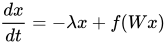
Hopfield attractor networks are an early implementation of attractor networks with associative memory. These recurrent networks are initialized by the input, and tend toward a fixed-point attractor. The update function in discrete time is , where is a vector of nodes in the network and is a symmetric matrix describing their connectivity. The continuous time update is .

Bidirectional networks are similar to Hopfield networks, with the special case that the matrix is a block matrix.[6]

Localist attractor networks

[edit]

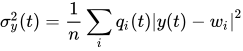
Zemel and Mozer (2001)[10] proposed a method to reduce the number of spurious attractors that arise from the encoding of multiple attractors by each connection in the network. Localist attractor networks encode knowledge locally by implementing an expectation–maximization algorithm on a mixture-of-gaussians representing the attractors, to minimize the free energy in the network and converge only the most relevant attractor. This results in the following update equations:

  1. Determine the activity of attractors:
  2. Determine the next state of the network:
  3. Determine the attractor width through network:
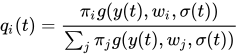
( denotes basin strength, denotes the center of the basin. denotes input to the net, is a un-normalized gaussian distribution centered in and of standard deviation equals to .)

The network is then re-observed, and the above steps repeat until convergence. The model also reflects two biologically relevant concepts. The change in models stimulus priming by allowing quicker convergence toward a recently visited attractor. Furthermore, the summed activity of attractors allows a gang effect that causes two nearby attractors to mutually reinforce the other's basin.

Reconsolidation attractor networks

[edit]

Siegelmann (2008)[11] generalized the localist attractor network model to include the tuning of attractors themselves. This algorithm uses the EM method above, with the following modifications: (1) early termination of the algorithm when the attractor's activity is most distributed, or when high entropy suggests a need for additional memories, and (2) the ability to update the attractors themselves: , where is the step size parameter of the change of . This model reflects memory reconsolidation in animals, and shows some of the same dynamics as those found in memory experiments.

Further developments in attractor networks, such as kernel-based attractor networks,[12] have improved the computational feasibility of attractor networks as a learning algorithm, while maintaining the high-level flexibility to perform pattern completion on complex compositional structures.

References

[edit]
Revisions and contributorsEdit on WikipediaRead on Wikipedia
from Grokipedia
An attractor network is a type of recurrent neural network in computational neuroscience characterized by dynamics that cause neural activity to converge toward stable equilibrium states, known as attractors, which sustain persistent firing patterns without ongoing external input. These networks typically feature excitatory interconnections among neurons, balanced by inhibitory mechanisms, allowing them to settle into discrete or continuous stable configurations that represent stored information, such as memories or sensory representations. First conceptualized in the framework of associative memory, attractor networks provide a mechanism for pattern completion, where partial or noisy inputs lead to the full retrieval of a stored state. Attractor networks are classified into several types based on their attractor structure: point attractors, which correspond to discrete stable states ideal for categorical storage; limit cycle attractors, involving periodic oscillations for rhythmic processes; and continuous attractors, such as line or ring attractors, which encode analog variables like head direction or spatial position along a continuum of states. Key properties include robustness to noise, error correction through self-sustaining activity, and the ability to integrate transient inputs over time, making them computationally efficient for brain-like processing. Historically, foundational models like the (1982) demonstrated how symmetric connections enable energy minimization to attractors, while later extensions incorporated asymmetric connectivity for continuous dynamics, as in path integration for . In , attractor networks model diverse brain functions, including working memory maintenance in the , where persistent activity holds information across delays; spatial navigation via head-direction cells in the , grid cells in the , and place cells in the hippocampus, which form ring or planar attractors to track orientation and location; and , where competition between attractors resolves ambiguous choices. These models highlight how recurrent connectivity in cortical circuits supports modular, low-dimensional representations that balance stability and flexibility, with applications extending to understanding disorders like through disrupted attractor dynamics. Advances as of 2025 emphasize their role in integrating noisy sensory cues, enabling probabilistic computations via stochastic transitions between states, causal implementations of continuous attractors for affective encoding, and self-orthogonalizing mechanisms bridging and AI.

Introduction

Definition and principles

An attractor network is a type of modeled as a in which the state trajectories of the network converge to stable patterns known as attractors, which often represent stored memories or computational states. These networks are particularly valued in and for their ability to perform associative recall, where partial or noisy inputs lead to the completion of full patterns. The core principles of attractor networks revolve around recurrent connections that enable feedback loops among neurons, allowing the system to evolve over time toward equilibrium states. These connections, often symmetric to ensure stability, create an energy landscape where the network's dynamics minimize a Lyapunov-like energy function, guiding trajectories downhill to local minima that correspond to s. Each is surrounded by a basin of attraction—a region in the state space from which initial conditions are drawn toward that specific stable state—facilitating robust pattern retrieval even from corrupted inputs. A simple illustrative example is a two-neuron attractor network with symmetric excitatory connections between the neurons. Starting from various initial states, the network dynamics cause both neurons to converge to a synchronized firing state (both active or both inactive), demonstrating the pull toward a fixed-point and the role of feedback in stabilizing the output. In contrast to networks, which process inputs unidirectionally without feedback and produce outputs instantaneously based on static mappings, attractor networks emphasize temporal dynamics through recurrent loops, enabling persistent activity and adaptive computation over multiple time steps.

Historical context

The concept of attractor networks traces its roots to early on associative memory models in . In 1972, James A. Anderson proposed a simple model capable of generating interactive through distributed representations, where patterns of neural activity could evoke associated memories via -based storage. Concurrently, Teuvo Kohonen developed matrix memories, which used linear associators to store and retrieve patterns, laying foundational ideas for in recurrent systems. These early works emphasized parallel processing and pattern completion but lacked a unified dynamical framework for stable states. A pivotal milestone occurred in 1982 when John Hopfield introduced the Hopfield network, formalizing attractor dynamics through an energy-based model inspired by statistical physics, where network states converge to local minima representing stored memories. This seminal paper, cited more than 29,000 times as of November 2024 (Google Scholar), marked the formal birth of attractor networks by demonstrating how symmetric recurrent connections could yield emergent computational abilities like error correction and associative recall. Hopfield's approach shifted the field from ad hoc memory models to rigorous dynamical systems analysis, influencing both computational neuroscience and physics. During the and , attractor networks evolved through expansions in , incorporating chaotic and continuous attractors to model complex brain processes. Building on Shun-ichi Amari's 1977 work on in lateral-inhibition neural fields, researchers applied continuous principles post-Hopfield to simulate head-direction cells and spatial navigation, where activity bumps represent continuous variables like orientation. Chaotic attractors emerged in models of irregular firing in cortical networks, as explored by Hertz, Krogh, and Palmer in the early , enabling sensitivity to initial conditions while maintaining attractor stability for tasks like sequence generation. These developments highlighted attractor networks' role in persistent activity and decision-making. In the post-2000 era, attractor networks integrated with to address classical limitations, such as low storage capacity in high dimensions. Modern variants, like dense associative memories, extend Hopfield's framework using exponential mechanisms to achieve near-optimal capacity for pattern storage and retrieval in large-scale applications. This resurgence has linked attractor dynamics to transformer architectures, enhancing interpretability in AI models for tasks like sequence processing and optimization. In 2024, Hopfield was awarded the , jointly with , "for foundational discoveries and inventions that enable with artificial neural networks."

Mathematical foundations

Dynamical systems prerequisites

studies the of systems governed by deterministic rules, encompassing both continuous and discrete formulations. In continuous time, a is typically expressed as x˙=f(x)\dot{x} = f(x), where xRnx \in \mathbb{R}^n represents the state vector, x˙\dot{x} denotes its , and f:RnRnf: \mathbb{R}^n \to \mathbb{R}^n is a smooth defining the system's dynamics. In discrete time, the evolution is given by xt+1=f(xt)x_{t+1} = f(x_t), where iterations of the map ff generate the system's behavior from an x0x_0. These formulations model a wide range of phenomena, from physical motions to biological processes, by predicting future states based on current ones. The , or state space, is the abstract arena in which the system's evolution unfolds, comprising all possible states xx as an nn-dimensional manifold. A is the traced by the state x(t)x(t) in as time progresses, uniquely determined by the for systems satisfying existence and uniqueness theorems, such as those under of ff. Stability refers to the robustness of system behaviors under perturbations, while convergence describes trajectories approaching specific sets or points over time. In continuous systems, trajectories follow integral of the ff, whereas in discrete systems, they form orbits under repeated application of the map. Fixed points, also known as equilibria, occur where the dynamics halt, satisfying f(x)=0f(x^*) = 0 in continuous time or x=f(x)x^* = f(x^*) in discrete time. Local stability of a fixed point xx^* is assessed via : the matrix Df(x)Df(x^*) approximates the system near xx^* as δx˙=Df(x)δx\dot{\delta x} = Df(x^*) \delta x, where δx\delta x is a small perturbation. The fixed point is asymptotically stable if all eigenvalues of Df(x)Df(x^*) have negative real parts (continuous case) or magnitudes less than 1 (discrete case), ensuring nearby trajectories converge to xx^*; otherwise, it is unstable. This eigenvalue-based analysis, rooted in the Hartman-Grobman theorem for hyperbolic fixed points, provides a valid locally. The basin of attraction for an attractor is the set of all initial conditions whose trajectories converge to that attractor as time approaches infinity. Boundaries between basins, known as separatrices, delineate regions of leading to different long-term behaviors, often associated with unstable fixed points or saddles. In discrete systems, basins can exhibit complex structures near chaotic regimes. Bifurcations mark qualitative changes in the system's phase portrait as a parameter varies, altering the number, stability, or type of attractors. For instance, a saddle-node bifurcation involves the creation or annihilation of fixed point pairs, one stable and one unstable, as the parameter crosses a critical value. The Hopf bifurcation, occurring in systems with at least two dimensions, transforms a stable fixed point into an unstable one while birthing a limit cycle attractor, signaled by a pair of complex conjugate eigenvalues crossing the imaginary axis with nonzero speed. Such transitions underpin the emergence of oscillatory or periodic behaviors from steady states.

Attractor dynamics in networks

In neural networks, the synaptic weights wijw_{ij} play a central role in shaping the landscape by defining the interactions between , such that states emerge as fixed points where the collective activity settles after transient dynamics. These weights are typically derived from Hebbian learning rules, encoding correlations between activations to form basins of attraction around desired patterns. Network updates can be implemented synchronously, where all are revised simultaneously based on the previous state, or asynchronously, where are updated sequentially, often randomly. Asynchronous updates ensure monotonic decrease in the system's energy, guaranteeing convergence to a state, whereas synchronous updates may introduce oscillations or cycles that prevent strict convergence. The dynamics of these networks are often formulated using an energy-based approach, analogous to a Hamiltonian in spin systems, given by E=12i,jwijsisj,E = -\frac{1}{2} \sum_{i,j} w_{ij} s_i s_j, where si=±1s_i = \pm 1 represents the binary state of neuron ii. Updates proceed via on this energy landscape, with the deterministic rule for binary neurons expressed as si=\sign(jwijsj),s_i = \sign\left( \sum_j w_{ij} s_j \right), selecting the state that locally minimizes EE. Stored patterns serve as attractors—low-energy minima—allowing the network to converge from noisy or partial inputs to complete representations. The capacity for storing patterns as attractors is limited; for a network of NN neurons, reliable storage is possible for up to approximately 0.14N0.14N uncorrelated patterns using the outer-product weight rule, beyond which overlaps between patterns lead to spurious states—unintended stable minima that degrade retrieval accuracy. These spurious states arise from the interference in the weight matrix, forming additional attractors that can trap the dynamics. To enhance robustness against or initial perturbations, variants incorporate Boltzmann dynamics, where the probability of flipping a neuron's state follows P(sisi)exp(ΔE/T)P(s_i \to -s_i) \propto \exp(-\Delta E / T), with TT as a parameter controlling . This allows the network to probabilistically escape shallow local minima, improving convergence to global attractors in noisy environments while maintaining equilibrium distributions over states.

Types of attractors

Fixed-point attractors

In attractor networks, fixed-point attractors represent equilibrium states where the network's dynamics come to a halt, characterized by conditions such as x˙=0\dot{x} = 0 in continuous-time formulations or xt+1=xtx_{t+1} = x_t in discrete-time updates, allowing the system to persist indefinitely at these points. These fixed points serve as memorized states, enabling the network to robustly hold discrete patterns against noise or partial inputs. Key properties of fixed-point attractors include their stability, which can be local—meaning nearby states converge to the point—or global, encompassing a broader basin of attraction—and the capacity for multiple coexisting fixed points within the same network, each forming a distinct minimum in the underlying . The network dynamics typically drive the state toward these minima via gradient-like descent, ensuring convergence to a configuration from initial conditions within the respective basins. This multiplicity allows the network to store and retrieve several patterns simultaneously, with stability analyzed through around the fixed points to confirm asymptotic behavior. The storage mechanism for fixed-point attractors relies on Hebbian learning rules, where synaptic weights are updated as wij=μξiμξjμw_{ij} = \sum_{\mu} \xi_i^\mu \xi_j^\mu (for iji \neq j), embedding desired ξμ\xi^\mu as the network's stable equilibria by aligning the weight matrix with the outer products of these patterns. This approach ensures that when the network is presented with a partial or corrupted version of a pattern, the dynamics evolve to complete it at the corresponding fixed point. A significant limitation of fixed-point attractors in these networks is the of spurious attractors due to interference among the stored patterns, which can create unintended stable states that mimic or distort the desired memories, reducing retrieval accuracy especially as the number of patterns approaches the network's capacity. These spurious states arise from cross-talk in the weight matrix and can possess basins of attraction comparable in size to legitimate ones, complicating pattern separation. As an illustrative example, consider binary pattern storage in low-dimensional attractor networks, where patterns are represented as vectors of ±1\pm 1 components; for a network of N100N \approx 100 units storing p0.14Np \approx 0.14N such patterns via the Hebbian rule, the fixed points correspond to exact recoveries of the originals, though spurious minima may appear for higher loads, as demonstrated in early analyses of storage capacity.

Cyclic attractors

Cyclic attractors, also referred to as limit cycles, represent closed trajectories in the of dynamical systems where the state evolves periodically and indefinitely, converging from nearby initial conditions to this stable orbit. These structures embody periodic dynamics that neither decay nor diverge, providing a mechanism for sustained oscillations in continuous-time models. In neural attractor networks, cyclic attractors emerge from the interplay of excitatory and inhibitory connections, fostering self-sustained rhythmic activity without external forcing. For instance, in —neural circuits that produce coordinated motor rhythms such as those for walking or —limit cycles arise through and excitation, enabling the network to cycle through repeating activation patterns. Such dynamics often manifest in recurrent networks where connectivity supports oscillatory modes, as seen in trained recurrent neural networks that develop phase-locked cycles for encoding temporal information. The stability of cyclic attractors in low-dimensional neural systems is underpinned by the Poincaré-Bendixson theorem, which asserts that in two-dimensional continuous systems with a bounded and no equilibria, trajectories must converge to either a fixed point or a . This result guarantees the existence of periodic orbits under conditions like monotone cyclic feedback, common in simplified models of inhibitory neural loops. In higher dimensions, stability persists through bifurcations, such as Hopf bifurcations, that transition networks from fixed points to oscillatory regimes. A representative model illustrating cyclic attractors in a network context is the , which captures self-excited oscillations analogous to those in coupled neural populations: x¨μ(1x2)x˙+x=0\ddot{x} - \mu (1 - x^2) \dot{x} + x = 0 Here, μ>0\mu > 0 introduces nonlinear damping that drives trajectories toward a unique , mimicking in excitatory-inhibitory ensembles. These attractors facilitate in neural circuits, supporting robust, periodic outputs essential for biological , though detailed applications extend beyond this scope.

Chaotic attractors

Chaotic attractors, also referred to as strange attractors, are bounded invariant sets in the of a where trajectories are dense, filling the without repeating periodically, and exhibit exponential divergence of nearby trajectories due to at least one positive , signifying chaotic behavior. These attractors possess a geometry, distinguishing them from simpler fixed-point or periodic structures, and their dense trajectories ensure that the system's long-term dynamics remain confined yet unpredictably complex. In attractor networks, particularly high-dimensional recurrent neural networks with nonlinear functions, chaotic attractors arise from the interplay of excitatory and inhibitory connections, leading to aperiodic oscillations that mimic phenomena like the Lorenz attractor in simplified neural models. For instance, in the , researchers discovered dynamics in variants of Hopfield networks by incorporating or nonlinear elements that induce sensitivity to initial conditions, transforming stable states into bounded chaotic regimes. These attractors enable networks to explore vast state spaces efficiently, supporting diverse computational roles beyond fixed-pattern retrieval. The complexity of chaotic attractors in such networks is quantified using the , which captures their non-integer dimensionality and indicates the effective , often ranging from low values in small networks to higher ones in large-scale models. Additionally, chaos is measured by metrics, such as the largest for divergence rates and the spectrum of exponents for overall unpredictability, providing insights into information processing capacity. Brief interventions, including protocols that align multiple chaotic trajectories, allow control of these attractors to stabilize useful dynamics for tasks like pattern generation or optimization in neural computations.

Continuous and ring attractors

Continuous attractor networks feature a continuum of stable states organized along low-dimensional manifolds, such as lines or planes, enabling the representation of analog or continuous variables rather than discrete patterns. In these systems, nearby states on the manifold remain stable under small perturbations, allowing for smooth shifts in activity that encode gradual changes in the represented feature, such as position or orientation. This structure supports analog storage by maintaining a family of equilibria where the network's state can slide continuously along the without converging to isolated points. Ring attractors represent a specific of continuous attractors, forming circular manifolds that wrap around to model periodic variables like angular orientation in . They are particularly prominent in models of head-direction cells, where neural activity encodes the animal's facing direction through a rotating bump of excitation on the ring. This circular geometry ensures seamless continuity across the full 360-degree range, with stability preventing drift except under controlled inputs. The dynamics of continuous and ring attractors exhibit neutral stability along the manifold, permitting arbitrary positioning of the activity packet, while transverse directions are attracting to confine activity to the manifold. Localized activity bumps, often Gaussian-shaped, emerge due to Mexican-hat connectivity profiles, featuring a narrow excitatory center surrounded by broader inhibition, which balances local reinforcement with global suppression. External inputs or asymmetric connections can then propel the bump along the manifold at controlled speeds, integrating sensory cues like head velocity. A canonical stationary solution for the bump in one-dimensional continuous attractors satisfies the self-consistency equation: u(x)=w(xy)u(y)dyu(x) = \int w(x - y) \, u(y) \, dy where ww is the Mexican-hat weight kernel with excitatory core and inhibitory flanks, ensuring the activity u(x)u(x) localizes while summing to a normalized total. In the , Kechen Zhang proposed a seminal ring attractor model for head-direction cells, demonstrating how symmetric excitatory-inhibitory connections stabilize a directional bump, with velocity-modulated asymmetries driving its rotation to track self-motion.

Implementations

Hopfield networks

The Hopfield network, introduced in 1982, represents a foundational model of a designed to exhibit attractor dynamics through fixed-point stability. It consists of a fully connected architecture with N s, where each is binary, taking states of 0 (inactive) or 1 (active), and connections are governed by symmetric weights Tij=TjiT_{ij} = T_{ji} with no self-connections (Tii=0T_{ii} = 0). These weights enable the network to store multiple patterns as stable states, leveraging collective computational properties analogous to spin-glass systems. The learning process employs a Hebbian rule to encode patterns, where the weights are set as Tij=s=1M(2ξis1)(2ξjs1)T_{ij} = \sum_{s=1}^{M} (2 \xi_i^s - 1)(2 \xi_j^s - 1) for M random binary patterns {ξs}\{\xi^s\}, with each ξis=0\xi_i^s = 0 or 1, effectively storing correlations between activations across patterns. This outer-product formulation allows the network to recall complete patterns from partial or noisy inputs by converging to the nearest stored . The storage capacity is limited to approximately 0.14N patterns for reliable retrieval, beyond which spurious states and errors dominate due to interference. Dynamics proceed via asynchronous updates, where s are sequentially selected at random and updated deterministically: i flips to 1 if jTijVj>0\sum_j T_{ij} V_j > 0 (threshold typically 0), otherwise to 0, ensuring the system evolves toward local minima of an associated energy function. This update rule guarantees convergence to a fixed point in finite steps, mimicking relaxation in physical systems. Variants extend the original binary model to address limitations in neuron representation. The continuous Hopfield network replaces binary states with graded responses using a sigmoid activation function Vi=g(ui)V_i = g(u_i), where gg is monotonically increasing and bounded, allowing smoother dynamics governed by differential equations that still minimize an energy landscape. versions incorporate probabilistic updates, often via parameters, to escape local minima and explore the state space more robustly. Despite these advances, the models retain core limitations, including binary or low-resolution states that constrain representational fidelity and a sublinear capacity scaling that hampers scalability for large N.

Localist and reconsolidation networks

Localist networks represent a class of models where individual neurons or small clusters of neurons serve as stable attractors corresponding to specific or categories, contrasting with distributed representations that spread information across many units. In these networks, is encoded in a localized manner, with each attractor basin tied to a dedicated unit, facilitating interpretable and sparse coding. This approach draws from cognitive modeling traditions, where single units might encode high-level entities akin to "grandmother cells"—neurons that respond selectively to particular stimuli or ideas, such as a specific face or object. For instance, empirical evidence from single-cell recordings in the human medial shows neurons firing invariantly to unique individuals like celebrities, supporting the biological plausibility of such localist schemes in dynamics. Proposals for localist representations in emerged in the 1990s as part of broader connectionist debates, emphasizing dedicated units for lexical or conceptual items to model knowledge access and priming. Unlike distributed systems, localist attractors minimize interference between stored patterns, as each basin is isolated and less prone to overlap-induced errors like catastrophic . This localization allows for straightforward network configuration, where excitatory connections to a target unit and inhibitory links from others create stable fixed points, enabling efficient pattern completion without spurious states. In cognitive applications, such as word tasks, localist networks demonstrate rapid convergence to target attractors, with dynamics that support phenomena like gang effects, where in nearby units enlarges the basin of attraction for related concepts. Reconsolidation networks extend principles to model updating processes, where retrieval destabilizes an existing , allowing external inputs to deform or shift it toward a revised state before restabilization. These models are inspired by findings from the early 2000s demonstrating that reactivated memories become labile and require protein synthesis for reconsolidation, particularly in the hippocampus. In such networks, a mismatch between the retrieved pattern and current contextual cues—often modeled as differences between CA3 pattern completion and CA1 inputs—triggers synaptic degradation, enabling plasticity-driven updates via Hebbian rules. For example, brief reexposure to a cue might cause hopping to an updated configuration, incorporating new associations, while prolonged mismatch leads to by forming a competing basin. This dynamics of deformation via external perturbations captures how memories evolve post-retrieval, reducing rigidity in static s and aligning with observed behavioral phenomena like fear modification.

Modern extensions

In the 2010s, deep attractor networks emerged as layered recurrent architectures that integrate attractor dynamics into deep learning frameworks to enhance tasks like pattern recognition and signal processing. A seminal example is the Deep Attractor Network (DAN), which employs a deep embedding network to project mixed signals into a latent space where attractors form around individual sources, enabling robust separation without explicit permutation solving. This approach revived interest in attractor mechanisms amid the deep learning boom by demonstrating their utility in scalable, data-driven audio processing, achieving state-of-the-art performance on speaker separation benchmarks like WSJ0-mix with signal-to-distortion ratios exceeding 10 dB. Echo state networks (ESNs), as variants, extended attractor-based recurrent nets in the by using fixed, randomly connected hidden layers to generate rich dynamics, including chaotic attractors, for time-series prediction and control. These networks leverage sparse connectivity—typically with 1-5% connection density—to address scalability, allowing thousands of nodes without full training and enabling real-time applications like chaotic system forecasting. For instance, ESNs have been applied to model spatiotemporal chaos in equations like Kuramoto-Sivashinsky, reconstructing attractors with prediction horizons up to several Lyapunov times. Liquid state machines (LSMs), continuous-time spiking counterparts to ESNs, incorporate chaotic s in recurrent spiking networks to perform temporal computations, transforming inputs into high-dimensional trajectories for readout . Introduced in the early but advanced in the through plasticity rules like spike-timing-dependent plasticity (STDP), LSMs shape landscapes for robust pattern separation, with recent Boolean variants using global plasticity to stabilize multiple s in noisy environments. This facilitates efficient processing of spatiotemporal data, such as in robotic control, where stability improves task performance over feedforward spiking nets. In the 2020s, concepts have integrated with transformer architectures, interpreting self- as soft dynamics that converge to relevant states without explicit recurrence. For example, modern Hopfield networks reformulate layers as continuous retrieval, enhancing generative models by storing patterns in energy-based landscapes that support associative completion. This connection, exemplified in energy-based views of transformers, addresses through sparse patterns, reducing quadratic complexity while maintaining -like stability for long-sequence modeling in tasks like language generation. Such extensions link post-2015 AI advancements, including generative models, to principles for improved sample efficiency and diversity.

Applications

Associative memory and pattern completion

Attractor networks serve as a foundational model for associative , where stored s correspond to stable fixed-point s, enabling the system to complete partial or noisy inputs by converging to the nearest stored within its basin of attraction. In this framework, an input with missing or corrupted elements initiates dynamics that evolve toward the representing the full , effectively performing pattern completion through the network's energy minimization process. This mechanism relies on the separation of basins of attraction, ensuring that inputs sufficiently close to a stored —measured by overlap or similarity—settle into the correct state rather than spurious ones. The performance of attractor networks in associative recall is characterized by robust error correction, particularly under low-noise conditions. For instance, in Hopfield networks with random binary patterns, the network provides significant error correction for moderate levels in low-load conditions. This capability diminishes as increases or storage capacity approaches its limit of approximately 0.14 times the number of neurons, beyond which basins overlap and retrieval errors rise sharply. Such error correction allows the network to reconstruct complete patterns from cues that share significant overlap with stored memories, demonstrating practical utility in tasks. Evaluation of pattern completion in attractor networks commonly employs metrics like Hamming distance, which quantifies the bit-wise differences between the input cue and the retrieved pattern to assess completion accuracy. A low final Hamming distance after convergence indicates successful recall, with thresholds often set to ensure the retrieved state matches the target memory within a small error margin, such as 5-10% mismatch. These metrics highlight the network's ability to handle partial inputs, where the initial Hamming distance to the nearest attractor determines the likelihood of correct completion. Extensions to basic attractor models include hierarchical structures, which organize memories into layered representations to support structured recall of complex patterns. In hierarchical networks, lower-level attractors encode basic features, while higher levels integrate them into composite memories, allowing completion of incomplete hierarchical inputs by propagating stability across layers. This approach enhances capacity for structured data, such as sequences or objects with parts, by nesting basins of attraction in a tree-like manner. A notable early application of attractor networks for associative involved 1980s optical prototypes, which implemented Hopfield models using vector-matrix multipliers for real-time image recall from partial or noisy visual inputs. These systems demonstrated the potential for hardware-accelerated pattern completion in image processing tasks.

Modeling neural processes

Attractor networks play a central role in modeling by simulating persistent neural activity that sustains information across delays without continuous sensory input. In these models, line or bump attractors represent continuous variables, such as spatial locations, where the position of the activity bump corresponds to the memorized feature and remains stable due to balanced recurrent excitation and inhibition. This persistent activity aligns with delay-period firing observed in neurons during visuospatial tasks in primates, where cells maintain elevated firing rates tuned to specific stimuli even after the stimulus is removed. Seminal models from the late and , such as those incorporating NMDA receptor-mediated synaptic currents, demonstrate how cellular —arising from intrinsic neuronal properties and recurrent network dynamics—stabilizes these activity patterns against and perturbations. These models have been validated against electrophysiological data from prefrontal cortex, showing that the diffusion of bump attractors under noise predicts the observed variability in behavioral precision during spatial tasks, with narrower tuning curves correlating to lower error rates. For instance, simulations reproduce the gradual broadening of neural tuning over delay periods, matching single-unit recordings and supporting the idea that prefrontal persistent activity underlies mnemonic maintenance. In , bi-stable networks capture winner-take-all dynamics, where competing neural populations integrate sensory evidence until one state dominates, leading to a categorical . Recurrent excitation amplifies weak input differences, while global inhibition prevents co-activation, resulting in slow buildup of activity that mirrors reaction time distributions in perceptual tasks. This framework explains probabilistic outcomes in ambiguous stimuli, such as motion direction discrimination, by incorporating noise that can trigger state transitions akin to changes of mind. Electrophysiological studies in lateral intraparietal cortex validate these predictions, with ramping activity trajectories aligning with model-simulated reverberation timescales of hundreds of milliseconds to seconds. Ring attractors, a type of continuous , model path integration in spatial by integrating self-motion signals to update an internal representation of position. In the entorhinal cortex, exhibit periodic firing patterns that emerge from symmetric excitatory connections in a ring topology, where activity bumps shift continuously with movement direction and speed. These models accurately simulate path integration over distances of 10-100 meters and durations of 1-10 minutes before cumulative errors degrade performance, consistent with behavioral data from navigating in . Validation comes from recordings showing grid cell phase precession and stability during tasks, where dynamics maintain spatial maps despite noisy inputs from head-direction and speed cells.

Emerging uses in AI

In recent years, attractor networks have found applications in generative modeling, where they facilitate mode-seeking behaviors to produce diverse yet coherent samples. For instance, models that learn dynamics enable robust retrieval and generation of patterns by iteratively refining noisy inputs toward stable fixed points, improving upon traditional variational autoencoders (VAEs) by incorporating recurrent refinement mechanisms that avoid vanishing gradients during training. This approach has been demonstrated to enhance generative tasks, such as reconstructing images from partial cues, by encoding patterns as attractors in high-dimensional latent spaces. In (RL), networks contribute to stable policy formation by modeling fixed points in recurrent critic architectures, allowing agents to converge on optimal actions amid noisy environments. Ring models, inspired by neural dynamics, integrate into RL action selection to support spatial , where continuous states represent positional awareness and guide policy updates toward equilibrium points. Such integrations have shown improved performance in tasks by stabilizing trajectories through -based value estimation in recurrent networks. Attractor networks are increasingly implemented on neuromorphic hardware for energy-efficient AI computing, leveraging spiking dynamics to simulate stable with minimal power. Intel's Loihi chip, post-2018 iterations like Loihi 2, supports attractor-based computations such as ring attractors for , enabling real-time stabilization in event-driven systems. Recent implementations demonstrate unsupervised learning of attractor dynamics on Loihi for spike , achieving low-latency with orders-of-magnitude savings over conventional GPUs. Studies from 2023 have explored dynamics within models, revealing how leads to stable sampling trajectories by transitioning from linear noise to -guided refinement toward data manifolds. This mechanism enhances stability, reducing mode collapse and promoting diverse outputs in high-fidelity image synthesis. As of 2024, extensions include reservoir-computing based memories for recalling complex dynamical patterns, improving robustness in tasks. Despite these advances, attractor networks face challenges in scalability for high-dimensional AI tasks, where designing robust attractor landscapes is complicated by spurious states and sensitivity to network wiring, limiting their application to large-scale models. Hybrid approaches combining attractors with transformers address this by interpreting self-attention as transient attractor dynamics, enabling efficient memory without full recurrence while mitigating dimensionality issues.

References

Add your contribution
Related Hubs
User Avatar
No comments yet.