Hubbry Logo
A. Atwater KentA. Atwater KentMain
Open search
A. Atwater Kent
Community hub
A. Atwater Kent
logo
8 pages, 0 posts
0 subscribers
Be the first to start a discussion here.
A. Atwater Kent
A. Atwater Kent
from Wikipedia

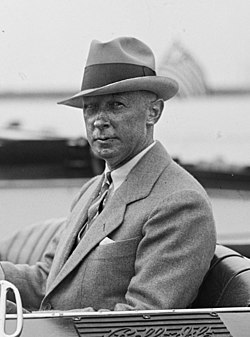
Arthur Atwater Kent Sr. (December 3, 1873 – March 4, 1949) was an American inventor and prominent radio manufacturer based in Philadelphia. In 1905, he invented the Unisparker which combined ignition points, condenser, centrifugal advance mechanism, and distributor in one unit, the system used in virtually every automobile until the development of fully electronic systems in the 1970s and '80s. In 1921, Kent patented the modern form of the automobile ignition coil.[1]

Key Information

Biography

[edit]

Arthur Kent was born on December 3, 1873, in Burlington, Vermont.[1]

The Kent family moved to Worcester, Massachusetts in 1881, where they lived at four different locations. His father was a doctor who had also been a machinist. The father maintained a machine shop in Worcester when Arthur was a child. Kent entered Worcester Polytechnic Institute’s freshman mechanical engineering class in the fall of 1895. He was elected treasurer of the class of 1899, but only remained in the position for one semester, because he did not attend recitation classes after the mid-year exams in January. Kent excelled in mechanics and drawing, but was weak in chemistry, algebra, and language, and had no interest in these subjects. He was already running a small business and that was his top priority. His business was called the Kent Electric Manufacturing Company, which he began in the back room of his father’s machine shop, and from which he sold small electric motors, generators, fans, and later automobile ignition systems. The Unisparker Ignition systems became the automobile industry standard for almost 50 years, until the advent of the high energy ignition (HEI) systems.[2]

An advertisement for Atwater Kent ignition systems for tractors, in Tractor and Gas Engine Review, December 1918.
Ad for an Atwater Kent Radio receiver in the Ladies' Home Journal (September, 1926)
Ad for Atwater Kent Radio Model 35, 1927

In 1921, Kent produced his first radio components, selling the do-it-yourself kits consisting of "breadboards" that could be assembled by early radio enthusiasts.[3] The same year, he introduced the Model 5, primarily as a promotional tool.[4] In 1923, his firm started producing complete radio sets, using a facility on Stenton Avenue, introducing the Model 10 for Christmas that year.[4] This was followed by the Model 9 "and a broad line of breadboard sets".[4] In 1924, the company moved to a new $2 million plant at 4745 Wissahickon Avenue in East Falls section of Philadelphia. This plant, constructed in sections, would eventually cover 32 acres (13 ha) and be considered one of the most modern and forward-thinking manufacturing plants in the world.

In 1925, the Atwater Kent Manufacturing Company became the largest maker of radios in the United States. The company also sponsored the popular The Atwater Kent Hour, a top-rated radio concert music program heard on NBC and CBS from 1926 to 1934. The show featured top entertainment and became one of the most popular and acclaimed regular radio programs of the era. At its peak in 1929, the company employed over 12,000 workers manufacturing nearly one million radio sets. Its models included the metal-cabinet seven-tube Model 57 at US$105 and the wooden-cabinet eight-tube Model 60 at US$80.[5] The plant itself was an architectural sensation and received hundreds of visitors annually.[6] By 1931, the company boasted that it had produced over three million radios.[7]

Atwater Kent radios were of high quality and many examples of working models exist today; they are highly prized by collectors and restorers. Their wooden cabinets were made for Atwater Kent by the Red Lion and Pooley furniture companies. Some models looked more like furniture than radios, and others had multiple functions, like the radio housed inside a grandfather clock.

The onset of the Great Depression led to greatly diminished demand for Atwater Kent's expensive radio sets. The company adjusted to consumer demands by building smaller, tabletop radio sets, but Kent was not one to compromise on quality. A drop in demand was compounded by the expiration of patents on the superheterodyne circuit—which led directly to the proliferation of inexpensive All American Five radio designs. New firms could now easily enter the radio manufacturing market without the same level of capital investment Kent had put into his production process, which relied on heavy metal presses for the relatively large Tuned Radio Frequency (TRF) type radio chassis the firm produced.[8] Kent dissolved his design engineering facility in 1931, and shuttered his radio factory in 1936.[9] A major local competitor, Philco, acquired the closed plant and built its refrigerators there.[10]

In 1937, Kent helped to organize and pay for the restoration of the Betsy Ross House in Center City Philadelphia. In 1938, Kent helped found the Atwater Kent Museum of Philadelphia, Philadelphia's city history museum, by purchasing the original home of the Franklin Institute on South 7th Street and donating it to the City of Philadelphia.

Personal life

[edit]

His daughter, Virginia Tucker Kent (April 17, 1915 – April 29, 1966) married and divorced Cummins Catherwood, and inspired Patricia Highsmith, resulting in the novel The Price of Salt.[11][12]

Atwater Kent died on March 4, 1949, in Hollywood, California.[1] He is buried at Forest Lawn Memorial Park, Glendale, California.

Legacy

[edit]

He was awarded the John Scott Medal of The Franklin Institute in 1914.

Kent's son-in-law, William L. Van Alen, is the founder of the United States Court Tennis Association[13]

Kent was inducted into the Broadcast Pioneers of Philadelphia's Hall of Fame in 1992.

Patents

[edit]

References

[edit]

Sources

[edit]
  • McMahon, Morgan E. A Flick of the Switch 1930–1950. Antiques Electronics Supply, 1990. Pages 62 & 63. ISBN 0-914126-10-5.
  • Williams, Ralph O. "Atwater Kent: Master of Marketing". The AWA Review, Vol. 10, 1996.
[edit]
Revisions and contributorsEdit on WikipediaRead on Wikipedia
from Grokipedia
Arthur Atwater Kent (December 3, 1873 – March 4, 1949) was an American inventor, electrical engineer, and industrialist renowned for his pioneering contributions to automotive ignition systems and radio manufacturing. Born in , to physician Prentis Kent and Mary Atwater Kent, he demonstrated early inventive talent by constructing the first in his teens using a primary bi-chromatic battery. Kent briefly attended for in 1895 but left after struggling with grades, later receiving an honorary from the institution in 1926. Kent's professional career began in 1902 when he founded the Atwater Kent Manufacturing Company in , initially producing electrical devices such as voltmeters, home telephones, and automotive components. His breakthrough invention, the Unisparker patented in 1905, combined the coil, timer, and into a single unit, simplifying automobile starting and becoming widely adopted until the ; he also developed early fuel gauges and amassed 97 patents overall, including designs for electric tops. By the early , as emerged post-World War I, Kent shifted focus to this field, producing his first complete five-tube in 1923 and shipping the initial sets in November 1922. Under Kent's leadership, the company expanded dramatically, relocating to a 15-acre factory on Wissahickon Avenue in 1924—at a cost of $2 million (equivalent to about $27 million in 2014 dollars)—and growing to 32 acres by 1929 with in-house production of nearly all radio parts except vacuum tubes and cabinets. By 1925, Atwater Kent had become America's largest radio manufacturer, employing 12,000 workers and reaching peak output of over one million units annually by 1929, including innovations like AC-powered models introduced in and more than 150 distinct models overall. The company sponsored the popular Atwater Kent Hour music program in the , further embedding its brand in American culture and making radio accessible across social classes. Facing the and labor union challenges, Kent retired in 1936, closing the company after selling assets to and the government; production had already ceased radio manufacturing in 1935. In his later years, he divided time between estates in , , and , marrying Mabel Lucas in 1906 (divorced) and raising children including A. Atwater Kent Jr., Elizabeth Kent van Alen, Virginia Kent Catherwood, and adopted son J. Prentiss Kent. A committed philanthropist, Kent established the Atwater Kent Foundation, restored the Betsy Ross House, donated $225,000 to the 's building fund, and in 1938 converted the former headquarters into a (now the Atwater Kent Collection at since 2018), which houses over 130,000 artifacts and preserves his legacy in historical preservation.

Early Life and Education

Birth and Family Background

Arthur Atwater Kent was born on December 3, 1873, in , to Prentiss J. Kent, a physician, machinist, and former surgeon in the New York 174th Volunteers during the Civil War, and Mary Elizabeth Atwater Kent. The family came from moderate means, with Prentiss Kent having pursued diverse careers before settling into medicine and mechanical work. Mary Elizabeth Atwater Kent, who encouraged her children's education and initiative, played a supportive role in the household. In 1881, the Kent family relocated from Burlington to , seeking professional opportunities for Prentiss Kent, who established a there. This move exposed young to an industrial environment that aligned with his father's mechanical pursuits, fostering his early fascination with engineering. Prentiss Kent's skills as a directly influenced his son, who often observed and assisted with tools and machinery in the family workshop. Kent's childhood in Worcester cultivated self-reliance and technical curiosity, shaped by hands-on exposure to his father's inventions and repairs, such as modifying steam engines for family use. The modest, dynamic household emphasized practical problem-solving, laying the groundwork for Kent's inventive mindset without formal structure.

Formal Education and Early Interests

Arthur Atwater Kent enrolled at (WPI) in the fall of 1895, joining the program with the intention of graduating in 1899. He was elected treasurer of his class early on, reflecting his initial engagement, but struggled academically, particularly with and courses. After completing his first year, Kent withdrew, citing financial constraints as a key factor; he briefly re-enrolled the following year but departed again before finishing, ultimately forgoing a formal degree in favor of practical pursuits. Despite his abbreviated formal education, Kent developed his skills in largely through self-directed experimentation, leveraging resources from his father's home workshop in Worcester, which had been active since at least 1889. Growing up in the city after his family's move from in his early childhood, he immersed himself in hands-on work with machine tools and electrical components, honing a practical understanding that formal studies had not fully provided. Kent's early hobbies centered on and , fostering an inventive mindset through minor projects such as constructing small electrical devices. In his teens, he built what is considered the first , powered by a primary bichromate battery with six cells. He experimented extensively with , batteries, and fans, building items like a battery-powered fan, a sewing machine , and early dynamos (such as the No. 2 and No. 3 models) by 1896. These endeavors, conducted in the workshop environment, emphasized practical innovation over theoretical learning. The industrial atmosphere of Worcester, a hub of and technical advancement in the late , profoundly influenced Kent's shift toward hands-on work. Surrounded by factories and opportunities, he prioritized real-world application and experimentation, viewing the city's resources and culture as more valuable than continued classroom instruction for his burgeoning interests.

Professional Career

Early Business Ventures

Arthur Atwater Kent founded the Kent Electric Manufacturing Company in 1895, operating initially from the basement of his father's machine shop in Worcester, Massachusetts. The company focused on producing small electric motors, fans, and other basic electrical components, reflecting Kent's early interest in electricity and self-taught engineering skills developed through practical experimentation. With limited capital at the outset, Kent's venture embodied the challenges of late-19th-century manufacturing, where small-scale operations often struggled against established competitors in the nascent electrical goods market and contended with rudimentary production facilities. In 1902, Kent relocated the business to , drawn by the city's burgeoning industrial opportunities and established position as a hub. He established the operation at 6th and Arch Streets in Center City, renaming it the Atwater Kent Manufacturing Works to capitalize on Philadelphia's skilled workforce and access to markets. The move allowed for modest expansion, enabling production of a broader range of items including batteries, battery testers, telephone systems, and sundry electrical goods tailored to niche demands. Kent's business strategies centered on quality craftsmanship, prioritizing and rigorous testing to differentiate his products in a competitive landscape dominated by larger firms. This approach helped sustain the company's growth despite ongoing hurdles like resource constraints and market saturation in early electrical , positioning it as a reliable supplier of specialized components before broader innovations emerged.

Automotive Inventions and Innovations

Arthur Atwater Kent's pioneering contributions to automotive electrical systems began with the invention of the Unisparker ignition system in 1905, a compact device that integrated ignition points, a condenser, a centrifugal advance mechanism, and a into a single unit. This innovation addressed the limitations of earlier hand-cranking starters by enabling reliable self-starting through a single, hot spark rather than a continuous stream, significantly improving safety and convenience for early automobile drivers. The Unisparker's design allowed for precise spark timing and eliminated the need for multiple coils, making it a foundational advancement in ignition. Kent's work extended to the development of the modern automobile , for which he received U.S. No. 1,391,256 in 1921 for an improved structure that enhanced spark reliability and efficiency. This described a compact, durable coil assembly using a core-wound in a protective casing, which reduced electrical interference and improved performance under varying engine conditions, becoming a standard component in electrical systems. By refining the coil's construction to minimize and heat-related failures, Kent's contributed to more robust engine operation in mass-produced automobiles. Through his early manufacturing efforts at the Kent Electric Manufacturing Company, Kent amassed 25 U.S. patents by 1919, all related to automotive electrical components such as timers, distributors, and wiring systems that supported the growing demands of the industry. These inventions built on his foundational work in small electric motors and generators, establishing a technical base for scalable production. The commercial impact of Kent's automotive innovations was profound, with the Unisparker quickly adopted as standard equipment by major automakers including and Ford between 1914 and 1917 through licensing agreements and direct sales. This widespread integration propelled the growth of the Atwater Kent Manufacturing Company, as the system's reliability led to its use in vehicles worldwide and supported the establishment of 117 repair stations across 40 U.S. states and six in by 1919, ensuring ongoing service and market dominance.

Radio Manufacturing

Entry into the Radio Industry

In 1921, amid a surge in demand for home radio receivers driven by the rapid expansion of broadcast stations, A. Atwater decided to enter the radio manufacturing industry. This move capitalized on the growing market, where sales escalated to 100,000 units by 1922, as leveraged his established automotive-electrical business to produce initial radio components. His nationwide network of service shops and dealers, combined with factory expertise in electrical parts, positioned him to meet distributor demands for assembled sets. Kent adapted mass-production techniques from his automotive work, including assembly line methods, standardized parts, and steel panel chassis, to streamline radio component fabrication and reduce costs for affordability. These innovations drew on skills in phenolic casting, coil winding, and machine assembly honed through production, enabling efficient scaling from do-it-yourself "breadboard" kits introduced in late 1921 to full receivers assembled starting in November 1922. By focusing on simplicity, Kent aimed to make high-quality radios accessible to a broader audience, with production reaching nearly 150 sets per day by late 1923. A key milestone was the introduction of the Model 10 on September 7, 1923, a five-tube receiver featuring two stages of tuned RF amplification, a detector, and two audio stages, designed for battery operation with a 1/4 filament battery and 22.5-volt B battery. Mounted on a board as part of the Radiodyne series, it offered three tunable circuits for improved selectivity amid over 550 stations by that , with low power output suited to magnetic diaphragm loudspeakers. Over 12,000 units were produced by year's end, simplifying assembly and lowering costs through the open-wire design. Early efforts faced challenges in component sourcing, including unreliable variable condensers, RF transformer coils, and condenser tracking, which Kent addressed via in-house production and design refinements. Competition from established firms like Eagle, FADA, , and intensified pressure, as many adopted similar steel panels, forcing Kent to emphasize performance and pricing innovations to gain market traction.

Company Growth and Peak Achievements

The Atwater Kent Manufacturing Company experienced rapid expansion in the mid-1920s, becoming the largest radio manufacturer by through innovative production techniques and strategic market positioning. Building on early successes with models like the Model 10, the company scaled operations significantly, employing 12,000 workers at its facilities by that year. This growth was fueled by a focus on high-quality, affordable receivers that appealed to a broad consumer base, ranging from entry-level sets priced at $14 to luxury models up to $5,000. Factory expansions in underpinned this surge, with the company constructing a new 15-acre plant at 4745 Wissahickon Avenue in 1923 and relocating operations by 1924, further extending to 32 acres by the late , including an additional 17-acre site added in 1928 connected by an enclosed bridge. These facilities incorporated advanced assembly-line processes, featuring automatic machinery for precision tasks like brass component fabrication and molding, along with progressive assembly benches where parts moved through multiple inspection stages—222 tests per set—to ensure reliability. By 1927-1928, this efficiency enabled the production of over one million radios in a single season, establishing market leadership in mass-market models suitable for every home. At its peak in , the company reached unprecedented scale with over 12,000 employees manufacturing nearly one million units annually, solidifying its dominance in the industry. Complementing this production prowess, Atwater Kent sponsored The Atwater Kent Hour from 1926 to 1934, a top-rated and program featuring orchestral and classical music that drew massive audiences and enhanced brand visibility. Innovations such as the introduction of AC-powered radios in further reinforced the company's reputation for accessible, high-quality technology.

Decline and Closure

The onset of the in 1929 severely impacted the Atwater Kent Manufacturing Company, leading to a sharp decline in radio sales as plummeted amid widespread economic hardship. At its peak just prior to the crash, the company had employed over 12,000 workers and produced nearly one million radio sets annually, but demand evaporated as rose and discretionary purchases like luxury radios became unaffordable. This resulted in significant layoffs, affecting several thousand remaining employees by the mid-1930s as production scaled back dramatically. Compounding the economic pressures, the radio industry underwent rapid technological and market shifts during the early 1930s, with competitors like and RCA accelerating adoption of more affordable designs, including superheterodyne circuits and mass-produced sets that appealed to budget-conscious consumers. Atwater Kent, known for high-quality, premium-priced receivers, was slower to pivot toward these cheaper, streamlined models, contributing to its loss of as the industry standardized on lower-cost production methods. By 1931, the company had produced over three million radios, but ongoing obsolescence in design relative to rivals exacerbated the sales downturn. Facing mounting financial strain, A. Atwater Kent personally decided to exit the manufacturing business in , leading to the complete closure of the radio operations the following year. The company ceased production after a final push to introduce updated models, selling off its factory assets to competitor , which repurposed the facilities for other manufacturing. This marked the end of Atwater Kent's dominance in the radio sector, with the once-leading firm unable to recover from the combined effects of and competitive innovation.

Personal Life

Marriage and Family

A. Atwater Kent married Lucas, a member of a prominent family, on May 24, 1906. Born on September 22, 1883, was a socialite. The couple had three biological children and one adopted son: A. Atwater Kent Jr. (born May 2, 1908), Elizabeth Brinton Kent (born 1911), Virginia Tucker Kent (born April 7, 1915), and J. Prentiss Kent. Kent's family life remained largely private, reflecting his reclusive personality and aversion to publicity, which limited available details on their daily dynamics. Their daughter , a and sculptor, married banker Catherwood in 1935 but later divorced; her 1940s romantic relationship with author inspired the character of Carol Aird in Highsmith's novel (1952), including parallels to Virginia's real-life custody battle over her daughter amid revelations of her same-sex affair. Kent and divorced in 1940, after which she continued living in the area until her death on March 17, 1971.

Residences, Lifestyle, and Death

A. Atwater Kent maintained his primary residence in , where he established his business and family life amid the city's industrial landscape. From around 1910 until 1946, Kent owned a summer home in , adjacent to St. Ann's by-the-Sea Episcopal Church, which he acquired from the Nesmith family. The property, known as Atwater's Edge, featured oceanfront views and included modifications such as leveling a nearby fort site for landscaping in 1919, which drew local controversy over the disturbance of historical remains. Kent used the estate for seasonal retreats, though his regular visits tapered off by the mid-1920s. In 1936, following the closure of his manufacturing operations, Kent retired to Hollywood, , settling in a luxurious Bel Air mansion where he cultivated social connections within the entertainment industry. He hosted elaborate parties attended by celebrities such as and , blending his industrial fortune with Hollywood glamour, and sponsored annual opera auditions while broadcasting performances on radio. Despite these high-profile events, Kent largely avoided personal publicity in his later years, focusing instead on private interests including philanthropy toward cultural and historical preservation. His family provided quiet support during this transition to retirement. Kent died on March 4, 1949, at his Hollywood home at the age of 75 from a virus infection complicated by a malignant condition. He was buried at Forest Lawn Memorial Park in Glendale, California.

Legacy

Awards and Honors

In 1914, A. Atwater Kent was awarded the John Scott Legacy Medal by the Franklin Institute on behalf of the City of Philadelphia for inventing the Unisparker ignition system, a breakthrough in automotive electrical technology that enhanced engine reliability and efficiency. This honor exemplified early 20th-century recognition of practical engineering innovations, as the John Scott Medal—established in 1816—celebrated inventions that improved human welfare and was among the first such prestigious awards in the United States, often bestowed on figures advancing industrial progress. Kent's contributions to radio were recognized posthumously in 1992 through his induction into the Broadcast Pioneers of Philadelphia Hall of Fame, honoring his role as a leader in radio invention, manufacturing, and distribution that democratized access to broadcast technology during the 1920s. By then, his company had set benchmarks for precision production, producing over a million receivers in 1928 alone from its expansive Philadelphia facility.

Philanthropy and Cultural Impact

In 1938, A. Atwater Kent, leveraging his wealth from the radio manufacturing industry, purchased the former building at 13-17 North Seventh Street in and donated it to the city to establish a dedicated museum for the city's history. This philanthropic gesture, facilitated through the Atwater Kent Foundation, prevented the building from being acquired by industrialist for relocation to and ensured its use as a public institution focused on preserving Philadelphia's artifacts and heritage. The museum, which opened to the public in 1941 as the Atwater Kent Museum (later renamed the Philadelphia History Museum at the Atwater Kent), received initial collections including city-owned items, dioramas, Society of Colonial Dames dolls, and artifacts from the Friends Historical Association emphasizing Quaker history. Kent's donation extended to personal collections of Philadelphia memorabilia, reflecting his lifelong passion for and commitment to its accessibility for future generations. The museum closed in 2018 due to financial challenges, but in 2022, its collection of over 100,000 artifacts was transferred to , where it is now known as the Atwater Kent Collection at Drexel University and remains accessible to the public through exhibitions, including "Philadelphia Revealed" at the Pennsylvania Academy of the Fine Arts (July 2024–April 2025). Beyond the museum, Kent's philanthropy encompassed broader efforts in historical preservation and through the Atwater Kent Foundation, which he established to support arts, culture, and human services initiatives. The foundation provided ongoing grants for charitable causes, including contributions to organizations focused on and welfare. Kent's support for preservation extended to partnerships with institutions like the Friends Historical Association, which donated over 1,800 objects—such as textiles, toys, and archival materials—to the museum, fostering exhibitions on Quaker values and early American history that endured into the late . These efforts underscored his vision of safeguarding industrial and cultural narratives for public . Kent's cultural legacy lies in his pivotal role in democratizing radio technology, which transformed and home entertainment in the early . By introducing affordable radios in 1923, such as the Model 4052 equipped with horn speakers, Kent enabled simultaneous family listening to , , and broadcasts, shifting radio from a niche requiring to a communal staple accessible across social classes with kits priced from $14 to $5,000 by 1925. His company, at its peak producing over one million sets annually, sponsored the Atwater Kent Hour—a top-rated program on and from 1926 to 1934—that drew massive audiences and exemplified radio's power to unite diverse communities in shared cultural experiences. This innovation not only boosted home entertainment but also laid foundational influences on modern by making information and leisure broadly available. Following his death in , Kent's impact persisted in posthumous recognition within vintage radio communities and industrial circles. Enthusiasts and collectors regard Atwater Kent receivers as emblematic of early radio engineering excellence, with detailed studies in publications like the Antique Wireless Association Review serving as essential resources for restoration and historical analysis. His contributions to techniques continue to be celebrated in narratives of American , influencing ongoing preservation of industrial artifacts in museums and private collections.

References

Add your contribution
Related Hubs
User Avatar
No comments yet.