Recent from talks
Nothing was collected or created yet.
Atyrau
View on WikipediaAtyrau (UK: /ˌætɪˈraʊ, -ˈrɔː/, US: /ˌɑːtɪˈraʊ, -ˈrɔː/; Kazakh: Атырау, pronounced [ɑtəˈrɑw] ⓘ; Russian: Атырау), known until 1991 as Guryev (Russian: Гурьев), is a city in Kazakhstan and the capital of Atyrau Region. Atyrau is a transcontinental city, at the mouth of the Ural River on the Caspian Sea, between Europe and Asia, 2,700 kilometres (1,700 miles) west of Almaty and 351 kilometres (218 miles) east of the Russian city of Astrakhan.
Key Information
Atyrau is famous for its oil and gas industries. It has a population of 355,117 as of 2020. It is predominantly made up of Kazakhs, the minorities being Russians, Koreans, Tatars and Uzbeks.
History
[edit]The wooden fort at the mouth of the Yaik River was founded in 1645 as Nizhny Yaitzky gorodok (literally, Lower Yaik Fort) by the Russian trader Gury Nazarov, a native of Yaroslavl, who specialized in trade with Khiva and Bukhara. The fort was plundered by the Yaik Cossacks, leading the Guriev family to rebuild it in stone (1647–62). Tsar Alexis sent a garrison of Streltsy to protect the fort from Cossack incursions. Despite these efforts, the Cossack rebel Stepan Razin held the town in 1667 and 1668. The fort gradually lost its strategic significance and was demolished in 1810. Between 1708 and 1992 the city was known as Guriev. The Kazakh name Atyrau means 'river delta'.
Two parts of the world have the city. The side of Samarskaya (right side of the river) lies in Europe and the left bank of Bukharskaya is in Asia. It was established in 1615, by the employer Mikhail Guriev, who applied the decree to tzar Mikhail Fedorovich for a monopoly in the mouth of Ural to fish sturgeons.[4]
Origin of the name
[edit]Murzaev E. Dictionary of popular geographical terms (1984) states:
- "The branched coast of a large lake or sea, on which appeared the bay and islands, the estuaries of rivers and capes. The north-eastern coast of the Caspian Sea, including its alyp, the locals still call Atyrau."
A. Nurmaganbetov and M. Khobdabayev states:
- "The word atyrau, which earlier means "island", also grasps the concept of the word saga -" the mouth of the river, "and this is natural, whatever the river, at the point where it enters the ocean or the sea, its mouth branches out, and between each branch appears dry We think that this is the main reason for joint use of Atyrau together with the "mouth of the river".
Ecological Kazakh–Russian Dictionary (2001) states:
- Atyrau is a tract, a cane shoal in the mouth of the Urals.
Geography
[edit]Atyrau (together with Aktau) is Kazakhstan's main harbour city on the Caspian Sea, Atyrau at the delta of the Ural River. Atyrau city is approximately 20 metres (66 feet) below sea level. The city is considered to be located both in Asia and Europe, as it is divided by the Ural River. The city is a hub for the oil-rich Caspian Depression; because of this, many oil wells have been drilled in the Tengiz Field and Kashagan Field areas. An oil pipeline runs from Atyrau to Samara, where it joins the Russian pipeline system. A separate oil pipeline runs from the Tengiz field to the Russian Black Sea port of Novorossiisk.
Demographics
[edit]At the beginning of 2020, the population of the city is 290,700 people, 355,117 people in the territory of the city akimat.
National composition (at the beginning of 2020):
- Kazakhs – 313 534 people (88.29%)
- Russians – 29 466 people (8.30%)
- Koreans – 2 987 people (0.84%)
- Tatars – 1 934 people (0.54%)
- Uzbeks – 1 320 people (0.37%)
- Ukrainians – 709 people (0.20%)
- Karakalpaks – 700 people (0.20%)
- Azerbaijanis – 510 people (0.14%)
- Germans – 406 people (0.11%)
- Karachais – 357 people (0.10%)
- Dargins – 229 people (0.06%)
- Belarusians – 210 people (0.06%)
- Bulgarians – 197 people (0.06%)
- Others – 2 558 people (0.72%)
In total – 355,117 people.
Climate
[edit]Atyrau's climate is semi-arid (Köppen climate classification BSk), just shy of being classified as arid (Köppen climate classification BWk), with hot summers and cold winters. Precipitation is low throughout the year. Snow is common, though light in winter. The lowest temperature on record is −37.9 °C (−36.2 °F), recorded in 1909, and the highest temperature is 44.6 °C (112.3 °F), recorded in August 1940.[5] It is much more continental than areas further west on the European continent, with summers characterized by temperatures averaging 33 °C (91 °F) and lack of precipitation, resembling continental hot-summer mediterranean climates, and subarctic winters with little snow but with chilling temperatures. These vast temperature swings are more comparable to Siberia and the North American plains.
The unofficial record high temperature is 50 °C (122 °F) on 4 July 1911, which would be the highest temperature recorded in Kazakhstan.
| Climate data for Atyrau (1991–2020, extremes 1881–present) | |||||||||||||
|---|---|---|---|---|---|---|---|---|---|---|---|---|---|
| Month | Jan | Feb | Mar | Apr | May | Jun | Jul | Aug | Sep | Oct | Nov | Dec | Year |
| Record high °C (°F) | 10.5 (50.9) |
15.0 (59.0) |
26.3 (79.3) |
34.5 (94.1) |
38.9 (102.0) |
42.8 (109.0) |
42.7 (108.9) |
44.6 (112.3) |
40.1 (104.2) |
29.6 (85.3) |
20.0 (68.0) |
11.9 (53.4) |
44.6 (112.3) |
| Mean daily maximum °C (°F) | −3.0 (26.6) |
−1.3 (29.7) |
6.8 (44.2) |
17.3 (63.1) |
25.3 (77.5) |
31.3 (88.3) |
33.7 (92.7) |
32.2 (90.0) |
24.7 (76.5) |
15.6 (60.1) |
5.3 (41.5) |
−1.2 (29.8) |
15.6 (60.1) |
| Daily mean °C (°F) | −6.4 (20.5) |
−5.6 (21.9) |
1.9 (35.4) |
11.6 (52.9) |
19.4 (66.9) |
25.1 (77.2) |
27.4 (81.3) |
25.6 (78.1) |
18.4 (65.1) |
10.2 (50.4) |
1.5 (34.7) |
−4.2 (24.4) |
10.4 (50.7) |
| Mean daily minimum °C (°F) | −9.3 (15.3) |
−9.0 (15.8) |
−2.1 (28.2) |
6.5 (43.7) |
13.7 (56.7) |
18.8 (65.8) |
21.0 (69.8) |
19.2 (66.6) |
12.7 (54.9) |
5.5 (41.9) |
−1.6 (29.1) |
−7.0 (19.4) |
5.7 (42.3) |
| Record low °C (°F) | −37.9 (−36.2) |
−37.4 (−35.3) |
−32.3 (−26.1) |
−12.3 (9.9) |
−2.3 (27.9) |
2.3 (36.1) |
8.1 (46.6) |
4.8 (40.6) |
−5.7 (21.7) |
−15.7 (3.7) |
−29.8 (−21.6) |
−35.8 (−32.4) |
−37.9 (−36.2) |
| Average precipitation mm (inches) | 16.0 (0.63) |
12.0 (0.47) |
15.6 (0.61) |
16.6 (0.65) |
27.8 (1.09) |
16.9 (0.67) |
11.6 (0.46) |
9.7 (0.38) |
9.0 (0.35) |
18.3 (0.72) |
16.0 (0.63) |
15.8 (0.62) |
185.3 (7.30) |
| Average extreme snow depth cm (inches) | 3 (1.2) |
6 (2.4) |
2 (0.8) |
0 (0) |
0 (0) |
0 (0) |
0 (0) |
0 (0) |
0 (0) |
0 (0) |
1 (0.4) |
2 (0.8) |
6 (2.4) |
| Average rainy days | 4 | 4 | 6 | 8 | 9 | 7 | 6 | 5 | 5 | 8 | 10 | 6 | 78 |
| Average snowy days | 14 | 11 | 7 | 1 | 0 | 0 | 0 | 0 | 0 | 1 | 5 | 11 | 50 |
| Average relative humidity (%) | 84 | 80 | 74 | 58 | 50 | 45 | 45 | 46 | 52 | 64 | 80 | 84 | 64 |
| Mean monthly sunshine hours | 98 | 138 | 167 | 245 | 311 | 330 | 343 | 323 | 267 | 196 | 105 | 75 | 2,598 |
| Mean daily sunshine hours | 3.2 | 4.9 | 5.4 | 8.2 | 10.0 | 11.0 | 11.1 | 10.4 | 8.9 | 6.3 | 3.5 | 2.4 | 7.1 |
| Source 1: Pogoda.ru.net[5] | |||||||||||||
| Source 2: NOAA (sun, 1961–1990),[6] Deutscher Wetterdienst (daily sun 1961-1990)[7] | |||||||||||||
Industry
[edit]Oil industry
[edit]The third biggest refinery in Kazakhstan is located in Atyrau.[8] Atyrau Refinery is operated by KazMunayGas and has a capacity of 16,600 m3/day (2012). A deep oil refining complex is under construction which is the final stage of complete reconstruction of Atyrau Oil Refinery. This project is designed to process 2.4 million tons/year of raw materials (oil and vacuum gas oil). The project will increase the depth of the oil processing at the refinery by 2016 to 85%. The volume of oil refining will reach 5.5 million tons per year.[9]
Atyrau is located near Tengiz field, which is operated in part by Chevron.[10] Most families of Chevron employees live in Dostyk village, a compound that includes housing, recreational facilities, and an international school.[11] Atyrau also has expatriate populations working for Agip, ExxonMobil, Royal Dutch Shell, and ConocoPhillips.[12]
Environmental problems
[edit]As a result of the oil industry, the air in the city is polluted with toxic hydrogen sulfide gas. The air in the city was found to regularly exceed the maximum permissible concentration and constantly had a 'rotten eggs' smell.[13][14]
Education
[edit]There are three major institutions of higher education in Atyrau (all state-owned): Atyrau Institute of Engineering and Humanities, Atyrau University of Oil and Gas named after Safi Utebayev, and Atyrau University named after Khalel Dosmukhamedov.
Sports
[edit]The city is home to the basketball team BC Barsy Atyrau. The team competes in the international FIBA Asia Champions Cup and the Kazakhstan Basketball Championship. It plays its home games at the Sports and Recreation complex Atyrau. There is a multi-use stadium called Munaishy Stadium, which is mostly used for football matches and it is home to the football club FC Atyrau. The stadium's capacity is 8,900 spectators.[15]
Transportation
[edit]Air
[edit]
Atyrau Airport (IATA: GUW, ICAO: UATG) serves the city of Atyrau. The airport is located 8 km northwest of Atyrau. The airport hosts 6 airlines, mostly operating domestic flights, and is the focus city of the flag carrier airline Air Astana. In 2019, it was the 5th busiest airport in Kazakhstan, as 937,032 people had passed the airport in that year. There are some international destinations, such as flights to Moscow, operated by Aeroflot, Amsterdam and Istanbul, both operated by Air Astana.
Railway
[edit]
There is a railway station, located northeast of Atyrau. There are mainly domestic routes, such as routes to large cities Almaty, Aktobe and Astana, but there's also international routes, such as a route to Russian cities Astrakhan, Saratov, Moscow, Volgograd and Tajikistani cities Kulob, Khujand, Dushanbe and Uzbekistan's capital Tashkent.
International relations
[edit]Twin towns
[edit]Atyrau is twinned with:
Notable people
[edit]Arts, literature, and entertainment
[edit]
- Timur Bekmambetov (1961), a Kazakh-Russian film director, producer, screenwriter, and tech entrepreneur
Bridges of Atyrau
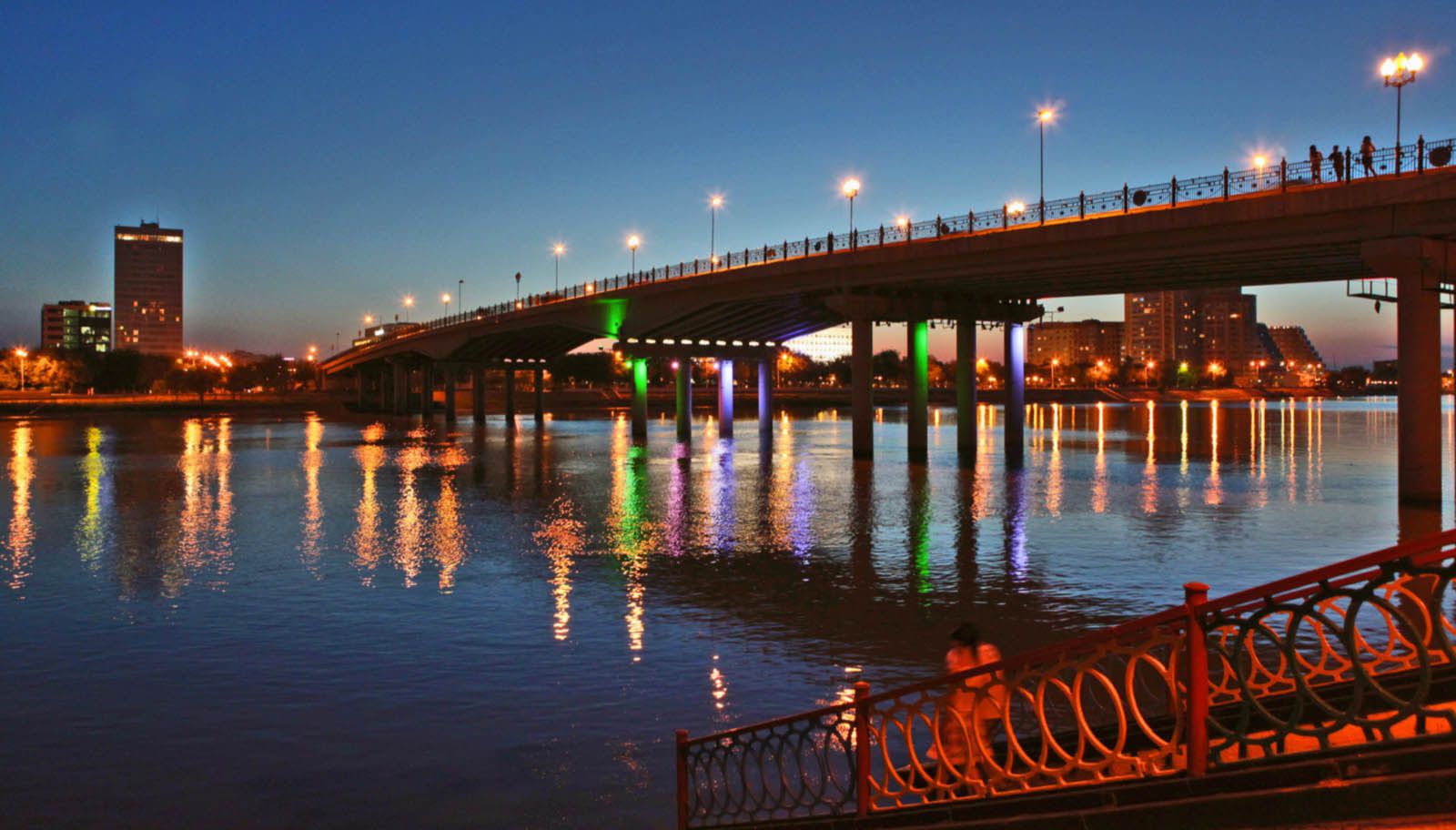
[edit]On August 28, 1965, the first real reinforced concrete bridge in the city, passing through the Ural River, was built and put into operation. The bridge is 259 meters (850 feet) long and 10 meters (33 feet) high. The bridge connects Satpayev Avenue and Abay Street. On the right European coast on Satpayev Avenue, the akimat (mayor's office) of the city and akimat (governor) of the Atyrau region adjoin the bridge.
In 2001, a unique pedestrian suspension bridge was built. The 551-meter-long (1,808-foot) bridge is listed in the Guinness Book of Records as the longest pedestrian bridge in the world. From the middle of the bridge over the Urals there are views of Azattyk Avenue and its surroundings.
In 2009, the Sultan Beibars was opened – a four-lane bridge with a throughput capacity of 5–7 thousand cars a day, 800 meters (2,600 feet) long with access roads, 380.74 meters (1,249.1 feet) long and 22 meters (72 feet) wide. The width of the roadway is 16 meters (52 feet), plus two walking paths of 2.5 meters (8.2 feet) each.
See also
[edit]References
[edit]- ^ "Назначен аким Атырау". www.zakon.kz (in Russian). 2023-07-10.
- ^ "Sub-national HDI – Area Database – Global Data Lab". hdi.globaldatalab.org. Archived from the original on 23 September 2018. Retrieved 2021-07-21.
- ^ DOSM. "Department of Statistics Kazakhstan". stat.gov.kz. Archived from the original on 2 January 2024. Retrieved 2023-03-01.
- ^ "Atyrau". Archived from the original on 2021-04-14. Retrieved April 3, 2021.
- ^ a b "pogoda.ru.net Погода и Климат". Retrieved January 3, 2022.
- ^ "Atyrary (Atyrau) Climate Normals 1961–1990". National Oceanic and Atmospheric Administration. Retrieved 13 May 2015.
- ^ "Klimatafel von Atyrau (Gurjew) / Kasachstan" (PDF). Federal Ministry of Transport and Digital Infrastructure. Retrieved September 17, 2016.
- ^ Company Overview of Atyrau Refinery LLP
- ^ "Japanese Banks Provide $297.5 million Loan to Atyrau Oil Refinery". The Gazette of Central Asia. Satrapia. 15 August 2012.
- ^ "Kazakhstan". chevron.com. Retrieved 2016-12-06.
- ^ "DAIS | Touching Hearts Strengthening Minds". www.daiskz.org. Retrieved 2016-12-06.
- ^ "General Information". atyrau.globaloutpostservices.com. Archived from the original on 2016-12-20. Retrieved 2016-12-06.
- ^ Ryskalieva, Damilya; Yessenamanova, Mansiya; Syrlybekkyzy, Samal; Koroleva, Elena G.; Yessenamanova, Zhanar; Tlepbergenova, Anar; Izbassarov, Amanbay; Turekeldiyeva, Rimma (2023-07-31). "Environmental Assessment of the Impact of Atmospheric Air Pollution with Hydrogen Sulfide on the Health of the Population of Atyrau, Republic of Kazakhstan". International Journal of Sustainable Development and Planning. 18 (7): 2199–2206. doi:10.18280/ijsdp.180724.
- ^ Yessenamanova, Mansiya; Yessenamanova, Zhanar; Tlepbergenova, Anar; Batyrbayeva, Gaukhar (2021-06-22). "Analysis of the Content of Hydrogen Sulfide in the Air of the City of Atyrau". International Journal of Sustainable Development and Planning. 16 (3): 479–483. doi:10.18280/ijsdp.160308.
- ^ "Как обновится стадион "Мунайшы" – Футбол".
- ^ "Есть ли побратимы у Актау и других городов Казахстана".
External links
[edit]Atyrau
View on GrokipediaEtymology
Historical Names and Origins
The settlement at the mouth of the Ural River was established in 1615 by Russian merchant Mikhail Guryev, who obtained a monopoly from Tsar Mikhail Fedorovich for sturgeon fishing in the area, leading to the construction of a fortified outpost primarily operated by Cossacks.[4][8] From 1708 onward, the site was officially designated as Guryev, honoring the Guriev merchant family that sponsored its development as a key fishing and trade hub under Russian imperial expansion into the steppe regions.[9] The name Guryev persisted through the Russian Empire and Soviet era, reflecting the site's integration into Russian economic and administrative structures, though local Kazakh and Nogai populations continued using indigenous designations tied to the river's delta geography.[10] In October 1991, shortly after Kazakhstan's declaration of independence, the city administration voted to restore the traditional Kazakh name Atyrau, which was formalized in official usage by 1992.[9] Atyrau derives from the Kazakh term atyrau, meaning "river mouth" or "delta," directly referencing the Ural River's confluence with the Caspian Sea, a feature central to the nomadic Turkic peoples' environmental nomenclature in the region long before Russian settlement.[9] This etymology underscores pre-imperial Turkic linguistic influences, contrasting with the Russified Guryev, which prioritized merchant patronage over local topography.[4]Geography
Location and Topography
Atyrau is positioned at the mouth of the Ural River where it empties into the northern Caspian Sea, serving as a key port in western Kazakhstan. The city's central coordinates are approximately 47°07′N 51°53′E.[11] The Ural River, conventionally regarded as the boundary between Europe and Asia, bisects the urban area, placing the western bank in Europe and the eastern bank in Asia.[4] Bridges span the river, linking the two sides of the city.[12] The topography surrounding Atyrau features flat steppe landscapes and low-lying riverine plains typical of the Ural River delta, situated within the Caspian Depression.[13] This deltaic environment includes mudflats, reed beds, and distributary channels prone to seasonal inundation from river overflow.[14] The region's elevation is minimal, contributing to its vulnerability to water level fluctuations in both the river and the endorheic Caspian Sea. Atyrau lies proximate to significant geological features, with the Tengiz oil field approximately 350 kilometers southeast and the offshore Kashagan field about 80 kilometers south in the Caspian Sea.[15][16]Climate Characteristics
Atyrau features a cold semi-arid climate (Köppen BSk), characterized by significant temperature seasonality and low humidity. Annual average temperatures hover around 11.2°C, with marked diurnal and seasonal variations driven by the region's continental position. Summers are hot, peaking in July with average highs of 33°C (91°F) and lows of 19°C (67°F), while winters are severe, with January averages near -6°C (21°F) and frequent drops to -20°C (-4°F) or below during cold snaps.[17][18][19] Precipitation is scant, totaling 176–210 mm annually, predominantly falling as rain in spring (April–May), when monthly totals can reach 40–50 mm, compared to under 10 mm in drier autumn months like September. Snowfall occurs in winter but contributes minimally to the yearly total due to rapid melting and evaporation in the arid conditions. High evaporation rates, exceeding precipitation by a factor of several times, reinforce the semi-arid designation.[20][18][19] Persistent winds, often exceeding 10–15 m/s, contribute to frequent dust storms, particularly in transitional seasons, as loose soils in the surrounding steppe and desert fringes are mobilized by gusts up to 18–20 m/s. These events reduce visibility to under 1 km and occur several times yearly, aligning with patterns in Kazakhstan's western arid zones.[21][22] Observational data from the 2020s indicate a slight warming trend, with Kazakhstan's overall temperature rise of +0.36°C per decade amplifying in Atyrau through extended heatwaves—days above 30°C have increased, and 2023 marked record warmth in the region alongside national anomalies. This aligns with broader Central Asian patterns of intensified aridity, though local records emphasize empirical station measurements over modeled projections.[23][24][25]History
Founding and Pre-Soviet Period
Atyrau originated as a Russian fishing outpost at the mouth of the Ural River (then known as the Yaik) into the Caspian Sea, established to exploit the region's abundant sturgeon populations. In 1615, merchant Mikhail Guryev secured a monopoly from Tsar Mikhail Fedorovich for sturgeon fishing in the Ural estuary, prompting initial settlement activities focused on commercial extraction.[9] By the mid-17th century, these efforts evolved into a fortified position, with a wooden fort constructed in 1645 under the name Nizhny Yaitzky Gorodok (Lower Yaik Fort) to defend against raids by nomadic groups, including Kazakh tribes, while facilitating fur trade and fisheries.[26][1] The fortress anchored early economic development centered on fishing, salt extraction, and commerce, serving as a southern outpost of Russian expansion along the Ural River. Renamed Guryev in honor of its founding merchant family, the settlement integrated into the Russian Empire's administrative framework as part of the Ural Cossack Host territories, with governance tied to Astrakhan and Orenburg provinces.[1] Local economy relied on riverine transport for exporting fish products and hides northward, though direct Volga connections were limited to overland or Caspian shipping routes rather than navigable waterways. During the 19th century, Guryev expanded modestly as a trade node, benefiting from imperial policies promoting settlement and resource exploitation in peripheral regions. By the 1860s, the town hosted around 58 commercial establishments, including shops for textiles, foodstuffs, and colonial goods, underscoring its role in regional exchange of livestock, fish, and grains with interior Russian markets. Population growth reflected influxes of Russian peasants, Cossacks, and merchants, reaching approximately 10,000 residents by 1917, with documented nomadic Kazakh interactions confined largely to peripheral trade and occasional conflicts rather than significant cultural integration.[1] This period solidified Guryev's identity as a predominantly Slavic enclave amid steppe nomadism, prioritizing defensive and extractive functions over broader urbanization.Soviet Industrialization
In the Soviet period, Guryev (the name used for Atyrau from the early 20th century through 1991) became a focal point for resource extraction in the Caspian region, aligning with the USSR's Five-Year Plans to mobilize natural assets for heavy industry. The 1920s and 1930s saw state-directed expansion of the fishing sector, leveraging the Ural River's sturgeon and other species for commercial output, with collective fishing operations formalized under Soviet oversight. Concurrently, early oil prospecting intensified in the Emba fields nearby, yielding initial discoveries that positioned the area as a supplementary producer to the Baku hub, though extraction remained modest until later decades due to technological limits.[4][27][28] Forced collectivization campaigns from 1929 onward disrupted traditional nomadic and fishing livelihoods across western Kazakhstan, compelling sedentarization and herd confiscations that triggered widespread famine and migration, with Guryev serving as a resettlement node for laborers redirected to fisheries and nascent oil sites. This policy, enforced by quotas and repression, swelled the local workforce through internal Soviet migrations and deportations, driving population increases from under 20,000 in the 1920s to around 100,000 by the 1970s, primarily via ethnic Russian and other non-Kazakh inflows for industrial tasks. Such demographic shifts supported output targets, though at the cost of social upheaval, including resistance and high mortality in the broader Kazakh steppe.[29] Post-World War II reconstruction prioritized hydrocarbon processing, with the Guryev oil refinery's construction decreed by the Soviet government in the late 1940s, operational by the early 1950s to refine Emba crude and bolster wartime recovery efforts via Lend-Lease influences. Infrastructure investments included the 720 km Guryev-Emba-Orsk pipeline initiated in 1932 for southward crude export, and a 440-mile rail extension completed in 1964 linking Makat oil fields to Guryev, circumventing Caspian salt flats to enhance logistics. These developments integrated Guryev into the USSR's Caspian production network, contributing roughly 5-10% of Soviet non-Baku oil by the 1970s through state-orchestrated drilling and transport, though environmental degradation and inefficiency marked the era's extractive model.[30][31][32][33]Post-Independence Growth
Following Kazakhstan's independence in 1991, the city formerly known as Guryev was renamed Atyrau, reflecting a broader effort to restore Kazakh nomenclature and assert national identity amid post-Soviet transitions.[34] This renaming coincided with market-oriented reforms that opened the region to foreign investment, particularly in hydrocarbons, transforming Atyrau from a Soviet-era outpost into a key economic hub.[35] A pivotal development occurred in April 1993 with the formation of Tengizchevroil (TCO), a joint venture between Kazakhstan's government, Chevron, ExxonMobil, and KazMunayGas, granting exclusive rights to develop the supergiant Tengiz oil field located approximately 350 kilometers southeast of Atyrau. The deal marked one of the first major foreign direct investments in post-independence Kazakhstan, injecting billions into exploration and production infrastructure, with Chevron holding a 50% stake as the initial international partner.[36] Subsequent expansions, including sour gas injection projects, boosted output and spurred ancillary economic activity in the Atyrau region.[37] By the 2020s, the city's population had roughly doubled to around 300,000, fueled by oil sector employment and migration, while the Atyrau region's GDP per capita reached 20,509 thousand tenge in 2023, the highest in Kazakhstan, driven primarily by hydrocarbon exports.[38] Oil production in the region expanded fourfold nationally over the independence period, with Atyrau's refineries modernized in the 2010s to process increased volumes and meet domestic needs.[39] Urban modernization accelerated in the 2000s and 2010s, exemplified by the Atyrau Refinery upgrade completed in 2015, which raised crude processing capacity and supported export growth, alongside infrastructure like the Third Generation Plant for gas injection.[40] Kazakhstan's national diversification initiatives in the 2020s have prompted Atyrau to pursue non-oil projects, though hydrocarbons remain dominant, with foreign investment inflows rising 86% in early 2023 amid global energy demand.[6]Demographics
Population Trends
The population of Atyrau city stood at approximately 154,000 in the 1989 census, reflecting modest size prior to post-Soviet economic shifts. By the 1999 census, it had grown to 247,311. The 2009 census recorded further expansion to 385,193 residents. This trajectory indicates an average annual growth rate of about 4.5% from 1999 to 2009, calculated as the compound annual growth rate (CAGR) from census figures: . Subsequent growth slowed, with an estimated population of 401,648 in 2023 and 420,168 as of October 1, 2024, yielding a CAGR of roughly 0.6% from 2009 to 2024: .[41]| Census/Estimate Year | Population |
|---|---|
| 1989 | 154,000 |
| 1999 | 247,311 |
| 2009 | 385,193 |
| 2023 (est.) | 401,648 |
| 2024 (Oct. 1) | 420,168 |
Ethnic and Religious Composition
As of recent estimates, ethnic Kazakhs comprise approximately 90% of Atyrau's population, a significant increase from around 80% in the late 1990s, attributable to post-Soviet repatriation programs encouraging ethnic Kazakhs from abroad to return.[43] Russians form the largest minority at about 5-8%, followed by smaller groups such as Tatars (around 0.5%), Koreans (0.8%), and Uzbeks.[44] This composition reflects broader national trends of Kazakh demographic dominance in western Kazakhstan, with the city's urban core exhibiting greater ethnic homogeneity compared to surrounding rural districts in Atyrau Oblast.[45] Religiously, the population is predominantly Sunni Muslim of the Hanafi school, aligning with the ethnic Kazakh majority and estimated at over 85% based on national patterns adjusted for local demographics.[46] A notable minority, roughly corresponding to the Russian population, adheres to Russian Orthodox Christianity, with active parishes such as the Orthodox Church in Atyrau. Other Christian denominations, including Protestants, exist but face occasional regulatory challenges.[47] The Soviet legacy of state atheism continues to influence societal secularism, resulting in a portion of residents identifying as non-religious or nominally observant, though religiosity has risen since independence.[48]| Ethnic Group | Approximate Share |
|---|---|
| Kazakhs | 90% |
| Russians | 5-8% |
| Tatars | 0.5% |
| Others | 2-4% |
