Auction theory
Auction theory
Main page

Auction theory

logo
Community Hub0 subscribers
Read side by side
from Wikipedia

Auction theory is a branch of applied economics that deals with how bidders act in auctions and researches how the features of auctions incentivise predictable outcomes. Auction theory is a tool used to inform the design of real-world auctions. Sellers use auction theory to raise higher revenues while allowing buyers to procure at a lower cost. The confluence of the price between the buyer and seller is an economic equilibrium. Auction theorists design rules for auctions to address issues that can lead to market failure. The design of these rulesets encourages optimal bidding strategies in a variety of informational settings.[1] The 2020 Nobel Prize for Economics was awarded to Paul R. Milgrom and Robert B. Wilson "for improvements to auction theory and inventions of new auction formats."[2]

Introduction

[edit]

Auctions facilitate transactions by enforcing a specific set of rules regarding the resource allocations of a group of bidders. Theorists consider auctions to be economic games that have two aspects: format and information.[3] The format defines the rules for the announcement of prices, the placement of bids, the updating of prices, when the auction closes, and the way a winner is picked.[4] The way auctions differ with respect to information regards the asymmetries of information that exist between bidders.[5] In most auctions, bidders have some private information that they choose to withhold from their competitors. For example, bidders usually know their personal valuation of the item, which is unknown to the other bidders and the seller; however, the behaviour of bidders can influence valuations by other bidders.

History

[edit]

A purportedly historical event related to auctions is a custom in Babylonia, namely when men make an offers to women in order to marry them.[6] The more familiar the auction system is, the more situations where auctions are conducted. There are auctions for various things, such as livestock, rare and unusual items, and financial assets.

Non-cooperative games have a long history, beginning with Cournot's duopoly model. A 1994 Nobel Laureate for Economic Sciences, John Nash,[7] proved a general-existence theorem for non-cooperative games, which moves beyond simple zero-sum games. This theory was generalized by Vickrey (1961) to deal with the unobservable value of each buyer. By the early 1970s, auction theorists had begun defining equilibrium bidding conditions for single-object auctions under most realistic auction formats and information settings.[8] Recent developments in auction theory consider how multiple-object auctions can be performed efficiently.

Auction types

[edit]

There are traditionally four types of auctions that are used for the sale of a single item:

  • First-price sealed-bid auction in which bidders place their bids in sealed envelopes and simultaneously hand them to the auctioneer. The envelopes are opened and the individual with the highest bid wins, paying the amount bid. This form of auction requires strategic considerations since bidders must not only consider their own valuations but other bidders' possible valuations.[9] The first formal analysis of such an auction was by Vickrey (1961). For the case of two buyers and uniformly distributed values, he showed that the symmetric-equilibrium strategy was to submit a bid equal to half of the buyer's valuation.
  • Second-price sealed-bid auctions (Vickrey auctions) which are the same as first-price sealed-bid auctions except that the winner pays a price equal to the second-highest bid. The logic of this auction type is that the dominant strategy for all bidders is to bid their true valuation.[10] William Vickrey was the first scholar to study second-price valuation auctions, but their use goes back in history, with some evidence suggesting that Goethe sold his manuscripts to a publisher using the second-price auction format.[11] Online auctions often use an equivalent version of Vickrey's second-price auction wherein bidders provide proxy bids for items. A proxy bid is an amount an individual values some item at. The online auction house will bid up the price of the item until the proxy bid for the winner is at the top. However, the individual only has to pay one increment higher than the second-highest price, despite their own proxy valuation.[12]
  • Open ascending-bid auctions (English auctions) are the oldest, and possibly most common, type of auction in which participants make increasingly higher bids, each stopping bidding when they are not prepared to pay more than the current highest bid. This continues until no participant is prepared to make a higher bid; the highest bidder wins the auction at the final amount bid. Sometimes the lot is sold only if the bidding reaches a reserve price set by the seller.
  • Open descending-bid auctions (Dutch auctions) are those in which the price is set by the auctioneer at a level sufficiently high to deter all bidders, and is progressively lowered until a bidder is prepared to buy at the current price, winning the auction.

Most auction theory revolves around these four "basic" auction types. However, other types have also received some academic study (see Auction § Types). Developments in the world and in technology have also influenced the current auction system. With the existence of the internet, online auctions have become an option.

  • Online auctions are efficient platforms for establishing precise prices based on supply and demand. Furthermore, they can overcome geographic boundaries. Online auction sites are used for a variety of purposes, such as online "garage sales" by companies liquidating unwanted inventory.[13] A significant difference between online auctions and traditional auctions is that bidders on the internet are unable to inspect the actual item, leading to differences between initial perception and reality.[14]

Auction process

[edit]

There are six basic activities that complement the auction-based trading process:[15]

  • Initial buyer and seller registration: authentication of trading parties, exchange of cryptography keys when the auction is online, and profile creation.
  • Setting up a particular auction event: describing items sold or acquired and establishing auction rules. Auction rules define the type of auction, starting date, closing rules, and other parameters.
  • Scheduling and advertising, as well as grouping of items of the same category to be auctioned together, is done to attract potential buyers. Popular auctions can be combined with less-popular auctions to persuade people to attend the less popular ones.
  • Bidding step: bids are collected and bid control rules of the auction are implemented.
  • Evaluation of bids and closing the auction: winners and losers are declared.
  • Trade settlement: payment to seller, transfer of goods, fees to agents.

Auction envelope theorem

[edit]

The auction envelope theorem defines certain probabilities expected to arise in an auction.[16]

Benchmark model

[edit]

The benchmark model for auctions, as defined by McAfee and McMillan (1987), is as follows:

  • All of the bidders are risk-neutral.
  • Each bidder has a private valuation for the item, which is almost always independently drawn from some probability distribution.
  • The bidders possess symmetric information.
  • The payment is represented only as a function of the bids.

Win probability

[edit]

In an auction a buyer bidding wins if the opposing bidders make lower bids.

The mapping from valuations to bids is strictly increasing; the high-valuation bidder therefore wins.

In statistics the probability of having the "first" valuation is written as:

With independent valuations and N other bidders

The auction

[edit]

A buyer's payoff is

Let be the bid that maximizes the buyer's payoff.

Therefore

The equilibrium payoff is therefore

Necessary condition for the maximum:

when

The final step is to take the total derivative of the equilibrium payoff

The second term is zero. Therefore

Then

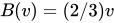
Example uniform distribution with two buyers. For the uniform distribution the probability if having a higher value that one other buyer is .

Then

The equilibrium payoff is therefore .

The win probability is .
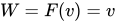
Then

.

Rearranging this expression,
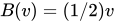
With three buyers, , then

With buyers

Lebrun (1996)[17] provides a general proof that there are no asymmetric equilibriums.

Optimal auctions

[edit]

Auctions from a buyer's perspective

[edit]

The revelation principle is a simple but powerful insight.

In 1979 Riley & Samuelson (1981) proved a general revenue equivalence theorem that applies to all buyers and hence to the seller. Their primary interest was finding out which auction rule would be better for the buyers. For example, there might be a rule that all buyers pay a nonrefundable bid (such auctions are conducted on-line). The equivalence theorem shows that any allocation mechanism or auction that satisfies the four main assumptions of the benchmark model will lead to the same expected revenue for the seller. (Buyer i with value v has the same "payoff" or "buyer surplus" across all auctions.)[18]

Symmetric auctions with correlated valuation distributions

[edit]

The first model for a broad class of models was Milgrom and Weber's (1983) paper on auctions with affiliated valuations.

In a recent working paper on general asymmetric auctions, Riley (2022) characterized equilibrium bids for all valuation distributions. Each buyer's valuation can be positively or negatively correlated.

The revelation principle as applied to auctions is that the marginal buyer payoff or "buyer surplus" is P(v), the probability of being the winner.

In every participant-efficient auction, the probability of winning is 1 for a high-valuation buyer. The marginal payoff to a buyer is therefore the same in every such auction. The payoff must therefore be the same as well.

Auctions from the seller's perspective (revenue maximization)

[edit]

Quite independently and soon after, Myerson (1981) used the revelation principle to characterize revenue-maximizing sealed high-bid auctions. In the "regular" case this is a participation-efficient auction. Setting a reserve price is therefore optimal for the seller. In the "irregular" case it has since been shown that the outcome can be implemented by prohibiting bids in certain sub-intervals.

Relaxing each of the four main assumptions of the benchmark model yields auction formats with unique characteristics.[18]

  • Risk-averse bidders incur some kind of cost from participating in risky behaviours, which affects their valuation of a product. In sealed-bid first-price auctions, risk-averse bidders are more willing to bid more to increase their probability of winning, which, in turn, increases the bid's utility. This allows sealed-bid first-price auctions to produce higher expected revenue than English and sealed-bid second-price auctions.
  • In formats with correlated values—where the bidders' valuations of the item are not independent—one of the bidders, perceiving their valuation of the item to be high, makes it more likely that the other bidders will perceive their own valuations to be high. A notable example of this instance is the winner’s curse, where the results of the auction convey to the winner that everyone else estimated the value of the item to be less than they did. Additionally, the linkage principle allows revenue comparisons amongst a fairly general class of auctions with interdependence between bidders' values.
  • The asymmetric model assumes that bidders are separated into two classes that draw valuations from different distributions (e.g., dealers and collectors in an antique auction).
  • In formats with royalties or incentive payments, the seller incorporates additional factors, especially those that affect the true value of the item (e.g., supply, production costs, and royalty payments), into the price function.[18]

The theory of efficient trading processes developed in a static framework relies heavily on the premise of non-repetition. For example, an auction-seller-optimal design (as derived in Myerson) involves the best lowest price that exceeds both the seller's valuation and the lowest possible buyer's valuation.

Game-theoretic models

[edit]

A game-theoretic auction model is a mathematical game represented by a set of players, a set of actions (strategies) available to each player, and a payoff vector corresponding to each combination of strategies. Generally, the players are the buyer(s) and the seller(s). The action set of each player is a set of bid functions or reservation prices (reserves). Each bid function maps the player's value (in the case of a buyer) or cost (in the case of a seller) to a bid price. The payoff of each player under a combination of strategies is the expected utility (or expected profit) of that player under that combination of strategies.

Game-theoretic models of auctions and strategic bidding generally fall into either of the following two categories. In a private values model, each participant (bidder) assumes that each of the competing bidders obtains a random private value from a probability distribution. In a common value model, the participants have equal valuations of the item, but they do not have perfectly accurate information to arrive at this valuation. In lieu of knowing the exact value of the item, each participant can assume that any other participant obtains a random signal, which can be used to estimate the true value, from a probability distribution common to all bidders.[19] Usually, but not always, the private-values model assumes that the valuations are independent across bidders, whereas a common-value model usually assumes that the valueations are independent up to the common parameters of the probability distribution.

A more general category for strategic bidding is the affiliated values model, in which the bidder's total utility depends on both their individual private signal and some unknown common value. Both the private value and common value models can be perceived as extensions of the general affiliated values model.[20]

Ex-post equilibrium in a simple auction market

When it is necessary to make explicit assumptions about bidders' value distributions, most of the published research assumes symmetric bidders. This means that the probability distribution from which the bidders obtain their values (or signals) is identical across bidders. In a private values model which assumes independence, symmetry implies that the bidders' values are "i.i.d." – independently and identically distributed.

An important example (which does not assume independence) is Milgrom and Weber's general symmetric model (1982).[21][22]

Asymmetric auctions

[edit]

The earliest paper on asymmetric value distributions is by Vickrey (1961). One buyer's valuation is uniformly distributed over the closed interval [0,1]. The other buyer has a known value of 1/2. Both the equilibrium and uniform bid distributions will support [0,1/2].

Jump-bidding;

Suppose that the buyers' valuations are uniformly distributed on [0,1] and [0,2] and buyer 1 has the wider support. Then both continue to bid half their valuations except at v=1.

The jump bid: buyer 2 jumps from bidding 1/2 to bidding 3/4. If buyer 1 follows suit she halves her profit margin and less than doubles her win probability (because of the tie breaking rule, a coin toss).

So buyer 2 does not jump. This makes buyer 1 much better off. He wins for use if his valuation is above 1/2.

The next paper, by Maskin and Riley (2000), provides a qualitative characterization of equilibrium bids when the "strong buyer" S has a value distribution that dominates that of the "weak buyer" under the assumption of conditional stochastic dominance (first-order stochastic dominance for every right-truncated value distribution). Another early contribution is Keith Waehrer's 1999 article.[23] Later published research includes Susan Athey's 2001 Econometrica article,[24] as well as that by Reny and Zamir (2004).[25]

Revenue equivalence

[edit]

One of the major findings of auction theory is the revenue equivalence theorem. Early equivalence results focused on a comparison of revenues in the most common auctions. The first such proof, for the case of two buyers and uniformly distributed values, was by Vickrey (1961). In 1979 Riley & Samuelson (1981) proved a much more general result. (Quite independently and soon after, this was also derived by Myerson (1981)).The revenue equivalence theorem states that any allocation mechanism, or auction that satisfies the four main assumptions of the benchmark model, will lead to the same expected revenue for the seller (and player i of type v can expect the same surplus across auction types).[18] The basic version of the theorem asserts that, as long as the Symmetric Independent Private Value (SIPV) environment assumption holds, all standard auctions give the same expected profit to the auctioneer and the same expected surplus to the bidder.[26]

Winner's curse

[edit]

The winner's curse is a phenomenon which can occur in common value settings—when the actual values to the different bidders are unknown but correlated, and the bidders make bidding decisions based on estimated values. In such cases, the winner will tend to be the bidder with the highest estimate, but the results of the auction will show that the remaining bidders' estimates of the item's value are less than that of the winner, giving the winner the impression that they "bid too much".[18]

In an equilibrium of such a game, the winner's curse does not occur because the bidders account for the bias in their bidding strategies. Behaviorally and empirically, however, winner's curse is a common phenomenon, described in detail by Richard Thaler.

Optimal auctions

[edit]

With identically and independently distributed private valuations, Riley and Samuelson (1981)[27] showed that in any auction or auction-like action (such as the "War of Attrition") the allocation is "participant efficient", i.e. the item is allocated to the buyer submitting the highest bid, with a probability of 1. They then showed that allocation equivalence implied payoff equivalence for all reserve prices. They then showed that discriminating against low-value buyers by setting a minimum, or reserve, price would increase expected revenue. Along with Myerson, they showed that the most profitable reserve price is independent of the number of bidders. The reserve price only comes into play if there is a single bid. Thus it is equivalent to ask what reserve price would maximize the revenue from a single buyer. If values are uniformly distributed over the interval [0, 100], then the probability p(r) that this buyer's value is less than r is p(r) = (100-r)/100. Therefore the expected revenue is

p(r)*r = (100 - r)*r/100 =(r-50)*(r-50) + 25

Thus, the expected revenue-maximizing reserve price is 50.[28] Also examined is the question of whether it might ever be more profitable to design a mechanism that awards the item to a bidder other than one with the highest value. Surprisingly, this is the case. As Maskin and Riley then showed, this is equivalent to excluding bids over certain intervals above the optimal reserve price.

Bulow and Klemperer (1996) have shown that an auction with n bidders and an optimally chosen reserve price generates a smaller profit for the seller than a standard auction with n+1 bidders and no reserve price.[29]

JEL classification

[edit]

In the Journal of Economic Literature Classification System, game theory is classified as C7, under Mathematical and Quantitative Methods, and auctions are classified as D44, under Microeconomics.[30]

Applications to business strategy

[edit]

Scholars of managerial economics have noted some applications of auction theory in business strategy. Namely, auction theory can be applied to preemption games and attrition games.[31]

Preemption games are games where entrepreneurs preempt other firms by entering a market with new technology before it's ready for commercial deployment. The value generated from waiting for the technology to become commercially viable also increases the risk that a competitor will enter the market preemptively. Preemptive games can be modeled as a first-priced sealed auction. Both companies would prefer to enter the market when the technology is ready for commercial deployment; this can be considered the valuation by both companies. However, one firm might hold information stating that technology is viable earlier than the other firm believes. The company with better information would then "bid" to enter the market earlier, even as the risk of failure is higher.

Games of attrition are games of preempting other firms to leave the market. This often occurs in the airline industry as these markets are considered highly contestable.[32] As a new airline enters the market, they will decrease prices to gain market share. This forces established airlines to also decrease prices to avoid losing market share. This creates an auction game. Usually, market entrants will use a strategy of attempting to bankrupt established firms. Thus, the auction is measured in how much each firm is willing to lose as they stay in the game of attrition. The firm that lasts the longest in the game wins the market share. This strategy has been used more recently by entertainment streaming services such as Netflix, Hulu, Disney+, and HBO Max which are all loss-making firms attempting to gain market share by bidding to expand entertainment content.[33]

Nobel Memorial Prize in Economic Sciences

[edit]

Two Stanford University professors, Paul Milgrom and Robert Wilson, won the 2020 Nobel Memorial Prize in Economic Sciences for advancing auction theory by inventing several new auction formats, including the simultaneous multiple-round auction (SMRA), which combines the benefit of both the English (open-outcry), and sealed-bid, auctions. SMRAs are deemed to solve a problem facing the Federal Communications Commission (FCC). If the FCC were to sell all of its telecommunication frequency slots by using a traditional auction method, it would eventually either give away licenses for free or end up with a telecom monopoly in the United States.[34]

The process of simultaneous multiple-round auctions is that there are three- to four-round auctions. Every bidder seals their bid, and the auctioneer announces the highest bid to all bidders at the end of each round. All the bidders can adjust and change their auction price and strategy after they listen to the highest bid in a particular round. The auction will continue until the highest bid of the current round is lower than the previous round's highest bid.

SMRA's first distinguishing feature is that the auction is taking place simultaneously for different items; therefore, it seriously increases the cost for speculators. For the same reason, sealed bidding can ensure that all bidding reflects the bidder’s valuation of the product. The second difference is that the bidding takes place in numerous rounds and the highest price of bidding is announced each round, allowing bidders to learn more about their competitors' preferences and information and to adjust their strategy accordingly, thus decreasing the effect of asymmetric information inside the auction. In addition, multiple-round bidding can maintain the bidder's activity in the auction. It has substantially increased the information the bidder has about the highest bid, because at the end of every round, the host will announce the highest bid after the bidding.[35]

Footnotes

[edit]

Further reading

[edit]
[edit]
Revisions and contributorsEdit on WikipediaRead on Wikipedia
from Grokipedia
Auction theory is a subfield of economics and game theory that analyzes strategic bidding behavior by agents with private or common information in competitive allocation mechanisms, focusing on equilibrium outcomes, seller revenue maximization, and allocative efficiency under varying informational assumptions.[1][2] Foundational work by William Vickrey demonstrated that sealed-bid second-price auctions elicit truthful revelation of valuations, as the dominant strategy for each bidder is to bid their true value, thereby promoting efficiency despite incomplete information about rivals' preferences.[3] Vickrey's 1961 analysis laid the groundwork for understanding incentive compatibility in auctions, earning him a share of the 1996 Nobel Prize in Economic Sciences.[3] A central result, the revenue equivalence theorem, establishes that under symmetric independent private values, risk-neutral bidders, and a reserve price of zero, standard auction formats—including first-price sealed-bid, second-price sealed-bid, English ascending-bid, and Dutch descending-bid—generate identical expected revenue for the seller and profits for the buyer with the highest valuation.[1][4] Extensions by Robert Wilson and Paul Milgrom addressed common-value settings, where bidders' signals about an item's worth are affiliated and subject to the winner's curse—the risk that the highest bidder overestimates value due to selection bias in winning.[5] Wilson's models incorporated linkage principles, revealing how auctions disseminating more bidder information mitigate adverse selection and the curse, while Milgrom generalized these to hybrid private-common value environments and designed formats that separate bidder estimates to enhance revenue and efficiency.[5] Their theoretical advances enabled practical innovations, such as simultaneous multi-round auctions for spectrum licenses, which the U.S. Federal Communications Commission adopted in the 1990s and 2000s, generating tens of billions in revenue while allocating assets to highest-value users.[6] These contributions earned Milgrom and Wilson the 2020 Nobel Prize in Economic Sciences.[5] Despite robust predictions in symmetric settings, empirical deviations arise from asymmetries, risk aversion, and behavioral factors like overbidding in common-value auctions, underscoring the theory's reliance on rational expectations and the need for mechanism design adjustments in real-world applications.[2]

Fundamentals

Definition and Core Principles

Auction theory is a branch of economics and game theory that analyzes auctions as strategic interactions among rational agents with incomplete information, focusing on bidder strategies, equilibrium outcomes, and mechanisms to allocate scarce resources efficiently or maximize seller revenue. Auctions serve as market institutions where a seller offers an item to multiple potential buyers, who submit bids, with the highest bidder typically winning and paying a price determined by the format—such as their own bid or the second-highest bid. This framework models auctions as Bayesian games, where bidders possess private signals about their valuations and update beliefs based on a common prior distribution.[1][7] Central to auction theory are assumptions of risk-neutral, symmetric bidders whose private values for the item are independently drawn from a known probability distribution, often under the independent private values (IPV) paradigm, where each bidder's value is intrinsic and unaffected by others' information. Bidders strategically shade bids below their true valuations in many formats to balance the probability of winning against the payment conditional on victory, leading to symmetric Bayesian Nash equilibria. A foundational principle is the revenue equivalence theorem, which asserts that, under IPV with risk neutrality and the efficient allocation of the item to the highest-value bidder (with the lowest type earning zero expected surplus), standard auction formats—such as first-price sealed-bid, second-price sealed-bid, English ascending, and Dutch descending—generate identical expected revenue for the seller, equal to the expected value of the second-highest bidder's valuation.[8][1][7] These principles underscore auctions' potential for incentive-compatible revelation of private information, though deviations arise in settings with common values (where valuations correlate across bidders, introducing the winner's curse) or affiliated signals, which can violate revenue equivalence and necessitate tailored designs. The theory emphasizes causal links between rules, information structure, and outcomes, prioritizing empirical verifiability over stylized narratives.[8][1]

Valuation Models and Bidder Information

In auction theory, valuation models formalize how bidders derive utility from acquiring the object and the informational basis for their valuations. The independent private values (IPV) model posits that each bidder ii privately observes their value viv_i, drawn independently and identically from a continuous probability distribution FF with support [0,vˉ][0, \bar{v}] and positive density ff, assuming risk neutrality and quasilinear utility ui=vipu_i = v_i - p if winning at price pp.[9][10] This framework, central to analyses since the 1960s, implies that valuations are bidder-specific and uncorrelated, eliminating interdependence in preferences and enabling dominant-strategy truth-telling in second-price auctions.[9] The pure common value model, by contrast, assumes a single unknown value VV identical across bidders, with each receiving a private signal xix_i drawn from a joint distribution conditional on VV, such that expected value E[Vx]E[V | \mathbf{x}] varies with the signal profile x=(x1,,xn)\mathbf{x} = (x_1, \dots, x_n).[10][11] Bidders must account for the winner's curse, wherein winning conveys adverse information about VV being lower than initially estimated, prompting shading of bids below conditional expectations to avoid losses.[11] Empirical applications, such as oil lease auctions, reveal overbidding risks when signals are noisy or asymmetrically precise.[11] Milgrom and Weber (1982) introduced the affiliated values model as a synthesis, where bidder ii's value vi=vi(x)v_i = v_i(\mathbf{x}) depends on all signals, with the joint density satisfying affiliation: for any increasing functions g,hg, h, E[g(x)xjt]E[g(x)E[h(x)xjt]]E[g(\mathbf{x}) | x_j \geq t] \geq E[g(\mathbf{x}) | E[h(\mathbf{x}) | x_j \geq t]] for all jj, implying positive stochastic dependence.[12] Affiliation generalizes IPV (where vi=xiv_i = x_i and independence holds) and common values (where vi(x)=E[Vx]v_i(\mathbf{x}) = E[V | \mathbf{x}]), capturing scenarios like mineral rights bidding where high private estimates correlate across bidders due to shared geological factors.[12][10] Bidder information structures specify the private nature of types (values or signals) and any asymmetries. Standard models assume symmetric information—identical distributions and beliefs—but relax this for realism, as in procurement where incumbents hold superior cost signals, leading to aggressive bidding by informed parties and potential inefficiencies.[13][14] Asymmetric equilibria often feature differential bidding functions solved via boundary conditions, with first-price formats amplifying distortions compared to second-price ones.[13] Risk attitudes, typically neutrality, can be extended to constant absolute risk aversion, altering shading but preserving qualitative insights under affiliation.[12]

Standard Auction Formats

In auction theory, the four standard formats are the English auction, Dutch auction, first-price sealed-bid auction, and second-price sealed-bid auction, each specifying distinct rules for bidding and payment while awarding the object to the highest effective bid.[8] These formats are typically analyzed under the independent private values (IPV) model, where each bidder's valuation is drawn independently from a common distribution and known only to that bidder.[1] The English auction, also known as the ascending-bid or open auction, begins with a low price that rises continuously or in increments until only one bidder remains active. Bidders drop out when the current price exceeds their private valuation, and the last remaining bidder wins the object, paying the price at which the second-highest bidder dropped out—effectively the second-highest valuation.[8] [1] In this format, bidding one's true valuation is a dominant strategy, as overbidding risks negative utility and underbidding risks losing to a lower-valuation competitor.[1] The Dutch auction, or descending-bid auction, starts with a high price that decreases continuously until a bidder accepts the current price, at which point that bidder wins the object and pays the acceptance price.[8] This format is strategically equivalent to the first-price sealed-bid auction, as the decision to accept mirrors choosing a bid in a sealed environment, requiring bidders to shade their bids below their true valuation to balance the probability of winning against expected surplus.[8] [1] In the first-price sealed-bid auction, all bidders simultaneously submit confidential bids, the highest bidder wins the object, and pays their own bid amount.[1] Bidders optimally bid less than their valuation in the symmetric Bayesian Nash equilibrium, where no bidder can improve their expected payoff by unilaterally changing their bid assuming others' bids remain fixed, with the shading amount increasing in the number of competitors; for example, under uniform [0,1] valuations with n bidders, the symmetric equilibrium bid is n1nv\frac{n-1}{n} v, where v is the bidder's value. For instance, with 2 bidders, a bidder with valuation 0.8 would bid 0.4 to balance the probability of winning against the expected profit.[1] The second-price sealed-bid auction, also called the Vickrey auction after William Vickrey's 1961 analysis, requires simultaneous sealed bids, awards the object to the highest bidder, but charges that bidder the second-highest bid amount.[8] [1] Bidding one's true valuation is a weakly dominant strategy, constituting a dominant strategy Nash equilibrium. Nash equilibrium in auctions is a strategy profile where no bidder can improve their payoff by changing their bid unilaterally, assuming others' bids remain fixed. This format is incentive-compatible: overbidding risks paying more than value, underbidding risks losing the item when winning would be profitable. For example, with bidders valuing an item at $10, $7, and $5, truthful bids lead to the $10 bidder winning and paying $7. This ensures the highest-valuation bidder wins without incentive to misrepresent value, though the format's sealed nature can introduce information asymmetries compared to open formats.[1]

Historical Development

Early Conceptual Foundations (Pre-1960s)

Auctions have been employed since antiquity for allocating goods and rights, with records indicating their use in Babylon around 500 BC for marriage contracts, in ancient Rome for selling plundered assets, and in China from the third century AD for distributing monks' belongings.[15] These early practices typically involved ascending-bid formats similar to the modern English auction, where participants openly increased offers until a final price was reached, or descending formats like the Dutch auction, originating in tulip markets of the 17th century and later formalized in commodity trading.[6] Such mechanisms relied on intuitive competitive dynamics rather than derived strategic equilibria, serving practical needs in commerce, taxation, and asset liquidation without systematic theoretical underpinning. Systematic analysis of bidding behavior emerged in the mid-1950s within operations research, focusing on sealed-bid procurement auctions where the lowest bid wins contracts, such as in construction or government tenders. Lawrence Friedman's 1956 model provided an early framework for optimal bidding, positing that contractors should select a markup over estimated costs to maximize expected profit, balancing the probability of submitting the lowest bid against the desired margin.[16] Friedman derived this by assuming bidders draw from a distribution of possible markups informed by historical data, treating the decision as maximizing profit equals markup times win probability minus any estimation errors, though without fully resolving interdependent strategies in equilibrium.[17] This approach introduced probabilistic elements to bidding, recognizing strategic shading—bidding above costs to ensure profitability while competing aggressively—but remained heuristic, relying on empirical bid dispersions rather than closed-form solutions. Pre-1960 efforts were primarily applied to reverse auctions for procurement, contrasting with sales auctions emphasized later, and lacked integration with broader economic theory like private value models. These operations research contributions highlighted causal links between bidder uncertainty, competition intensity, and bid levels—more rivals leading to lower markups—but did not address revenue equivalence or incentive compatibility formally.[18] By the late 1950s, such models influenced practical bidding in industries like highway construction, yet theoretical rigor was limited, setting the stage for game-theoretic advancements in the following decade.[19]

Independent Private Values Era (1960s-1980s)

The independent private values (IPV) model posits that each bidder independently draws a private valuation for the auctioned object from a common known distribution, with no informational externalities affecting others' values. This framework, which abstracts from common value dependencies, facilitated rigorous equilibrium analysis using game-theoretic tools emerging in the post-war era. Vickrey's 1961 analysis marked the inception of modern IPV theory by examining sealed-bid formats where bidders strategically conceal information to maximize expected utility.[20][21] In his seminal paper, William Vickrey demonstrated that the second-price sealed-bid auction—where the highest bidder wins but pays the second-highest bid—induces truthful revelation of valuations as a weakly dominant strategy, ensuring allocation to the bidder with the highest value irrespective of beliefs about others' distributions or risk preferences.[21] Vickrey contrasted this with the first-price sealed-bid auction, where symmetric equilibria involve bid shading: bidders submit bids below their valuations to trade off higher winning probabilities against reduced margins upon victory, with the extent of shading increasing in the number of competitors.[21] For instance, under uniform [0,1] valuations and two risk-neutral bidders, the equilibrium bidding function in the first-price auction is $ b(v) = \frac{1}{2} v $.[1] Extensions in the 1960s and 1970s derived closed-form symmetric Bayesian Nash equilibria for IPV settings across auction formats, often assuming risk neutrality and continuous distributions to solve differential equations governing optimal bid functions.[20] These equilibria highlighted efficiency in second-price and English auctions—where ascending bids reveal values dynamically—versus strategic shading in first-price and Dutch auctions, though Vickrey noted empirical parallels between first-price and Dutch formats due to equivalent incentives.[21] The era culminated in the early 1980s with the revenue equivalence theorem, which proved that, under symmetric IPV, risk-neutral bidders, independent draws from a continuous distribution with positive density everywhere, and conditions ensuring the lowest type earns zero expected utility, any auction allocating efficiently to the highest-value bidder generates identical expected revenue for the seller—equal to the expected second-order statistic of valuations.[22] This result, foreshadowed in Vickrey's comparisons of revenue distributions, was independently formalized by Roger Myerson, John Riley and William Samuelson, and Robert Wilson circa 1981, unifying prior findings and revealing that payment rules alone do not affect seller revenue under these assumptions.[13][20] Empirical tests later affirmed these predictions in lab and field settings, though deviations arose with risk aversion or affiliation.[23] [center]

Extensions to Complex Environments (1990s-2020s)

In the 1990s, auction theory advanced significantly by addressing multi-object environments, where bidders value combinations of items differently due to complementarities or substitutabilities, extending beyond single-item independent private values models.[20] Paul Milgrom and Robert Wilson's theoretical contributions enabled the design of practical formats for such settings, including the simultaneous ascending auction (SAA), which mitigates the exposure problem—where bidders hesitate to bid aggressively on individual items fearing overpayment without securing complements—through iterative bidding across multiple licenses.[24] This format was first implemented in the U.S. Federal Communications Commission's (FCC) 1994 auction of narrowband personal communications services (PCS) licenses, selling 99 licenses for $617 million over five days, demonstrating efficiency in revealing bidder values dynamically while discouraging collusion via activity rules that penalize inactivity.[25] Subsequent FCC auctions, such as the December 1994 broadband PCS sale raising $7.7 billion, refined SAA with percentage activity requirements (typically 5-10%) to sustain bidding and approximate efficiency in linked markets.[26] Combinatorial auctions emerged as a key extension, permitting bids on bundles to internalize synergies, theoretically grounded in the Vickrey-Clarke-Groves (VCG) mechanism for incentive compatibility and efficiency, though computational complexity limits its direct use in large settings.[27] Dynamic formats like the clock auction, where prices rise iteratively and bidders signal demand, approximate VCG outcomes while reducing strategic withholding, as analyzed in multi-unit demand models.[28] In practice, these addressed spectrum complementarities, with Milgrom's designs influencing global auctions that generated over $200 billion in revenues by the 2010s, prioritizing revenue and efficiency over simple uniform pricing.[20] Theoretical work also incorporated affiliated values and risk aversion, showing SAA's robustness but vulnerability to the threshold effect, where bidders drop out en masse near values, prompting hybrid formats with package bidding.[24] From the 2000s onward, extensions tackled dynamic and revenue management contexts, such as perishable inventory auctions where sellers post reserves adaptively to maximize expected revenue under uncertain demand. Multi-unit discriminatory auctions faced scrutiny for demand reduction incentives, leading to uniform-price alternatives analyzed via equilibrium refinements under budget constraints.[29] Recent developments integrate behavioral insights and computational methods, including approximate mechanisms for large combinatorial settings, though empirical validations highlight deviations from theory in resale opportunities and multi-object demands.[30] These advancements underscore auction theory's pivot to real-world complexity, balancing theoretical optimality with implementability in environments like electricity markets and online advertising.[6]

Core Theoretical Frameworks

Revenue Equivalence and Efficiency

The revenue equivalence theorem asserts that, under specified conditions, diverse auction mechanisms generate identical expected revenues for the seller. These conditions include bidders possessing independent private values drawn from the same known continuous distribution, risk neutrality, symmetry among bidders, and the mechanism ensuring that the bidder with the highest value wins the item with probability one while the bidder with the lowest possible value receives zero expected utility.[31] In such settings, mechanisms like the first-price sealed-bid auction, second-price sealed-bid auction (Vickrey auction), English ascending auction, and Dutch descending auction yield equivalent expected seller revenues, equal to the expected value of the second-highest bidder's valuation.[32] This equivalence arises from the envelope theorem applied to bidders' utility functions, where the derivative of a bidder's expected utility with respect to their private value equals their probability of winning, leading to identical integral expressions for revenue across formats.[22] The theorem's proof typically proceeds by deriving the equilibrium bidding strategies or utilities via differential equations. For a bidder with value vv, expected utility U(v)U(v) satisfies U(v)=Pr(winningv)U'(v) = \Pr(\text{winning} \mid v), with boundary condition U(0)=0U(0) = 0, implying U(v)=0vPr(winningt)dtU(v) = \int_0^v \Pr(\text{winning} \mid t) \, dt. Seller revenue, as the complement to total bidder surplus, integrates to the same value regardless of the specific format, provided allocation and participation rules align.[31][22] This result simplifies auction analysis by focusing comparisons on deviations from these assumptions rather than format-specific details. In the independent private values framework satisfying revenue equivalence conditions, standard auction formats achieve allocative efficiency, allocating the item to the bidder with the highest valuation.[33] Efficiency holds because equilibrium bidding strategies—such as truth-telling in second-price auctions or shading in first-price auctions—preserve the ranking of bids according to true values, ensuring the highest-value bidder prevails without externalities distorting incentives.[34] Departures from assumptions, such as risk aversion or correlated values, can violate equivalence and efficiency, but within the core IPV model, these formats maximize social welfare by matching the good to its highest-valued use.[33]

Bidding Equilibria and the Envelope Theorem

In symmetric independent private value (IPV) auctions with risk-neutral bidders, bidding equilibria are analyzed using Nash equilibrium concepts. A Nash equilibrium in auctions is a strategy profile where no bidder can improve their expected payoff by unilaterally changing their bid, assuming others' bids remain fixed. In a second-price sealed-bid auction (also known as a Vickrey auction), there is a dominant strategy Nash equilibrium in which each bidder submits a bid equal to their true private valuation. This is incentive-compatible: bidding above one's valuation risks paying more than the item is worth if winning, while bidding below risks losing the item when winning would be profitable. For example, suppose three bidders have valuations of $10, $7, and $5. In this equilibrium, they bid $10, $7, and $5 respectively. The bidder with $10 wins the item and pays $7 (the second-highest bid), yielding a surplus of $3. This truth-telling property arises because the payment rule—where the winner pays the second-highest bid—decouples the bid from the payment conditional on winning.[1][35] In contrast, first-price sealed-bid auctions lack a dominant strategy, leading bidders to shade their bids below their valuation in a symmetric Bayesian Nash equilibrium (BNE) to trade off higher winning probability against lower conditional payment. For instance, with two bidders and valuations independently drawn from the uniform distribution on [0,1], each bids half their valuation in equilibrium. A bidder with valuation 0.8 would thus bid 0.4. Assuming i.i.d. valuations drawn from a continuous distribution FF with density ff on [0,vˉ][0, \bar{v}] and nn bidders, the equilibrium bidding function b(v)b(v) is strictly increasing and differentiable. A bidder with valuation vv bidding as if their type were yy receives interim expected utility u(v,y)=(vb(y))[F(y)]n1u(v, y) = (v - b(y)) [F(y)]^{n-1}, where [F(y)]n1[F(y)]^{n-1} is the probability of having the highest bid against n1n-1 opponents following the equilibrium.[1] The equilibrium utility is U(v)=maxyu(v,y)=u(v,v)U(v) = \max_y u(v, y) = u(v, v). The envelope theorem simplifies derivation of U(v)U(v) and b(v)b(v) by focusing on the direct effect of vv on utility at the optimum. Differentiating the maximized utility gives U(v)=u(v,y)vy=b1(b(v))=[F(v)]n1U'(v) = \frac{\partial u(v, y)}{\partial v} \big|_{y = b^{-1}(b(v))} = [F(v)]^{n-1}, as the indirect effect through optimal yy vanishes under first-order conditions.[36] With boundary condition U(0)=0U(0) = 0 (zero utility for valuation zero), integration yields U(v)=0v[F(t)]n1dtU(v) = \int_0^v [F(t)]^{n-1} \, dt. Substituting into the equilibrium utility expression produces the bidding function:
b(v)=vU(v)[F(v)]n1=v0v[F(t)]n1dt[F(v)]n1. b(v) = v - \frac{U(v)}{[F(v)]^{n-1}} = v - \frac{\int_0^v [F(t)]^{n-1} \, dt}{[F(v)]^{n-1}}.
This formula holds generally under the symmetry and monotonicity assumptions, with sufficiency verified by confirming the first-order condition for maximization and concavity of u(v,y)u(v, y) in yy.[1][37] For the common case of uniform valuations on [0,1][0, 1] where F(v)=vF(v) = v, the expression simplifies to U(v)=vn/nU(v) = v^n / n and b(v)=n1nvb(v) = \frac{n-1}{n} v. For n=2n=2 bidders, this yields the linear strategy b(v)=12vb(v) = \frac{1}{2} v: Bidders thus shade bids by half their value on average, increasing with nn toward truth-telling as competition intensifies.[38] For n=3n=3, b(v)=23vb(v) = \frac{2}{3} v.[1] This envelope-based approach extends to affiliated values or asymmetric settings with adjustments for distribution forms, though equilibrium existence requires regularity conditions like log-concavity of FF to ensure monotonicity.[35] Deviations from these, such as risk aversion, alter shading: risk-averse bidders bid more aggressively, closer to valuation, as derived by modifying the utility maximization.

Winner's Curse in Common Value Settings

In common value auctions, the winner's curse manifests as the winning bidder overestimating the item's true value conditional on securing the win, resulting in expected losses if bids are not adjusted accordingly. This occurs because the item's value VV is identical ex post for all participants, but bidders receive imperfect private signals correlated with VV, such that the highest signal—and thus the winning bid—is upward biased as an estimator of VV. The concept originated in analyses of oil lease bidding, where Capen, Clapp, and Campbell (1971) documented that winners frequently realized negative returns, attributing this to failure to condition estimates on the adverse selection implied by victory against informed rivals.[39] The curse stems from the informational content of winning: rational bidders infer that their signal exceeds others', implying a downward revision in E[Vwin]E[V \mid \text{win}]. Naive bidding of E[VSi]E[V \mid S_i], where SiS_i is bidder ii's signal, ignores this, leading to overbidding. Equilibrium strategies counteract it via bid shading, where bids reflect E[VSi,win]E[V \mid S_i, \text{win}], ensuring non-positive expected utility for the marginal winner. In Milgrom and Weber's (1982) framework for affiliated values, which encompasses pure common values, this adjustment varies with signal distribution and auction format, but the curse intensifies with greater uncertainty or fewer competitors, as the winner's signal provides less precise information about VV.[12] A canonical illustration is the mineral rights model, where VV is the unknown mineral deposit size, and each of nn bidders independently draws signal SiUniform[0,V]S_i \sim \text{Uniform}[0, V] conditional on VV. In the symmetric Bayesian Nash equilibrium of a first-price sealed-bid auction, bidders shade bids to b(s)=n1nsb(s) = \frac{n-1}{n} s, deriving from the second-order statistic: the pivot for indifference is the expected value conditional on one's signal equaling the second-highest among rivals. For n=2n=2, this yields b(s)=12sb(s) = \frac{1}{2} s: For n=3n=3, b(s)=23sb(s) = \frac{2}{3} s, with shading decreasing as nn rises due to the maximum signal converging to VV. This equilibrium, zero-profit for all, fully internalizes the curse via the envelope condition on interim expected utility.[12] Failure to shade adequately persists in practice, as evidenced by laboratory experiments where inexperienced bidders exhibit the curse, overbidding relative to theory and earning negative profits, while experienced ones converge to equilibrium. Field data from offshore oil auctions similarly reveal overbidding patterns consistent with partial curse mitigation, though asymmetric information or affiliation can exacerbate it.[40][41]

Optimal Mechanism Design

Seller Revenue Maximization

In auction theory, seller revenue maximization focuses on designing incentive-compatible mechanisms that elicit truthful bidding while extracting the highest possible expected payments from risk-neutral buyers with independent private values drawn from known distributions. Unlike efficiency-maximizing auctions, which prioritize allocative efficiency by awarding the good to the highest-valuing bidder, revenue-optimal designs may withhold the good from low-valuation bidders via reserves or ironing to balance participation and extraction. Roger Myerson's seminal characterization shows that, under symmetry and regularity (monotone hazard rates), the optimal mechanism allocates the good to the bidder with the highest virtual valuation ϕ(vi)=vi1F(vi)f(vi)\phi(v_i) = v_i - \frac{1 - F(v_i)}{f(v_i)}, where FF and ff are the cumulative distribution and density of values, but only if this exceeds the seller's value (typically zero for outside options).[42] This virtual valuation adjusts the bidder's reported value viv_i downward by the information rent 1F(vi)f(vi)\frac{1 - F(v_i)}{f(v_i)}, reflecting the surplus buyers capture from asymmetric information; maximizing expected virtual surplus thus yields the revenue-maximizing outcome by the revenue equivalence principle, as payments equal virtual surplus minus rents. For regular distributions, the mechanism implements as a second-price auction with a reserve price rr solving ϕ(r)=0\phi(r) = 0, independent of the number of bidders NN, ensuring individual rationality by excluding inframarginal types below rr. Empirical implementations, such as in spectrum auctions, confirm reserves boost revenue by screening low bidders, though overhigh reserves risk inefficient exclusion.[42][43] A canonical example arises with symmetric bidders valuing the good uniformly on [0,1][0, 1], yielding ϕ(v)=2v1\phi(v) = 2v - 1 and reserve r=0.5r = 0.5. In a second-price auction without reserve, expected revenue is NN+1\frac{N}{N+1}; with optimal reserve, it rises to E[max{maxivi,0.5}]1N+1P(maxvi<0.5)E[\max\{ \max_i v_i, 0.5 \}] - \frac{1}{N+1} \cdot P(\max v_i < 0.5), or approximately NN+1+14(N+1)\frac{N}{N+1} + \frac{1}{4(N+1)} for large NN, demonstrating the reserve's additive value from the monopoly screening effect against the single-bidder optimum of posted price 0.5 yielding 0.25. For N=1N=1, the reserve extracts the full optimum; for N2N \geq 2, competition amplifies revenue, but the reserve persists to curb rents. Irregular distributions require "ironing" to convexify the virtual function, potentially bundling or randomizing allocations.[42][43] Extensions reveal tradeoffs: in asymmetric settings, bidder-specific reserves apply, favoring stronger types; with correlated values, linkage principles tie payments to public signals for revenue gains. Computationally, for digital goods or multi-unit sales, Bulow-Klemperer (1996) argues adding bidders can outperform optimization, as marginal revenue from competition exceeds reserve tuning, validated in lab experiments where naive second-price auctions rival optima. Critiques note assumptions like full type revelation and quasilinear utility falter in behavioral contexts, where overbidding or spite reduces yields, underscoring empirical calibration over pure theory.[42][43]

Buyer Perspectives and Efficiency Tradeoffs

Buyers in auction settings aim to maximize their expected utility, defined as the probability of winning multiplied by the surplus from valuation minus payment conditional on winning.[44] In incentive-compatible mechanisms, the envelope theorem implies that interim expected utility for a buyer with valuation vv is the integral of the allocation probability over lower valuations, ensuring monotonicity in vv.[44] This structure incentivizes truthful reporting in direct mechanisms like the Vickrey auction, where buyers reveal true values without strategic shading, achieving dominant-strategy incentive compatibility and positive expected surplus for participants with vv above the expected second-highest valuation. Revenue-optimal mechanisms, as characterized by Myerson (1981), prioritize seller expected revenue by allocating based on virtual valuations $ \phi(v) = v - \frac{1 - F(v)}{f(v)} $, excluding buyers whose virtual valuation falls below a reserve threshold.[44] For independent private values with regular distributions, this results in a reserve price rr solving $ \phi(r) = 0 $, such as r=0.5r = 0.5 for uniform [0,1] distributions, preventing allocation even when the highest v>0v > 0 but all v<rv < r.[44] Buyers with v<rv < r receive zero utility, while higher-vv buyers face reduced competition but pay more due to the effective exclusion, lowering overall buyer surplus compared to efficient no-reserve auctions. This design introduces allocative inefficiency, as the good may remain unsold despite positive total surplus, with the efficiency loss ratio bounded above by 1/(N+1)1/(N+1) in binary-value i.i.d. settings with NN bidders.[45] For general i.i.d. single-item auctions, the loss diminishes with more bidders or support points, approaching full efficiency asymptotically, but finite-NN cases show nontrivial reductions in total and buyer surplus to boost seller revenue by up to 20-30% in uniform examples.[45] Buyers thus face a tradeoff where seller revenue maximization diminishes their access and extraction of rents, prompting preferences for efficient formats like open ascending auctions in practice, though seller control often prevails.[46]

Myerson's Virtual Valuation Approach

Myerson's virtual valuation approach, introduced in his seminal 1981 analysis of optimal auction design, transforms the revenue maximization problem for a seller facing bidders with independent private values into an equivalent problem of maximizing expected virtual surplus.[42] For a bidder with value vv drawn from a distribution with cumulative distribution function FF (assumed continuously differentiable with density ff), the virtual valuation is defined as ϕ(v)=v1F(v)f(v)\phi(v) = v - \frac{1 - F(v)}{f(v)}.[42] This function adjusts the bidder's true value downward by a term representing the information rent or monopsony distortion arising from the bidder's incentive to shade bids below their value to capture surplus.[44] Incentive-compatible mechanisms that maximize seller revenue are those that allocate the good to the bidder with the highest nonnegative virtual valuation ϕ(vi)\phi(v_i), provided it exceeds zero; otherwise, the good may be reserved (not sold).[42] Myerson proves that the expected revenue of any such direct, incentive-compatible mechanism equals the expected virtual surplus— the sum of virtual valuations of allocated units minus any ex post rents paid to bidders—integrated over the distribution of types.[44] This equivalence holds under the assumption of symmetric bidders and regular distributions (where ϕ(v)\phi(v) is increasing), ensuring monotonicity and implementability via standard auction formats like a second-price auction with a reserve price rr^* satisfying ϕ(r)=0\phi(r^*) = 0.[42] For asymmetric bidders or irregular distributions (where ϕ(v)\phi(v) is non-monotonic), the approach requires "ironing" the virtual valuation—convexifying the revenue curve—to restore monotonicity, potentially leading to randomized allocation rules that bunch types in intervals of equal ironed virtual value.[43] This ironing addresses cases where high-value bidders would otherwise distort bidding excessively, as seen in distributions with heavy tails. Empirical applications, such as spectrum auctions, leverage this framework to set reserves that exclude low virtual values, though real-world deviations from independence or regularity necessitate adjustments.[47] The approach's robustness stems from its derivation via the envelope theorem applied to bidders' utility maximization, linking payments directly to type-dependent rents without relying on specific equilibrium strategies.[42]

Advanced and Asymmetric Models

Asymmetric Bidders and Correlated Values

In auction models with asymmetric bidders, participants possess private valuations drawn from heterogeneous probability distributions, such as differing supports or densities, which complicates equilibrium analysis compared to symmetric settings. This asymmetry often models real-world distinctions like experienced incumbents versus novice entrants, or buyers with varying risk tolerances. In independent private values frameworks, pure strategy Nash equilibria exist under mild conditions, but bidding functions satisfy coupled differential equations without closed-form solutions in general, requiring numerical methods for computation. For instance, in first-price auctions with two asymmetric bidders having uniform distributions over [0,1] and [0,a] where a ≠ 1, the stronger bidder shades bids less aggressively, leading to higher expected revenues for certain formats than predicted by symmetric revenue equivalence.[13][48] When values are correlated, asymmetry interacts with dependence structures like affiliation, where higher signals for one bidder stochastically increase expectations for others, amplifying strategic shading to mitigate the winner's curse. The affiliated values model, assuming symmetric bidders initially, yields the linkage principle: auction formats revealing more bidder information—such as the ascending English auction exposing dropouts—generate higher seller revenues by reducing information rents, outperforming sealed-bid formats like first-price or second-price auctions. Extensions to asymmetric affiliated or common-value settings preserve monotone equilibria under regularity conditions, but revenue rankings may reverse; for example, in common-value auctions with bidders having asymmetrically noisy signals, the seller's optimal mechanism exploits informational disparities, yielding revenues increasing in the degree of asymmetry as the disadvantaged bidder's bids become more aggressive.[49][50][51] Empirical estimation in asymmetric correlated settings demands nonparametric identification of type-specific distributions and dependence, often via ascending auction data where bid dynamics reveal asymmetries; however, unobserved heterogeneity or partial anonymity biases structural estimates unless corrected for affiliation. Key implications include deviations from revenue equivalence, where asymmetry favors open formats for revenue maximization, and heightened sensitivity to correlation strength, as positive dependence exacerbates overbidding risks for weaker types. These models underpin analyses of procurement auctions with incumbent advantages or resource sales with geological signal disparities.[52][53]

Multi-Unit and Combinatorial Auctions

Multi-unit auctions involve the sale of multiple identical or homogeneous goods to bidders with multi-unit demands, extending single-object auction formats to settings where supply exceeds one unit. In such auctions, bidders submit demand schedules or bids for varying quantities, and allocation maximizes seller revenue or efficiency subject to pricing rules. Theoretical analysis reveals that uniform-price auctions, where all winning bidders pay the same price per unit (often the highest rejected bid), induce strategic bid shading: bidders reduce bids on inframarginal units to influence the clearing price, potentially leading to inefficiencies compared to the efficient Vickrey-Clarke-Groves (VCG) mechanism, which generalizes the second-price rule by charging winners the externality imposed on losers.[54] For independent private values, the revenue equivalence theorem holds under regularity conditions, equating expected revenues across standard formats like discriminatory (pay-your-bid) and uniform-price auctions, though discriminatory auctions may yield higher revenue in practice due to reduced shading incentives. Empirical studies of treasury auctions confirm that uniform-price formats mitigate collusion risks but can amplify the winner's curse in common-value environments. Key challenges in multi-unit auctions arise from demand reduction incentives, where bidders strategically lower quantity bids to lower the price, as formalized in Ausubel and Cramton's model showing that English clock auctions with activity rules approximate efficiency but require careful design to curb tacit collusion.[55] In ascending-bid multi-unit formats, the equilibrium involves bidders dropping out at values adjusted for infra-marginal units, yielding outcomes close to efficient for symmetric bidders but diverging with asymmetries. For procurement settings, reverse multi-unit auctions (e.g., for electricity or goods) mirror these dynamics, with sellers shading costs to win multiple contracts, and the VCG mechanism ensuring incentive compatibility at the cost of computational complexity. Combinatorial auctions address goods with complementarities or substitutabilities by allowing bids on bundles or packages, mitigating the exposure problem where bidders underbid due to risk of winning only partial subsets. The winner determination problem—selecting a revenue-maximizing set of bids—is NP-complete, but approximation algorithms like those based on linear programming relaxations achieve near-optimal solutions for sparse instances. Theoretical equilibria in combinatorial settings often rely on the VCG mechanism for efficiency, where payments equal the difference between a bidder's contribution to social welfare and the counterfactual without them, though it suffers from low seller revenue (sometimes negative) and vulnerability to shill bidding. In private-value models with unit-demand bidders, core pricing (allocating to avoid post-auction improvements) can enhance stability, but full efficiency requires expressive bidding languages like XOR or OR bids to capture true valuations. Advances in combinatorial auction theory include dynamic formats, such as the simultaneous ascending auction (SAA) used in FCC spectrum sales, where bidders signal package values through relative bidding, converging to efficient outcomes under exposure aversion but risking demand condensation (focusing on core packages).[56] For correlated values, Bayesian incentive-compatible mechanisms, as in Cremer-McLean, leverage full surplus extraction under certain belief conditions, though practical implementations favor heuristic approaches like the combinatorial clock auction, which separates price discovery from allocation to reduce complexity. Limitations persist in high-dimensional settings, where computational intractability necessitates hybrid human-machine designs, and theoretical guarantees weaken with budget constraints or non-truthful bidding equilibria.

Dynamic and Repeated Auction Settings

In dynamic auction settings, mechanisms unfold over multiple stages, enabling bidders to observe prior actions and adjust strategies accordingly, which introduces time-dependent information revelation and strategic depth absent in static models. These settings model scenarios where goods arrive sequentially or auctions progress through rounds, such as in revenue management where a seller allocates a fixed inventory across arriving buyers over discrete periods. Theoretical analyses demonstrate that optimal dynamic auctions can achieve revenue equivalence to static counterparts under certain conditions, but deviations arise due to the option value of delaying sales, leading sellers to post higher initial prices or reserves that decline over time. For instance, in models with perishable inventory and unit-demand buyers, the seller's optimal mechanism involves myopic pricing in early periods transitioning to auctions as scarcity increases, maximizing expected revenue through intertemporal trade-offs. Empirical estimation of dynamic auctions often employs structural models to infer primitives like valuation distributions from bidding patterns in multi-round formats. In procurement contexts, dynamic auctions for heterogeneous items allow combinatorial bidding, reducing inefficiency from package underbidding observed in static formats, with clock auctions facilitating price discovery via ascending bids until convergence. However, bidder participation in dynamic settings reveals entry deterrence effects, where incumbents bid aggressively early to signal strength and discourage future rivals, as evidenced in second-price auctions with costly entry. Computational frameworks further quantify how information sharing among bidders in dynamic environments amplifies collusion risks or enhances efficiency, depending on the degree of observability. Repeated auction settings extend dynamics to indefinite or finite horizons of independent sales, fostering learning, reputation, and long-term strategic interactions among persistent bidders. In these models, participants condition current bids on histories, deviating from myopic truth-telling; for example, in repeated second-price auctions, a bidder with a reputation for aggressive play can sustain higher bids from opponents, overturning single-auction dominance results. Strategic buyers exploit repetition by underbidding initially to manipulate perceived demand distributions, eroding seller revenue, as confirmed in sponsored search contexts where empirical data show non-myopic shading reduces platform yields by up to 10-20%. Reserve pricing algorithms adapt dynamically in repeated formats to counter such behavior, converging to near-optimal levels under bandit-like learning, though finite horizons introduce unraveling where cooperation sustains only if discounting is patient enough. Collusion remains a persistent concern, with tacit agreements emerging in repeated English auctions via bid rotation or suppression, particularly when bidder identities are observable and market shares are concentrated. Mean-field equilibria capture large-scale repeated auctions with learning bidders, where asymptotic bids converge to competitive levels despite initial strategic experimentation, but finite-player deviations persist due to incomplete information. Empirical tests in construction procurement reveal that repeated entry correlates with capacity constraints and sunk costs, yielding biased estimates if dynamics are ignored, underscoring the need for Markovian bidding models to recover true valuations. Overall, while repeated settings promote efficiency through reputation for honest play, they heighten vulnerability to anti-competitive equilibria, prompting regulatory scrutiny in markets like spectrum allocation.

Empirical Validation and Limitations

Testing Predictions with Data

Laboratory experiments have provided foundational tests of auction theory predictions, particularly regarding bidder behavior and outcomes under controlled conditions. In independent private value (IPV) settings, experiments confirm revenue equivalence across standard formats like first-price and second-price sealed-bid auctions when bidders are risk-neutral and values are symmetrically drawn, with average seller revenues aligning closely with theoretical expectations of the expected value of the second-highest valuation. However, in common value auctions, Kagel and Levin's 1986 experiments revealed a pronounced winner's curse, where naive bidders systematically overbid, resulting in negative expected profits; this effect diminishes with repeated play and information feedback, supporting theory's emphasis on conditional expectations in bidding strategies. Field data from real-world auctions offer broader validation, often using structural econometric models to estimate primitives like value distributions and test equilibrium predictions. Analysis of U.S. Outer Continental Shelf (OCS) oil and gas lease auctions by Hendricks and Porter (1988) uncovered empirical evidence of the winner's curse in common value environments, especially for "wildcat" tracts with uncertain reserves; winning bids frequently exceeded ex-post realized values, with overbidding patterns matching theoretical predictions under affiliated values and incomplete information adjustment.[57] Subsequent studies extended this by estimating bidder-specific learning, finding that experienced firms bid more conservatively, reducing curse incidence over time.[58] Spectrum auctions conducted by the U.S. Federal Communications Commission (FCC) have tested efficiency and revenue predictions in multi-unit settings. Fox and Bajari's 2011 structural estimation of the FCC's C-block auction (Auction 35 in 1996) revealed high allocative efficiency, with the probability that the highest-value bidder won licenses exceeding 90% in many markets, aligning with theoretical benchmarks for simultaneous ascending auctions under symmetric IPV assumptions; deviations were attributed to asymmetries rather than fundamental flaws in design.[59] Revenue outcomes in these auctions also tracked Vickrey-Clarke-Groves mechanism approximations, though discriminatory pricing formats showed slightly lower efficiency than uniform-price alternatives in empirical comparisons.[60] Treasury bill auctions provide additional evidence, where reduced-form tests confirm winner's curse effects in uniform-price formats, with winning yields below marginal investor expectations, consistent with common value models incorporating affiliation among bidder signals.[61] Overall, these data-driven tests affirm core predictions like strategic underbidding in first-price auctions and efficiency gains from information revelation, though structural approaches reveal that unmodeled heterogeneity, such as risk aversion, can shift equilibria away from risk-neutral baselines.[62]

Behavioral Anomalies and Real-World Deviations

Bidders in common-value auctions frequently succumb to the winner's curse, overestimating an asset's value by failing to adjust bids downward for the informational content of winning, leading to negative expected profits for winners. This anomaly arises because the highest bidder's signal is the most optimistic, implying the true value is lower conditional on victory; empirical studies of U.S. offshore oil lease auctions from the 1950s to 1970s reveal systematic overbidding consistent with unmitigated winner's curse, with profits near zero after correcting for information aggregation.[63] In merger and acquisition markets, acquiring firms experience average announcement returns of -0.7% to -1%, suggesting bidders pay premiums exceeding synergies due to competitive overoptimism rather than superior information.[63] Experience mitigates but does not eliminate the curse; repeated participation in experimental common-value auctions reduces overbidding over time, yet real-world high-stakes settings like housing bidding wars show winners purchasing at 5-10% premiums with subsequent price underperformance relative to non-competitive sales.[64][65] The endowment effect, rooted in loss aversion, causes bidders to inflate valuations of items they temporarily "own" or anticipate winning, deviating from independent private values assumed in theory. Experimental auctions elicit willingness-to-pay values 2-3 times higher when participants are endowed with the good compared to cash equivalents, as ownership triggers reference dependence where selling feels like a loss.[66] In online platforms like eBay, pseudo-endowment from leading bids induces overbidding, with late sniping mitigating but not erasing the effect; field data from art auctions further link endowment to anchoring on reservation prices, yielding bids 15-20% above theoretical equilibria due to status quo bias.[67][68] Procurement auctions among producers exhibit anchoring bias, where initial contract offers serve as reference points, distorting competitive bids downward by up to 10% in U.S. agricultural conservation programs.[69] Overbidding persists even in private-value second-price auctions, where truth-telling is dominant, often exceeding equilibrium by 20-50% due to anticipated regret, thrill-seeking, or spite toward rivals rather than valuation errors. Laboratory experiments with all-pay formats confirm overbidding rates of 30-40%, mirroring field observations in pay-per-bid online auctions where bidders chase sunk costs irrationally across 140,000+ instances.[70][71] Framing auctions to emphasize potential losses amplifies this, as neural reward circuitry activates more strongly for avoiding regret than maximizing gains, per fMRI-integrated behavioral tests.[72] While structural estimates from timber and spectrum auctions sometimes align with rational models after controlling for risk aversion, nonstandard behaviors like declining prices with more bidders indicate unmodeled psychological factors over pure competition.[57][73] These deviations underscore bounded rationality's role, challenging revenue equivalence but informing robust designs like reserve prices to curb excesses.[74]

Critiques of Rationality Assumptions

Auction theory's foundational models, such as those developed by Vickrey, Milgrom, and Wilson, rely on the assumption of fully rational bidders who maximize expected utility under complete information processing and common knowledge of rationality.[75] Critics argue this framework overlooks cognitive limitations and systematic behavioral deviations observed in both laboratory experiments and field data, rendering predictions unreliable for real-world applications. Bounded rationality, as conceptualized by Herbert Simon in the 1950s, posits that decision-makers operate under constraints of incomplete information, limited computational capacity, and time pressures, leading to satisficing rather than optimizing behaviors.[76] In auction contexts, this manifests as bidders employing heuristics, such as anchoring on initial prices or mimicking competitors, rather than solving complex Bayesian equilibria. Empirical models incorporating bounded rationality, for instance in Chinese land auctions from 2007–2018, demonstrate that prospect theory-based adjustments better explain bidding patterns than rational benchmarks, with boundedly rational agents exhibiting greater risk aversion in gains and underbidding relative to Nash predictions.[77] A prominent critique stems from experimental evidence revealing persistent overbidding and failure to mitigate the winner's curse in common-value auctions. The winner's curse occurs when the highest bidder overestimates the asset's value, paying more than its true worth due to selection bias in winning; rational theory prescribes bidding adjustments to account for this, yet novices in lab settings bid as if values were private, resulting in negative expected profits. Kagel and Levin's 1986 experiments with oil lease analogs showed inexperienced subjects incurring losses up to 20-30% of equilibrium values, while even "super-experienced" bidders only partially converged to rationality after hundreds of trials.[78] Similar deviations appear in first-price sealed-bid auctions, where risk-neutral Nash equilibrium predicts shading bids below value, but participants overbid by 10-20% on average, as documented in meta-analyses of over 50 studies. These findings challenge the implausibility of strict rationality for structural estimation, as bid data from U.S. timber auctions (analyzed in 2003) reject models assuming perfect foresight, with errors better explained by noise or learning dynamics.[75] Field evidence reinforces laboratory critiques, particularly in high-stakes settings like U.S. Treasury auctions and corporate takeovers. Dealers in Treasury auctions exhibit bounded rationality through rule-of-thumb bidding, deviating from equilibrium by 5-10 basis points in response to order flow, as opposed to full Bayesian updating. In all-pay auctions, experimental subjects overbid by factors of 2-3 times efficient levels, driven by competitive arousal rather than strategic calculation. While some adaptations occur—such as reduced winner's curse in repeated oil lease sales—systematic biases persist, with winners overpaying by 15-25% in early Outer Continental Shelf auctions during the 1970s. Recent analyses, including Thaler's 2025 examination of anomalies, attribute these to loss aversion and overconfidence, undermining revenue equivalence theorems that hinge on identical rationality across formats.[79][80][81] These deviations highlight causal realism: real bidders' limited foresight and emotional influences, not abstract rationality, drive outcomes, prompting calls for hybrid models integrating behavioral insights to enhance predictive power.[82]

Practical Applications

Spectrum and Natural Resource Allocation

Auction theory has been instrumental in designing mechanisms for allocating electromagnetic spectrum licenses, a finite resource critical for telecommunications infrastructure. In the United States, the Federal Communications Commission (FCC) initiated spectrum auctions in 1994 following congressional authorization, shifting from administrative allocations or lotteries to market-based formats like simultaneous multi-round auctions (SMRAs). These designs, drawing on theoretical insights into bidder strategies and incentive compatibility, enable bidders to aggregate licenses across geographic areas and frequency bands while revealing information dynamically to mitigate the winner's curse.[83][84] Empirical outcomes demonstrate high allocative efficiency in early FCC auctions, with licenses assigned to bidders forming efficient regional portfolios and prices converging across similar lots, generating substantial government revenue—exceeding $233 billion cumulatively by 2023—while fostering competition in wireless services. However, challenges persist, including demand reduction tactics where bidders withhold bids to suppress prices and evidence of tacit collusion in regional markets, which can reduce efficiency below theoretical optima. Auction theorists like Paul Milgrom and Robert Wilson influenced these formats through combinatorial bidding innovations in later designs, such as the 2006 AWS-1 auction, which incorporated package bidding to address complementarities.[85][86][87] Beyond spectrum, auction theory applies to natural resource extraction rights, such as oil, gas, and minerals, where governments auction leases or concessions to balance revenue extraction with efficient allocation amid uncertain reserves and common-value elements. In the U.S., the Bureau of Land Management (BLM) conducts competitive sealed-bid auctions for federal oil and gas leases, with over 2,000 parcels offered annually in the 2000s, yielding average revenues per acre that reflect bidder valuations adjusted for exploration risks. Studies comparing auctioned leases to privately negotiated ones in Texas find auctions produce higher upfront payments but potentially lower long-term rents due to winner overbidding risks.[88][89] Internationally, India's New Exploration Licensing Policy since 2013 mandates auctions for oil and gas blocks, incorporating revenue-sharing models to incentivize bidding while addressing information asymmetries, though empirical analyses reveal uneven participation and revenues influenced by reserve estimates. For non-fuel minerals like bauxite and chromite, auctions in developing economies often prioritize first-price sealed bids to curb corruption, but face critiques for favoring incumbents and underrevealing true resource values, as seen in Indian iron ore auctions where bid spreads indicate weak competition. Overall, these applications underscore auction theory's role in promoting transparency over discretionary grants, though real-world deviations from independent private values—due to geological externalities—necessitate hybrid formats blending auctions with royalties.[90][91][92]

Online Markets and Advertising

In sponsored search auctions, platforms such as Google allocate advertising slots adjacent to search results through generalized second-price (GSP) mechanisms, where advertisers submit bids for keywords, and positions are ranked by the product of bid and an estimated click-through rate (CTR) derived from historical data and quality factors like ad relevance.[93] The GSP format, implemented by Google starting with the evolution of AdWords from 2000 onward, assigns the highest-ranked advertiser to the top slot and charges them the minimum bid necessary to retain that position, typically the bid of the next advertiser adjusted for CTR differences.[93] This structure generalizes the second-price auction to multiple slots with position-specific values, incentivizing bids close to advertisers' expected values per click under equilibrium conditions that approximate truth-telling.[94] Auction theory analysis reveals that GSP equilibria are "locally envy-free," meaning no advertiser prefers swapping with an adjacent slot given others' bids, leading to efficient allocation when CTRs are separable from bids and bidders have independent private values.[93] Edelman, Ostrovsky, and Schwarz (2007) prove that the GSP dynamic process converges to a unique equilibrium mirroring the Vickrey-Clarke-Groves (VCG) outcome, which maximizes social welfare by prioritizing ads with the highest expected surplus (value minus cost), though GSP deviates by generating less revenue for the platform in some settings due to lower payments from lower bidders.[94] Empirical deviations arise from quality score manipulations and incomplete information about CTRs, prompting platforms to refine mechanisms; for instance, Google's Ad Rank system incorporates advertiser-specific adjustments to mitigate gaming.[93] Display advertising extends these principles via real-time bidding (RTB) exchanges, where ad impressions are auctioned in milliseconds using predominantly second-price formats until shifts to first-price auctions around 2017-2019 by major platforms like Google and AppNexus to simplify bidder strategies and reduce latency.[95] Under standard assumptions of risk-neutral bidders with independent private values, revenue equivalence theorem implies identical expected revenues between first- and second-price auctions, as bidders shade bids downward in first-price to account for winner's curse analogs, converging to second-price outcomes.[95] However, field data from RTB platforms indicate transient revenue gaps post-format changes, with second-price yielding 10-20% higher initial revenues due to slower bidder adaptation to optimal shading, underscoring limitations of equilibrium predictions in high-frequency, asymmetric-information environments.[95] Beyond pure ad slots, auction theory informs broader online marketplaces, such as eBay's proxy bidding in ascending auctions, which theoretically elicit true valuations via English auction dynamics but face common-value risks like winner's curse when bidder signals correlate with unobserved quality.[96] In advertising ecosystems, hybrid models incorporate budgets and pacing, where theory predicts overbidding early in campaigns to secure impressions, analyzed via fluid approximations showing revenue impacts from myopic versus strategic allocation.[97] These applications demonstrate auction theory's role in scaling to trillions of daily queries, though real-world efficiency hinges on verifiable CTRs and enforcement against collusion, with GSP and RTB generating billions in annual platform revenue as early as 2006.[94]

Procurement, Treasury, and Policy Uses

Auction theory guides the implementation of reverse auctions in government procurement, inverting traditional formats so that suppliers compete downward on price to supply standardized goods or services, thereby minimizing agency expenditures while fostering competition. Empirical evidence from U.S. federal applications shows these mechanisms generated up to $100 million in savings in 2016 by enabling iterative bidding and standardized comparisons, though they suit commoditized items best to avoid quality erosion from excessive price focus.[98] Theoretical models emphasize rule designs that deter collusion and account for bidder asymmetries, such as incorporating quality scoring to balance cost with performance.[99] Treasury auctions for sovereign debt leverage auction theory to select between discriminatory (pay-your-bid) and uniform-price formats, aiming to curb strategic underbidding and optimize issuance costs in multi-unit settings. The U.S. Treasury transitioned certain coupon securities to uniform pricing in 1992, informed by analyses showing it mitigates the "winner's curse" and demand revelation issues prevalent in discriminatory auctions, though bills retain pay-your-bid for liquidity reasons.[100] [101] Cross-country evidence reveals market-oriented economies favor uniform auctions for broader participation and lower yields, while discriminatory formats persist where bidder coordination risks are higher.[102] In public policy, auction theory enables efficient resource allocation through mechanisms like scoring reverse auctions for environmental services, where bids are evaluated on cost-effectiveness to maximize benefits from limited budgets. The U.S. Conservation Reserve Program, for instance, employs such auctions to contract landowners for practices yielding high environmental returns per dollar, enhancing outcomes over fixed-price alternatives.[103] Similarly, in climate initiatives, auctions distribute emission allowances or subsidize reductions, as in cap-and-trade systems, revealing private valuations to internalize externalities via market incentives rather than regulatory mandates.[104] These designs prioritize incentive compatibility to counter information asymmetries inherent in policy implementation.[105]

Recognition and Broader Impact

Key Nobel Contributions (2020)

In 2020, the Sveriges Riksbank Prize in Economic Sciences in Memory of Alfred Nobel was awarded to Paul R. Milgrom and Robert B. Wilson for their foundational improvements to auction theory, particularly in handling interdependent values among bidders, and for developing innovative auction formats to allocate multiple interrelated goods efficiently.[5] Their work addressed limitations in earlier independent private values models by incorporating scenarios where bidders' valuations are correlated, such as in auctions for oil leases or radio spectrum, where the true value depends on shared information like geological data or frequency interference.[6] This theoretical advancement enabled better predictions of bidder behavior and seller revenues under realistic conditions of incomplete information. Robert B. Wilson's contributions centered on common value auctions, where all bidders assess the same underlying asset but with noisy private signals, leading to the "winner's curse"—the risk that the highest bidder overestimates the value and overpays.[6] He modeled rational bidders as shading their bids below their expected value estimates to mitigate this curse, with bid reductions increasing under greater uncertainty or fewer competitors.[5] Wilson's framework explained empirical patterns of conservative bidding in resource auctions and provided a benchmark for equilibrium strategies, influencing analyses of securities and natural resource markets.[6] Paul R. Milgrom extended these ideas to auctions with affiliated values, where private signals are positively correlated, refining general equilibrium bidding strategies across formats like first-price, second-price, and English auctions. He introduced the linkage principle, demonstrating that auction formats revealing more bidder information—such as through ascending English auctions where bids are public—generate higher expected revenues for sellers by reducing information rents and the winner's curse.[6] This principle underscored the benefits of transparency, advising sellers to disclose independent valuations (e.g., expert appraisals) to boost prices, as evidenced in comparisons where English auctions outperform sealed-bid alternatives.[5] Building on theory, Milgrom and Wilson invented formats for simultaneous auctions of multiple linked objects, such as the Simultaneous Multiple Round Auction (SMRA), which allows iterative bidding on packages to account for complementarities and reduce exposure to the winner's curse.[6] Adopted by the U.S. Federal Communications Commission since 1994, SMRA has facilitated over $120 billion in spectrum sales domestically and $200 billion worldwide, optimizing allocations in countries including the UK, Germany, and India.[6] Milgrom further pioneered the incentive auction in 2017, repurposing broadcast TV spectrum for wireless broadband by enabling voluntary band reconfiguration, yielding $19.8 billion in U.S. Treasury revenue while enhancing efficiency. These designs have transformed public resource allocation, prioritizing societal welfare over simple revenue maximization.[5]

Influence on Economic Policy and Business Strategy

Auction theory has significantly shaped economic policy by informing the design of mechanisms for allocating public resources efficiently and transparently. For instance, the Federal Communications Commission (FCC) adopted auction formats derived from auction theory starting in 1994, raising over $23 billion in revenue by 1998 through carefully designed rules that mitigated issues like the winner's curse and collusion risks.[85] Paul Milgrom and Robert Wilson's contributions, recognized in the 2020 Nobel Prize, directly influenced innovations such as the Simultaneous Multiple Round Auction (SMRA), which allows bidders to adjust strategies across related items, enhancing revenue and allocation efficiency in spectrum sales.[20] These designs prioritize empirical outcomes over theoretical ideals, as evidenced by their application in FCC spectrum auctions, where bidder behavior aligns with predicted equilibria under independent private values, though deviations occur in common-value settings due to information asymmetries.[106] In broader policy contexts, auction theory underpins frameworks for environmental regulation and energy markets. Economists have leveraged auction mechanisms to create efficient pollution control systems, such as tradable permits auctions, which allocate emission rights based on marginal abatement costs rather than administrative fiat, promoting causal incentives for reduction.[107] Similarly, electricity markets employ ascending-bid auctions during peak periods to match supply with demand, with designs informed by revenue equivalence theorems ensuring comparable outcomes across formats when bidder risk neutrality holds.[108] Policy implementations often adapt theory to real-world frictions, such as strategic withholding, where empirical data from U.S. Treasury bill auctions—totaling trillions annually—validate sealed-bid formats for minimizing bidder manipulation.[85] For business strategy, auction theory provides tools for optimizing procurement, mergers, and revenue management by predicting bidder responses and equilibrium outcomes. Firms like Google apply generalized second-price auctions, rooted in Vickrey-Clarke-Groves mechanisms from auction theory, to allocate online advertising slots, where advertisers bid based on expected click-through values, yielding billions in annual revenue while approximating truth-telling incentives.[109] In procurement, companies use reverse auctions to solicit supplier bids, with strategies shading bids below costs to account for competition intensity, as formalized in symmetric equilibria models; empirical studies confirm these yield cost savings of 10-20% in multi-round formats. Corporate M&A processes increasingly structure bidding rounds to elicit true valuations, avoiding winner's curse through sealed bids or activity rules, as seen in multi-billion-dollar deals where theory guides reserve prices and entry fees to maximize seller surplus.[110] These applications underscore causal links between mechanism design and firm performance, tempered by behavioral deviations like overbidding in low-information environments.[111]

References

User Avatar
No comments yet.