Hubbry Logo
Numerical analysisNumerical analysisMain
Open search
Numerical analysis
Community hub
Numerical analysis
logo
8 pages, 0 posts
0 subscribers
Be the first to start a discussion here.
Numerical analysis
Numerical analysis
from Wikipedia

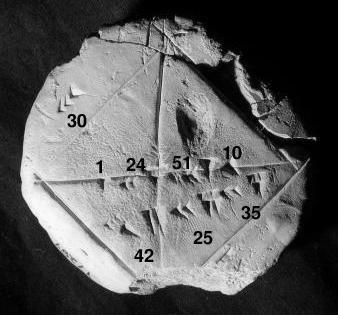
Babylonian clay tablet YBC 7289 (c. 1800–1600 BCE) with annotations. The approximation of the square root of 2 is four sexagesimal figures, which is about six decimal figures. 1 + 24/60 + 51/602 + 10/603 = 1.41421296...[1]

Numerical analysis is the study of algorithms that use numerical approximation (as opposed to symbolic manipulations) for the problems of mathematical analysis (as distinguished from discrete mathematics). It is the study of numerical methods that attempt to find approximate solutions of problems rather than the exact ones. Numerical analysis finds application in all fields of engineering and the physical sciences, and in the 21st century also the life and social sciences like economics, medicine, business and even the arts. Current growth in computing power has enabled the use of more complex numerical analysis, providing detailed and realistic mathematical models in science and engineering. Examples of numerical analysis include: ordinary differential equations as found in celestial mechanics (predicting the motions of planets, stars and galaxies), numerical linear algebra in data analysis,[2][3][4] and stochastic differential equations and Markov chains for simulating living cells in medicine and biology.

Before modern computers, numerical methods often relied on hand interpolation formulas, using data from large printed tables. Since the mid-20th century, computers calculate the required functions instead, but many of the same formulas continue to be used in software algorithms.[5]

The numerical point of view goes back to the earliest mathematical writings. A tablet from the Yale Babylonian Collection (YBC 7289), gives a sexagesimal numerical approximation of the square root of 2, the length of the diagonal in a unit square.

Numerical analysis continues this long tradition: rather than giving exact symbolic answers translated into digits and applicable only to real-world measurements, approximate solutions within specified error bounds are used.

Applications

[edit]

The overall goal of the field of numerical analysis is the design and analysis of techniques to give approximate but accurate solutions to a wide variety of hard problems, many of which are infeasible to solve symbolically:

  • Advanced numerical methods are essential in making numerical weather prediction feasible.
  • Computing the trajectory of a spacecraft requires the accurate numerical solution of a system of ordinary differential equations.
  • Car companies can improve the crash safety of their vehicles by using computer simulations of car crashes. Such simulations essentially consist of solving partial differential equations numerically.
  • In the financial field, (private investment funds) and other financial institutions use quantitative finance tools from numerical analysis to attempt to calculate the value of stocks and derivatives more precisely than other market participants.[6]
  • Airlines use sophisticated optimization algorithms to decide ticket prices, airplane and crew assignments and fuel needs. Historically, such algorithms were developed within the overlapping field of operations research.
  • Insurance companies use numerical programs for actuarial analysis.

History

[edit]

The field of numerical analysis predates the invention of modern computers by many centuries. Linear interpolation was already in use more than 2000 years ago. Many great mathematicians of the past were preoccupied by numerical analysis,[5] as is obvious from the names of important algorithms like Newton's method, Lagrange interpolation polynomial, Gaussian elimination, or Euler's method. The origins of modern numerical analysis are often linked to a 1947 paper by John von Neumann and Herman Goldstine,[7][8] but others consider modern numerical analysis to go back to work by E. T. Whittaker in 1912.[7]

NIST publication

To facilitate computations by hand, large books were produced with formulas and tables of data such as interpolation points and function coefficients. Using these tables, often calculated out to 16 decimal places or more for some functions, one could look up values to plug into the formulas given and achieve very good numerical estimates of some functions. The canonical work in the field is the NIST publication edited by Abramowitz and Stegun, a 1000-plus page book of a very large number of commonly used formulas and functions and their values at many points. The function values are no longer very useful when a computer is available, but the large listing of formulas can still be very handy.

The mechanical calculator was also developed as a tool for hand computation. These calculators evolved into electronic computers in the 1940s, and it was then found that these computers were also useful for administrative purposes. But the invention of the computer also influenced the field of numerical analysis,[5] since now longer and more complicated calculations could be done.

The Leslie Fox Prize for Numerical Analysis was initiated in 1985 by the Institute of Mathematics and its Applications.

Key concepts

[edit]

Direct and iterative methods

[edit]

Direct methods compute the solution to a problem in a finite number of steps. These methods would give the precise answer if they were performed in infinite precision arithmetic. Examples include Gaussian elimination, the QR factorization method for solving systems of linear equations, and the simplex method of linear programming. In practice, finite precision is used and the result is an approximation of the true solution (assuming stability).

In contrast to direct methods, iterative methods are not expected to terminate in a finite number of steps, even if infinite precision were possible. Starting from an initial guess, iterative methods form successive approximations that converge to the exact solution only in the limit. A convergence test, often involving the residual, is specified in order to decide when a sufficiently accurate solution has (hopefully) been found. Even using infinite precision arithmetic these methods would not reach the solution within a finite number of steps (in general). Examples include Newton's method, the bisection method, and Jacobi iteration. In computational matrix algebra, iterative methods are generally needed for large problems.[9][10][11][12]

Iterative methods are more common than direct methods in numerical analysis. Some methods are direct in principle but are usually used as though they were not, e.g. GMRES and the conjugate gradient method. For these methods the number of steps needed to obtain the exact solution is so large that an approximation is accepted in the same manner as for an iterative method.

As an example, consider the problem of solving

3x3 + 4 = 28

for the unknown quantity x.

Direct method
3x3 + 4 = 28.
Subtract 4 3x3 = 24.
Divide by 3 x3 =  8.
Take cube roots x =  2.

For the iterative method, apply the bisection method to f(x) = 3x3 − 24. The initial values are a = 0, b = 3, f(a) = −24, f(b) = 57.

Iterative method
a b mid f(mid)
0 3 1.5 −13.875
1.5 3 2.25 10.17...
1.5 2.25 1.875 −4.22...
1.875 2.25 2.0625 2.32...

From this table it can be concluded that the solution is between 1.875 and 2.0625. The algorithm might return any number in that range with an error less than 0.2.

Conditioning

[edit]

Ill-conditioned problem: Take the function f(x) = 1/(x − 1). Note that f(1.1) = 10 and f(1.001) = 1000: a change in x of less than 0.1 turns into a change in f(x) of nearly 1000. Evaluating f(x) near x = 1 is an ill-conditioned problem.

Well-conditioned problem: By contrast, evaluating the same function f(x) = 1/(x − 1) near x = 10 is a well-conditioned problem. For instance, f(10) = 1/9 ≈ 0.111 and f(11) = 0.1: a modest change in x leads to a modest change in f(x).

Discretization

[edit]

Furthermore, continuous problems must sometimes be replaced by a discrete problem whose solution is known to approximate that of the continuous problem; this process is called 'discretization'. For example, the solution of a differential equation is a function. This function must be represented by a finite amount of data, for instance by its value at a finite number of points at its domain, even though this domain is a continuum.

Generation and propagation of errors

[edit]

The study of errors forms an important part of numerical analysis. There are several ways in which error can be introduced in the solution of the problem.

Round-off

[edit]

Round-off errors arise because it is impossible to represent all real numbers exactly on a machine with finite memory (which is what all practical digital computers are).

Truncation and discretization error

[edit]

Truncation errors are committed when an iterative method is terminated or a mathematical procedure is approximated and the approximate solution differs from the exact solution. Similarly, discretization induces a discretization error because the solution of the discrete problem does not coincide with the solution of the continuous problem. In the example above to compute the solution of , after ten iterations, the calculated root is roughly 1.99. Therefore, the truncation error is roughly 0.01.

Once an error is generated, it propagates through the calculation. For example, the operation + on a computer is inexact. A calculation of the type is even more inexact.

A truncation error is created when a mathematical procedure is approximated. To integrate a function exactly, an infinite sum of regions must be found, but numerically only a finite sum of regions can be found, and hence the approximation of the exact solution. Similarly, to differentiate a function, the differential element approaches zero, but numerically only a nonzero value of the differential element can be chosen.

Numerical stability and well-posed problems

[edit]

An algorithm is called numerically stable if an error, whatever its cause, does not grow to be much larger during the calculation.[13] This happens if the problem is well-conditioned, meaning that the solution changes by only a small amount if the problem data are changed by a small amount.[13] To the contrary, if a problem is 'ill-conditioned', then any small error in the data will grow to be a large error.[13] Both the original problem and the algorithm used to solve that problem can be well-conditioned or ill-conditioned, and any combination is possible. So an algorithm that solves a well-conditioned problem may be either numerically stable or numerically unstable. An art of numerical analysis is to find a stable algorithm for solving a well-posed mathematical problem.

Areas of study

[edit]

The field of numerical analysis includes many sub-disciplines. Some of the major ones are:

Computing values of functions

[edit]

Interpolation: Observing that the temperature varies from 20 degrees Celsius at 1:00 to 14 degrees at 3:00, a linear interpolation of this data would conclude that it was 17 degrees at 2:00 and 18.5 degrees at 1:30pm.

Extrapolation: If the gross domestic product of a country has been growing an average of 5% per year and was 100 billion last year, it might be extrapolated that it will be 105 billion this year.

A line through 20 points

Regression: In linear regression, given n points, a line is computed that passes as close as possible to those n points.

How much for a glass of lemonade?

Optimization: Suppose lemonade is sold at a lemonade stand, at $1.00 per glass, that 197 glasses of lemonade can be sold per day, and that for each increase of $0.01, one less glass of lemonade will be sold per day. If $1.485 could be charged, profit would be maximized, but due to the constraint of having to charge a whole-cent amount, charging $1.48 or $1.49 per glass will both yield the maximum income of $220.52 per day.

Wind direction in blue, true trajectory in black, Euler method in red

Differential equation: If 100 fans are set up to blow air from one end of the room to the other and then a feather is dropped into the wind, what happens? The feather will follow the air currents, which may be very complex. One approximation is to measure the speed at which the air is blowing near the feather every second, and advance the simulated feather as if it were moving in a straight line at that same speed for one second, before measuring the wind speed again. This is called the Euler method for solving an ordinary differential equation.

One of the simplest problems is the evaluation of a function at a given point. The most straightforward approach, of just plugging in the number in the formula is sometimes not very efficient. For polynomials, a better approach is using the Horner scheme, since it reduces the necessary number of multiplications and additions. Generally, it is important to estimate and control round-off errors arising from the use of floating-point arithmetic.

Interpolation, extrapolation, and regression

[edit]

Interpolation solves the following problem: given the value of some unknown function at a number of points, what value does that function have at some other point between the given points?

Extrapolation is very similar to interpolation, except that now the value of the unknown function at a point which is outside the given points must be found.[14]

Regression is also similar, but it takes into account that the data are imprecise. Given some points, and a measurement of the value of some function at these points (with an error), the unknown function can be found. The least squares-method is one way to achieve this.

Solving equations and systems of equations

[edit]

Another fundamental problem is computing the solution of some given equation. Two cases are commonly distinguished, depending on whether the equation is linear or not. For instance, the equation is linear while is not.

Much effort has been put in the development of methods for solving systems of linear equations. Standard direct methods, i.e., methods that use some matrix decomposition are Gaussian elimination, LU decomposition, Cholesky decomposition for symmetric (or hermitian) and positive-definite matrix, and QR decomposition for non-square matrices. Iterative methods such as the Jacobi method, Gauss–Seidel method, successive over-relaxation and conjugate gradient method[15] are usually preferred for large systems. General iterative methods can be developed using a matrix splitting.

Root-finding algorithms are used to solve nonlinear equations (they are so named since a root of a function is an argument for which the function yields zero). If the function is differentiable and the derivative is known, then Newton's method is a popular choice.[16][17] Linearization is another technique for solving nonlinear equations.

Solving eigenvalue or singular value problems

[edit]

Several important problems can be phrased in terms of eigenvalue decompositions or singular value decompositions. For instance, the spectral image compression algorithm[18] is based on the singular value decomposition. The corresponding tool in statistics is called principal component analysis.

Optimization

[edit]

Optimization problems ask for the point at which a given function is maximized (or minimized). Often, the point also has to satisfy some constraints.

The field of optimization is further split in several subfields, depending on the form of the objective function and the constraint. For instance, linear programming deals with the case that both the objective function and the constraints are linear. A famous method in linear programming is the simplex method.

The method of Lagrange multipliers can be used to reduce optimization problems with constraints to unconstrained optimization problems.

Evaluating integrals

[edit]

Numerical integration, in some instances also known as numerical quadrature, asks for the value of a definite integral.[19] Popular methods use one of the Newton–Cotes formulas (like the midpoint rule or Simpson's rule) or Gaussian quadrature.[20] These methods rely on a "divide and conquer" strategy, whereby an integral on a relatively large set is broken down into integrals on smaller sets. In higher dimensions, where these methods become prohibitively expensive in terms of computational effort, one may use Monte Carlo or quasi-Monte Carlo methods (see Monte Carlo integration[21]), or, in modestly large dimensions, the method of sparse grids.

Differential equations

[edit]

Numerical analysis is also concerned with computing (in an approximate way) the solution of differential equations, both ordinary differential equations and partial differential equations.[22]

Partial differential equations are solved by first discretizing the equation, bringing it into a finite-dimensional subspace.[23] This can be done by a finite element method,[24][25][26] a finite difference method,[27] or (particularly in engineering) a finite volume method.[28] The theoretical justification of these methods often involves theorems from functional analysis. This reduces the problem to the solution of an algebraic equation.

Software

[edit]

Since the late twentieth century, most algorithms are implemented in a variety of programming languages. The Netlib repository contains various collections of software routines for numerical problems, mostly in Fortran and C. Commercial products implementing many different numerical algorithms include the IMSL and NAG libraries; a free-software alternative is the GNU Scientific Library.

Over the years the Royal Statistical Society published numerous algorithms in its Applied Statistics (code for these "AS" functions is here); ACM similarly, in its Transactions on Mathematical Software ("TOMS" code is here). The Naval Surface Warfare Center several times published its Library of Mathematics Subroutines (code here).

There are several popular numerical computing applications such as MATLAB,[29][30][31] TK Solver, S-PLUS, and IDL[32] as well as free and open-source alternatives such as FreeMat, Scilab,[33][34] GNU Octave (similar to Matlab), and IT++ (a C++ library). There are also programming languages such as R[35] (similar to S-PLUS), Julia,[36] and Python with libraries such as NumPy, SciPy[37][38][39] and SymPy. Performance varies widely: while vector and matrix operations are usually fast, scalar loops may vary in speed by more than an order of magnitude.[40][41]

Many computer algebra systems such as Mathematica also benefit from the availability of arbitrary-precision arithmetic which can provide more accurate results.[42][43][44][45]

Also, any spreadsheet software can be used to solve simple problems relating to numerical analysis. Excel, for example, has hundreds of available functions, including for matrices, which may be used in conjunction with its built in "solver".

See also

[edit]

Notes

[edit]

References

[edit]
[edit]
Revisions and contributorsEdit on WikipediaRead on Wikipedia
from Grokipedia
Numerical analysis is the study of algorithms for the numerical of solutions to continuous mathematical problems, particularly those involving real or complex quantities that cannot be solved exactly by analytical methods. It focuses on developing, analyzing, and implementing computational procedures to approximate unknowns with rapid convergence, while accounting for limitations like errors in finite-precision arithmetic. This discipline bridges and , originating from real-world applications in sciences, , , and business, where precise numerical solutions enable modeling complex phenomena. Key areas of numerical analysis include the solution of nonlinear equations, systems of linear equations, and of functions, and integration, and the treatment of ordinary and partial differential equations. It also encompasses eigenvalue problems, least-squares fitting, optimization techniques, and error analysis to ensure stability and accuracy in computations. These methods rely on fundamental concepts such as floating-point representation, conditioning of problems, and convergence rates, which are critical for reliable results on digital computers. The roots of numerical analysis trace back to ancient civilizations, with early root-finding algorithms documented in the Rhind around 1650 BC and approximation techniques by using the . Significant advancements occurred during the 17th and 18th centuries through the works of Newton, Leibniz, Euler, Lagrange, and Gauss, who applied numerical methods to physical models and . The field expanded dramatically in the mid-20th century with the rise of electronic computers, transforming it into a cornerstone of scientific and enabling simulations in diverse fields from climate modeling to . Today, numerical analysis remains essential, as without these methods, much of modern science and engineering would be infeasible.

History

Early foundations

The origins of numerical analysis trace back to ancient civilizations, where manual techniques were developed to approximate solutions to practical problems in geometry, astronomy, and engineering. In ancient Babylon, around 1800 BCE, mathematicians employed iterative methods to compute square roots, as evidenced by the clay tablet YBC 7289, which records an approximation of √2 as 1;24,51,10 in sexagesimal notation, accurate to about six decimal places. This approach, akin to the modern Babylonian method (also known as the Heronian method), involved successive approximations using the formula x_{n+1} = (x_n + a/x_n)/2, where a is the number under the root, demonstrating early recognition of convergence in iterative processes. In , around 250 BCE, advanced approximation techniques through the , a precursor to integral calculus, to bound the value of π. By inscribing and circumscribing regular polygons with up to 96 sides within a circle of diameter 1, established that 3 10/71 < π < 3 1/7, providing bounds accurate to about three decimal places and laying foundational principles for limit-based approximations in numerical geometry. During the Renaissance, numerical methods gained momentum with tools for efficient computation. In 1614, John Napier introduced logarithms in his work Mirifici Logarithmorum Canonis Descriptio, defining them as a continuous product scaled to powers of a base close to 1 (specifically, 10^7), which transformed multiplication and division into addition and subtraction, revolutionizing astronomical and navigational calculations. Building on this, William Oughtred invented the slide rule in 1622, a mechanical analog device using two logarithmic scales that slide relative to each other to perform multiplication and division by aligning indices and reading products directly, as described in his Clavis Mathematicae. Key 17th- and 18th-century contributions from prominent mathematicians further solidified interpolation and summation techniques essential to numerical analysis. Isaac Newton developed finite difference interpolation in the 1670s, as outlined in his unpublished manuscripts and later correspondence, using divided differences to construct polynomials that pass through given data points, enabling accurate estimation of intermediate values from discrete observations. Similarly, Leonhard Euler formulated summation rules in the 1730s, including the Euler-Maclaurin formula, which relates sums to integrals via Bernoulli numbers and derivatives, as presented in his Institutiones Calculi Differentialis (1755), providing a bridge between discrete and continuous mathematics for approximating series. In the 19th century, efforts toward mechanization highlighted numerical analysis's practical applications. Charles Babbage proposed the Difference Engine in 1822, a mechanical device designed to automate the computation and tabulation of polynomial values using the method of finite differences, as detailed in his paper to the , aiming to eliminate human error in logarithmic and trigonometric tables. Accompanying Babbage's later Analytical Engine, 's 1843 notes included a detailed algorithm for computing Bernoulli numbers up to the 7th order, written in a tabular format that specified operations like addition and looping, marking an early conceptual program for a general-purpose machine. A notable example of 19th-century innovation is Horner's method for efficient polynomial evaluation, published by William George Horner in 1819 in his paper "A new method of solving numerical equations of all orders, by continuous approximation" to the Royal Society. This synthetic division technique reduces the number of multiplications required to evaluate a polynomial p(x) = a_n x^n + ... + a_1 x + a_0 at a point x_0 by nesting the computation as b_n = a_n, b_{k} = b_{k+1} x_0 + a_k for k = n-1 down to 0, with p(x_0) = b_0, avoiding the computational expense of explicit powers and minimizing round-off errors in manual calculations; it was particularly valuable for root-finding in higher-degree equations before electronic aids.

Development in the 20th century

The advent of electronic computing in the mid-20th century revolutionized numerical analysis, shifting it from manual and mechanical methods to automated processes capable of handling complex calculations at unprecedented speeds. The , completed in 1945 by and at the University of Pennsylvania, was designed specifically to compute artillery firing tables for the U.S. Army's Ballistic Research Laboratory, performing ballistic trajectory calculations that previously took hours by hand in mere seconds. This machine's ability to solve systems of nonlinear differential equations numerically marked a pivotal step in applying computational power to real-world problems in physics and engineering, laying groundwork for modern numerical methods. John von Neumann's contributions further propelled this evolution through his advocacy for the stored-program computer architecture, outlined in his 1945 EDVAC report, which separated computing from manual reconfiguration and enabled flexible execution of numerical algorithms. This design influenced subsequent machines and emphasized the computer's role in iterative numerical computations, such as matrix inversions essential for scientific simulations. Algorithmic advancements soon followed, with Gaussian elimination for solving linear systems gaining modern formalization in the 1940s through error analyses by Harold Hotelling and others, adapting the ancient method for electronic implementation and highlighting its stability in computational contexts. Similarly, George Dantzig's simplex method, proposed in 1947, provided an efficient algorithm for linear programming problems, optimizing resource allocation in operations research and becoming a cornerstone for numerical optimization. Error analysis emerged as a critical discipline amid these developments, with James H. Wilkinson's 1963 book Rounding Errors in Algebraic Processes offering the first comprehensive study of floating-point arithmetic errors in key computations like and eigenvalue calculations. Wilkinson's backward error analysis framework demonstrated how rounding errors propagate in algebraic processes, establishing bounds that guide stable algorithm design and remain foundational in numerical software. Alan Turing's 1948 report on the Automatic Computing Engine (ACE) also shaped numerical software by detailing a high-speed design for executing iterative methods, influencing early programming practices for scientific computing at the National Physical Laboratory. Institutionally, the field grew rapidly post-World War II, driven by the need to apply mathematics to industry and defense. The Society for Industrial and Applied Mathematics (SIAM) was incorporated on April 30, 1952, to promote the development and application of mathematical methods, including numerical analysis, fostering collaboration among mathematicians, engineers, and scientists. This era saw expanded post-war efforts in applied mathematics, with organizations like SIAM supporting conferences and research that integrated computing into numerical techniques, building on earlier international gatherings to address growing computational demands in the 1950s and 1960s.

Contemporary advancements

Since the 1990s, numerical analysis has increasingly incorporated parallel computing paradigms to address the demands of high-performance computing (HPC). The emergence of standardized parallel algorithms was marked by the release of the standard in 1994, which provided a portable framework for message-passing in distributed-memory systems, enabling efficient scaling across multiprocessor architectures. This development facilitated the transition from sequential to parallel numerical methods, such as domain decomposition for solving partial differential equations on clusters. Exascale computing systems, capable of at least 10^18 floating-point operations per second (exaFLOPS), began widespread deployment in the early 2020s, starting with the U.S. Department of Energy's Frontier supercomputer achieving 1.1 exaFLOPS in 2022, followed by Aurora reaching 1.012 exaFLOPS in May 2024 and El Capitan achieving 1.742 exaFLOPS by November 2024, which as of November 2025 is the world's fastest supercomputer supporting advanced simulations in climate modeling and materials science. In November 2025, a contract was signed for Alice Recoque, Europe's first exascale supercomputer based in France, powered by AMD and Eviden, further advancing international capabilities in AI, scientific computing, and energy-efficient research. The integration of numerical analysis with machine learning has accelerated since the 2010s, particularly through neural networks employed as surrogate models to approximate complex computational processes. These models reduce the need for repeated evaluations of expensive numerical simulations, such as in optimization problems, by learning mappings from input parameters to outputs with high fidelity after training on limited data. For uncertainty quantification, Bayesian methods have become prominent, treating numerical solutions as probabilistic inferences over posterior distributions to account for modeling errors and data variability in fields like fluid dynamics and structural analysis. Notable events in the 2020s underscore the role of numerical advancements in crisis response, including DARPA high-performance computing initiatives, such as the 2010-launched Ubiquitous High-Performance Computing (UHPC) program, which evolved to influence energy-efficient architectures for exascale-era simulations amid broader 2020s efforts in resilient computing. The COVID-19 pandemic in 2020 highlighted the impact of simulation-driven drug discovery, where physics-based numerical methods, combined with high-performance computing, accelerated virtual screening of molecular interactions to identify potential inhibitors for SARS-CoV-2 proteins, shortening traditional timelines from years to months. Advances in stochastic methods have addressed big data challenges through variants of Monte Carlo techniques, exemplified by randomized singular value decomposition (SVD) algorithms introduced in the early 2010s, which provide low-rank approximations of large matrices with probabilistic guarantees, outperforming deterministic methods in speed for applications like on massive datasets. The growth of open-source contributions has further democratized these tools, as seen in the evolution of the since its inception in 2001, which has expanded to include robust implementations of parallel and stochastic numerical routines, fostering widespread adoption in scientific computing communities.

Fundamental Concepts

Classification of numerical methods

Numerical methods in numerical analysis are broadly classified into direct and iterative approaches based on how they compute solutions to mathematical problems. Direct methods produce an exact solution (within the limits of finite precision arithmetic) after a finite number of arithmetic operations, such as solving linear systems exactly via matrix factorizations. In contrast, iterative methods generate a sequence of approximations that converge to the solution under suitable conditions, refining estimates step by step without guaranteeing an exact result in finite steps. Another key distinction lies between deterministic and stochastic methods. Deterministic methods rely on fixed, repeatable procedures without incorporating randomness, ensuring the same output for identical inputs. Stochastic methods, however, introduce randomness to handle uncertainty or complexity, such as in for approximating high-dimensional integrals where traditional deterministic quadrature rules fail due to the curse of dimensionality. Iterative methods can further be categorized by their formulation: fixed-point iterations reformulate the problem as finding a point xx where x=g(x)x = g(x) for some function gg, iterating xn+1=g(xn)x_{n+1} = g(x_n) until convergence; optimization-based methods, on the other hand, cast the problem as minimizing an objective function, using techniques like gradient descent to locate minima corresponding to solutions. For instance, in root-finding, the bisection method operates directly by halving intervals containing a root, while the Newton-Raphson method iteratively approximates roots using local linearizations. The efficiency of iterative methods is often assessed by their order of convergence, which quantifies how the error en=xnxe_n = |x_n - x^*| (where xx^* is the true solution) decreases with iterations. Linear convergence occurs when en+1ρene_{n+1} \approx \rho e_n for a constant 0<ρ<10 < \rho < 1, reducing error proportionally each step; quadratic convergence holds when en+1Cen2e_{n+1} \approx C e_n^2 for some constant C>0C > 0, squaring the error and accelerating near the solution. For example, exhibits linear convergence with ρ=1/2\rho = 1/2, halving the interval error per step, whereas Newton-Raphson achieves quadratic convergence under smoothness assumptions. Convergence in iterative methods also depends on , where small perturbations must not derail the process.

Discretization and approximation

Discretization in numerical analysis involves transforming continuous mathematical problems, such as differential equations defined over infinite domains, into discrete forms suitable for computation on finite grids or meshes. This process replaces continuous variables with discrete points or elements, enabling the use of algebraic equations to approximate solutions. Common techniques include grid-based methods like finite differences, which approximate derivatives using differences between function values at nearby grid points; spectral methods, which expand solutions in terms of global basis functions such as Fourier or Chebyshev polynomials for high accuracy in smooth problems; and finite element methods, which divide the domain into smaller elements and use local piecewise polynomials to represent the solution within each. Approximation theory underpins these discretization techniques by providing mathematical frameworks for estimating continuous functions with simpler discrete representations. offer a local , expanding a function around a point using its derivatives to achieve high-order accuracy near that point, as formalized by . In contrast, global polynomial bases, such as Legendre or Chebyshev polynomials, approximate functions over the entire domain, leveraging properties like for efficient computation and error control in methods like approximations. The quantifies the accuracy of these methods, indicating how the decreases with finer discretization. For instance, the central approximation for the first is second-order accurate, given by f(x)f(x+h)f(xh)2h,f'(x) \approx \frac{f(x+h) - f(x-h)}{2h}, where the is proportional to h2h^2, derived from the Taylor expansion of ff around xx. A practical example of discretization arises in solving ordinary differential equations (ODEs), where the approximates the solution to y=f(t,y)y' = f(t, y) with y(t0)=y0y(t_0) = y_0 by using a forward difference: yn+1=yn+Δtf(tn,yn),y_{n+1} = y_n + \Delta t \, f(t_n, y_n), with grid spacing Δt\Delta t determining the time step between discrete points tn=t0+nΔtt_n = t_0 + n \Delta t. This method is simple but illustrates the core idea of replacing the continuous with a discrete increment. Mesh refinement, by reducing grid spacing or element size, improves approximation accuracy but incurs a with computational cost, as finer meshes increase the number of operations required, often scaling cubically in three dimensions for finite element methods.

Conditioning of problems

In numerical analysis, the conditioning of a problem quantifies its inherent sensitivity to small perturbations in the input data, determining how much such changes can amplify errors in the output. A well-conditioned problem exhibits limited sensitivity, allowing reliable even with imprecise inputs, whereas an ill-conditioned problem can lead to drastically different outputs from minor input variations, making accurate solutions challenging regardless of the computational method employed. This distinction is crucial for assessing the feasibility of numerical solutions before selecting algorithms. The foundational framework for evaluating problem conditioning stems from Jacques Hadamard's criteria for well-posedness, introduced in his 1902 lectures, which require that a problem possess a solution, that the solution be , and that the solution depend continuously on the input data (i.e., exhibit stability under small perturbations). Problems failing these criteria are deemed ill-posed; for instance, certain inverse problems in partial differential equations may lack existence or , or their solutions may vary discontinuously with data changes. Hadamard's criteria emphasize that conditioning assesses the problem's intrinsic properties, not the solution method. For linear systems Ax=bAx = b, where AA is an n×nn \times n , the κ(A)\kappa(A) provides a precise measure of conditioning, defined as κ(A)=AA1\kappa(A) = \|A\| \cdot \|A^{-1}\| using a consistent matrix norm such as the 2-norm or infinity-norm. This value acts as an amplification factor: the relative error in the computed solution x^\hat{x} satisfies xx^xκ(A)bb^+AA^x/bb\frac{\|x - \hat{x}\|}{\|x\|} \leq \kappa(A) \cdot \frac{\|b - \hat{b}\| + \|A - \hat{A}\| \cdot \|x\| / \|b\|}{\|b\|}, approximately bounding the output error by κ(A)\kappa(A) times the input perturbation for small errors. A near 1 indicates excellent conditioning, while values exceeding 101010^{10} or more signal severe ill-conditioning, often arising in applications like geophysical modeling. Illustrative examples highlight ill-conditioning's impact. In polynomial interpolation, the Vandermonde matrix VV with entries vij=xij1v_{ij} = x_i^{j-1} for distinct points xix_i becomes severely ill-conditioned as the points cluster or as the degree increases, with κ(V)\kappa(V) growing exponentially (e.g., κ(V)1016\kappa(V) \approx 10^{16} for n=20n=20 equispaced points in [0,1][0,1]), leading to unstable coefficient computations despite exact arithmetic. Similarly, the Hilbert matrix HnH_n with entries hij=1/(i+j1)h_{ij} = 1/(i+j-1) exemplifies extreme ill-conditioning, where κ(Hn)e3.5n\kappa(H_n) \approx e^{3.5n} in the 2-norm, rendering even low-order systems (e.g., n=10n=10) practically unsolvable due to sensitivity to rounding. These cases underscore how geometric or algebraic structures can inherently degrade conditioning. Backward error analysis complements conditioning by viewing computed solutions through a perturbation lens: a numerical produces x^\hat{x} that exactly solves a slightly perturbed problem (A+ΔA)x^=b+Δb(A + \Delta A)\hat{x} = b + \Delta b, where the backward errors ΔA\Delta A and Δb\Delta b are small relative to machine precision. This perspective, pioneered by Wilkinson, reveals that well-designed algorithms keep backward errors bounded independently of conditioning, but the forward error in x^\hat{x} still scales with κ(A)\kappa(A), emphasizing the need to separate problem sensitivity from algorithmic reliability. Notably, conditioning is an intrinsic property of the , independent of the chosen to solve it; however, poor conditioning necessitates careful algorithm selection, such as specialized solvers for stiff systems to mitigate amplification effects. This independence guides numerical analysts in prioritizing problem reformulation or regularization when κ\kappa is large.

Error Analysis

Round-off errors

Round-off errors arise from the finite precision of computer arithmetic, where real numbers are approximated using a limited number of bits, leading to inaccuracies in representation and . In numerical analysis, these errors are inherent to floating-point systems and can significantly affect the reliability of algorithms, particularly when small perturbations propagate through operations. The predominant standard for floating-point representation is , first established in 1985 and revised in 2008 to include enhancements like fused multiply-add operations and support for decimal formats, with a further minor revision in that provided clarifications, bug fixes, and additional features. It defines binary formats such as single precision (32 bits, approximately 7 decimal digits) and double precision (64 bits, approximately 15-16 decimal digits), where numbers are stored as , exponent, and . The , ϵ\epsilon, represents the smallest relative difference between 1 and the next representable number greater than 1; for double precision, ϵ2522.22×1016\epsilon \approx 2^{-52} \approx 2.22 \times 10^{-16}. A fundamental bound on the representation error is given by fl(x)xϵx,|fl(x) - x| \leq \epsilon |x|, where fl(x)fl(x) denotes the floating-point approximation of a real number xx. This relative error ensures that well-scaled numbers are represented accurately to within a small fraction, but arithmetic operations like addition and multiplication introduce further round-off during evaluation. One major source of round-off error is subtractive cancellation, where subtracting two nearly equal numbers leads to a loss of significant digits. For instance, computing 1+101611 + 10^{-16} - 1 in double precision yields exactly 0 due to the loss of the small perturbation beyond the precision limit, exemplifying catastrophic cancellation. Such errors occur because the result has fewer significant bits than the inputs, amplifying relative inaccuracies. In iterative processes like , round-off errors accumulate as low-order bits are discarded in each addition. The mitigates this by maintaining a compensation term to recover lost precision, reducing the total error bound from O(nϵ)O(n \epsilon) to nearly O(ϵ)O(\epsilon) for nn terms. Developed in 1965, it is widely used in numerical libraries for more accurate accumulation. The impact of round-off errors is particularly pronounced in ill-conditioned problems, where small input perturbations lead to large output variations, magnifying these precision limitations.

Truncation and discretization errors

Truncation error arises in numerical methods when an infinite process, such as , is approximated by terminating it after a finite number of terms. occurs in the expansion of a function f(x)f(x) around a point aa, where the approximation Pn(x)=f(a)+f(a)(xa)++f(n)(a)n!(xa)nP_n(x) = f(a) + f'(a)(x-a) + \cdots + \frac{f^{(n)}(a)}{n!}(x-a)^n is used, and the truncation error is given by the remainder term Rn(x)=f(n+1)(ξ)(n+1)!(xa)n+1R_n(x) = \frac{f^{(n+1)}(\xi)}{(n+1)!}(x-a)^{n+1} for some ξ\xi between aa and xx. This error quantifies the difference between the exact function value and its polynomial approximation, and its magnitude depends on the higher-order derivatives of ff and the distance from the expansion point. Discretization error, closely related but distinct, emerges when continuous mathematical models are approximated on discrete grids or with finite steps, leading to inconsistencies between the numerical scheme and the underlying differential or . In the context of ordinary differential equations (ODEs), consistency of a method requires that the local —the error introduced in a single step assuming previous steps are exact—approaches zero as the step size hh tends to zero faster than hh. For Runge-Kutta methods, which approximate solutions to ODEs y=f(t,y)y' = f(t,y) via weighted averages of function evaluations, the local is typically O(hp+1)O(h^{p+1}), where pp is the order of the method, ensuring consistency when p1p \geq 1. A representative example of discretization error appears in numerical integration using the trapezoidal rule, which approximates abf(x)dx\int_a^b f(x) \, dx over nn subintervals of width h=(ba)/nh = (b-a)/n as h[f(a)+f(b)2+i=1n1f(a+ih)]h \left[ \frac{f(a)+f(b)}{2} + \sum_{i=1}^{n-1} f(a + i h) \right]. The global error for this method is E=(ba)h212f(ξ)E = -\frac{(b-a) h^2}{12} f''(\xi) for some ξ(a,b)\xi \in (a,b), assuming ff'' is continuous, yielding an O(h2)O(h^2) bound. To derive this, consider a single interval [xi,xi+1][x_i, x_{i+1}]; the exact integral is xixi+1f(x)dx=hf(xi+θh)+h312f(ξ)\int_{x_i}^{x_{i+1}} f(x) \, dx = h f(x_i + \theta h) + \frac{h^3}{12} f''(\xi) for some θ(0,1)\theta \in (0,1) and ξ\xi, while the trapezoidal approximation is h2[f(xi)+f(xi+1)]\frac{h}{2} [f(x_i) + f(x_{i+1})], and applying Taylor expansions around xi+θhx_i + \theta h reveals the O(h3)O(h^3) local error per step, summing to O(h2)O(h^2) globally over the interval. To mitigate truncation and discretization errors, techniques like combine approximations at different step sizes to eliminate leading error terms and achieve higher-order accuracy. For a method with error ϕ(h)=ϕ+chp+O(hp+1)\phi(h) = \phi + c h^p + O(h^{p+1}), computing ϕ(h)\phi(h) and ϕ(h/2)\phi(h/2) allows to ϕ=2pϕ(h/2)ϕ(h)2p1+O(hp+1)\phi^* = \frac{2^p \phi(h/2) - \phi(h)}{2^p - 1} + O(h^{p+1}), effectively reducing the error order from pp to p+1p+1. This approach is particularly effective for integration rules like the trapezoidal method, where repeated yields Romberg integration with exponential convergence. In consistent numerical methods, and errors converge to zero as the step size h0h \to 0, enabling the approximate solution to approach the exact one, though this must be balanced against round-off errors that amplify with smaller hh. The is determined by the order of the method, with higher-order schemes reducing these errors more rapidly for sufficiently smooth problems.

Error propagation and numerical stability

Error propagation in numerical computations refers to the way small initial errors, such as those from rounding or approximations, amplify or diminish as they pass through successive steps of an algorithm. Forward error analysis quantifies the difference between the exact solution and the computed solution, often expressed as the relative forward error y^yy\frac{\| \hat{y} - y \|}{\| y \|}, where yy is the exact solution and y^\hat{y} is the computed one. In contrast, backward error analysis examines the perturbation to the input data that would make the computed solution exact for the perturbed problem, measured by the relative backward error δxx\frac{\| \delta x \|}{\| x \|}, providing insight into an algorithm's robustness. For linear systems Ax=bAx = b, backward error is commonly assessed via the residual r=bAx^r = b - A\hat{x}, where x^\hat{x} is the computed solution; a small r\|r\| indicates that x^\hat{x} solves a nearby system (A+δA)x~=b+δb(A + \delta A)\tilde{x} = b + \delta b with small perturbations δA\delta A and δb\delta b. Numerical stability ensures that errors do not grow uncontrollably during computation. An is backward stable if the computed solution is the exact solution to a slightly perturbed input problem, with perturbations bounded by times a modest function of the problem size. For instance, the Householder is backward stable, producing factors QQ and RR such that A+δA=QRA + \delta A = QR with δAO(ϵA)\|\delta A\| \leq O(\epsilon \|A\|), where ϵ\epsilon is the unit , making it reliable for solving problems. In the context of finite difference methods for linear partial differential equations (PDEs), the Lax equivalence theorem states that a consistent scheme converges it is , where consistency means the local approaches zero as the grid spacing h0h \to 0, and stability bounds the growth of solutions over time. This theorem underscores that stability is essential for convergence in well-posed linear problems. A classic example of stability's impact is . The naive method of computing p(x)=anxn+an1xn1++a0p(x) = a_n x^n + a_{n-1} x^{n-1} + \cdots + a_0 by successive powering and multiplication can lead to exponential growth due to repeated squaring, whereas , which rewrites the as p(x)=a0+x(a1+x(a2++xan))p(x) = a_0 + x(a_1 + x(a_2 + \cdots + x a_n \cdots )), requires only nn multiplications and nn additions, achieving backward stability with a backward bounded by O(nϵ)maxaiO(n \epsilon) \max |a_i|. Gaussian elimination without pivoting illustrates instability through the growth factor ρn=maxi,juijmaxi,jaij\rho_n = \frac{\max_{i,j} |u_{ij}|}{\max_{i,j} |a_{ij}|}, where UU is the upper triangular factor; in the worst case, ρn=2n1\rho_n = 2^{n-1}, causing severe error amplification in . For (ODE) solvers, A-stability requires the stability region to include the entire left half of the , ensuring bounded errors for stiff systems with eigenvalues having negative real parts. Dahlquist's criterion reveals that A-stable have order at most 2, limiting explicit methods and favoring implicit ones like the for stiff problems.

Core Numerical Techniques

Computing function values

Computing function values in numerical analysis involves evaluating elementary and special functions using algorithms that ensure accuracy and efficiency, often leveraging series expansions, recurrences, and approximations to handle the limitations of finite-precision arithmetic. For elementary functions like the exponential and trigonometric functions, Taylor series expansions provide a foundational method for numerical evaluation. The exponential function is approximated by its Taylor series exp(x)=n=0xnn!\exp(x) = \sum_{n=0}^{\infty} \frac{x^n}{n!}, truncated at a suitable order based on the desired precision and the magnitude of xx, with convergence guaranteed for all real xx. Similarly, the sine function uses sinx=xx33!+x55!\sin x = x - \frac{x^3}{3!} + \frac{x^5}{5!} - \cdots, which converges rapidly for small x|x| and is computed term-by-term until the terms fall below the machine epsilon. To extend these expansions to larger arguments, particularly for periodic functions like sine and cosine, argument reduction is essential: the input xx is reduced modulo 2π2\pi to a primary interval such as [π/2,π/2][-\pi/2, \pi/2], using high-precision representations of π\pi to minimize phase errors in floating-point arithmetic. Special functions, such as , are often evaluated using recurrence relations for stability and efficiency. The of the first kind Jn(x)J_n(x) satisfies the three-term recurrence Jn+1(x)=2nxJn(x)Jn1(x)J_{n+1}(x) = \frac{2n}{x} J_n(x) - J_{n-1}(x), with initial values computed via series or asymptotic approximations; forward recurrence is stable for increasing nn when xx is fixed, allowing computation of higher-order values from lower ones. For the Γ(z)\Gamma(z), the offers a continued fraction representation that converges rapidly for Re(z)>0\operatorname{Re}(z) > 0, expressed as Γ(z+1)=2π(z+g+1/2)z+1/2e(z+g+1/2)k=0nck/(z+k)+ϵ(z)\Gamma(z+1) = \sqrt{2\pi} (z + g + 1/2)^{z + 1/2} e^{-(z + g + 1/2)} \sum_{k=0}^{n} c_k / (z + k) + \epsilon(z)
Add your contribution
Related Hubs
User Avatar
No comments yet.