Hubbry Logo
search
logo
2036985

Austin A40

logo
Community Hub0 Subscribers
Read side by side
from Wikipedia

A number of different motor vehicles were marketed under the Austin A40 name by Austin between 1947 and 1967.

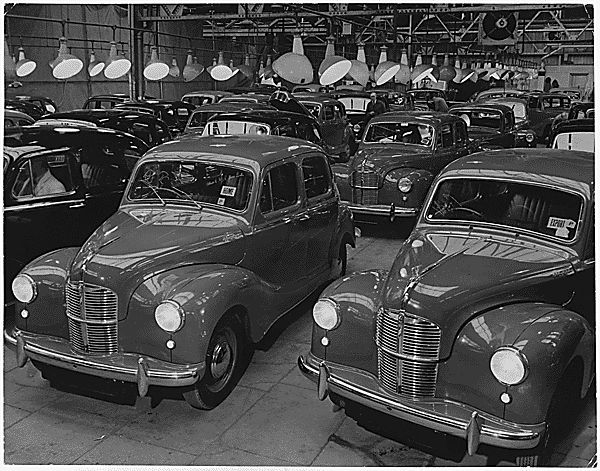
2-door Austin A40 Dorsets and 4-door Austin A40 Devons for the home and export markets, from about 1947 until 1952

Austin's naming scheme at that time derived from the approximate engine output, in horsepower. To distinguish between the different models, they were also named after counties of England.

The following vehicles were sold under the Austin A40 name:

References

[edit]
Revisions and contributorsEdit on WikipediaRead on Wikipedia
from Grokipedia
The Austin A40 was a range of economy cars produced by the Austin Motor Company from 1947 to 1967, encompassing several generations that evolved from post-war designs to more modern integrated bodies. The initial models, the Devon and Dorset saloons introduced in 1947, replaced pre-war models like the Austin Eight and Ten, featuring a separate chassis with all-steel bodies and a new 1,200 cc overhead-valve inline-four B-series engine producing 40 bhp at 4,300 rpm.[1][2] Body styles included the four-door Devon saloon, two-door Dorset saloon, and three-door Countryman estate, prioritizing family practicality, economical operation, and reliability amid post-World War II material shortages and export demands, with fuel consumption of 38–40 mpg at 30 mph and a top speed exceeding 70 mph.[2] The Devon saloon measured 12 feet 9.25 inches in length with a 7-foot 8.5-inch wheelbase, weighed approximately 2,128 lbs dry, and was offered in colors like Portland grey and mist green, priced at £392 plus purchase tax in 1947.[2][1] Innovations included sound insulation, concealed door hinges on the Devon, Girling hydraulic front brakes with mechanical rears, and a four-speed manual gearbox with floor-mounted lever.[2][1] For the early variants (1947–1956), production totaled 456,544 units, including 273,958 Devon saloons, 15,939 Dorsets, 26,587 Countrymans, and commercial derivatives like vans (78,242) and pickups (61,818).[1] The Dorset was discontinued in 1948, the Devon in 1952, and the Countryman in 1956 with a power increase to 42 bhp; a limited-run A40 Sports variant (4,011 units, 1950–1953) featured an aluminium body and twin carburettors for 46–50 bhp.[1][3] The B-series engine became foundational for later Austin and British Motor Corporation models. The A40 Somerset (1952–1954) adopted unitary construction while retaining the 1,200 cc engine (uprated to 42–46 bhp), producing around 173,000 units.[4] Later, the Farina A40 (1958–1967) featured Pininfarina styling, smaller A-series engines (948–1,098 cc, 34–48 bhp), and integrated bodies, with 342,162 produced including saloon and Countryman estate variants.[5] Overall, the A40 range exceeded one million units, reflecting Austin's post-war recovery and adaptation to changing markets.[6]

Overview

Background and Naming

The Austin Motor Company, founded in 1905, played a significant role in Britain's wartime efforts during World War II, producing over 120,000 military vehicles including trucks, ambulances, and utility cars, alongside aircraft components and munitions at its Longbridge plant.[7][8] Following the war's end in 1945, the company shifted focus back to civilian production, resuming assembly of pre-war models while developing entirely new designs to meet postwar demand for affordable family cars.[8][9] This transition culminated in the launch of the A40 series in 1947, marking Austin's first clean-sheet postwar saloon and replacing earlier models like the Eight and Ten.[1][10] The "A40" designation reflected Austin's naming convention at the time, indicating an engine output of approximately 40 horsepower, a practical measure for marketing economy cars to a recovering economy.[1][10] To evoke British heritage and regional familiarity, early variants were named after English counties—such as Devon for the four-door saloon, Dorset for the two-door version, and later Somerset—distinguishing them while aligning with the company's strategy of accessible, reliable motoring.[1][11] The initial A40 Devon and Dorset, styled by in-house designer Ricardo "Dick" Burzi, an Argentine-Italian engineer who had joined Austin in 1929, emphasized sturdy construction with a separate chassis and overhead-valve engine.[12] Spanning from 1947 to 1967, the A40 line encompassed multiple generations, including the postwar Devon/Dorset (approximately 290,000 units), Somerset (over 173,000 units), and Sports (around 4,000 units), followed by later models influenced by Italian styling from Pininfarina, such as the Farina saloon and Countryman estate (over 366,000 units combined).[1][13][14] Total production across all variants exceeded 800,000, making the A40 a cornerstone of Austin's output during a period of industrial consolidation. In 1952, Austin's merger with the Nuffield Organisation to form the British Motor Corporation further shaped the evolution of later A40 iterations.[9][15]

Post-War Context

Following World War II, Britain's economy faced severe challenges, including widespread rationing of essential goods and fuels that persisted well into the peacetime era. Petrol rationing, introduced in 1939, continued until May 1950, limiting civilian access and fostering a strong emphasis on fuel-efficient vehicles amid ongoing shortages.[16] The government promoted an "export or die" policy to rebuild foreign reserves and stimulate industrial recovery, with the automotive sector prioritized for its potential to generate hard currency; by 1950, approximately 75 percent of British passenger car production was exported to markets like the United States and Commonwealth countries.[17] This environment created pent-up domestic demand for affordable family cars, as households sought reliable, economical transport after years of austerity and restricted mobility. Austin Motor Company played a pivotal role in this landscape as one of Britain's leading automakers, competing fiercely with rivals such as Ford and Morris for market share in the compact car segment. The company's focus on mass production positioned it to capitalize on the export boom, though internal rivalries persisted until the 1952 merger with Nuffield Organization (Morris's parent) to form the British Motor Corporation (BMC), which aimed to consolidate resources amid intensifying competition.[18] Prior to the merger, Austin independently navigated the post-war recovery, shifting from wartime military vehicle output—such as trucks, ambulances, and utility cars—to civilian production to meet both export imperatives and growing home needs.[19] The Austin A40's development and 1947 launch aligned closely with these dynamics, marking Austin's first entirely new passenger car design since the war and directly addressing the backlog of consumer demand suppressed by years of factory retooling for defense efforts.[20] Government policies reinforced this orientation, mandating high export volumes—such as raising the industry-wide quota to 60 percent of production by mid-1947—to support economic stabilization, with early A40 output heavily directed overseas to comply.[21] Additionally, lingering fuel rationing influenced design priorities toward efficiency, ensuring vehicles like the A40 suited a market where economical operation was essential for everyday use.[22]

Early Models (1947–1954)

Devon and Dorset

The Austin A40 Devon and Dorset were introduced in 1947 as Austin's inaugural post-war saloon models, with the Devon offered as a four-door variant and the Dorset as a two-door counterpart, both employing body-on-frame construction to balance durability and manufacturing costs.[1][23] These designs replaced pre-war models like the Eight and Ten, emphasizing utilitarian styling with a boxy profile suited to the era's rationing and recovery needs.[1] Key features included a separate boot lid for easier access to luggage space and, on the Devon, rear suicide doors that hinged from the rear pillar to facilitate entry to the back seats.[24] The bodies measured 153 inches in overall length and rode on a 92.5-inch wheelbase, providing ample interior room for four passengers while prioritizing everyday practicality such as generous legroom and simple, robust trim.[25] Powered by a shared 1.2 L inline-four engine, these saloons were adapted for export markets, including left-hand-drive configurations for destinations like the United States alongside standard right-hand drive for the UK and Commonwealth.[23] Production of the Dorset ran from 1947 to 1948, yielding 15,939 units, while the Devon continued until 1952 with 289,897 examples built, for a combined total of 305,836 saloons.[2] These figures marked a significant achievement in post-war British automotive output, though the models were discontinued in favor of the more modern Austin A40 Somerset.[11]

Somerset

The Austin A40 Somerset was introduced in 1952 as the successor to the A40 Devon and Dorset models, offering updated styling with more modern, flowing lines that included a smoother integration of the boot and body for a less boxy appearance.[26][4] It was available primarily as a four-door saloon, with a rarer two-door cabriolet variant produced in limited numbers.[26] Key design changes included a revised front grille inspired by the larger A70 Hereford, giving it a more contemporary "Transatlantic" look aimed at export markets while retaining the separate pressed-steel chassis and 92.5-inch wheelbase from its predecessors.[26][4][27] Minor mechanical refinements enhanced refinement, such as the adoption of hydraulic rear brakes for improved stopping power over the Devon's mechanical system, and the same independent front suspension setup that contributed to a compliant ride on British roads.[4] Production of the Somerset spanned 1952 to 1954, with a total of 173,306 units built at the Longbridge plant before it was discontinued following the 1952 merger forming the British Motor Corporation, which prioritized new unified platforms.[26] Positioned for domestic British buyers seeking affordable family transport with greater style and comfort, the Somerset achieved solid sales but faced criticism for its carryover dated mechanics, including the 1.2-liter inline-four engine and live rear axle, which lagged behind more advanced rivals in handling and performance.[26][4] The model carried over the core chassis and powertrain from the Devon and Dorset, serving as a bridge to BMC's forthcoming designs.[28]

Sports

The Austin A40 Sports was introduced in 1951 as a convertible variant based on the Devon platform, featuring an aluminum body constructed by Jensen Motors to reduce weight and enhance its sporty appeal. Designed by Eric Neale at Jensen, the drop-head coupe styling emphasized open-top motoring with a four-passenger layout, including a wooden frame for structural support and steel panels for the bonnet and boot lid. This halo model aimed to add flair to the early A40 lineup, sharing the underlying chassis but with adaptations for greater rigidity, such as a boxed center section.[29][30] Performance modifications included twin SU carburetors on the 1.2-liter engine, boosting output to 46 bhp from the standard Devon's 40 bhp, along with leather upholstery and optional wire wheels for a premium feel. These tweaks enabled a top speed of approximately 75 mph and a 0-60 mph time of around 24 seconds, though the car remained modestly powered for its era. Fuel economy hovered at 29 mpg, making it suitable for leisurely touring rather than high-speed driving.[31][32][33] Production ran from 1951 to 1953, with only 4,011 units assembled, limited by its high cost of £818 in the UK and niche positioning as an export-oriented model, particularly for the US market where fewer than 650 were sold. The low volume stemmed from its specialized appeal amid post-war economic constraints, positioning it as a prestige item rather than a mass-market offering.[29][30][31] Contemporary reviews praised the A40 Sports for its enjoyable open-air experience and elegant proportions, but critics noted the engine's underpowered nature limited its sporting credentials, often describing it as more of a stylish tourer than a true sports car. Its durability was demonstrated in a 1951 round-the-world drive covering 10,000 miles in 21 days, averaging 29 mpg. Today, it is a rare survivor among classic British convertibles, valued by enthusiasts for its understated charm and historical ties to Jensen's craftsmanship.[32][29][33]

Later Models (1958–1967)

Farina Saloon

The Austin A40 Farina saloon, introduced in 1958, served as the replacement for the earlier A35 model and marked a significant stylistic departure for Austin with its Italian-influenced two-box body design penned by Pininfarina.[34][35] Measuring 144 inches in length, the Mark I version featured a 948 cc overhead-valve engine producing 34 horsepower, emphasizing economy and compact family transport in a rear-wheel-drive layout.[36] Its two-door configuration provided seating for four, with a focus on practicality through a spacious interior and fuel efficiency suitable for post-war British motorists.[37][38] In 1961, the Mark II variant arrived with a facelifted front grille for a more modern appearance, wind-up windows replacing the fixed ones of the Mark I, and an optional enlarged 1,098 cc engine offering improved performance while maintaining the model's economical ethos.[37][39] Production continued until 1967, bridging the gap to the subsequent Austin 1100 range, with the saloon sharing its platform underpinnings with the Countryman estate variant.[38] The design prioritized family usability, including a large curved rear window for better visibility and a boot accessible via a hinged lid, contributing to its role as an accessible economy car.[37] Overall production for the Farina saloon reached approximately 258,000 units, with the Mark I accounting for 141,897 examples from 1958 to 1961 and the Mark II adding 115,738 from 1961 to 1967.[35][38][37] This volume underscored its success as a staple in Austin's lineup during a period of transition in British automotive manufacturing.[34]

Countryman Estate

The Austin A40 Countryman, introduced in October 1959 as an estate variant of the Farina saloon, featured a practical two-box body design with a horizontally split tailgate that opened upward for the rear window and downward for the boot lid, making it one of the earliest production small hatchbacks.[40][41] This innovative rear access, combined with the Pininfarina-styled body shared from the saloon, emphasized utility while maintaining a compact footprint suitable for urban and rural use.[37] The initial Mark I version (1959–1961) utilized the 948 cc A-series engine producing 34 bhp, with dimensions including a 83.5-inch wheelbase, 144.25-inch overall length, and 56.5-inch height.[40][37] Key design innovations included fold-flat rear bench seats and forward-tipping front seats, enabling versatile cargo configurations for loads up to approximately 6 feet in length when the seats were lowered, ideal for small business or family needs.[42][39] By summer 1960, a flat lid was added over the rear spare wheel compartment to enhance load area usability.[40] The Mark II Countryman, launched in October 1961 and produced until 1967, introduced a slightly longer 87-inch wheelbase for improved rear legroom, wind-up rear windows, revised interior trim, and a full-width front grille.[41] Engine options expanded to include a detuned 948 cc variant at 37 bhp and, from 1962, a 1,098 cc version delivering 48 bhp for better performance.[37][41] Production of the Countryman totaled 27,715 units for the Mark I and 56,830 for the Mark II, reflecting its appeal in export markets where complete knock-down kits were assembled locally, such as in Australia for rural and small commercial applications.[37] Priced competitively at around £695 for the Mark I and £577–£618 for the Mark II, it offered economical motoring with a maximum speed of 79 mph and 0-60 mph in 29 seconds for later models.[37][41] The split tailgate persisted across both marks, providing practical "barn door" access that distinguished it from traditional estates and contributed to its enduring reputation for versatility.[42][39]

Engineering Features

Engines and Performance

The Austin A40 series employed a range of inline-four engines across its production run, evolving from larger-displacement units in the early post-war models to more efficient smaller engines in the later Farina designs. The initial engines, used in the Devon and Dorset variants from 1947 to 1948, were 1,197 cc overhead-valve designs from the Austin B-series family, producing 40 horsepower at 4,300 rpm and 59 lb-ft of torque at 3,000 rpm, with power delivered through a single carburetor.[43][44] The Somerset variant (1952-1954) used an updated version producing 42 horsepower at similar rpm with a single carburetor, while the Sports variant (1950-1953) featured twin carburetors boosting output to 50 horsepower at 4,800 rpm and 62 lb-ft of torque.[45][46][47] These engines emphasized reliability and economy over outright performance, enabling top speeds of around 70 mph and 0-60 mph acceleration in approximately 35 seconds, while achieving fuel economy of 30-35 mpg under typical conditions.[20][48] In the later models from 1958 to 1967, including the Farina Saloon and Countryman Estate, the A40 transitioned to the smaller BMC A-series overhead-valve engines, starting with a 948 cc unit from 1958 to 1962 that generated 34 horsepower at 4,750 rpm and 50 lb-ft of torque at 2,000 rpm, again with a single carburetor.[49][39] This was upgraded in 1962 to a 1,098 cc version, boosting output to 48 horsepower at 5,100 rpm and 60 lb-ft of torque at 3,500 rpm, reflecting improvements in compression ratios and internal efficiency without adopting exotic technologies like turbocharging.[39][50] Performance correspondingly improved, with 0-60 mph times ranging from 25 to 30 seconds, top speeds reaching 75-83 mph, and fuel economy improving to 35-40 mpg, making the cars suitable for everyday motoring.[51][20] Overall, the engine evolution prioritized incremental power gains through displacement increases and valvetrain refinements, ensuring the A40 line delivered consistent, if modest, performance that integrated well with its unibody chassis for balanced handling in period terms.[52]

Chassis, Body, and Suspension

The early Austin A40 models, including the Devon, Dorset, and Somerset produced from 1947 to 1954, utilized a traditional body-on-frame construction with a pressed steel chassis featuring a cruciform design for structural rigidity. This separate chassis allowed for relatively straightforward body mounting and was particularly advantageous for export markets and commercial derivatives, where some variants retained the frame for local body adaptations or utility conversions. The chassis measured approximately 92.5 inches in wheelbase, contributing to a curb weight of around 2,200 pounds, which provided a stable platform for the saloon bodies despite the post-war emphasis on lightweight materials.[1][25][44] Body construction across the early A40 range employed pressed steel panels welded to the frame, accented by chrome trim on grille surrounds, window frames, and bumpers to enhance aesthetic appeal in line with contemporary British design trends. These thin-gauge steel panels, while economical for mass production, were prone to corrosion, especially in wheel arches, sills, and underbody seams, leading to widespread rust issues in surviving examples due to inadequate rustproofing in the era. The Somerset iteration refined this approach with smoother panel integration for improved aerodynamics, but retained the same material vulnerabilities.[27][53] Suspension systems in the early models featured independent front suspension with coil springs and wishbones, paired with a live rear axle on semi-elliptical leaf springs, delivering a compliant ride suited to British roads of the time. Braking was provided by Girling drum units, with hydraulic operation at the front wheels from the 1947 launch and mechanical linkage at the rear, later upgraded to full hydraulic in the Somerset for better modulation. Steering employed a worm-and-peg mechanism, offering adequate directness but limited precision compared to emerging rack-and-pinion designs.[43][23] In contrast, the later A40 Farina models from 1958 to 1967 adopted a unibody or monocoque construction under the ADO 8 project code, integrating the body panels and chassis rails into a single all-steel structure for reduced weight and enhanced torsional stiffness. This design shortened the wheelbase from the early models to 83.5 inches for the Mk I (1958-1961) and 87 inches for the Mk II (1962-1967), lowering curb weight to approximately 1,700 pounds and improving fuel efficiency and handling responsiveness. Body panels remained pressed steel with chrome accents, though rust remained a concern in vulnerable areas like door bottoms and the tailgate hinge. Suspension evolved to coil springs over wishbones at the front and leaf springs at the rear, with full hydraulic drum brakes throughout and retained worm-and-peg steering, prioritizing economy over sporty dynamics. The engine was mounted directly to the unibody's front structure via rubber insulators for vibration isolation.[54][55][56]

Production and Variants

Manufacturing and Assembly

The Austin A40 was primarily manufactured at the Longbridge Works in Birmingham, United Kingdom, which served as the central production hub for the Austin Motor Company throughout the model's lifespan.[57] Production commenced in 1947 with the introduction of the Devon and Dorset saloons, marking the beginning of the A40 line's assembly processes at the facility.[1] Body pressings were created at the West Works section of Longbridge, where panels were stamped and welded into sub-assemblies, before being transported to the South Works for painting, trimming, and final mechanical integration.[1] In these early years, assembly relied heavily on manual labor, with workers hand-fitting components in a semi-skilled process typical of post-war British automotive manufacturing.[58] The Somerset model succeeded the Devon and Dorset from 1952 to 1954, continuing at Longbridge with similar methods but benefiting from incremental efficiencies following the 1952 formation of the British Motor Corporation (BMC), which introduced some automated tooling for engine and chassis components.[28] Production rates during the 1950s peaked at over 1,000 units per week for the early A40 variants, reflecting the plant's expansion to meet domestic and export demand.[59] Key suppliers contributed essential parts, including electrical systems from Lucas Industries and hydraulic brakes from Girling, ensuring standardized integration across the assembly line.[60] However, contemporary reviews occasionally highlighted quality control challenges, such as inconsistent panel gaps, attributed to the hand-assembly techniques and high-volume output pressures.[32] With the launch of the Farina-bodied models in 1958, Longbridge underwent retooling to accommodate the new Pininfarina-designed bodywork, shifting toward greater use of jigs and fixtures for improved precision in welding and alignment.[37] Assembly continued at the expanded facility until production ceased in 1967, replaced by the Austin 1100 as part of BMC's rationalization efforts.[37] Overall, approximately 463,000 early A40 units (Devon: 273,958; Dorset: 15,939; Somerset: 173,306, including 166,063 saloons and 7,243 coupés) were produced, alongside around 342,000 Farina models (169,612 Mk I and 172,568 Mk II, including estates).[1][28][37] Some completely knocked-down (CKD) kits were exported for final assembly in countries like Australia and South Africa to support overseas markets.[37]

Commercial and Export Derivatives

The Austin A40 lineup included several commercial derivatives designed for utility purposes, building on the base saloon's platform to meet demands for light commercial vehicles in the post-war era. The A40 Van, designated as the GV2 model, was introduced in 1947 as a panel van with an aluminium body that transitioned to steel construction in later years, powered by the standard 1200 cc overhead-valve engine, with total production of 78,242 units. This variant featured the same doors and bonnet as the Devon saloon, providing a payload capacity suitable for small-scale deliveries, and remained in production until 1956. Similarly, the GQU2 Pickup, launched in March 1948, utilized an aluminium cab and body sides on the Devon chassis, offering a practical open-bed configuration for tradesmen and farmers, with total production of 61,818 units; it too was produced through 1956, with early models distinguished by a chrome grille until 1951. In Australia, a localized adaptation known as the Hi-Lite coupe utility emerged during the same period (1947–1956), featuring a distinctive rear window wraparound design and built specifically to suit regional preferences for versatile "ute" vehicles, though exact production figures for this variant are not well-documented.[61][62][63][1] The Countryman estate, coded GP2, served as a hybrid commercial-passenger option and was launched in 1949 on a van-derived chassis, emphasizing practicality with its two-door wagon body and wood-framed rear sections that shifted to steel from late 1951. Equipped with the 1200 cc engine producing 42 bhp, it appealed to rural users and families needing extra cargo space, achieving total production of 26,587 units before discontinuation in 1956. Commercial adaptations across these models included chassis reinforcements to handle increased loads, such as boxed side rails and custom cross-members in some configurations, ensuring durability for panel van and pickup duties without altering the core mechanical layout.[1][61][64] Export derivatives expanded the A40's reach, with right-hand-drive configurations standard for the UK and Commonwealth markets, while left-hand-drive versions were developed for continental Europe and the United States to comply with local driving conventions. A significant overseas adaptation occurred in Italy through Innocenti, which began assembling the A40 Farina model from CKD kits in November 1960 and transitioned to full local production by 1962. Innocenti produced 67,706 units in total through February 1967, comprising the Berlina saloon (23,902 examples across Series 1, 2, and A40S variants) and the Combinata estate (43,804 units), the latter featuring innovative elements like wind-up windows and a single-piece top-hinged tailgate introduced in 1962 as an early hatchback design. These Italian models incorporated minor enhancements, such as an extended wheelbase in the second series for improved rear legroom, and were exported to countries including Australia and the USA.[65][66] Among discontinued variants, rare open-top utilities like the A40 Tourer were produced exclusively in Australia starting in September 1948, where chassis were shipped as "scuttles" and rebodied by local coachbuilders such as Ruskin in Melbourne or Dominion Motors in Brisbane. These four-passenger convertibles, often in two-tone schemes, catered to the convertible market but saw limited numbers due to their regional focus and eventual phasing out by the mid-1950s, with surviving examples now preserved by enthusiast registers. Exports overall accounted for a substantial portion of early A40 production, underscoring the model's role in Britain's post-war economic recovery through international sales.[67][4][1]

Reception and Legacy

Market Performance and Sales

The Austin A40 series achieved significant commercial success in the immediate postwar period, with the initial Devon and Dorset models emerging as top sellers in the UK market from 1947 to 1950. By November 1950, production had reached 250,000 units, making it Britain's leading export earner and generating nearly $77 million in foreign currency for the economy. In 1949 alone, Austin produced almost 91,000 A40s, the majority destined for export markets amid domestic shortages. These early models dominated small car sales in Britain, appealing to families seeking affordable post-war transportation. The Farina models, produced from 1958 to 1967, contributed substantially to the line's global totals, with 342,162 units built across saloon and Countryman variants. Overall, the A40 series amassed approximately 850,000 units across all iterations from 1947 to 1967, reflecting sustained demand despite evolving competition. Regional sales breakdowns highlighted its export strength: roughly 40% remained in the UK, while exports accounted for the balance, with Australia and New Zealand proving particularly receptive due to local assembly of CKD kits. In Australia, the A40 was the best-selling car in 1948 and 1949, outpacing emerging local production like the Holden. Sales in the US were limited by the car's compact size but still positioned it as the top import in the early 1950s, with over 11,000 units peaking in one year. European markets saw assembly via Innocenti in Italy, yielding over 67,000 units tailored for continental tastes. Contemporary reviews in the 1950s praised the A40 for its affordability, reliability, and fuel economy, positioning it as a practical choice for everyday use over performance-oriented rivals. Publications noted its simple mechanics and spacious interior as strengths, with the Somerset variant lauded for improved ride quality compared to pre-war designs. However, criticisms focused on its underpowered engine, delivering modest acceleration, and excessive body roll in corners, which limited excitement for enthusiasts. These traits underscored a design prioritizing economy and dependability, resonating with budget-conscious buyers but drawing mixed feedback from motoring journalists. Sales began to decline in the mid-1960s as the A40 faced stiffer competition from the BMC Mini and rising imports, leading to its phase-out by 1967. The Farina's market share eroded from 1962 onward, with annual figures dropping amid shifting preferences for more modern, compact designs. Despite this, the series' legacy as a postwar staple endured, bolstered briefly by positive motorsport imagery that enhanced its rugged appeal.

Motorsport and Cultural Impact

The Austin A40 Farina achieved notable success in motorsport during the late 1950s and early 1960s, particularly in rallying and saloon car racing. In the 1959 Monte Carlo Rally, driver Pat Moss and co-driver Ann Wisdom secured the Coupe des Dames, the Houbigant Cup, the RAC Challenge Trophy, and the Souvenir Henri Rougier in an A40 Farina, finishing 10th overall and marking the model's international rallying debut.[68][69] The car also competed effectively in British saloon car racing, with examples like the one driven by George "Doc" Shepherd winning the 1960 British Saloon Car Championship, and restored championship-winning A40s parading at events such as the Silverstone Classic.[70][71] Earlier A40 variants, including the Devon and Somerset models, participated in hill climbs across the UK and Australia, with records of entries at venues like Loton Park in 1967 and Templestowe in 1960.[72][73] The A40's sporting legacy extended to later rallies and modern vintage events, where prepared examples continue to compete. A40 Farina models entered international events like the East African Safari Rally in the 1960s, showcasing the car's durability on rough terrain.[74] The Austin A40 Sports, a convertible variant produced from 1950 to 1953, remains active in contemporary vintage racing and shows, often earning trophies for its rarity and period charm.[30][75] In popular culture, the A40 symbolized post-war British motoring optimism and economy during the 1950s, embodying accessible family transport amid economic recovery.[24] A 1950 Austin A40 Devon appeared in the 1953 film Genevieve, highlighting veteran car enthusiasm in a comedic London-to-Brighton race narrative.[76] Today, collector interest sustains the model's appeal, supported by dedicated groups like the A40 Farina Club, which fosters ownership, events, and preservation among enthusiasts. The A40's enduring legacy includes widespread restorations, where addressing rust—particularly in sills, floors, and wheel arches—is a common focus due to the body's vulnerability to corrosion.[77] Its role as an affordable, reliable small car influenced BMC's strategy toward compact designs, paving the way for innovative economy models like the Mini by emphasizing space efficiency and mass-market accessibility.[78][79]

References

User Avatar
No comments yet.