Hubbry Logo
search
logo
2077962

Austin Sheerline

logo
Community Hub0 Subscribers
Read side by side
from Wikipedia

Austin Sheerline
A110 and A125
A125
Overview
ManufacturerAustin
Production1947–1954
DesignerRicardo Burzi
Body and chassis
Body style4-door saloon
4-door limousine (lwb)
Ambulance (lwb)
Hearse (lwb)
RelatedAustin Princess
Powertrain
Engine
Dimensions
Wheelbase3,028.9 mm (119.25 in)
3,352.8 mm (132 in) (lwb)
Length4,864.1 mm (191.5 in)
Width1,854.2 mm (73 in)
Height1,701.8 mm (67 in)
Kerb weight1,880–2,032 kg (4,145–4,480 lb)
Chronology
PredecessorAustin 28 Ranelagh
SuccessorAustin A135 Princess
Vanden Plas Princess

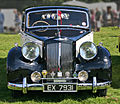
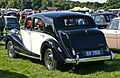
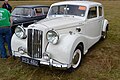
The Austin Sheerline is a large luxury car produced by Austin in the United Kingdom from 1947 until 1954.

History

[edit]

The new Sheerline, with razor-edge styling, first appeared at the Geneva Motor Show on 13 March 1947.[1]

It was a luxurious car in the style of the contemporary Rolls-Royce or Bentley but at a much lower price, around two-thirds that of the equivalent Rolls-Royce but still the price of five or six small Austins.

Design began in 1942 during WW2 when Austin Motors Chairman, Sir Leonard Lord, decided that Austin needed a large and traditionally styled car to compete in the luxury car market.[2]

Argentine/Italian stylist, Ricardo Burzi designed the Austin Sheerline based on Leonard Lord's sketches. The day Italy entered the war, Ricardo Burzi was interned on the Isle of Man due to being an 'Italian resident alien' and only released after Leonard Lord pulled some strings and personally vouched for his character. Upon release he was allowed to work on condition that he worked in an isolated area and reported daily to the police. He designed the Austin Sheerline alongside the Austin A40 in a 30 ft long office and about half as wide with a full sized layout board and three desks. Initially a Plasticine model was created with a full size wooden "Mock-up" model completed by 1946.[3]

The Austin Sheerline was the first Austins to have a 'Flying A' bonnet mascot and 'Austin of England' script. Austin Chairman, Sir Leonard Lord, owned a Bentley during the war and the story goes that he took the Bentley 'Flying B' bonnet mascot from his personal Bentley and gave it to Austin designer Ricardo Burzi to create something similar. In one day, Burzi altered the slope of the 'B' and formed a stylized 'A' attaching a skeletal wing to the trailing edge and wrapped it in foil. This mascot became Austin's logo and featured on all models until the 1960s.[2]

Production

[edit]

Volume production did not begin until 1947 because of Austin Motors commitment to war production.

In 1949 a limousine model was produced on a stretched 11 ft chassis, Twelve and a half inches had been added to the wheelbase as well as a sliding glass partition behind the driver an foldaway occasional seating.[4]

Both models were built at Austin's Longbridge plant from 1947 to 1954.

There were about 8,000 built along with 475 long wheelbase limousines and 300 chassis available to coacbuilders for ambulances, shooting brake estate and hearses.[5]

Austin Sheerline Model Data
Vehicle Type Chassis Code/Numbers Dates Number Produced
A110/125 Sheerline SWB Saloon DS1 (1-10504) 1947–1954 approx 8000
A125 Sheerline LWB Limousine DM1 (3020-10165) 1949–1953 approx 475
A125 Sheerline Ambulance DA1 (3195-12812) 1950–1955 approx 300 Ambulance/Hearse combined
A125 Sheerline Hearse DH1 (3100-12458) 1950–1955 Ratio of 4 hearses to each ambulance

Production ceased in 1954 and Austin's luxury offering was limited to the A135 Austin Princess.

Engine

[edit]

The Austin Sheerline 4-Litre OHV straight-six engine was based on the famous Austin D-Series engine, with slight differences.[5]

The first new British cars to be introduced since the war by one of the large manufacturers have now been announced. They are the Austin Sheerline 110 and Princess 120 saloons, the former with knife-edge coachwork made at Longbridge Birmingham and the latter having a more streamlined body which is the work of Vanden Plas, the coach building firm acquired by Austins last year. The chassis of both cars is similar, the only difference being in the number of carburettors. The figures after the names of the models indicate the brake horse-power. The cars are new from end to end, and the specifications include a new three and a half litre six-cylinder, overhead valve engine, steering column control of the four-speed synchromesh gearbox, independent front suspension using coil springs, and hydraulic brakes. The prices are £1,278 for the 110 and £1,917 for the 120, including purchase tax.[6] designated A110, had a 3,460 cc straight-six overhead valve engine but this was soon[7] increased to 3,995 cc with 125 bhp (93 kW) and the designation then became A125. At 37 hundredweight (1,850 kg) for the saloon and 2 tons (2,000 kg) for the limousine this was a heavy car, and to maintain performance a low final drive ratio of 4.55:1 with 16-inch tyres was fitted. The saloon version had a top speed of 82 mph (132 km/h).

Anders Clausager, an archivist at BL Heritage Ltd, discovered that no more than 12 Sheerlines and 32 Princesses, mainly prototype and pre-production cars, were fitted with the 3,460cc engine before the increase to 3,993cc at the end of 1947.[1]

The Austin Sheerline engine was shared with the Austin Princess and also used in the Jensen PW[8] and Jensen 541[9]

Chassis

[edit]

Austin produced two chassis for the Austin Sheerline and the Austin Princess.[10]

Initially only a saloon version on a 9-foot-11¼-inch (3 metre) wheelbase chassis was made, but this was joined by a limousine version in late 1949[11] on a stretched 11 ft (3.3 metre) chassis available for use by coachbuilders for conversion to an ambulance, shooting brake estate or hearse.

A pressed-steel cross-braced chassis frame was used, and for the first time on an Austin, independent front suspension. Other features were a hydraulic jacking system, Lockheed hydraulic brakes and a steering-column gearshift.[1] Suspension was by coil springs at the front and semi-elliptic leaf springs at the rear.

The Austin Sheerline had Smith's "Red Jackall" hydraulic jacking system installed on its chassis behind each wheel. This was operated by a hydraulic pump that allowed all four wheels to be lifted at once to easily change a tyre. A valve knob accessed through a trap door under the carpet under the driver's seat operated this system. this[12][13]

The consensus is that in the Last of the Summer Wine episode The Loxley Lozenge, the chassis of an Austin Sheerline was used as a prop for the titular (fictional) vehicle.[14]

Coachbuilt examples

[edit]

The Austin Sheerline and Princess could also be supplied as either a rolling chassis or chassis cab[15][16][17] for the fitting of bespoke coachwork.

Approximately 300 chassis cabs were produced for coachbuilders to produce hearses, ambulances and shooting brake/woodies.

A unique 4-door convertible was built on a 1949 Austin Sheerline rolling chassis by Belgian Coachbuilders Vesters & Neirinck in Brussels. Originally ordered by Desire Gillet of the motorcycle manufacturer 'Gillet-Herstal', it resembles the work of the French coachbuilder Saoutchik.[18]

In 1950 Queen Juliana of the Netherlands ordered Dutch coachbuilders Pennock to construct a six-cylinder convertible limousine for the Dutch Royal Household. A 1950 Austin Sheerline Limousine DM1 (left hand drive) rolling chassis was delivered to Pennock and the unique Double Convertible Town Car was delivered to the Royal Household in 1952.[19]

Austin Motors and their London distributors, Car Mart Ltd, gifted a 1947 Austin Sheerline to HRH Queen Elizabeth II and Prince Philip on their wedding day. This particular car had some interesting features being fitted with Vanden Plas' sportier triple carburettor's as opposed to the standard single Stromberg unit, rear compartment shelves that held 'His and Hers' glass fragrance bottles, etc.[20]

References

[edit]

Further reading

[edit]
[edit]
Revisions and contributorsEdit on WikipediaRead on Wikipedia
from Grokipedia
The Austin Sheerline is a full-size luxury car produced by the Austin Motor Company in the United Kingdom from 1947 to 1954, known for its traditional British styling with a razor-edged rear, prominent free-standing headlights, and a vertical chrome grille, powered by a 4.0-litre overhead-valve inline-six engine delivering approximately 125 horsepower.[1][2][3] Conceived in 1942 during World War II as part of Austin's post-war planning under the direction of Leonard Lord, the Sheerline was one of the first new British car designs to emerge after the conflict, aiming to offer affordable luxury in competition with higher-end marques like Rolls-Royce and Bentley.[3][4] The project evolved from an initial A110 prototype with a 3.46-litre engine, of which only 12 were built in 1947, before transitioning to the more powerful A125 model later that year to meet performance expectations.[3][2] Production took place at Austin's Longbridge plant, where the car's steel body and chassis were constructed, incorporating the largest single steel roof pressing in British automotive history at the time.[1] The Sheerline featured a robust ladder-frame chassis with independent front suspension and live rear axle, hydraulic drum brakes, and a distinctive "Jackall" hydraulic jacking system for easy wheel changes.[1][2] Its interior boasted high-quality walnut veneer dashboard, leather upholstery, thick carpets, and amenities such as a sliding steel sunroof, radio option, and centrally mounted instruments, all offered at a relatively accessible price of around £1,277 in 1947.[3][4] Performance included a top speed of about 83 mph, 0-60 mph acceleration in around 20 seconds, and fuel economy of 15 mpg, with the engine's strong low-end torque making it suitable for effortless cruising.[1] Available primarily as a four-door saloon on a 10-foot wheelbase, the Sheerline also came in a long-wheelbase limousine variant (DM1) from 1949, as well as bare chassis for specialist conversions into hearses, ambulances, and estates.[1][2] A closely related coachbuilt version, the Vanden Plas Princess (initially A120 and later A135), shared the same mechanicals but featured more opulent trim and optional triple-carburettor tuning for enhanced power, continuing production until 1968.[1] Total Sheerline production reached between 7,000 and 11,600 units, depending on inclusion of commercial derivatives, reflecting its niche appeal in the post-war market before being discontinued without a direct successor.[1][3]

Development

Conception

The development of the Austin Sheerline was initiated in 1942 under the leadership of Austin's chairman, Sir Leonard Lord, who envisioned a new luxury saloon to elevate the brand's prestige in the post-war era.[5] Lord, an owner of a Bentley, envisioned a design inspired by his personal car, aiming to create an accessible high-end vehicle often described as a "Bentley for the masses."[5] Styling was led by Austin's chief designer Ricardo (Dick) Burzi, an Italian-Argentine stylist who refined Lord's concepts into a distinctive razor-edge aesthetic influenced by American luxury cars such as Packard models.[1] This resulted in flowing lines, a pillarless saloon body, and a bustle-backed rear, setting it apart from contemporary British designs while incorporating opulent features like separate fenders and large Lucas P100 headlights.[1] The Sheerline introduced the 'Flying A' bonnet mascot, inspired by Bentley's iconic 'Flying B' and marking the first such emblem on an Austin model, along with 'Austin of England' script on the hubcaps.[6] The engineering brief emphasized producing a "poor man's Bentley" using entirely in-house resources at the Longbridge works, distinguishing it from the more exclusive, coachbuilt Austin Princess.[5] This in-house approach was facilitated by Austin's 1946 acquisition of coachbuilder Vanden Plas, allowing volume production while offering coachbuilt alternatives.[1] This approach allowed for volume production of a chauffeur-driven alternative amid Britain's post-war austerity, prioritizing luxury positioning without relying on external coachbuilders.[1] Pre-production prototypes, initially fitted with a 3.5-litre engine, underwent testing in 1946 to refine ride quality and performance for the emerging civilian market.[1]

Launch

The Austin Sheerline was unveiled at the Geneva Motor Show on 13 March 1947 as the A110 model, representing Austin's inaugural post-war luxury automobile designed to compete in the upper echelons of the British motor industry.[7][8] This debut showcased the car's distinctive razor-edge styling, drawing inspiration from pre-war luxury designs while incorporating modern engineering advancements such as independent front suspension and hydraulic brakes. The A110 featured a 3,460 cc straight-six overhead-valve engine, positioning it as a sophisticated offering for discerning buyers seeking elegance without the prohibitive cost of marques like Rolls-Royce or Bentley.[3][7] Priced at £1,277 ex-works in August 1947 for the saloon variant, the Sheerline was marketed as an accessible luxury option, often described by Austin's chairman Leonard Lord as a "poor man's Bentley." This pricing strategy—significantly lower than the £3,250 for a contemporary Rolls-Royce—emphasized British craftsmanship, refined performance, and understated opulence to appeal to owner-drivers and professional classes. Initial production of the A110 was limited to just 12 units, a brief transitional phase before the model evolved into the A125 designation by late 1947, incorporating an enlarged 3,995 cc engine to align with the UK's new flat-rate road tax system and enhance power output.[3][7] Marketing efforts highlighted the Sheerline's embodiment of post-war British engineering excellence, with promotional materials underscoring its smooth ride, spacious interior, and elegant lines tailored for executive transport. From the outset, Austin targeted export markets, including Europe—facilitated by the Geneva unveiling—and Commonwealth nations such as Australia, alongside ambitions in the United States through the newly established Austin of America division. These early exports underscored the model's international appeal, though initial volumes were modest amid post-war economic constraints.[7][9] Following the launch, immediate adaptations focused on refining the powertrain for better reliability and compliance, culminating in the swift transition to the A125's 4-litre engine by the end of 1947; this upgrade addressed performance expectations in diverse markets without altering the core chassis or body design.[3][7]

Engineering

Engine

The Austin Sheerline featured a straight-six overhead-valve (OHV) engine with pushrod actuation, derived from the Austin D-Series used in commercial vehicles but refined for smoother operation in a luxury context.[1] The initial A110 variant, introduced in 1947, displaced 3,460 cc and produced 110 bhp at 4,000 rpm.[10] By 1948, the engine was enlarged to 3,995 cc for the A125 model, yielding 130 bhp at 3,700 rpm and 150 lb-ft of torque at 2,000 rpm, with an all-iron construction, a 6.8:1 compression ratio, and a single Zenith carburetor.[11][3] Power was transmitted via a four-speed manual column-shift gearbox without synchromesh on first gear, and an optional overdrive unit became available from 1950 to enhance highway cruising.[1] Performance characteristics included a 0-60 mph time of approximately 19 seconds, a top speed of 82 mph, and fuel economy of 14-16 mpg under typical conditions.[12][13] The engine incorporated practical maintenance features, such as replaceable wet cylinder liners for easier rebuilding and a cooling system adapted from pre-war Austin designs to ensure reliability in the post-war luxury chassis.[3]

Chassis

The Austin Sheerline employed a conventional steel ladder-frame chassis, providing a robust foundation for its luxury positioning and enabling straightforward body mounting. This pressed-steel construction incorporated cross-bracing for structural integrity, supporting the vehicle's substantial curb weight of approximately 4,300 lb (1,950 kg).[7] The standard saloon rode on a 9 ft 11 in (3,023 mm) wheelbase, offering ample interior space while maintaining balanced proportions for handling. In contrast, the limousine variant featured an extended wheelbase of 11 ft (3,353 mm), achieved by lengthening the frame rails to accommodate additional passenger length without compromising overall rigidity. This adaptability facilitated coachbuilding applications, such as reinforced chassis variants for heavier limousine bodies.[7][14] Suspension design emphasized comfort and durability suitable for long-distance travel. At the front, an independent setup utilized coil springs with wishbones and lever-arm dampers, representing Austin's inaugural implementation of independent front suspension and contributing to smoother ride quality over uneven roads. The rear employed a live axle mounted on semi-elliptic leaf springs.[7][15] Braking was handled by Lockheed hydraulic drum systems, delivering reliable stopping power for the era's large luxury cars. Complementing this, the chassis integrated a Smith's Jackall electro-hydraulic jacking system, with pumps positioned behind each wheel to enable simultaneous lifting of all four corners for simplified tire maintenance—a practical feature enhancing owner convenience.[11][16] Steering employed a cam-and-peg mechanism, providing precise control with a compact turning radius appropriate for urban maneuvering in a full-size vehicle. These elements collectively ensured the Sheerline's chassis prioritized refined ride dynamics and longevity, with the engine mounted low for optimal weight distribution and power delivery integration.[7]

Production and Variants

Standard Models

The Austin Sheerline standard models encompassed the factory-produced short-wheelbase (SWB) saloon and the long-wheelbase (LWB) limousine, built at the Longbridge Works from 1947 to 1954. Approximately 7,000 SWB saloons were manufactured during this period, with production emphasizing hand-assembly lines and in-house body pressing to navigate post-war material shortages. These vehicles utilized surplus materials, including aircraft-derived components for trim elements, reflecting the era's resource constraints.[1][11] The SWB saloon measured 16 feet in overall length, featuring a pillarless four-door body design that seated six passengers comfortably on a sofa-like rear bench and flexible front seating arrangements. Its interior boasted leather upholstery, a walnut-veneered dashboard, and an electric clock among standard luxury appointments, such as a built-in radio and folding armrests. Priced at £1,277 ex-works, the saloon targeted affluent private buyers seeking post-war elegance. A minor update in 1952 introduced a synchromesh gearbox for smoother shifting.[1][11] Introduced in 1949, the LWB limousine variant added approximately 700 units to the lineup through 1954, extending the wheelbase by over a foot to accommodate an extended roofline and a chauffeur division with sliding glass partition for privacy. This eight-seater configuration, complete with occasional rear seats and walnut paneling, was priced at £1,692 and aimed at executive and fleet markets requiring formal transport.[1] Standard production concluded in 1954 amid declining demand for separate-chassis luxury cars and Austin's transition to British Motor Corporation (BMC) unibody construction methods, with luxury duties shifting to the Vanden Plas Princess.[1]

Coachbuilt Examples

Approximately 300 Sheerline chassis cabs were supplied to external coachbuilders from 1947 to 1956 for specialized applications, including hearses, ambulances, and shooting brakes.[8] These variants extended production beyond the standard saloon models, continuing until 1956 to meet ongoing demand in the funeral and medical sectors.[8] Hearses were among the most common coachbuilt forms, with bodies crafted by firms such as Martel Motors and Woodall Nicholson on the reinforced Sheerline chassis.[17] Ambulances followed a similar pattern, utilizing the long-wheelbase chassis for spacious interiors suited to medical transport, though specific builders varied by region. Shooting brakes and woodies, often featuring teak-paneled estates for up to eight passengers, were produced in limited numbers by coachbuilders like Zenith Carriages.[8] Rare convertible examples highlight the versatility of the Sheerline platform. A unique 1949 A125 cabriolet, bodied by Vesters & Neirinck of Brussels, was commissioned for Mr. Gillet of the Gillet-Herstal motorcycle firm; it includes a folding roof with landau bars, a hand-cranked glass partition, three rear seats, and an Art Deco wooden dashboard.[6] Limousine specials were also created for elite clientele, such as a 1950 left-hand-drive rolling chassis delivered to Pennock in The Hague for the Dutch royal household; completed in 1952 as an extended-wheelbase Sheerline Princess limousine for Queen Juliana, it featured inlaid woodwork, front fender flagstaffs, and a glass partition.[18] Notable survivors of these coachbuilt Sheerlines include the Vesters & Neirinck cabriolet, which was exported to France in 1976 and partially restored by its long-term owner, and the Pennock royal limousine, recovered from a U.S. barn and returned to the Netherlands for restoration.[6][18] These examples, often showcased at classic events, demonstrate the enduring appeal of the Sheerline's adaptable chassis design.[8]

Reception and Legacy

Market Performance

The Austin Sheerline experienced modest initial sales following its launch, amid postwar economic constraints and ongoing fuel rationing in the UK.[1] Production peaked in the early 1950s, reflecting growing demand for luxury vehicles as rationing eased, though the model's high base price—equivalent to approximately £59,000 in 2025 terms—limited broader accessibility.[19][9] In the UK luxury car segment, the Sheerline competed directly with the Rolls-Royce Silver Dawn and Bentley Mk VI, offering relatively affordable pricing and proven reliability derived from prewar Austin engineering.[1] Exports bolstered overall figures, with notable uptake in Australia and South Africa, while performance in the US was hampered by high import tariffs and stylistic mismatches with American preferences, resulting in minimal penetration there.[9] Total global sales, including variants, reached between 7,000 and 11,600 units by the end of production in 1954.[1] The Sheerline's decline in the early 1950s stemmed from intensifying competition, notably from the Jaguar Mk VII's sportier appeal and BMC's internal Austin A90 Atlantic, alongside the industry's pivot toward modern unit-body construction that rendered the Sheerline's traditional chassis less competitive.[1] Pricing evolved upward with inflation and material costs, while limousine variants accounted for about 6% of total output, appealing primarily to fleet and ceremonial buyers.[20]

Cultural Impact

The Austin Sheerline endures as a symbol of post-war British luxury motoring, embodying the era's blend of understated elegance, engineering reliability, and affordability compared to rivals like Rolls-Royce and Bentley.[21][7] Launched amid Britain's economic recovery, it represented Austin's ambition to deliver high-end features—such as overhead-valve engines and independent front suspension—to a broader audience, influencing perceptions of British craftsmanship in the immediate post-war years.[7] With production totaling around 8,000 units from 1947 to 1954, approximately 100 examples survive worldwide today, many preserved as wedding cars or museum pieces due to their imposing presence and durability.[22][8] Enthusiast communities play a vital role in its preservation, with organizations like the Austin Sheerline & Princess Club and the Austin Sheerline Owners Group providing support through events, technical advice, and parts sourcing.[23][24] Modern restorations often focus on rebuilding the original 4.0-liter inline-six engine, leveraging its robust design derived from commercial vehicle applications, while addressing bodywork challenges with specialist suppliers.[25] As of 2025, well-restored or concours examples command values typically ranging from £5,000 to £15,000 at auction, reflecting their rarity and appeal to collectors seeking authentic post-war icons, though parts scarcity persists without widespread reproductions—specialists like Kip Motor Company offer limited original-stock alternatives.[26][27][28] The Sheerline's cultural footprint extends to media and events, appearing as period props in television series such as The Invisible Man (1958–1960) and Danger Man (1960–1961), where its stately form evoked mid-20th-century British sophistication.[29] It participates in international classic car rallies, including the annual Statesman Vintage & Classic Car Rally in Kolkata, India—where a 1950 example served as General K.M. Cariappa's official car—and the Tata Steel Vintage & Classic Car Rally in Jamshedpur, showcasing its enduring allure among global enthusiasts.[30][31] The model's technical innovations, including hydraulic brakes and a spacious chassis, paved the way for BMC's later Farina-styled series in the 1950s, which adopted similar engineering principles for mass-market luxury saloons.[7] In 2022, the Austin Motor Vehicle Club of Queensland marked the Sheerline's 75th anniversary with commemorative articles and gatherings, highlighting its debut at the 1947 Geneva Motor Show and role in Austin's heritage.[8] Preservation efforts face hurdles from dwindling original components, particularly for coachbuilt rarities like Neirinck conversions, but club networks and targeted reproductions for essentials like trim and seals help sustain the fleet.[32][28]

References

User Avatar
No comments yet.