



Community hub
Recent from talks
Knowledge base stats:
Talk channels stats:
Members stats:
Azo compound
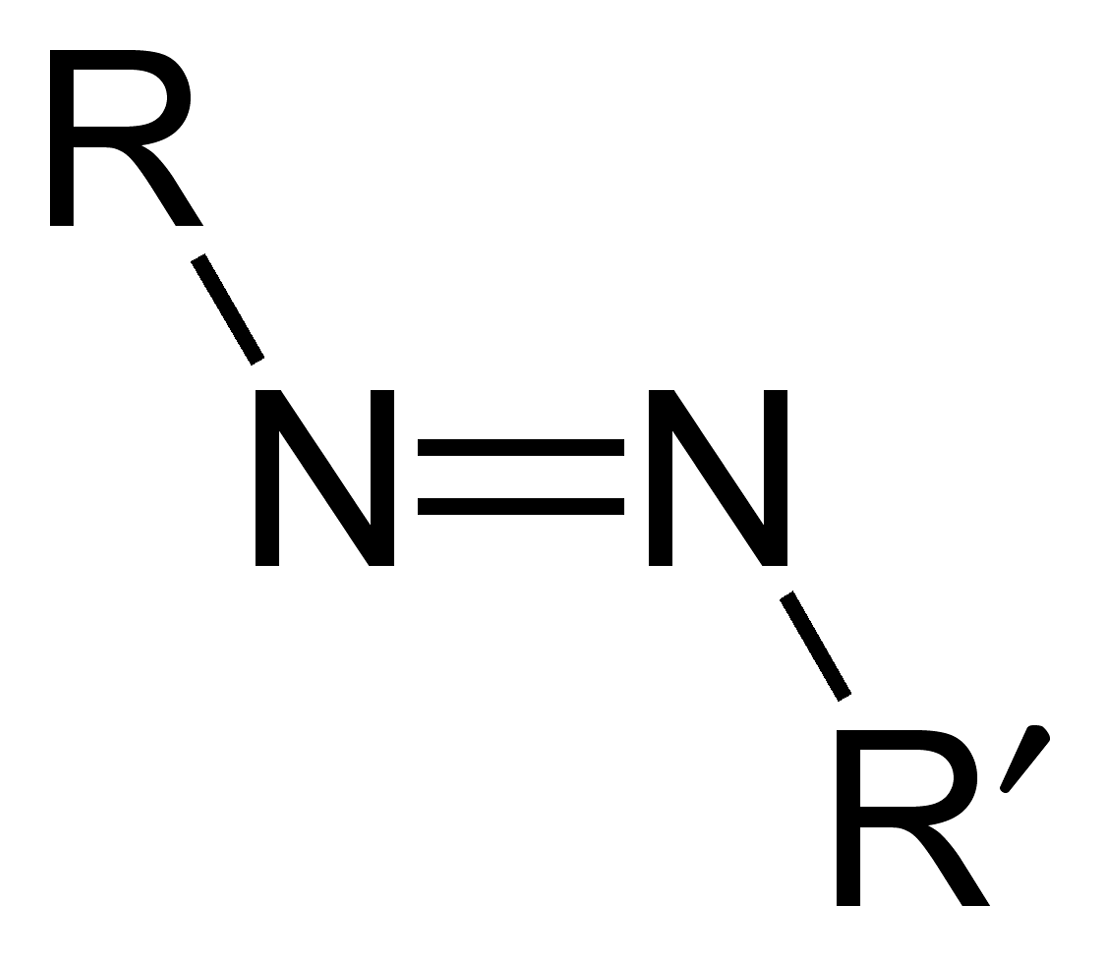
Azo compounds are organic compounds bearing the functional group diazenyl (R−N=N−R′, in which R and R′ can be either aryl or alkyl groups).
IUPAC defines azo compounds as: "Derivatives of diazene (diimide), HN=NH, wherein both hydrogens are substituted by hydrocarbyl groups, e.g. PhN=NPh azobenzene or diphenyldiazene.", where Ph stands for phenyl group. The more stable derivatives contain two aryl groups. The N=N group is called an azo group (from French azote 'nitrogen', from Ancient Greek ἀ- (a-) 'not' and ζωή (zōē) 'life').
Many textile and leather articles are dyed with azo dyes and pigments.
Aryl azo compounds are usually stable, crystalline species. Azobenzene is the prototypical aromatic azo compound. It exists mainly as the trans isomer, but upon illumination, converts to the cis isomer.
Aromatic azo compounds can be synthesized by azo coupling, which entails an electrophilic substitution reaction where an aryl diazonium cation is attacked by another aryl ring, especially those substituted with electron-donating groups:
Since diazonium salts are often unstable near room temperature, the azo coupling reactions are typically conducted near 0 °C. The oxidation of hydrazines (R−NH−NH−R′) also gives azo compounds. Azo dyes are also prepared by the condensation of nitroaromatics with anilines followed by reduction of the resulting azoxy intermediate:
For textile dying, a typical nitro coupling partner would be disodium 4,4′-dinitrostilbene-2,2′-disulfonate. Typical aniline partners are shown below.
As a consequence of π-delocalization, aryl azo compounds have vivid colors, especially reds, oranges, and yellows. Therefore, they are used as dyes, and are commonly known as azo dyes, an example of which is Disperse Orange 1. Some azo compounds, e.g., methyl orange, are used as acid-base indicators due to the different colors of their acid and salt forms. Most DVD-R/+R and some CD-R discs use blue azo dye as the recording layer. The commercial success of azo dyes motivated the development of azo compounds in general.
Hub AI
Azo compound AI simulator
(@Azo compound_simulator)
Azo compound
Azo compounds are organic compounds bearing the functional group diazenyl (R−N=N−R′, in which R and R′ can be either aryl or alkyl groups).
IUPAC defines azo compounds as: "Derivatives of diazene (diimide), HN=NH, wherein both hydrogens are substituted by hydrocarbyl groups, e.g. PhN=NPh azobenzene or diphenyldiazene.", where Ph stands for phenyl group. The more stable derivatives contain two aryl groups. The N=N group is called an azo group (from French azote 'nitrogen', from Ancient Greek ἀ- (a-) 'not' and ζωή (zōē) 'life').
Many textile and leather articles are dyed with azo dyes and pigments.
Aryl azo compounds are usually stable, crystalline species. Azobenzene is the prototypical aromatic azo compound. It exists mainly as the trans isomer, but upon illumination, converts to the cis isomer.
Aromatic azo compounds can be synthesized by azo coupling, which entails an electrophilic substitution reaction where an aryl diazonium cation is attacked by another aryl ring, especially those substituted with electron-donating groups:
Since diazonium salts are often unstable near room temperature, the azo coupling reactions are typically conducted near 0 °C. The oxidation of hydrazines (R−NH−NH−R′) also gives azo compounds. Azo dyes are also prepared by the condensation of nitroaromatics with anilines followed by reduction of the resulting azoxy intermediate:
For textile dying, a typical nitro coupling partner would be disodium 4,4′-dinitrostilbene-2,2′-disulfonate. Typical aniline partners are shown below.
As a consequence of π-delocalization, aryl azo compounds have vivid colors, especially reds, oranges, and yellows. Therefore, they are used as dyes, and are commonly known as azo dyes, an example of which is Disperse Orange 1. Some azo compounds, e.g., methyl orange, are used as acid-base indicators due to the different colors of their acid and salt forms. Most DVD-R/+R and some CD-R discs use blue azo dye as the recording layer. The commercial success of azo dyes motivated the development of azo compounds in general.