Hubbry Logo
BK Whopper BarBK Whopper BarMain
Open search
BK Whopper Bar
Community hub
BK Whopper Bar
logo
8 pages, 0 posts
0 subscribers
Be the first to start a discussion here.
BK Whopper Bar
BK Whopper Bar
from Wikipedia

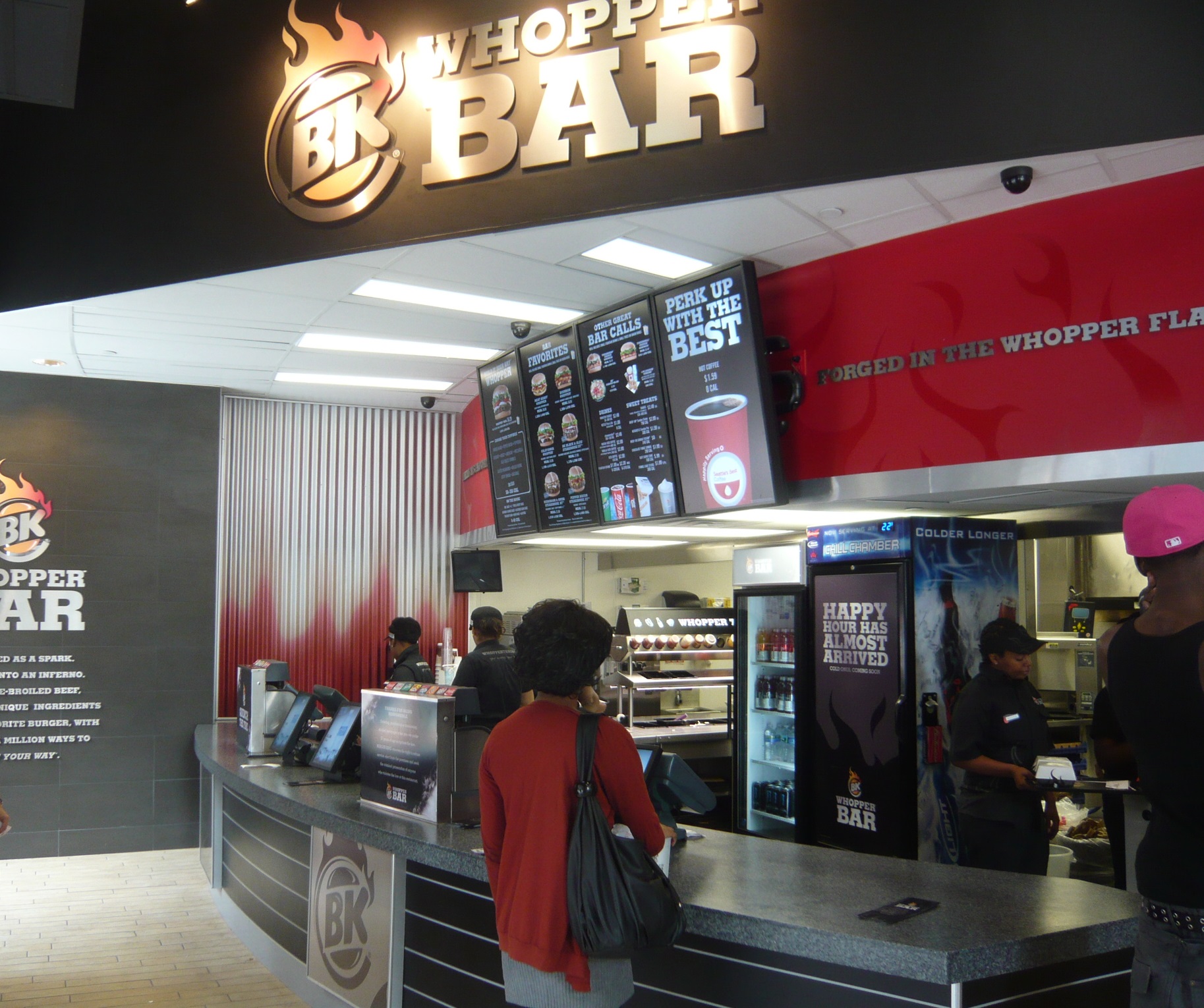
A BK Whopper Bar in Manhattan in 2010

The BK Whopper Bar is a limited service concept created by fast-food restaurant Burger King in 2009.

Format

[edit]

The Whopper Bar is a high end concept designed to compete with fast casual and casual dining restaurants. The locations feature an open kitchen with a semi-circular metal counter top.[1] The exposed kitchen allows customers to view the preparation of their foods. Decoration of the new locations is limited to plasma televisions playing looped videos of open flames. The concept is similar to the McCafé concept from rival McDonald's, and like the McCafé locations they are designed for malls, airports, casinos and other areas with limited space.[2]

[edit]

Whopper Bars are specialty restaurants with a menu limited to the company's Angus sandwiches; drinks; and desserts.[3] The menu features higher-end ingredients and variants not sold in the normal Burger King locations.

While international locations sold beer at the Whopper Bar locations, the company originally stated that it did not intend to do so at its North American locations. The company changed its mind with the opening of its second Whopper Bar location in the South Beach section of the company's home town of Miami; Burger King reported that it would be the only current American, national fast food chain selling beer in its home territory.[4]

In markets where alcohol can be sold at fast food restaurants, the company will be selling products from SABMiller and Anheuser-Busch including Budweiser, Bud Light and Miller Lite in aluminum bottles designed to maintain temperature. The move, designed to target the important 30-and-under demographic, has been called risky by industry analysts because the company is known as a fast food purveyor and not as an alcoholic beverages seller. Other industry consultants have disagreed with the assessment, believing that the move is a practical one because the company is growing with its aging customer base.[5][6][7]

References

[edit]
Revisions and contributorsEdit on WikipediaRead on Wikipedia
from Grokipedia
The BK Whopper Bar is a limited-service restaurant concept developed by Corporation, launched in 2009 as a premium extension of the chain's signature burger, allowing customers to customize their sandwiches with over 20 toppings assembled in view. This format emphasizes a more experiential dining approach compared to standard outlets, featuring build-your-own options and occasional premium ingredients like steakhouse bacon or bourbon-infused elements in select variations. The concept debuted on March 19, 2009, with its flagship location at in , marking the world's first Whopper Bar and targeting entertainment district visitors with a focus on customization and visual assembly. Initially positioned as an innovative test for expansion, Burger King planned to roll out additional sites in high-traffic areas, including a short-lived location in Miami Beach's and another in , though most have since closed. The Orlando venue remains operational as of 2025, integrated into the CityWalk food court and offering extended hours alongside standard menu items. Key features include a toppings bar where patrons select from ingredients such as , jalapeños, or premium cheeses, with burgers prepared on-site for freshness, and in some cases, the addition of or other beverages to enhance the bar-like atmosphere. This setup differentiates it from traditional fast-food service by promoting personalization and a more upscale vibe within the quick-service model, though it maintains Burger King's core flame-grilled patty preparation. Despite its innovative appeal, the Whopper Bar has not expanded widely, serving primarily as a proof-of-concept for customizable menu strategies in the fast-food industry.

History

Launch in 2009

The Whopper Bar was introduced by in 2009 as a limited-service format designed to enhance the customization and premium presentation of the sandwich, allowing customers to select from over 20 toppings built in an interactive setting. This concept marked a departure from traditional outlets by emphasizing a more upscale, fast-casual dining experience centered on the brand's iconic burger. Burger King Holdings Inc. announced the Whopper Bar initiative in October 2008, with the inaugural location opening on March 19, 2009, at in , a high-traffic entertainment complex adjacent to . The site was selected for its ability to attract diverse, innovation-seeking customers in a non-traditional venue, aligning with 's strategy to expand into premium locations such as theme parks and urban entertainment districts. The motivations behind the launch included targeting the growing premium fast-casual segment to differentiate from standard quick-service restaurants, while reinforcing the —Burger King's signature flame-grilled burger introduced in 1957—as the core of the brand. Company executives viewed the format as a way to pioneer new revenue channels and compete with elevated concepts in the industry, such as McCafé's upscale offerings. Design inspirations for the initial Whopper Bar drew from high-end bars and counters, incorporating an open kitchen, a central circular for visible topping assembly, and a modern aesthetic with red, black, and gray tones to create an engaging, theater-like atmosphere. These elements encouraged customer interaction and highlighted the customization process, setting the stage for a more experiential dining option focused primarily on variants.

Expansion and Challenges

Following the successful debut of the first BK Whopper Bar at in , in March 2009, the concept saw its second U.S. location open in Miami's neighborhood in February 2010. This venue introduced beer sales, marking Burger King's first alcohol service in the United States, with options from and available alongside combos for $7.99. The addition aligned with the bar's upscale, customizable format, featuring an open kitchen and premium toppings theater to enhance the dining experience. In July 2010, Burger King opened another U.S. site in , , , at 561 Seventh Avenue, expanding the concept to a high-traffic . This location emphasized the bar's modern design, including visible assembly counters, but initially delayed alcohol service pending licensing. International growth included the opening of a Whopper Bar in , , in June 2009, as the first in . Burger King announced ambitious expansion plans in 2009, targeting 6 to 12 additional U.S. units by year-end, alongside further international rollouts in venues like sports stadiums, casinos, and cruise ships. These sites were envisioned for high-traffic areas with space constraints unsuitable for full-scale restaurants, aiming for up to 300-500 units globally. However, the premium setup—featuring custom toppings stations, upgraded interiors, and staff training—incurred higher operational costs compared to standard fast-food outlets. The Bar's upscale positioning created scalability challenges within 's traditional fast-food model, as it targeted niche, limited-space environments rather than broad replication. This approach risked internal competition with full-service locations offering similar core menu items at lower price points and faster service. Early skepticism arose over the brand's shift from value-driven to a gourmet-like experience, echoing failed 2008 Bistro experiment due to mismatched operational demands.

Developments Post-2010

Following Burger King's acquisition by in September 2010 for $3.3 billion, the Whopper Bar concept entered a period of stagnation, with corporate priorities shifting toward cost-cutting measures and core menu revitalization rather than experimental formats. This , which took the company private, emphasized operational efficiencies and global growth, limiting investments in niche outlets like the Whopper Bar. The trend continued after the 2014 merger with , forming (RBI) in a $11.4 billion deal that created the world's third-largest quick-service restaurant company. Under RBI, focus turned to system-wide innovations and international expansion of standard locations, further deprioritizing dedicated Whopper Bar sites in favor of broader brand strategies. Expansion efforts post-2010 included a U.S. location at the Rio All-Suite Hotel & Casino in , opened in April 2011, which offered burgers and but closed in the mid-2010s. In a brief promotional experiment, the Whopper Bar introduced the Pizza Burger in September 2010, a shareable sandwich priced at $12.99 and consisting of four flame-grilled patties topped with pizza sauce, slices, and cheese on a 9.5-inch sesame seed bun. This limited-time item sought to draw crowds with its oversized, pizza-inspired design but remained exclusive to that location and did not expand chain-wide. International efforts proved minimal, as seen with the opening of Europe's first Whopper Bar in , , in June 2009, which offered customized Whoppers in a bar-style setting but represented one of only a few global kiosks without subsequent scaling. No major post-2010 international trials materialized, and the overall concept failed to grow beyond these handful of sites. Dedicated Whopper Bar locations gradually closed amid operational challenges, including repeated health code violations that shuttered the Times Square, New York, site in June 2012 due to pest issues. The Miami South Beach location also closed in the late 2010s. Key features of the concept, particularly extensive customization with up to 20 toppings, have since been incorporated into standard menus through the longstanding "Have It Your Way" policy. This allows similar personalization at regular outlets, enhanced by digital tools like the 2025 "Whopper By You" platform for building custom burgers via app or in-store ordering.

Concept and Format

Design Elements

The BK Whopper Bar locations were designed with a premium, lounge-like atmosphere to differentiate from standard fast-food outlets, featuring high-end interiors that emphasize customer interaction and visibility into food preparation. Central to this is a semi-circular metal surrounding an open kitchen, where patrons can observe the flame-broiling process in real time, fostering an engaging dining experience. Complementing this are plasma televisions mounted around the space, displaying looped videos of flames to highlight the brand's signature cooking method. Adopting a compact kiosk-style footprint significantly smaller than traditional Burger King restaurants, the Whopper Bar concept was tailored for high-traffic venues such as malls, , casinos, and entertainment districts, allowing for efficient placement in space-constrained environments. The interior incorporates a sophisticated of black and red accents, diverging from the chain's usual orange-and-red palette, paired with gleaming surfaces in the kitchen area for a modern, polished look. Seating options, including bright red furniture and bar-style arrangements, contribute to a casual lounge feel that encourages lingering and customization during the dine-in process. Unlike conventional sites, Bars omit drive-thru service entirely, prioritizing an immersive dine-in experience centered on personalized burger assembly at the counter. This layout supports a service flow where customers select toppings directly, enhancing the interactive and premium positioning of the format.

Service and Operations

The BK Bar operates as a limited-service fast-food outlet, where customers place orders at a counter and watch their burgers being assembled in real time, emphasizing speed and without table service or waitstaff. This model allows for quick turnover, with sandwiches prepared to order from fresh ingredients to accommodate high-volume urban locations. Staffing at the Whopper Bar includes specialized employees, often referred to as "Whopper-istas" or bar-tenders, who assist customers in selecting and applying toppings from a visible "toppings theater" featuring over 20 options such as smoked , , and jalapeños. These staff members are trained to guide personalization, ensuring efficient customization while maintaining the fast-paced environment. The open kitchen design further supports this by providing transparency into the preparation process. Operational hours vary by location but are often extended to support in target areas, with some sites like the Miami Beach outlet running 24 hours a day, seven days a week, including a walk-up for on-the-go orders. The format prioritizes high capacity through rapid service and fresh preparation, typically in compact spaces around 490 square feet designed for dense foot traffic. Unique policies include limited alcohol service where local regulations permit, such as beer offerings at select U.S. locations like and , available from early morning until late night but without a full bar setup. Self-serve stations integrate seamlessly into the counter-service flow, allowing customers to handle beverages independently to further expedite operations.

Core Items

The core menu at the BK Whopper Bar centers on the signature sandwich, consisting of a flame-grilled quarter-pound patty topped with lettuce, tomatoes, onions, pickles, mayonnaise, and ketchup, all served on a sesame seed bun. This foundational item emphasizes Burger King's flame-grilling technique, which imparts a distinctive charred flavor to the patty. Complementing the are other staple sandwiches, including the TenderCrisp with its breaded chicken breast fillet on a bun, and initially the Angus Steakhouse XT burger featuring a premium Angus patty. These items provide variety while maintaining the Bar's focus on customizable, grilled proteins. Basic sides such as and onion rings round out the offerings, providing classic fast-food accompaniments. As of 2025 at the operational Orlando location, core meals include the Meal for $12.49, Double Whopper Meal for $9.49, and TenderCrisp Meal for $9.79, alongside options like chicken nuggets and salads. Beverages include a selection of soft drinks, milkshakes in flavors like and , and simple desserts such as pies, with coffee options available. The pricing structure positions these core items slightly higher than at standard locations to reflect the premium, interactive dining experience. For instance, the base Whopper was approximately $4.99 upon the 2009 launch, compared to about $3.59 at regular outlets. Customers have the option to customize these staples with additional toppings available at the Bar.

Customization and Premium Options

The BK Whopper Bar emphasized extensive customization of its signature sandwich, allowing patrons to select from over 20 toppings to create personalized versions built upon the flame-grilled beef patty foundation. Premium choices included , various cheese varieties such as mozzarella and , , crispy onions, and specialty sauces, enabling upscale flavor profiles not typically available at standard locations. As of 2025, toppings such as , Swiss cheese, , onion rings, crispy onions, jalapeños, and are available for an additional $0.89 each. Exclusive items further distinguished the Whopper Bar menu, such as beer pairings offered at select sites like the location in , where customers could complement their customized burgers with alcoholic beverages from 8 a.m. to 5 a.m. Limited-time offerings highlighted innovative variants, exemplified by the 2010 Burger introduced exclusively at the Times Square Whopper Bar, which featured four patties topped with , cheese, and on a large sesame seed bun. Dietary accommodations were integrated into the customization framework, with options like the —substituting a plant-based for the , introduced in 2019—and grilled alternatives, all assembled using fresh ingredients to support varied preferences.

Locations and Availability

United States Sites

The BK Whopper Bar concept debuted in the with its first location at Universal in , opening in March 2009 as a for the chain's customizable burger experience in a high-traffic . This site, integrated into the CityWalk , remains operational as of November 2025, offering over 20 topping options for Whoppers amid the area's tourist-heavy environment. Recent visitor feedback highlights consistently available service despite elevated pricing compared to standard outlets, with the location maintaining its role as a quick-service option within the Universal Orlando complex. In , a Bar opened in in August 2010, strategically positioned to capitalize on the area's dense pedestrian and tourist foot traffic with an emphasis on premium, made-to-order burgers. However, the location faced repeated health code violations, leading to temporary closures in 2012, and it has since permanently shut down, with no indications of reopening or rebranding under the Bar format by 2025. The Miami Beach Whopper Bar, located on Washington Avenue in and opened in late 2010, marked a pioneering effort by offering beer selections such as and alongside customizable , a first for in the U.S. to integrate alcohol service starting at 8 a.m. This site continues to operate as of 2025, preserving its unique bar element within the vibrant nightlife scene, though it has not expanded the alcohol feature to other domestic locations. A Whopper Bar also opened in Las Vegas at the Rio All-Suite Hotel and Casino around 2011, targeting tourists with customizable options in a casino setting, but it operated briefly and closed by the mid-2010s. The concept has been largely confined to these urban and tourist-oriented venues, with no sustained expansions beyond the flagship sites.

International Presence

The BK Whopper Bar concept saw a limited international rollout beginning in , primarily as an experimental extension of the U.S. model to test customization and premium offerings in select markets. The first overseas location opened in at the das Einstein in , , in June , featuring the signature build-your-own with up to 20 toppings alongside beer service compliant with local regulations. This site marked Burger King's initial push into upscale fast-casual formats abroad, with plans announced for additional European sites, though only a handful materialized. In , the inaugural Whopper Bar debuted in at in September 2009, the first of its kind in the region and designed to appeal to late-night crowds with extended hours until 3 a.m. Local adaptations included unique toppings such as chili rings and nacho chips to align with regional tastes, while was offered as a beverage option to differentiate from standard outlets. Similarly, a Whopper Bar opened in around the same period, one of three confirmed international sites, emphasizing alcohol pairings like to enhance the bar-like atmosphere. These locations, including the one in Valencia's mall, incorporated customization stations and premium items tailored to Latin American preferences. Burger King explored further expansion into and additional Asian markets through franchising partners, scouting 20 to 25 potential sites, but no dedicated Whopper Bars beyond and were established. By 2012, the international footprint consisted solely of the , , and outlets, all serving where permitted and focusing on experiential dining. The concept remained experimental globally, with fewer than a dozen sites worldwide—including U.S. locations—by 2015, reflecting cautious adoption amid varying regulatory and market challenges. However, all international Whopper Bars have since closed: the location by around 2017, the site amid widespread franchise closures in in 2014, and the outlet with no evidence of operations post-2015, leaving no active international presence as of 2025.

Reception and Impact

Customer and Critical Response

The BK Whopper Bar received praise from customers and media for its extensive customization options and upscale atmosphere, which differentiated it from standard Burger King outlets. Upon its 2009 launch, outlets like Nation's Restaurant News lauded the concept's innovation, noting that patrons could select from 22 toppings such as smoked bacon and to personalize , Double Whoppers, or Steakhouse XT burgers in an open-kitchen setting that emphasized a premium, interactive . Early customer feedback from 2009-2010 highlighted the fun of building custom burgers, with reviewers appreciating the "classier cousin" vibe through upgraded ingredients and visual elements like plasma TVs displaying flame-grilled animations. Criticisms centered on elevated pricing, inconsistent food quality during peak times, and a menu heavily focused on burger variations with limited alternatives. Items at the Whopper Bar were reported to cost about $3 more than comparable offerings at regular locations shortly after opening, contributing to perceptions of poor value despite the added customization. In busy venues, diners noted variability in preparation, including cold food or uneven application, while the emphasis on Whopper-centric options disappointed those expecting broader staples like chicken sandwiches. Premium items, such as the Burger priced at $12.99, were described as "hefty" and emblematic of overall 20-30% markups compared to standard menus. Media coverage evolved from initial enthusiasm to observations of underperformance tied to its niche appeal amid economic pressures. While 2009 articles celebrated the Whopper Bar as a potential expansive franchise model, later analyses in 2010 pointed to sluggish , attributing it to higher costs alienating core fast-food customers during . As of 2025, the Orlando location at continues to draw mixed responses, with ratings at 2.7 stars reflecting complaints about high prices, rude service, low food quality, and uncleanliness, though some praise the freshness of made-to-order burgers. Yelp aggregates 2.1 stars from 54 reviews, citing good-quality food but limited seating and slower service in the high-traffic area, while scores it 3.4 out of 5 from 299 reviews, balancing positive notes on customization against ongoing value concerns.

Business Legacy and Current Status

The BK Whopper Bar concept, launched in 2009, played a pivotal role in reinforcing Burger King's emphasis on customization, extending the longstanding "Have it your way" —introduced in —into a more experiential format that influenced global menu strategies across standard locations. By allowing customers to select from over 20 toppings in a bar-style setting, it popularized personalized burger assembly, paving the way for digital tools like the modern app-based ordering system. This shift helped solidify the 's position as a cultural staple, a flame-grilled sandwich debuted in 1957 that now sells billions of units annually worldwide, marking over 68 years of prominence. Despite early promise, the Whopper Bar achieved limited expansion, with only a few sites opened between 2009 and 2011, after which no significant new locations were added as the core ideas were integrated into Burger King's broader brand rather than maintained as a standalone format. This restrained growth reflected challenges in scaling the premium, space-efficient model amid economic pressures and operational complexities in the fast-food sector. As of November 2025, the sole operational Whopper Bar remains the outlet at in , fully integrated into the venue's food court and granted an alcohol license in December 2024 after a 14-year legal battle, enabling beer pairings with customized s. All other locations, including those in New York, , and , have closed or been rebranded to standard formats. Under parent company , there are no announced plans for further Whopper Bar expansions, with focus instead on systemwide remodels and value-driven initiatives across the chain's approximately 19,000 global outlets. The Whopper Bar's legacy endures through occasional pop-up events and the "Whopper by You" platform, which echoes its customization ethos by offering AI-assisted and limited-time personalized burger options via the app, sustaining innovation without dedicated physical sites.

References

Add your contribution
Related Hubs
User Avatar
No comments yet.