Hubbry Logo
Balloon poppingBalloon poppingMain
Open search
Balloon popping
Community hub
Balloon popping
logo
8 pages, 0 posts
0 subscribers
Be the first to start a discussion here.
Balloon popping
Balloon popping
from Wikipedia
A high-speed photograph of a popped balloon

A balloon pops when the material that makes up its surface tears or shreds, creating a hole.[1][2] Normally, there is a balance of the balloon skin's elastic tension in which every point on the balloon's surface is being pulled by the material surrounding it. However, if a hole is made on the balloon's surface, the force becomes imbalanced, since there is no longer any force exerted by the center of the hole on the material at its edge. As a result, the balloon's surface at the edge of the hole pulls away, making it bigger; the high pressure air can then escape through the hole and the balloon pops.[1][2] A balloon can be popped by either physical or chemical actions. Limpanuparb et al. use popping a balloon as a demonstration to teach about physical and chemical hazards in laboratory safety.[3]

Physical

[edit]
Balloon skewer experiment

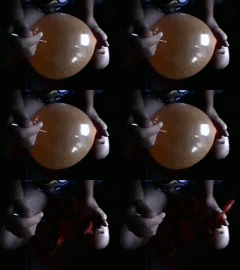
A pin or needle is frequently used to pop a balloon.[4] As the needle or pin creates a hole on the balloon surface, the balloon pops. However, if tape is placed on the part where the hole is created, the balloon will not pop since the tape helps reinforce the elastic tension in that area, preventing the edges of the hole pulling away from the center.[5] Likewise, the thick spots of the balloon at the top and the bottom can be pierced by a needle, pin, or even skewer without the balloon popping.[3]

Chemical

[edit]

Organic solvent

[edit]
A balloon popped by toluene

Applying an organic solvent such as toluene onto a balloon's surface can pop it, since the solvent can partially dissolve the material making up the balloon's surface.[3]

cis-1,4-polyisoprene (solid) + organic solvent → cis-1,4-polyisoprene (partly dissolved)[3]

Baby oil can also be applied to water balloons to pop them.[6]

Orange peel

[edit]

Orange peel contains a compound called limonene which is a hydrocarbon compound similar to the rubber that can be used to make balloons. Based on "like dissolves like" principle, rubber balloons can be dissolved by limonene, popping the balloon. If the balloon is vulcanized (hardened with sulfur), the balloon will not pop.[7]

[edit]

See also

[edit]

References

[edit]
[edit]
Revisions and contributorsEdit on WikipediaRead on Wikipedia
from Grokipedia
Balloon popping is the abrupt rupture of an inflated 's elastic membrane, typically composed of or similar rubber material, triggered by excessive internal gas surpassing the material's tensile strength, mechanical puncture, or , which causes a rapid expulsion of the enclosed air, , or other contents along with a distinctive loud explosive . This exemplifies principles of elasticity and , where the balloon's thin wall stretches under until failure occurs, often initiating at a weak point and propagating as a tear. has identified two primary bursting modes: at lower inflation , a single linear tear forms and widens progressively, while at higher , multiple radial cracks emerge, branch, and fragment the material into petal-like remnants. The intensity of the pop varies with factors such as balloon size, gas type, and inflation level; for instance, gases with lower specific heat ratios, like refrigerants, produce louder bursts due to greater stored energy release. The characteristic bang arises not from the gas expansion or supersonic motion of the , but from the high-frequency of the intact membrane and the oscillating edges of the rupture, generating primarily in the 3,100–3,400 Hz range, akin to a drumhead's . These loud bursts can pose risks to hearing, particularly at close range without protection. Mylar (foil) balloons, in contrast, produce a quieter hiss due to their non-elastic metallic , which limits vibrational compared to stretchable . In educational settings, balloon popping serves as a hands-on demonstration for concepts like absorption, , and chemical reactions.

Fundamentals

Definition and Principles

Balloon popping is the sudden and often explosive rupture of an inflated balloon, occurring when the internal gas pressure surpasses the tensile strength limits of the balloon's material or when chemical degradation weakens the structure. This phenomenon releases stored rapidly, typically producing a sharp and scattering fragments. At its core, balloon popping hinges on the mechanical balance between and the material's resistance to stress. As gas is added, the balloon expands, thinning its walls and increasing tensile stress until failure. governs this for spherical balloons, stating that the wall stress σ\sigma is given by σ=ΔPr2h\sigma = \frac{\Delta P \cdot r}{2 h}, where ΔP\Delta P is the pressure difference across the , rr is the , and hh is the wall thickness; equivalently, ΔP=2σhr\Delta P = \frac{2 \sigma h}{r}. Larger radii reduce the pressure needed to maintain a given stress for fixed thickness, but material thinning often leads to rupture. This principle explains why overinflation causes popping, as the equilibrium shifts toward material failure. The historical roots of balloon popping trace to 1824, when Michael Faraday invented rubber balloons by cementing sheets of rubber for containing hydrogen in experiments at the Royal Institution of Great Britain, where overpressurization likely first demonstrated explosive rupture. These early balloons laid the foundation for observing popping as a consequence of gas containment limits. Latex balloons, derived from natural rubber, are highly elastic and pop with a loud bang due to their ability to store significant elastic energy before bursting. Mylar balloons, made from metallicized polyester film, exhibit minimal stretch and typically deflate gradually through tears rather than exploding, owing to their rigid structure.

Balloon Materials and Properties

Balloon materials significantly influence popping behavior through their mechanical and chemical properties. The two primary types used are latex, derived from natural rubber, and Mylar (boPET), a synthetic polyester film often metallized for foil balloons. Latex balloons, made from natural rubber (cis-1,4-polyisoprene), exhibit a nonlinear stress-strain curve characterized by an initial steep slope that flattens under increasing strain, reflecting the uncoiling and alignment of polymer chains before crystallization at high extensions. This hyperelastic behavior allows significant deformation without permanent damage. Additionally, natural rubber latex displays viscoelasticity, combining viscous and elastic properties, which manifests as shear-thinning (pseudoplastic) flow where viscosity decreases with increasing shear rate, aiding in molding and inflation processes. Biodegradation of latex begins upon inflation due to mechanical stress that initiates oxidative decomposition, though empirical studies indicate this process is slow, with minimal mass loss (1-2%) and retained structural integrity over 16 weeks in compost, freshwater, or saltwater environments. In contrast, Mylar foil balloons are composed of biaxially oriented (BoPET), a non-elastic material that provides dimensional stability and minimal stretch under load. This rigidity enhances puncture resistance, with tensile strengths of 20-30 depending on thickness, making it less susceptible to small impacts compared to . However, under sharp or localized stress, such as creasing or edge loading, Mylar can propagate tears due to its film-like structure. Key mechanical metrics for these materials include for natural rubber latex, typically ranging from 1-5 MPa, which quantifies initial stiffness, and elongation at break up to 800%, enabling extreme stretching before failure. Balloon wall thickness plays a critical role in burst pressure; thicker walls elevate the critical pressure threshold for both instantaneous and delayed rupture by distributing stress more evenly and reducing swelling-induced weakening in gel-like models analogous to rubber. Popping behaviors differ markedly: latex balloons, due to their elasticity, rupture explosively, shredding into fragments from rapid recoil; Mylar balloons, with their non-elastic nature, deflate slowly through a tear without a loud pop, often producing only a soft hiss.

Physical Mechanisms

Overinflation and Stress Failure

Overinflation occurs when air is continuously added to a balloon, causing its radius to expand and the wall thickness to decrease proportionally, which intensifies the mechanical stress within the material. This process follows the hoop stress formula for thin-walled spherical pressure vessels, where the circumferential stress σ is given by σ = P r / (2 t), with P representing the differential, r the balloon radius, and t the wall thickness. As inflation proceeds, the increasing radius r amplifies σ even if P remains moderate, while the thinning t further elevates the risk of ; latex rubber, the common material for party balloons, exhibits nonlinear elasticity under such strain, allowing significant deformation before rupture. A 2015 study by French physicists Sébastien Moulinet and Mokhtar Adda-Bedia utilized high-speed cameras to capture the dynamics of balloon bursting due to overinflation, revealing two distinct modes determined by the and resulting stress levels. In the low-pressure regime, typically below a critical stress threshold of approximately 88 MPa, the balloon fails via a clean, single tear or a few radial cracks (2–3), propagating as a simple opening that divides the into large fragments. Conversely, at high pressures exceeding this threshold, the failure transitions to a complex fragmentation mode, where multiple cracks form a branching, treelike network, driven by the stored surpassing the material's . During rupture, the tear edges retract at velocities approaching or exceeding the speed of shear waves in the rubber, with crack tip speeds reaching up to 570 m/s in the fragmentation , independent of the precise tension level. This rapid propagation releases the balloon's dynamically, leading to shredding into 10–100 pieces, with the final number of fragments increasing quasilinearly with the pre-burst tension above the critical value (around 1.8 MPa effective ). The extent of fragmentation thus scales with the total stored during overinflation, highlighting how higher inflation levels produce finer debris through successive crack tip splitting.

Puncturing and Mechanical Damage

Puncturing a balloon occurs when a sharp object introduces a localized defect in the , creating a that exceeds the material's tensile strength and initiates rapid tear propagation. This defect acts as a seed crack, triggering dynamic where the tear branches and accelerates at intersonic speeds, up to the speed in rubber, leading to explosive fragmentation. The process is governed by a critical tensile stress threshold of approximately 88 MPa, beyond which the fails catastrophically. Common techniques for mechanical puncturing include pricking the balloon with a pin or needle, which causes an immediate pop as the air rushes out and the tear spreads across the entire surface. A notable demonstration involves threading a long through the balloon without causing it to burst; this is achieved by inserting the skewer into unstretched regions near the and opposite end, where the remains slack. In these areas, the localized stretching around the puncture point does not generate sufficient tension for the tear to extend, allowing the balloon to slowly rather than explode. Balloons can also pop from blunt mechanical impacts, such as slapping or excessive squeezing, which deform the membrane unevenly and create localized high-stress zones that mimic puncturing effects. The susceptibility to mechanical damage depends on the balloon's tension and the geometry of the intervention; highly inflated, taut balloons pop more readily because their pre-existing hoop stress amplifies the initial defect, facilitating faster tear propagation compared to loosely filled ones. Additionally, the angle of puncture influences outcomes—a more perpendicular approach maximizes normal force and stress concentration, increasing the likelihood of immediate failure, while oblique angles may allow partial penetration without full rupture. Unlike internal stress failure from overinflation, these external triggers initiate failure abruptly at lower overall pressures. Popping via puncturing generates sharp latex fragments that can cause minor injuries, highlighting debris hazards.

Chemical Mechanisms

Solvent Dissolution

Solvent dissolution refers to the chemical process by which certain organic solvents degrade the structure of rubber in balloons, leading to a loss of tensile strength and eventual rupture under . balloons are typically made from vulcanized , a network of chains cross-linked with bonds, which provides elasticity but can be compromised by compatible solvents. Non-polar organic solvents, such as , penetrate the rubber matrix, causing swelling as they solvate the chains and weaken the cross-links, reducing the material's ability to withstand stress. This degradation occurs rapidly, often within seconds to minutes, depending on the solvent's potency and exposure level. Common organic solvents used to demonstrate or induce this effect include toluene, turpentine, and petroleum-based fuels like gasoline. Toluene, for instance, when applied as a single drop to an inflated balloon, diffuses into the latex, causing immediate swelling and a burst within seconds due to the solvent's affinity for the non-polar rubber. Turpentine, derived from pine resin, similarly weakens the rubber through prolonged rubbing or immersion, often resulting in a slow leak before a full pop as the material thins and tears. Gasoline acts analogously, with its hydrocarbon components dissolving the polymer surface upon contact, leading to structural failure in under a minute for typical party balloons. These solvents are applied externally via direct contact, and the popping is exacerbated by the balloon's internal gas pressure. At the molecular level, the reaction involves the of the cross-linked sulfur bonds in vulcanized rubber, where solvent molecules intercalate between chains, disrupting the bridges and increasing chain mobility. This process is governed by the 's solubility parameter matching that of rubber (approximately 8.6 (cal/cm³)^0.5), promoting and equilibrium swelling. The rate of degradation is influenced by solvent concentration, temperature, and exposure duration; higher concentrations accelerate bond solvation, while brief exposures may cause only localized weakening. Unlike complete dissolution, which requires extended immersion, balloon popping typically results from partial degradation sufficient to create a critical defect under tension. This mechanism has been illustrated in educational demonstrations to highlight , such as in training where is used to burst a , emphasizing the need for fume hoods, gloves, and ventilation to avoid or skin exposure risks. Such experiments underscore the incompatibility of organic solvents with rubber materials, providing a tangible example of polymer-solvent interactions without mechanical intervention.

Reaction with Natural Substances

One notable natural substance that induces balloon popping is D-limonene, a found in orange peels. This compound dissolves rubber, the primary material in many inflatable balloons, through a "like dissolves like" mechanism where the non-polar structure of D-limonene interacts with the chains in latex, causing swelling and structural weakening that leads to rupture under internal air pressure. When fresh orange peel is squeezed or rubbed against an inflated balloon, the released limonene typically causes popping within 10-30 seconds. Other plant-derived substances exhibit similar but varying effects on latex balloons. Terpene-rich essential oils also dissolve latex by similar non-polar solvent action, leading to balloon failure upon prolonged contact. This reaction is specific to natural rubber latex balloons and does not affect Mylar or foil balloons, which lack hydrocarbon-based polymers susceptible to terpene dissolution. The potency depends on environmental factors, including the freshness of the plant material, as older peels yield less limonene oil. A common demonstration involves rubbing the inner surface of an orange peel directly on a balloon to release , often used in chemistry education to illustrate principles; this technique has been documented in educational resources since at least 2015.

Acoustics and Effects

Sound Production

The characteristic bang of a balloon pop arises from the high-frequency vibrations of the intact and the oscillating edges of the rupture, generating akin to a resonance. This process is accompanied by rapid crack through the at speeds up to approximately 300–570 m/s, depending on stress levels, leading to abrupt energy release. Several factors influence the and character of this . Larger balloons, containing greater volumes of gas, produce louder pops due to the higher amount of released during rupture, with studies showing a between inflated and overall acoustic output. Higher prior to popping results in a sharper, more intense as the gas expands more forcefully. Additionally, the acoustic environment plays a role; reflective surfaces can amplify the through echoes, increasing perceived in enclosed spaces compared to open areas. The frequency spectrum is , with the characteristic bang featuring primary peaks at 3,100–3,400 Hz from , alongside in lower frequencies (130–1,400 Hz) from the overall rupture dynamics. Acoustic measurements indicate peak levels (SPL) near the can reach 140-160 dB, with up to 168 dB for large balloons; these levels exceed safe exposure thresholds (e.g., 120 dB peak for children per WHO guidelines) and pose risks of hearing damage, highlighting the impulsive nature of the event.

Fragmentation and Debris

When a balloon pops, the stored in the highly stretched latex membrane is released instantaneously, driving the of cracks that tear the material apart. This dynamical fragmentation begins with an initial seed crack—often from a puncture or stress —that accelerates across the surface, potentially splitting into multiple branches when it reaches a , forming a treelike network of ruptures. For standard balloons inflated to near-bursting levels, the result is typically dozens of elongated shreds rather than a clean split, as the high strain amplifies the instability of crack . The pattern of fragmentation depends on the level of internal stress prior to bursting. Under low stress, such as in a moderately inflated pricked by a needle, a single crack races around the , dividing the balloon into just two large pieces with minimal shredding. In contrast, high-stress conditions from overinflation lead to radial cracking and successive tip-splitting events, producing a complex web of fractures that yields numerous fragments. This transition occurs above a critical stress of approximately 1.8 MPa, as observed in high-speed imaging experiments. A 2015 study highlighted in demonstrated these modes, showing how greater initial strain correlates with more extensive breakup. The debris from latex balloons consists of thin, flexible shreds typically measuring several centimeters in length, propelled outward by the jet of escaping pressurized air. These fragments can travel at speeds sufficient to pose minor projectile risks nearby, though exact velocities vary with balloon size and inflation. Mylar (foil) balloons, due to their non-elastic metallic coating, fragment less dramatically, often yielding larger, flatter pieces that are lighter and scatter more widely upon rupture. The fragmentation process itself generates the sharp acoustic burst associated with popping. Latex balloons are marketed as biodegradable, but peer-reviewed studies indicate minimal degradation for whole balloons over months in , , or . Fragmented pieces may degrade faster due to greater surface area exposure, with estimates ranging from 6 months to several years depending on conditions and additives; however, they persist long enough to contribute to environmental and hazards.

Applications and Safety

Educational Demonstrations

Balloon popping serves as an engaging tool in educational settings to illustrate fundamental physics and chemistry principles, often integrated into classroom demonstrations to foster hands-on learning. In , the demonstrates equilibrium by connecting two inflated s of different sizes via a tube, allowing air to flow until internal pressures balance, causing the larger balloon to deflate and the smaller to inflate. This setup highlights and the elasticity of balloon materials without requiring complex equipment. Additionally, high-speed video analysis of balloon bursts reveals fragmentation dynamics, where the tears at speeds approaching the , producing petal-like debris patterns; a 2015 study by French physicists using ultra-high-speed cameras captured these processes to quantify crack propagation and material failure. In chemistry classrooms, balloon popping demos emphasize and interactions. The orange peel experiment shows how d-limonene, a natural in oils, dissolves latex polymers upon contact, weakening the balloon's structure and causing it to burst due to ; this illustrates the "like dissolves like" principle for non-polar and hydrocarbons. Similarly, tests with organic like demonstrate rapid , as the swells and dissolves the rubber, leading to immediate rupture; these activities teach about chemical compatibility and the vulnerability of elastomers to hydrocarbons. Safety education incorporates balloon popping to teach recognition and protective measures in environments. Demonstrations often include chemical dissolution to highlight risks such as flying fragments and volatile emissions, with instructors emphasizing the use of appropriate . A structured lab session using these demos encourages students to observe, predict outcomes, and document risks, reinforcing protocols for handling pressurized systems and reactive substances. Historically, balloon-related experiments trace back to Michael Faraday's 1824 work at the Royal Institution, where he fashioned rudimentary rubber balloons for hydrogen gas studies. In modern contexts, large-scale group activities involving simultaneous balloon popping promote collaborative learning and excitement around scientific phenomena in community events.

Health and Safety Considerations

Balloon popping poses significant risks primarily due to the release of proteins, high noise levels, and physical debris, particularly affecting individuals with allergies, hearing sensitivities, and young children. , triggered by aerosolized proteins from the rupture of balloons, can cause severe anaphylactic reactions including , facial and throat swelling, difficulty breathing, and a . These airborne particles may provoke reactions even without direct contact, with severe cases potentially experiencing sensitivity to residual latex in the air for up to 48 hours. The condition affects approximately 1-6% of the general population, with higher rates among those with frequent exposure such as healthcare workers. Additional hazards include noise-induced hearing loss from the explosive sound of popping, which can reach 140-168 decibels—exceeding safe exposure limits and comparable to gunfire or a shotgun blast—and may cause immediate temporary or permanent damage, especially in children whose ears are more vulnerable. Eye injuries from sharp balloon fragments are a rarer but documented risk, with cases of blunt ocular trauma, corneal abrasions, or even cataracts reported following bursts near the face. For children under 8 years old, popped balloon debris presents a choking hazard, as small pieces can lodge in the airway; latex balloons are the leading non-food cause of choking deaths in this age group, accounting for nearly one-quarter of such incidents. To mitigate these risks, precautions include opting for Mylar (foil) balloons as latex-free alternatives for allergy-prone individuals, closely supervising children during play to prevent ingestion of debris, and wearing protective eyewear during demonstrations or events involving popping. Activities should be avoided in enclosed spaces for those with , as airborne latex can exacerbate respiratory symptoms. The Centers for Disease Control and Prevention (CDC) and organizations like the American College of Allergy, Asthma & Immunology (ACAAI) recommend using powder-free latex balloons to reduce protein allergens, though complete avoidance remains ideal for sensitized individuals. A notable 2019 case highlighted by the involved a woman with severe who experienced life-threatening reactions from proximity to balloons, underscoring the need for awareness even from residual particles.

References

Add your contribution
Related Hubs
User Avatar
No comments yet.