Hubbry Logo
Two-balloon experimentTwo-balloon experimentMain
Open search
Two-balloon experiment
Community hub
Two-balloon experiment
logo
8 pages, 0 posts
0 subscribers
Be the first to start a discussion here.
Two-balloon experiment
from Wikipedia
Fig. 1. Two balloons are connected via a hollow tube. When the valve is opened, the smaller balloon shrinks and the larger balloon expands.

The two-balloon experiment is an experiment involving interconnected balloons. It is used in physics classes as a demonstration of elasticity.

Two identical balloons are inflated to different diameters and connected by means of a tube. The flow of air through the tube is controlled by a valve or clamp. The clamp is then released, allowing air to flow between the balloons. For many starting conditions, the smaller balloon then gets smaller and the balloon with the larger diameter inflates even more. This result is surprising, since most people assume that the two balloons will have equal sizes after exchanging air.

The behavior of the balloons in the two-balloon experiment was first explained theoretically by David Merritt and Fred Weinhaus in 1978.[1]

Theoretical pressure curve

[edit]

The key to understanding the behavior of the balloons is understanding how the pressure inside a balloon varies with the balloon's diameter. The simplest way to do this is to imagine that the balloon is made up of a large number of small rubber patches, and to analyze how the size of a patch is affected by the force acting on it.[1]

The Karan–Guth stress–strain relation[2] for a parallelepiped of ideal rubber can be written

Here, fi is the externally applied force in the ith direction, Li is a linear dimension, k is the Boltzmann constant, K is a constant related to the number of possible network configurations of the sample, T is the absolute temperature, Li0 is an unstretched dimension, p is the internal (hydrostatic) pressure, and V is the volume of the sample. Thus, the force consists of two parts: the first one (caused by the polymer network) gives a tendency to contract, while the second gives a tendency to expand.

Suppose that the balloon is composed of many such interconnected patches, which deform in a similar way as the balloon expands.[1] Because rubber strongly resists volume changes,[3] the volume V can be considered constant. This allows the stress-strain relation to be written

where λiLi/Li0 is the relative extension. In the case of a thin-walled spherical shell, all the force which acts to stretch the rubber is directed tangentially to the surface. The radial force (i.e., the force acting to compress the shell wall) can therefore be set equal to zero, so that

where t0 and t refer to the initial and final thicknesses, respectively. For a balloon of radius , a fixed volume of rubber means that r2t is constant, or equivalently

hence
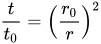
and the radial force equation becomes
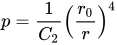
The equation for the tangential force ft (where Lt r) then becomes

Fig. 2. Pressure curve for an ideal rubber balloon. When air is first added to the balloon, the pressure rises rapidly to a peak. Adding more air causes the pressure to drop. The two points show typical initial conditions for the experiment. When the valve is opened, the balloons move in the direction indicated by the arrows.

Integrating the internal air pressure over one hemisphere of the balloon then gives

where r0 is the balloon's uninflated radius.

This equation is plotted in the figure at left. The internal pressure P reaches a maximum for

and drops to zero as r increases. This behavior is well known to anyone who has blown up a balloon: a large force is required at the start, but after the balloon expands (to a radius larger than rp), less force is needed for continued inflation.

When both balloons are initially inflated to the peak pressure, spontaneous symmetry breaking will occur, since the pressure in both balloons will drop when some air flows from one balloon into the other.

Why does the larger balloon expand?

[edit]

When the valve is released, air will flow from the balloon at higher pressure to the balloon at lower pressure. The lower pressure balloon will expand. Figure 2 (above left) shows a typical initial configuration: The smaller balloon has the higher pressure because of the sum of pressure of the elastic force Fe which is proportional to the pressure (P=Fe/S) plus the air pressure in the small balloon is greater than the air pressure in the big balloon. So, when the valve is opened, the smaller balloon pushes air into the larger balloon. It becomes smaller, and the larger balloon becomes larger. The air flow ceases when the two balloons have equal pressure, with one on the left branch of the pressure curve (r < rp) and one on the right branch (r > rp).

Equilibria are also possible in which both balloons have the same size. If the total quantity of air in both balloons is less than Np, defined as the number of molecules in both balloons if they both sit at the peak of the pressure curve, then both balloons settle down to the left of the pressure peak with the same radius, r < rp. On the other hand, if the total number of molecules exceeds Np, the only possible equilibrium state is the one described above, with one balloon on the left of the peak and one on the right. Equilibria in which both balloons are on the right of the pressure peak also exist but are unstable.[4] This is easy to verify by squeezing the air back and forth between two interconnected balloons.

Non-ideal balloons

[edit]

At large extensions, the pressure inside a natural rubber balloon once again goes up. This is due to a number of physical effects that were ignored in the James/Guth theory: crystallization, imperfect flexibility of the molecular chains, steric hindrances and the like.[5] As a result, if the two balloons are initially very extended, other outcomes of the two-balloon experiment are possible,[1] and this makes the behavior of rubber balloons more complex than, say, interconnected soap bubbles.[4] In addition, natural rubber exhibits hysteresis: the pressure depends not just on the balloon diameter, but also on the manner in which inflation took place and on the initial direction of change. For instance, the pressure during inflation is always greater than the pressure during subsequent deflation at a given radius. One consequence is that equilibrium will generally be obtained with a lesser change in diameter than would have occurred in the ideal case.[1] The system has been modeled by a number of authors,[6][7] for example to produce phase diagrams[8] specifying under what conditions the small balloon can inflate the larger, or the other way round.

Applications

[edit]

The two-balloon instability may play a role in the early stages of reproduction. As some germ cells grow, others shrink, and fluid flow between interconnected cells causes the shrinking (smaller) cell to undergo cell death while the larger cell eventually becomes an egg. Bio-physical models suggest that this process is effectively similar to the behavior of the balloons in the two-balloon experiment [9]

Due to a shortage of ventilators during the COVID-19 pandemic, it has been proposed that one ventilator could be shared between two patients.[10] However Tronstad et al.[11] found that when the two sets of lungs had very different elasticities or airway resistance, there could be large discrepancies in the amount of air delivered. They argued that this might be seen as an example of the two-balloon experiment, with the two sets of lungs playing the role of the two balloons: "The 'two-balloon effect' (Merritt and Weinhaus 1978) could possibly have contributed to this volume discrepancy, and the inclusion of one-way valves could possibly help."

See also

[edit]

References

[edit]
[edit]
Revisions and contributorsEdit on WikipediaRead on Wikipedia
from Grokipedia
The two-balloon experiment is a classic physics demonstration that explores the counterintuitive behavior of and elasticity in inflated rubber balloons. In the setup, two identical balloons are partially inflated to different volumes—one larger and one smaller—and connected by a flexible tube equipped with a to control between them. When the valve is opened, air flows from the smaller to the larger one, causing the smaller balloon to deflate and the larger to inflate further until they reach a equilibrium, rather than equalizing their sizes as intuition might suggest. This phenomenon arises from the nonlinear pressure-volume relationship in rubber balloons, where is higher in the smaller balloon due to greater elastic tension and effects relative to its surface area. Specifically, for a given volume of air, the PP in a decreases as its rr increases beyond an initial threshold, following a curve approximated by P=P0+Cro2r[1(ror)6]P = P_0 + \frac{C}{r_o^2 r} \left[1 - \left(\frac{r_o}{r}\right)^6 \right], where P0P_0 is , ror_o is the balloon's unstretched , and CC is a constant related to the rubber's properties; this results in a pressure gradient driving air toward the lower-pressure larger balloon. The experiment highlights in the elastic deformation of materials and the principle that fluids flow from regions of high to low , demonstrating a loop until stability is achieved, typically when the smaller balloon's is about 38% larger than its initial unstretched state. Commonly used in introductory , the two-balloon experiment serves to challenge students' preconceptions about equilibrium and , often presented with simple materials like , tubing, and a for easy replication in classrooms or labs.

Introduction

Experiment Setup

The two-balloon experiment requires two identical , a short length of flexible plastic tubing or a to connect them, and stoppers or clamps to seal the balloon openings initially. Optional tools for inflation include a or to achieve precise volumes, though blowing by mouth is also common in basic setups. To prepare the experiment, first inflate one to a larger , making it roughly spherical, while partially inflating the second to a smaller , ensuring both remain elastic and untied at the neck. Insert stoppers or clamps into the necks of both balloons to maintain their airtight. Next, attach the tubing securely to the neck of one balloon, then connect the other end to the second balloon, using tape if necessary to prevent air leaks at the joints. Finally, remove the stoppers or open the clamps to allow air flow between the balloons. The setup is conducted under standard laboratory conditions, with the balloons held stationary. Upon opening the connection, the smaller balloon deflates while the larger one expands further. Safety precautions are essential, as overinflation can cause balloons to burst unexpectedly; participants, especially children, should wear protective and handle materials gently to minimize risks of allergies or minor injuries from popping.

Observed Phenomenon

In the two-balloon experiment, two identical rubber are inflated to different volumes and connected via a tube with a . Upon opening the valve, the primary observation is that air flows from the smaller to the larger one, causing the smaller to while the larger inflates further—a counterintuitive result that defies the expectation of volume equalization between the two. The process begins with a brief period of stability before the valve is opened, after which the air transfer occurs gradually over several seconds to minutes, depending on the setup, until a new equilibrium is reached where the size difference is accentuated. Visually, the smaller balloon exhibits wrinkling and contraction as it loses air, while the larger balloon shows increased stretching and smoothing of its surface as it expands. Observations can vary based on initial conditions; for instance, greater initial inflation differences lead to more pronounced and potentially faster air transfer, and the rate of change accelerates as the size disparity grows during the process.

Theoretical Foundations

Balloon Pressure Basics

In the context of inflated balloons, gauge pressure refers to the excess pressure inside the balloon relative to the surrounding atmospheric pressure, arising from the elastic tension in the balloon's walls that counteracts the tendency of the enclosed gas to expand. This gauge pressure, denoted as ΔP = P_in - P_atm, where P_in is the absolute internal pressure and P_atm is atmospheric pressure, must be positive for the balloon to maintain its shape against external forces. Balloons filled with air behave as elastic enclosures made from materials like or similar polymers, where the stretchability of the walls modulates the in response to changes. The enclosed gas follows the under isothermal conditions, but the overall pressure- relationship is determined by the elastic restoring force of the walls balancing the gas . As the balloon enlarges, the walls stretch thinner and the tension adjusts, leading to a nonlinear relationship where can decrease with increasing in certain regimes. This elastic behavior distinguishes balloons from fixed- rigid systems, enabling adjustments during air transfer. For a spherical balloon approximation at an introductory level, the gauge pressure can be expressed as ΔP = 2σ / r, where σ represents the surface tension (or effective wall tension) and r is the radius, added to atmospheric pressure to yield the total internal pressure: P_in = P_atm + 2σ / r. This equation highlights how smaller radii require higher excess pressure to maintain equilibrium, a fundamental aspect of balloon stability.

Surface Tension Effects

In the two-balloon experiment, effects in the balloon walls play a crucial role in generating pressure differences that drive air transfer between the balloons. According to for curved surfaces, the pressure difference ΔP\Delta P across the interface is given by ΔP=2σr\Delta P = \frac{2\sigma}{r}, where σ\sigma is the and rr is the ; this relationship indicates that smaller radii result in higher internal pressures for a given tension. This inverse dependence on radius explains why the smaller balloon in the experiment maintains a higher internal pressure, causing air to flow toward the larger one until equilibrium is reached. Rubber latex balloons approximate the behavior of a under , where the elastic membrane's tension σ\sigma creates a analogous to that in fluid interfaces. In this model, the latex's surface tension leads to disproportionately high internal pressures in smaller balloons, as the thinner effective and smaller amplify the ΔP\Delta P term in Laplace's equation. This application treats the balloon as an elastic sheet with tension properties similar to a , enabling the observed counterintuitive inflation dynamics. Laplace's law originated in 1805 from Pierre-Simon Laplace's work on , building on Thomas Young's qualitative theory of , and was later adapted for elastic membranes in 20th-century physics demonstrations involving balloons. These adaptations, such as in rubber balloon models, highlight the law's utility in explaining pressure variations without relying solely on behavior. To illustrate the inverse radius-pressure relationship, consider the analogy to soap bubbles or liquid droplets: just as a smaller droplet requires greater to balance its —yielding ΔP=2σr\Delta P = \frac{2\sigma}{r} for a single surface—the smaller balloon's curved wall similarly elevates its , promoting air migration to the larger balloon. This visual parallel underscores the geometric dominance in -driven phenomena.

Detailed Analysis

Pressure-Volume Relationships

The pressure-volume relationship in the two-balloon experiment is governed by a combined model that incorporates , the Laplace pressure due to the balloon's , and an elastic contribution from the rubber membrane, assuming ideal rubber . The total P(V)P(V) for a of volume VV is given by P(V)=Patm+2σr(V)+Pelastic,P(V) = P_\text{atm} + \frac{2\sigma}{r(V)} + P_\text{elastic}, where PatmP_\text{atm} is the , σ\sigma is the effective of the rubber, r(V)(3V4π)1/3r(V) \approx \left( \frac{3V}{4\pi} \right)^{1/3} is the assuming a spherical , and PelasticP_\text{elastic} accounts for the of the rubber wall. This model captures the essential behavior observed in the experiment, where the Laplace term dominates the nonlinear variation at moderate inflations. The derivation begins with for a thin-walled spherical , which states that the excess pressure across the membrane ΔP=PPatm\Delta P = P - P_\text{atm} balances the wall tension TT according to ΔP=2Tr.\Delta P = \frac{2T}{r}. Here, TT represents the tangential per unit length in the balloon wall. For rubber, TT arises from both an intrinsic surface tension-like component σ\sigma (analogous to molecular cohesion in the material) and the elastic response to deformation. The surface tension contribution is Tsurface=σT_\text{surface} = \sigma, yielding the curvature-dependent term 2σr\frac{2\sigma}{r}. To incorporate the elastic term, assume the rubber behaves as an ideal elastic material with EE, initial wall thickness h0h_0, and initial unstretched radius r0r_0. The radial stretch ratio is λ=r/r0\lambda = r / r_0. For incompressible rubber, the wall thickness scales as h=h0/λ2h = h_0 / \lambda^2 to conserve volume. The hoop stress in the wall is then σwall=E(λ1)\sigma_\text{wall} = E (\lambda - 1), a for moderate strains under ideal elasticity. The elastic tension is thus Telastic=σwallh=Eh0(λ1)/λ2T_\text{elastic} = \sigma_\text{wall} \, h = E h_0 (\lambda - 1) / \lambda^2, and the corresponding excess pressure is Pelastic=2Telasticr=2Eh0r0(λ1)λ3.P_\text{elastic} = \frac{2 T_\text{elastic}}{r} = \frac{2 E h_0}{r_0} \cdot \frac{(\lambda - 1)}{\lambda^3}. Substituting λ=r/r0\lambda = r / r_0 and expressing in terms of volume via r(V)r(V), the full P(V)P(V) function follows directly. This derivation highlights how the elastic term grows with stretch, modifying the pure inverse-radius dependence. When plotting PP versus VV, the curve exhibits a hyperbolic decrease in the early inflation phase, driven primarily by the 1/r(V)1/r(V) term as the radius increases, which reduces the Laplace pressure. For small volumes, pressure rises sharply from atmospheric levels; as volume grows, the declining curvature term causes pressure to fall after an initial peak, before the elastic term causes a secondary rise at high stretches. This non-monotonic behavior is key to the experiment's dynamics. In the two-balloon setup, air transfers through the connecting tube until equilibrium is reached, where the internal s equalize: Psmall(Vsmall)=Plarge(Vlarge)P_\text{small}(V_\text{small}) = P_\text{large}(V_\text{large}). Given the shape of the P(V)P(V) curve, a smaller balloon (smaller VV, larger 1/r1/r) has higher than a larger one at comparable inflation levels, driving net flow from the smaller to the larger balloon and promoting further expansion of the larger one.

Dynamics of Air Transfer

The dynamics of air transfer in the two-balloon experiment begin with an initial pressure imbalance between the balloons. The smaller balloon exhibits a higher than the larger one due to the relationship governed by a modified Young-Laplace for rubber membranes, where pp is given by p=2γR(1(R0R)6)p = \frac{2\gamma}{R} \left(1 - \left(\frac{R_0}{R}\right)^6 \right), with γ\gamma as , RR as the current , and R0R_0 as a reference unstretched radius. This higher pressure in the smaller balloon drives air flow toward the lower-pressure larger balloon when the connecting tube is opened. The air flow through the narrow tube follows Poiseuille's law for viscous , where the QQ is proportional to the pressure difference ΔP\Delta P and inversely proportional to the tube's resistance, specifically QΔPLd4Q \propto \frac{\Delta P}{L} \cdot d^4, with LL as tube length and dd as diameter. In the context of the experiment, the hydraulic conductance GG between balloons is G=πd4128μLG = \frac{\pi d^4}{128 \mu L}, where μ\mu is air , determining the rate of transfer. Over time, the volume evolution is described by coupled differential equations for the balloon volumes V1V_1 and V2V_2, such as dV1dt=G(p1p2)\frac{dV_1}{dt} = -G (p_1 - p_2) and dV2dt=G(p1p2)\frac{dV_2}{dt} = G (p_1 - p_2), where p1p_1 and p2p_2 are the instantaneous pressures. This leads to an asymptotic approach to equilibrium as pressures equalize, with air continuing to transfer until the smaller balloon deflates and the larger one expands further. The process assumes constant to maintain isothermal conditions, ensuring consistent gas behavior. The counterintuitive expansion of the larger balloon arises because its lower initial sustains net inflow, even as the system tends toward pressure equalization; the nonlinear pressure-volume relationship (detailed in prior sections) reinforces this preferential growth. Flow rate is further influenced by tube length and resistance, with longer or narrower tubes slowing transfer by increasing viscous drag.

Practical Variations

Ideal vs. Non-Ideal Balloons

In the ideal model of the two-balloon experiment, balloons are assumed to have uniform wall thickness, exhibit perfect hyperelasticity without viscous effects, and display no in their deformation response, leading to predictions that closely align with the combined Laplace-Boyle framework where pressure equilibrates based solely on radius-dependent and gas compliance. These assumptions treat the rubber as an incompressible, homogeneous, and isotropic material, allowing for reversible inflation and deflation without . Real balloons deviate from these ideals due to inherent material properties of latex rubber and viscoelastic behavior that incorporates time-dependent responses. Viscoelasticity in particular manifests as hysteresis during cyclic inflation-deflation cycles, resulting in energy loss through internal friction and slower equilibration times as polymer chains relax over extended periods. Experimental observations in the two-balloon setup reveal discrepancies such as the smaller balloon failing to deflate completely, often stabilizing in a partially collapsed, wrinkled configuration due to minimum volume constraints from the balloon's neck geometry and adhesion between folded rubber surfaces. Quantitative comparisons of -volume (P-V) curves for typical balloons show that real measurements exhibit steeper rises at low volumes compared to ideal hyperelastic predictions, reflecting initial stiffening from uneven stretching; for instance, experimental data with an initial radius of approximately 1.92 cm fit Mooney-Rivlin parameters (C₁₀ ≈ 0.009 MPa, C₀₁ ≈ 0.0005 MPa). These curves, as detailed in the theoretical relationships, underscore how non-ideal traits amplify gradients in underinflated states.

Influencing Factors

The choice of balloon material significantly influences the outcomes of the two-balloon experiment, with latex balloons demonstrating more pronounced air transfer effects due to their superior elasticity compared to Mylar balloons. Latex, derived from natural rubber, allows for substantial stretching, enabling the nonlinear pressure-volume behavior that drives the counterintuitive equalization where air moves from the smaller to the larger balloon. In contrast, Mylar balloons, made from non-stretchable metallized polyester film, exhibit minimal deformation. Environmental conditions play a key role in altering experimental results, particularly through variations that affect air volume via , where increased expands the gas and can intensify pressure differences between balloons. Higher levels soften latex rubber, reducing its elasticity and potentially accelerating minor air leakage, which may disrupt the expected equilibrium. To minimize these effects, experiments should be conducted in a controlled indoor setting with stable and low . Scale variations, such as size and connecting tube , impact the speed and observability of air transfer. Standard party , with their smaller size and higher elasticity, produce clearer demonstrations than larger scientific-grade , which may require more air volume for similar effects. A smaller tube restricts flow rate, extending the time for equalization and allowing better observation, whereas a wider facilitates rapid transfer that can conclude too quickly for . Optimal results occur with inflated to 30-50 cm circumferences, where they maintain a for reliable dynamics. Human-induced errors, including uneven initial and tube blockages, can lead to inconsistent or misleading outcomes. Uneven introduces initial imbalances unrelated to elasticity, skewing air flow; to achieve consistency, balloons should be repeatedly inflated and deflated several times beforehand to warm and condition the rubber for uniform elasticity. Blockages from dust or in the tube can halt transfer entirely, so inspecting and cleaning the tube prior to use is crucial, along with ensuring identical balloons from the same batch.

Broader Implications

Educational Uses

The two-balloon experiment is widely employed in middle and high school physics classrooms as a hands-on demonstration of the inverse pressure-radius relationship, where a smaller balloon deflates into a larger connected one due to differing internal pressures. This setup, suitable for students aged 11–16, uses simple materials like s and tubing to reveal how dominates over basic volume equalization expectations, making it an effective tool for engaging learners in and elasticity concepts. The primary learning objectives center on illustrating , which governs the elevated pressure in smaller radii from effects, alongside ideal gas laws like and the counterintuitive dynamics of non-rigid systems. By prompting predictions before the demonstration—such as whether balloons will equalize in size—educators uncover common misconceptions, with studies showing only about 5–6% of students correctly anticipate the air transfer direction, thereby promoting active reflection and deeper conceptual grasp. To extend the activity, students can measure balloon volumes via water displacement in a graduated cylinder, then plot pressure-volume points to visualize and fit curves matching theoretical models, enhancing skills in experimental design and . Following its theoretical foundation in the late , the experiment became a staple in 20th-century kits and lecture demonstrations for exploring elastic equilibria. Its popularity surged in the with the advent of online educational videos and digital platforms, enabling widespread adoption in both formal classrooms and informal settings like science festivals; as of , it remains popular in demonstrations.

Scientific Applications

The two-balloon experiment, demonstrating pressure differences due to varying balloon sizes under , has principles analogous to those in modeling biological systems, particularly in . The pressure-radius relationship it illustrates parallels how smaller alveoli experience higher internal , potentially leading to collapse or if levels are insufficient to counteract disparities, as seen in conditions like ; critiques highlight that real alveoli are interconnected rather than independent spheres, limiting the direct applicability of spherical assumptions. Similarly, balloon inflation dynamics relate to in blood vessels, where larger diameters increase wall tension for a given , influencing risk and vessel compliance; smaller vessels require less tension, explaining why exacerbates rupture in dilated arteries. The experiment has also been used as an in medical contexts, such as explaining intracranial hypotension in conferences as of 2024. In engineering, the principles from the two-balloon setup inform the design of inflatable structures and pneumatic systems, where pressure equalization prevents uneven expansion or failure. Pneumatic actuators in industrial systems draw on related concepts of air distribution between chambers, optimizing efficiency in soft robotics and adaptive devices. Research on the two-balloon experiment in soft matter physics dates to the 1970s, when studies began using rubber balloons to validate hyperelastic models for large deformations. A seminal 1977 analysis modeled spherical balloon inflation to test finite elasticity theories, revealing non-monotonic pressure-volume curves that align with experimental observations of instability during inflation. These investigations laid groundwork for understanding viscoelastic behavior in polymeric materials, influencing subsequent work on hysteresis and damage in inflated membranes. In modern applications, simulations of the two-balloon dynamics via (CFD) have extended to microscale flows, replicating pressure-driven instabilities in microfluidic devices for . For example, coupled with immersed boundary techniques simulate three-dimensional balloon deformation to study fluid-structure interactions at sub-millimeter scales, aiding designs for systems. In the , these principles underpin , where balloon-like actuators exploit size-dependent pressures for compliant motion; hyperelastic growing robots use low-stiffness inflation tails per for navigation in confined spaces, as demonstrated in 2022 prototypes. Double-balloon configurations in endoscopic robots further apply air transfer dynamics for inchworm-like propulsion, enhancing minimally invasive procedures. The experiment's concepts have also inspired kinetic sculptures using non-Newtonian fluids as of 2025.

References

Add your contribution
Related Hubs
User Avatar
No comments yet.