Hubbry Logo
Barbara RuickBarbara RuickMain
Open search
Barbara Ruick
Community hub
Barbara Ruick
logo
8 pages, 0 posts
0 subscribers
Be the first to start a discussion here.
Barbara Ruick
Barbara Ruick
from Wikipedia

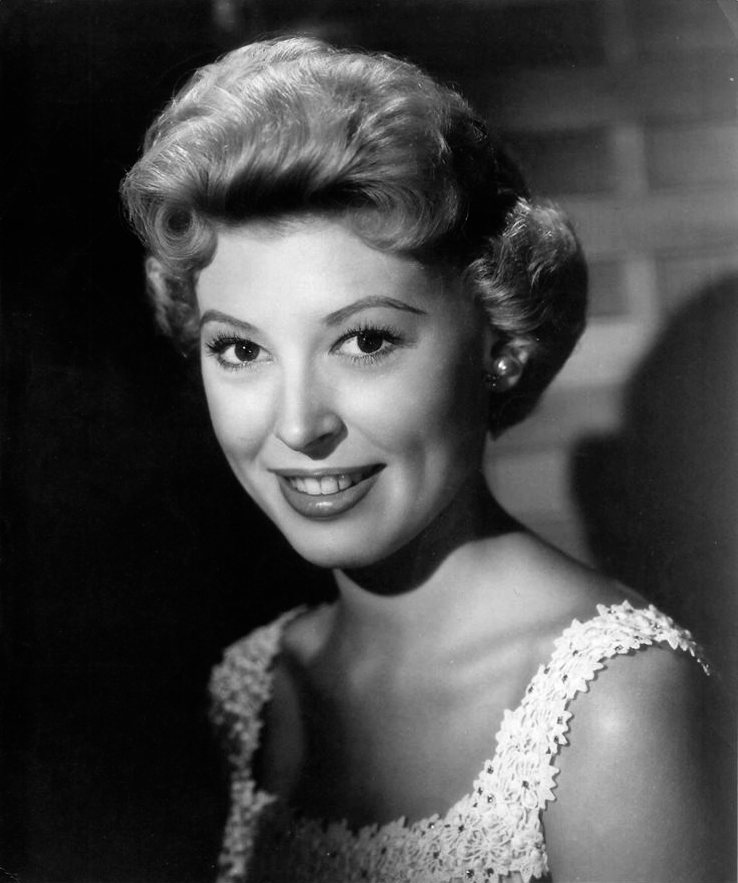
Barbara Ruick (December 23, 1932[citation needed] – March 3, 1974)[1] was an American actress and singer.

Key Information

Early years

[edit]

Ruick was the daughter of actors Lurene Tuttle and Melville Ruick,[2] and grew up acting out scenes with dolls, employing her mother as an audience.

Ruick attended North Hollywood High School.[3] She did little acting in high school but joined a school band at the age of 14. Ruick sang with the band at dances and benefits.

Career

[edit]
L-R: Ruick with Bob Fosse, Debbie Reynolds and Bobby Van in The Affairs of Dobie Gillis (1953)

Early in her career, Ruick sang in clubs[4] and acted in Little Theater productions.[2] She achieved success in radio, then signed as a contract player with Metro-Goldwyn-Mayer.[5] She was heard in the original radio version of Dragnet. She also recorded several songs for MGM Records. In the 1950s, Ruick starred as Kay in the first LP recording of the songs from George Gershwin and Ira Gershwin's 1926 Broadway musical Oh, Kay!. This studio cast recording was released by Columbia Records and conducted by Lehman Engel.

She landed a job on Hollywood Screen Test, a talent show which aired on ABC from 1948 to 1953. Ruick appeared on the Kraft Television Theatre, soap operas, and The College Bowl (1950), which was hosted by Chico Marx.[6] She also performed for fifteen weeks on The Jerry Colonna Show.[6]: 531  In 1955, she was a regular on The Johnny Carson Show.[6]: 540 

She made guest appearances on The Millionaire (1957), The Public Defender (1954), The Brothers Brannagan (1960), The 20th Century Fox Hour (1956), and Climax Mystery Theater (1955).

In 1951, Ruick was signed by MGM for a role in the film Invitation (1952).[7] She had bit parts in her first four films, one of them being The Band Wagon (1953), and then graduated to supporting roles. Her best remembered roles both came from Rodgers and Hammerstein. She played Carrie Pipperidge in the film version of Carousel (1956) and Esmerelda, one of the wicked stepsisters, in the 1965 TV version of Rodgers and Hammerstein's Cinderella.

She released several singles of her singing on the MGM label in 1952 and 1953, including some with arrangements by Nelson Riddle.

Personal life

[edit]

Ruick married actor Robert Horton in 1953.[8] She had co-starred with Horton in the movie Apache War Smoke the previous year. The couple separated just prior to their second wedding anniversary in 1955 and divorced in 1956,[9] just after he accompanied her to the world premiere of Carousel. She then married the young composer John Williams, who later became famous for Star Wars and many other films. Williams dedicated his First Violin Concerto to her memory (notes to DGG recording 289 471 326–2). During her marriage to Williams, Ruick appeared in few motion pictures. They had three children together, one of whom, Joseph Williams, is lead singer in the rock band Toto.[10]

Death

[edit]

Ruick died in Reno, Nevada, aged 41, while playing a small role on location in Robert Altman's California Split. She was found dead the afternoon of March 3, 1974, in her hotel room, where her body had been lying for 10 to 12 hours. She had complained of nausea and a headache the previous night.[1] The coroner found that her death was caused by a ruptured berry (saccular) aneurysm and intracerebral hemorrhage.[11] She was interred at the Columbarium of Blessedness, Forest Lawn Memorial Park, Glendale, California.[12]

Filmography

[edit]
Year Title Role Notes
1952 Invitation Sarah
1952 Scaramouche Amoureause Uncredited
1952 You for Me Ann Elcott
1952 Fearless Fagan Second Nurse
1952 Apache War Smoke Nancy Dekker
1952 Above and Beyond Mary Malone
1953 Confidentially Connie Barbara
1953 I Love Melvin Studio Guide
1953 The Band Wagon Passenger on Train Uncredited
1953 The Affairs of Dobie Gillis Lorna Ellingboe
1956 Carousel Carrie Pipperidge
1956 The Star of Bethlehem[13] Narrator Reissue version
1974 California Split Reno Barmaid Posthmous release; final film role

Notes

[edit]

References

[edit]
[edit]
Revisions and contributorsEdit on WikipediaRead on Wikipedia
from Grokipedia
Barbara Ruick (December 23, 1932 – March 3, 1974) was an American actress and singer best known for her supporting roles in classic musical films, particularly as Carrie Pipperidge in the adaptation of (1956). Born in , to actors and , she began her career in the early 1950s with bit parts in films such as Above and Beyond (1952), Fearless Fagan (1952), and Invitation (1952), gradually transitioning to more prominent musical and dramatic roles. Ruick's breakthrough came with her portrayal of the bubbly mill worker Carrie in Carousel, opposite and , where she performed memorable songs like "When the Children Are Asleep" and "Mr. Snow," showcasing her bright soprano voice and effervescent stage presence. She continued in musical theater and film, appearing in (1953) and (1953), and later took on comedic supporting parts, including the stepsister Esmerelda in the CBS television production of Rodgers and Hammerstein's (1965) alongside . Her television work spanned anthology series like and in the 1950s, as well as guest spots on various sitcoms. In her personal life, Ruick married actor Robert Horton in 1953, divorcing in 1956, before wedding composer-conductor later that year; the couple had three children, including singer-songwriter Joseph Williams, known as a member of the band Toto. She largely retired from acting in the early to focus on family but made a brief return for a small role as a barmaid in Robert Altman's California Split (). Ruick died suddenly of a cerebral hemorrhage at age 41 while filming in , leaving behind a legacy of joyful performances in mid-20th-century American musical entertainment.

Early life

Family background

Barbara Ruick was born on December 23, 1932, in Pasadena, California. She was the daughter of actors Lurene Tuttle, a prominent radio and film actress dubbed the "First Lady of Radio" for her prolific roles including Effie Perrine on The Adventures of Sam Spade, and Melville Ruick, a stage and radio performer with credits in soap operas such as Guiding Light. As the only child of these show business professionals, Ruick received early exposure to the , frequently attending her parents' rehearsals and sets. Her parents divorced in 1945, after which Ruick lived primarily with her mother.

Childhood and early influences

Barbara Ruick was born on December 23, 1932, in , and grew up in the area, where her family's involvement in entertainment shaped her early environment. As the daughter of radio actors and , she was profoundly influenced by their professional success, which sparked her interest in performing from a young age. From childhood, Ruick exhibited strong dramatic tendencies, often staging elaborate scenes with her dolls and enlisting her mother as a captive , which nurtured her budding instincts. She attended local schools in the Pasadena and Los Angeles regions during her formative years, including high school, but no formal higher education is documented; instead, she gained informal through her parents' industry connections. In her teenage years during the late , Ruick began performing publicly by singing with local teenage bands at dances and events, representing her initial foray into entertainment. She also made early appearances on local radio shows, drawing on her parents' established roles as actors and announcers in the medium.

Career

Stage and musical theater

Ruick began her stage career in the early 1950s through appearances in regional and little theater productions, where she developed her talents as a singer and performer. A highlight of her musical theater work came in 1957 with the studio cast recording of George and Ira Gershwin's Oh, Kay!, in which she starred as the title character Kay and delivered standout performances of Gershwin standards such as "Someone to " and "Do, Do, Do," highlighting her bright voice. She continued performing in national and regional tours during the and , often in supporting roles that showcased her versatility in comic and romantic parts. In 1964, Ruick took on the role of Miss Ritter in a regional tour of , appearing opposite as Kodaly and Bill Hayes as Georg Nowack at venues including Melodyland Theatre in Anaheim and Circle Star Theatre in San Carlos. Ruick also appeared in off-Broadway and stock productions of musicals. Although she did not perform in the original Broadway casts of Rodgers and Hammerstein shows, she contributed vocals to cast recordings of their works, such as the 1965 television production of Cinderella. Her live stage career, centered on musical theater, reached its peak in the 1950s and 1960s before she transitioned more fully to screen roles.

Film roles

Barbara Ruick began her film career in 1952 with uncredited bit parts in the war drama Above and Beyond, where she appeared as Mary Malone, and the comedy Fearless Fagan, portraying a second nurse. That same year, she progressed to supporting roles in Invitation, a romantic drama co-starring Van Johnson, and the swashbuckler Scaramouche, marking her early establishment in Hollywood under MGM and other major studios. Her breakthrough came in musical films, most notably as Carrie Pipperidge in the 1956 adaptation of Carousel, where she performed a duet of "When the Children Are Asleep" opposite Robert Rounseville. This performance highlighted her vocal talents and charm in ensemble musical sequences, solidifying her presence in the genre. Among her other notable films from the 1950s were supporting turns in The Affairs of Dobie Gillis (1953) as Lorna Ellingboe, a romantic interest in the lighthearted comedy, and an ensemble appearance as a passenger on a train in The Band Wagon (1953), Vincente Minnelli's celebrated musical starring Fred Astaire and Cyd Charisse. She also took on dramatic roles, such as in You for Me (1952), a romantic comedy with Peter Lawford, and Confidentially Connie (1953), a family-oriented farce opposite Van Johnson and Janet Leigh. Ruick's final film appearance was a brief as a Reno barmaid in Robert Altman's (1974), released posthumously after her death during production. Over her career, she accumulated approximately 20 film credits, predominantly in musicals and comedies from and 20th Century Fox.

Television and radio appearances

Barbara Ruick began her broadcast career in the late and early , drawing on her family's entertainment connections—her mother, , was a renowned radio actress—to secure in radio soap operas and dramatic programs. These radio efforts provided foundational experience before her transition to . Ruick's early television work included hosting vocal segments on the variety series The in 1950, where she performed alongside host in a format blending and . She made her notable debut on in the episode "January Thaw" (1950), playing Barbara Gage in a domestic . Further guest roles in anthologies followed, such as Phyllis Holt in the episode "Destiny" (1954) and Eleanor in the General Electric Theater episode "Strictly Solo" (1960). Ruick's musical abilities shone in television specials, most prominently as the stepsister Esmeralda in the 1965 CBS remake of Rodgers and Hammerstein's , where she performed the comedic "The Stepsister's Lament" opposite . She also appeared in the 20th Century Fox Hour episode "With a in My Heart" (1956), portraying Julie Morrison in a musical tribute to entertainer . Additional musical variety work included regular performances as a vocalist on The Jerry Colonna Show in 1951 and as a series regular on in 1955, contributing songs and sketches to the emerging late-night format. Throughout the and , Ruick amassed over 15 television credits, frequently in light comedic or musical guest roles across and Western series, complementing her background in musical theater. Examples include appearances on Hour of Stars () and dramatic turns in programs like Climax! (), where she balanced singing with character-driven parts until her later career focus shifted.

Personal life

Marriages and relationships

Ruick's first marriage occurred in 1949 to Frank Allen Howren when she was 17 years old. The union was annulled within months, with few details publicly available about the short-lived partnership, which biographies have characterized as a youthful mistake. Ruick married actor Robert Horton on August 22, 1953. She had co-starred with Horton in the film Apache War Smoke (1952). The couple divorced on April 27, 1956. On April 15, 1956, Ruick married and conductor John Williams, with whom she had initially crossed paths in high school before reconnecting as adults during her ascending film career in the mid-1950s. Their partnership endured until her death in 1974 and was marked by mutual support; Williams has reflected on her role in bolstering his shift from television composing to major Hollywood film scores. Although Williams did not directly score her own productions, his early professional networks in occasionally intersected with her television and stage work. No other significant romantic relationships are documented for Ruick, who thereafter prioritized a stable family life alongside her selective professional commitments.

Family and children

Barbara Ruick and composer had three children together: daughter Jennifer, born in 1956; son Mark Towner Williams, born in April 1958; and son Joseph Stanley Williams, born on September 1, 1960. Jennifer Williams pursued a career as a psychotherapist and married songwriter , with whom she had two sons who became musicians. Mark Towner Williams became a professional session and multi-instrumentalist, collaborating on recordings with artists including , , , and . Joseph Williams followed a path in music as a , and composer, most notably serving as the for the rock band Toto from 1986 to 1988 and contributing to later reunions; his work with the band included vocals on albums such as Fahrenheit (1986) and (1988). The resided in the area, where Ruick increasingly prioritized home life and child-rearing over her acting career during the , accepting only sporadic roles as her professional opportunities diminished. This shift allowed her to focus on supporting her growing while Williams advanced in film scoring. The children's entry into the music industry was deeply influenced by their parents' artistic backgrounds, fostering a household immersed in performance and composition. Joseph's prominence with Toto, in particular, has served to extend Ruick's musical legacy posthumously through the family's enduring creative connections.

Death and legacy

Circumstances of death

Barbara Ruick died on March 3, 1974, at the age of 41, from a cerebral hemorrhage while in , for location filming on the film , in which she had a small role as a poker room bartender. She was discovered deceased in her room at the Mapes Hotel that Sunday afternoon after failing to appear on set. The Washoe County coroner's office determined the to be a ruptured berry aneurysm resulting in an , ruling it natural causes with no involvement of accident, , or foul play; no prior health conditions had been publicly reported for Ruick. A funeral service was held in , , after which Ruick was interred at Forest Lawn Memorial Park in Glendale. She was survived by her husband, composer , whom she had married in 1956, and their three children, Mark, Jennifer, and Joseph.

Posthumous recognition

Ruick's performances in musical theater have endured through archival releases and revivals, particularly her role as Carrie Pipperidge in the 1956 film adaptation of 's Carousel, where her duet "When the Children Are Asleep" with Robert Rounseville remains a highlight in cast album reissues and streaming platforms. The soundtrack, originally released by , has been included in comprehensive collections, such as the 2014 Blu-ray set featuring retrospective featurettes that contextualize her contributions alongside stars like . Similarly, her portrayal of the stepsister Esmeralda in the 1965 television production of 's Cinderella gained renewed visibility with the 2014 50th Anniversary Edition DVD release by Shout! Factory, which restored the broadcast and emphasized the ensemble's charm in period musicals. Her studio as in the 1957 Columbia release of George and Ira Gershwin's Oh, Kay!, conducted by , continues to circulate on digital platforms, preserving her interpretations of standards like "Someone to Watch Over Me" and underscoring her versatility in Broadway revivals. Although Ruick received no major awards during her lifetime, her work has been retrospectively noted in discussions of underappreciated 1950s musical talents, with family ties enhancing her visibility—her son Joseph Williams, lead vocalist for the rock band Toto since 1986, has referenced her influence in interviews, linking her singing legacy to his career in rock histories. Her elder son, Mark Towner Williams, a session and recording artist, further perpetuates the family's musical heritage through his contributions to albums under the moniker Lionel's Dad.

References

Add your contribution
Related Hubs
User Avatar
No comments yet.