Hubbry Logo
LauburuLauburuMain
Open search
Lauburu
Community hub
Lauburu
logo
8 pages, 0 posts
0 subscribers
Be the first to start a discussion here.
Lauburu
Lauburu
from Wikipedia
A typical lauburu. Each arm can be drawn with three sweeps of a compass
Left and right facing lauburu
Curved lauburu.

The lauburu (from Basque lau, "four" + buru, "head") is an ancient swastika with four comma-shaped heads and the most widely known traditional symbol of the Basque Country and the Basque people.[1] In the past, it has also been associated with the Galicians, Illyrians and Asturians.[citation needed]

A variant of lauburu consisting of geometrically curved lines can be constructed with a compass and straightedge, beginning with the formation of a square template; each head can be drawn from a neighboring vertex of this template with two compass settings, with one radius half the length of the other.

Background

[edit]

Historians and authorities have attempted to apply allegorical meaning to the ancient symbol of lauburu. Augustin Chaho[2] said it signifies the "four heads or regions" of the Basque Country. The lauburu does not appear in any of the seven historical provinces' coats-of-arms that have been combined in the arms of the Basque Country: Biscay, Gipuzkoa, Araba, Upper Navarre, Lower Navarre, Labourd, and Soule. While some authors have suggested that the four heads of lauburu could signify, e.g., form, life, sensibility, and conscience,[3] lauburu is more generally considered just a symbol of prosperity and good fortune.

After the time of the Antonines, Camille Jullian[4] finds no specimen of swastikas, round or straight, in the Basque areas until modern times.

Louis Colas[5] considers that the lauburu is not related to the swastika but comes from Paracelsus and marks the tombs of healers of animals and healers of souls (i.e., priests). Around the end of the 16th century, the lauburu appears abundantly as a Basque decorative element, in wooden chests or tombs, perhaps as another form of the cross.[6] Straight swastikas are not found until the 19th century.

Many Basque homes and shops display the symbol over the doorway as a sort of talisman. Sabino Arana interpreted it as a solar symbol, to support his own theory of a hypothetical Basque solar cult (based on etymologies that have later been shown to be incorrect) in the first issue of the daily newspaper Euzkadi in 1913.

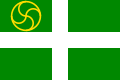
The lauburu has been featured on flags and emblems of various Basque political organisations including Eusko Abertzale Ekintza (EAE-ANV).

The use of the lauburu as a cultural icon fell into some disuse during the Francoist regime in Spain (1939–1975), which repressed many elements of Basque culture.

Etymology

[edit]

Lau buru means "four heads", "four ends" or "four summits" in modern Basque. In some sources it has been argued that this might be a folk etymology applied to the Latin labarum.[7]

However, Father Fidel Fita thought the relation reversed, labarum being adapted from Basque, under Augustus Caesar's rule.[8]

[edit]

See also

[edit]

References

[edit]
[edit]
Revisions and contributorsEdit on WikipediaRead on Wikipedia
from Grokipedia
The lauburu is a traditional hooked featuring four comma-shaped heads arranged in a curvilinear form, serving as the most prominent emblem of Basque and heritage. The name derives from the Basque words lau ("four") and buru ("head"), literally translating to "four heads," reflecting its structural composition. Historically, the lauburu appears in Basque , , and artifacts, with documented uses dating to at least the , though claims of prehistoric origins lack definitive archaeological corroboration and remain speculative. It is frequently interpreted as a signifying prosperity, the cycle of life, or elemental forces such as fire, , air, and , though these attributions stem from cultural traditions rather than empirical historical records. The symbol's adoption by Basque nationalist movements in the 19th and 20th centuries elevated its role in expressing ethnic pride and autonomy, distinguishing it from similar Indo-European motifs while embedding it deeply in contemporary Basque iconography, including flags and jewelry. Its counterclockwise variant is sometimes associated with positive connotations like and renewal in Basque lore, contrasting with clockwise forms linked to other traditions.

Origins and Etymology

Linguistic Origins

The term lauburu originates from the (Euskara), where it is a compound of lau, meaning "four," and buru, meaning "head" or "end," yielding a literal translation of "four heads" or "four ends." This etymology directly references the symbol's characteristic form of four curved, comma-like arms radiating from a central point, evoking heads in motion. The word's usage as a descriptor for the symbol appears to be relatively modern, emerging in cultural and folkloric documentation from the 19th and 20th centuries amid Basque nationalist revival, though the symbol itself predates written records of the term. As Euskara is a with no known relatives, the of lauburu lacks deeper Indo-European or pre-Basque roots, distinguishing it from similar symbols like the (hakenkreuz in German, from Sanskrit meaning "well-being"). Alternative interpretations, such as "four mountain peaks," occasionally appear but lack substantiation in primary linguistic sources and contradict the prevailing morphological analysis. The term's adoption reflects Basque cultural emphasis on solar and elemental motifs, with lau buru encapsulating the quaternary structure symbolizing unity or cyclical motion in traditional contexts.

Earliest Historical Evidence

The earliest documented appearances of the Lauburu symbol, characterized by its four curved, comma-shaped arms, date to the late in the Basque region. One of the oldest known examples originates from the town of Macaya in Nafarroa Beherea (, present-day ), likely carved or engraved on local artifacts during the late 1500s or early 1600s. By this period, the motif emerged in decorative contexts such as wooden chests, tombs, and architectural elements, marking its integration into Basque artisanal traditions. No verified archaeological evidence predates these instances, despite assertions in some cultural narratives of prehistoric, , or even Roman-era origins—claims often rooted in or ethnonationalist interpretations rather than empirical findings. Scholarly analysis indicates the Lauburu likely developed as a localized variant of broader Indo-European solar or rotational motifs, such as the , but with distinct curved arms unique to Basque contexts emerging only in early modern times. The absence of earlier attestations underscores that while the symbol holds deep cultural resonance today, its historical trajectory reflects post-medieval evolution rather than ancient continuity.

Symbolism and Design

Core Design Features

The lauburu features a cross composed of four identical comma-shaped or hook-like arms radiating from a central point, each arm curving smoothly outward in a continuous rotational pattern. Unlike the straight-armed with right-angled bends, the lauburu's arms exhibit rounded, flowing contours that emphasize fluidity and continuity, often forming a near-circular when viewed as a whole. This geometric structure achieves tetraskelic , with each "head" terminating in a tapered, teardrop-like form that evokes the Basque term's literal meaning of "four heads" (from lau "four" and buru "head"). The arms typically extend at 90-degree intervals, enabling or counterclockwise orientations, with the former predominating in positive contexts within Basque tradition. Core to its design is the uniform thickness of the arms, which may vary slightly in artistic renderings but maintains proportional balance to ensure visual harmony and rotational invariance. While isolated forms exist, the lauburu is frequently depicted with encircling elements or integrated into larger motifs, though the standalone four-armed configuration remains the defining feature.

Traditional Interpretations

In , the lauburu is traditionally regarded as a solar , depicted as a curvilinear symbolizing the sun's motion and invoked to dispel darkness and malevolent forces, functioning as a harbinger of good fortune. A prevalent folk interpretation links its four comma-shaped arms to the classical elements—fire, earth, air, and water—with vertical arms embodying feminine attributes tied to fire and water, and horizontal arms representing masculine qualities associated with air and earth. This elemental symbolism underscores the lauburu's role in denoting balance and cyclical renewal, akin to broader Indo-European motifs found in ancient artifacts across Eurasia, though its counterclockwise orientation distinguishes it as a positive, life-affirming variant in Basque tradition. Pre-Christian connotations further associate the symbol with sacred fire and generative vitality, as noted in analyses of Basque , where it served as a cross-like predating Christian influences. Debates persist among researchers, with figures like Mikel Susperregi prioritizing elemental over explicit solar meanings, while others, such as Maria S. Santisteban, emphasize connections to a feminine solar in ancient Basque practices. The lauburu differs from the primarily in its design, featuring four continuously curved, comma-shaped arms that form a rounded, circular motif, in contrast to the swastika's sharp, right-angled hooks extending from a straight-armed . This curvilinear form evokes fluidity and solar motion specific to Basque , often appearing encircled to denote completeness or protection, whereas the swastika is typically isolated and angular across its ancient Eurasian distributions. Although both symbols share and prehistoric solar associations, the lauburu's arms terminate in tapered, head-like commas—etymologically "lau buru" (four heads)—lacking the swastika's geometric rigidity. In comparison to the triskele or , a three-armed spiral motif prevalent in Celtic and Mediterranean artifacts, the lauburu's quaternary structure sets it apart, aligning with Basque emphases on quadripartite divisions such as the four elements (fire, earth, air, water) or cardinal directions rather than triadic patterns. The triskele's arms are often independent spirals emphasizing motion or cycles of three, while the lauburu integrates its four elements into a cohesive, hooked without separate limbs, underscoring cultural divergence from Indo-European traditions given the Basque language's isolate status. Unlike the , which combines a with an intersecting nimbus circle symbolizing and eternity, the lauburu lacks vertical elongation or overt priority, retaining a balanced, pagan rotational form adapted later into Basque ecclesiastical contexts without Christian overlay. These distinctions highlight the lauburu's indigenous Basque evolution, independent of broader Celtic or Indo-European derivations despite superficial hooked resemblances.

Historical Uses in Basque Culture

Prehistoric and Ancient Applications

The Lauburu symbol lacks confirmed archaeological attestation in prehistoric or ancient Basque contexts, despite folkloric claims linking it to early solar worship or fire-making rituals in the region. , including areas inhabited by proto-Basque populations, features megalithic dolmens and tumuli from the (approximately 5000–2500 BCE) and (2500–800 BCE) periods, which exhibit solar motifs such as wheel-like spirals and radial patterns suggestive of celestial cycles. However, these do not match the Lauburu's distinctive form of four curved, comma-shaped heads arranged in a swastika-like configuration. Swastika variants, often interpreted as solar or regenerative emblems, appear sporadically in Iberian artifacts, such as incised or , but typically with straight arms rather than the Lauburu's hooked, flowing ends. Genetic and linguistic evidence supports Basque cultural continuity from hunter-gatherers through the , with minimal Indo-European admixture compared to neighboring groups, yet no artifacts bearing the Lauburu have been recovered from these strata. Claims of origins, occasionally advanced in popular accounts, rely on visual analogies to comma motifs in cave paintings rather than direct evidence. In ancient times, following Roman conquest (circa 200 BCE–400 CE), Basque hillforts (castros) and in northern Iberia display geometric symbols, but none identifiable as Lauburu. The symbol's earliest documented appearances emerge in the late medieval to , around the 16th–17th centuries, on architectural elements like keystones in and , indicating a likely post-Roman development within Basque Christian or pre-Christian syncretic traditions. This timeline underscores that while the Lauburu evokes ancient Indo-European solar widespread in , its specific application in Basque culture postdates prehistoric eras.

Medieval to Early Modern Contexts

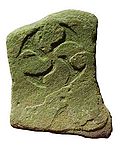
The earliest documented depiction of the lauburu appears on a tombstone in the town of Macaya, , dating to the late 16th or early 17th century. This artifact marks the symbol's initial verifiable presence in Basque material culture, serving as a funerary ornament potentially linked to protective or solar motifs. By the close of the , the lauburu proliferated as a decorative element in everyday and ceremonial objects, including wooden chests, furniture, and additional tombstones across the Basque territories. Its adoption reflected local craftsmanship traditions, where it functioned as a non-heraldic rather than a standardized , appearing in both rural households and settings without evident ties to feudal . In the , the symbol achieved relative commonality in ornamental contexts, such as engravings on buildings and personal items, amid the influences on Basque and . Usage expanded further in the , integrating into popular motifs on doorways, lintels, and grave markers, often symbolizing prosperity or elemental harmony in vernacular designs. No confirmed medieval precedents—such as in Romanesque churches or Gothic manuscripts—substantiate its prevalence prior to this era, distinguishing it from more ancient solar crosses while underscoring its evolution within early modern Basque folk aesthetics.

19th-Century Revival and Nationalism

In the late , the lauburu underwent a notable revival amid the Basque cultural , known as the rexerida or pizkundea, which emphasized reclaiming pre-modern traditions against the backdrop of rapid industrialization, linguistic suppression, and centralizing reforms imposed by the Spanish government, such as the 1839 abolition of Basque fueros (traditional charters of ). This movement, gaining momentum from the onward, promoted ancient symbols like the lauburu in , , and public displays to foster a sense of continuity with Basque heritage. The symbol's association with emerging political nationalism intensified under Sabino Arana Goiri, founder of the (Partido Nacionalista Vasco, or PNV), established on July 31, 1895, in . Arana, emphasizing Basque racial purity (ezpatismo) and Catholic traditionalism, incorporated the lauburu into nationalist iconography, interpreting its four comma-shaped arms as representing a solar cult (eguzki-jainko) integral to pre-Christian Basque identity, distinct from Indo-European influences. He promoted this view in early PNV publications, such as the inaugural issue of Bizkaitarra in 1894, linking the symbol etymologically to Basque roots for "four heads" (lau buru) and sun-related terms, though subsequent linguistic analysis has deemed these derivations speculative and unsupported by comparative . By the 1890s, the lauburu appeared in nationalist artifacts, including party emblems, jewelry, and architectural motifs in and surrounding areas, symbolizing territorial unity across Basque provinces (four in , three in ) and resistance to perceived cultural dilution from and . Its adoption extended its prior regional uses in and , aligning with Arana's vision of aberri (fatherland) as a bulwark against and Spanish integration, though it remained secondary to the flag designed by Arana in 1894. This revival solidified the lauburu's role in articulating Basque exceptionalism, predating its 20th-century politicization.

Cultural and Artistic Representations

In Architecture and Crafts

The lauburu is extensively used in traditional Basque architecture, particularly in stone carvings on funerary steles known as hilarri, which are disk-shaped monuments marking graves and featuring the symbol as a central decorative element symbolizing life and Basque heritage. These steles, prevalent from onward, often incorporate the lauburu alongside inscriptions and crosses, evidencing its integration into memorial structures across the Basque Country and diaspora areas like , where gravestones blend the motif with local Christian . In domestic and rural architecture, the lauburu adorns door lintels (atalburu) and building facades, serving both aesthetic and protective purposes in farmhouses and traditional homes, with carvings dating back to at least the . examples include its appearance on baptismal fonts and church elements, such as at sites reflecting Basque cultural influence, underscoring its compatibility with Christian contexts despite pre-Christian origins. Within Basque crafts, the lauburu features prominently in metalwork and jewelry, crafted into silver or gold pendants, earrings, and brooches as talismans of prosperity and identity, a practice rooted in historical artisanal traditions. incorporates the symbol into cabinets (kutxak), furniture, and decorative items, while ceramics and other media extend its use in household objects, maintaining continuity from ancient motifs to production techniques.

In Folklore, Religion, and Daily Life

In Basque folklore, the lauburu symbolizes the four classical elements—fire, water, earth, and air—embodying concepts of balance and harmony derived from the union of opposing energies. Vertical heads represent feminine expressions linked to fire and water, while horizontal heads denote masculine aspects associated with air and earth. Legends attribute protective qualities to the symbol, as in the tale where the bear Otso employs it as a medallion empowered by the goddess Mairi's strength to repel malevolent entities such as the dragon Herensugea and the Lamias. Prehistorically, the lauburu served as an amulet for igniting , signifying sacred , productive , and an ever-living flame that counters darkness. Its rotational form evokes the sun's , offering power against evil forces in traditional narratives. The symbol's orientation influences its auspiciousness: counterclockwise rotation is deemed to bring , whereas may portend misfortune. Within pre-Christian Basque religion, the lauburu connects to solar cults of possible Indo-European origin, reflecting prehistoric reverence for celestial cycles and elemental forces. It functioned not as a but as a pagan predating Roman influences, tied to myths of sun and dynamics. In daily life and traditions, the lauburu appeared as a safeguard, particularly against wolves, underscoring its role in protective customs among herders. As a decorative and talismanic motif, it adorned personal items and structures, perpetuating its integration into everyday Basque cultural practices as a marker of enduring harmony and vitality.

Controversies and External Perceptions

Pre-20th Century Associations

The Lauburu, translating to "four heads" in Basque, was historically associated with protective qualities in folk traditions, appearing on tombstones, house doorways, and carved stones as a against . Its curved form, distinct from rectilinear variants, dates to prehistoric applications in the Basque region, with possible symbolic links to the sun's movement or the four classical elements—, air, fire, and —reflecting pre-Christian cosmological views. Despite origins tied to pagan beliefs, the symbol integrated into Christian Basque practices during the medieval and early modern periods, adorning grave markers and architectural elements without evident clerical opposition, indicating cultural rather than outright rejection. This acceptance is exemplified by its decorative presence on the in Francisco de Goya's circa 1805 portrait of Joaquina Téllez-Girón, Marchioness of Santa Cruz, a figure connected to with Basque ties. In the 19th century, amid cultural revival efforts, nationalist thinker (1865–1903) interpreted the Lauburu as emblematic of ancient Basque sun worship, positing it as evidence of the ' non-Indo-European heritage and unique spiritual traditions. External perceptions from Spanish or French observers treated it largely as a quaint regional emblem, with no documented pre-1900 campaigns against it akin to later ideological conflicts; scholarly attributions occasionally extended it to neighboring groups like or , but these remained speculative without sparking disputes. One academic analysis posits the modern Lauburu form emerged in the , potentially as a stylized , though this contrasts with archaeological evidence of earlier hooked crosses in the region.

Nazi Swastika Confusion and Basque Responses

The visual resemblance between the Lauburu—a traditional Basque symbol featuring four curved, comma-shaped arms in continuous rotation, often encircled—and the prompted confusion following the Nazi Party's adoption of the latter as its primary emblem in 1920, formalized on national flags and insignia by 1935 to signify racial ideology. Early 20th-century Basque nationalists, including , founder of the , had occasionally employed straight-armed variants as representations of Basque identity, amplifying the potential for misidentification once the Nazi Hakenkreuz—characterized by sharp, right-angled hooks—became globally reviled after . Basque responses focused on differentiation through morphological and historical emphasis: post-1933, with Hitler's rise, nationalists standardized the curved Lauburu form to underscore its distinction from the angular Nazi , permanently embedding this variant in cultural usage as a safeguard against . Advocates highlighted the Lauburu's pre-Christian Basque roots, tied to indigenous motifs of the four provinces (Araba, Bizkaia, , Nafarroa) or cosmic elements, unlinked to Indo-European narratives co-opted by Nazis, with archaeological evidence from Basque solar stones and medieval artifacts predating such appropriations by thousands of years. This reclamation effort persisted, enabling continued display in Basque , , and nationalist without legal prohibition in or , while educating outsiders on the 's autonomy from Nazi ideology amid sporadic international sensitivities.

Post-War Debates and Reclamations

After , the lauburu's resemblance to the fueled debates about its viability as a Basque emblem, particularly amid Europe's widespread stigmatization of swastika-like symbols. Basque nationalists countered by stressing the lauburu's ancient origins, predating usage, and its distinct curved comma-shaped arms representing the four elements or provinces, rather than the straight-armed Hakenkreuz associated with Aryan ideology. This reclamation emphasized empirical distinctions in form and cultural context, with the symbol often depicted encircled to evoke solar motifs absent in iconography. During the Franco dictatorship (1939–1975), overt displays of the lauburu diminished as the regime systematically suppressed Basque cultural symbols, language, and nationalist expressions to enforce Spanish centralism. Public usage waned, though the symbol endured in private, folkloric, and exiled nationalist circles, serving as a subtle marker of resistance. Franco's policies, including bans on Euskara and regional insignia, indirectly targeted icons like the lauburu, which had earlier promoted as a national signifier in the late . Post-Franco, following the dictator's death on November 20, 1975, and Spain's , the lauburu underwent vigorous reclamation amid Basque cultural revival. The 1979 Statute of Autonomy for the Basque Country enabled renewed public embrace, with the symbol appearing in political emblems, such as the logo of Acción Nacionalista Vasca (founded 1982), and cultural motifs, solidifying its role in asserting ethnic identity. Debates persisted over its politicization—ranging from apolitical heritage to radical nationalism linked to groups like —but proponents across ideologies upheld it as a unifying, pre-Christian artifact, detached from wartime perversions.

Modern Significance and Usage

In Contemporary Basque Identity

The lauburu remains a central emblem in contemporary Basque identity, widely recognized as a symbol of , unity, and prosperity across the Basque Country. It appears ubiquitously in everyday contexts, such as storefronts, tombstones, and personal adornments like jewelry and tattoos, signifying pride in Basque traditions without inherent political connotation. In municipal s, including that of Arrieta in , the lauburu integrates with regional colors to represent local and broader Basque affiliation. Politically, the symbol features in emblems of nationalist organizations, such as Eusko Abertzale Ekintza (EAE-ANV), a left-wing Basque party, and variants of the flag used by various movements, underscoring its role in expressions of ethnic solidarity post-ETA ceasefire in 2011. Despite occasional associations with , proponents emphasize its apolitical essence, uniting irrespective of ideology and distinguishing it from external misappropriations. Its inclusion in commercial products and artifacts further reinforces cultural continuity amid globalization.

Global Diaspora and Commercialization

The Lauburu symbol maintains prominence among communities worldwide, particularly in the , where it serves as an emblem of cultural continuity amid emigration waves from the 19th and 20th centuries. In Mexico's region, archaeological and architectural evidence reveals Lauburu-like motifs in stone carvings and structures, attributed by researchers to Basque settlers or influences during the colonial era and subsequent migrations, as documented in studies linking these to European Basque remnants on Mexican shores. These instances highlight the symbol's role in preserving ethnic identity far from the Basque homeland, often appearing in community gatherings, festivals, and heritage sites established by descendants. Commercialization of the Lauburu has expanded globally through merchandise targeting Basque expatriates and enthusiasts, transforming it into a marketable icon of heritage. Online retailers offer Lauburu-embellished items such as jewelry, t-shirts, hoodies, and stickers, with platforms like featuring handmade pieces emphasizing its traditional motifs. Apparel incorporating the symbol in Basque flag colors—red, white, and green—has been available on Amazon since at least 2020, appealing to those expressing regional pride. Spanish brand Lauburu, established as an affordable fashion line, produces leather bags and accessories bearing the design, further embedding the symbol in everyday consumer goods. This trend underscores the Lauburu's adaptability from sacred or folk emblem to commodified product, facilitating cultural dissemination while raising occasional debates over authenticity in mass-produced forms.
Add your contribution
Related Hubs
User Avatar
No comments yet.