Hubbry Logo
Battle of GagronBattle of GagronMain
Open search
Battle of Gagron
Community hub
Battle of Gagron
logo
8 pages, 0 posts
0 subscribers
Be the first to start a discussion here.
Battle of Gagron
Battle of Gagron
from Wikipedia

Battle of Gagron
Part of Mewar-Malwa Conflict

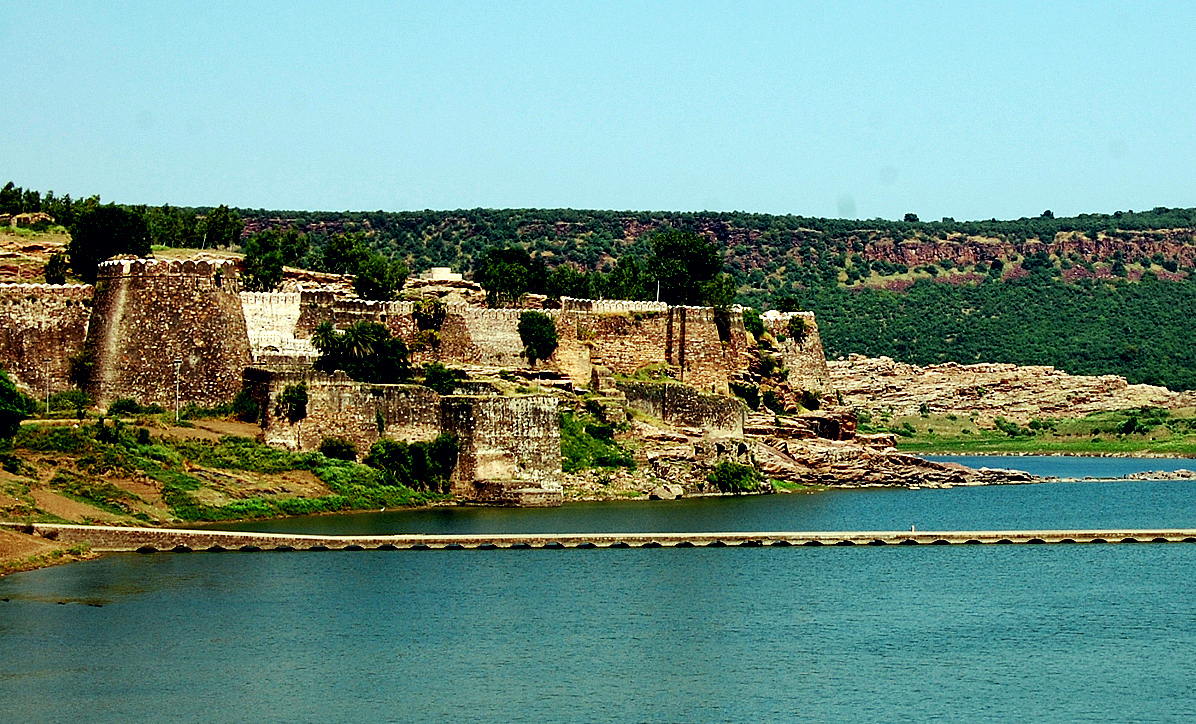
Fort of Gagron in Rajasthan
Date1519
Location
Result
  • Mahmud Khalji II taken as prisoner for six months.[1]
Territorial
changes
Raisen, Chanderi, Bhilsa, Kalpi, Sarangpur and Ranthambore captured by Mewar.[2]
Belligerents
Malwa Sultanate
Gujarat Sultanate
Commanders and leaders
Rana Sanga
Haridas Kesaria
Ajja Jhala
Rao Viramdeva
Prithviraj Singh I
Medini Rai
Mahmud Khilji II (POW)
Asaf Khan

The Battle of Gagron was fought in 1519 between Mahmud Khalji II of Malwa and Kingdom of Mewar's Rana Sanga. The conflict took place in Gagron (in the present-day Indian state of Rajasthan) and resulted in Sanga's victory, with him taking Mahmud captive and annexing significant territory.

Background

[edit]

Following the death of the Sultan of Malwa, Nasir-ud-Din Khalji, a succession struggle erupted amongst his sons. Mahmud Khalji II emerged victorious, primarily with the aid of the Rajput chief Medini Rai. The latter amassed considerable influence, resulting in the enmity of the Muslim nobles, with even the new sultan finding it necessary to appeal to Muzaffar Shah II of Gujarat. A Gujarati army was dispatched to Mandu, held by Medini Rai's son, and besieged it. The Rajput chief in turn appealed to Rana Sanga of Mewar for aid, who then marched his army into Malwa, reaching Sarangpur. However, Mandu was captured by the Gujaratis, prompting Sanga to return to Mewar alongside Medini Rai, who was then employed in his service.[3]

Battle

[edit]

In retribution for them entering his territory, Mahmud marshalled an army against the Mewaris and marched it through Gagron.[3] Sanga advanced with a large army from Chittor reinforced by the Rathors of Merta under Rao Viramdeva, and met Mahmud, accompanied by the Gujarat auxiliaries under Asaf Khan. The Mewari cavalry made a charge through that of the Gujarati, with the surviving men scattering. They subsequently did the same to the Malwa army, resulting in a decisive victory. Mahmud was wounded and taken prisoner by Rana Sanga, with most of his officers having died and his army decimated. Asaf Khan's son was killed, though he himself managed to escape.[4]

Aftermath

[edit]

Sanga subsequently took control of Bhilsa, Raisen, Sarangpur, Chanderi and Ranthambore. Mahmud was kept captive at Chittor for 6 months, though the Rana himself is said to have personally tended to his wounds. He was subsequently allowed an "honourable" return to his own lands, though one of his sons remained at Mewar as a hostage. Mahmud later sent Sanga a jewelled belt and crown as gifts.[5] Sanga presented the Chittor fortress to Haridas Kesaria after their victory, who humbly declined and accepted a jagir of 12 villages in return.[4][6]

References

[edit]
[edit]
Revisions and contributorsEdit on WikipediaRead on Wikipedia
from Grokipedia
The Battle of Gagron was a decisive military confrontation in 1519 CE near the fortified town of Gagron in present-day Jhalawar district, Rajasthan, India, pitting the Rajput confederacy under Rana Sangram Singh (Rana Sanga) of Mewar against the forces of the Malwa Sultanate led by Sultan Mahmud Khilji II. The engagement arose from Malwa's encroachment on territories held by Medini Rai, a key vassal of Mewar, prompting Sanga to mobilize a large Rajput army reinforced by Rathor allies from Merta to confront the Sultan. Rana Sanga's forces, numbering tens of thousands including cavalry and infantry drawn from various , launched a fierce assault that overwhelmed the army, which was supported by auxiliaries from the under Asaf Khan. The battle culminated in the rout of the Sultanate troops and the personal capture of Khilji II, marking a significant humiliation for and enabling Sanga to annex substantial eastern territories of the sultanate. This victory underscored Sanga's strategic prowess and temporarily elevated Mewar's dominance in northern , contributing to his reputation as a formidable warrior-king despite personal injuries from prior campaigns that left him with the loss of an eye, an arm, and a limp. The conflict highlighted the ongoing power struggles between kingdoms and the , with Gagron's strategic hill fort—perched amid rivers and known for its defensive resilience—serving as a focal point that had witnessed earlier sieges, such as the 1444 attempt by Mahmud's predecessor. Sanga's triumph at Gagron bolstered his confederacy's resources and alliances, paving the way for subsequent campaigns against and , though it also drew the attention of emerging powers like the Mughals under .

Historical Context

Rivalry Between Mewar and Malwa Sultanate

The rivalry between the Rajput kingdom of Mewar and the Muslim-ruled Malwa Sultanate originated in the early 15th century, driven by competing territorial ambitions in the border regions of present-day Rajasthan and Madhya Pradesh. Malwa, under the expansionist Khilji dynasty, sought to consolidate control over fertile plains and strategic forts, frequently launching incursions into Mewar to assert dominance over disputed areas. Mewar, governed by the Sisodia clan, responded with fortified defenses and retaliatory campaigns to safeguard its sovereignty, establishing a pattern of intermittent warfare that intensified border frictions. A pivotal phase unfolded during the reigns of Rana Kumbha (r. 1433–1468) of and Sultan Mahmud Khilji (r. 1436–1469) of , marked by multiple invasions and counteroffensives. In 1437, Mahmud Khilji invaded , prompting Kumbha to engage him at the Battle of Sarangpur, where forces decisively defeated the sultanate army, capturing Mahmud himself and compelling a temporary truce. This victory, corroborated in regional historical accounts, humiliated and spurred further retaliatory efforts, including a 1442 of that Kumbha repelled. Between 1442 and 1446, a series of engagements known as the Battles of Mandalgarh and Banas saw Mahmud Khilji suffer three major defeats against Kumbha's armies, exhausting 's resources and enforcing a decade-long respite from large-scale invasions. Malwa's aggressive posture often involved alliances with the to pressure states, as seen in coordinated threats to 's northeastern and southern frontiers during the 1440s, aiming to encircle and weaken 's domain. countered through extensive fortification projects— erected or strengthened 32 forts, including key passes against Malwa incursions—and opportunistic raids into sultanate territories to disrupt supply lines and reclaim outposts. The fort of Gagron, a contested stronghold on the shared border held by Malwa-aligned Khichi s, became a flashpoint; Khilji besieged it in 1444, only for to dispatch reinforcements that preserved local control amid the broader cycle of sieges and skirmishes. These conflicts, documented in Mewari inscriptions such as Kumbha's prashastis and sultanate chronicles, reflected deeper geopolitical tensions: Malwa's drive for clashed with 's defensive resilience, fostering fragile truces punctuated by raids over resources and tribute. Empirical records indicate at least 17 confrontations initiated by Malwa sultans against in the mid-15th century, underscoring the sultanate's repeated failures to subjugate the Rajputs despite numerical advantages in some campaigns. This enduring antagonism over borderlands like Gagron set the stage for escalated hostilities into the early , without resolution through diplomacy.

Ascension and Early Conquests of Rana Sanga

, later known as , ascended to the throne of in 1508 following the death of his father, , amid intense internal strife among his brothers Prithviraj and Jaimal, who vied for control after Raimal's passing. , having initially fled to for safety during the succession conflicts, returned to consolidate power through a combination of military action against rival claimants and diplomatic maneuvering to stabilize the kingdom, marking the end of a period of fragmentation in . His rise restored centralized authority, enabling subsequent expansions that positioned as a counterweight to sultanate incursions. Sanga's personal resilience, forged in prior conflicts, underscored his ; traditional accounts record him sustaining over 80 wounds across numerous engagements before and during his reign, including the loss of an eye, an arm severed by sword, and lameness from an arrow wound, yet he persisted in frontline command without apparent diminishment in efficacy. These injuries, accumulated in battles against regional foes, highlighted his commitment to direct participation, fostering loyalty among warriors who viewed his survival as emblematic of valor. To build a formidable confederacy, Sanga unified disparate —such as those from , , and —through strategic matrimonial alliances, oaths of mutual defense, and coercive subjugation of recalcitrant chieftains, creating a coalition unprecedented since the era of . This unification extended to non-Rajput allies like the Meo leader , whose forces provided additional , enabling Sanga to field armies emphasizing mobile Rajput horsemen supported by allied and war elephants for and pursuit. Logistically, he overcame Mewar's arid by securing supply lines through territories, amassing forces up to 80,000 with 500 elephants and substantial , which sustained extended campaigns without collapse. Sanga's early military prowess manifested in the Battle of Khatoli in 1517, where his forces decisively routed an invading army of the under Ibrahim Lodi, capturing the sultan briefly before releasing him upon payment of ransom, thus repelling threats to Mewar's eastern borders. Employing superior cavalry maneuvers to exploit Lodi's overextended lines, Sanga's smaller but cohesive contingent—bolstered by confederate allies—dismantled a numerically superior foe, demonstrating tactical acumen in terrain utilization near . The following year's Battle of Dholpur in 1518 further validated this, as Sanga again defeated Lodi's reprisal force, incurring personal wounds but shattering the sultan's cohesion and expanding Mewar's influence into eastern , with his -led charges proving decisive against Afghan-heavy infantry. These victories, against larger sultanate armies reliant on massed troops, established Sanga's reputation as a unifier capable of reversing declines, setting the stage for challenges to without direct reliance on internal divisions alone.

Prelude to the Battle

Immediate Triggers and Diplomatic Maneuvers

In the years preceding the battle, Mahmud Khilji II of sought to reassert control over territories lost amid internal strife, particularly after Rana Sanga's intervention in support of the rebellious minister , who had been granted fiefs in Malwa regions under Mewar's influence. By 1517, Sanga's aid enabled to challenge Mahmud's authority, forcing the sultan to flee temporarily to , though Mahmud later regained his throne with external assistance. , strategically positioned as a gateway controlling access routes into from Malwa, became a focal point due to its occupation by Medini Rai's forces loyal to Sanga, prompting Mahmud's campaigns in 1518–1519 to reclaim it and adjacent border areas. Mahmud's assault on Gagron in 1519 represented a direct retaliation for Sanga's prior encroachments into , escalating tensions as the aimed to punish the rana for undermining Malwa's sovereignty. Sanga, having extended protection to and conducted strikes into Malwa's border regions to secure vassal holdings, rejected any demands for tribute or submission, viewing them as incompatible with codes of honor that prioritized martial independence over acquiescence to sultanate overlordship. Persian chronicles, such as those drawing from Ferishta, record mutual recriminations of aggression, with Malwa accusing of opportunistic expansionism while Sanga framed his actions as defensive consolidation against sultanate incursions. Diplomatic efforts faltered amid these animosities, as forged an alliance with , securing auxiliaries under Asaf Khan to bolster his campaign against Gagron, while Sanga rallied vassals, including the Rathors of Merta, emphasizing collective resistance rooted in shared territorial and honor-bound imperatives. No substantive negotiations bridged the divide, as both leaders' ambitions—Malwa's recovery of lost domains and Mewar's expansion into contested frontiers—precluded compromise, leading inexorably to open confrontation. The failure of mediation underscored the causal role of unyielding prestige dynamics in precipitating the clash, where concessions were perceived as existential threats to rulership legitimacy.

Assembly of Armies and Strategic Preparations

mobilized a force primarily drawn from , reinforced by contingents from allied clans including the Rathors of Merta under Rao Viramdeva, emphasizing mobile cavalry suited to rapid maneuvers and the rugged terrain of eastern . The composition reflected traditional military structure, with heavy reliance on mounted warriors experienced in guerrilla tactics and close-quarters combat, supported by for holding ground. Sanga's preparations involved a strategic march from Chittor, navigating supply lines through hilly passes to preserve momentum and avoid overextension against a numerically superior foe. In contrast, Sultan Mahmud Khilji II of Malwa assembled a larger, more heterogeneous army, incorporating Afghan mercenaries, levies from allied Gujarat Sultanate forces under Muzaffar Shah II, and elements of the sultanate's standing troops, which included a significant elephant corps for shock tactics and rudimentary artillery for sieges and field engagements. Mahmud's logistical approach centered on fortified marching camps to protect his supply trains from raids, leveraging the sultanate's resources in war elephants—estimated in dozens for intimidation and breakthrough—and diverse infantry, though internal rivalries among mercenaries reduced overall cohesion. Both commanders employed and networks; Sanga drew on local spies and knowledge from bardic traditions like the Vanshavali to monitor Malwa movements, while Mahmud relied on mounted outriders from his Afghan auxiliaries to probe positions, though the latter's unfamiliarity with the local landscape limited effectiveness. These preparations underscored Sanga's advantage in adaptability against Mahmud's in superior numbers and heavy assets, setting the stage for confrontation near .

Course of the Battle

Initial Deployment and Terrain Advantages

The Battle of Gagron unfolded in 1519 near , located in the hilly and riverine terrain of present-day , , close to the border, where the fort's elevated position was naturally fortified by the Kali Sindh, Parvan, and Ahu rivers converging on three sides, creating a water-encircled (jal durg) defensive landscape that restricted large-scale maneuvers and favored mobile forces familiar with local features. This inherently advantaged agile operations over ponderous or elephant-based arrays, as the uneven ground and waterways fragmented enemy lines and enabled ambuscades from concealed approaches. Sultan Mahmud Khilji II of , supported by auxiliary cavalry from under Asaf Khan, encamped his forces proximate to the fort, adopting a conventional formation centered on the sultan himself, which exposed flanks to rapid strikes in the constrained terrain. In contrast, advanced southward from Chittor with a reinforced confederacy, including Rathor horsemen from Merta under Rao Viramdeva, leveraging superior equine mobility and to execute flanking movements that capitalized on ravines and riverbanks for concealment and surprise. These environmental factors causally amplified tactical edges, as chronicled by Ferishta, wherein the sultan's premature engagement allowed Sanga's mounted warriors to shatter the Gujarat auxiliaries through swift charges, underscoring the mismatch between Malwa's linear dispositions—vulnerable in fragmented landscapes—and the terrain-attuned horse archery, which outmaneuvered infantry-heavy opponents without reliance on fixed positions. No significant weather disruptions are recorded for the mid-1519 clash, permitting full exploitation of these positional asymmetries.

Major Engagements and Tactical Maneuvers

The major engagements unfolded as Rana Sanga's Rajput confederacy, reinforced by Rathor contingents from Merta under Rao Viramdeva, advanced to confront the combined army of Mahmud Khilji II and Gujarat forces led by Asaf Khan near . These clashes emphasized the Rajputs' tactical emphasis on mobile cavalry units to probe and pressure enemy lines, exploiting the fort's surrounding rivers and elevated terrain for positional advantages in maneuvering. Sanga's warriors, proficient in mounted assaults, engaged in phased combat actions that disrupted the sultanate's infantry-heavy formations through repeated charges, while allied elements contributed to outflanking efforts against the less coordinated opposition. The Malwa side mounted counterefforts with their own wings, aiming to hold defensive positions, but close-quarters proficiency with lances and swords dominated melee phases. Historical records, primarily derived from later chronicles and sultanate annals, provide limited granular detail on maneuvers, reflecting the era's reliance on oral traditions over contemporaneous tactical logs.

Decisive Moments and Rout of the Enemy

The critical turning point unfolded as Rana Sanga's cavalry executed a decisive charge against the Gujarat auxiliary forces allied with , shattering the enemy's central lines and precipitating widespread disorder. Chronicler Ferishta attributes this collapse to Sultan Mahmud Khilji's premature commitment to open battle, which exposed vulnerabilities in the combined Muslim ranks to the superior mobility and ferocity of the horse. The destruction of these auxiliaries created a causal breach, allowing warriors to penetrate deeper into the formation and disrupt coordinated resistance. This rupture induced panic across the enemy army, triggering a chaotic as troops fled en masse, discarding baggage trains laden with supplies and in their desperation to evade . Sanga, demonstrating personal valor amid the fray, spearheaded the pursuit of the disintegrating forces, pressing them relentlessly toward Mandu and preventing any effective rally. The phased attrition—initially from the clash, then amplified by the flight—ensured the command structure's total unraveling, as described in Ferishta's balanced chronicle drawing from contemporary Deccani records.

Immediate Outcome

Casualties, Captures, and Surrender of Mahmud Khilji

The forces under Mahmud Khilji II endured devastating casualties during the battle, with historical accounts describing the army as nearly annihilated and most of its officers slain in combat. The auxiliaries commanded by Asaf Khan fared similarly, suffering the loss of Asaf's son amid the rout, compelling the commander himself to flee the field. While exact figures for and allied dead or wounded are not quantified in preserved chronicles, the scale of the defeat is evidenced by the complete collapse of their organized resistance, with survivors scattering in disarray. Rajput casualties, by contrast, appear to have been comparatively minimal, attributable to the swift decisive charges that disrupted enemy formations before they could fully engage. Sultan Khilji II, wounded and bleeding from the fray, was personally captured by Rana Sanga's troops, marking a profound humiliation for the ruler. In captivity, he yielded tangible proofs of submission, including a jewelled crown and belt—family heirlooms tracing to his ancestor Sultan —presented as nazrana to the victor. To secure his release, further agreed to retain one of his sons as a hostage in Chittor, ensuring adherence to terms of toward . These immediate concessions underscored the rout's totality, with treated with nominal honor during detention but ultimately restored to his throne only under Mewar's overarching authority, as per bardic records emphasizing the victory's unyielding dominance. Accounts vary on the duration of his , ranging from two to six months, reflecting potential embellishments in secondary retellings drawn from oral traditions rather than contemporaneous documentation.

Short-Term Territorial and Political Shifts

Following the decisive victory at Gagron on January 10, 1519, Rana Sanga annexed the strategic fort of Gagron and the adjoining eastern Malwa territories, integrating them into Mewar's administrative sphere. To secure control, Sanga appointed loyal vassals, notably Medini Rai, as governors over captured Malwa regions including Chanderi, thereby extending Mewar's influence without full incorporation of the sultanate's core. Mahmud Khilji II, held captive for approximately two to six months at Chittor, was released after pledging submission, including annual tribute payments and a vow of non-aggression against territories. This arrangement imposed vassalage on , curtailing its independent military initiatives and compelling to dispatch symbolic gifts such as a jewelled crown and belt to affirm Sanga's overlordship. The outcome strained Malwa's pre-existing alliances, particularly with the under Muzaffar Shah II, as the sultanate's weakened position prompted Gujarat to withhold further joint campaigns against in the immediate aftermath, fostering regional diplomatic realignments. No major reprisal raids materialized from in late 1519, with Mahmud's forces instead focusing on internal consolidation, enabling a temporary truce that lasted until subsequent campaigns in 1520.

Long-Term Consequences

Weakening of the Malwa Sultanate

The defeat at Gagron on 25 January 1519 inflicted heavy casualties on Malwa's forces, routing their army and capturing Sultan Mahmud Khilji II, which exposed the fragility of his regime amid pre-existing factionalism between Turkish elites, Afghan settlers, and Hindu nobles. This military humiliation eroded Mahmud's prestige, as nobles perceived him as incapable of defending the sultanate's core territories or maintaining order, prompting shifts in loyalty and opportunistic power grabs. Persian chronicler Ferishta notes the battle's decisiveness in Tarikh-i-Ferishta, portraying it as a pivotal reversal that diminished Malwa's coercive capacity over its diverse aristocracy. Emboldened by the sultan's weakness, Rajput minister , leveraging his administrative influence and military resources, assumed de facto control of much of by the early 1520s, sidelining as a nominal and installing loyalists in key posts. This internal coup fragmented authority, as rival factions vied for provincial fiefs, exacerbating revolts and administrative paralysis; succession uncertainties and ethnic tensions further destabilized governance, with revenue collection faltering due to disrupted agrarian systems and war indemnities. Economic pressures mounted from depleted treasuries—exhausted by prior conflicts and the costs of rebuilding after Gagron—limiting recruitment and fortifications, rendering unable to project power effectively. The sultanate's reduced military strength post-1519, evidenced by its failure to repel incursions, hastened fragmentation into semi-autonomous noble domains, culminating in Bahadur Shah of Gujarat's and of Mandu in 1531, which dismantled centralized rule and left residual territories vulnerable to emerging powers like the Mughals. This causal chain—from battlefield rout to institutional collapse—underscored how the loss at Gagron amplified latent fractures, preventing any coherent recovery and sealing Malwa's trajectory toward dissolution by the mid-16th century.

Expansion of Mewar's Influence and Regional Power Dynamics

The victory at Gagron in 1519 enabled , known as , to annex significant territories in eastern , including the strategically vital and regions such as , which had previously been under Malwa or control. This consolidation strengthened 's grip on , providing a buffer against southern sultanates and a base for further expansion northward and westward. These gains facilitated Sanga's subsequent campaigns, notably his invasion of in 1520, where his forces defeated Sultan Muzaffar Shah II, pursued the retreating army to , and compelled the sultan to seek refuge while reinstating allies in the region. Similarly, the diminished Malwa threat allowed Sanga to assert dominance over remnants of Lodi influence in areas like , transferring control of key Malwa-acquired lands to and undermining Delhi's regional footholds. The battle's outcome elevated Sanga's stature among Rajput rulers, bolstering the confederacy he led, which encompassed seven kings and nine chieftains from states including and , forged through alliances reinforced by shared military successes and coordinated resistance to sultanate incursions. This network enhanced collective military capacity, deterring aggression from and while enabling joint operations that preserved autonomy in northern . Regionally, the power shift redirected tribute and resources from the weakened toward Mewar-dominated principalities, with annexed territories contributing to Mewar's revenue and fostering economic advantages through oversight of central Indian passes linking ports to northern trade networks. These dynamics diminished sultanate , elevating states as primary arbiters in the area's political and economic affairs until the rise of new external powers.

Historiography and Legacy

Accounts in Contemporary Sources

Rajput khyats and vanshavalis, such as those chronicling Mewar history, portray the 1519 Battle of Gagron as a resounding victory for Rana Sanga, detailing the collapse of Mahmud Khilji II's forces under Rajput cavalry assaults and the subsequent capture of the Malwa sultan. These bardic accounts emphasize Sanga's strategic exploitation of the local terrain and the honorable release of Mahmud after tribute, though they characteristically amplify enemy troop numbers—claiming up to 100,000 Malwa soldiers—to magnify Rajput valor. The Persian chronicler Ferishta, in his Tarikh-i-Ferishta, provides a counter-narrative drawn from sultanate records, describing Mahmud's premature advance leading to the annihilation of Gujarat auxiliary cavalry by Rajput horsemen, resulting in the sultan's wounding and imprisonment; Ferishta highlights Sanga's chivalrous conduct in nursing the captive, but the account, compiled decades later, likely minimizes Malwa losses to preserve dynastic prestige. Discrepancies between sources arise in force estimates and tactical details, with Rajput texts favoring heroic charges and Persian ones premature engagements; such variances stem causally from the battle's terrain—Gagron's fort, encircled by rivers on three sides, constrained Malwa maneuvers and favored ambush tactics, biasing victor reports toward routs while loser accounts stress missteps. Archaeological remains at Gagron fort, including its foundationless rock-built ramparts and water barriers, corroborate the site's defensibility as invoked in both traditions, though no inscriptions or artifacts uniquely tied to the 1519 clash have surfaced, limiting material cross-verification to structural evidence of repeated sieges.

Interpretations in Modern Scholarship and Debates

Modern historians regard the Battle of Gagron as a landmark success that temporarily reversed the Sultanate's southward thrusts into , with Rana Sanga's forces capturing Sultan Mahmud Khilji II and securing eastern territories like . This outcome is interpreted as emblematic of Sanga's ability to forge confederacies among fractious , leveraging numerical superiority and charges to exploit Malwa's overstretched supply lines. Scholars emphasize its role in curbing sultanate hegemony, as Malwa's repeated defeats under Sanga—from earlier skirmishes to Gagron—shifted regional balances, enabling to assert dominance over a swath of until internal challenges eroded these gains. Debates persist over logistical details, such as army compositions, where contemporary Persian chronicles like those of courts inflate figures—claiming Sanga fielded up to 80,000 while mustered 40,000—to dramatize the rout, but modern analyses, drawing from comparative studies of 16th-century Indian warfare, advocate scaled-down estimates of 20,000–30,000 per side based on muster rolls and terrain constraints. Fringe assertions linking Gagron's aftermath to Sanga's purported overtures to for anti-Lodi campaigns lack primary corroboration; 's Baburnama mentions envoys but attributes initial invitations to and Afghan nobles in 1524–1525, predating any post-Gagron desperation, with timeline evidence showing Sanga's independent victories over Lodi (e.g., 1517–1519) negating dependency claims. While Gagron underscored Mewar's brief hegemony—facilitating alliances that checked Gujarat and Delhi incursions—critiques highlight structural Rajput limitations, including clan rivalries that precluded unified governance, as evidenced by Sanga's failure to hold annexed lands long-term amid revolts and succession disputes. This victory, though tactically brilliant, is seen not as a foundational empire-builder but as a pyrrhic high tide, with Malwa's resilience under later sultans underscoring how decentralized Rajput polities prioritized honor over administrative consolidation, per analyses of pre-Mughal power vacuums.

References

Add your contribution
Related Hubs
User Avatar
No comments yet.