Hubbry Logo
KumbhaKumbhaMain
Open search
Kumbha
Community hub
Kumbha
logo
8 pages, 0 posts
0 subscribers
Be the first to start a discussion here.
Contribute something
Kumbha
Kumbha
from Wikipedia

Kumbha
Kumbha
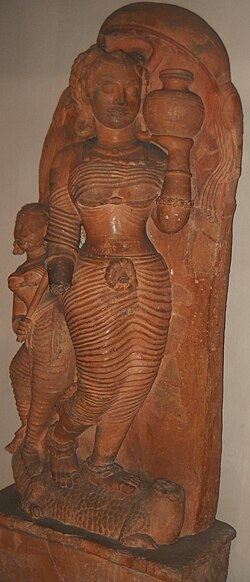
The goddess Ganga shown with a kumbha (a full vase)

A kumbha (Sanskrit: कुम्भ) is a type of pottery in India. Traditionally, it is made by Kumbhars, also known as Prajapatis.

In the context of Hindu, Jain and Buddhist mythology, the kumbha symbolises the womb. It represents fertility, life, generative power of human beings and sustenance and is generally associated with devis, particularly Ganga.[1]

Mythological origin

[edit]

According to Hindu mythology, the first kumbha was created by Prajapati on the occasion of the marriage of Shiva, so he was first kumbhara "potter".[2] Another myth says that the first pot was created by Vishvakarman on the occasion of the churning of the ocean for the first Amrit Sanchar.

In Hindu mythology and scriptures, several references are found of human beings born from a kumbha. A legend states that rishi Agastya was born out of a kumbha.

Raw Kumbh made by Hans Raj Prajapati in Punjab : May 2010

In several religious ceremonies and rituals, kumbhas or kalashas filled with water and leaves and decorated with intricate motifs, sometimes with ornaments, play an important role in ancient India. These rituals still survive in India.

In Hindu astrology, the kumbha stands for the zodiac sign Aquarius and is ruled by 2 important planets that is (Saturn and Rahu). Kumbha is also associated with the Kumbha Mela, which happens when the planet Brihaspati moves into Aquarius.

In Hindu epic Ramayana, Ravana's brother Kumbhakarna had a son named Kumbha, who was killed by Sugriva.

With time professions turned in to last names e.g. the last name Kumbha refers to one of the surnames of Schedule tribe Community named Yerukala in Andhra Pradesh.

See also

[edit]

References

[edit]
Revisions and contributorsEdit on WikipediaRead on Wikipedia
from Grokipedia
Kumbha is a term meaning "pot" or "pitcher," revered in as a potent symbol of , , abundance, and the generative power of life, often equated with the womb and the divine source of sustenance. In Hindu rituals, the purnakumbha—a "full pot"—holds a central place, filled with to represent plentiful resources in an , topped with fresh leaves for vitality and eternity, a for the unity of individual and , and decorated with and to invoke auspiciousness and divine energy. This sacred vessel is invoked with mantras calling upon deities, sacred texts, and natural elements like rivers and the , embodying completeness and the infusion of the into human existence. It appears prominently in ceremonies such as housewarmings, weddings, and the welcoming of spiritual figures, where it is offered with garlands during Vedic rituals to signify blessings and welfare. Mythologically, kumbha gains prominence in the Samudra Manthan, or churning of the ocean, a key episode in Hindu texts like the and , where gods and demons collaborate to extract treasures from the cosmic ocean of milk, culminating in the emergence of the amrita kumbha, the pot of immortality nectar. Drops from this pot are said to have fallen at four sacred sites—, , , and —establishing the locations for the , a massive pilgrimage festival held every 12 years (or every three years rotationally) that draws hundreds of millions of devotees for ritual bathing to attain purification and spiritual merit. The most recent Maha Kumbh Mela in 2025 at attracted over 400 million visitors. The festival, recognized by as an Intangible Cultural Heritage of Humanity, underscores kumbha's role as a vessel of eternal life and communal devotion. In Vedic astrology, Kumbha Rashi refers to the eleventh zodiac sign, equivalent to Aquarius, ruled by Saturn and associated with air, innovation, humanitarian ideals, independence, and forward-thinking vision. Individuals born under this sign are often characterized as intellectual reformers and social activists, with the water-bearer's imagery symbolizing the flow of knowledge and universal welfare. This astrological dimension further extends kumbha's symbolism to cosmic balance and progressive change.

Etymology and Definition

Linguistic Origins

The word kumbha in originates from the Proto-Indo-Aryan kumbʰás, tracing back to the kúmbʰos, denoting a pot or vessel, likely derived from concepts of bending or enclosing that evoke the shape and function of a covered . This etymological foundation reflects an evolution from a verbal notion of covering or forming a hollow to the concrete designation of a or , as documented in classical lexicons. In early Vedic literature, particularly the (composed circa 1500–1200 BCE), kumbha appears as a term for earthenware pots or water vessels, often in ritual or domestic contexts symbolizing containment and utility. These usages highlight its practical role in ancient Indo-Aryan society, where such containers were essential for storing liquids and grains. Indo-European cognates of kumbha include the Avestan xumba- (meaning "pot" or "jar"), indicating shared linguistic heritage across ancient , with possible parallels in Old Persian forms like kumba for similar vessels. The term's influence extended to Middle Indo-Aryan Prakrit dialects, where it retained forms close to the Sanskrit original, and further adapted in modern regional languages, such as Hindi kumbh (a pitcher or pot) and Tamil kumbam (borrowed directly from Sanskrit to signify a jar or zodiacal reference).

Core Meaning and Symbolism

In Hindu tradition, the term kumbha primarily denotes a pitcher, pot, or jar, typically crafted from clay or metal, employed for storing and transporting liquids such as water or milk. This vessel embodies the womb (garbha), symbolizing fertility, the generative power of creation, and the sustenance of life, as it holds the primordial waters from which the universe emerges. In iconographic depictions, the kumbha is often carried by deities like Brahma, representing cosmic containment and the life-giving essence of water, and is frequently associated with river goddesses such as Ganga, whose waters are revered as a source of purity and renewal. Furthermore, the kumbha serves as a metaphor for immortality, particularly as a container for amrita, the nectar of eternal life, underscoring its role as a bridge between the mortal and divine realms. Within , the kumbha retains its connotation as a full pot or , symbolizing abundance, cosmological power, and the womb-like origin of life, as seen in the fourteenth dream of Marudevi, the mother of , where a brimming vessel foretells the birth of a world-renouncer. Varieties such as the jala-kumbha (water-filled pot) evoke and sustenance through their life-giving properties, while the purna-kumbha (full pot) signifies auspiciousness, spiritual wealth, and liberation (), often appearing in temple architecture on pillars and doorways to denote generative and ultimate . This symbolism extends to motifs intertwined with creepers and fruits, reinforcing themes of and the cyclical renewal of existence. In Buddhist contexts, the kumbha, rendered as kalasa or vase, functions similarly as a pitcher holding amrita, the elixir of immortality, thereby representing generative power, sustenance, and the transcendence of death. Deities like and Avalokitesvara (Padmapani) are iconographically shown bearing the vessel, linking it to water's nurturing force and the cosmic origins of life, such as waters emanating from divine forms to foster creation. Across these traditions, the kumbha thus emerges as a profound emblem of the life source, encapsulating , continuity, and the sacred container of existential potential.

Mythological and Religious Contexts

Creation Myths

In , a legend among the potter community attributes the origin of the kumbha, or sacred pot, to the divine wedding of and . According to this story, as preparations for the marriage proceeded, the absence of an earthen pot for ceremonial rituals posed a challenge. A potter named Kulaluk offered his services and, with tools provided by the gods—including the Sudarshan from , a pestle from , and a scraper from —fashioned the first kumbha from clay derived from 's body. This act provided the essential vessel and linked the potter community (kumbhars) as descendants of , the lord of creation, symbolizing the potter's role in shaping life from primal elements and laying the foundation for the artisan tradition associated with clay vessels. Another key myth links the primordial kumbha to the Samudra Manthan, the cosmic churning of the ocean described in ancient texts like the and . During this event, gods and demons collaborated to extract treasures from the milky ocean, resulting in the emergence of the kumbha containing , the nectar of . The pot, carried by , the divine physician, became central to the subsequent amrita sanchar, or distribution of the nectar, where as mediated between the warring factions to ensure the gods' share. This kumbha represents the vessel of eternal life and cosmic abundance, underscoring its role in divine preservation and the balance of creation. The sage 's birth further illustrates the kumbha's generative symbolism in Hindu lore. As recounted in texts such as the Brihaddevata, emerged from a kumbha filled with the combined of and , gods of cosmic order, after their union with the celestial nymph . This miraculous origin from —earning him epithets like Kumbhayoni (born from the pot) and Kumbhasambhava—highlights the vessel as a womb-like container of divine essence, embodying the transformation of sacred fluids into enlightened wisdom and sagehood. In broader Indian religious traditions, including and , the kumbha symbolizes the womb, representing fertility and life.

Role in Hindu Epics and

In the Ramayana, Kumbha appears as a prominent demon warrior, the son of —Ravana's brother—and thus part of the lineage defending against Rama's forces. During the climactic battle in the Yuddha Kanda, Kumbha engages in fierce combat with the monkey army led by , showcasing his prowess by countering attacks from and others with arrows and physical might. Ultimately, strikes Kumbha with a thunderbolt-like to the chest, killing him and weakening Ravana's defenses. This narrative underscores Kumbha's role in symbolizing the unyielding strength and familial bonds of the demon warriors, with his name evoking the robust, pot-like resilience associated with his father's legendary form. In the , the kumbha functions as a sacred vessel in elaborate rituals, particularly those involving the preparation and offering of soma, the divine believed to grant and visionary insight to participants and deities. These depictions highlight the kumbha's practical and symbolic importance in Vedic sacrificial practices embedded within the epic's accounts of royal ceremonies and moral conflicts. The frequently portray the kumbha in association with , the deity presiding over waters and cosmic law, where it serves as an attribute representing abundance and control over oceanic forces. In narratives such as those in the and , the kumbha embodies a life-preserving container amid deluges, akin to an ark safeguarding seeds of life and during cyclical floods that test humanity's adherence to rita (universal order). 's wielding of the kumbha reinforces themes of purification and renewal, distinguishing it from mere utility to a emblem of divine intervention in cataclysmic events. Buddhist adaptations of the kumbha motif appear in the , where it often symbolizes a vessel containing moral lessons related to karma and the path to enlightenment. In the Kumbha Jataka (No. 512), a royal pot of represents the intoxicating pitfalls of desire that lead to societal downfall, prompting the future —reborn as a king—to shatter such vessels and embrace precepts, illustrating karma's accumulative nature through . This narrative reframes the Hindu kumbha's abundance as a cautionary storehouse of actions, whose contents determine rebirth and spiritual progress.

Astrological and Calendrical Significance

Kumbha in Vedic Astrology

In Vedic astrology, Kumbha Rashi represents the eleventh sign of the zodiac, spanning from approximately 300° to 330° in the , and is symbolized by a water bearer or a pot (kumbha) pouring forth life-sustaining , embodying the flow of knowledge and cosmic energy. This sign is primarily ruled by (Saturn), the planet associated with discipline, karma, and long-term structures, which imparts a sense of perseverance and detachment to its natives. Additionally, , the north , serves as co-ruler, amplifying themes of innovation, unconventional thinking, and social disruption, as Rahu's influence in Kumbha enhances desires for large-scale networks and progressive reforms. Kumbha Rashi is classified as an air element with a fixed modality, fostering intellectual depth, stability in ideas, and a humanitarian orientation that prioritizes collective welfare over personal gain. Natives typically exhibit traits such as innovativeness, , and a strong sense of , often appearing aloof or eccentric due to their forward-thinking nature and preference for independence. These individuals are drawn to abstract concepts and social causes, thriving in environments that allow for and on societal issues. In terms of predictions, Kumbha influences by promoting visionary and , often leading natives toward careers in , scientific research, social reform, or humanitarian organizations, where their inventive mindset drives progress. Specifically for individuals with Aquarius Lagna (Kumbha Lagna), this innovative nature suits fields such as information technology (IT), science, social work, and entrepreneurship. Health-wise, vulnerabilities may include issues, such as or poor blood flow, as well as ankle and lower leg problems, necessitating attention to and . Compatibility tends to favor air and fire signs like Mithuna (Gemini) and Dhanu (Sagittarius), fostering intellectual synergy and shared ideals.

Kumbha as a Solar Month

In the Hindu solar sidereal calendar, Kumbha serves as the eleventh month, commencing with the Kumbha Sankranti and extending approximately from mid-February to mid-March. For instance, in 2025, the month spanned from February 12, when the Sun transited into Aquarius, to March 14, marking the onset of the month. This sidereal positioning provides a solar-based framework that complements the lunisolar system used for many festivals, differing from the tropical zodiac in due to the of the equinoxes. Astronomically, Kumbha begins precisely at Kumbha , the moment the Sun enters the zodiac sign of Aquarius (Kumbha ), signifying a shift in seasonal energies. This transit is observed through precise calculations of the Sun's position relative to the , emphasizing the calendar's sidereal nature. Associated festivals during this period include preparations for , which fell on February 26 in 2025 and involved devotees engaging in fasting, prayers, and temple visits dedicated to Lord . In regional variations, the Tamil month of Masi, corresponding to Kumbha, features observances like Masi Magam, a festival with ritual bathing and processions at sacred tanks, particularly in . Climatically, Kumbha heralds the transition from winter to spring across , with milder temperatures facilitating agricultural renewal in . This period marks the season for summer vegetables such as tomatoes, okra, and bitter , as farmers prepare fields for the warmer months ahead. The month's alignment with budding flora underscores its role in agrarian cycles, where communities perform rituals to invoke prosperity for upcoming harvests.

Cultural and Ritualistic Uses

In Festivals and Ceremonies

The , an auspicious pot typically made of or , plays a pivotal role in Hindu pujas and ceremonies, where it is filled with —often from the —along with items such as coins, rice grains, a nut, and topped with five leaves and a wrapped in red cloth. This preparation symbolizes the universe's , divine abundance, and spiritual purity, serving as a conduit for invoking prosperity and positive energies during rituals. In weddings and housewarming ceremonies (grihapravesha), the is installed at the entrance or to bless the union or new home, acting as a protective emblem that wards off negativity and ensures harmony, with the representing the sanctity of life and leaves denoting renewal. The kumbha's most prominent ceremonial manifestation occurs in the Kumbha Mela, a massive Hindu pilgrimage held in a 12-year cycle at four sacred sites, with major events occurring every three years in rotation: at the confluence of the , , and mythical rivers; on the ; on the Godavari; and on the Shipra. Rooted in planetary alignments, particularly Jupiter's position, the festival draws hundreds of millions of devotees who participate in ritual bathing (snan) in these rivers, believed to cleanse sins and confer —liberation from the cycle of rebirth—transforming the waters into vessels of immortality during key moments like the Shahi Snan. The 2025 Maha Kumbh at , held from January 13 to February 26, drew over 450 million devotees, underscoring its massive contemporary significance. In broader Hindu rituals, the kumbha facilitates , the anointing of deities with consecrated water poured from the pot during temple consecrations (kumbhabhishekam) or daily , infusing divine energy into idols and structures to homogenize spiritual powers and renew sacred spaces. During Navratri, kalash sthapana marks the festival's commencement, with the pot filled with water, rice, and betel nuts, placed over barley seeds, and adorned with mango leaves and a coconut to invoke Goddess Durga's presence, symbolizing cosmic creation and the seat of divine feminine energy for the nine nights of devotion. Similarly, in puja, kalash sthapana precedes , where the filled pot sanctifies the altar, inviting prosperity and fulfilling desires through mantras and offerings. Beyond , the holds significance in Jain and Buddhist traditions, where it appears in religious ceremonies and processions as an emblem of , , and , with its elements like coconuts and leaves underscoring fertility and the dissemination of —ethical teachings that guide moral conduct and spiritual enlightenment.

As Pottery and Artisan Traditions

In Indian pottery traditions, the kumbha, referring to earthen vessels, is primarily crafted by the Kumbhar or Kumhar communities, hereditary artisan groups spread across the subcontinent. These potters employ traditional techniques such as wheel-throwing, where men typically shape the clay on a manually operated potter's wheel to form symmetrical forms, while women often use hand-building methods like coiling and pinching for smaller items. The clay, sourced locally and prepared by soaking, sieving, and wedging to remove impurities, is then dried and fired in open clamp kilns or temporary pits using wood or dung fuel, achieving temperatures around 800–1000°C to produce durable terracotta wares. Common types of kumbha include the matka, a wide-mouthed pot designed for natural cooling through , and the surahi, an elegant with a bulbous body, elongated neck, and flared mouth, often carved with geometric patterns. Regional variations enrich this craft; for instance, in , blue pottery—introduced from Persian and Central Asian influences in the —involves quartz stone powder mixed with clay and glazed with hues, creating decorative kumbhas for architectural and household use. These forms highlight the artisans' skill in balancing utility and aesthetics, with surahis exemplifying intricate embossing techniques post-wheel-throwing. The historical trade of kumbha pottery traces back to the Indus Valley Civilization around 2500 BCE, where wheel-thrown vessels were mass-produced using standardized techniques, evidencing early specialization. By the medieval period, potter guilds, known as srenis, organized production and commerce in regions like , regulating quality, apprenticeships, and market distribution while facilitating trade along routes to . These guilds underscored the economic significance of pottery in sustaining urban economies. Socially, the Kumbhar communities, often adopting the surname to invoke their mythological descent from the , form endogamous castes integral to rural and semi-urban economies, with as a primary occupation passed through generations. In modern , however, poses severe challenges, including clay scarcity due to polluted water bodies, competition from inexpensive alternatives, and the younger generation's shift to urban jobs, threatening the continuity of these traditions despite occasional revivals through eco-friendly policies.

References

Add your contribution
Related Hubs
Contribute something
User Avatar
No comments yet.