Hubbry Logo
Battle of JarrabBattle of JarrabMain
Open search
Battle of Jarrab
Community hub
Battle of Jarrab
logo
8 pages, 0 posts
0 subscribers
Be the first to start a discussion here.
Contribute something
Battle of Jarrab
Battle of Jarrab
from Wikipedia

Battle of Jarrab
Part of the Unification of Saudi Arabia and the Second Saudi-Rashidi War (1915–1918)

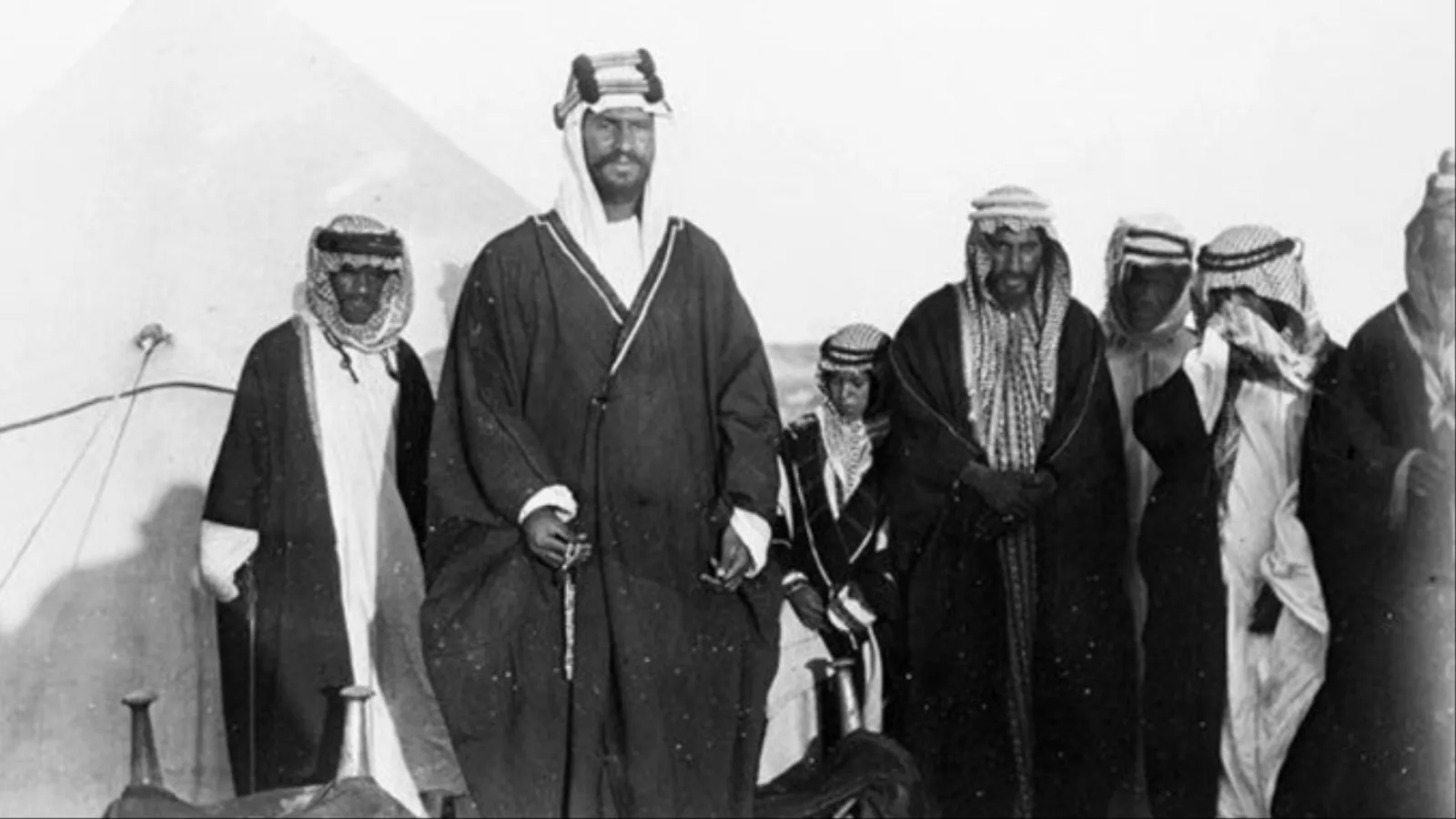
A picture of King Abdulaziz with Sheikh Faisal bin Sultan Al-Dawish next to him, taken by the English officer Shakespeare the day before the Battle of Jerab where Shakespeare was killed.
Date24 January 1915[1]
Location
Jarrab Lake, North of town of Al Majma'ah, Arabia
Result Jabal Shammar victory
Belligerents
Jabal Shammar
Supported by:
Ottoman Empire
Nejd and Hasa
Supported by:
United Kingdom of Great Britain and Ireland British Empire
Commanders and leaders
Saud bin Abdulaziz
Saud bin Saleh Al Sabhan 
Abdulaziz Ibn Saud
United Kingdom of Great Britain and Ireland William Shakespear 
Strength
1,500–1,800 2,000
Casualties and losses
Few 600

The Battle of Jarrab was a territorial battle between the Al Saud and their traditional enemies, the Al Rashid on 24 January 1915.[1][2] It was a proxy battle of World War I and the Second Saud-Rashidi War between the British-supported Saudis and the Ottoman-supported Rashidis.[2]

Rashidi forces led by young Saud bin Abdulaziz Al Rashid defeated the forces of Ibn Saud.[3] The main significance of the battle was the death of Ibn Saud's British Military Advisor, Captain William Shakespear.[4] The reason for the defeat of Ibn Saud's forces is given by both Arabic and British sources as the withdrawal of the Ajman tribe led by Dhaydan bin Hithlain from the battlefield.[4]

The defeat and the death of William Shakespear diminished the relationship between Ibn Saud and the British changing the course of the Arab Revolt against the Ottoman Empire.[5] It also resulted other negative conclusions for Ibn Saud, including a year-long struggle with the Ajman tribe, namely the Battle of Kanzan, and the decrease in his newly emerged prestige.[5]

See also

[edit]

References

[edit]

Literature

[edit]
  • Travellers in Arabia, Eid Al Yahya, Stacey International (2006). ISBN 0-9552193-1-0 (9780955219313).
  • The Historical Journal 14 (3) (September 1971), pp. 627–633.
  • H. St. John Philby. (1930). Arabia, London.


Revisions and contributorsEdit on WikipediaRead on Wikipedia
from Grokipedia
The Battle of Jarrab was a military confrontation in January 1915 between the forces of the , commanded by Abdulaziz Al Saud, and those of the , under , near Jarrab in central Arabia. The Rashidi forces achieved victory, inflicting a defeat on the Saudi army despite initial advantages in cavalry, which temporarily checked Al Saud's territorial ambitions during the early stages of . A pivotal event in the ongoing Saudi-Rashidi rivalry, the battle served as a proxy conflict reflecting broader wartime alignments, with Al Saud leaning toward British interests and Al Rashid maintaining ties to the . The death of British political and William Shakespear, who fought alongside Al Saud and was killed by Rashidi gunfire, underscored the international dimensions of the engagement and prompted intensified British support for Al Saud in subsequent operations.

Background

Saudi-Rashidi Rivalry

The Al Rashid dynasty established control over the in the 1830s, with Abdullah bin Rashid seizing Ha'il as the capital and expanding influence southward through military campaigns and alliances with nomadic tribes, including the confederation from which the rulers originated. This positioned the Rashidis as dominant in northern and central Arabia, overseeing vital oases like Ha'il and strategic caravan routes linking the Arabian interior to Syrian and Iraqi markets, which generated revenue from tolls, protection fees, and trade in dates, grains, and livestock. In contrast, the Al Saud family, based in Nejd around , faced repeated setbacks during the decline of their second state, culminating in the Rashidi capture of in 1891 amid tribal revolts and internal divisions that forced the Al Saud into exile in . Abdulaziz ibn Saud's daring raid on January 15, 1902, recaptured from the Rashidi-appointed governor Ajlan ibn Muhammad, killing him and restoring Al Saud authority over the Nejd heartland with a force of about 40 men who scaled the city's walls using trunks. This event ignited a cycle of retaliatory conquests, as Abdulaziz consolidated power by subduing local sheikhs and expanding into eastern oases like al-Hasa by , directly challenging Rashidi hegemony over the agriculturally rich Qassim region, which featured over 20 settlements producing wheat, dates, and fruits essential for sustaining armies and urban populations. The ensuing First Saudi-Rashidi War (1903–1907) saw sporadic clashes, including Saudi victories at Bukairi in 1906 that secured parts of Qassim, underscoring the rivalry's roots in territorial control rather than ideology, with both sides leveraging levies—Rashidis drawing from camel nomads for mobility, while Saudis courted tribes like the for cavalry support in raids. By the early , the contest had escalated into a broader struggle for supremacy in central Arabia, where economic incentives intertwined with tribal loyalties: Rashidi dominance ensured monopolies on northern trade corridors, while Saudi advances threatened to redirect commerce southward through , fostering revenge-driven alliances that destabilized the desert frontiers and drew in external powers seeking proxies amid weakening Ottoman oversight. These dynamics, marked by ambushes, sieges, and shifting allegiances among subtribes, perpetuated a pattern of expansion and contraction, with neither side achieving decisive victory until external interventions in , setting the stage for intensified confrontations over borderlands like Jarrab.

World War I Alignments

The , aligned with the following its entry into on October 29, 1914, reinforced its longstanding partnership with the Al Rashid rulers of the to maintain influence in and counter British expansionism in Arabia. This alliance, dating to the 1880s, involved supplying arms, subsidies, and Ottoman military advisors to Emir Abdullah bin Rashid, enabling the Rashidis to project power against rivals and secure the region as a bulwark against Entente incursions. Such support was strategically aimed at preserving Ottoman amid the global conflict, transforming the local Saudi-Rashidi feud into an extension of imperial rivalries. Abdulaziz ibn Saud, ruler of the , adopted a stance of initial neutrality upon the war's outbreak, having earlier sought but failed to obtain binding British guarantees against Ottoman threats. British overtures escalated from early , with offers of financial subsidies, weaponry, and as independent in exchange for restraining Ottoman activities and potential military cooperation. These incentives reflected Britain's imperative to neutralize Ottoman proxies in the periphery, gradually drawing toward alignment despite his primary orientation toward consolidating power against the Rashidis rather than direct participation in broader theaters. The subsequent , initiated by Sharif Hussein bin Ali of on June 5, 1916, under British patronage, introduced indirect pressures on by amplifying anti-Ottoman momentum across the peninsula, though he prioritized neutralizing the Ottoman-backed Rashidi stronghold over joining Hussein's campaign. This divergence underscored Ibn Saud's pragmatic focus on existential tribal threats, yet the revolt's success in weakening Ottoman garrisons facilitated his anti-Rashidi efforts by diverting imperial resources. Overall, these alignments rendered the rivalry a proxy arena, where aid amplified local capabilities without fully dictating outcomes determined by terrain, tribal loyalties, and command decisions.

Prelude

Territorial Disputes and Mobilization

In late 1914, territorial tensions between the Emirate of Nejd under and the under the Al Rashid intensified over disputed borderlands in eastern Nejd, particularly around the Jarrab depression near al-Zulfi, a vital seasonal water source known as Lake Jarrab essential for pastoralism and caravan routes. Rashidi forces, seeking to reclaim influence lost in prior Saudi expansions, launched probing raids into these Al Saud-claimed territories, escalating minor skirmishes over grazing rights and water access into broader mobilizations that threatened Nejd's cohesion. These incursions, numbering in the dozens according to contemporary accounts, disrupted local tribal economies and prompted retaliatory Saudi patrols, setting the stage for direct confrontation by early January 1915. Abdulaziz mobilized defensive forces comprising core Nejdi levies and allied contingents, dispatching an estimated 1,500-2,000 men under subordinate commanders to fortify positions at Jarrab and deter further eastern encroachments from Ha'il. Tribal groups such as the and Mutair were recruited through promises of spoils and protection, but their participation hinged on fluid loyalties influenced by recent raids, kinship ties to the Rashidis, and material incentives, foreshadowing defections during the ensuing clash. On the Rashidi side, Muhammad ibn Abdullah Al Rashid urged mobilization of confederates and conscripted levies, totaling around 3,000 fighters led by his nephew Saud al-Kabir bin Al Rashid, framing the campaign as a reclamation of ancestral Nejdi domains amid the ongoing Saudi-Rashidi rivalry. These buildups reflected deeper causal dynamics of resource scarcity and in arid central Arabia, where control of oases and wadis like Jarrab determined tribal viability and state legitimacy, unmitigated by formal borders until post-war delineations. Empirical records from British observers embedded in the confirm the raids' role in catalyzing the January 24, 1915, engagement, with no evidence of premeditated Saudi aggression but rather reactive fortification against Ha'il's opportunistic advances.

British and Ottoman Influences

Captain William Shakespear, a British political agent and explorer, embedded himself with Abdulaziz ibn Saud's forces in the lead-up to the Battle of Jarrab on 24 January 1915, offering tactical intelligence, photographic reconnaissance, and diplomatic counsel to foster anti-Ottoman maneuvers. Shakespear's presence exemplified Britain's strategic interest in cultivating Ibn Saud as a counterforce to Ottoman dominance in central Arabia, though material assistance was confined to advisory input and mapping support rather than arms shipments, reflecting London's pre-treaty reticence amid World War I entanglements. In early January 1915, he transmitted an initial draft of a prospective Anglo-Saudi treaty to British authorities, advocating for formal recognition of Ibn Saud's territorial claims in exchange for opposition to Ottoman proxies. Ottoman influence operated through bolstering the under Mohammed bin Abdullah Al Rashid, supplying rifles, ammunition, and fiscal subsidies to sustain its role as a frontline against British spheres in and the Gulf sheikhdoms. This reinforcement framed the prelude to Jarrab as a localized proxy skirmish within the broader Anglo-Ottoman imperial rivalry, with prioritizing Rashidi resilience to forestall Wahhabi expansion southward and secure northern trade routes. Direct Ottoman military contingents were not deployed to the theater, limiting support to logistical enhancements that augmented Al Rashid's tribal levies without altering their predominantly composition. Ibn Saud, navigating dual Ottoman suzerainty and nascent British overtures, adopted a provisional stance pre-battle, eschewing overt belligerence toward to preserve maneuverability amid precarious alliances. This hesitancy persisted until the post-Jarrab on 26 December 1915, wherein Britain pledged protection and subsidies in return for Ibn Saud's pledge to disrupt Ottoman communications, marking a pivotal shift from to explicit alignment only after testing Rashidi vulnerabilities.

The Battle

Opposing Forces

The forces aligned with Abdulaziz ibn Saud of the totaled historical estimates of 1,000–2,000 fighters, primarily irregulars and levies from Nejd tribes such as the , equipped with a mix of rifles and traditional swords. These semi-nomadic units emphasized rapid camel-based maneuvers adapted to the harsh, water-scarce terrain along the Nafud desert's southern edge, where oases like Jarrab determined operational feasibility. Opposing them, the fielded forces under estimated at 3,000–4,000 strong, drawing heavily from loyal tribesmen and regional allies with superior from Ottoman-backed supply lines. This contingent benefited from enhanced , including greater quantities of modern rifles funneled via Ha'il's connections to Ottoman garrisons, offsetting the decentralized nature of tribal mobilization. Both sides' reliance on caravans underscored the battle's dependence on desert mobility, though Rashidi access to Jarrab's wells provided a tactical edge in endurance.

Course of the Engagement

Rashidi forces, commanded by Saud bin AbdulʿAzīz Āl Rashīd, launched an assault on the Saudi encampment at Jarrab Lake, exploiting their superior numbers—estimated at around 1,500 fighters against a similar but less cohesive Saudi force—and intimate knowledge of the arid terrain north of Al Majmaʿah. The attack caught the Saudis, dispatched northward under field commanders while ʿAbd al-ʿAzīz Āl Suʿūd directed operations from , in a vulnerable position near the water source, initiating intense clashes that sources date variably from 17 to 24 January 1915. Saudi troops mounted a defensive stand, leveraging their Ikhwan contingents' fanaticism, but faltered amid ammunition shortages that hampered sustained fire and reports of tribal wavering or defections amid the rout. British political officer William Shakespear, embedded with the Saudi column to coordinate against Ottoman-aligned foes, was killed in the fighting on 24 January, underscoring the proxy dimensions of the engagement. Over the ensuing hours to days of sporadic but fierce exchanges, the ' cohesion broke, compelling a disorganized withdrawal eastward toward their Nejd heartlands and ceding the field to the Rashidis. This outcome stemmed causally from the Rashidis' tactical initiative and the ' logistical strains, rather than any decisive maneuver, marking a temporary setback in Saudi expansion.

Aftermath

Immediate Military Outcomes

The Rashidi forces, commanded by , achieved a tactical victory over the Saudi army led by Abdulaziz ibn Saud at Jarrab on 24 January 1915, securing short-term control of the surrounding area and repelling the Saudi advance toward Ha'il. This outcome disrupted Saudi momentum in their northward push during the Second Saudi-Rashidi War, affirming Rashidi defensive capabilities in the contested Qasim frontier. Saudi troops executed a disorganized withdrawal southward, with Abdulaziz ibn Saud retreating to to regroup his remaining forces and address internal tribal unrest, such as the emerging revolt, which further limited consolidation efforts. The absence of pursuit by Rashidi units prevented total annihilation of the Saudi contingent, preserving its core strength for future engagements while exposing logistical vulnerabilities inherent to prolonged desert operations. The battle's results underscored a war of attrition rather than decisive conquest, as Rashidi gains in Jarrab proved ephemeral and insufficient to shift the broader frontline significantly beyond local stabilization.

Casualties and Tribal Dynamics

Casualty figures for the Battle of Jarrab remain imprecise due to contradictory contemporary reports and the absence of detailed records from the skirmish-oriented engagement. Saudi-aligned accounts minimized their losses to a few dozen killed, emphasizing tactical withdrawal over defeat, while Rashidi sources claimed higher Saudi casualties in the low hundreds, portraying a decisive without corresponding verification of slaughter on either side. The death of Captain William Shakespear, Ibn Saud's British military advisor, represented a singularly documented Saudi loss, struck by gunfire amid the chaos, which disrupted British advisory support but did not indicate broader devastation. These estimates align with the battle's scale—roughly 1,500–2,000 combatants per side—and the prevalence of among forces, which typically limited fatalities compared to prolonged sieges. Post-battle tribal dynamics revealed the fragility of alliances in , where loyalties hinged on immediate gains rather than enduring fealty. The tribe's mid-engagement withdrawal, led by , directly precipitated the Saudi retreat and fueled subsequent unrest, escalating into open revolt against 's authority in . This defection temporarily bolstered Rashidi influence, drawing opportunistic support from segments of other groups, including some Mutair sheikhs who shifted allegiance amid perceptions of Saudi vulnerability. countered these realignments through targeted subsidies and co-optation, reintegrating elements by 1916 and stabilizing his tribal base without formal treaties, underscoring the pragmatic, subsidy-driven nature of desert politics over ideological commitment. Verifiable participant accounts, such as those from British observers, highlight these shifts as driven by rather than inflated narratives of unyielding tribal ferocity.

Strategic and Historical Impact

Role in the Second Saudi-Rashidi War

The Battle of Jarrab, fought on 24 January 1915, represented a tactical setback for ibn Saud's forces during the early phases of the renewed Saudi-Rashidi conflict, which intensified from 1911 onward and extended into 1921, amid the broader proxy dynamics of . As Al Saud cavalry initially gained ground but ultimately withdrew after heavy fighting against Ottoman-backed Al Rashid troops, the engagement underscored the limitations of nascent British material support—limited to advisors like the slain Captain William Shakespear—contrasted with the Rashidis' access to Ottoman arms and reinforcements, which proved more reliable in the short term despite the empire's distant commitments. This outcome temporarily stalled Al Saud momentum, contributing to a period of defensive consolidation in Nejd rather than immediate northern expansion. Jarrab's indecisive nature, marked by mutual retreats and significant casualties without territorial gains for either side, exemplified the resource strains afflicting both factions during ; Ottoman focus on European fronts diluted sustained aid to the Rashidis, while British reluctance to commit substantial forces pre- constrained Al Saud offensives. The battle preceded by months the December 1915 , which formalized Anglo-Saudi alignment and provided rifles, subsidies, and recognition, enabling recovery from Jarrab's losses. Historians note this as a pivot, where the setback highlighted alliance vulnerabilities but did not fracture Al Saud resolve, instead prompting strategic restraint amid Rashidi overextension southward. In the war's progression, Jarrab initiated a cycle of attritional clashes that exposed Rashidi vulnerabilities, including tribal defections and logistical overreach, paving the way for Al Saud counteroffensives by 1918–1920. These built on post-Jarrab stabilization, culminating in the November 1921 capture of Ha'il, the Rashidi capital, which dismantled the and ended the dynasty's rule after a of intermittent engagements totaling several thousand combatants across fronts like Qasim and Jawf. Empirical accounts of the war's 1915–1921 phase record Jarrab among roughly five major indecisive battles, where neither side achieved decisive superiority until Al Saud's Ikhwan-augmented forces overwhelmed depleted Rashidi defenses, influenced by wartime exhaustion rather than singular heroism.

Long-Term Consequences for Saudi Unification

The defeat at Jarrab on January 24, 1915, compelled Abdulaziz ibn Saud to recalibrate his military strategy amid ongoing vulnerabilities exposed by Rashidi resilience and internal tribal unrest, such as the subsequent revolt that preoccupied his forces through much of 1915. This setback underscored the limitations of his early reliance on loosely organized tribal levies, prompting a shift toward disciplined fighters and external alliances to bolster cohesion and logistics for sustained campaigns. Rather than signaling inevitable decline, the battle highlighted Abdulaziz's adaptive , as he leveraged post-defeat to secure the in December 1915, which provided British gold and arms despite the loss of advisor William Shakespear. These resources proved instrumental in enabling Abdulaziz's expansion beyond Nejd, facilitating the resolution of the in 1919 against Hashemite claimants and culminating in the in November 1921, which dismantled the Rashidi emirate after a prolonged . The Ha'il victory, supported by auxiliaries and British-supplied weaponry, eliminated a primary northern rival and integrated Jabal Shammar territories into Saudi control, marking a pivotal step toward the 1932 proclamation of the Kingdom of Saudi Arabia. From a Rashidi vantage, as reflected in Ottoman-aligned tribal records, Jarrab epitomized a high-water mark of resistance to Al Saud's Wahhabi-driven incursions, critiquing Abdulaziz's foreign entanglements as opportunistic dilutions of Arabian in favor of imperial patronage. Contrary to deterministic views of Saudi ascendancy as preordained by doctrinal fervor, Jarrab's outcome necessitated pragmatic concessions—intensified regimentation and Anglo-Saudi coordination—that causally propelled unification by addressing logistical shortfalls evident in the engagement's . This pivot mitigated the battle's immediate erosion of momentum, transforming transient weakness into a foundation for territorial consolidation, though Rashidi chroniclers emphasized how such external dependencies alienated purist factions, sowing seeds of later rebellions quelled only in the late 1920s. Ultimately, the episode reinforced Abdulaziz's pattern of resilient opportunism over rigid ideological purity, enabling the absorption of fractious regions into a centralized state apparatus.

References

Add your contribution
Related Hubs
Contribute something
User Avatar
No comments yet.