Hubbry Logo
search
logo

Beam diameter

logo
Community Hub0 Subscribers
Read side by side
from Wikipedia

The beam diameter or beam width of an electromagnetic beam is the diameter along any specified line that is perpendicular to the beam axis and intersects it. Since beams typically do not have sharp edges, the diameter can be defined in many different ways. Five definitions of the beam width are in common use: D4σ, 10/90 or 20/80 knife-edge, 1/e2, FWHM, and D86. The beam width can be measured in units of length at a particular plane perpendicular to the beam axis, but it can also refer to the angular width, which is the angle subtended by the beam at the source. The angular width is also called the beam divergence.

Beam diameter is usually used to characterize electromagnetic beams in the optical regime, and occasionally in the microwave regime, that is, cases in which the aperture from which the beam emerges is very large with respect to the wavelength.

Beam diameter usually refers to a beam of circular cross section, but not necessarily so. A beam may, for example, have an elliptical cross section, in which case the orientation of the beam diameter must be specified, for example with respect to the major or minor axis of the elliptical cross section. The term "beam width" may be preferred in applications where the beam does not have circular symmetry.

Definitions

[edit]

Siegman[1] lists seven different measures of beam width, with some of the practical difficulties of defining beam width. Commonly used definitions include:

Rayleigh beamwidth

[edit]

The angle between the maximum peak of radiated power and the first null (no power radiated in this direction) is called the Rayleigh beamwidth. This is well-defined for some beam profiles, for example, the Airy diffraction pattern of a uniformly-lit aperture, but is undefined for an ideal Gaussian beam.

Full width at half maximum

[edit]

The simplest way to define the width of a beam is to choose two diametrically opposite points at which the irradiance is a specified fraction of the beam's peak irradiance, and take the distance between them as a measure of the beam's width. An obvious choice for this fraction is 1/2 (−3 dB), in which case the diameter obtained is the full width of the beam at half its maximum intensity (FWHM). This is also called the half-power beam width (HPBW).

1/e2 width

[edit]

The 1/e2 width is the distance between the two points where the intensity falls to 1/e2 = 0.135 times the maximum value. If there are more than two points that are 1/e2 times the maximum value, then the two points closest to the maximum are chosen. The 1/e2 width is important in the mathematics of Gaussian beams, in which the intensity profile is described by

The American National Standard Z136.1-2007 for Safe Use of Lasers (p. 6) defines the beam diameter as the distance between diametrically opposed points in that cross-section of a beam where the power per unit area is 1/e (0.368) times that of the peak power per unit area. This is the beam diameter definition that is used for computing the maximum permissible exposure to a laser beam. The Federal Aviation Administration also uses the 1/e definition for laser safety calculations in FAA Order JO 7400.2, Para. 29-1-5d.[2]

Measurements of the 1/e2 width only depend on three points on the marginal distribution, unlike D4σ and knife-edge widths that depend on the integral of the marginal distribution. 1/e2 width measurements are noisier than D4σ width measurements. For multimodal marginal distributions (a beam profile with multiple peaks), the 1/e2 width usually does not yield a meaningful value and can grossly underestimate the inherent width of the beam. For multimodal distributions, the D4σ width is a better choice. For an ideal single-mode Gaussian beam, the D4σ, D86 and 1/e2 width measurements would give the same value.

For a Gaussian beam, the relationship between the 1/e2 width and the full width at half maximum is where is the full width of the beam at 1/e2.[3]

D4σ or second-moment width

[edit]

The D4σ width of a beam in the horizontal or vertical direction is 4 times σ, where σ is the standard deviation of the horizontal or vertical marginal distribution respectively. Mathematically, the D4σ beam width in the x dimension for the beam profile is expressed as[1]


where
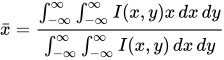
is the centroid of the beam profile in the x direction.

When a beam is measured with a laser beam profiler, the wings of the beam profile influence the D4σ value more than the center of the profile, since the wings are weighted by the square of its distance, x2, from the center of the beam. If the beam does not fill more than a third of the beam profiler's sensor area, then there will be a significant number of pixels at the edges of the sensor that register a small baseline value (the background value). If the baseline value is large or if it is not subtracted out of the image, then the computed D4σ value will be larger than the actual value because the baseline value near the edges of the sensor are weighted in the D4σ integral by x2. Therefore, baseline subtraction is necessary for accurate D4σ measurements. The baseline is easily measured by recording the average value for each pixel when the sensor is not illuminated. The D4σ width, unlike the FWHM and 1/e2 widths, is meaningful for multimodal marginal distributions — that is, beam profiles with multiple peaks — but requires careful subtraction of the baseline for accurate results. The D4σ is the ISO international standard definition for beam width.

Knife-edge width

[edit]

Before the advent of the CCD beam profiler, the beam width was estimated using the knife-edge technique: slice a laser beam with a razor and measure the power of the clipped beam as a function of the razor position. The measured curve is the integral of the marginal distribution, and starts at the total beam power and decreases monotonically to zero power. The width of the beam is defined as the distance between the points of the measured curve that are 10% and 90% (or 20% and 80%) of the maximum value. If the baseline value is small or subtracted out, the knife-edge beam width always corresponds to 60%, in the case of 20/80, or 80%, in the case of 10/90, of the total beam power no matter what the beam profile. On the other hand, the D4σ, 1/e2, and FWHM widths encompass fractions of power that are beam-shape dependent. Therefore, the 10/90 or 20/80 knife-edge width is a useful metric when the user wishes to be sure that the width encompasses a fixed fraction of total beam power. Most CCD beam profiler's software can compute the knife-edge width numerically.

Fusing knife-edge method with imaging

[edit]

The main drawback of the knife-edge technique is that the measured value is displayed only on the scanning direction, minimizing the amount of relevant beam information. To overcome this drawback, an innovative technology offered commercially allows multiple directions beam scanning to create an image like beam representation.[4]

By mechanically moving the knife edge across the beam, the amount of energy impinging the detector area is determined by the obstruction. The profile is then measured from the knife-edge velocity and its relation to the detector's energy reading. Unlike other systems, a unique scanning technique uses several different oriented knife-edges to sweep across the beam. By using tomographic reconstruction, mathematical processes reconstruct the laser beam size in different orientations to an image similar to the one produced by CCD cameras. The main advantage of this scanning method is that it is free from pixel size limitations (as in CCD cameras) and allows beam reconstructions with wavelengths not usable with existing CCD technology. Reconstruction is possible for beams in deep UV to far IR.

D86 width

[edit]

The D86 width is defined as the diameter of the circle that is centered at the centroid of the beam profile and contains 86% of the beam power. The solution for D86 is found by computing the area of increasingly larger circles around the centroid until the area contains 0.86 of the total power. Unlike the previous beam width definitions, the D86 width is not derived from marginal distributions. The percentage of 86, rather than 50, 80, or 90, is chosen because a circular Gaussian beam profile integrated down to 1/e2 of its peak value contains 86% of its total power. The D86 width is often used in applications that are concerned with knowing exactly how much power is in a given area. For example, applications of high-energy laser weapons and lidars require precise knowledge of how much transmitted power actually illuminates the target.

ISO11146 beam width for elliptic beams

[edit]

The definition given before holds for stigmatic (circular symmetric) beams only. For astigmatic beams, however, a more rigorous definition of the beam width has to be used:[5]

and

This definition also incorporates information about xy correlation , but for circular symmetric beams, both definitions are the same.

Some new symbols appeared within the formulas, which are the first- and second-order moments:
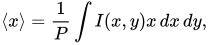
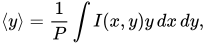
the beam power
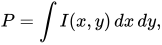
and

Using this general definition, also the beam azimuthal angle can be expressed. It is the angle between the beam directions of minimal and maximal elongations, known as principal axes, and the laboratory system, being the and axes of the detector and given by

Measurement

[edit]

International standard ISO 11146-1:2005 specifies methods for measuring beam widths (diameters), divergence angles and beam propagation ratios of laser beams (if the beam is stigmatic) and for general astigmatic beams ISO 11146-2 is applicable.[6][7] The D4σ beam width is the ISO standard definition and the measurement of the M2 beam quality parameter requires the measurement of the D4σ widths.[6][7][8]

The other definitions provide complementary information to the D4σ. The D4σ and knife-edge widths are sensitive to the baseline value, whereas the 1/e2 and FWHM widths are not. The fraction of total beam power encompassed by the beam width depends on which definition is used.

The width of laser beams can be measured by capturing an image on a camera, or by using a laser beam profiler.

See also

[edit]

References

[edit]
Revisions and contributorsEdit on WikipediaRead on Wikipedia
from Grokipedia
The beam diameter is the transverse width of a light beam, such as a laser beam, measured perpendicular to its axis of propagation and typically defined as twice the beam radius, where the radius represents the distance from the center to the point at which the beam's intensity drops to a specific fraction (often 1/e² or approximately 13.5%) of its peak value.[1] This parameter is fundamental in optics for characterizing beam geometry, propagation behavior, and interaction with optical components.[2] In laser systems, beam diameter is crucial for assessing beam quality and performance, influencing factors like focusability, divergence, and power density.[3] Several standardized definitions exist to quantify it precisely, accommodating different beam profiles:
  • Full Width at Half Maximum (FWHM): The distance across the beam where the intensity is at least 50% of the maximum, commonly used for non-Gaussian or multimodal beams; for ideal Gaussian beams, it approximates 1.177 times the 1/e² beam radius.[4]
  • 1/e² Diameter: Based on the Gaussian beam model, this measures the width where intensity falls to 1/e² (about 13.5%) of the peak, enclosing approximately 86.5% of the total power and serving as a standard for many laser specifications.[2]
  • D4σ Method: Defined by ISO 11146 as four times the standard deviation (σ) of the intensity distribution's second moment, this approach is versatile for both Gaussian and non-ideal beams, ensuring accurate predictions of beam evolution during propagation.[1][4]
These definitions are selected based on application needs, such as precision manufacturing, medical procedures, or safety assessments like nominal ocular hazard distance (NOHD), where accurate beam sizing prevents thermal damage.[5] Beam diameter typically ranges from micrometers to millimeters at the laser output, depending on the source (e.g., 0.5–1 mm for helium-neon lasers, 2.5–5 mm for diode lasers), and it expands with distance due to diffraction, governed by the beam waist and divergence angle.[2] Tools like beam profilers enable direct measurement, often incorporating noise reduction and background subtraction for reliability.[1]

Core Concepts

Physical Basis of Beam Diameter

The beam diameter characterizes the transverse spatial extent of an electromagnetic beam's intensity profile, representing the width over which the beam's energy is primarily distributed perpendicular to its direction of propagation.[6] In coherent optical beams, such as those produced by lasers, this profile is fundamentally Gaussian, with the electric field amplitude varying as exp(r2/w2)\exp(-r^2 / w^2), where rr is the radial distance from the beam axis and ww is the beam radius defined at the 1/e21/e^2 intensity points. This Gaussian form arises from solutions to the paraxial wave equation, which approximates the Helmholtz equation for beams propagating nearly parallel to the optical axis, ensuring minimal diffraction losses over propagation distances.[6] Central to the physical basis is the Gaussian beam model, which describes how the beam evolves along its propagation axis zz. The beam reaches its minimum diameter, known as the beam waist w0w_0, at the focal point, beyond which it diverges due to diffraction.[7] The beam radius w(z)w(z) at any axial position is given by
w(z)=w01+(zzR)2, w(z) = w_0 \sqrt{1 + \left( \frac{z}{z_R} \right)^2},
where zR=πw02/λz_R = \pi w_0^2 / \lambda is the Rayleigh range, defining the distance over which the beam area remains roughly constant before significant spreading occurs, and λ\lambda is the wavelength.[6] Beam divergence, quantified as the far-field half-angle θλ/(πw0)\theta \approx \lambda / (\pi w_0), quantifies this spreading and is inversely proportional to the waist size, highlighting the trade-off between focus tightness and propagation stability. These relations stem from the beam's complex curvature and phase structure, including the Gouy phase shift, which totals π\pi radians over the full propagation distance from far field to far field due to transverse confinement.[8] The foundational principles of beam diameter trace their origins to 19th-century optics, where Louis Georges Gouy identified anomalous phase shifts in focused waves in 1890, laying groundwork for understanding diffraction-limited propagation.[9] However, the modern conceptualization gained prominence with the invention of the laser in 1960 by Theodore Maiman, which produced highly coherent Gaussian-mode outputs and necessitated precise models for beam characterization in applications like precision cutting and optical communication. This development transformed beam diameter from a theoretical construct into a critical parameter for engineering light-matter interactions.[10]

Factors Influencing Beam Propagation

The propagation of a laser beam's diameter is fundamentally governed by diffraction, which causes the beam to spread over distance due to the wave nature of light, with the extent of spreading proportional to the wavelength and inversely related to the initial beam waist.[11] In free space, this diffraction-limited broadening is described for ideal Gaussian beams, where higher-order modes or imperfections increase the effective divergence.[12] Absorption in the propagation medium reduces beam intensity without directly altering the diameter but can indirectly affect perceived width through diminished signal strength in measurements.[13] Scattering, however, contributes to beam broadening by redirecting photons away from the primary path, particularly in aerosols or particulate-laden atmospheres, where Mie scattering dominates for wavelengths comparable to particle sizes.[13] In clear atmospheric conditions, molecular scattering like Rayleigh adds minimal broadening but accumulates over long paths.[14] Properties of the propagation medium, such as variations in refractive index, significantly influence beam diameter; a uniform index primarily affects phase velocity, but gradients—arising from temperature, pressure, or humidity fluctuations—induce beam bending and distortion.[15] Atmospheric turbulence, characterized by refractive index fluctuations, exacerbates this through effects like beam wander and scintillation, leading to an effective increase in beam diameter by factors dependent on the turbulence strength parameter Cn2C_n^2.[13] In high-intensity beams, nonlinear optical effects emerge, where the Kerr nonlinearity induces a intensity-dependent refractive index change, causing self-focusing that reduces the beam diameter until balanced by diffraction or plasma formation.[16] This self-focusing, first theoretically described in the early 1960s, can collapse the beam to catastrophic intensities if power exceeds the critical threshold, altering propagation dynamics in media like glass or plasmas.[17] The beam quality factor M2M^2 qualitatively modulates these influences, with M2=1M^2 = 1 for diffraction-limited beams yielding minimal broadening in free space, while M2>1M^2 > 1 accelerates divergence, as seen in multimode fiber outputs where the effective waist expands faster than in single-mode fibers.[12] In fiber optics, total internal reflection confines the beam, suppressing diffraction-induced broadening and maintaining near-constant diameter over long distances, unlike free-space propagation where environmental factors dominate unchecked spreading.[18] For example, a fiber-delivered beam with low M2M^2 preserves focusability upon exit, whereas free-space beams degrade more rapidly due to cumulative diffraction and turbulence.[11]

Definitions and Metrics

Full Width at Half Maximum (FWHM)

The full width at half maximum (FWHM) is defined as the distance between the two points on a beam's transverse intensity profile where the intensity equals half of its peak value, providing a measure of the beam's effective diameter at the central region.[4] This metric is particularly robust for characterizing beam diameters in both Gaussian and non-Gaussian profiles, such as Lorentzian distributions commonly encountered in spectral lines or multimode laser outputs.[19][20] For a Gaussian beam, the FWHM relates directly to the standard 1/e² beam radius $ w $ by the approximation FWHM1.177w\mathrm{FWHM} \approx 1.177 w, derived from the intensity profile $ I(r) = I_0 \exp(-2 r^2 / w^2) $, where the half-maximum occurs at $ r = w \sqrt{(\ln 2)/2} $.[21] This relation allows straightforward conversion between common beam size conventions in laser optics.[1] In astronomy, FWHM quantifies the primary beam size or point spread function, directly influencing the resolving power and field of view in observations, as seen in submillimeter arrays where it defines the effective telescope diameter.[22] Similarly, in spectroscopy, the FWHM of a beam or spectral line determines instrumental resolution, with $ R = \lambda / \Delta\lambda $ where $ \Delta\lambda $ is the FWHM, enabling precise analysis of emission features in astronomical and laboratory settings.[23] A key advantage of FWHM is its ease of measurement using direct intensity thresholding, making it intuitive and applicable to irregular or clipped beam profiles without requiring complex statistical analysis.[20] However, it is insensitive to low-intensity tails in the beam profile, potentially underestimating the total energy spread or effective size for non-Gaussian beams with significant peripheral content.[4][20]

1/e² Width

The 1/e² width refers to the beam diameter measured at points where the intensity drops to 1/e20.1351/e^2 \approx 0.135 (or about 13.5%) of the peak intensity. This metric is particularly standard for characterizing Gaussian laser beams, as it aligns with the natural mathematical form of their transverse intensity distribution.[21] For an ideal Gaussian beam, the radial intensity profile is described by the equation
I(r)=I0exp(2r2w2), I(r) = I_0 \exp\left(-2 \frac{r^2}{w^2}\right),
where I0I_0 is the on-axis peak intensity, rr is the radial distance from the beam axis, and ww is the beam radius at the 1/e² intensity level. The corresponding diameter is then d=2wd = 2w. This definition facilitates precise modeling of beam propagation, as the 1/e² contour captures approximately 86.5% of the total beam power within the circle of radius ww.[21][4] The enclosed power within a radius RR is derived from integrating the intensity over the circular area:
P(R)=P[1exp(2R2w(z)2)], P(R) = P \left[ 1 - \exp\left( -\frac{2R^2}{w(z)^2} \right) \right],
where PP is the total power, obtained as $ P = \frac{\pi w(z)^2 I_0}{2} $. Setting R=w(z)R = w(z) yields P(R)/P=1e20.865P(R)/P = 1 - e^{-2} \approx 0.865, confirming the 86.5% energy containment. The full 1/e² beamwidth is thus $ d = 2 w(z) $, with $ w(z) = w_0 \sqrt{1 + (z/z_R)^2} $, where w0w_0 is the waist radius and zR=πw02/λz_R = \pi w_0^2 / \lambda is the Rayleigh range.[21][11] The 1/e² width became a standardized metric in the laser industry during the 1970s, reflecting the growing adoption of Gaussian beam theory in practical applications. It directly informs key performance indicators, such as the beam parameter product w0θw_0 \theta, where w0w_0 is the beam waist radius (at 1/e²) and θ\theta is the far-field divergence half-angle; for a diffraction-limited Gaussian beam, this product equals λ/π\lambda / \pi, with λ\lambda being the wavelength. This relation underscores the metric's role in assessing beam quality and focusing ability.[24][21] Despite its ubiquity, the 1/e² width assumes a perfect Gaussian profile and thus has limitations when applied to multimode beams, where higher-order modes introduce deviations from the ideal shape, leading to inaccurate size estimates. In such cases, alternative metrics may be necessary to capture the full beam structure. The 1/e² width offers simplicity in characterizing fundamental-mode Gaussian beams, directly tying to the spot size parameter w(z)w(z) for propagation modeling. However, it has limitations for non-Gaussian profiles, such as multimode or distorted beams, where the 1/e21/e^2 intensity contour does not reliably enclose 86% of the energy due to deviations from the assumed Gaussian shape.[25][26]

Second-Moment Width (D4σ)

The second-moment width, denoted as D4σD_{4\sigma}, provides a statistically rigorous metric for the diameter of a laser beam by leveraging the variance of the intensity distribution across the entire transverse profile. This approach treats the beam as a probability distribution weighted by local intensity, where the second moment captures the spread of energy without assuming a specific shape.[1] Formally, D4σ=4r2D_{4\sigma} = 4 \sqrt{\langle r^2 \rangle}, with r2=r2I(r,θ)rdrdθI(r,θ)rdrdθ\langle r^2 \rangle = \frac{\int r^2 I(r,\theta) \, r \, dr \, d\theta}{\int I(r,\theta) \, r \, dr \, d\theta} representing the intensity-weighted mean squared radial distance from the beam centroid, integrated over the full two-dimensional plane. This derivation arises from the root-mean-square (RMS) deviation σ=r2r2\sigma = \sqrt{\langle r^2 \rangle - \langle r \rangle^2}, which simplifies to r2\sqrt{\langle r^2 \rangle} for a centered beam (r=0\langle r \rangle = 0), yielding the full width as 4σ4\sigma. For an ideal Gaussian beam with intensity profile I(r)=I0exp(2r2/w2)I(r) = I_0 \exp(-2r^2 / w^2), D4σD_{4\sigma} exactly matches the 1/e21/e^2 width 2w2w, where ww is the Gaussian radius.[1] The International Organization for Standardization (ISO) 11146 partially incorporates this metric in its methods for beam width determination, emphasizing its use in propagation ratio calculations like the M2M^2 factor for quality assessment. It proves particularly advantageous for noisy or asymmetric beams, as the moment-based integration averages over the complete energy content, reducing sensitivity to outliers or irregularities that could skew threshold-dependent measures.[27] Computing D4σD_{4\sigma} necessitates two-dimensional numerical integration of the captured intensity profile, often obtained via array detectors like CCD cameras in beam profilers, with preprocessing to subtract background noise and define a region of interest encompassing at least three times the expected diameter. This ensures accurate centroid location and moment evaluation, though it demands higher computational resources compared to simpler thresholding techniques.[28]

Knife-Edge Width

The knife-edge width serves as a practical operational definition for beam diameter, determined from the lateral distance traversed by a sharp edge during a scan that reduces the transmitted beam power from 90% to 10% of its total value. This metric captures the effective extent of the beam's cross-section based on power occlusion, providing a robust estimate that bridges theoretical profiles with experimental measurements and often approximates the full width at half maximum (FWHM) for near-Gaussian beams.[29] For a Gaussian beam intensity profile $ I(r) = I_0 \exp\left(-2 r^2 / w^2 \right) $, where $ w $ denotes the 1/e² radius, the knife-edge width $ d_\mathrm{KE} $ relates to $ w $ through the cumulative power distribution, yielding the approximation $ d_\mathrm{KE} \approx 1.28 w $. This relation arises from solving the error function integrals describing the occluded power fractions at the 10% and 90% thresholds, with the positions occurring at approximately $ \pm 0.64 w $ from the beam center.[29] The technique emerged in early laser laboratories during the 1960s, coinciding with the initial development and characterization of coherent light sources, and was refined in subsequent studies for precise radius measurements down to micrometer scales. Key error sources include diffraction at the knife edge, which introduces fringe patterns and non-monotonic variations in the measured power curve, potentially biasing the width estimate by several percent depending on beam wavelength and edge quality.[30] Variants of the knife-edge approach encompass the basic linear scan for one-dimensional profiling and hybrid implementations that integrate occlusion data with direct imaging, such as shadowgraphy on a detector array, to enhance resolution and mitigate diffraction artifacts while enabling full two-dimensional beam mapping.[31]

D86 Width

The D86 width serves as an energy-containment metric particularly suited for multimode or irregular laser beams, where traditional intensity-based definitions may falter due to non-uniform profiles. It is defined as the diameter of a circle centered on the beam's centroid that encloses 86% of the total beam power, making it a versatile measure for assessing effective beam size in applications requiring precise power distribution knowledge. This width is determined through cumulative energy integration, starting from the beam center and expanding radially outward until the integrated power reaches the 86% threshold, based on the two-dimensional intensity profile.[32][33] For Gaussian beams, the D86 width aligns precisely with the Rayleigh (1/e²) beamwidth, as the enclosed power within this diameter is approximately 86.5%, derived from the radial power distribution P(r). This equivalence stems from the Gaussian intensity profile I(r) = I_0 exp(-2 r² / w²), where the integral of P(r) over the area confirms the containment fraction without needing profile-specific adjustments. The metric's formulation involving P(r) allows it to generalize beyond ideal Gaussians, providing a consistent enclosure-based diameter for arbitrary beam shapes.[34] The D86 width has been widely used in fiber optics and high-power laser systems since the 1990s, offering robustness for multimode outputs and distorted profiles common in these domains, where power enclosure directly impacts coupling efficiency and thermal management.[33] For elliptic or non-circular beams, ISO 11146 incorporates adaptations by defining D86 widths along the major and minor axes, enabling separate characterization of asymmetric profiles while maintaining the 86% enclosure criterion. Knife-edge scanning can approximate the D86 width by integrating successive power measurements across the beam.[33]

Measurement Techniques

Knife-Edge Scanning Methods

Knife-edge scanning methods involve translating a sharp, opaque razor edge across the path of a laser beam while monitoring the transmitted power with a photodetector, such as a photodiode, to infer the beam's transverse intensity profile. The edge is typically mounted on a precision translation stage, and the beam is aligned perpendicular to the scanning direction to ensure a clean occlusion. As the edge progressively blocks portions of the beam, the detected power decreases from the full unblocked value to near zero, providing a cumulative distribution of the beam's power along the scan axis. This technique is particularly suited for determining beam diameters in one dimension, often repeated in orthogonal directions for full characterization. For Gaussian beams, the transmitted power data is fitted to an error function model to extract the beam width. The normalized transmitted power $ P_{\text{trans}} $ as a function of edge position $ x $ is given by
Ptrans(x)P0=1+\erf(xx0σ)2, \frac{P_{\text{trans}}(x)}{P_0} = \frac{1 + \erf\left( \frac{x - x_0}{\sigma} \right)}{2},
where $ P_0 $ is the total beam power, $ x_0 $ is the beam center, $ \erf $ is the error function, and $ \sigma $ is a scale parameter related to the beam's standard deviation. The beam width, such as the 1/e² diameter, is then derived from $ \sigma $ (specifically, the 1/e² radius $ w = \sigma \sqrt{2} $), enabling precise quantification of the profile. Nonlinear least-squares fitting algorithms are commonly applied to the measured power curve for optimal parameter estimation. Calibration is essential to account for diffraction effects at the knife edge, which can introduce systematic errors by scattering light around the edge and altering the detected transmission. For beam sizes much larger than the wavelength (e.g., $ D \gg \lambda $), diffraction typically contributes less than 5% error in width measurements if the detector collects light with sufficient numerical aperture, such as $ \tan \theta = 5\lambda / D $ to capture over 98% of the diffracted light. Historical development began in the mid-1970s with manual scanning using chopper-driven edges and oscilloscope readouts for micron-scale beams, evolving to automated systems by the 1980s with motorized stages and digital data acquisition for improved repeatability and speed. Early implementations demonstrated sub-wavelength precision, better than $ \lambda/8 $, laying the foundation for standardized beam metrology.[35] The method offers advantages including low cost (requiring only basic mechanical and optical components) and suitability for in-situ measurements in optical setups without disturbing beam alignment. It excels for stable, continuous-wave beams where scanning speeds match detector response times. However, limitations arise with high-power or fast-pulsed beams, where edge damage, thermal effects, or insufficient temporal resolution can degrade accuracy, necessitating robust materials and high-bandwidth detectors. The knife-edge width, defined as the distance over which transmission drops from 84% to 16% of maximum, aligns closely with second-moment metrics for Gaussian profiles under ideal conditions.[35]

Beam Profiling with Imaging

Beam profiling with imaging employs camera-based systems to capture two-dimensional spatial intensity distributions of laser beams, enabling comprehensive mapping of beam diameters across the transverse plane. These systems typically utilize charge-coupled device (CCD) or complementary metal-oxide-semiconductor (CMOS) sensors positioned perpendicular to the beam path, often behind a lens to focus the beam onto the sensor array. To prevent sensor saturation from high-intensity beams, neutral density (ND) filters are integrated, such as filter wheels offering attenuation levels from 20 dB to 60 dB, ensuring the beam power remains within the camera's dynamic range (e.g., nanowatts to several watts depending on the model). Specialized software processes the raw pixel data to generate intensity maps, displaying the beam profile in real-time for immediate visualization and analysis.[36][37] Analysis of the captured images involves pixel-by-pixel evaluation of the intensity distribution to extract beam width metrics. For instance, the full width at half maximum (FWHM) is determined by applying thresholding techniques to identify the intensity contour at 50% of the peak value, followed by fitting algorithms (e.g., Gaussian or super-Gaussian models) to interpolate sub-pixel precision and account for noise. This method allows for robust estimation even in uncontrolled conditions, achieving sub-pixel resolution (e.g., 0.05 pixels) for beams spanning only a few pixels on the sensor. Second-moment widths, as defined elsewhere, can also be computed from the same intensity data for complementary assessments. Sensor noise introduces errors, typically limiting accuracy to ±2-5% for beam diameter measurements under optimal conditions, with higher precision (±2%) possible using advanced noise-reduction algorithms like Ultracal.[38][39] Hybrid approaches combine imaging with knife-edge techniques to validate results and mitigate imaging-specific artifacts, such as blooming (charge spillover between pixels) or non-uniform sensor response. In these methods, digital micromirror devices (DMDs) or spatial light modulators simulate a knife-edge by selectively reflecting or blocking portions of the beam before it reaches the camera, allowing sequential power scans to be overlaid with the full 2D image for cross-verification. This fusion enhances reliability for complex or dynamic beams, reducing artifacts by up to 50% compared to pure imaging alone.[40] Post-2000 advancements have focused on real-time capabilities for profiling dynamic or pulsed beams, driven by improvements in CMOS sensor technology. High-speed cameras, such as those with frame rates exceeding 1000 Hz and resolutions up to 12.3 megapixels, enable capture of transient profiles with minimal distortion from beam motion. These developments, including lower readout noise and enhanced software for automated fitting, have extended applicability to short-wave infrared wavelengths and industrial monitoring, with typical error rates from sensor noise remaining in the 2-5% range.[41][42][39]

Slit and Pinhole Scanning

Slit and pinhole scanning methods provide aperture-based techniques for measuring laser beam diameters through mechanical scanning, offering high resolution for one-dimensional profiles. In the slit method, a narrow fixed-width slit (typically 5–25 μm) is scanned transversely across the beam while monitoring the transmitted power with a detector. For a sufficiently narrow slit, the transmitted power as a function of slit position $ x $ is proportional to the local beam intensity $ I(x) $, allowing reconstruction of the beam profile by differentiation or direct fitting. This approach is effective for beams larger than the slit width by a factor of about 4–5.[43][44] For a Gaussian beam profile, the intensity is $ I(x) \propto \exp\left(-2 \frac{x^2}{w^2}\right) $, where $ w $ is the 1/e² beam radius; the beam width is extracted by fitting the measured profile. An alternative variable-slit-width method, with the slit centered on the beam and width $ w $ varied, yields transmitted power $ T(w) = \erf\left( \frac{w}{w_{\text{beam}} \sqrt{2}} \right) $, from which the profile can be derived via differentiation $ \frac{dT}{dw} \propto I(w/2) $.[21] The pinhole variant employs a small circular aperture with diameter much smaller than the beam size to sample local intensity at specific points. By scanning the pinhole across the beam and integrating the transmitted power measurements, a reconstructed intensity profile is obtained, enabling precise determination of the beam diameter.[45] These techniques are well-suited for cleanroom applications involving micrometer-scale beams, such as in semiconductor lithography, where high spatial resolution is critical without introducing contaminants. However, in high-power laser scenarios, the apertures can suffer thermal damage or distortion due to absorbed energy, limiting their use unless power attenuation is applied.[46][47]

ISO 11146 Compliant Methods

The ISO 11146 series of standards, particularly ISO 11146-1:2021, provides standardized test methods for characterizing laser beam widths, divergence angles, and propagation ratios, applicable to both continuous-wave and pulsed lasers, including those from laser diodes and LEDs.[48] This standard emphasizes the second-moment method, which calculates beam widths based on the variance of the intensity distribution (D4σ width), and truncation-based methods, such as the 86% enclosed energy width (D86), which account for partial beam occlusion in practical measurements.[1] These approaches ensure consistent quantification of beam diameters for propagating beams, addressing challenges like diffraction and truncation effects in real-world optics.[49] For elliptic (simple astigmatic) beams, where the intensity distribution differs along the principal axes, ISO 11146-1 requires separate measurements of beam widths in the x and y directions, denoted as w_x and w_y, to capture the beam's asymmetry.[48] The ellipticity ratio ε is defined as the ratio of the smaller to the larger principal width (ε = w_min / w_max), with beams considered effectively circular if ε ≥ 0.87, allowing simplified analysis; otherwise, independent propagation parameters are computed for each axis.[50] This handling is crucial for propagating beams, as astigmatism affects focusability and divergence differently in orthogonal planes, and the standard aligns with related norms like ISO 11145 for consistent terminology.[51] The measurement procedure outlined in ISO 11146 involves multi-plane scanning along the beam propagation axis to determine parameters like the beam quality factor , requiring at least 10 transverse planes with half positioned within one Rayleigh length of the waist and the other half beyond.[52] Data from these planes are fitted to hyperbolic curves for waist size, location, and divergence, enabling accurate modeling of beam evolution.[53] Compliant methods integrate knife-edge scanning for high-power or precise edge detection and camera-based profilers for full 2D profiles, with the standard specifying error tolerances and aperture corrections to ensure reproducibility across instruments.[54] For elliptic beams, orthogonal scans or 2D imaging at each plane yield separate x and y caustics, supporting certification in applications like laser processing.[55]

Applications and Standards

Role in Laser Optics

In laser optics, the beam diameter plays a pivotal role in determining the focusing performance of optical systems, as it directly influences the achievable spot size at the focus. For a Gaussian beam, the minimum spot diameter $ w_0 $ at the focus is approximated by $ w_0 \approx \frac{\lambda f}{\pi w} $, where $ \lambda $ is the wavelength, $ f $ is the focal length of the lens, and $ w $ is the input beam radius (half the diameter); thus, a larger beam diameter enables a smaller focused spot size by reducing the effective f-number of the system.[11] This relationship underscores the importance of expanding the beam diameter before focusing to achieve diffraction-limited performance, minimizing aberrations and maximizing intensity at the target. Beam diameter is intrinsically linked to overall beam quality, quantified by the $ M^2 $ factor, which measures how closely a laser beam approximates an ideal Gaussian beam in terms of propagation characteristics. The $ M^2 $ value scales the beam parameter product (beam waist diameter times far-field divergence angle), rendering it invariant under free-space propagation or through lossless optical elements; for an ideal Gaussian beam, $ M^2 = 1 $, but real beams with larger diameters relative to their divergence often exhibit $ M^2 > 1 $, indicating reduced focusability.[12] This invariance ensures that beam diameter specifications guide system design for consistent performance over distance, as deviations in diameter can amplify $ M^2 $-induced broadening.[28] In laser resonators, the beam diameter critically affects mode stability by determining the overlap between the Gaussian beam curvature and resonator mirror profiles, as analyzed in the ABCD ray matrix formalism. Stable resonators require the beam diameter to align with the cavity geometry to confine higher-order modes and prevent walk-off losses; for instance, in a hemispherical resonator, an optimal beam diameter at the flat mirror maintains confinement within the stability diagram's boundaries.[10] Similarly, in beam delivery optics, mismatches between the incident beam diameter and optical element apertures lead to clipping and insertion losses, where even a 10% diameter mismatch can introduce up to 1-2% power loss due to diffraction at edges.[56] Etendue conservation further highlights beam diameter's role in optical throughput, as the product of beam area (proportional to diameter squared) and solid angle remains invariant in paraxial systems without losses. A larger beam diameter increases the etendue, allowing higher power throughput in multimode systems but limiting brightness for applications requiring tight focusing; this conservation principle dictates that diameter expansions, such as via telescopes, preserve overall system efficiency while redistributing angular content.[57]

Industrial and Scientific Uses

In industrial manufacturing, particularly for laser welding and cutting processes, beam diameters are typically maintained below 1 mm—often in the range of 50 to 900 µm—to ensure high precision and minimize defects such as incomplete penetration or excessive material distortion.[58] Continuous monitoring of beam diameter is essential, as positional tolerances must be less than half the beam diameter to avoid inconsistencies in weld quality or cut edges.[58] For instance, in fiber laser micro-welding, single-mode lasers produce focused beams with core diameters around 9 µm, enabling intricate joins in electronics and medical devices without thermal damage.[59] In scientific research, beam diameter plays a critical role in high-precision applications like particle accelerators, where transverse beam sizes are controlled to the micron scale—such as 10–100 µm—for optimal beamline transport and collision efficiency.[60] Similarly, in astronomical adaptive optics, laser beam diameters are shaped and optimized, often elliptical with axes 1.5 to 2 times larger in one direction, to deliver high-quality guide stars that correct atmospheric turbulence for sharper imaging.[61] A notable case study is in LIDAR systems for remote sensing and autonomous navigation, where beam diameter directly impacts spatial resolution over distance; smaller initial diameters reduce divergence, maintaining spot sizes under several millimeters at ranges up to kilometers to achieve sub-meter accuracy.[62] However, real-time measurement of beam diameter in harsh environments, such as high-temperature industrial settings exceeding 1000°C during laser processing, presents challenges including sensor degradation and optical distortions from thermal gradients.[63] Techniques like knife-edge scanning can provide rapid profiling in these conditions, though they require robust, cooled instrumentation to maintain accuracy.[63]

Evolving Standards

The measurement of laser beam diameter began with ad-hoc techniques in the 1960s, shortly after the invention of the laser in 1960, relying on rudimentary methods such as knife-edge scanning and Ronchi rulings to assess beam profiles without standardized protocols.[64][65] These early approaches were inconsistent and application-specific, often limited by the lack of precise instrumentation for quantifying beam widths or divergence. By the 1970s and 1980s, the American National Standards Institute (ANSI) Z136 series emerged to address laser safety, with the first edition of ANSI Z136.1 published in 1973 and significant revisions in 1986 incorporating beam diameter as a key parameter for hazard evaluation, such as in calculating nominal ocular hazard distances. The standard has continued to evolve, with the latest edition ANSI Z136.1-2022 providing updated guidance on beam parameters for safe use across applications.[66][67][68][69] The development of comprehensive international standards accelerated in the late 1990s, culminating in ISO 11146, which established rigorous methods for beam width, divergence, and propagation measurements; its initial publication occurred in 1999, with the first edition of ISO 11146-1 specifically for stigmatic and simple astigmatic beams released in 2005.[70][71] This standard built on prior safety-focused guidelines like ANSI Z136 by providing detailed, reproducible techniques, such as second-moment (D4σ) calculations, to ensure consistency across global applications. Post-2015 updates, including the 2021 revision of ISO 11146-1, have extended applicability to advanced scenarios, though gaps persist in addressing quantum optics beams, where techniques like ion-based profiling are emerging to characterize non-classical light profiles without traditional ISO-compliant tools.[72] Ongoing advancements highlight future trends toward integrating machine learning for real-time beam analysis, such as neural networks that automate D4σ measurements from camera images, enabling faster and more adaptive profiling in dynamic environments.[73] For specialized systems like free-electron lasers, where beam diameters often reach sub-micrometer scales with high divergence, emerging protocols are being developed to adapt ISO methods, focusing on emittance and overlap with electron beams to support next-generation X-ray sources.[74] Global harmonization efforts are led by bodies like the International Electrotechnical Commission (IEC), which maintains safety standards such as IEC 60825-1:2014 (with 2021 amendment) for laser product classification including beam parameters, and ASTM International, which collaborates on joint ISO/ASTM standards like 52941:2020 for laser beam qualification in additive manufacturing. Additionally, in 2023, the U.S. FDA issued Laser Notice 56, requiring alignment with updated international safety standards by the end of 2024, further emphasizing beam diameter in hazard assessments.[75][76][77]

References

User Avatar
No comments yet.


