Hubbry Logo
Sub-pixel resolutionSub-pixel resolutionMain
Open search
Sub-pixel resolution
Community hub
Sub-pixel resolution
logo
8 pages, 0 posts
0 subscribers
Be the first to start a discussion here.
Sub-pixel resolution
from Wikipedia
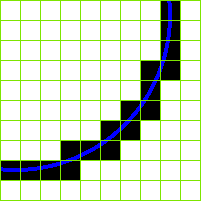
Sub-pixel rendering of a circle

In digital image processing, sub-pixel resolution can be obtained in images constructed from sources with information exceeding the nominal pixel resolution of said images.[citation needed]

Example

[edit]

For example, if the image of a ship of length 50 metres (160 ft), viewed side-on, is 500 pixels long, the nominal resolution (pixel size) on the side of the ship facing the camera is 0.1 metres (3.9 in). Now sub-pixel resolution of well resolved features can measure ship movements which are an order of magnitude (10×) smaller. Movement is specifically mentioned here because measuring absolute positions requires an accurate lens model and known reference points within the image to achieve sub-pixel position accuracy. Small movements can however be measured (down to 1 cm) with simple calibration procedures.[citation needed] Specific fit functions often suffer specific bias with respect to image pixel boundaries. Users should therefore take care to avoid these "pixel locking" (or "peak locking") effects.[1]

Determining feasibility

[edit]

Whether features in a digital image are sharp enough to achieve sub-pixel resolution can be quantified by measuring the point spread function (PSF) of an isolated point in the image. If the image does not contain isolated points, similar methods can be applied to edges in the image. It is also important when attempting sub-pixel resolution to keep image noise to a minimum. This, in the case of a stationary scene, can be measured from a time series of images. Appropriate pixel averaging, through both time (for stationary images) and space (for uniform regions of the image) is often used to prepare the image for sub-pixel resolution measurements.[citation needed]

See also

[edit]

References

[edit]

Sources

[edit]
  1. Shimizu, M.; Okutomi, M. (2003). "Significance and attributes of subpixel estimation on area-based matching". Systems and Computers in Japan. 34 (12): 1–111. doi:10.1002/scj.10506. ISSN 1520-684X. S2CID 41202105.
  2. Nehab, D.; Rusinkiewiez, S.; Davis, J. (2005). "Improved sub-pixel stereo correspondences through symmetric refinement". Tenth IEEE International Conference on Computer Vision (ICCV'05) Volume 1. pp. 557–563. doi:10.1109/ICCV.2005.119. ISBN 0-7695-2334-X. ISSN 1550-5499. S2CID 14172959.
  3. Psarakis, E. Z.; Evangelidis, G. D. (2005). "An enhanced correlation-based method for stereo correspondence with subpixel accuracy". Tenth IEEE International Conference on Computer Vision (ICCV'05) Volume 1 (PDF). pp. 907–912. doi:10.1109/ICCV.2005.33. ISBN 0-7695-2334-X. ISSN 1550-5499. S2CID 2723727.
Revisions and contributorsEdit on WikipediaRead on Wikipedia
from Grokipedia
Sub-pixel resolution refers to techniques that achieve effective resolution finer than the native grid, applied in both display rendering and image processing. In displays, treats the individual color sub-pixels—typically , , and (RGB)—within each as independent elements, increasing the apparent sharpness and detail of images beyond the native count. This method leverages the sub-pixel structure of displays (LCDs), organic (OLED) screens, and similar technologies, where each full is composed of three or more sub-pixels arranged in patterns like RGB stripes or PenTile layouts. By applying specialized filters to modulate sub-pixel intensities separately, mitigates artifacts, particularly in text and fine edges, while accounting for the human visual system's greater sensitivity to changes over to minimize unwanted color fringing. Pioneered by technologies like Microsoft's , announced in 1998 and released in 2000, sub-pixel techniques were developed primarily in the late 1990s and early 2000s to address the limitations of low-resolution flat-panel displays. These methods have become integral to modern computing and mobile devices, enabling crisper visuals without requiring higher native pixel counts. Key algorithms, such as those using Gaussian-windowed sinc filters, allow for real-time implementation on graphics processing units (GPUs), with processing overheads as low as 1-2 milliseconds for high-definition resolutions. Benefits include improved of small fonts and enhanced image fidelity in resource-constrained environments, though effectiveness varies by sub-pixel geometry—such as RGBW quad arrangements that further boost color gamut and efficiency. In image processing and , sub-pixel resolution involves to refine feature detection in captured images, achieving finer than individual pixels and aiding applications like and high-accuracy measurements. Overall, these methods represent a cost-effective approach to perceptual enhancement, influencing standards in graphics rendering and display manufacturing.

Fundamentals

Definition and Basic Principles

Sub-pixel resolution refers to techniques that exploit the spatial arrangement and color components of sub-pixels within a to infer or render details at a scale smaller than one full . In systems, this approach leverages the fact that a , the smallest addressable unit in an or , often consists of non-addressable sub-pixel elements, such as the , , and blue (RGB) components in displays (LCDs), to achieve higher effective detail without increasing the physical count. The basic principles of sub-pixel resolution build on the Nyquist-Shannon sampling theorem, which states that a continuous signal can be perfectly reconstructed from its samples if the sampling frequency is greater than twice the highest frequency component of the signal. By introducing sub-pixel level sampling—through shifts, color separation, or multiple frames—systems can effectively increase the sampling rate beyond the pixel grid, allowing reconstruction of higher-frequency spatial details that would otherwise be or lost. This enables resolution enhancement by increasing the effective sampling density and allowing reconstruction of finer spatial details that would otherwise be lost to . The concept of sub-pixel resolution first emerged in the amid early advancements in , with seminal work on multi-frame techniques that used sub-pixel displacements to overcome sensor limitations, evolving from foundational methods in developed during the same . These principles laid the groundwork for later applications, distinguishing sub-pixel approaches from simple pixel-level processing by emphasizing the exploitation of sub-pixel structure for superior perceptual or analytical outcomes.

Sub-pixel Structure in Imaging Systems

In color imaging systems, such as liquid crystal displays (LCDs) and light-emitting diode (LED) panels, a pixel is typically composed of three primary sub-pixels—red, green, and blue (RGB)—arranged to form full-color representations. These sub-pixels are physically distinct elements, each capable of independent luminance control, and are often organized in a vertical stripe pattern where red, green, and blue elements align sequentially within each horizontal pixel row. This structure allows the human eye to perceive a blended color at the pixel level while enabling finer spatial details through sub-pixel-level addressing. In monochrome imaging sensors, sub-pixels refer to conceptual fractional sampling areas within the pixel grid, where light-sensitive elements capture intensity data at sub-pixel offsets to support interpolation and reduce aliasing in high-resolution reconstruction. Variations in sub-pixel layouts exist across display and sensor technologies to optimize for factors like manufacturing efficiency and color fidelity. In traditional LCD and LED displays, the RGB stripe layout predominates, with sub-pixels forming continuous vertical columns across the screen for straightforward alignment and high color accuracy. In contrast, PenTile arrangements, commonly used in organic light-emitting diode () displays, employ an RGBG (red, green, blue, green) pattern where green sub-pixels are shared between adjacent pixels, reducing the total number of elements by approximately one-third compared to full RGB stripes while maintaining perceived through the eye's higher sensitivity to green. This diamond-shaped or staggered layout enhances in compact devices. In image sensors, the pattern overlays color filters on the sensor array, such that each photosite (pixel) captures only one color channel—typically half green, one-quarter red, and one-quarter blue in a repeating 2x2 —effectively treating the filter-covered area as a sub-pixel for single-channel sampling before reconstructs full color. The sub-pixel structure contributes to beyond the nominal by leveraging spatial offsets between elements. For instance, in an RGB stripe layout, the , , and sub-pixels occupy one-third of the width each, creating horizontal offsets of approximately 1/3 spacing that theoretically triple the sampling points along the horizontal axis compared to treating the full as a single unit. This enables enhanced perceived sharpness, particularly for edges and fine lines, as the eye integrates the offset luminances. Visually, the layout can be represented as a repeating horizontal sequence per row: [R | G | B | R | G | B], with identical alignment in subsequent rows, allowing analysis to reveal extended modulation (MTF) capabilities in the horizontal direction without introducing severe up to higher frequencies. In RGBG PenTile configurations, similar offsets between the two sub-pixels and the / pair provide a comparable boost, often achieving effective gains through shared sampling that approximates full RGB density. The evolution of sub-pixel structures reflects advancements in display hardware from early (CRT) systems to modern flat panels. CRTs employed triads—triangular clusters of , , and dots excited by beams—arranged in a dense to form pixels, prioritizing precision for color purity over individual addressing. As flat-panel technologies emerged, LCDs shifted to linear RGB stripe arrangements for easier fabrication and uniform backlighting, improving scalability for larger screens. Contemporary displays have further evolved to Pentile RGBG layouts, which use fewer sub-pixels in a non-rectangular to achieve higher densities and , as self-emissive elements eliminate the need for uniform triads and enable flexible patterning.

Techniques

Sub-pixel Rendering in Displays

Sub-pixel rendering in displays is a software that enhances the perceived sharpness of text and graphics on color LCD screens by exploiting the sub-pixel structure of pixels, treating the red, green, and blue (RGB) components as independent luminances rather than a single unit. This approach reduces artifacts, particularly in horizontal directions, by allowing finer control over edge transitions. Pioneered by with , announced in 1998, the method was designed to improve on LCD panels, which were becoming prevalent in laptops and monitors at the time. The core process involves several key steps: first, adjusts outlines to align optimally with the sub-pixel grid at small sizes, ensuring strokes fit the display's ; second, applies sub-pixel sampling to smooth edges by modulating the intensity of individual sub-pixels; and third, is performed per color channel to account for the non-linear response of LCDs, preventing color imbalances while preserving contrast. These steps collectively enable the renderer to position features at sub-pixel , effectively tripling the horizontal on RGB stripe layouts where sub-pixels are arranged linearly. In LCD-optimized algorithms, rendering samples at 1/3-pixel intervals horizontally, mapping the font outline to a virtual grid three times denser than the grid. For a basic sub-pixel anti-aliasing implementation, the process can be outlined as follows:

For each horizontal scanline of the [glyph](/page/Glyph): For each sub-pixel position (R, G, B) along the line: Compute coverage = intersection of glyph edge with sub-pixel area If coverage > threshold: Set sub-pixel intensity = coverage * gamma-corrected value Else: Set sub-pixel intensity = 0 Apply channel-specific filtering to blend adjacent sub-pixels and reduce fringing

For each horizontal scanline of the [glyph](/page/Glyph): For each sub-pixel position (R, G, B) along the line: Compute coverage = intersection of glyph edge with sub-pixel area If coverage > threshold: Set sub-pixel intensity = coverage * gamma-corrected value Else: Set sub-pixel intensity = 0 Apply channel-specific filtering to blend adjacent sub-pixels and reduce fringing

This illustrates the sampling and , where coverage determines partial activation, leveraging the eye's of adjacent colors for smoother perceived edges. Implementations vary between systems, with Microsoft's emphasizing aggressive hinting to snap features to sub-pixel boundaries for maximum sharpness, often at the cost of slight color shifts, while Apple's , which introduced sub-pixel rendering in Mac OS X 10.2 in , prioritizes fidelity to the original font design with subtler sub-pixel , resulting in less aggressive but more consistent rendering across weights. Studies evaluating these approaches have quantified benefits, such as a 5.6% increase in reading speed for continuous text and up to 7.2% for scanning tasks with ClearType-enabled fonts compared to standard . Hardware dependencies are critical, as sub-pixel rendering relies on the RGB stripe layout common in most LCDs, where each pixel's sub-pixels are independently addressable in a horizontal sequence. On PenTile matrices, which use a diamond-pattern layout with shared sub-pixels (typically two green per three RGB equivalents), the technique fails to deliver the full resolution gain, as the non-uniform spacing disrupts independent luminance control and introduces additional artifacts. In standard RGB stripe layouts used in VA LCD panels, sub-pixel rendering provides excellent text clarity without fringing edges, making them comfortable for long document viewing in office work. In contrast, QD-OLED panels exhibit slight text edge fringing due to their non-standard sub-pixel arrangements, such as triangular RGB layouts, which misalign with optimized rendering algorithms like ClearType and can reduce readability in productivity tasks.

Sub-pixel Estimation in Image Processing

Sub-pixel estimation in image processing involves algorithms that refine the localization of features, such as points, edges, or displacements, beyond the pixel grid of discrete images, thereby improving measurement precision in applications like tracking and . These methods exploit the continuity of underlying image signals, often assuming models like Gaussian distributions or polynomial approximations to interpolate sub-pixel details from sampled values. By leveraging mathematical fitting or frequency-domain analysis, such techniques can achieve resolutions finer than the sensor's size, typically requiring computational optimization to handle real-world distortions. Common estimation methods for point sources include fitting, which computes the weighted average of pixel intensities within a local to determine the center of mass, achieving sub-pixel accuracy by matching the window to the target's intensity distribution. For instance, Gaussian fitting models the point spread as a 2D and estimates parameters like center coordinates through least-squares optimization or moment-based methods, outperforming simpler approaches in noisy images with windows up to 5×5 s. Another technique, , detects sub-pixel shifts between images by analyzing phase differences in their transforms; the cross-power spectrum is computed as the normalized product of the transforms, and the integer shift is found from the peak of the inverse FFT, with sub-pixel displacement estimated by parabolic around the peak using the values of neighboring pixels. This method provides robust translation estimation even under moderate noise, as validated in registration. Interpolation approaches are particularly useful for edge detection, where sub-pixel positions are refined by approximating the intensity profile across pixels. Parabolic interpolation fits a quadratic surface to the cross-correlation peak neighborhood in 2D, using closed-form expressions on a 3×3 patch to compute fractional offsets in range and azimuth directions, as demonstrated in synthetic aperture radar image alignment with errors below 0.1 pixel. Sinc interpolation, based on the ideal band-limited reconstruction kernel, extends edge locations by resampling the image signal at non-integer positions, preserving high-frequency details for precise boundary refinement. An example using Taylor series expansion localizes edges by approximating the intensity function f around an integer pixel x. For a quadratic fit using three points I_{i-1}, I_i, I_{i+1}, the sub-pixel offset δ is given by δ = 0.5 × (I_{i-1} - I_{i+1}) / (I_{i-1} - 2 I_i + I_{i+1}), yielding the sub-pixel position x + δ; this approach enables rapid computation in displacement measurement with relative errors under 1.1%. To handle noise, least-squares optimization minimizes the residual between observed pixel values and the fitted model, such as in iterative refinement of parameters, routinely achieving accuracies of 1/10 to 1/100 depending on and feature contrast. The Lucas-Kanade method exemplifies this for , assuming constant brightness and small motions within a local neighborhood; it solves the of partial derivatives via least-squares to estimate velocity vectors at sub-pixel resolution, as originally formulated for and extended to dense flow fields. These optimizations mitigate random errors from photon noise or sensor variability, with experimental tracking demonstrating precisions down to 5 nm in biological . In recent years, approaches, such as convolutional neural networks (CNNs), have been applied to sub-pixel estimation, directly regressing fractional offsets from image patches for improved accuracy in challenging conditions like low light or , building on classical methods. Accurate sub-pixel estimation necessitates calibration of the (), as pixel integration introduces systematic biases that distort the effective image model and propagate errors in localization. A known PSF allows mapping of these intra-pixel shifts, enabling correction filters that reduce biases by factors of 20 or more during sub-pixel operations, essential for applications requiring emitter positioning within 0.01 . Without such calibration, unmodeled PSF variations can limit overall precision, underscoring the need for empirical in systems.

Applications

In Display Technologies

Sub-pixel resolution techniques have significantly enhanced text rendering in consumer operating systems, particularly on displays with limited . Microsoft's , introduced as an optional feature in in 2001, leverages sub-pixel to improve the horizontal resolution of LCD screens by treating , , and sub-pixels independently, resulting in sharper text edges and up to a theoretical 300% increase in effective horizontal resolution compared to grayscale . This advancement has been crucial for low-DPI screens, such as early laptop displays around 96 , enabling clearer e-reading experiences by reducing and improving legibility without requiring hardware upgrades. In mobile devices, sub-pixel rendering contributes to high-PPI displays (often exceeding 300 PPI in modern smartphones) by optimizing for sub-pixel layouts like RGB stripes or PenTile matrices, which enhances text clarity and image smoothness during and rendering. For instance, and implementations adapt sub-pixel techniques to handle varying sub-pixel arrangements in panels, minimizing color fringing while maintaining perceived sharpness on compact screens. For productivity applications in modern desktop monitors, such as office work involving long document viewing, VA (Vertical Alignment) LCD panels often provide superior text clarity compared to QD-OLED panels. VA panels utilize standard RGB sub-pixel layouts compatible with systems like ClearType, resulting in excellent text rendering without fringing edges, which enhances comfort during extended sessions. In contrast, QD-OLED panels, due to their non-standard sub-pixel arrangements (e.g., triangular layouts), can exhibit slight color fringing around text edges, potentially reducing legibility for text-heavy tasks. In advanced displays, sub-pixel resolution plays a key role in (VR) and (AR) headsets by mitigating the —the visible grid of pixels that disrupts immersion. By exploiting sub-pixel structures in high-density LCD or panels, rendering algorithms can simulate finer details, effectively increasing perceived and reducing pixel gaps; for example, displays achieving over 2000 incorporate sub-pixel optimizations to push beyond traditional limits, improving visual fidelity in close-viewing scenarios. Similarly, in projectors, sub-pixel dithering techniques, such as subframe rendering, simulate higher by temporally or spatially modulating sub-pixels, eliminating artifacts in single-chip DLP systems and enhancing overall image sharpness without additional hardware. Performance evaluations of sub-pixel methods demonstrate substantial gains in perceived , with studies reporting improvements ranging from 20% to 300% depending on content and display type, particularly for text and edges where sub-pixel addressing aligns with human visual sensitivity. These benefits are amplified through integration with algorithms, such as modified for sub-pixel awareness, which preserves and during or downsampling, avoiding in non-integer scenarios common in multi-resolution environments. Industry standards and drivers have widely adopted sub-pixel support to standardize these enhancements. HDMI specifications, starting from version 1.4, facilitate high-resolution transmission that enables sub-pixel rendering on compatible displays by supporting uncompressed pixel data flows up to and beyond, allowing downstream devices to apply sub-pixel optimizations. Graphics drivers often include options compatible with sub-pixel rendering.

In and Scientific Imaging

In , sub-pixel resolution enables precise object tracking and beyond the native grid of imaging sensors. Particle image velocimetry (), a technique for measuring fluid flow velocities, achieves sub-pixel accuracy in estimation, often reaching a standard deviation of approximately 0.05 under optimal conditions, which is critical for analyzing turbulent flows in applications. Similarly, stereo matching algorithms refine disparity maps to sub-pixel levels, improving depth estimation in tasks by interpolating between integer correspondences, as demonstrated in early parallel stereo methods that produce dense, accurate depth maps. These approaches rely on correlation-based estimation to mitigate quantization errors inherent in discrete sampling. In scientific imaging, sub-pixel techniques enhance positional accuracy in astronomy and . For astronomical observations, the () employs sub-pixel to refine star positions, enabling precise measurements of trans-Neptunian objects with astrometric uncertainties below 0.1 pixels after multi-epoch processing of guide star and target frames. In , super-resolution methods extend stimulated emission depletion (STED) imaging through sub-pixel registration of multiple frames, aligning low-resolution inputs to reconstruct finer structural details in biological samples, thereby surpassing limits while preserving signal integrity. Such registration corrects for minor shifts between acquisitions, facilitating quantitative analysis of cellular components at scales finer than the detector's size. Representative case studies illustrate the practical impact of sub-pixel resolution. Sub-pixel techniques in satellite () imagery, such as from , enable ship detection and localization with sub-meter accuracy from native resolutions around 5 m, supporting maritime surveillance and traffic monitoring. In , sub-pixel refines tumor boundary delineation in MRI scans, enabling detection at scales as fine as 1/20 of a , which supports more accurate volume estimation and treatment planning for tumors. Modern integration with further advances sub-pixel capabilities in these fields. Deep learning models, such as the Super-Resolution (SRCNN) introduced in 2014, perform sub-pixel upsampling by learning mappings from low- to high-resolution images, achieving improvements of about 1 dB compared to , and have been adapted for enhancing resolution in tasks like object localization and scientific image analysis.

Limitations and Evaluation

Determining Feasibility

To determine the feasibility of achieving sub-pixel resolution in an or display system, one primary assessment technique involves measuring the (PSF) of isolated features, such as points or edges, to quantify the system's sensitivity to sub-pixel displacements. This process begins with capturing calibration images of known sub-resolution features, like fluorescent microspheres or pinholes, positioned at various sub-pixel offsets using a precision stage. The captured images are then analyzed by fitting parametric models, such as a Gaussian distribution, to the observed PSF; a (FWHM) narrower than the size (e.g., FWHM < 1 pixel) indicates potential for sub-pixel distinguishability, as it allows the system to resolve features below the nominal pixel pitch. Key metrics for feasibility include the signal-to-noise ratio (SNR), where thresholds like SNR > 10 are typically required to achieve localization accuracy on the order of 1/10 , based on the Cramér-Rao lower bound for position estimation under Poisson noise conditions. This bound approximates the standard deviation of localization error as σ ≈ s / √N, where s is the PSF standard deviation and N is the number of detected photons; for sub-pixel precision, sufficient SNR ensures the error σ remains below the desired fraction of size. To improve SNR and mitigate noise, techniques such as averaging multiple frames or spatial binning of can be employed, reducing variance by a factor proportional to the of the number of averaged samples while preserving sub-pixel information. Evaluating potential biases, such as locking—where sub-pixel position estimates disproportionately cluster near centers due to sampling artifacts—is essential to confirm unbiased feasibility. This can be detected by generating sub-pixel maps of estimated positions from repeated measurements and applying statistical tests, like the , to assess uniformity across the interval (0 to 1); significant deviations from a (p < 0.05) signal locking bias that could undermine sub-pixel reliability. Experimental setups often incorporate known sub-pixel shifts, such as via piezoelectric stages, to validate uniformity empirically. Open-source tools facilitate these assessments; for instance, the library provides functions like cornerSubPix for sub-pixel feature refinement and Gaussian fitting routines to estimate parameters from calibration images.

Artifacts and Challenges

One of the primary visual artifacts in sub-pixel rendering for displays is color fringing, where the independent modulation of red, green, and sub-pixels along edges produces unwanted colored halos, such as fringes on the left sides and on the right sides of text or lines. This effect is particularly noticeable on thin features like black text against a white background, as not all sub-pixel components are uniformly activated, leading to perceived color imbalances. In imaging systems, sub-pixel misalignment between the sensor grid and the subject can generate moiré patterns, manifesting as low-frequency fringes that distort the image and reduce overall fidelity. In modern displays, non-standard sub-pixel layouts exacerbate fringing challenges. For instance, (WOLED) arrangements can produce shadow-like or yellow-tinted edges around text, while triangular RGB (QD-OLED) layouts lead to or fringes, particularly visible at pixel densities around 100-110 in ultrawide or monitors. These artifacts arise because standard RGB-optimized rendering software (e.g., ) does not account for the altered sub-pixel geometry, resulting in misaligned color contributions; mitigations include layout-specific optimizations in operating systems or third-party tools like MacType, though issues persist in some applications as of 2025. Technical challenges further complicate sub-pixel techniques, including peak locking in position estimation, where calculated sub-pixel displacements cluster around integer pixel centers, causing systematic errors and reduced accuracy near edges—often limiting effective resolution to 0.1 pixels or worse in unmitigated cases. Sub-pixel methods are also highly sensitive to and defocus, as these introduce additional uncertainty in sub-pixel shifts, which can amplify errors and confine reliable application to static or low-motion scenes. To mitigate these issues, adaptive filtering approaches, such as bilateral filters, are employed to blend sub-pixel contributions while preserving sharp edges, thereby reducing color fringing without over-smoothing the image. Hardware advancements, including higher sub-pixel densities in high-density displays, such as smaller screens (e.g., 15-24 inches) that can exceed 200 pixels per inch (), diminish the visibility of fringing and moiré by making individual sub-pixel separations less discernible to the . Quantitative assessments reveal notable impacts from these challenges; for instance, peak locking in Gaussian-based sub-pixel can introduce errors equivalent to 10-20% in accuracy under moderate conditions. Furthermore, processing RGB sub-pixels individually can incur a computational overhead ranging from 1.1 to 2.2 times that of standard full-pixel rendering, depending on the sub-pixel layout and optimization method. Recent advancements as of 2024-2025 address some limitations through techniques, such as residual neural networks for single-image sub-pixel rendering, which enhance fidelity while reducing distortions, and sub-pixel optimizations in systems to effectively increase perceived resolution beyond native limits. These trade-offs underscore the balance required between enhanced resolution and practical robustness in sub-pixel implementations.

References

Add your contribution
Related Hubs
User Avatar
No comments yet.