Hubbry Logo
Erica cinereaErica cinereaMain
Open search
Erica cinerea
Community hub
Erica cinerea
logo
8 pages, 0 posts
0 subscribers
Be the first to start a discussion here.
Erica cinerea
Erica cinerea
from Wikipedia

Erica cinerea
Scientific classification Edit this classification
Kingdom: Plantae
Clade: Tracheophytes
Clade: Angiosperms
Clade: Eudicots
Clade: Asterids
Order: Ericales
Family: Ericaceae
Genus: Erica
Species:
E. cinerea
Binomial name
Erica cinerea

Erica cinerea, the bell heather,[2] is a species of flowering plant in the heath family Ericaceae, native to western and central Europe.

Description

[edit]

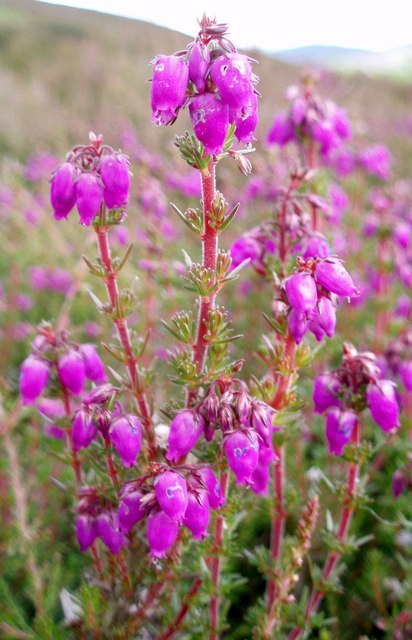
It is a low, spreading shrub growing to 15–60 centimetres (6–23+12 inches) tall, with fine needle-like leaves 4–8 millimetres (1838 in) long arranged in whorls of three. The flowers are bell-shaped, purple (rarely white), 4–7 mm (1814 in) long, produced in mid- to late summer. The flowers are dry, similar in texture to the strawflower.

Etymology

[edit]

The Latin specific epithet cinerea means "ash coloured".[3]

Distribution and habitat

[edit]

E. cinerea is native to the west of Europe, where it is most abundant in Britain and Ireland, France, northern Spain and southern Norway. It also occurs in the Faroe Islands, Belgium, Germany, north-western Italy, and the Netherlands.[4]

It mostly occurs on moors and heathland with relatively dry, acidic, nutrient poor soils. It occurs in coastal dune heath and dune slack and occasionally in woodland.

Ecology

[edit]

The plant provides a great deal of nectar for pollinators. It was rated in the top 5 for most nectar production (nectar per unit cover per year) in a UK plants survey conducted by the AgriLand project which is supported by the UK Insect Pollinators Initiative.[5]

It is described as "of least concern" on the IUCN Red List of Threatened Species.[4]

Cultivation

[edit]

It is grown as an ornamental plant, cultivated in a wider range of colors. It is drought-tolerant and grows well in full sun with well-drained soil. Like most heathers, it is a calcifuge and dislikes alkaline soils (e.g. calcareous) which cause the symptoms of iron deficiency. Like other cultivated heathers, it is often seen as groundcover among plantings of dwarf conifers.[6]

These cultivars have gained the Royal Horticultural Society's Award of Garden Merit:[7]

'Eden Valley' has lavender flowers shading to white at the base of the corolla and a prostrate habit. The original plant was found on Trink Hill, Cornwall, by Miss Gertrude Waterer.[12]

Uses

[edit]

Bell heather is a source of heather honey.[13]

References

[edit]
[edit]
Revisions and contributorsEdit on WikipediaRead on Wikipedia
from Grokipedia
Erica cinerea, commonly known as bell heather or Scotch heath, is a low-growing evergreen subshrub in the family Ericaceae, native to western and central Europe. It typically reaches heights of 15–60 cm, with slender, woody branches bearing needle-like leaves arranged in whorls of three, measuring 2.5–5 mm in length and often revolute along the margins. The plant produces abundant, urn-shaped flowers that are bright reddish-purple, 4–7 mm long, arranged in terminal racemes or panicles, blooming from July to September and attracting pollinators such as bees. Native primarily to oceanic regions, E. cinerea is widespread across the , , northern , , and extends to parts of , the , , , and other areas in northern, middle, southeastern, and southwestern . It has been introduced to regions such as parts of (e.g., and ), , , and , where it occasionally naturalizes but is not persistent in many cases. The species favors well-drained, acidic soils ( 3.6–6.6) that are nutrient-poor and oligotrophic, commonly occurring in drier heathlands, moorlands, maritime grasslands, shrublands, woodlands, and rocky crevices. It often co-occurs with species like Calluna vulgaris, , , and in these habitats. Ecologically, E. cinerea is a long-lived that reproduces via (producing up to 450,000 viable per square meter annually) and vegetative spread, tolerating shade, , and while relying on insect pollination, though it can self-pollinate. It plays a key role in heathland ecosystems, supporting in nutrient-starved environments, but populations have declined in some areas due to habitat loss from agricultural intensification, , and atmospheric pollution. Widely cultivated as an for its vibrant flowers and compact form, over 140 cultivars exist, varying in height, spread, and flower color from white to deep red, thriving in full sun and acidic conditions in USDA zones 5 and above.

Taxonomy and nomenclature

Etymology

The scientific name Erica cinerea was formally established by the Swedish botanist in the first edition of his seminal work , published in 1753, where it appears on page 352 of volume 1. This followed Linnaeus's system of classifying based on shared characteristics, placing E. cinerea within the family , known for its heath and heather species. The name Erica originates from the ancient Greek term ereikē (ἐρείκη), used by classical authors such as and to denote heath or heather plants, likely referring to species with brittle stems or similar growth habits. Linnaeus adopted this root into Latinized form to encompass the diverse group of shrubs now recognized in the . The specific cinerea, the feminine form agreeing with the , derives from the Latin cinereus (from cinis, meaning "ash"), translating to "ash-colored" or "ash-gray," in reference to the plant's distinctive grayish foliage or its appearance after flowering.

Classification and synonyms

Erica cinerea belongs to the kingdom Plantae, phylum Tracheophyta, class Magnoliopsida, order , family , genus Erica, and subgenus Erica. The accepted name is Erica cinerea L., first published in 1753, with several synonyms recognized in botanical literature, including Eremocallis cinerea (L.) Gray, Erica cinerea var. alba Aiton, Erica cinerea f. alba (Aiton) D.C.McClint., Erica cinerea var. maderensis Benth., and Erica cinerea var. purpurea (Wimm. & Grab.) Nyman. The genus Erica, which encompasses approximately 851 accepted species, has experienced significant taxonomic revisions, particularly in and , where high has led to the description of new taxa and ongoing debates over species boundaries due to subtle morphological differences and hybridization.

Description

Morphology

Erica cinerea is an low , typically reaching heights of 15–60 cm, with a compact, spreading habit formed by numerous wiry, branching stems that create dense mats. The branches are stiff and much-divided, often ascending from the base, contributing to the plant's mat-forming growth. The stems are green when young and bear short, stiff hairs, giving them a pubescent appearance; as they mature, the twigs become brownish and glabrescent, developing a smooth texture. This hairiness is most prominent on shoots of the current season, enhancing the plant's resilience in its native environments. Older stems form the woody framework of the . The leaves are needle-like and arranged in whorls of three at the nodes, measuring 2–5 mm in length and 0.3–0.6 mm in width. They are linear to linear-lanceolate in shape, with strongly revolute margins that curl under and often conceal the undersurface, resulting in a deep green coloration; the leaves are glabrous. These firm, leathery leaves persist year-round, providing the shrub's characteristic dense foliage.

Flowering and reproduction

The flowers of Erica cinerea are bell-shaped urns, typically 4–7 mm long, with a corolla that rarely appears white in certain variants, and they form dense terminal clusters along the stems. The whorled arrangement of leaves in groups of three helps support these compact flower clusters. Blooming occurs primarily from mid- to late summer, spanning through in its native European range, though some populations may extend into early autumn. Erica cinerea exhibits a self-compatible breeding system but relies mainly on outcrossing via pollinators for effective , with hermaphroditic flowers promoting cross- through protandry. Seed production follows successful pollination, resulting in small capsules that release numerous tiny seeds dispersed primarily by wind. Additionally, the species propagates vegetatively when prostrate stems root upon contact with moist soil, allowing clonal spread in suitable habitats.

Distribution and habitat

Geographic range

Erica cinerea is native to western and central Europe, with its range extending from southern northward to southern . It is widespread across the , including the —where it occurs commonly except in the east—and , as well as in , , , , , the , the [Faroe Islands](/page/Faroe Islands), and . The species also reaches disjunct populations in the , particularly in north-western , where it exhibits a distribution isolated from its main continental range. Pollen records confirm its long-standing presence in these areas, indicating native status and relative stability in its distribution since post-Ice Age recolonization, with no major shifts documented in the . Outside its native range, E. cinerea has been introduced and occasionally naturalized in limited areas through ornamental planting. In , it was historically naturalized on Island, , from 1878 to 1906 under planted pines but has not persisted. It is also introduced in parts of , including , and in .

Habitat preferences

Erica cinerea prefers well-drained, acidic soils that are nutrient-poor, typically with a ranging from 3.6 to 6.6, such as peaty podzols, raw humic peats, or sandy substrates. These conditions ensure low fertility and prevent waterlogging, which the species tolerates poorly in its natural settings. The species is characteristic of open, lowland to montane ecosystems in , including heathlands dominated by Calluna vulgaris and , moorlands, blanket bogs, coastal fixed dunes, and gaps in open woodlands or rocky outcrops. It often co-occurs with and in these nutrient-impoverished environments, contributing to the structure of dwarf-shrub communities. In terms of , Erica cinerea is adapted to temperate oceanic conditions prevalent across its European range, with tolerance for mild winters (minimum January temperatures around 2°C) and cool summers (maximum June temperatures up to 22°C), reaching an upper altitudinal limit of approximately 620 m. Once established in suitable habitats, it exhibits resistance to short-term but is sensitive to prolonged dry periods, late frosts below -3.5°C, and excessive moisture.

Ecology

Pollination and biotic interactions

Erica cinerea, commonly known as bell heather, relies primarily on insect , with bumblebees serving as the main pollinators due to their ability to access the within the urn-shaped flowers. Honeybees, hoverflies, and such as the (Plebejus argus) and (Argynnis paphia) also visit the flowers, though some honeybees engage in robbery by piercing the corolla base without effecting . The flower's structure, with its deep tubular corolla, favors long-tongued for efficient access. Notably, E. cinerea produces substantial volumes, ranking among the top five plant species for nectar provision per unit area cover annually, making it a critical resource for pollinator communities. Beyond pollination, E. cinerea engages in various biotic interactions that shape its ecology. It forms ericoid mycorrhizal associations with fungi such as those in the Helotiales order, which enhance nutrient uptake—particularly nitrogen and phosphorus—from nutrient-poor, acidic soils typical of heathlands. These symbioses allow the plant to thrive in oligotrophic environments by facilitating the decomposition of organic matter. As a food source, E. cinerea is browsed by herbivores including sika deer (Cervus nippon), which consume it frequently in dry and wet heath habitats,[](https://www.footprint-ecology.co.uk/reports/Underhill-Day and Liley - 2006 - Deer and heathlands, a review. A report to English.pdf) and red deer (Cervus elaphus), which include heather species in their diet, especially during winter. Insects, such as nectar-robbing bees and foliage-feeding larvae, further interact with the plant, though heavy herbivory can influence flowering and growth. As a dominant species in lowland heathlands, E. cinerea plays a key role in local food webs by providing foundational resources for primary consumers like pollinators and herbivores, thereby supporting higher trophic levels including predatory and birds. Its abundance fosters heathland , stabilizing soil and creating mosaics that sustain diverse communities.

Conservation status

Erica cinerea is assessed as Least Concern on the global and European scales according to the criteria, with the most recent comprehensive evaluation conducted in 2011 and no subsequent updates indicating a change in status as of 2025. This classification reflects its relatively broad distribution across , which buffers it against immediate risks despite localized pressures. Regionally, the faces threats from loss and degradation, particularly in the and parts of . In , it is assessed as Near Threatened due to a 29% decline in area of occupancy since 1930. In , populations have declined due to conversion of heathlands for agriculture and urban development, as well as with non-native that shades out understory vegetation. In Brittany, , has been a primary driver of heathland reduction over the past five decades. exacerbates these issues through increased drying and hotter conditions that stress the species' preference for moist, acidic soils, potentially shifting suitable habitats. Additionally, competition from such as bracken (Pteridium aquilinum) and gorse (Ulex spp.) can invade and dominate heathland patches, further fragmenting suitable areas. Conservation efforts for E. cinerea are integrated into broader heathland protection strategies under the EU Habitats Directive, where it occurs within Annex I type 4030 (European dry heaths), requiring maintenance and restoration of these ecosystems across member states. In the UK, active management in protected areas like National Park involves by livestock such as Dartmoor ponies to control invasive scrub and promote dwarf shrub diversity, alongside controlled burning to rejuvenate heathland vegetation and prevent woody encroachment. These measures have helped stabilize populations in managed reserves, though ongoing monitoring is essential to address cumulative threats.

Cultivation and uses

Cultivation requirements

Erica cinerea thrives in full sun, requiring at least six hours of direct sunlight daily to promote abundant flowering and compact growth. It prefers acidic, well-drained soils with a pH below 6.5, such as sandy or humus-rich types that mimic its native moorland habitats; heavy or alkaline soils should be amended with ericaceous compost or peat to improve drainage and acidity. The plant is hardy in USDA zones 5–8, tolerating moderate winters but benefiting from mulch in colder areas to protect roots. For planting, space individuals 45–60 cm apart to allow for their mature spread of 30–80 cm, ideally in spring or autumn using container-grown specimens set so the foliage rests at ground level without burying the root ball. regularly to keep moist during the first year until established, then sparingly as mature are drought-tolerant; overwatering should be avoided to prevent root issues. lightly after flowering in late summer or early spring by cutting stems back to the base of the flower stalks to maintain shape and encourage new growth. can be achieved via semi-hardwood cuttings taken in late summer, dipped in rooting hormone and inserted into well-drained, acidic medium, or by sowing seeds in a similar substrate. Erica cinerea is generally resistant to most pests and diseases but can suffer from larvae, which damage roots in infested , and phytophthora root rot in poorly drained or overly wet conditions. Regular inspection and cultural practices like ensuring good drainage help mitigate these risks.

Ornamental and practical uses

Erica cinerea is prized in ornamental for its compact, form and prolonged summer bloom of bell-shaped purple to flowers, making it suitable for rock gardens, borders, and ground cover plantings. Its dense, mat-forming growth helps stabilize soil, providing effective erosion control on slopes and banks. Several cultivars, including the compact 'C.D. Eason' with soft flowers, have earned the Royal Horticultural Society's for their reliability and aesthetic appeal in garden settings. Practically, Erica cinerea contributes significantly to apiculture as a key nectar source for heather honey, particularly the bell heather variety, which bees forage extensively during its July-to-September flowering period. Historically, its flowers have been used in traditional processes to produce yellow-brown hues on textiles, while the material served for thatching roofs in rural European communities, especially in and . Culturally, Erica cinerea holds symbolic importance in as a offering shelter and protection, often associated with the rugged moorlands. It has limited historical medicinal applications, such as teas from its leaves and flowers to alleviate colds and respiratory issues, though these uses lack modern substantiation.

References

Add your contribution
Related Hubs
User Avatar
No comments yet.