Hubbry Logo
Bernoulli schemeBernoulli schemeMain
Open search
Bernoulli scheme
Community hub
Bernoulli scheme
logo
7 pages, 0 posts
0 subscribers
Be the first to start a discussion here.
Bernoulli scheme
Bernoulli scheme
from Wikipedia

In mathematics, the Bernoulli scheme or Bernoulli shift is a generalization of the Bernoulli process to more than two possible outcomes.[1][2] Bernoulli schemes appear naturally in symbolic dynamics, and are thus important in the study of dynamical systems. Many important dynamical systems (such as Axiom A systems) exhibit a repellor that is the product of the Cantor set and a smooth manifold, and the dynamics on the Cantor set are isomorphic to that of the Bernoulli shift.[3] This is essentially the Markov partition. The term shift is in reference to the shift operator, which may be used to study Bernoulli schemes. The Ornstein isomorphism theorem[4][5] shows that Bernoulli shifts are isomorphic when their entropy is equal.

Definition

[edit]

A Bernoulli scheme is a discrete-time stochastic process where each independent random variable may take on one of N distinct possible values, with the outcome i occurring with probability , with i = 1, ..., N, and

The sample space is usually denoted as

as a shorthand for

The associated measure is called the Bernoulli measure[6]

The σ-algebra on X is the product sigma algebra; that is, it is the (countable) direct product of the σ-algebras of the finite set {1, ..., N}. Thus, the triplet

is a measure space. A basis of is the cylinder sets. Given a cylinder set , its measure is

The equivalent expression, using the notation of probability theory, is

for the random variables

The Bernoulli scheme, as any stochastic process, may be viewed as a dynamical system by endowing it with the shift operator T where
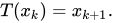
Since the outcomes are independent, the shift preserves the measure, and thus T is a measure-preserving transformation. The quadruplet

is a measure-preserving dynamical system, and is called a Bernoulli scheme or a Bernoulli shift. It is often denoted by

The N = 2 Bernoulli scheme is called a Bernoulli process. The Bernoulli shift can be understood as a special case of the Markov shift, where all entries in the adjacency matrix are one, the corresponding graph thus being a clique.

Matches and metrics

[edit]

The Hamming distance provides a natural metric on a Bernoulli scheme. Another important metric is the so-called metric, defined via a supremum over string matches.[7]

Let and be two strings of symbols. A match is a sequence M of pairs of indexes into the string, i.e. pairs such that understood to be totally ordered. That is, each individual subsequence and are ordered: and likewise


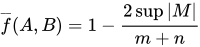
The -distance between and is

where the supremum is being taken over all matches between and . This satisfies the triangle inequality only when and so is not quite a true metric; despite this, it is commonly called a "distance" in the literature.

Generalizations

[edit]

Most of the properties of the Bernoulli scheme follow from the countable direct product, rather than from the finite base space. Thus, one may take the base space to be any standard probability space , and define the Bernoulli scheme as


This works because the countable direct product of a standard probability space is again a standard probability space.

As a further generalization, one may replace the integers by a countable discrete group , so that

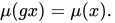
For this last case, the shift operator is replaced by the group action

for group elements and understood as a function (any direct product can be understood to be the set of functions , as this is the exponential object). The measure is taken as the Haar measure, which is invariant under the group action:

These generalizations are also commonly called Bernoulli schemes, as they still share most properties with the finite case.

Properties

[edit]

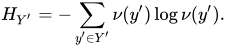
Ya. Sinai demonstrated that the Kolmogorov entropy of a Bernoulli scheme is given by[8][9]
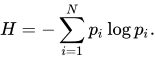
This may be seen as resulting from the general definition of the entropy of a Cartesian product of probability spaces, which follows from the asymptotic equipartition property. For the case of a general base space (i.e. a base space which is not countable), one typically considers the relative entropy. So, for example, if one has a countable partition of the base Y, such that , one may define the entropy as

In general, this entropy will depend on the partition; however, for many dynamical systems, it is the case that the symbolic dynamics is independent of the partition (or rather, there are isomorphisms connecting the symbolic dynamics of different partitions, leaving the measure invariant), and so such systems can have a well-defined entropy independent of the partition.

Ornstein isomorphism theorem

[edit]

The Ornstein isomorphism theorem states that two Bernoulli schemes with the same entropy are isomorphic.[4] The result is sharp,[10] in that very similar, non-scheme systems, such as Kolmogorov automorphisms, do not have this property.

The Ornstein isomorphism theorem is in fact considerably deeper: it provides a simple criterion by which many different measure-preserving dynamical systems can be judged to be isomorphic to Bernoulli schemes. The result was surprising, as many systems previously believed to be unrelated proved to be isomorphic. These include all finite[clarification needed] stationary stochastic processes, subshifts of finite type, finite Markov chains, Anosov flows, and Sinai's billiards: these are all isomorphic to Bernoulli schemes.

For the generalized case, the Ornstein isomorphism theorem still holds if the group G is a countably infinite amenable group. [11][12]

Bernoulli automorphism

[edit]

An invertible, measure-preserving transformation of a standard probability space (Lebesgue space) is called a Bernoulli automorphism if it is isomorphic to a Bernoulli shift.[13]

Loosely Bernoulli

[edit]

A system is termed "loosely Bernoulli" if it is Kakutani-equivalent to a Bernoulli shift; in the case of zero entropy, if it is Kakutani-equivalent to an irrational rotation of a circle.

See also

[edit]

References

[edit]
Revisions and contributorsEdit on WikipediaRead on Wikipedia
from Grokipedia
In mathematics, particularly within , a Bernoulli scheme (also called a Bernoulli shift) is a defined on the of bi-infinite sequences over a finite X={1,,n}X = \{1, \dots, n\}, equipped with the product μ\mu induced by a p=(p1,,pn)p = (p_1, \dots, p_n) where pi=1\sum p_i = 1, and the left shift map σ\sigma that acts by σ(θ)k=θk+1\sigma(\theta)_k = \theta_{k+1} for each integer index kk. This setup generalizes the classical of independent trials to an infinite sequence framework, forming a quadruple (B(X),S,μ,σ)(B(X), \mathcal{S}, \mu, \sigma) where B(X)B(X) is the sequence , S\mathcal{S} is the Borel σ\sigma-algebra generated by cylinder sets, and the system is invariant under σ\sigma. Bernoulli schemes are fundamentally characterized by their ergodic : they are measure-preserving, meaning μ(σ1(A))=μ(A)\mu(\sigma^{-1}(A)) = \mu(A) for any measurable set AA, and ergodic, implying that any σ\sigma-invariant set has measure 0 or 1, so time averages of integrable functions converge to their space averages by Birkhoff's ergodic theorem. Moreover, they exhibit mixing, a stronger form of where limnμ(σn(A)B)=μ(A)μ(B)\lim_{n \to \infty} \mu(\sigma^n(A) \cap B) = \mu(A) \mu(B) for measurable sets A,BA, B, ensuring asymptotic independence of events under iteration, which follows from the independence of the coordinate functions in the product measure. These position Bernoulli schemes as prototypical examples of chaotic dynamical systems, with applications in analyzing long-term statistical behavior in sequence spaces and random processes. A key invariant distinguishing Bernoulli schemes is their entropy, defined as H(σ)=i=1npilogpiH(\sigma) = -\sum_{i=1}^n p_i \log p_i, which quantifies the average information per symbol and remains unchanged under measure-preserving transformations. The Ornstein isomorphism theorem establishes that two Bernoulli schemes are isomorphic (as measure-preserving transformations) if and only if they share the same entropy, resolving a central classification problem in and highlighting the structural rigidity of these systems. Additionally, invertible Bernoulli schemes are K-automorphisms, possessing a generating partition that produces the full σ\sigma-algebra through finite iterations and exhibiting a countable Lebesgue spectrum in their unitary operator representation, which underscores their maximal randomness and lack of non-trivial invariant subspaces. Beyond their theoretical foundations, Bernoulli schemes connect to broader contexts such as subshifts of finite type, Markov chains, and random walks on groups, where mixing Markov shifts are isomorphic to Bernoulli shifts under certain conditions. For instance, the binary case with equal probabilities p=(1/2,1/2)p = (1/2, 1/2) is isomorphic to the angle-doubling map on the circle, linking discrete and continuous dynamics. These connections have influenced developments in , , and , making Bernoulli schemes a cornerstone for studying , , and spectral properties in measure-theoretic dynamics.

Definition and Construction

Formal Definition

A measure-preserving dynamical system is a fundamental object in ergodic theory, consisting of a probability space (X,B,μ)(X, \mathcal{B}, \mu) equipped with a measurable transformation T:XXT: X \to X that preserves the measure μ\mu, meaning μ(T1A)=μ(A)\mu(T^{-1}A) = \mu(A) for every measurable set ABA \in \mathcal{B}. This setup models the evolution of systems under iterations of TT, allowing the study of long-term statistical behavior. The Bernoulli scheme is a specific measure-preserving dynamical system defined on the bi-infinite product space X=nZ{1,,N}X = \prod_{n \in \mathbb{Z}} \{1, \dots, N\}, where N2N \geq 2 is a finite integer representing the number of possible outcomes per trial. The space XX is endowed with the product σ\sigma-algebra B\mathcal{B} generated by cylinder sets and the infinite product measure μ=nZμ0\mu = \bigotimes_{n \in \mathbb{Z}} \mu_0, where μ0\mu_0 is a fixed probability measure on the finite set {1,,N}\{1, \dots, N\} given by μ0({i})=pi>0\mu_0(\{i\}) = p_i > 0 for each i=1,,Ni = 1, \dots, N with i=1Npi=1\sum_{i=1}^N p_i = 1. This measure μ\mu arises as the unique probability measure on the infinite product of probability spaces ({1,,N},μ0)(\{1, \dots, N\}, \mu_0), ensuring that coordinates are independent and identically distributed under μ\mu. The dynamics are governed by the bilateral T:XXT: X \to X, defined by (Tx)n=xn+1(Tx)_n = x_{n+1} for every x=(xn)nZXx = (x_n)_{n \in \mathbb{Z}} \in X and all nZn \in \mathbb{Z}. This transformation is invertible (with inverse given by the left shift (T1x)n=xn1(T^{-1}x)_n = x_{n-1}), bi-measurable, and measure-preserving, as the product structure implies that shifting coordinates does not alter probabilities of cylinder sets. Moreover, TT is ergodic with respect to μ\mu, meaning that any TT-invariant measurable set has measure 0 or 1. In this framework, points in XX represent discrete-time processes consisting of bi-infinite sequences of independent trials, each taking values in {1,,N}\{1, \dots, N\} according to the distribution μ0\mu_0; the shift TT advances the process by one step while preserving the μ\mu. The case of uniform probabilities pi=1/Np_i = 1/N corresponds to the classical fair Bernoulli shift, but the definition extends naturally to non-uniform pip_i, capturing a class of i.i.d. product measures.

Examples

A paradigmatic example of a Bernoulli scheme is the fair coin flip model, where the symbol set has N=2N=2 elements, say {0,1}\{0,1\} representing tails and heads, with equal probabilities p1=p2=1/2p_1 = p_2 = 1/2. The underlying space consists of all bi-infinite sequences of these symbols, equipped with the product measure that assigns probability (1/2)(1/2)^\infty to cylinder sets defined by finite initial segments, and the dynamics are given by the left shift operator that moves each sequence one position to the left. This setup models an infinite sequence of independent fair coin tosses, where the shift corresponds to advancing time by one trial. For a biased coin, the scheme takes N=2N=2 symbols again, but with unequal probabilities p1=p1/2p_1 = p \neq 1/2 and p2=1pp_2 = 1-p, where 0<p<10 < p < 1. The product measure now weights cylinder sets according to pik\prod p_{i_k} for the sequence of outcomes i1,i2,i_1, i_2, \dots, reflecting the persistent bias across independent trials, while the shift operator remains the same. This example illustrates how the scheme accommodates non-uniform distributions while preserving the independence structure. Another concrete instance is the fair die roll scheme, with N=6N=6 symbols {1,2,3,4,5,6}\{1,2,3,4,5,6\} and uniform probabilities pi=1/6p_i = 1/6 for each face. The space comprises bi-infinite sequences of die outcomes, the measure is the infinite product assigning equal weight to each possible finite history, and the shift advances the sequence to simulate successive rolls. This generalizes the coin flip to more outcomes, capturing scenarios like repeated independent rolls of a standard die over time. The Bernoulli scheme originates in efforts to model sequences of independent probabilistic trials, drawing motivation from Jacob Bernoulli's law of large numbers, which demonstrates that empirical frequencies in such trials converge to theoretical probabilities as the number of repetitions grows. This foundational result, proven in Bernoulli's Ars Conjectandi (1713), underpins the probabilistic independence central to these schemes.

Properties

Basic Properties

The product measure μ=nZν\mu = \bigotimes_{n \in \mathbb{Z}} \nu on the configuration space {1,,N}Z\{1, \dots, N\}^\mathbb{Z}, where ν({i})=pi>0\nu(\{i\}) = p_i > 0 for i=1,,Ni = 1, \dots, N with i=1Npi=1\sum_{i=1}^N p_i = 1, is stationary under the bilateral shift T:x(xn+1)nZT: x \mapsto (x_{n+1})_{n \in \mathbb{Z}}. Specifically, μ(T1B)=μ(B)\mu(T^{-1} \mathcal{B}) = \mu(\mathcal{B}) for every B\mathcal{B} in the product σ\sigma-algebra, as the shift merely permutes the identical marginal factors of the infinite . This invariance ensures that the coordinate maps Xn(x)=xnX_n(x) = x_n form a bi-infinite stationary sequence of random variables, meaning the joint distribution of (Xk+1,,Xk+m)(X_{k+1}, \dots, X_{k+m}) is independent of kk for any m1m \geq 1. A fundamental quantitative invariant of the Bernoulli scheme ({1,,N}Z,μ,T)(\{1, \dots, N\}^\mathbb{Z}, \mu, T) is its , defined for the as h=limn1nH(μ,An),h = \lim_{n \to \infty} \frac{1}{n} H(\mu, \mathcal{A}^n), where A=i=1N{i}×{1,,N}Z{0}\mathcal{A} = \bigvee_{i=1}^N \{i\} \times \{1, \dots, N\}^{\mathbb{Z} \setminus \{0\}} is the partition into length-1 sets (singletons in the zeroth coordinate), and H(μ,P)=APμ(A)logμ(A)H(\mu, \mathcal{P}) = -\sum_{A \in \mathcal{P}} \mu(A) \log \mu(A) is the Shannon entropy of the partition P\mathcal{P}. This limit exists by the subadditivity of conditional entropy and characterizes the average uncertainty per symbol in long blocks of the sequence. For the Bernoulli scheme, the independence of coordinates implies that H(μ,An)=nH(μ,A)H(\mu, \mathcal{A}^n) = n H(\mu, \mathcal{A}) exactly, so the coincides with the single-symbol entropy H(μ,A)=i=1NpilogpiH(\mu, \mathcal{A}) = -\sum_{i=1}^N p_i \log p_i. The Kolmogorov-Sinai entropy hμ(T)h_\mu(T) of the equals this , given explicitly by hμ(T)=i=1Npilogpih_\mu(T) = -\sum_{i=1}^N p_i \log p_i (base-2 or , consistent across contexts). This formula arises from the asymptotic equipartition property (AEP) for the cylinder sets generated by A\mathcal{A}, which form a generating partition for the σ\sigma-: typical sequences of length nn have probability roughly 2nh2^{-n h} under μ\mu, partitioning the space into exponentially many sets of nearly equal measure. The AEP ensures the entropy is independent of the choice of generating partition, a key result first established for Bernoulli systems. The measure μ\mu is uniquely determined as the shift-invariant probability measure on {1,,N}Z\{1, \dots, N\}^\mathbb{Z} with the prescribed marginal ν\nu: any other such measure must match the consistent family of finite-dimensional distributions induced by and ν\nu, and the guarantees this family extends to a unique measure on the product space. Up to (i.e., measure-preserving conjugacy), this yields a unique Bernoulli scheme for fixed (p1,,pN)(p_1, \dots, p_N).

Ergodic and Mixing Properties

Bernoulli schemes exhibit strong ergodic properties, ensuring that the dynamics of the shift map TT on the product space preserve the structure of the invariant measure in a robust manner. Specifically, a Bernoulli scheme is ergodic with respect to the product μ\mu, meaning that for any integrable function ff, the time average limN1Nk=0N1f(Tkx)=fdμ\lim_{N \to \infty} \frac{1}{N} \sum_{k=0}^{N-1} f(T^k x) = \int f \, d\mu . This follows from Kolmogorov's 0-1 , which establishes the triviality of the tail σ\sigma-algebra generated by the independent coordinate events in the infinite product space. Beyond ergodicity, Bernoulli schemes are strongly mixing, a stronger form of asymptotic independence that captures the rapid decorrelation of events under iteration. For measurable sets A,BA, B in the product space, limnμ(ATnB)=μ(A)μ(B)\lim_{n \to \infty} \mu(A \cap T^{-n} B) = \mu(A) \mu(B), reflecting the independence of coordinate projections separated by large shifts. This property arises directly from the product structure, where distant coordinates become asymptotically independent under the shift dynamics. Bernoulli schemes further qualify as K-automorphisms, characterized by complete mixing and the Rohlin property, which allows for the construction of Rohlin towers that approximate the with arbitrary precision using finite partitions. This places them at the apex of the , with positive for every non-trivial partition ensuring maximal in their .

Metrics and Equivalence

Matches and Distances

To measure similarity between two Bernoulli schemes, foundational tools include distances defined on finite and infinite sequences, as well as notions of optimal matchings between their underlying . These metrics quantify how closely the symbolic representations of points in the schemes agree, enabling comparisons that underpin equivalence relations in . The serves as a basic metric for finite strings in the product of a Bernoulli scheme. For two sequences x=(x1,,xn)x = (x_1, \dots, x_n) and y=(y1,,yn)y = (y_1, \dots, y_n) over a finite alphabet, the dH(x,y)d_H(x, y) is the number of positions ii where xiyix_i \neq y_i, often normalized by nn to yield a proportion between 0 and 1. This distance captures local disagreements and forms the building block for more global comparisons in shift spaces. For infinite bi-infinite sequences in the full shift space underlying a Bernoulli scheme, the d\overline{d}-metric extends this idea to an ultrametric on the entire space. Defined for sequences x=(,x1,x0,x1,)x = (\dots, x_{-1}, x_0, x_1, \dots) and y=(,y1,y0,y1,)y = (\dots, y_{-1}, y_0, y_1, \dots) as d(x,y)=inf{2k:xi=yi i<k},\overline{d}(x, y) = \inf \left\{ 2^{-k} : x_i = y_i \ \forall |i| < k \right\}, it measures the scale of the largest initial segment where the sequences agree in both directions from the origin; if no such kk exists, d(x,y)=0\overline{d}(x, y) = 0. This metric induces the on the shift space and is invariant under the shift map, making it suitable for analyzing dynamical similarities. Matchings provide a way to align points across two schemes to minimize discrepancies under these distances. A matching ϕ\phi between the spaces XX and X\overline{X} of two Bernoulli schemes (X,μ,T)(X, \mu, T) and (X,μ,T)(\overline{X}, \overline{\mu}, \overline{T}) is a measure-preserving bijection that optimizes agreement, typically by minimizing the average Hamming distance over finite approximations. Specifically, [ϕ](/page/Phi)[\phi](/page/Phi) qualifies as a strong matching if 1ndH(x,ϕ(x))dμ(x)0\int \frac{1}{n} d_H(x, \phi(x)) \, d\mu(x) \to 0 as nn \to \infty, where the integral is with respect to the invariant measure μ\mu; this condition ensures that the schemes are indistinguishable at finer scales almost everywhere. Such matchings are central to establishing when schemes are equivalent, as they average the pointwise d\overline{d}-distances effectively.

Isomorphism Criteria

Two Bernoulli schemes ((X×Y)Z,(μ×ν)Z,σ)((X \times Y)^\mathbb{Z}, (\mu \times \nu)^\mathbb{Z}, \sigma) and ((X×Y)Z,(μ×(ν))Z,σ)((X' \times Y')^\mathbb{Z}, (\mu' \times (\nu'))^\mathbb{Z}, \sigma'), where σ\sigma and σ\sigma' are the respective product shifts, are metrically if there exists a measure-preserving ϕ:(X×Y)Z(X×(Y))Z\phi: (X \times Y)^\mathbb{Z} \to (X' \times (Y'))^\mathbb{Z} that is invertible and conjugates the shifts, i.e., ϕσ=σϕ\phi \circ \sigma = \sigma' \circ \phi , while preserving the structure. This equivalence captures measure-theoretic similarity, ensuring that the dynamical and probabilistic behaviors align under the transformation. A necessary condition for such isomorphism is that the two schemes have equal metric entropies, hμ(σ)=hμ(σ)h_\mu(\sigma) = h_{\mu'}(\sigma'), where the entropy hμ(σ)h_\mu(\sigma) is computed as pilogpi-\sum p_i \log p_i for the probabilities pip_i in the base measure μ\mu. However, equal entropies alone are not sufficient to guarantee isomorphism for arbitrary measure-preserving transformations, though they play a pivotal role in the classification of Bernoulli schemes. To establish isomorphism, one approach involves constructing perfect matchings between the name spaces of generating partitions of the schemes, where the d\overline{d}-distance between matched partitions vanishes as the block length increases. If such a perfect matching exists with d\overline{d}-distance approaching zero, the schemes are metrically isomorphic, as this ensures the distributions of finite-name blocks align sufficiently to build the conjugating map. Unlike , which requires a between the underlying spaces that commutes with the dynamics, metric isomorphism emphasizes measure preservation and equivalence , disregarding topological structure. This distinction is crucial in , where measure-theoretic properties dominate for Bernoulli schemes.

Key Theorems

Ornstein Isomorphism Theorem

The Ornstein isomorphism theorem asserts that two Bernoulli schemes are isomorphic as measure-preserving dynamical systems if and only if they possess the same Kolmogorov-Sinai entropy. This result provides a complete metric classification of Bernoulli schemes up to their entropy value, establishing that entropy serves as the sole invariant distinguishing non-isomorphic schemes within this class. Proved by Donald Ornstein in 1970, the theorem resolved a longstanding open problem in , building on earlier work by Kolmogorov and Sinai that identified as a distinguishing feature for Bernoulli shifts. Ornstein's proof, detailed in his seminal paper, demonstrated that schemes with matching entropies can be conjugated via a measure-preserving that commutes with the underlying shift transformations. The proof proceeds by leveraging the symbolic dynamics inherent to Bernoulli schemes, where sequences of independent identically distributed symbols model the processes. To construct the , Ornstein employs Rohlin towers—stacked partitions of the that approximate the dynamics over finite horizons with high fidelity. These towers enable the building of partial matchings between the schemes, ensuring that the distributions of symbols align closely due to equal . Successive refinements of these matchings, guided by the rates dictated by , yield distances (such as those based on partition discrepancies) that vanish in the limit, thereby establishing a full . This theorem has profound implications for the study of independent and identically distributed (i.i.d.) stochastic processes, classifying all such processes metrically by their alone and underscoring the universality of Bernoulli schemes as archetypes of mixing behavior in . It paved the way for extensions to more general dynamical systems, affirming 's role as a fundamental classifier in random processes.

Bernoulli Automorphisms

A measure-preserving transformation TT on a (X,B,μ)(X, \mathcal{B}, \mu) is a Bernoulli automorphism if it is measure-theoretically isomorphic to a Bernoulli shift on a product space with product measure. This isomorphism preserves the measure and the dynamics, meaning there exists a measurable bijection ϕ:XY\phi: X \to Y between the spaces such that ϕT=Sϕ\phi \circ T = S \circ \phi almost everywhere, where SS is the Bernoulli shift. A key characterization of Bernoulli automorphisms involves the existence of a generating partition P\mathcal{P} of XX such that the iterates {TnP,,TnP}\{T^{-n}\mathcal{P}, \dots, T^n\mathcal{P}\} form independent partitions for every n1n \geq 1, and the entropy hμ(T,P)h_\mu(T, \mathcal{P}) equals the entropy of the corresponding Bernoulli scheme defined by the measure on the atoms of P\mathcal{P}. This independence ensures that the dynamics mimic the independent trials of a Bernoulli process, while the entropy condition aligns the information production rate with that of the shift. Prominent examples include hyperbolic toral automorphisms on the nn- Tn\mathbb{T}^n, which are induced by matrices with no eigenvalues of modulus 1 and positive entropy; these are Bernoulli automorphisms. Specifically, Katznelson proved that every ergodic automorphism of Tn\mathbb{T}^n is isomorphic to a Bernoulli shift. Bernoulli automorphisms constitute a proper subclass of Kolmogorov K-automorphisms, where the latter are defined by the existence of a generating partition whose iterates produce asymptotically independent sigma-algebras, but without the strict independence required for Bernoulli systems. The Ornstein provides a criterion for isomorphism among Bernoulli automorphisms by equating their entropies.

Generalizations and Extensions

Loosely Bernoulli Systems

A is loosely Bernoulli if it is Kakutani-equivalent to a Bernoulli shift of the same . Kakutani equivalence arises when one system can be obtained from the other through a Rohlin skew product construction involving a nonsingular transformation that preserves measure on a set of positive measure, thereby inducing approximate in the symbolic representations of the systems. This relation preserves essential dynamical features while allowing for more flexible structural variations compared to strict measure-theoretic . Loosely Bernoulli systems are characterized by positive and strong mixing properties, ensuring that the system's behavior approximates the seen in Bernoulli shifts. A generating partition for the system must satisfy that its iterates become asymptotically independent, meaning the statistical dependence between sufficiently separated blocks of the partition diminishes to zero under the dynamics, as measured by the Feldman f-metric on cylinder sets. This criterion implies that for large block lengths, most segments appear nearly independent, facilitating within the Kakutani class. In relation to Bernoulli systems, loosely Bernoulli represents a weaker condition than exact isomorphism under the Ornstein theorem, which equates Bernoulli shifts solely by , but stronger than mere mixing or positive alone. It encompasses a diverse array of mixing transformations, including certain finite-rank systems and skew products that deviate from the rigid product structure of Bernoulli shifts yet retain similar independence properties through the equivalence. The notion of loosely Bernoulli systems was introduced by Jack Feldman in the late 1970s, building on earlier work by Donald Ornstein and others on Bernoulli classifications, with Feldman providing a precise formulation via the f-metric, which relaxes the distance requirements for very weak Bernoulli processes. This development enabled the identification and study of larger equivalence classes of systems exhibiting Bernoulli-like randomness.

Broader Extensions

Bernoulli actions extend the classical scheme to countable groups GG, where the space is the infinite product gG(X0,μ0)\prod_{g \in G} (X_0, \mu_0) over a base probability space (X0,μ0)(X_0, \mu_0), equipped with the product measure, and the action is induced by the left shift on the indices via the group operation. These actions preserve the measure and inherit mixing properties from the classical case when G=ZG = \mathbb{Z}, with ergodicity holding for free actions on infinite groups. Positive entropy Bernoulli actions of countable groups factor onto standard Bernoulli shifts, linking them to broader classification results in ergodic theory. Continuous-state generalizations replace the finite base alphabet with standard probability spaces, yielding schemes like Gaussian automorphisms on infinite-dimensional Hilbert spaces with Gaussian measures. These preserve the measure class and exhibit ergodic self-joinings that remain Gaussian, providing analogs to discrete mixing via spectral analysis. For instance, the shift on a product of continuous variables, such as Gaussian processes, maintains across coordinates while allowing for weak mixing under suitable conditions. In , Bernoulli schemes model independent sources, where the h=pilogpih = -\sum p_i \log p_i quantifies for memoryless channels, as the shift preserves this rate for asymptotic equipartition. Cryptographic applications leverage the of Bernoulli shifts, generating sequences indistinguishable from random bits via iterations on the shift , passing NIST statistical tests for . In , they describe non-interacting spin systems, where the on independent spins corresponds to the infinite-volume limit of lattice models at infinite temperature, facilitating computations of functions through . Modern developments include non-singular Bernoulli transformations, which preserve measure classes rather than measures, allowing factors like Maharam extensions that retain entropy structure for classification. Quantum Bernoulli shifts emerge in many-body quantum systems, where dual-unitary circuits mimic classical mixing, achieving thermalization and ergodicity in open quantum dynamics post-2010. These extensions to quantum channels classify mixing hierarchies, bridging classical ergodic theory with quantum information.
Add your contribution
Related Hubs
User Avatar
No comments yet.